
Parity Conservation in the weak beta decay interaction
Parity Conservation in the weak (beta decay) interaction
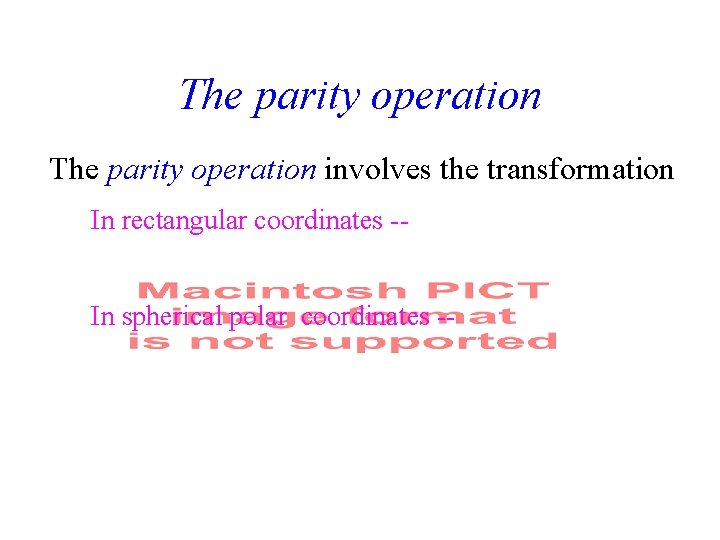
The parity operation involves the transformation In rectangular coordinates -In spherical polar coordinates --
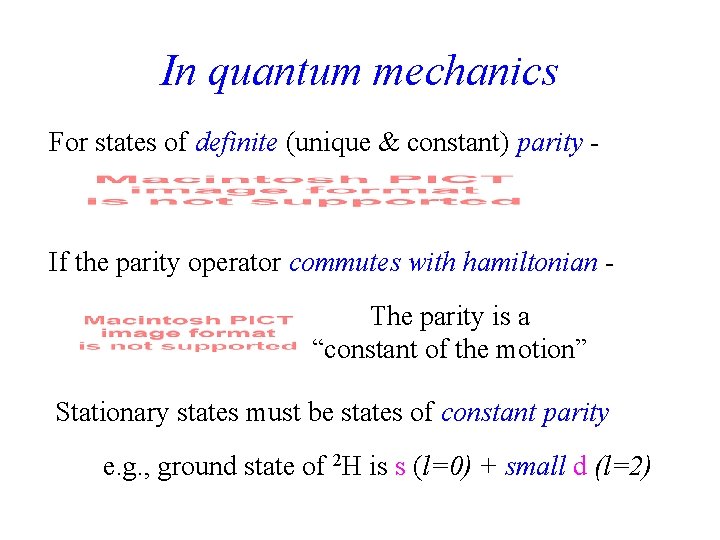
In quantum mechanics For states of definite (unique & constant) parity - If the parity operator commutes with hamiltonian The parity is a “constant of the motion” Stationary states must be states of constant parity e. g. , ground state of 2 H is s (l=0) + small d (l=2)
In quantum mechanics To test parity conservation - Devise an experiment that could be done: (a) In one configuration (b) In a parity “reflected” configuration - If both experiments give the “same” results, parity is conserved -- it is a good symmetry.
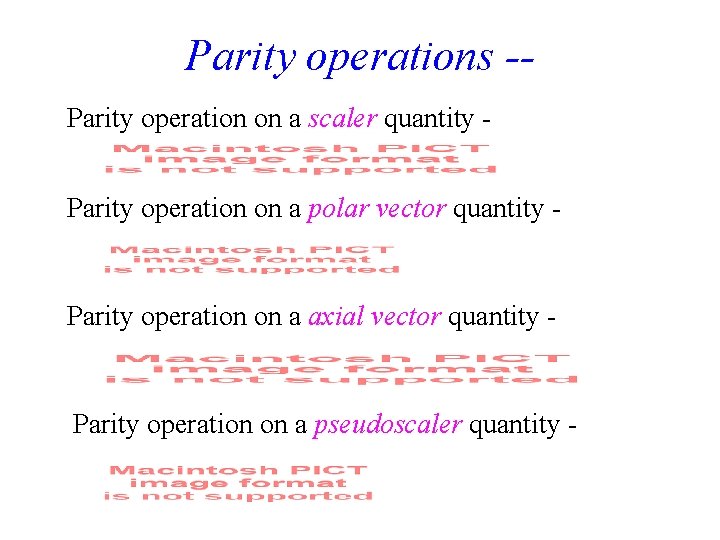
Parity operations -Parity operation on a scaler quantity Parity operation on a polar vector quantity - Parity operation on a axial vector quantity - Parity operation on a pseudoscaler quantity -
If parity is a good symmetry… • The decay should be the same whether the process is parity-reflected or not. • In the hamiltonian, V must not contain terms that are pseudoscaler. • If a pseudoscaler dependence is observed - parity symmetry is violated in that process - parity is therefore not conserved. T. D. Lee and C. N. Yang, Phys. Rev. 104, 254 (1956). http: //publish. aps. org/ puzzle
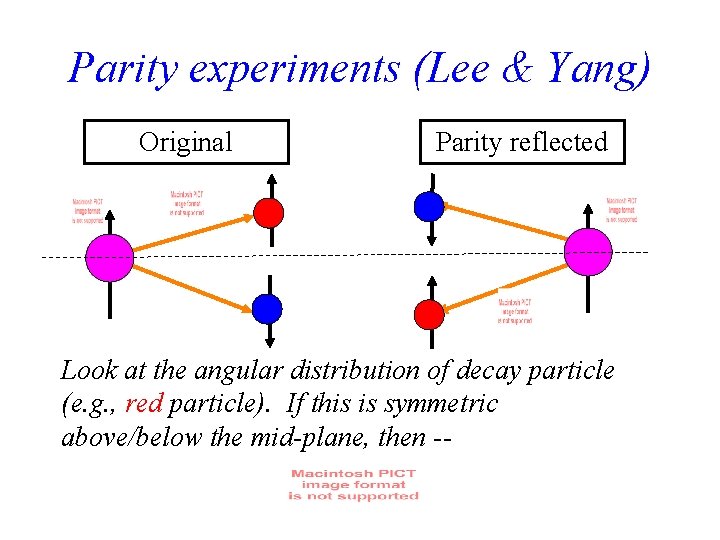
Parity experiments (Lee & Yang) Original Parity reflected Look at the angular distribution of decay particle (e. g. , red particle). If this is symmetric above/below the mid-plane, then --
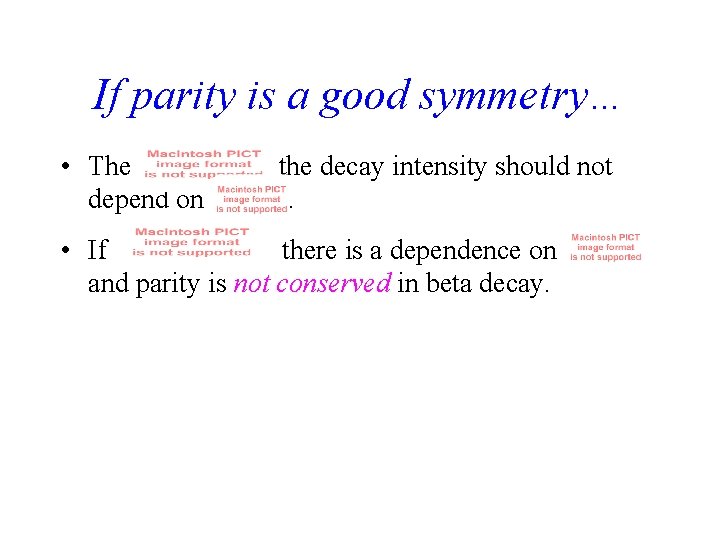
If parity is a good symmetry… • The depend on the decay intensity should not. • If there is a dependence on and parity is not conserved in beta decay.
Discovery of parity nonconservation (Wu, et al. ) Consider the decay of 60 Co Conclusion: G-T, allowed C. S. Wu, et al. , Phys. Rev 105, 1413 (1957) http: //publish. aps. org/
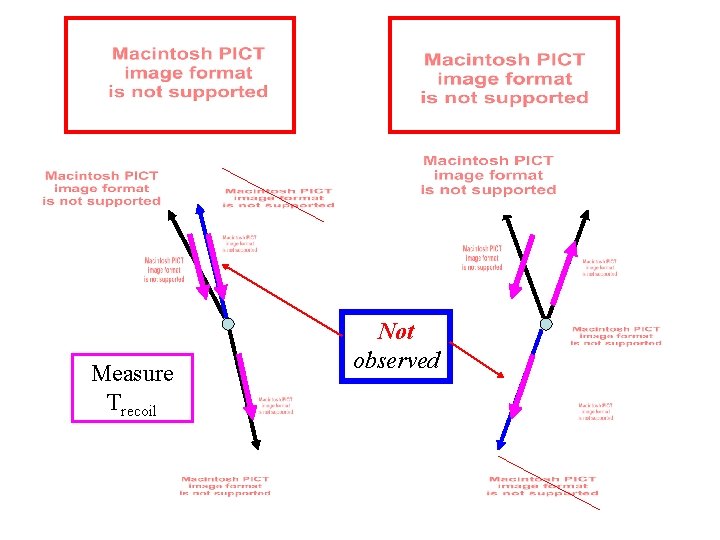
Measure Trecoil Not observed
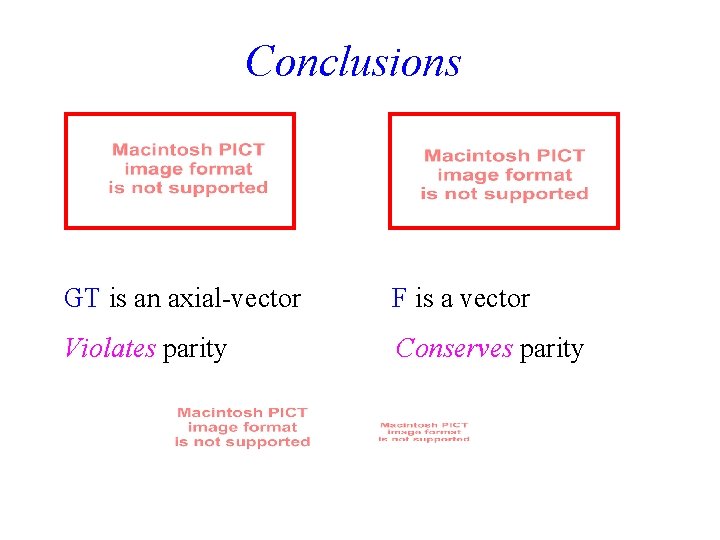
Conclusions GT is an axial-vector F is a vector Violates parity Conserves parity
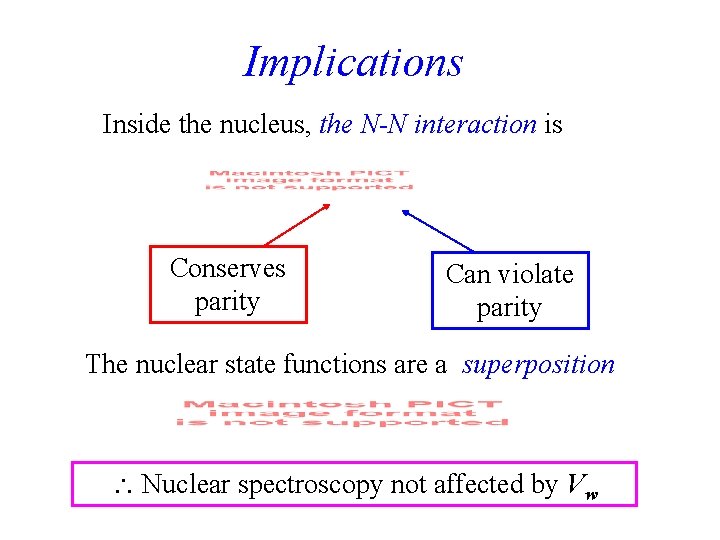
Implications Inside the nucleus, the N-N interaction is Conserves parity Can violate parity The nuclear state functions are a superposition Nuclear spectroscopy not affected by Vw
Generalized -decay The hamiltonian for the vector and axial-vector weak interaction is formulated in Dirac notation as -- Or a linear combination of these two --
Generalized -decay The generalized hamiltonian for the weak interaction that includes parity violation and a two-component neutrino theory is -- Empirically, we need to find -- and Study: n p (mixed F and GT), and: 14 O 14 N* (I=0 I=0; pure F)

Generalized -decay 14 O 14 N* (pure F) n p (mixed F and GT)
Generalized -decay Assuming simple (reasonable) values for the square of the matrix elements, we can get (by taking the ratio of the two ft values -- Experiment shows that CV and CA have opposite signs.
Universal Fermi Interaction In general, the fundamental weak interaction is of the form -- semi-leptonic weak decay pure-leptonic weak decay semi-leptonic weak decay Pure hadronic weak decay All follow the (V-A) weak decay. (c. f. Feynman’s CVC)
Universal Fermi Interaction In general, the fundamental weak interaction is of the form -BUT -- is it really that way - absolutely? How would you proceed to test it? pure-leptonic weak decay The Triumf Weak Interaction Symmetry Test - TWIST
Other symmetries Charge symmetry - C C All vectors unchanged Time symmetry - T T (Inverse -decay) All time-vectors changed (opposite)
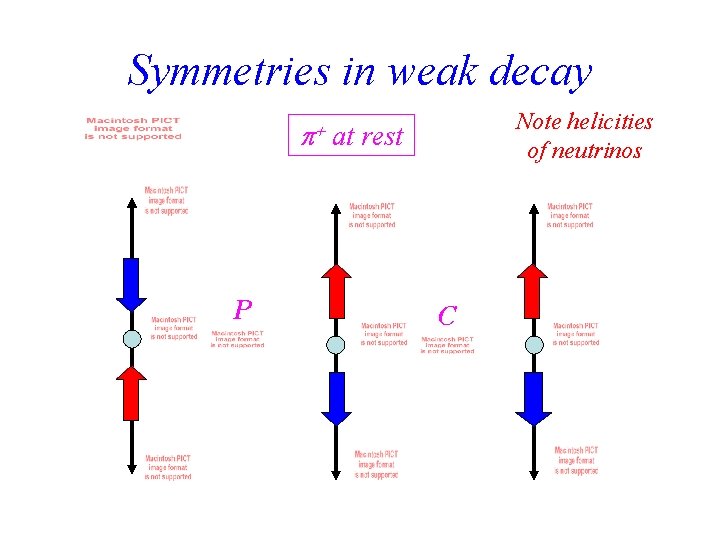
Symmetries in weak decay P Note helicities of neutrinos at rest C
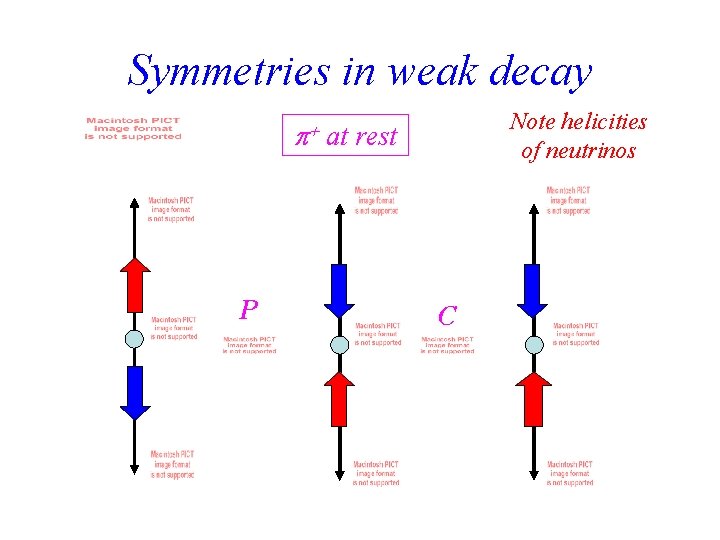
Symmetries in weak decay P Note helicities of neutrinos at rest C
Conclusions 1. Parity is not a good symmetry in the weak interaction. (P) 2. Charge conjugation is not a good symmetry in the weak interaction. (C) 3. The product operation is a good symmetry in the weak interaction. (CP) - except in the kaon system! 4. Time symmetry is a good symmetry in the weak interaction. (T) 5. The triple product operation is also a good symmetry in the weak interaction. (CPT)
- Slides: 22