
Parity Conditions in International Finance and Currency Forecasting
- Slides: 43
Parity Conditions in International Finance and Currency Forecasting Chapter 4 1
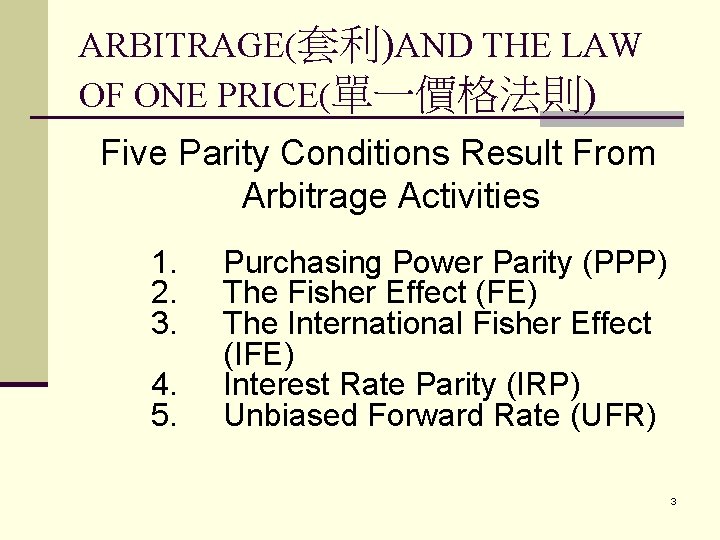
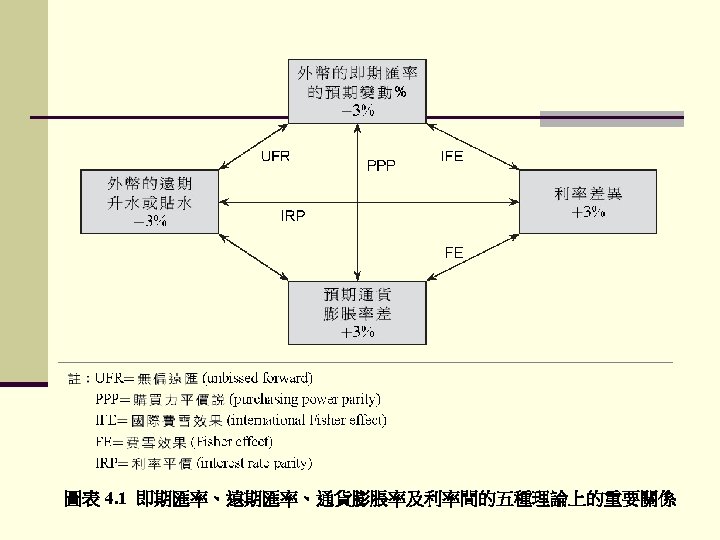
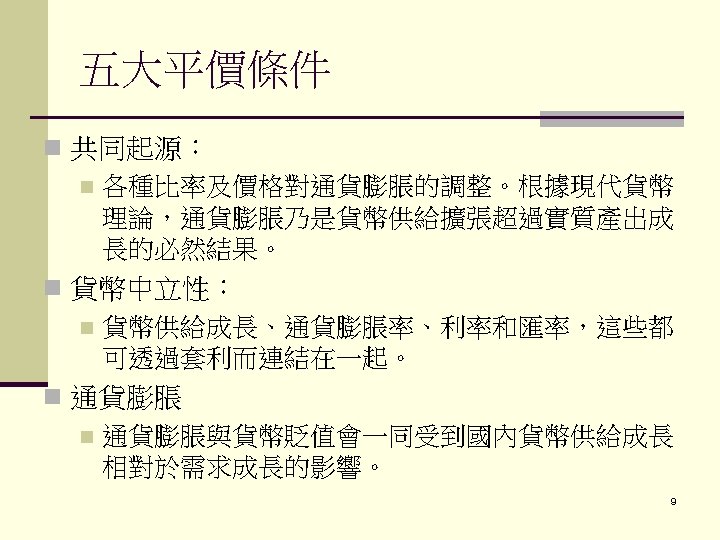
ARBITRAGE(套利)AND THE LAW OF ONE PRICE(單一價格法則) Five Parity Conditions Result From Arbitrage Activities 1. 2. 3. 4. 5. Purchasing Power Parity (PPP) The Fisher Effect (FE) The International Fisher Effect (IFE) Interest Rate Parity (IRP) Unbiased Forward Rate (UFR) 3
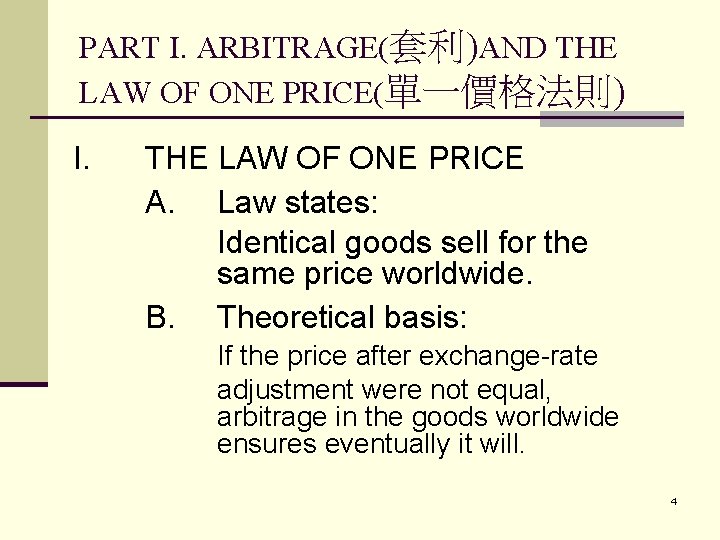
PART I. ARBITRAGE(套利)AND THE LAW OF ONE PRICE(單一價格法則) I. THE LAW OF ONE PRICE A. Law states: Identical goods sell for the same price worldwide. B. Theoretical basis: If the price after exchange-rate adjustment were not equal, arbitrage in the goods worldwide ensures eventually it will. 4
ARBITRAGE(套利)AND THE LAW OF ONE PRICE(單一價格法則) C. Five Parity Conditions Linked by The adjustment of rates and prices to inflation 6
ARBITRAGE AND THE LAW OF ONE PRICE D. Inflation and home currency depreciation are: 1. Jointly determined by the growth of domestic money supply (Ms) and 2. Relative to the growth of domestic money demand. 8
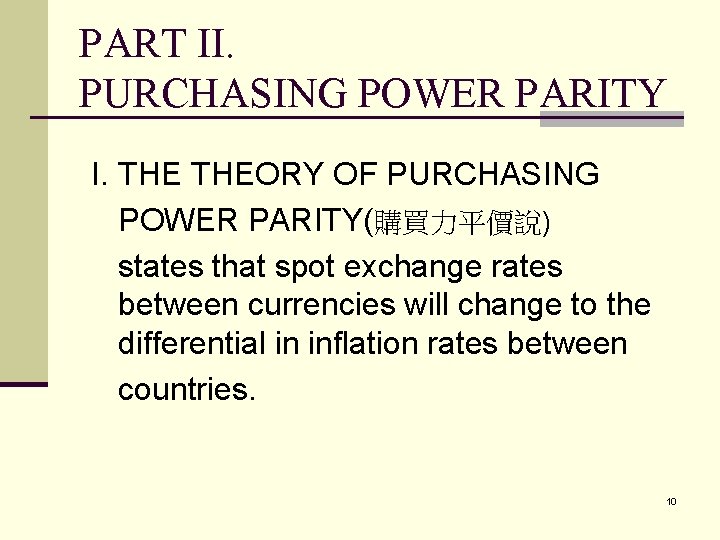
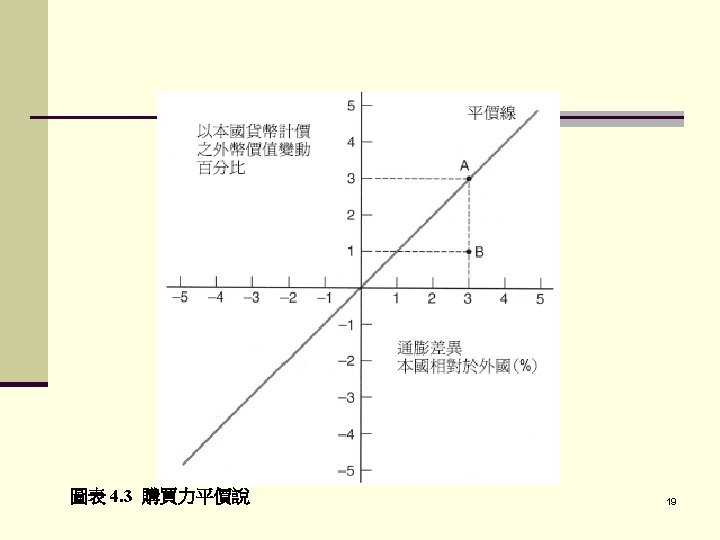
PART II. PURCHASING POWER PARITY I. THEORY OF PURCHASING POWER PARITY(購買力平價說) states that spot exchange rates between currencies will change to the differential in inflation rates between countries. 10
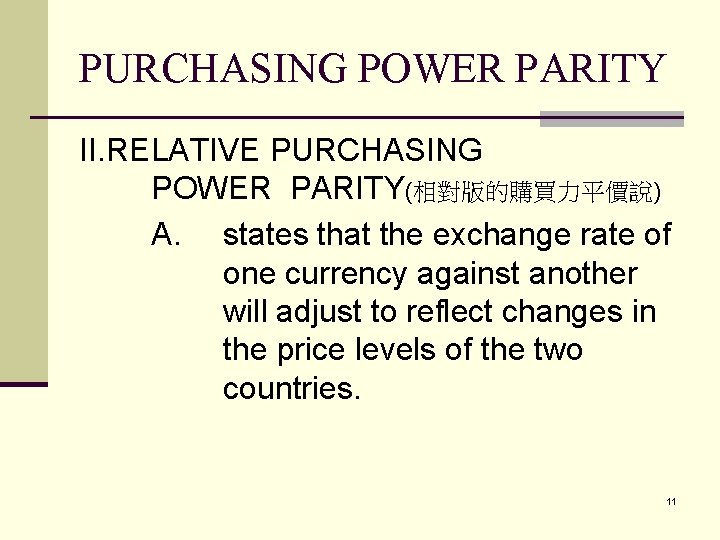
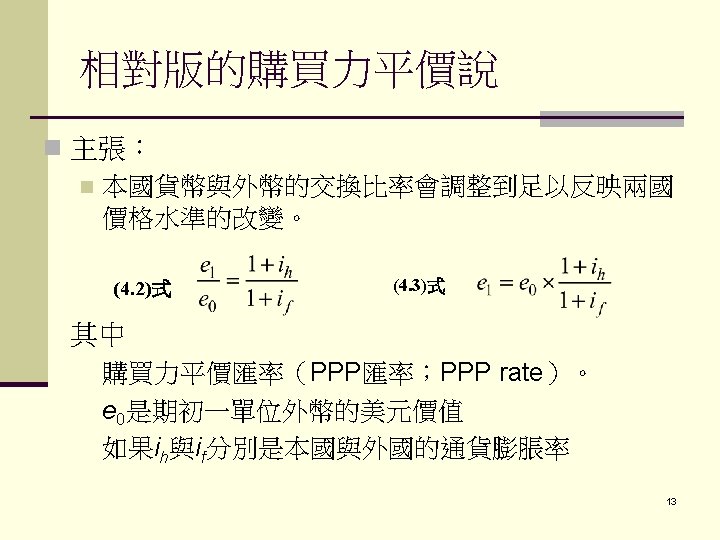
PURCHASING POWER PARITY II. RELATIVE PURCHASING POWER PARITY(相對版的購買力平價說) A. states that the exchange rate of one currency against another will adjust to reflect changes in the price levels of the two countries. 11
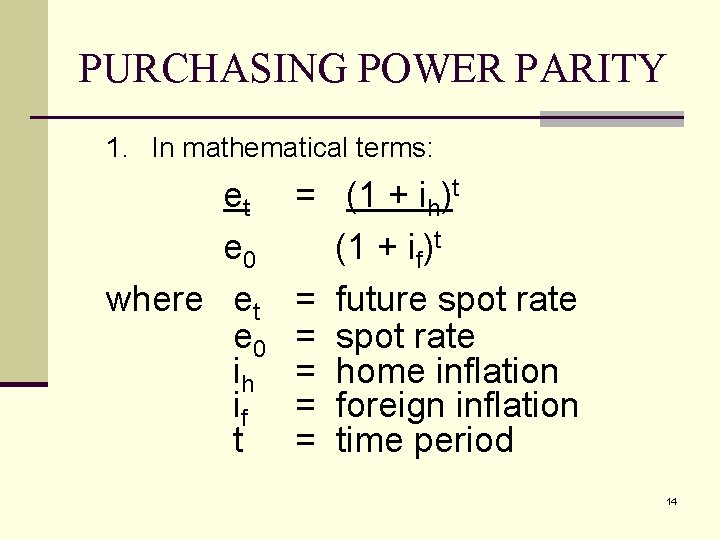
PURCHASING POWER PARITY 1. In mathematical terms: et e 0 where et e 0 ih if t = (1 + ih)t (1 + if)t = future spot rate = home inflation = foreign inflation = time period 14
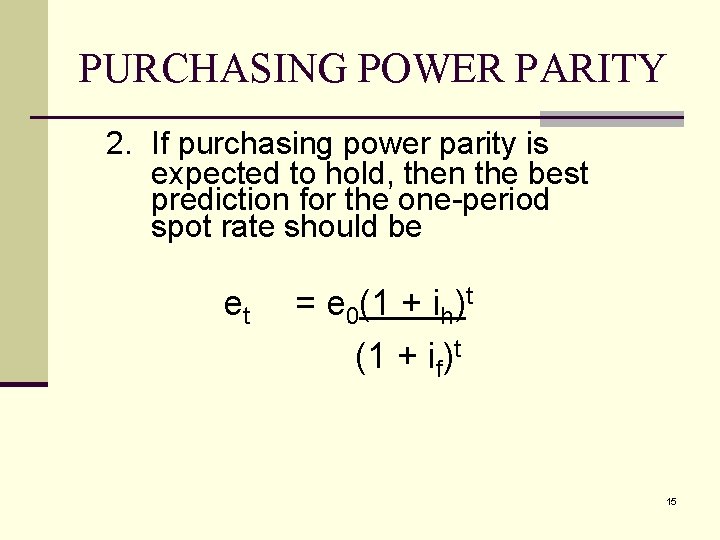
PURCHASING POWER PARITY 2. If purchasing power parity is expected to hold, then the best prediction for the one-period spot rate should be et = e 0(1 + ih)t (1 + if)t 15
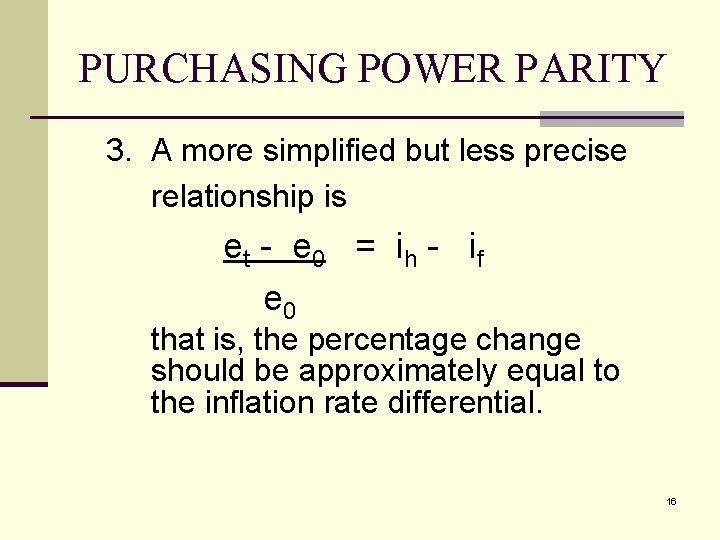
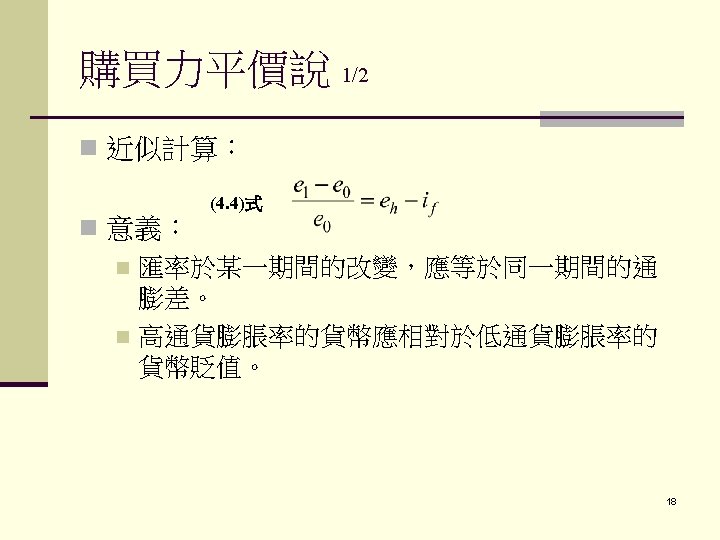
PURCHASING POWER PARITY 3. A more simplified but less precise relationship is et - e 0 = ih - i f e 0 that is, the percentage change should be approximately equal to the inflation rate differential. 16
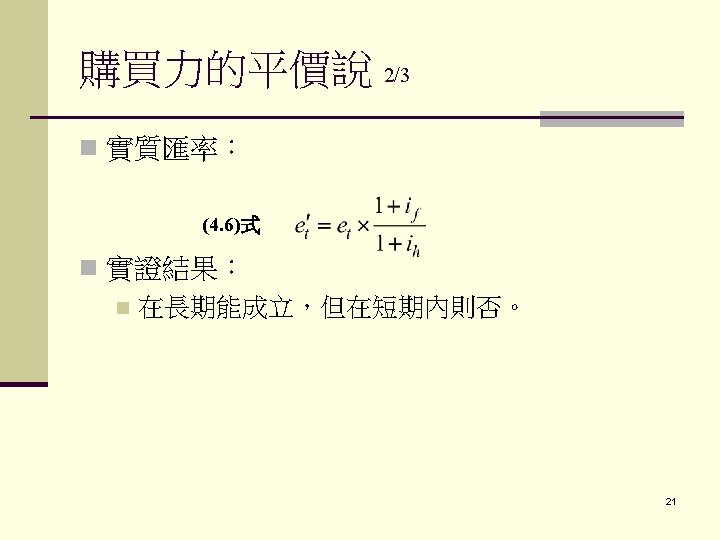
PURCHASING POWER PARITY 4. PPP says the currency with the higher inflation rate is expected to depreciate relative to the currency with the lower rate of inflation. 17
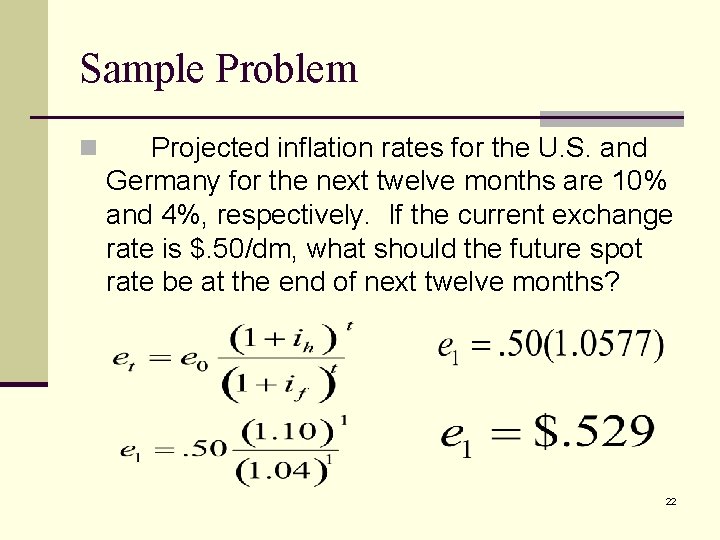
Sample Problem n Projected inflation rates for the U. S. and Germany for the next twelve months are 10% and 4%, respectively. If the current exchange rate is $. 50/dm, what should the future spot rate be at the end of next twelve months? 22
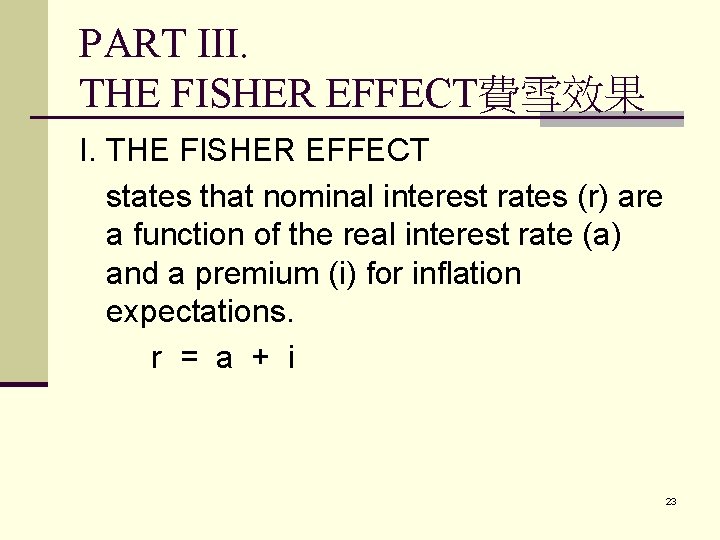
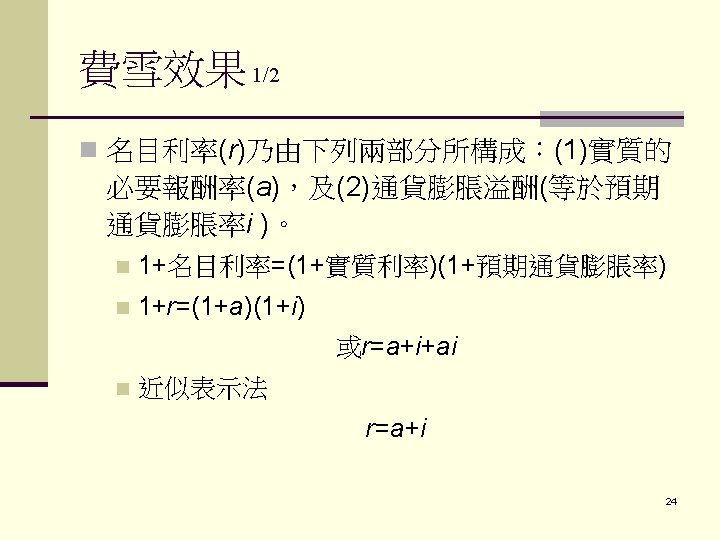
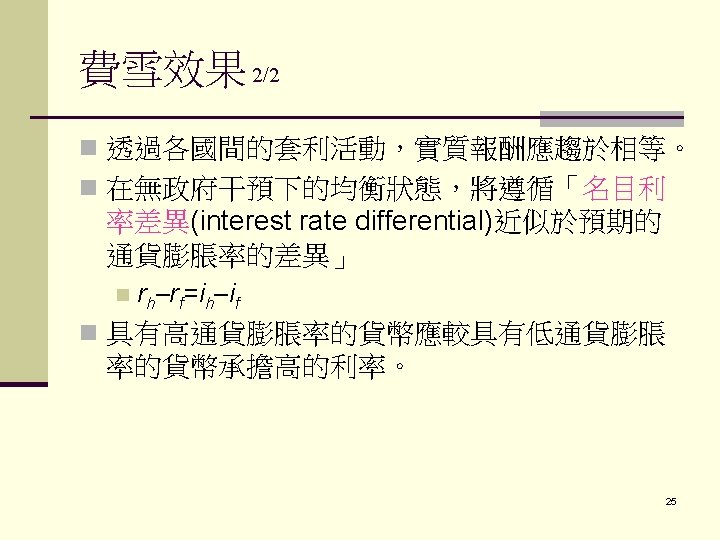
PART III. THE FISHER EFFECT費雪效果 I. THE FISHER EFFECT states that nominal interest rates (r) are a function of the real interest rate (a) and a premium (i) for inflation expectations. r = a + i 23
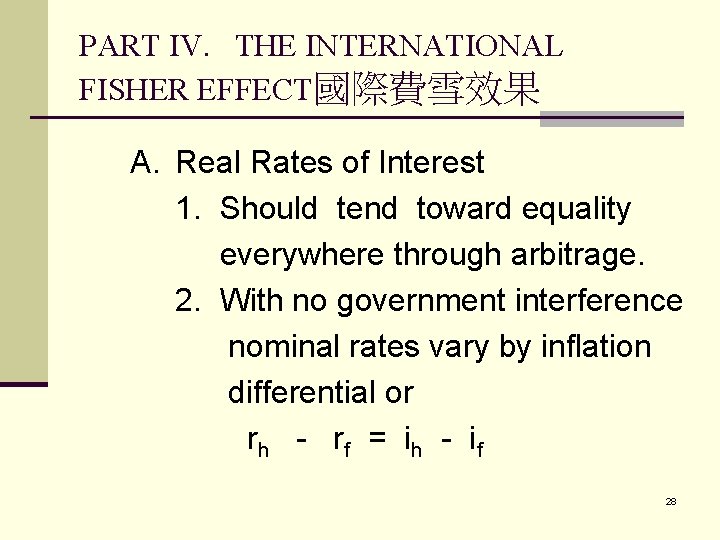
PART IV. THE INTERNATIONAL FISHER EFFECT國際費雪效果 A. Real Rates of Interest 1. Should tend toward equality everywhere through arbitrage. 2. With no government interference nominal rates vary by inflation differential or rh - r f = i h - i f 28
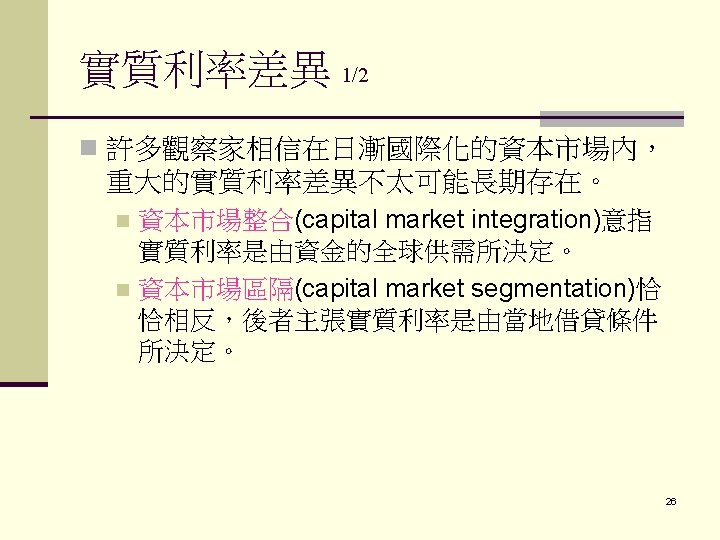
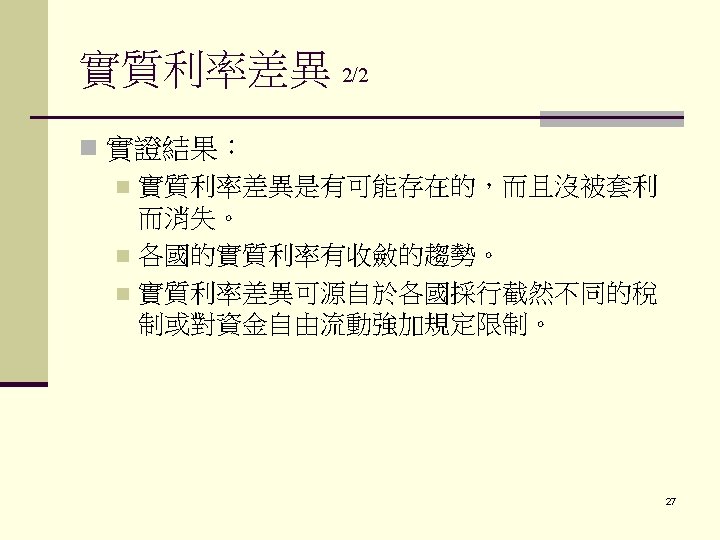
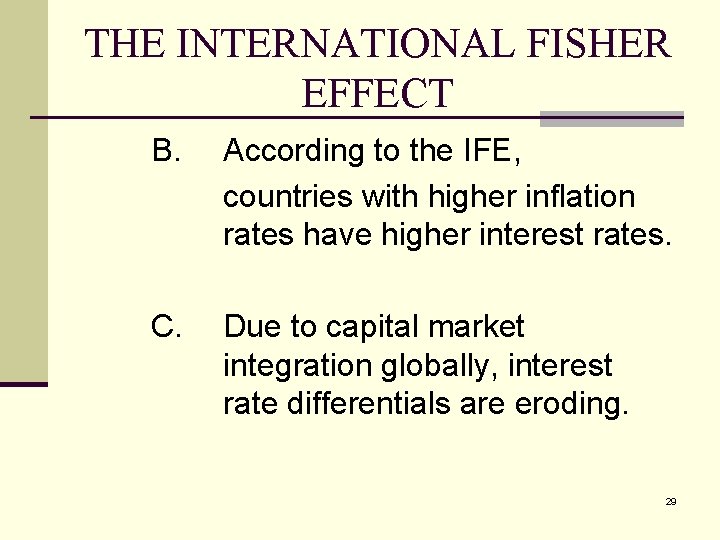
THE INTERNATIONAL FISHER EFFECT B. According to the IFE, countries with higher inflation rates have higher interest rates. C. Due to capital market integration globally, interest rate differentials are eroding. 29
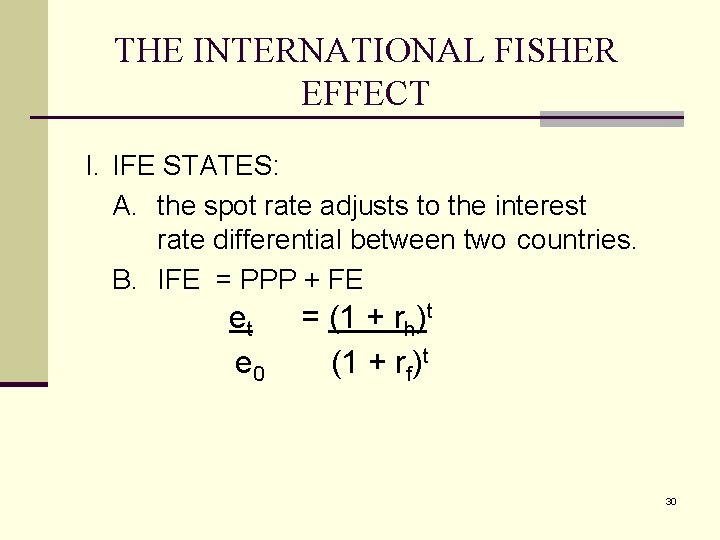
THE INTERNATIONAL FISHER EFFECT I. IFE STATES: A. the spot rate adjusts to the interest rate differential between two countries. B. IFE = PPP + FE et e 0 = (1 + rh)t (1 + rf)t 30
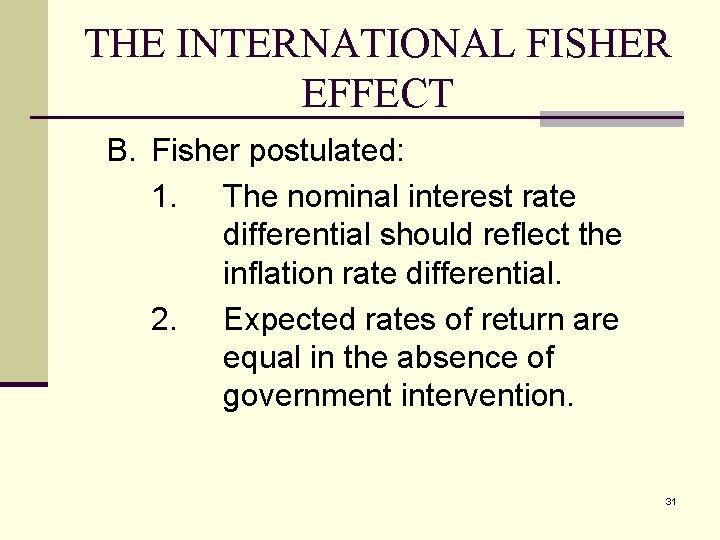
THE INTERNATIONAL FISHER EFFECT B. Fisher postulated: 1. The nominal interest rate differential should reflect the inflation rate differential. 2. Expected rates of return are equal in the absence of government intervention. 31
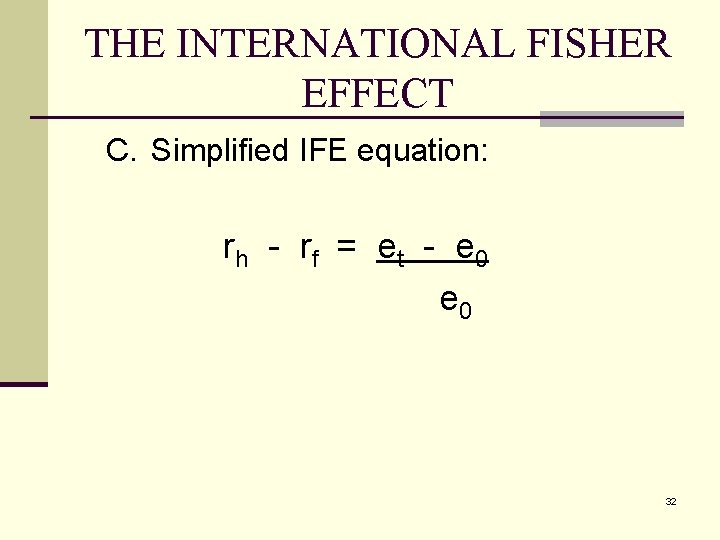
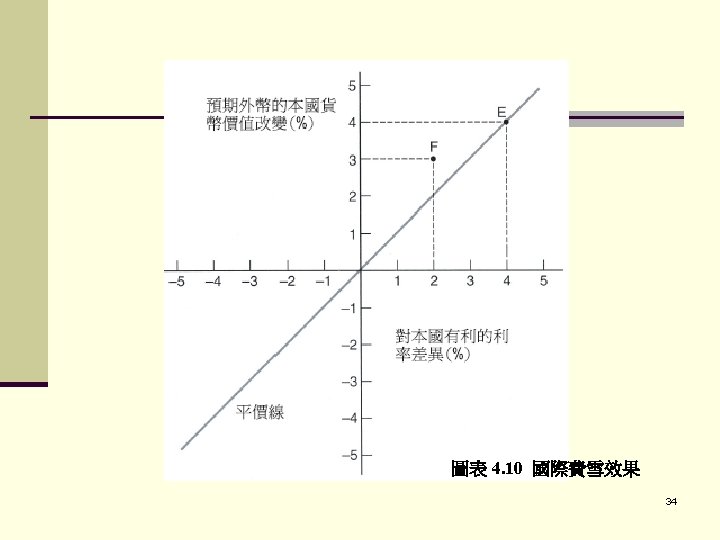
THE INTERNATIONAL FISHER EFFECT C. Simplified IFE equation: rh - r f = e t - e 0 32
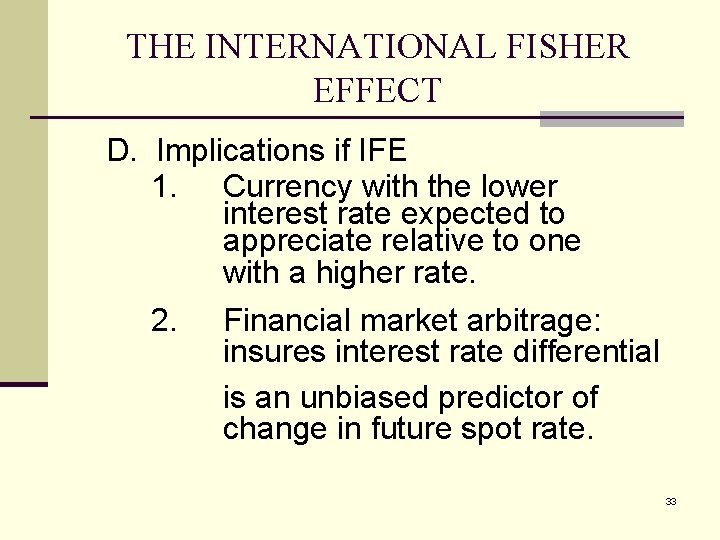
THE INTERNATIONAL FISHER EFFECT D. Implications if IFE 1. Currency with the lower interest rate expected to appreciate relative to one with a higher rate. 2. Financial market arbitrage: insures interest rate differential is an unbiased predictor of change in future spot rate. 33
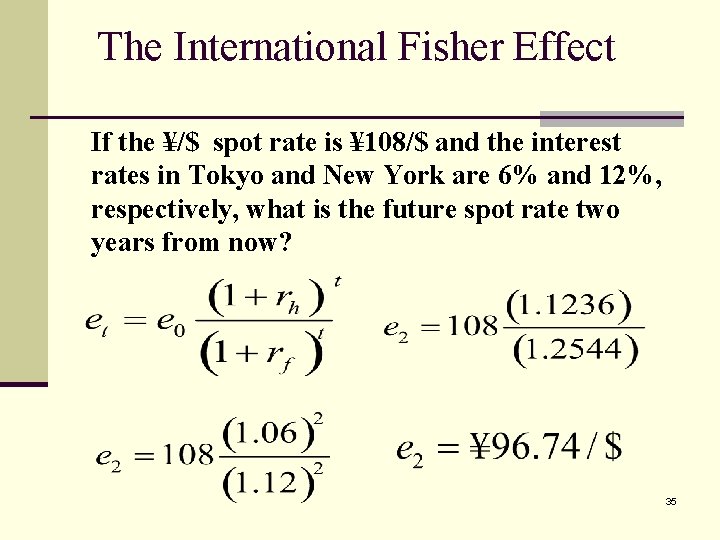
The International Fisher Effect If the ¥/$ spot rate is ¥ 108/$ and the interest rates in Tokyo and New York are 6% and 12%, respectively, what is the future spot rate two years from now? 35
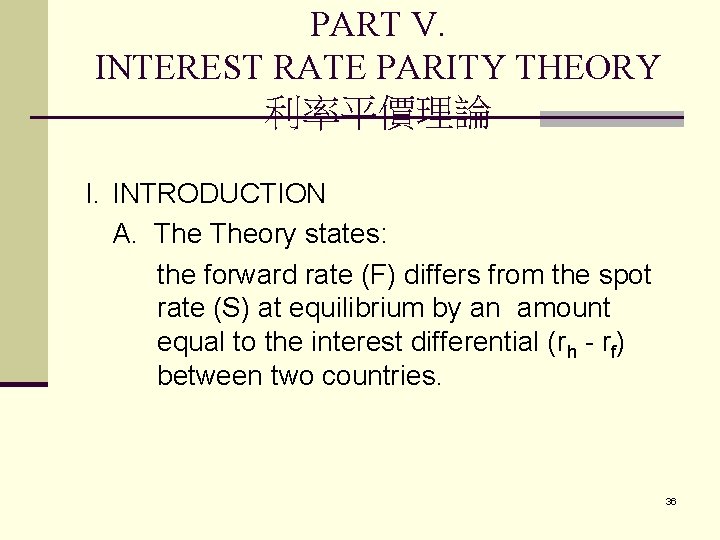
PART V. INTEREST RATE PARITY THEORY 利率平價理論 I. INTRODUCTION A. Theory states: the forward rate (F) differs from the spot rate (S) at equilibrium by an amount equal to the interest differential (rh - rf) between two countries. 36
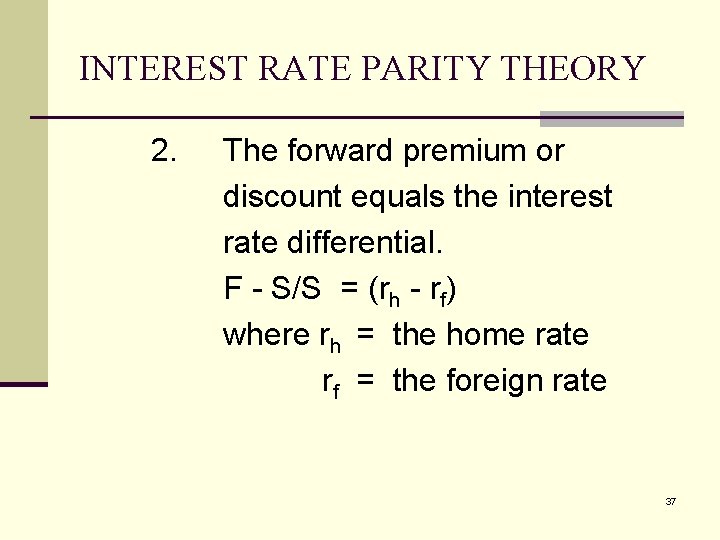
INTEREST RATE PARITY THEORY 2. The forward premium or discount equals the interest rate differential. F - S/S = (rh - rf) where rh = the home rate rf = the foreign rate 37
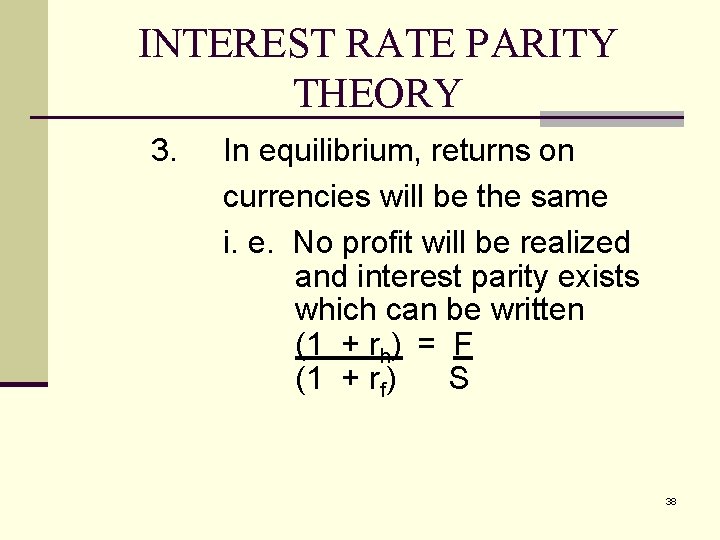
INTEREST RATE PARITY THEORY 3. In equilibrium, returns on currencies will be the same i. e. No profit will be realized and interest parity exists which can be written (1 + rh) = F (1 + rf) S 38
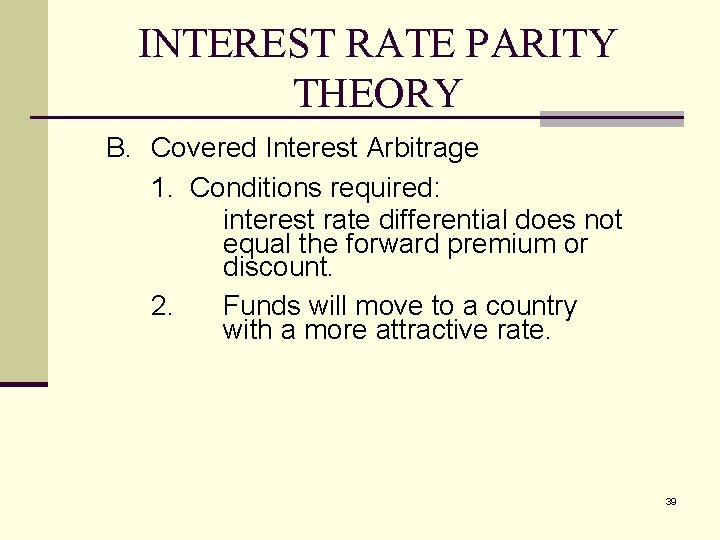
INTEREST RATE PARITY THEORY B. Covered Interest Arbitrage 1. Conditions required: interest rate differential does not equal the forward premium or discount. 2. Funds will move to a country with a more attractive rate. 39
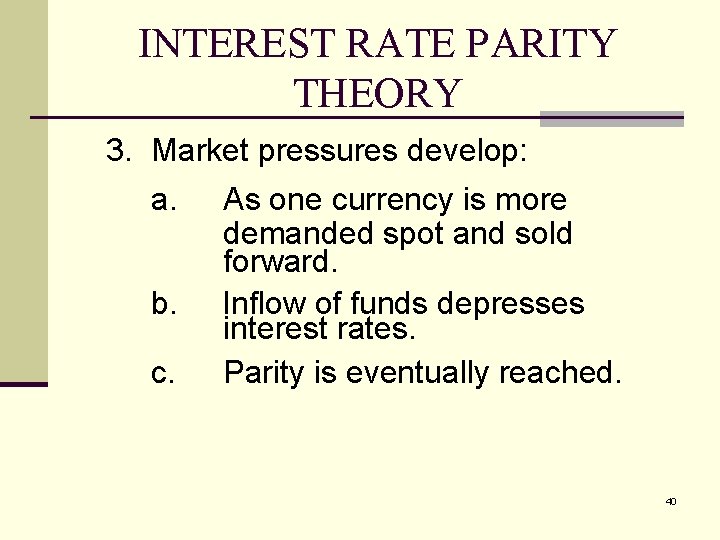
INTEREST RATE PARITY THEORY 3. Market pressures develop: a. b. c. As one currency is more demanded spot and sold forward. Inflow of funds depresses interest rates. Parity is eventually reached. 40
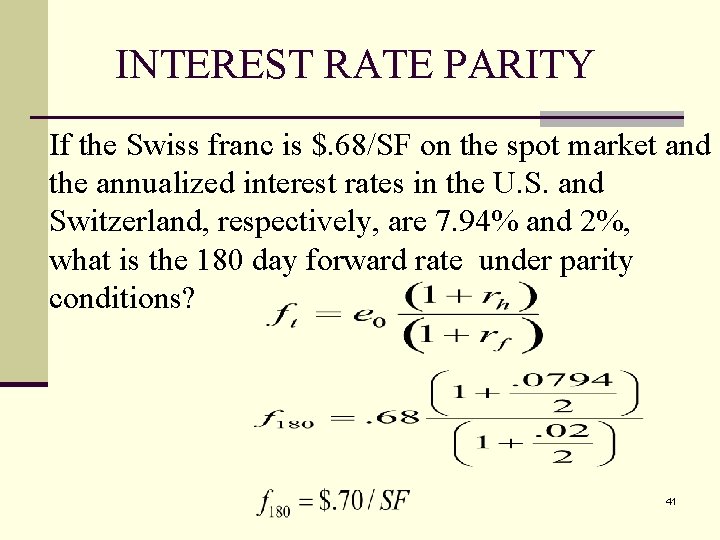
INTEREST RATE PARITY If the Swiss franc is $. 68/SF on the spot market and the annualized interest rates in the U. S. and Switzerland, respectively, are 7. 94% and 2%, what is the 180 day forward rate under parity conditions? 41
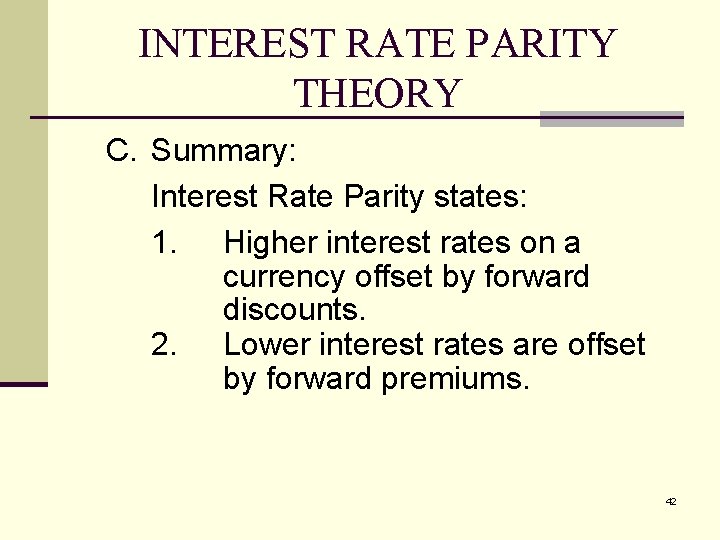
INTEREST RATE PARITY THEORY C. Summary: Interest Rate Parity states: 1. Higher interest rates on a currency offset by forward discounts. 2. Lower interest rates are offset by forward premiums. 42
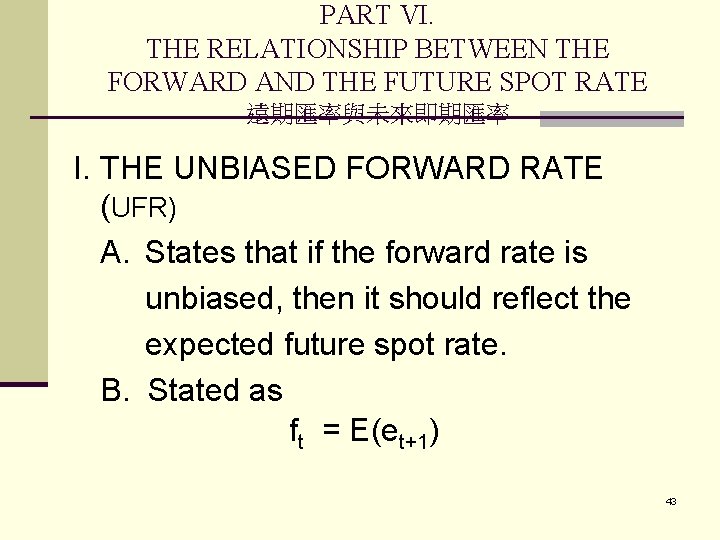
PART VI. THE RELATIONSHIP BETWEEN THE FORWARD AND THE FUTURE SPOT RATE 遠期匯率與未來即期匯率 I. THE UNBIASED FORWARD RATE (UFR) A. States that if the forward rate is unbiased, then it should reflect the expected future spot rate. B. Stated as ft = E(et+1) 43