
Parental Fluids Therapy Fluids and electrolytes disturbances Indication

Parental Fluids Therapy Fluids and electrolytes disturbances
Indication of Parental fluid therapy • To provide water and electrolytes and nutrients to meet daily requirement • To replace water and correct electrolytes deficit • To administer medications and blood products
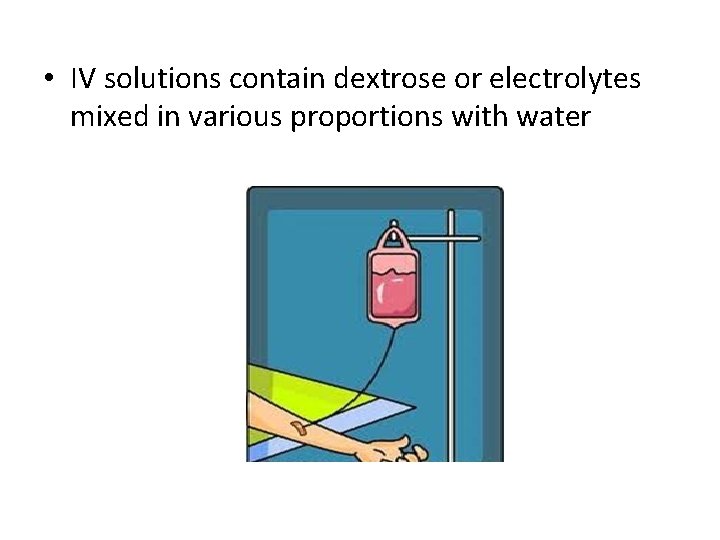
• IV solutions contain dextrose or electrolytes mixed in various proportions with water
Types of IV solutions Isotonic solution Hypertonic solution
Isotonic solution A solution that has the same salt concentration as the normal cells of the body and the blood. Examples: 1 - 0. 9% Na. Cl. 2 - Ringer Lactate. 3 - Blood Component. 4 - D 5 W.

Hypotonic solution A solution with a lower salts concentration than in normal cells of the body and the blood. EXamples: 1 -0. 45% Na. Cl. 2 - 0. 33% Na. Cl.
Hypertonic solution A solution with a higher salts concentration than in normal cells of the body and the blood. Examples: 1 - D 5 W in normal Saline solution. 2 -D 5 W in half normal Saline. 3 - D 10 W.
Categories of intravenous solutions according to their purpose �Nutrient solutions. �Electrolyte solutions. �Volume expanders.

Nutrient solution � It contain some form of carbohydrate and water. � Water is supplied for fluid requirements and carbohydrate for calories and energy. � They are useful in preventing dehydration and ketosis but do not provide sufficient calories to promote wound healing, weight gain, or normal growth of children. � Common nutrient solutions are D 5 W and dextrose in half-strength saline
Electrolyte solutions (Crystalloid) � fluids that consist of water and dissolved crystals, such as salts. � Used as maintenance fluids to correct body fluids and electrolyte deficit. � Commonly used solutions are: -Normal saline (0. 9% sodium chloride solution). -Ringer’s solutions (which contain sodium, chloride, potassium, and calcium. -Lactated Ringer’s solutions (which contain sodium, chloride, potassium , calcium and lactate).

Volume expanders (Colloid) • Are used to increase the blood volume following severe loss of blood (haemorrhage) or loss of plasma ( severe burns). • Expanders present in dextran, plasma, and albumin.
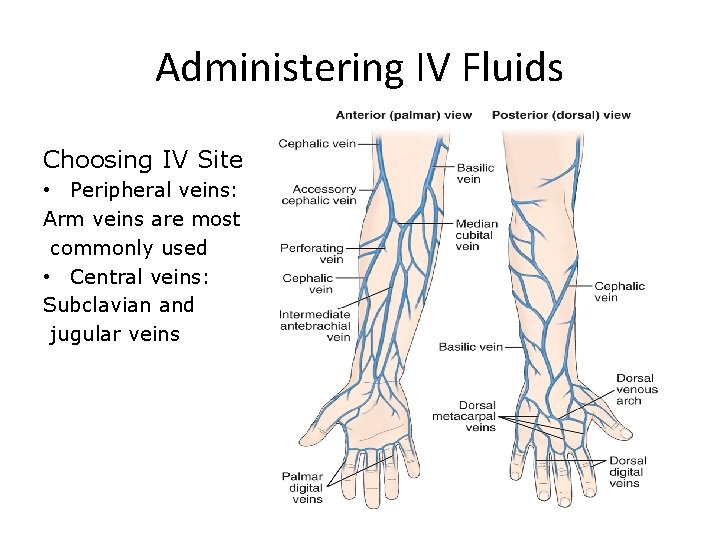
Administering IV Fluids Choosing IV Site • Peripheral veins: Arm veins are most commonly used • Central veins: Subclavian and jugular veins
Consideration during selecting venipuncture site • • Condition of the vein Type of fluids or medication to be infused Duration of therapy Patients’ age and size Weather the patient is right or left handed Patients medical history and current health status Skill of the person performing the venipuncture
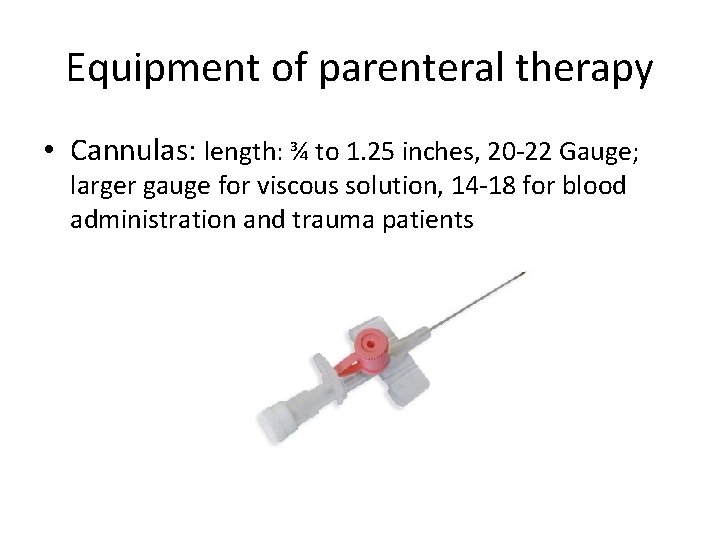
Equipment of parenteral therapy • Cannulas: length: ¾ to 1. 25 inches, 20 -22 Gauge; larger gauge for viscous solution, 14 -18 for blood administration and trauma patients
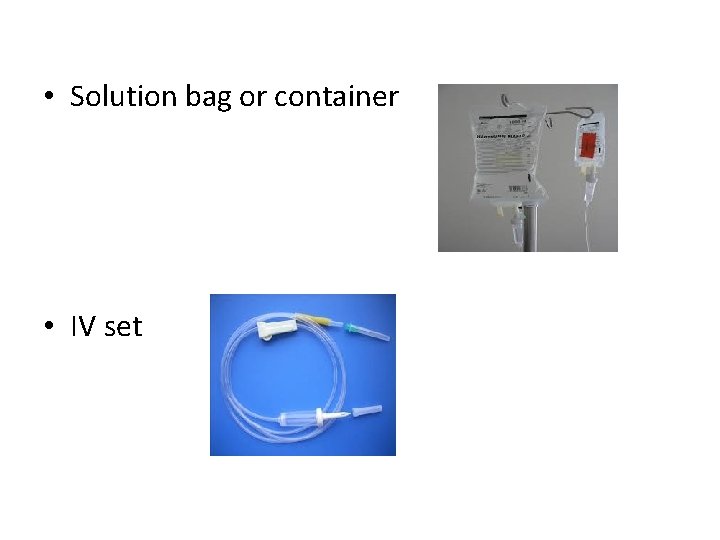
• Solution bag or container • IV set
Nursing management of the patient receiving IV Therapy • Selecting the appropriate venipuncture site, type of cannulas and technique of vein entry: Cleanse infusion site. 2 - Excessive hair at selected site should be clipped with scissor. 3 - Cleanse I. V site with effective topical antiseptic. 4 - Made Venipuncture at a 10 to 30 degree angle
Nursing management: continue • Patient teaching : venipuncture, length of infusion, activity restriction • Preparing the IV site • Assess the solution: sterile, clear, no small particles, no leakage, not expired • Preparing and reading the lable on the solution • Determine the compatibility of all fluid and additives
• Observe IV set for crack, hole, missing clamp, expired date • Assess any allergies and arm placement preference. • Assess any planned surgeries. • Assess patient’s activities of daily living. • Assess type and duration of I. V therapy, amount, and rate.
Nursing diagnosis • Anxiety (mild, moderate, severe) related to threat regarding therapy. • Fluid volume excess. • Fluid volume deficit. • Risk for infection. • Risk for sleep pattern disturbance. • Knowledge deficit related to I. V therapy.
Planning Identify expected outcomes which focus on: preventing complications from I. V therapy. minimal discomfort to the patient. restoration of normal fluid and electrolyte balance. • patient’s ability to verbalize complications. • •
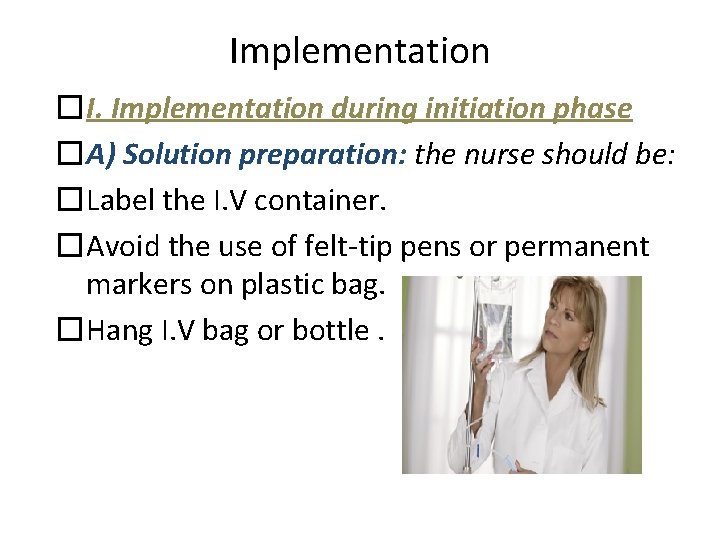
Implementation �I. Implementation during initiation phase �A) Solution preparation: the nurse should be: �Label the I. V container. �Avoid the use of felt-tip pens or permanent markers on plastic bag. �Hang I. V bag or bottle.
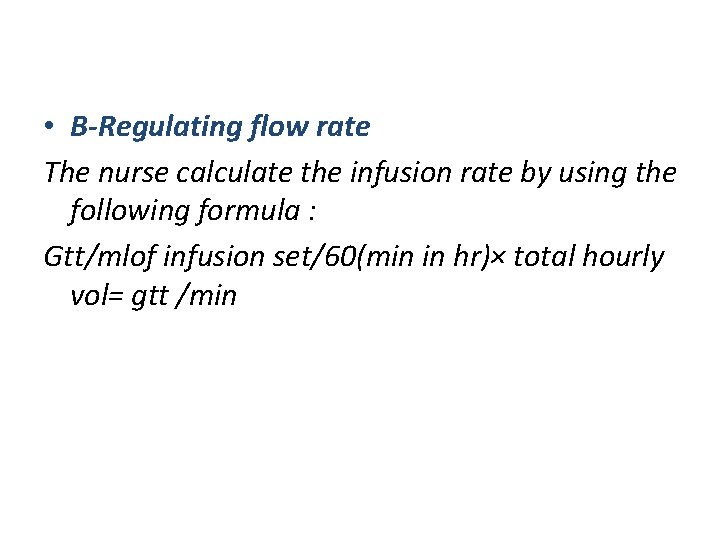
• B-Regulating flow rate The nurse calculate the infusion rate by using the following formula : Gtt/mlof infusion set/60(min in hr)× total hourly vol= gtt /min
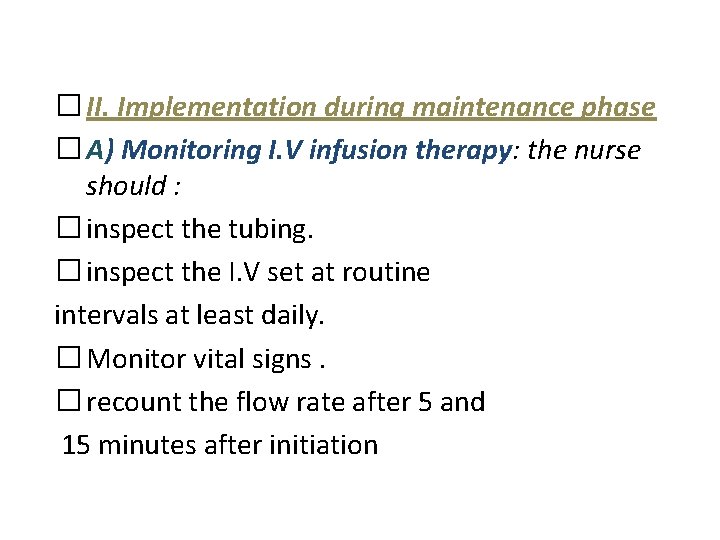
� II. Implementation during maintenance phase � A) Monitoring I. V infusion therapy: the nurse should : � inspect the tubing. � inspect the I. V set at routine intervals at least daily. � Monitor vital signs. � recount the flow rate after 5 and 15 minutes after initiation
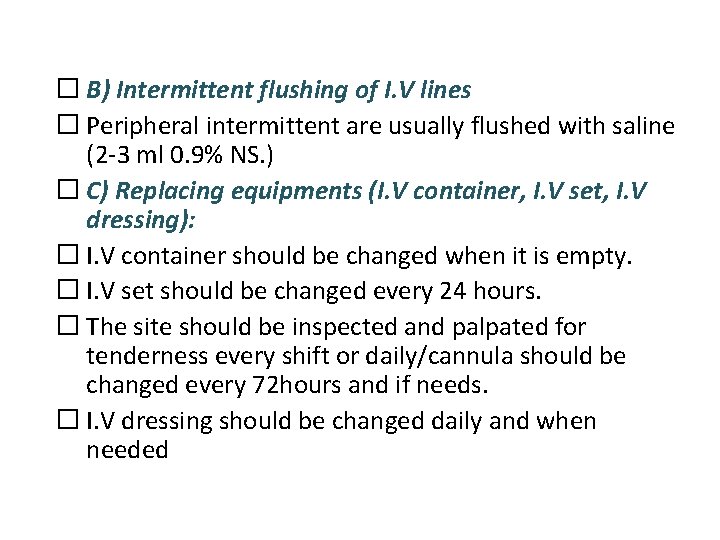
� B) Intermittent flushing of I. V lines � Peripheral intermittent are usually flushed with saline (2 -3 ml 0. 9% NS. ) � C) Replacing equipments (I. V container, I. V set, I. V dressing): � I. V container should be changed when it is empty. � I. V set should be changed every 24 hours. � The site should be inspected and palpated for tenderness every shift or daily/cannula should be changed every 72 hours and if needs. � I. V dressing should be changed daily and when needed
�III. Implementation during phase of discontinuing an I. V infusion �The nurse never use scissors to remove the tape or dressing. �Apply pressure to the site for 2 to 3 minutes using a dry, sterile gauze pad. �Inspect the catheter for intactness. �The arm or hand may be flexed or extended several times.
Recording and reporting • Type of fluid, amount, flow rate, and any drug added. • Insertion site. • Size and type of I. V catheter or needle. • The use of pump. • When infusion was begun and discontinuing. • Expected time to change I. V bag or bottle, tubing, cannula, and dressing.
• • • Any side effect. Type and amount of flush solution. Intake and output every shift, daily weight. Temperature every 4 hours. Blood glucose monitoring every 6 hours, and rate of infusion.

Evaluation • Produce therapeutic response to medication, fluid and electrolyte balance. • Observe functioning and patency of I. V system. • Absence of complications

Complications of IV therapy • • Fluid overload Air embolism Septicemia, other infections Infiltration, extravasation Phlebitis Thrombophlebitis Hematoma Clotting, obstruction
Acid Base disturbance Fluids and electrolytes imbalances
• Plasma p. H is an indicator of hydrogen ion (H+) concentration • Homeostatic mechanisms (buffer system) keep p. H within a normal range (7. 35 -7. 45) • Buffer systems prevent major changes in the p. H of body fluids by removing or releasing H+ • Major extracellular fluid buffer system; bicarbonate-carbonic acid buffer system regulated by kidney • Lungs under control of medulla regulate CO 2, carbonic acid in ECF
Acid base disturbance 1 - Acedosis: – Increased concentration H+ • Increased acidity • Lower the p. H: below 7. 35 2 -Alkalosis – Deceased H+ concentration • Increased alkalinity • Higher the p. H: above 7. 45
• Metabolic Acidosis: bicarbonate is decreased in relation to the amount of acid • Metabolic Alkalosis: excess of bicarbonate in relation to the amount of hydrogen ion • Respiratory Acidosis: CO 2 is retained, caused by sudden failure of ventilation due to chest trauma, aspiration of foreign body, acute pneumonia, and overdose of narcotics or sedatives • Respiratory Alkalosis: CO 2 is blown off, caused by mechanical ventilation and anxiety with hyperventilation
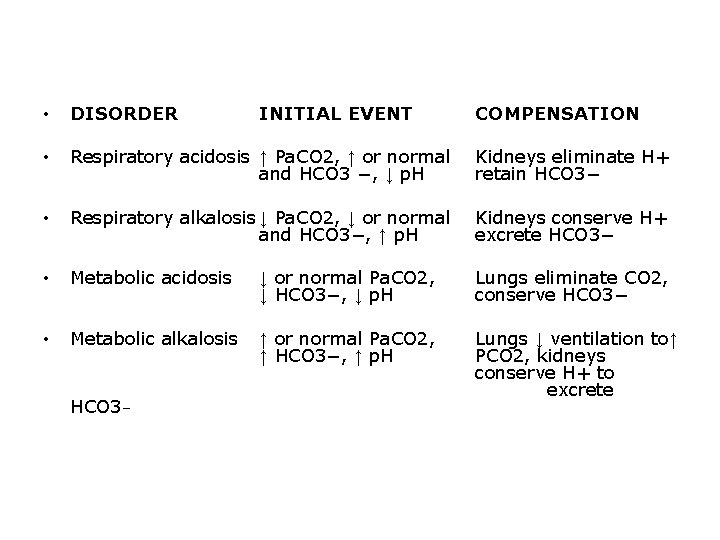
• DISORDER • Respiratory acidosis ↑ Pa. CO 2, ↑ or normal and HCO 3 −, ↓ p. H Kidneys eliminate H+ retain HCO 3− • Respiratory alkalosis ↓ Pa. CO 2, ↓ or normal and HCO 3−, ↑ p. H Kidneys conserve H+ excrete HCO 3− • Metabolic acidosis ↓ or normal Pa. CO 2, ↓ HCO 3−, ↓ p. H Lungs eliminate CO 2, conserve HCO 3− • Metabolic alkalosis ↑ or normal Pa. CO 2, ↑ HCO 3−, ↑ p. H Lungs ↓ ventilation to↑ PCO 2, kidneys conserve H+ to excrete HCO 3− INITIAL EVENT COMPENSATION
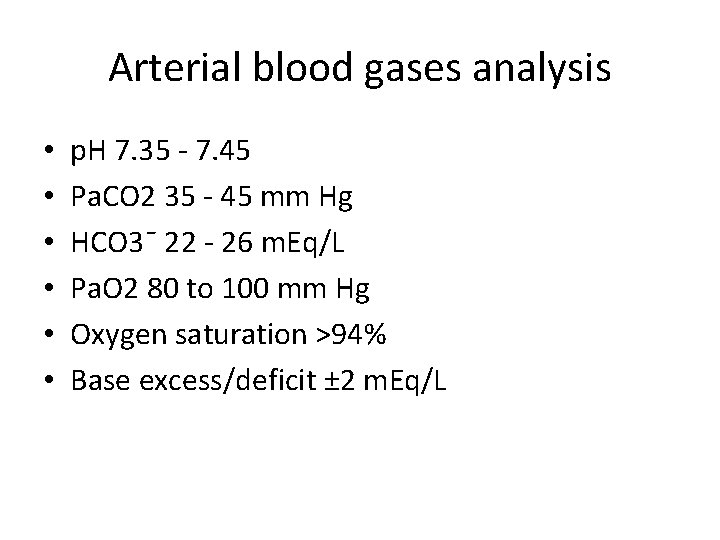
Arterial blood gases analysis • • • p. H 7. 35 - 7. 45 Pa. CO 2 35 - 45 mm Hg HCO 3ˉ 22 - 26 m. Eq/L Pa. O 2 80 to 100 mm Hg Oxygen saturation >94% Base excess/deficit ± 2 m. Eq/L

Example • PH: 7. 30 • Paco 2: 52 • HCO 3: 24 • What is the interpretation?
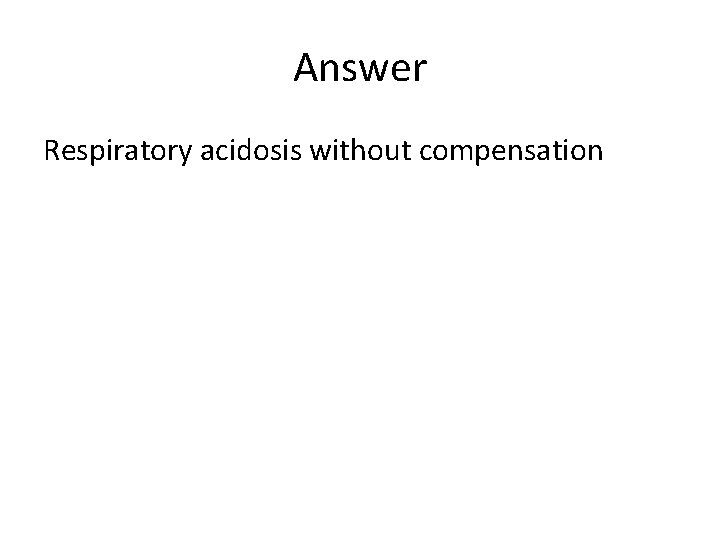
Answer Respiratory acidosis without compensation
- Slides: 37