
Parent University Lice By Dr Secory The Iowa
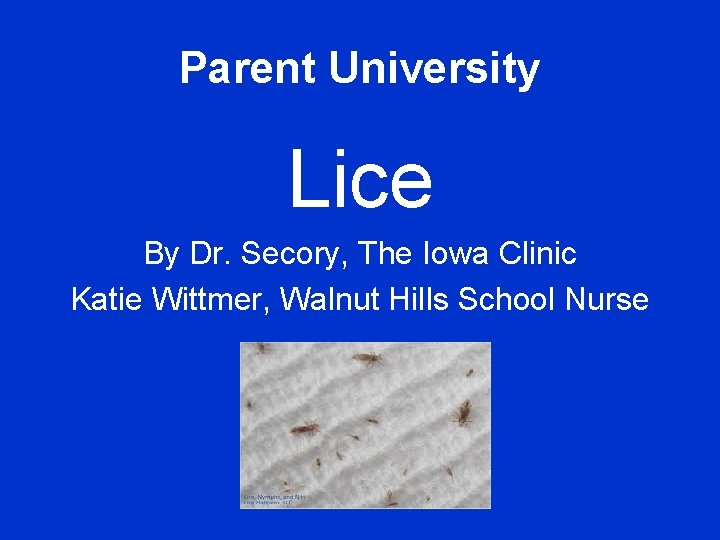
Parent University Lice By Dr. Secory, The Iowa Clinic Katie Wittmer, Walnut Hills School Nurse
Head Lice: Basics • Move only by crawling, cannot hop or fly. • Head-to-head contact is most common source of transmission. –Younger ages most prevalent • Sharing personal items discouraged, but less likely source of transmission. • Not a true medical problem or public health hazard –Do not spread disease –Are annoying, can cause loss of sleep and secondary infections due to itching. • No relationship to cleanliness of individual or home
3 Stages of Head Louse • Nit/Egg – Tiny oval shaped, yellow or white. – Cemented to hair shaft, near scalp. – Can be difficult to see and resemble dandruff or hair product build up. Unlike dandruff, will not flake loose – Take apx 1 week to hatch • Nymph – Hatched, immature louse. – Nit shell will remain on hair shaft after nymph emerges and becomes more visible. – Looks like small adult. • Adult Louse – Turn from nymph to adult louse after apx. 9 days. – Can live 30 days feeding on blood from head. Die w/in 2 days if fall off. – Females lay apx. 6 eggs/day.
OTC Treatment Options • Kill only hatched louse, not eggs, so 2 nd treatment recommended between 7 -9 days. By then all viable nits should have hatched, but louse will not mature into egglaying adult. • Pyrethrins – Brand name: Rid – Naturally occurring pyrethroid extracts from chrysanthemum flower. – Not to be used by persons with allergy to ragweed. – Approved for use on ages 2 years+ • Permethrin Lotion – 1% – Brand name: Nix – Synthetic, but similar to naturally occurring pyrethrins. – May continue to kill newly hatched lice for several days after treatment. – Approved for use on ages 2 months+
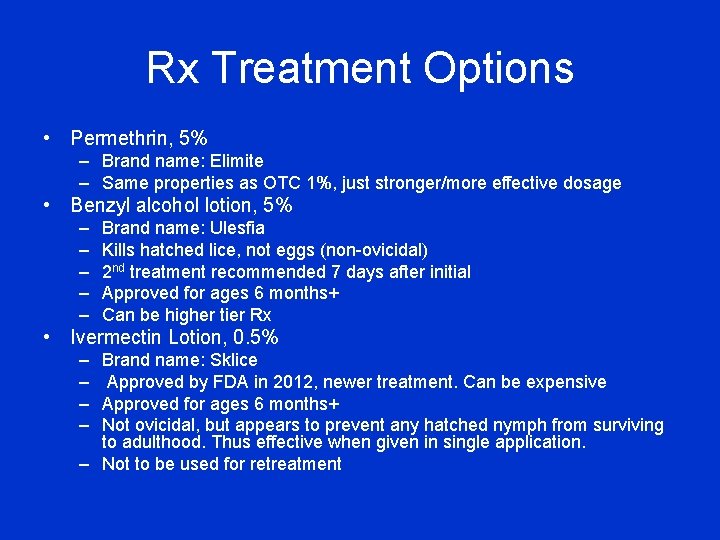
Rx Treatment Options • Permethrin, 5% – Brand name: Elimite – Same properties as OTC 1%, just stronger/more effective dosage • Benzyl alcohol lotion, 5% – – – Brand name: Ulesfia Kills hatched lice, not eggs (non-ovicidal) 2 nd treatment recommended 7 days after initial Approved for ages 6 months+ Can be higher tier Rx • Ivermectin Lotion, 0. 5% – – Brand name: Sklice Approved by FDA in 2012, newer treatment. Can be expensive Approved for ages 6 months+ Not ovicidal, but appears to prevent any hatched nymph from surviving to adulthood. Thus effective when given in single application. – Not to be used for retreatment
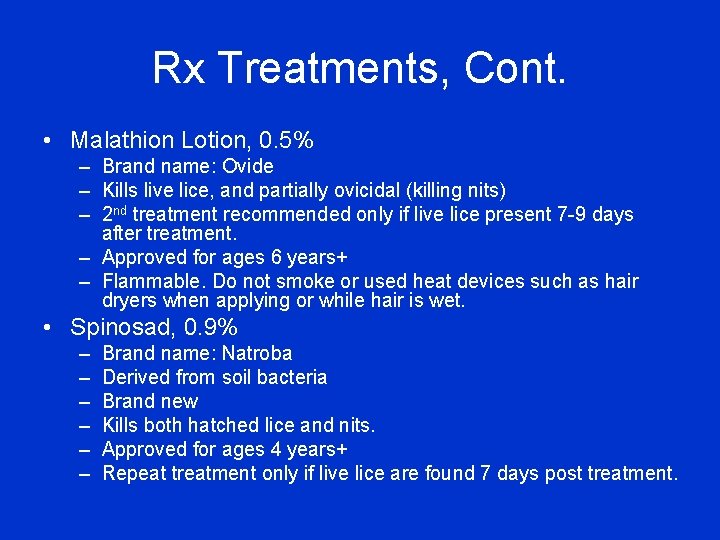
Rx Treatments, Cont. • Malathion Lotion, 0. 5% – Brand name: Ovide – Kills live lice, and partially ovicidal (killing nits) – 2 nd treatment recommended only if live lice present 7 -9 days after treatment. – Approved for ages 6 years+ – Flammable. Do not smoke or used heat devices such as hair dryers when applying or while hair is wet. • Spinosad, 0. 9% – – – Brand name: Natroba Derived from soil bacteria Brand new Kills both hatched lice and nits. Approved for ages 4 years+ Repeat treatment only if live lice are found 7 days post treatment.
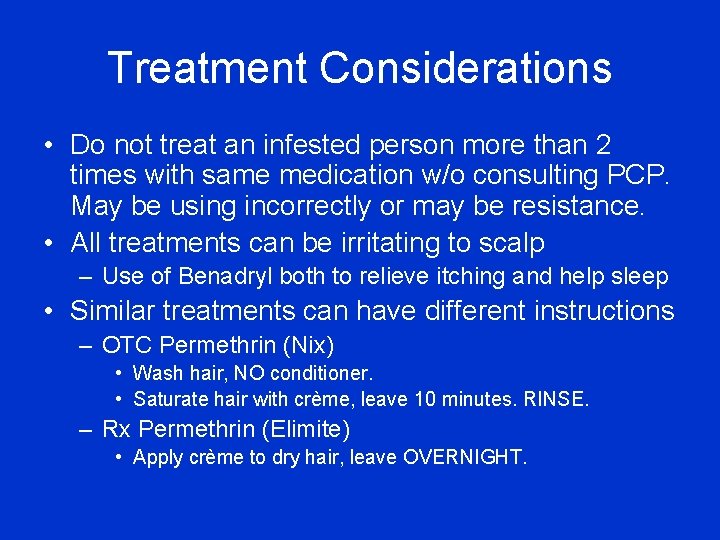
Treatment Considerations • Do not treat an infested person more than 2 times with same medication w/o consulting PCP. May be using incorrectly or may be resistance. • All treatments can be irritating to scalp – Use of Benadryl both to relieve itching and help sleep • Similar treatments can have different instructions – OTC Permethrin (Nix) • Wash hair, NO conditioner. • Saturate hair with crème, leave 10 minutes. RINSE. – Rx Permethrin (Elimite) • Apply crème to dry hair, leave OVERNIGHT.
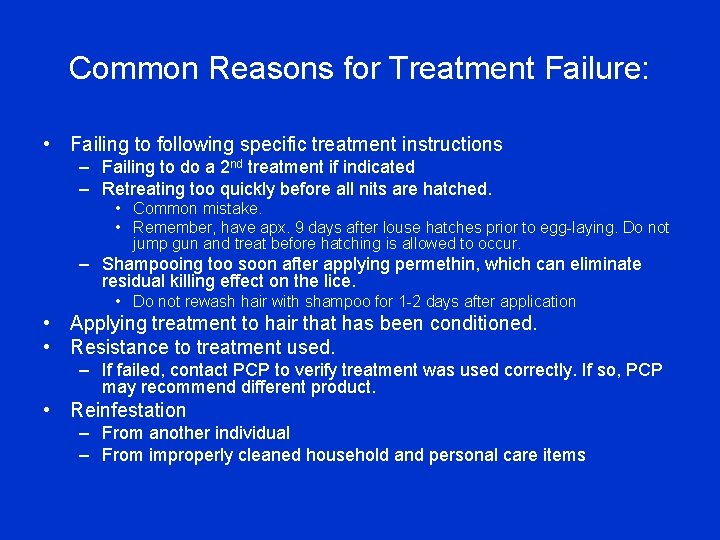
Common Reasons for Treatment Failure: • Failing to following specific treatment instructions – Failing to do a 2 nd treatment if indicated – Retreating too quickly before all nits are hatched. • Common mistake. • Remember, have apx. 9 days after louse hatches prior to egg-laying. Do not jump gun and treat before hatching is allowed to occur. – Shampooing too soon after applying permethin, which can eliminate residual killing effect on the lice. • Do not rewash hair with shampoo for 1 -2 days after application • Applying treatment to hair that has been conditioned. • Resistance to treatment used. – If failed, contact PCP to verify treatment was used correctly. If so, PCP may recommend different product. • Reinfestation – From another individual – From improperly cleaned household and personal care items

Secondary Treatment Measures: • Nit/egg removal – Often done for cleanliness/aesthetic reasons, and desire to not have lice hatch before retreatment. – If OTC/Rx medications are used correctly, no absolute need to remove all nits. • Doing 2 treatments 7 -9 days apart (as indicated) is designed to eliminate all live lice before laying more eggs. • Can provide reassurance as nits are very difficult to see, especially in long/thick hair. – When attempting to remove nits, focus effort near scalp, especially behind ears and at nape of neck. • Nits more than ¼’’ from scalp are generally non-viable. • Makes combing process slightly more tolerable.
Secondary Treatment Measures, Cont. • House Cleaning – Vacuum carpets, furniture, car seats and other fabric items unable to be laundered – Wash all linens, clothing and stuffed toys used by the infested person. • Probably only necessary 2 -3 times during course of treatment, but could do sheets daily in exercise of caution • Freezing items – Freezing temps can kill lice and nits, but several days may be necessary so not recommended means to kill • Bagging items – Although hatched lice survive less than 2 days if they fall off scalp, and nits usually die within 1 week if they are not near scalp, some experts recommend bagging any item that cannot be laundered for 2 weeks to prevent any chance of reinfestation. – Good excuse to bag up excess stuffed animals to see if they really miss them. • Fumigation – Not recommended. – Fumigant sprays and fogs can be toxic if inhaled and are not necessary to control head lice.
Secondary Treatment Measures, Cont. • At-home treatments such as olive oil, coconut oil, mayonnaise have not been proven in studies to be effective on their own. – However, can be good supportive measures to be used between the 2 medication treatments. – Helpful to loosen and remove nits – Condition itchy scalp
Prevention • Instruct children to do their best to avoid head-to-head direct contact. • Inform to avoid sharing hats/brushes/other personal items with scalp contact • Use of tea tree oil has shown to have preventative value. – Can make own concoction, mainly water with essential oil, sprayed on scalp – Available in products such as Fairy Tales
• If unsure of head lice infestation, diagnosis can be made by physician, local health department official, or other person trained to identify (school nurse).
Walnut Hills Protocol • Follow IDPH (Iowa Dept. of Public Health) guidelines. – Children are at risk for head lice as long as they play together – Parent’s are the KEY to looking and treating for head lice • Advise 15 min. each week searching for lice – Gone are the days the school nurse searches head lice in every student (has not shown that it decreases head lice in schools)
Walnut Hills Protocol • What happens when a case of head lice is diagnosed at school? – Remember it is confidential – “Need to know basis” – Parents are notified & educated • students are NOT excluded from school • Need to be treated after school. – Notify teacher section & to watch for students itching their heads
Walnut Hills Protocol • Put info on health blog for parents (no names released) • Subscribe to site for updates – http: //blogs. waukee. k 12. ia. us/health/ – http: //blogs. waukee. k 12. ia. us/sharlan • Educate teachers – no sharing, try to limit head to head contact, remove pillows/blankets • Cleaning protocol for rooms – Custodian is notified for vacuuming
FAQ’s Q: Can I send my student’s items in a plastic baggie. A: Yes you can. But remember head lice does not live more than 24 hours off the head and is spread thru head to head contact.
FAQs Q: Can student’s have individual lockers A: Unfortunately this is not available due to the abundance of students at the school. Q: Should I re-treat my student A: Not necessarily. Only re-treat if you still see a live bug present in the hair. Re-treatment can lead to resistance. Call the school nurse or your PCP if you have questions.
Helpful Websites • • www. cdc. gov/lice/head www. Lice. MD. com www. headlice. org www. idph. state. ia. us/adper/common/pdf/e pi_manual/lice. pdf
- Slides: 19