
Parent Presentation The FRIENDS for Life Programme What

- Slides: 50
Parent Presentation The FRIENDS for Life Programme
What is the FRIENDS For Life Programme? In school, children are taught many subjects, including English, Irish……… They are also taught Social Personal and Health Education (SPHE). The aims of SPHE are to promote all aspects of health and wellbeing – physical health, mental health, emotional development and social development. The FRIENDS For Life programme fits into the SPHE programme.
What is the FRIENDS For Life Programme? • It consists of ten sessions and it is delivered by teachers who have attended two full days of training on its use • It was developed in Australia and is being used in schools worldwide. It has been translated into 12 languages. The World Health Organisation acknowledges and recommends it.
Aim of FRIENDS To: Build self-esteem and confidence Build social and emotional strength Help prevent anxiety Identify and develop support networks Give children the skills and tools for coping with life’s stresses; build resilience
CONTENT • 4 programmes (4 -7; 8 -11; 12 -15; 16+) • Core themes in the programme: F: Feelings R: Remember to Relax I: I can do it E: Explore solutions, Develop a Coping Step Plan N: Now reward yourself D: Don’t forget to practise S: Smile! Stay calm and talk to your Support Networks
WHY BOTHER? . . . . The Statistics… How Common are Anxiety and Depression? • Anxiety is the most common mental health concern for children and teenagers. • 1 in 5 (20%) of the general population experience significant emotional distress-this can increase with particular groups • Anxiety and depression are more prevalent than drug use, ADHD, or any other mental health problem. • Childhood anxiety is often overlooked as often these children are shy, cooperative, compliant… they act in rather than act out • If left unattended, anxiety can significantly interfere with a child’s development and can cause serious problems in later life, such as social isolation, underachievement, depression, etc.
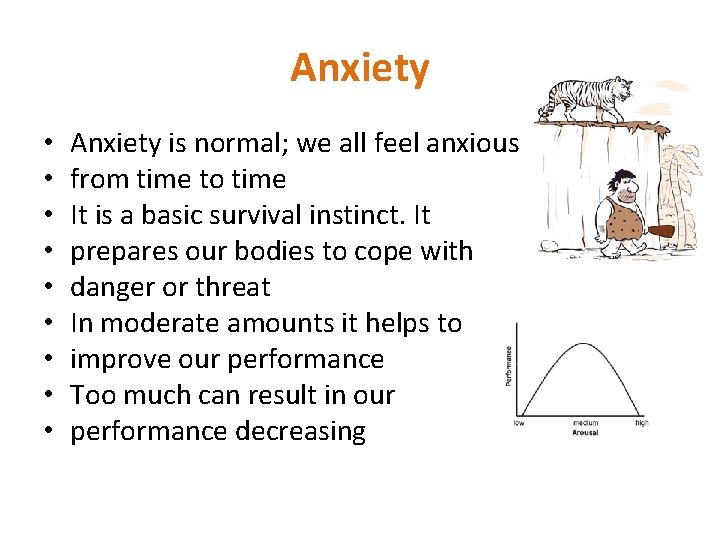
Anxiety • • • Anxiety is normal; we all feel anxious from time to time It is a basic survival instinct. It prepares our bodies to cope with danger or threat In moderate amounts it helps to improve our performance Too much can result in our performance decreasing
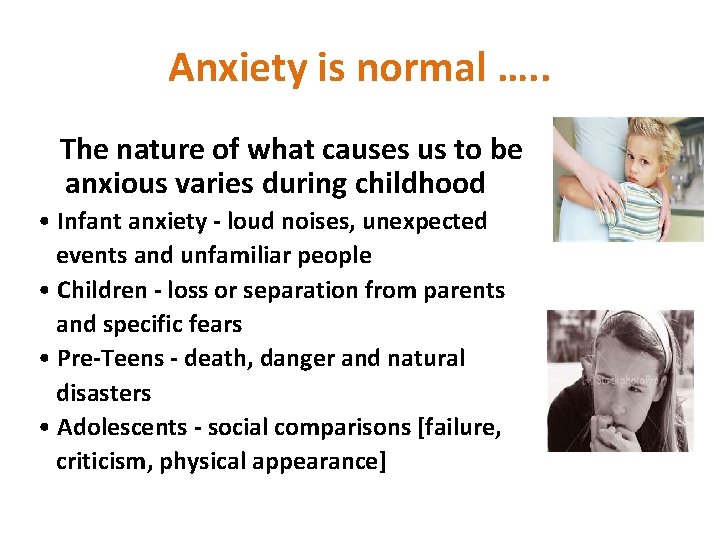
Anxiety is normal …. . The nature of what causes us to be anxious varies during childhood • Infant anxiety - loud noises, unexpected events and unfamiliar people • Children - loss or separation from parents and specific fears • Pre-Teens - death, danger and natural disasters • Adolescents - social comparisons [failure, criticism, physical appearance]
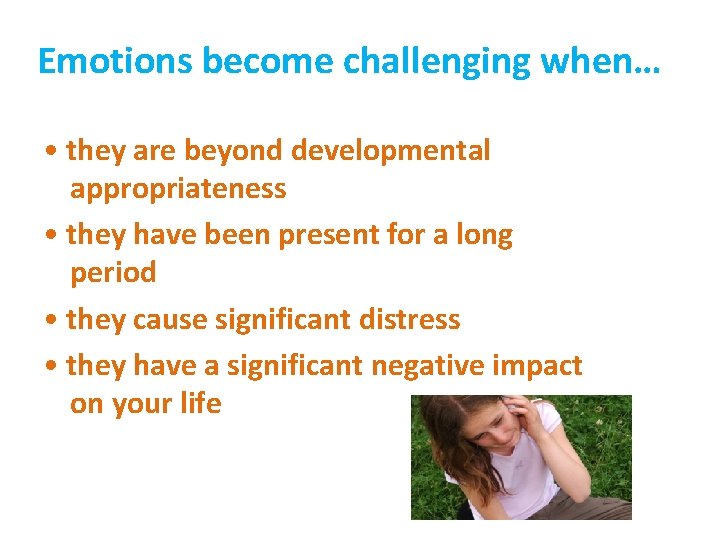
Emotions become challenging when… • they are beyond developmental appropriateness • they have been present for a long period • they cause significant distress • they have a significant negative impact on your life
Emotions become challenging when… • …. . they prevent us from thinking in helpful ways • ……they prevent us from paying attention to positive aspects of situations
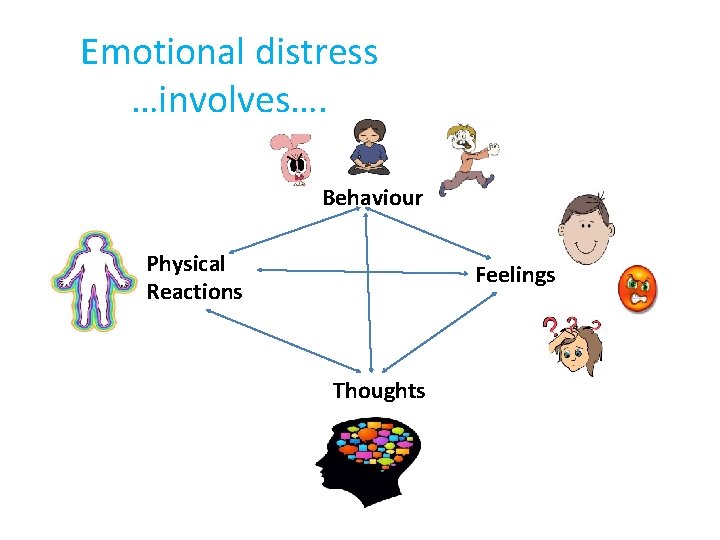
Emotional distress …involves…. Behaviour Physical Reactions Feelings Thoughts
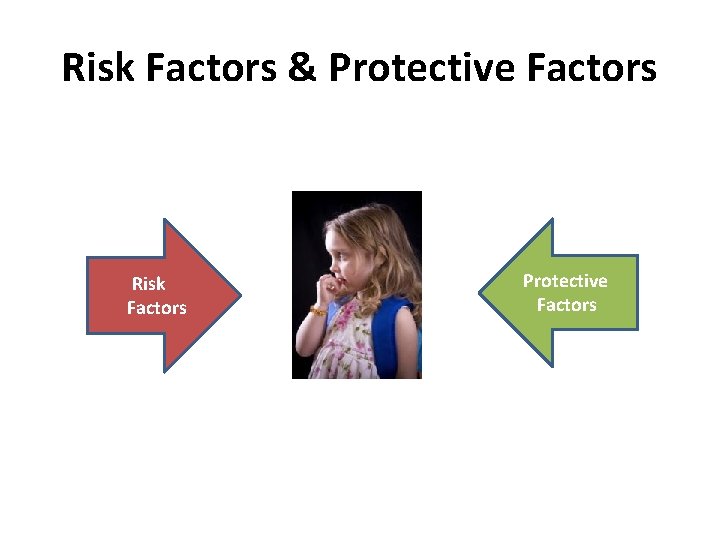
Risk Factors & Protective Factors Risk Factors Protective Factors
Risk Factors associated with a vulnerability to experience severe emotional distress • Temperament - Sensitivity/low threshold for stress • Traumatic experiences • Developmental Challenges • Longterm effect of not dealing with anxiety
Some of the important gifts you can give your children… Unconditional Love/Affection/Positive, Stable Attachment • Paying attention to the positives…happy things that happen • Positive thinking style…helpful thoughts • Time to be children; unstructured, creative outdoor, active play • Health Factors (sleep, physical activity, healthy eating) • Resilience Skills – social and emotional skills taught in evidence-based prevention programmes • Role Models, Support Networks
Resilience = to spring back, rebound, recover Oxford Dictionary Ability to overcome adversity; achieving good outcomes regardless of life events or circumstances
Social and Emotional Skills Necessary for Resilience • Ability/ Opportunity to Form and Maintain positive and Stable Attachments • Self-Awareness, Understanding Feelings, understanding Thoughts, Identifying Values • Self-Regulation, Self-Soothing • Social Awareness • Empathy…Compassion • Relationship Skills • Problem-Solving Skills
What can we do to build children’s resilience?
Overview of the Programme: Let’s take a look. .
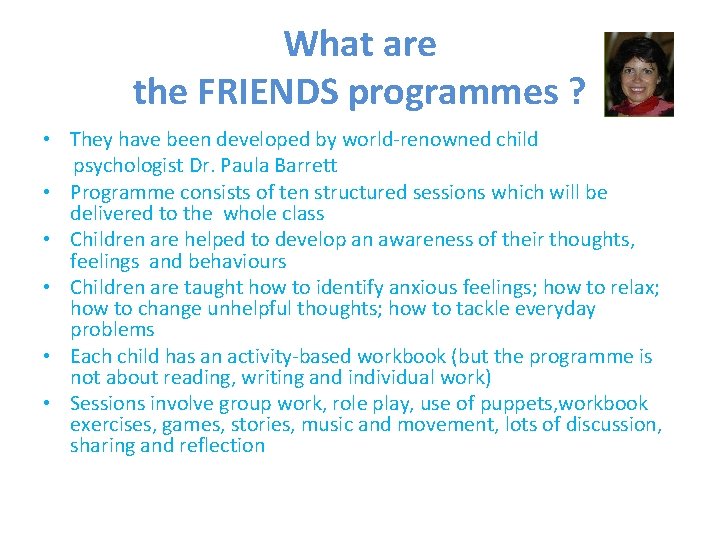
What are the FRIENDS programmes ? • They have been developed by world-renowned child psychologist Dr. Paula Barrett • Programme consists of ten structured sessions which will be delivered to the whole class • Children are helped to develop an awareness of their thoughts, feelings and behaviours • Children are taught how to identify anxious feelings; how to relax; how to change unhelpful thoughts; how to tackle everyday problems • Each child has an activity-based workbook (but the programme is not about reading, writing and individual work) • Sessions involve group work, role play, use of puppets, workbook exercises, games, stories, music and movement, lots of discussion, sharing and reflection
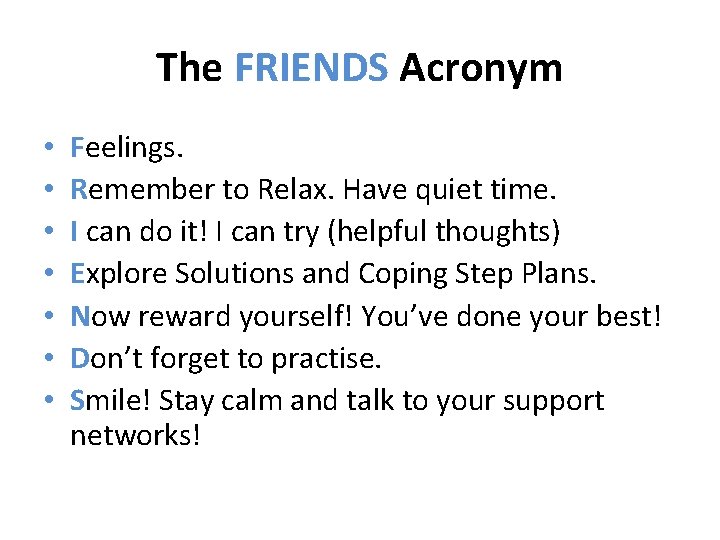
The FRIENDS Acronym • • Feelings. Remember to Relax. Have quiet time. I can do it! I can try (helpful thoughts) Explore Solutions and Coping Step Plans. Now reward yourself! You’ve done your best! Don’t forget to practise. Smile! Stay calm and talk to your support networks!
What to expect • Talking about feelings - learning a ‘new’ language • More empathy towards others (people, animals and nature) • Being braver – trying new situations that may have been fearful of in the past • Calmer, more positive thinking • Using coping step plans to deal with challenging situations
How can you help? Families and caregivers play a vital role in the development and maintenance of the skills taught in the FRIENDS programme. • Each week your child will be introduced to specific skills to help build his/ her resilience. These skills need to be reinforced both during the group and in the home environment in order for change to occur. • You are part of your child’s support network • Children look to us for how to respond in situations; they will model our responses •
F: Feelings • Identifying/ Recognising Feelings…your own, others’ • Working on Feeling Happy, Brave and confident (focussing on the positive, making choices to help us feel better)
Your Body is Your Friend • Children learn to: • - Recognise their own individual body clues and • signs/ what their body is telling them • - Use their body in healthy ways to help them feel • better –breathing exercises, relaxation exercises, • mindfulness, physical exercise, having fun
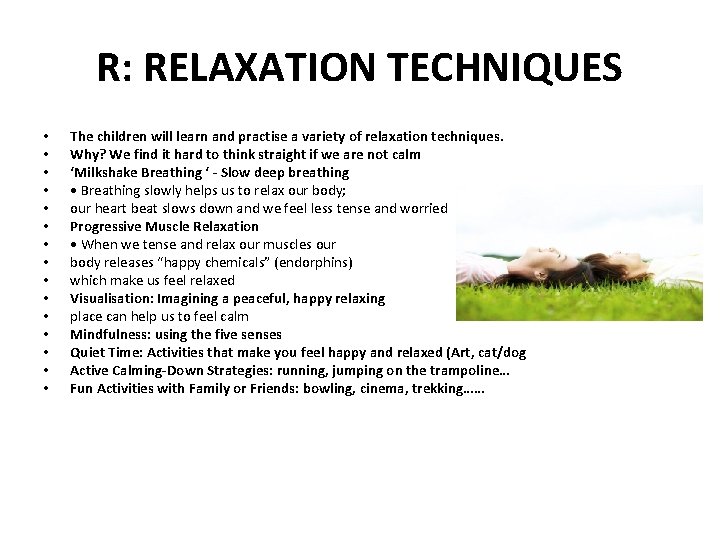
R: RELAXATION TECHNIQUES • • • • The children will learn and practise a variety of relaxation techniques. Why? We find it hard to think straight if we are not calm ‘Milkshake Breathing ‘ - Slow deep breathing • Breathing slowly helps us to relax our body; our heart beat slows down and we feel less tense and worried Progressive Muscle Relaxation • When we tense and relax our muscles our body releases “happy chemicals” (endorphins) which make us feel relaxed Visualisation: Imagining a peaceful, happy relaxing place can help us to feel calm Mindfulness: using the five senses Quiet Time: Activities that make you feel happy and relaxed (Art, cat/dog Active Calming-Down Strategies: running, jumping on the trampoline… Fun Activities with Family or Friends: bowling, cinema, trekking……
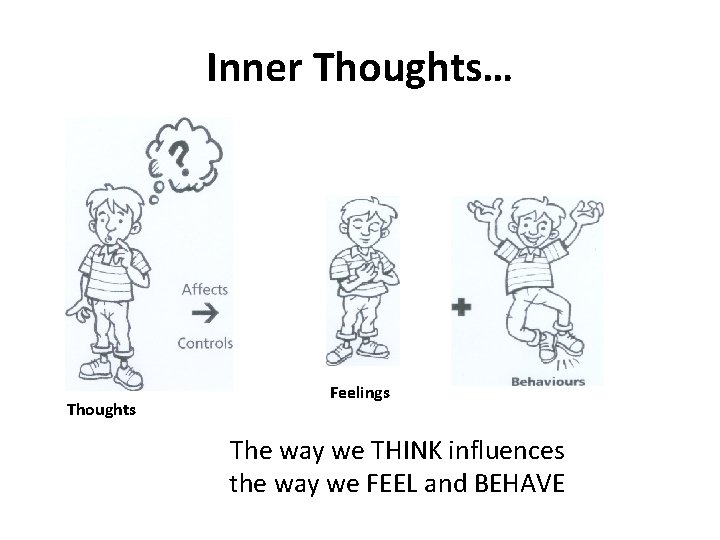
Inner Thoughts… Thoughts Feelings The way we THINK influences the way we FEEL and BEHAVE
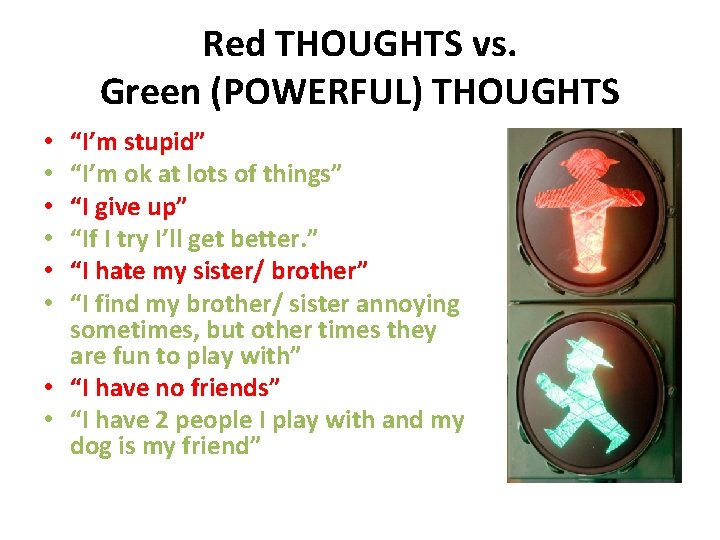
I: ‘I can do it!’ Teaches children to tune into their self-talk. This is an important skill as thoughts influence feelings and behaviour. There are two main steps: 1. Awareness of red thoughts (negative self-talk) 2. Replacing with green thoughts (positive self talk). “Red thoughts try to trick us” “I can be the boss of my thoughts”
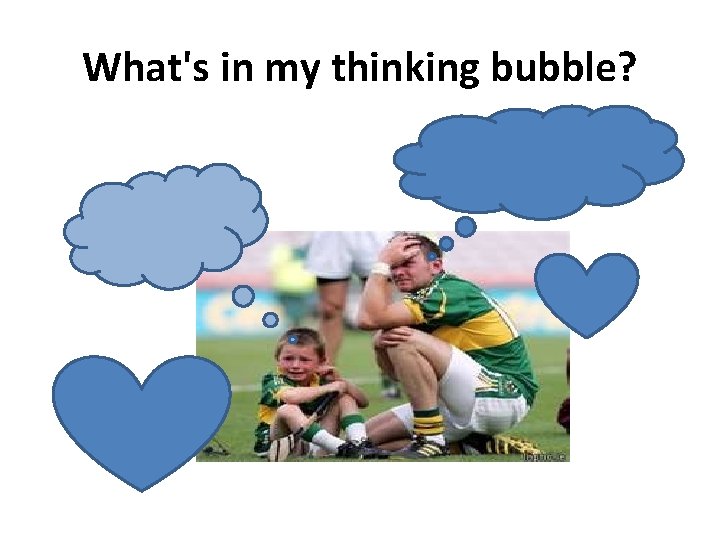
What's in my thinking bubble?
Challenging Unhelpful Thoughts • • • Ask Questions…Look for Evidence Against the Red Thought Examples of Questions: Is that really true? Can I really expect to be perfect at everything I do?
Red THOUGHTS vs. Green (POWERFUL) THOUGHTS “I’m stupid” “I’m ok at lots of things” “I give up” “If I try I’ll get better. ” “I hate my sister/ brother” “I find my brother/ sister annoying sometimes, but other times they are fun to play with” • “I have no friends” • “I have 2 people I play with and my dog is my friend” • • •
E: Exploring Solutions The children learn how to: • - Cope with challenges by breaking them into small steps • - Learn how to find positive solutions by thinking of possible consequences
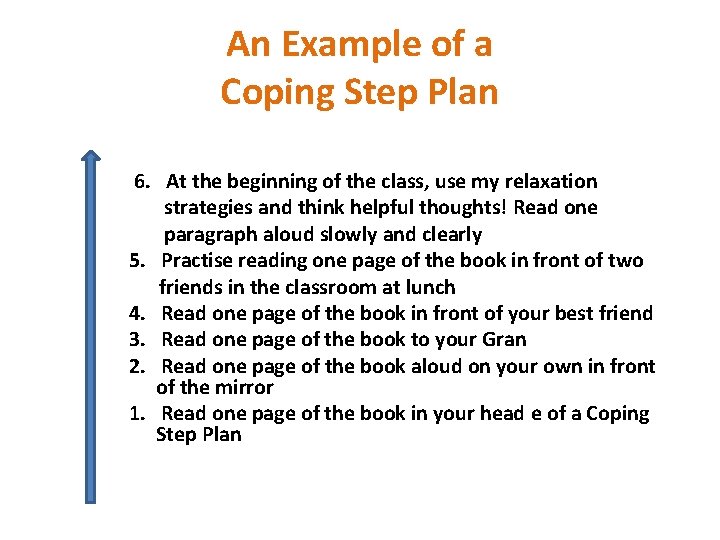
Coping Step Plans • Break down a situation into small steps • The steps gradually become more difficult • Children use the FRIENDS skills (deep breaths, green thoughts) as they climb each step • Children don’t go to the next step until they feel calm and relaxed on the current step
Coping Step Plan Situations could be: • A Fear • An Upcoming Event • Learning a New Skill • Dealing with Change • Trying Something New
An Example of a Coping Step Plan 6. At the beginning of the class, use my relaxation strategies and think helpful thoughts! Read one paragraph aloud slowly and clearly 5. Practise reading one page of the book in front of two friends in the classroom at lunch 4. Read one page of the book in front of your best friend 3. Read one page of the book to your Gran 2. Read one page of the book aloud on your own in front of the mirror 1. Read one page of the book in your head e of a Coping Step Plan
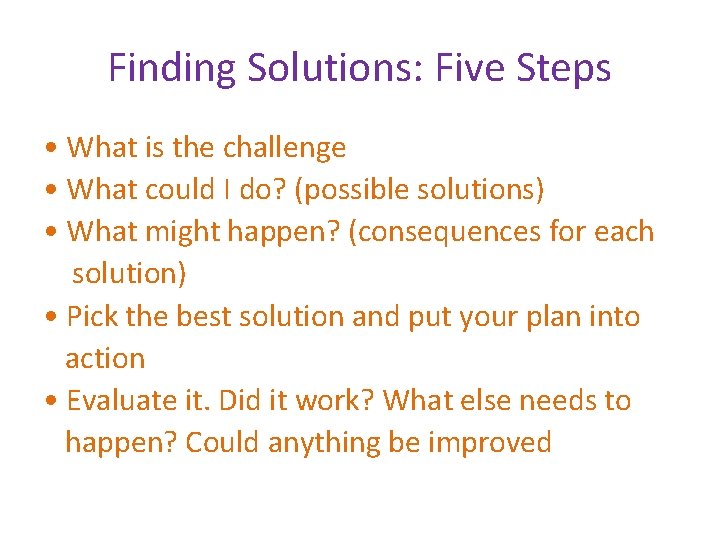
Finding Solutions: Five Steps • What is the challenge • What could I do? (possible solutions) • What might happen? (consequences for each solution) • Pick the best solution and put your plan into action • Evaluate it. Did it work? What else needs to happen? Could anything be improved
N: Now Reward Yourself Encourage non-material rewards Rewards should happen as soon as possible after the effort
D: Do it Every Day/ Don’t Forget to Practise
S: Smile! Stay Calm! Talk to your Support Networks!
Tips for Families • Learn the Skills; Model the Skills; Become Self-Aware • Try to incorporate the FRIENDS language into everyday life. • Continue to challenge unhelpful thoughts (RED thoughts) and turn them into helpful thoughts (GREEN thoughts). • Pay attention to the positive aspects of situations… encourage children to do this. Positive attention can be an essential first step in thinking positively. • Help your children to see life through a ‘positive’ lens, and to see the glass as ‘half-full’. This takes practice • Remember: young people model what they see and hear around them. If you recognise that you are saying unhelpful words or feeling tense or nervous then let your child know that you are aware of this. Then demonstrate coming up with an alternative positive way of looking at your situation
Tips For Families…. cont’nd • Help children understand the relationship and interaction between thoughts, feelings and behaviour • Help children to see the link between their emotions and what is happening inside their body…then they need to do something about this…. Encourage them to practise relaxation strategies…. Develop a menu of family feel-good relaxation activities • Verbalise your child’s feelings (or help child to verbalise them) • Validate their feelings; Reassure that all feelings are Okay
Tips for Families…. cont’nd • Discuss situations where a coping step plan may be useful (e. g. , going to school, making friends, learning to ride a bike). • Share your own experiences when facing challenges. • Focus on what the child can do, then help them try to “have a go” at what they find challenging. • Praise children when they try their best. • Help children practise green thoughts when faced with a challenge
Tips for Families…. cont’nd • Continue to help your child generate personal ways to reward him/herself for effort. Trying is more important than the outcome. • Make an effort to notice and praise small changes • Help children keep practising each day to maintain positive changes and to deal with real-life situations as they arise
Tips for Families…. cont’nd • Identify people you look up to…identify their strengths… • Discuss your support network
Testimonials from Irish parents… "The programme gave her more strategies for dealing with problems. She still remembers the calming techniques, like the milkshake. “ "My son was calling out every night when he woke up but with the help of the relaxation exercises and the program, he learned to settle himself back to sleep. "
Testimonials from Irish parents… "I found the program very good for my daughter. She seems to have more confidence in speaking to adults that would not be close family members. What a pity it can't be run in all classes, all children would benefit greatly from this course. Thank you so much"
Testimonials from Irish children… FRIENDS skills is helping each other out. Being able to do things on your own and with your friends. It helps you cope better as you get older. It helps turn negative thoughts into positive thoughts. It also helps with your feelings and moods. The program helps you to be more confident and helps you to stay calm in difficult situations. We all learned that when we are angry we do the milkshake breathing.
Testimonials from Irish children… The FRIENDS for Life program helps us and our families deal with whatever life throws at us. FRIENDS for life is a program where it helps you when you are angry, worried or stressed. FRIENDS for Life helps with having more friends and not getting angry or worried
Testimonials from Irish children… FRIENDS For life is a program that helps you if you have a problem. It helps you feel good about it and solve it. The FRIENDS program is about being better friends and helps you to cope with troubles. It helps you to stop fighting and you learn how to make a coping step plan. It is a very good program.
Any questions?