
PARENT INFORMATION SERIES DYSGRAPHIA WAY TO SPOT THE

- Slides: 15
• PARENT INFORMATION SERIES • DYSGRAPHIA WAY TO SPOT THE SIGNS UNDERSTANDING DYSGRAPHIA Step 02 Step 04 Step 01 03 LEARNING IT’S CAUSES Farida Raj, Special Educator TIPS FOR PARENTS/ TEACHERS
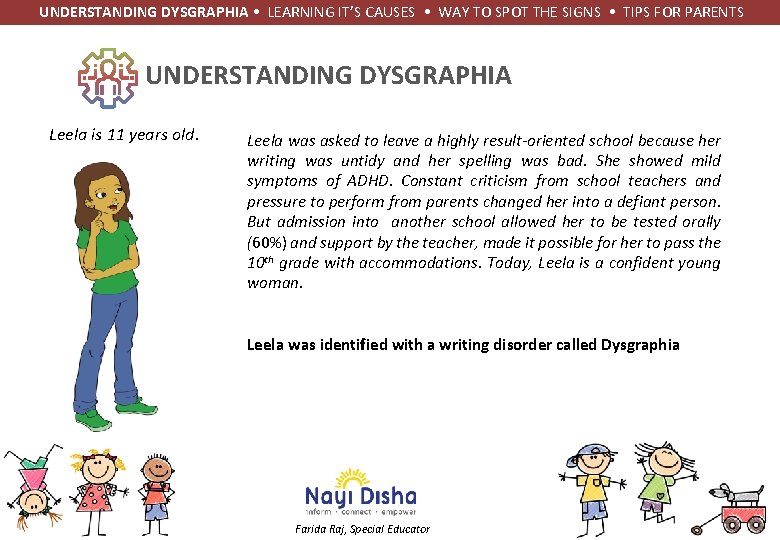
UNDERSTANDING DYSGRAPHIA • LEARNING IT’S CAUSES • WAY TO SPOT THE SIGNS • TIPS FOR PARENTS UNDERSTANDING DYSGRAPHIA Leela is 11 years old. Leela was asked to leave a highly result-oriented school because her writing was untidy and her spelling was bad. She showed mild symptoms of ADHD. Constant criticism from school teachers and pressure to perform from parents changed her into a defiant person. But admission into another school allowed her to be tested orally (60%) and support by the teacher, made it possible for her to pass the 10 th grade with accommodations. Today, Leela is a confident young woman. Leela was identified with a writing disorder called Dysgraphia Farida Raj, Special Educator
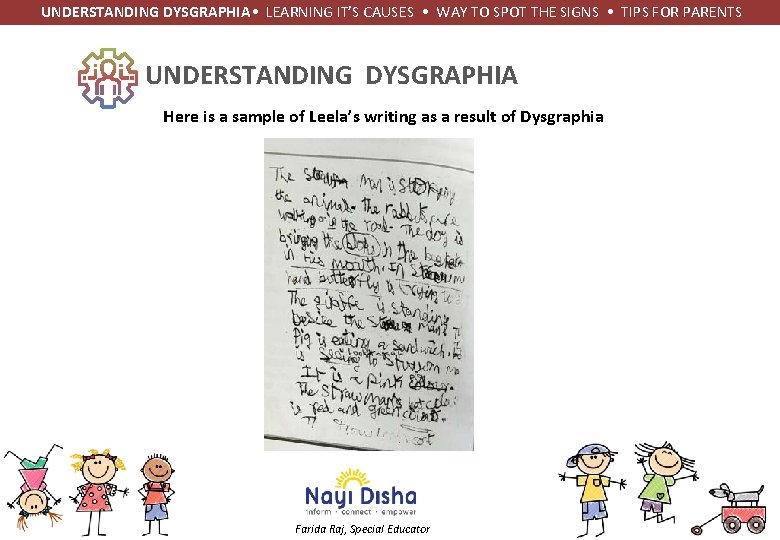
UNDERSTANDING DYSGRAPHIA • LEARNING IT’S CAUSES • WAY TO SPOT THE SIGNS • TIPS FOR PARENTS UNDERSTANDING DYSGRAPHIA Here is a sample of Leela’s writing as a result of Dysgraphia Farida Raj, Special Educator
UNDERSTANDING DYSGRAPHIA • LEARNING IT’S CAUSES • WAY TO SPOT THE SIGNS • TIPS FOR PARENTS UNDERSTANDING DYSGRAPHIA Children are put under tremendous pressure at school & home to write well. So much that in the process the original content is lost and effective writing that helps people remember, organize and process information becomes the primary barrier to learning. Among various types of learning disabilities, the difficulties that cause an otherwise bright youngster to have significant difficulty in producing neat, legible written body of work is called Dysgraphia Farida Raj, Special Educator
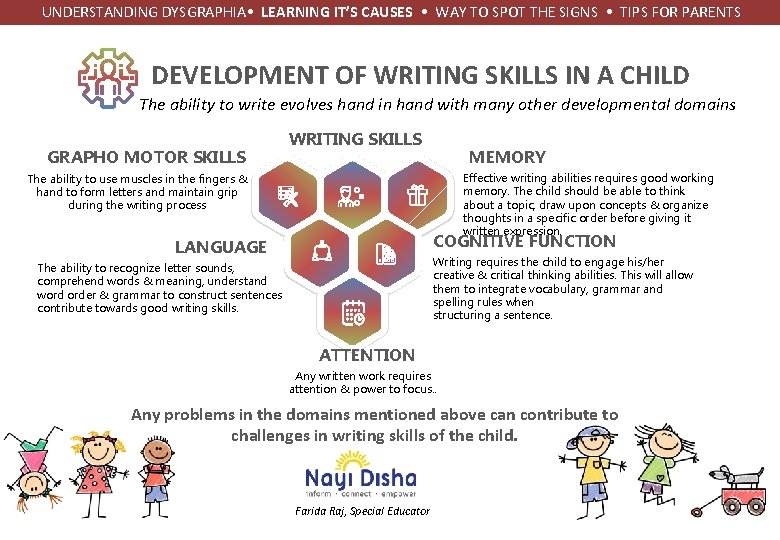
UNDERSTANDING DYSGRAPHIA • LEARNING IT’S CAUSES • WAY TO SPOT THE SIGNS • TIPS FOR PARENTS DEVELOPMENT OF WRITING SKILLS IN A CHILD The ability to write evolves hand in hand with many other developmental domains GRAPHO MOTOR SKILLS The ability to use muscles in the fingers & hand to form letters and maintain grip during the writing process WRITING SKILLS MEMORY Effective writing abilities requires good working memory. The child should be able to think about a topic, draw upon concepts & organize thoughts in a specific order before giving it written expression. COGNITIVE FUNCTION LANGUAGE Writing requires the child to engage his/her creative & critical thinking abilities. This will allow them to integrate vocabulary, grammar and spelling rules when structuring a sentence. The ability to recognize letter sounds, comprehend words & meaning, understand word order & grammar to construct sentences contribute towards good writing skills. ATTENTION Any written work requires attention & power to focus. . Any problems in the domains mentioned above can contribute to challenges in writing skills of the child. Farida Raj, Special Educator
UNDERSTANDING DYSGRAPHIA • LEARNING IT’S CAUSES • WAY TO SPOT THE SIGNS • TIPS FOR PARENTS CAUSES OF DYSGRAPHIA There is no neuronal abnormality per se that is clinically identifiable & indicative of Dysgraphia There are no known causes for Dysgraphia Farida Raj, Special Educator
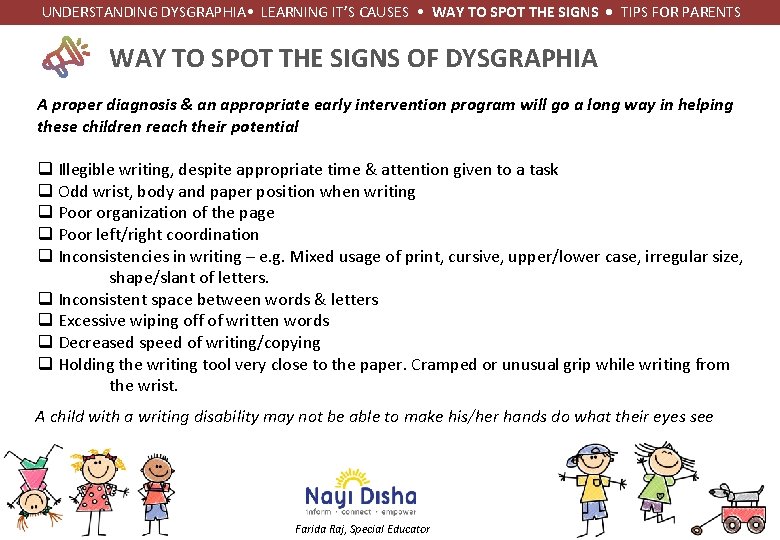
UNDERSTANDING DYSGRAPHIA • LEARNING IT’S CAUSES • WAY TO SPOT THE SIGNS • TIPS FOR PARENTS WAY TO SPOT THE SIGNS OF DYSGRAPHIA A proper diagnosis & an appropriate early intervention program will go a long way in helping these children reach their potential q Illegible writing, despite appropriate time & attention given to a task q Odd wrist, body and paper position when writing q Poor organization of the page q Poor left/right coordination q Inconsistencies in writing – e. g. Mixed usage of print, cursive, upper/lower case, irregular size, shape/slant of letters. q Inconsistent space between words & letters q Excessive wiping off of written words q Decreased speed of writing/copying q Holding the writing tool very close to the paper. Cramped or unusual grip while writing from the wrist. A child with a writing disability may not be able to make his/her hands do what their eyes see Farida Raj, Special Educator
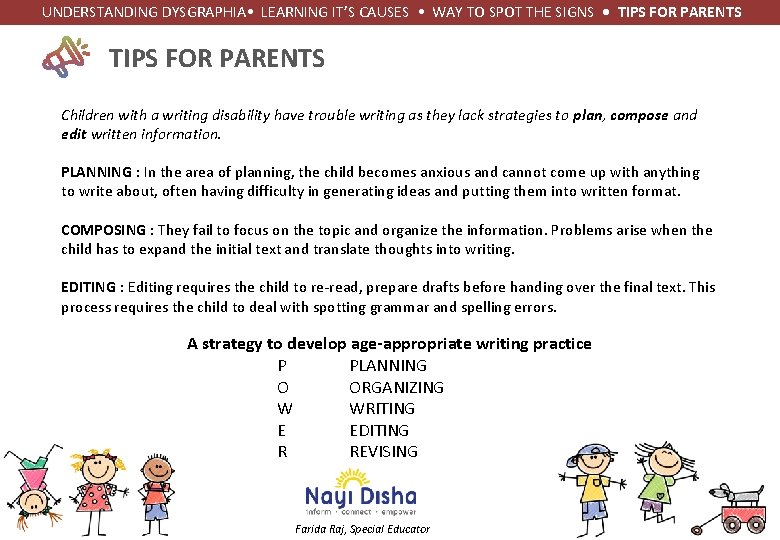
UNDERSTANDING DYSGRAPHIA • LEARNING IT’S CAUSES • WAY TO SPOT THE SIGNS • TIPS FOR PARENTS Children with a writing disability have trouble writing as they lack strategies to plan, compose and edit written information. PLANNING : In the area of planning, the child becomes anxious and cannot come up with anything to write about, often having difficulty in generating ideas and putting them into written format. COMPOSING : They fail to focus on the topic and organize the information. Problems arise when the child has to expand the initial text and translate thoughts into writing. EDITING : Editing requires the child to re-read, prepare drafts before handing over the final text. This process requires the child to deal with spotting grammar and spelling errors. A strategy to develop age-appropriate writing practice P PLANNING O ORGANIZING W WRITING E EDITING R REVISING Farida Raj, Special Educator
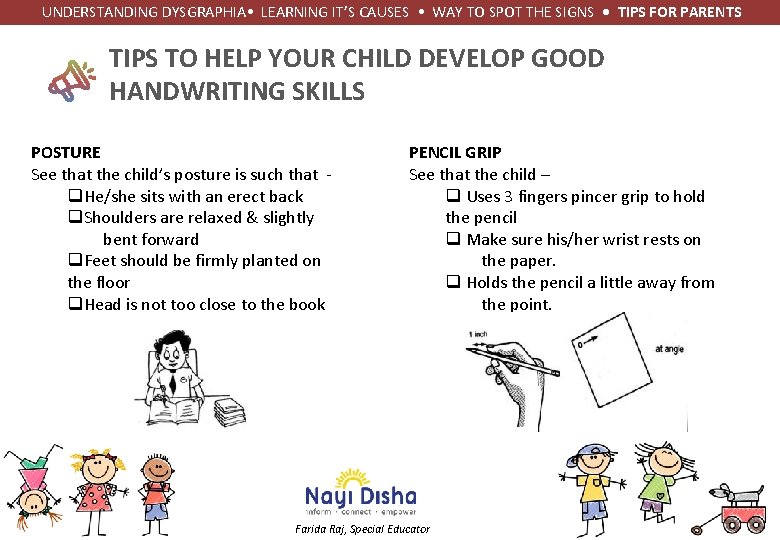
UNDERSTANDING DYSGRAPHIA • LEARNING IT’S CAUSES • WAY TO SPOT THE SIGNS • TIPS FOR PARENTS TIPS TO HELP YOUR CHILD DEVELOP GOOD HANDWRITING SKILLS POSTURE See that the child’s posture is such that q. He/she sits with an erect back q. Shoulders are relaxed & slightly bent forward q. Feet should be firmly planted on the floor q. Head is not too close to the book PENCIL GRIP See that the child – q Uses 3 fingers pincer grip to hold the pencil q Make sure his/her wrist rests on the paper. q Holds the pencil a little away from the point. Farida Raj, Special Educator
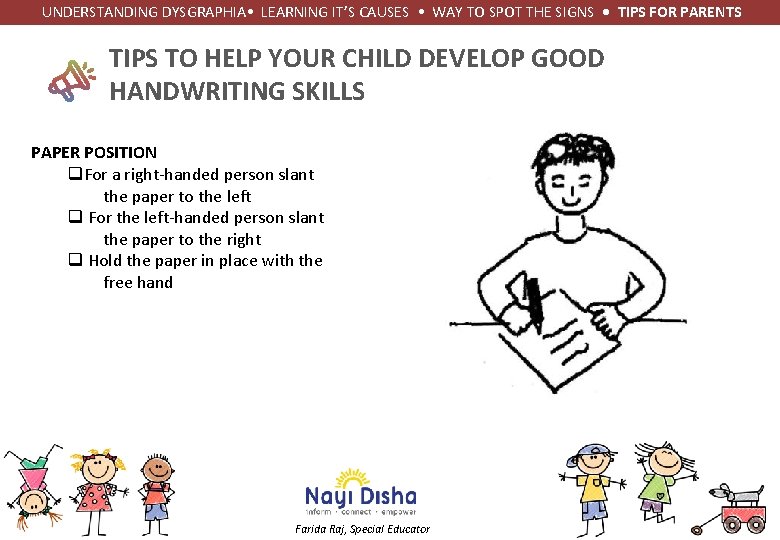
UNDERSTANDING DYSGRAPHIA • LEARNING IT’S CAUSES • WAY TO SPOT THE SIGNS • TIPS FOR PARENTS TIPS TO HELP YOUR CHILD DEVELOP GOOD HANDWRITING SKILLS PAPER POSITION q. For a right-handed person slant the paper to the left q For the left-handed person slant the paper to the right q Hold the paper in place with the free hand Farida Raj, Special Educator
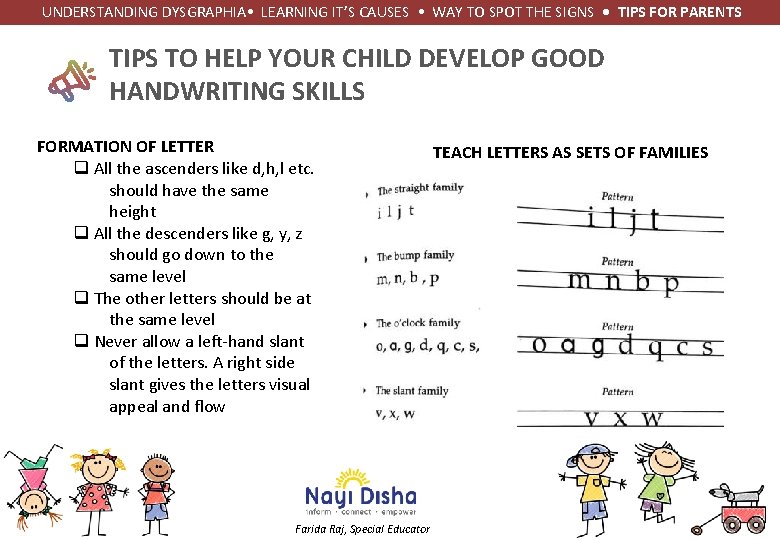
UNDERSTANDING DYSGRAPHIA • LEARNING IT’S CAUSES • WAY TO SPOT THE SIGNS • TIPS FOR PARENTS TIPS TO HELP YOUR CHILD DEVELOP GOOD HANDWRITING SKILLS FORMATION OF LETTER q All the ascenders like d, h, l etc. should have the same height q All the descenders like g, y, z should go down to the same level q The other letters should be at the same level q Never allow a left-hand slant of the letters. A right side slant gives the letters visual appeal and flow Farida Raj, Special Educator TEACH LETTERS AS SETS OF FAMILIES
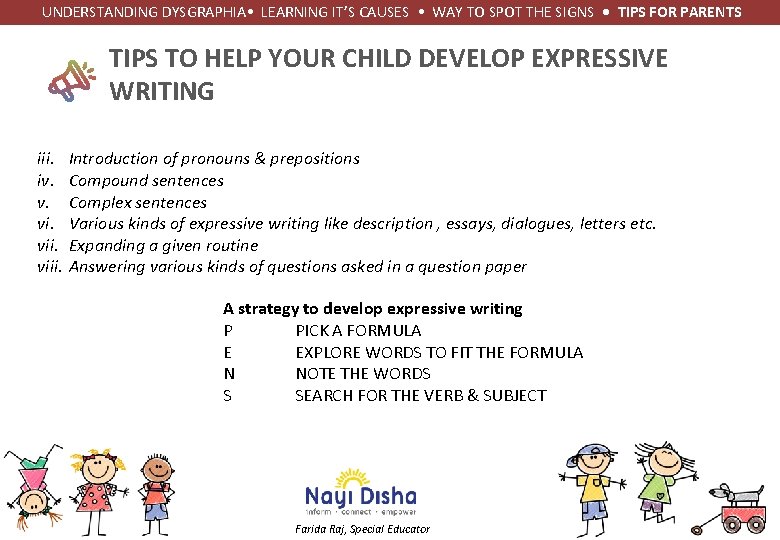
UNDERSTANDING DYSGRAPHIA • LEARNING IT’S CAUSES • WAY TO SPOT THE SIGNS • TIPS FOR PARENTS TIPS TO HELP YOUR CHILD DEVELOP EXPRESSIVE WRITING Expressive writing depends on listening, speaking, handwriting & spelling. Problems appear when the child is required to use the various language components in written form as children with learning disability produce an age-inappropriate written expression. It is therefore, necessary that they are taught in a systematic manner. Practice expressive speech and writing in the following format i. Forming of simple sentences – the child dictates, & the teacher writes. ii. Teach sentence construction : a. Noun + verb – Dogs bark b. Adjective + noun +verb – Big dogs bark c. Article + adjective + noun + verb – A big dog barks d. Article + adjective + noun + verb + adverb – A big dog barks loudly Farida Raj, Special Educator
UNDERSTANDING DYSGRAPHIA • LEARNING IT’S CAUSES • WAY TO SPOT THE SIGNS • TIPS FOR PARENTS TIPS TO HELP YOUR CHILD DEVELOP EXPRESSIVE WRITING iii. iv. v. viii. Introduction of pronouns & prepositions Compound sentences Complex sentences Various kinds of expressive writing like description , essays, dialogues, letters etc. Expanding a given routine Answering various kinds of questions asked in a question paper A strategy to develop expressive writing P PICK A FORMULA E EXPLORE WORDS TO FIT THE FORMULA N NOTE THE WORDS S SEARCH FOR THE VERB & SUBJECT Farida Raj, Special Educator
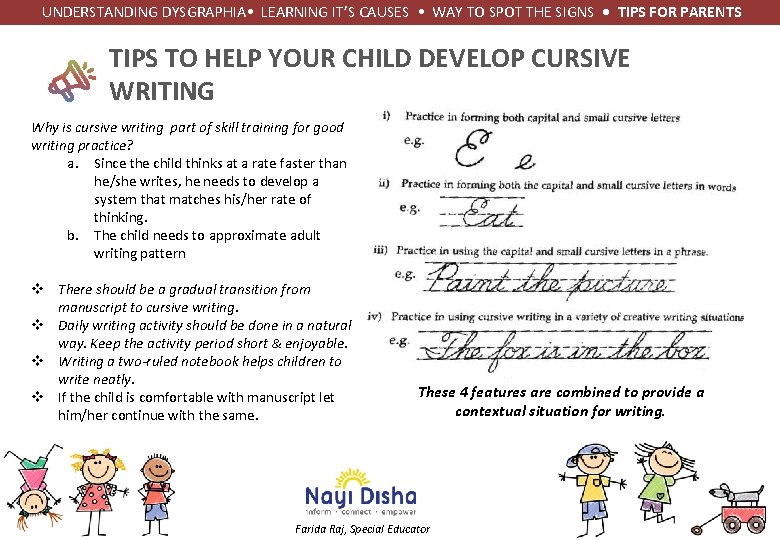
UNDERSTANDING DYSGRAPHIA • LEARNING IT’S CAUSES • WAY TO SPOT THE SIGNS • TIPS FOR PARENTS TIPS TO HELP YOUR CHILD DEVELOP CURSIVE WRITING Why is cursive writing part of skill training for good writing practice? a. Since the child thinks at a rate faster than he/she writes, he needs to develop a system that matches his/her rate of thinking. b. The child needs to approximate adult writing pattern v There should be a gradual transition from manuscript to cursive writing. v Daily writing activity should be done in a natural way. Keep the activity period short & enjoyable. v Writing a two-ruled notebook helps children to write neatly. v If the child is comfortable with manuscript let him/her continue with the same. These 4 features are combined to provide a contextual situation for writing. Farida Raj, Special Educator
This content has been developed in collaboration with Remedial & Special Educator Ms. Farida Raj. It has been adapted from her book ''Breaking Through" - A Hand Book for Teachers and Parents of Children with Learning Difficulties & reproduced here with consent Nayi Disha Resource Centre is an online information resource platform that supports families of persons with, Specific Learning Disabilities, Intellectual & Developmental Disabilities. Visit us at WWW. NAYI-DISHA. ORG Join Us on Facebook Join Us on Twitter Join Us on Linkedin