
Parc Mediterrani de la Tecnologia Edifici ESAB Carrer
Parc Mediterrani de la Tecnologia Edifici ESAB Carrer Esteve Terradas, 8 08860 Castelldefels, Barcelona POTENTIAL IMPACT OF THE FUTURE PIG WELFARE POLICY IN EUROPE ON THE SPANISH SECTOR Francesc Borrisser-Pairób, Zein Kallasa, Nuria Panella-Rierab , Maria Avenab, Beatriz Martínezc, María Dolores Garridod, Alvaro Olivarese; Miguel Ibáñeze; M. Angels Oliverb, José María Gila a Centre for Agro-food Economy and Development, Castelldefels, Barcelona. Product Quality program, finca camps i armet, e-17121 Monells, Girona. c Estación Tecnológica de la Carne, Instituto Tecnológico Agrario, Jta. de Castilla y León, Guijuelo. d Facultad de Veterinaria, Tecnología de los alimentos, Universidad de Murcia, Murcia. e Facultad de Veterinaria, Producción Animal, Universidad Complutense de Madrid, Madrid. b IRTA-Monells, Paper prepared for presentation at the X CONGRESO NACIONAL DE ECONOMÍA AGRARIA Córdoba, 9 -11 de Septiembre 2015 "Alimentación y territorios sostenibles desde el sur de Europa"
1. INTRODUCTION: Background q ANIMAL WELFARE is becoming a relevant FACTOR affecting CONSUMER PREFERENCES. q Consumers are DEMANDING animals being reared, fed and housed AS CLOSELY AS POSSIBLE as they would in their NATURAL CONDITIONS. q The growing CONCERNS about ANIMAL WELFARE in EU are being extensively debated, resulting in CONTINUOUS CHANGES in regulations and POLICIES. Paper prepared for presentation at the X CONGRESO NACIONAL DE ECONOMÍA AGRARIA Córdoba, 9 -11 de Septiembre 2015 "Alimentación y territorios sostenibles desde el sur de Europa"
1. INTRODUCTION: Background q EU regulations have led to BANS of a number of INTENSIVE farming methods. q In this context, PIG WELFARE has received and is still receiving special attention as pork is the MOST PRODUCED and consumed meat in the EU. q For instance, the Council Directive 2008/120/EC has BANNED the use of SOW STALLS by January 2012. Paper prepared for presentation at the X CONGRESO NACIONAL DE ECONOMÍA AGRARIA Córdoba, 9 -11 de Septiembre 2015 "Alimentación y territorios sostenibles desde el sur de Europa"
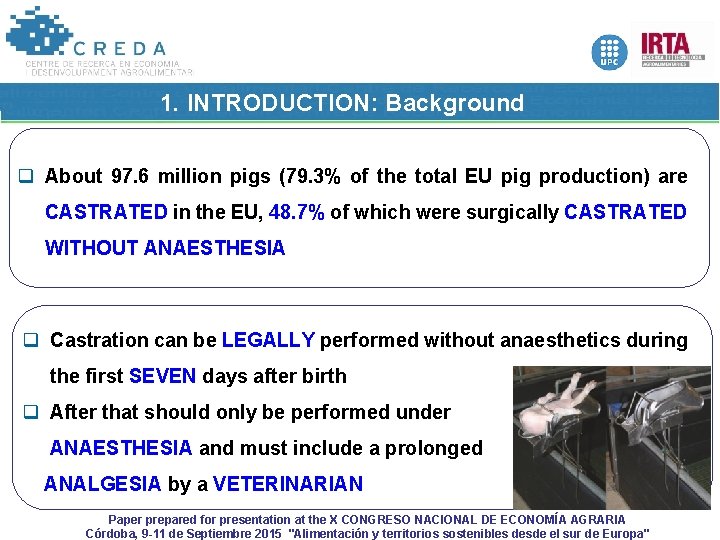
1. INTRODUCTION: Background q About 97. 6 million pigs (79. 3% of the total EU pig production) are CASTRATED in the EU, 48. 7% of which were surgically CASTRATED WITHOUT ANAESTHESIA q Castration can be LEGALLY performed without anaesthetics during the first SEVEN days after birth q After that should only be performed under ANAESTHESIA and must include a prolonged ANALGESIA by a VETERINARIAN Paper prepared for presentation at the X CONGRESO NACIONAL DE ECONOMÍA AGRARIA Córdoba, 9 -11 de Septiembre 2015 "Alimentación y territorios sostenibles desde el sur de Europa"

1. INTRODUCTION: Background q CASTRATION of ENTIRE MALES’ pigs is carried out: § To ENCOURAGE the DEPOSIT OF INTRAMUSCULAR FAT § To PREVENT aggressive BEHAVIOR problems § To AVOID the RISK of obtaining meat with BOAR TAINT Off-odour and flavour related to the accumulation of Androstenone and Skatole in the fat tissue Consumers REACT DIFFERENTLY to this SMELL and therefore it can affect CONSUMERS’ ACCEPTABILITY of pork There is an associated MEAT 5 (sensory) QUALITY problem
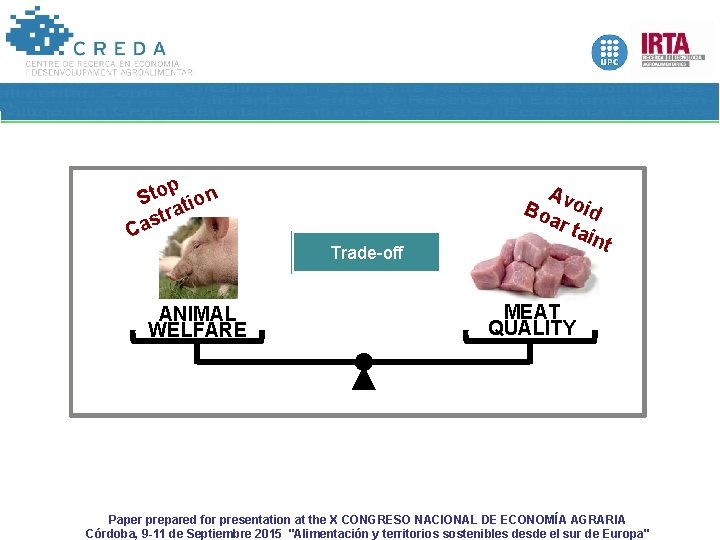
p Sto tion a str a C Trade-off ANIMAL WELFARE Av Bo oid ar tain t MEAT QUALITY Paper prepared for presentation at the X CONGRESO NACIONAL DE ECONOMÍA AGRARIA Córdoba, 9 -11 de Septiembre 2015 "Alimentación y territorios sostenibles desde el sur de Europa"
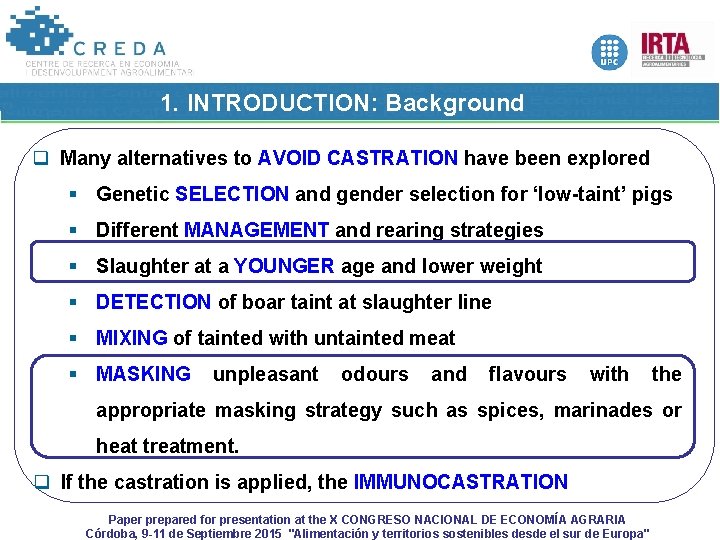
1. INTRODUCTION: Background q Many alternatives to AVOID CASTRATION have been explored § Genetic SELECTION and gender selection for ‘low-taint’ pigs § Different MANAGEMENT and rearing strategies § Slaughter at a YOUNGER age and lower weight § DETECTION of boar taint at slaughter line § MIXING of tainted with untainted meat § MASKING unpleasant odours and flavours with the appropriate masking strategy such as spices, marinades or heat treatment. q If the castration is applied, the IMMUNOCASTRATION Paper prepared for presentation at the X CONGRESO NACIONAL DE ECONOMÍA AGRARIA Córdoba, 9 -11 de Septiembre 2015 "Alimentación y territorios sostenibles desde el sur de Europa"
1. INTRODUCTION: Background q Focusing only on the CONSUMERS’ PREFERENCES gives only a PARTIAL VIEW OF THE PROBLEM. § The consumer FINAL CHOICE of a food product is a MIXTURE between the SENSORY EXPERIENCE (Intrinsic cues) and the other descriptors of the products (Extrinsic cues). q The opinions and attitudes of SPANISH STAKEHOLDERS from the whole pork CHAIN regarding this POLICY CHANGE Paper prepared for presentation at the X CONGRESO NACIONAL DE ECONOMÍA AGRARIA Córdoba, 9 -11 de Septiembre 2015 "Alimentación y territorios sostenibles desde el sur de Europa"
1. INTRODUCTION: Objective q Thus, the objective of this paper is twofold: 1. To assess STAKEHOLDERS’ OPINIONS and ATTITUDES of the Spanish pork supply chain towards the potential market of the production of entire male pigs and the impact of a potential mandatory banning of piglet castration. 2. To analyze the DETERMINANTS FACTORS of fresh meat PURCHASING for BUTCHERS, as the main retailers in the Spanish pork chain supply Paper prepared for presentation at the X CONGRESO NACIONAL DE ECONOMÍA AGRARIA Córdoba, 9 -11 de Septiembre 2015 "Alimentación y territorios sostenibles desde el sur de Europa"
2. METHODOLOGICAL FRAMEWORK q 4 FOCUS GROUPS (26 participants) as a QUALITATIVE METHOD were applied to analyze OPINIONS AND ATTITUDES. q A FACE-TO-FACE SURVEY of 127 butcheries in Madrid and Barcelona was carried out to identify the determining FACTORS FOR PURCHASING PIG MEAT, HIERARCHY PROCESS (AHP). using the ANALYTICAL
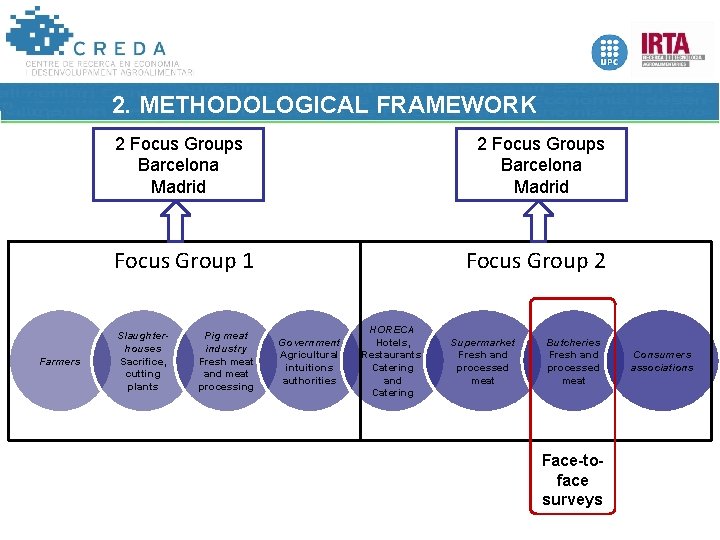
2. METHODOLOGICAL FRAMEWORK 2 Focus Groups Barcelona Madrid Focus Group 1 Farmers Slaughterhouses Sacrifice, cutting plants Pig meat industry Fresh meat and meat processing Focus Group 2 Government Agricultural intuitions authorities HORECA Hotels, Restaurants, Catering and Catering Supermarket Fresh and processed meat Butcheries Fresh and processed meat Face-toface surveys Consumers associations
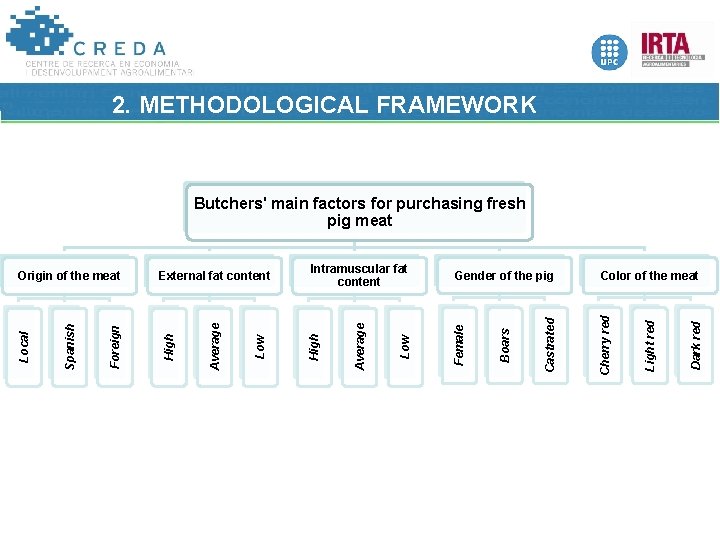
2. METHODOLOGICAL FRAMEWORK Butchers' main factors for purchasing fresh pig meat Dark red Light red Color of the meat Cherry red Castrated Boars Gender of the pig Female Low Average Intramuscular fat content High Low Average External fat content High Foreign Spanish Local Origin of the meat
4. RESULTS q Participants believed that in Spain there would be NO IMPORTANT IMPLICATION since a LARGE PART of the market is already based on entire males. q BOAR TAINT IS SELDOM FOUND in the fresh meat due to the fact that animals in Spain are slaughtered at an EARLY AGE (6 months old) and that GENETIC TYPES have changed q Serious problem for the IBERIAN PIG SECTOR. Paper prepared for presentation at the X CONGRESO NACIONAL DE ECONOMÍA AGRARIA Córdoba, 9 -11 de Septiembre 2015 "Alimentación y territorios sostenibles desde el sur de Europa"
4. RESULTS q In PROCESSED PRODUCTS because it is easier to mask it. q Participants agreed that Spanish CONSUMERS ARE NOT READY to pay a PREMIUM for meat coming from animals raised under HIGHER WELFARE STANDARD CONDITIONS because animal welfare is a comparatively recent issue in Spain. Paper prepared for presentation at the X CONGRESO NACIONAL DE ECONOMÍA AGRARIA Córdoba, 9 -11 de Septiembre 2015 "Alimentación y territorios sostenibles desde el sur de Europa"
4. RESULTS q Los consumidores en España aún NO ESTÁN PREPARADOS para pagar realmente por el bienestar animal. Lo que pagan ahora son una minoría. q El consumidor NO QUIERE Y NO ASOCIA el animal con la carne. (Corderito del Norit con la paletilla). q NO CASTRAR nos cargamos los productos de Calidad Paper prepared for presentation at the X CONGRESO NACIONAL DE ECONOMÍA AGRARIA Córdoba, 9 -11 de Septiembre 2015 "Alimentación y territorios sostenibles desde el sur de Europa"
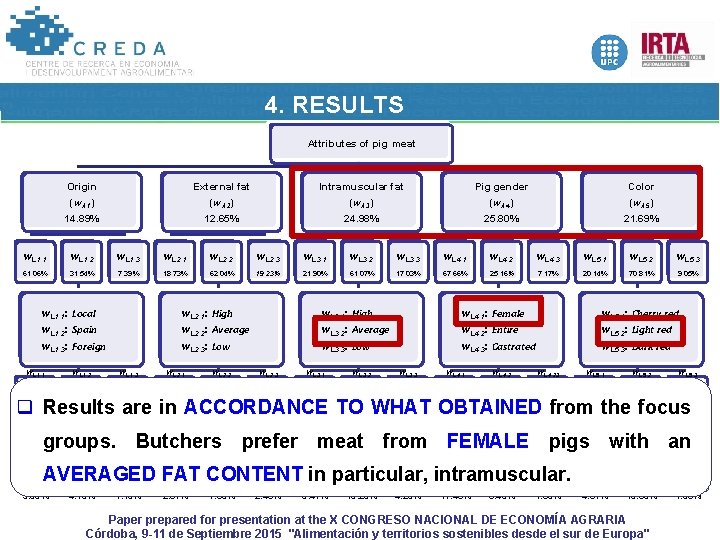
4. RESULTS Attributes of pig meat Origin (w. A 1) 14. 89% External fat (w. A 2) 12. 65% Intramuscular fat (w. A 3) 24. 98% Pig gender (w. A 4) 25. 80% Color (w. A 5) 21. 69% w. L 1. 1 w. L 1. 2 w. L 1. 3 w. L 2. 1 w. L 2. 2 w. L 2. 3 w. L 3. 1 w. L 3. 2 w. L 3. 3 w. L 4. 1 w. L 4. 2 w. L 4. 3 w. L 5. 1 w. L 5. 2 w. L 5. 3 61. 06% 31. 54% 7. 39% 18. 73% 62. 04% 19. 23% 21. 90% 61. 07% 17. 03% 67. 66% 25. 16% 7. 17% 20. 14% 70. 81% 9. 05% w. L 1. 1: Local w. L 1. 2: Spain w. L 1. 3: Foreign w. L 1. 1 w. A 1 w. L 1. 2 w. A 1 w. L 2. 1: High w. L 2. 2: Average w. L 2. 3: Low w. L 1. 3 w. A 1 w. L 2. 1 w. A 2 w. L 2. 2 w. A 2 w. L 3. 1: High w. L 3. 2: Average w. L 3. 3: Low w. L 2. 3 w. A 2 w. L 3. 1 w. A 3 w. L 3. 2 w. A 3 w. L 4. 1: Female w. L 4. 2: Entire w. L 4. 3: Castrated w. L 3. 3 w. A 3 w. L 4. 1 w. A 4 w. L 4. 2 w. A 4 w. L 5. 1: Cherry red w. L 5. 2: Light red w. L 5. 3: Dark red w. L 4. 23 w. A 4 w. L 5. 1 w. A 5 w. L 5. 2 w. A 5 w. L 5. 3 w. A 5 q Results are in ACCORDANCE TO WHAT OBTAINED from thew focus w w w w = = G_L 1. 1 = G_L 1. 2 G_L 1. 3 = G_L 2. 1 = G_L 2. 2 = G_L 2. 3 = G_L 3. 1 = G_L 3. 2 = G_L 3. 3 = G_L 4. 1 = G_L 4. 2 = G_L 5. 1 = G_L 5. 2 = G_L 5. 3 groups. Butchers prefer meat from FEMALE pigs with an AVERAGED FAT CONTENT in particular, intramuscular. 9. 09% 4. 70% 1. 10% 2. 37% 7. 85% 2. 43% 5. 47% 15. 25% 4. 25% 17. 46% 6. 49% 1. 85% 4. 37% 15. 35% Paper prepared for presentation at the X CONGRESO NACIONAL DE ECONOMÍA AGRARIA Córdoba, 9 -11 de Septiembre 2015 "Alimentación y territorios sostenibles desde el sur de Europa" 1. 96%
5. CONCLUSIONS q The ban of PIGLET CASTRATION in Europe by 2018 might not be considered a problem since already some percentage of entire males is currently produced. q Boar taint is not present in almost all fresh meat product § Slaughtered at lower age § Boar tainted processed product q However, for the production of high quality products, mainly the Iberian breed should be allowed in order to obtain an adequate INTRAMUSCULAR FAT CONTENT and to avoid boar taint Paper prepared for presentation at the X CONGRESO NACIONAL DE ECONOMÍA AGRARIA Córdoba, 9 -11 de Septiembre 2015 "Alimentación y territorios sostenibles desde el sur de Europa"
Thank you for your attention Paper prepared for presentation at the X CONGRESO NACIONAL DE ECONOMÍA AGRARIA Córdoba, 9 -11 de Septiembre 2015 "Alimentación y territorios sostenibles desde el sur de Europa"
- Slides: 18