
PARASYMPATHATIC NERVOUS SYSTEM Dr Iram Tassaduq INTRODUCTION ANS



- Slides: 20
PARASYMPATHATIC NERVOUS SYSTEM Dr Iram. Tassaduq
INTRODUCTION �ANS is the subdivision of the peripheral nervous system that regulates body activities that are generally not under conscious control �Composed of a special group of neurons serving: ◦ Cardiac muscle (the heart) ◦ Smooth muscle (walls of viscera and blood vessels) ◦ Internal organs ◦ Skin 3
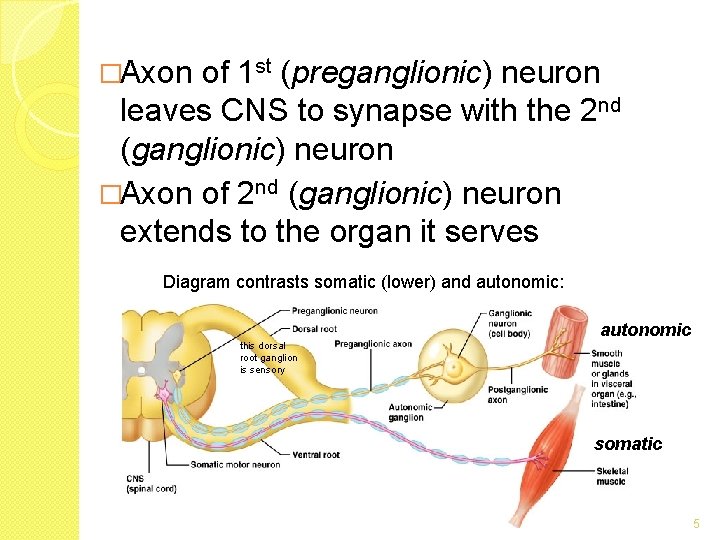
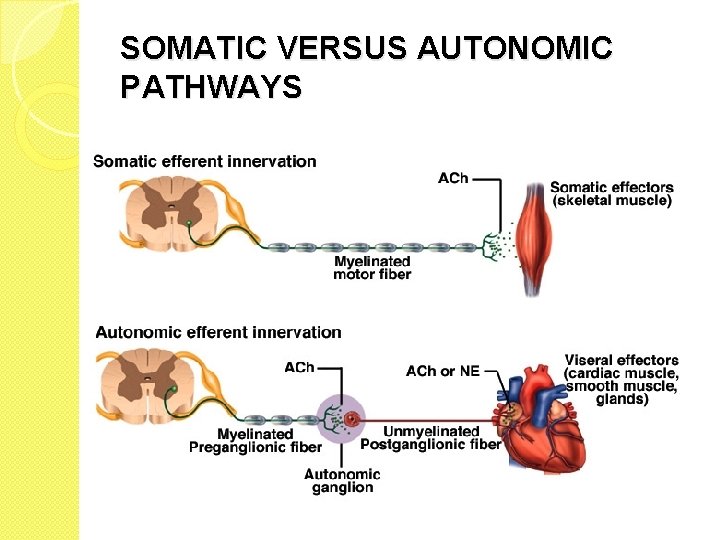
DIFFERENCE BETWEEN THE MOTOR PATHWAYS OF THE VOLUNTARY SOMATIC AND AUTONOMIC NERVOUS SYSTEM � Somatic division: ◦ Cell bodies of motor neurons reside in CNS (brain or spinal cord) ◦ Their axons (sheathed in spinal nerves) extend all the way to their skeletal muscles � Autonomic neurons system: chains of two motor ◦ 1 st = preganglionic neuron (in brain or cord) ◦ 2 nd = gangionic neuron (cell body in ganglion outside CNS) ◦ Slower because lightly or unmyelinated 4
�Axon of 1 st (preganglionic) neuron leaves CNS to synapse with the 2 nd (ganglionic) neuron �Axon of 2 nd (ganglionic) neuron extends to the organ it serves Diagram contrasts somatic (lower) and autonomic: autonomic this dorsal root ganglion is sensory somatic 5
SOMATIC VERSUS AUTONOMIC PATHWAYS
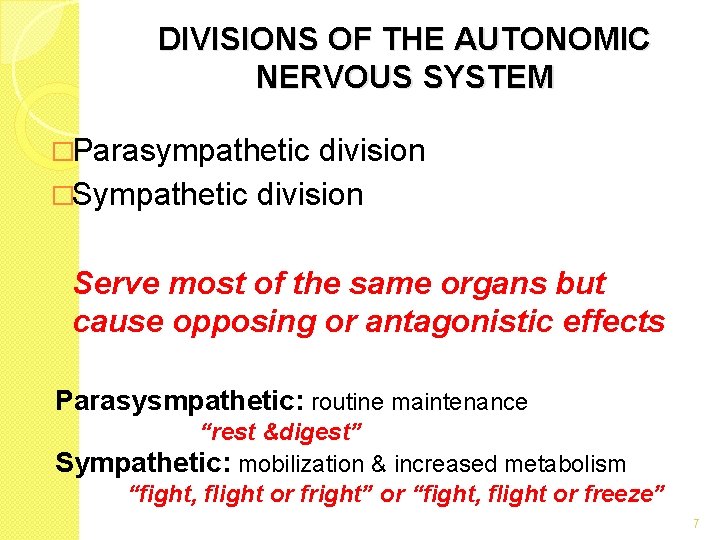
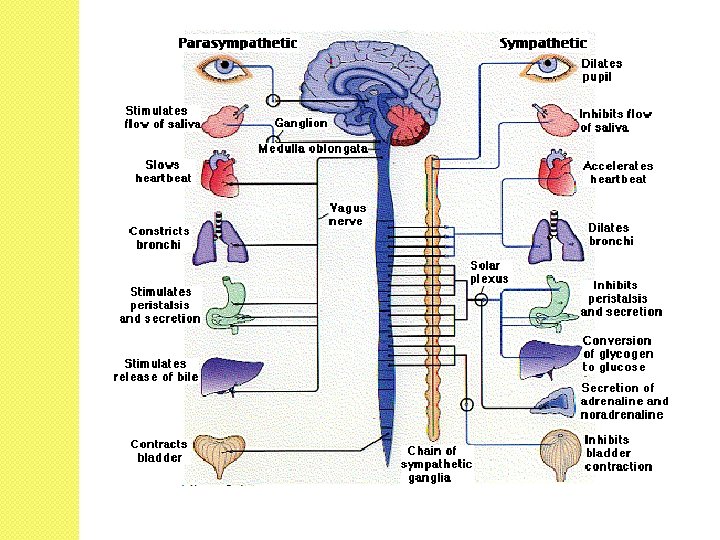
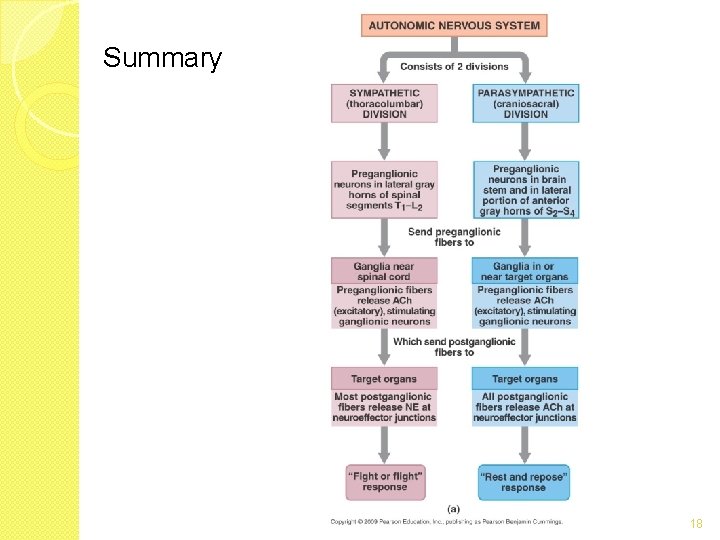
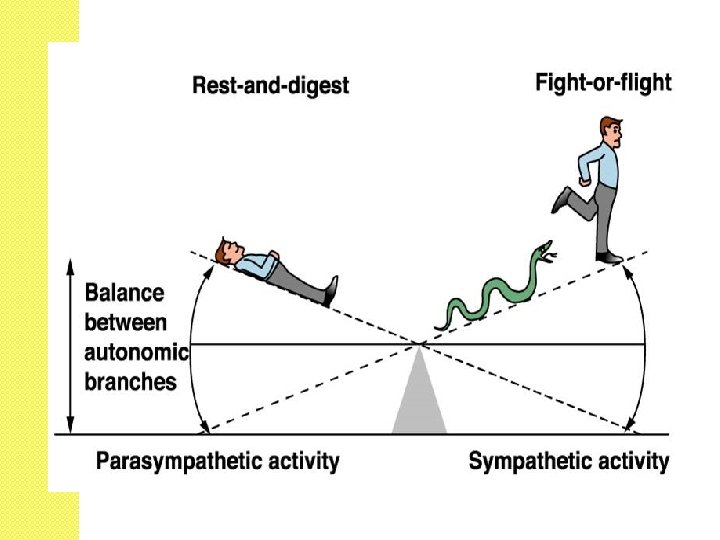
DIVISIONS OF THE AUTONOMIC NERVOUS SYSTEM �Parasympathetic division �Sympathetic division Serve most of the same organs but cause opposing or antagonistic effects Parasysmpathetic: routine maintenance “rest &digest” Sympathetic: mobilization & increased metabolism “fight, flight or fright” or “fight, flight or freeze” 7
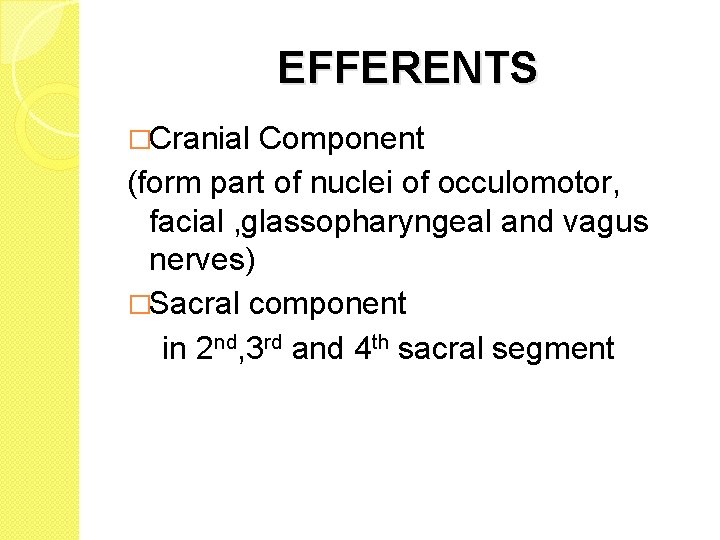
EFFERENTS �Cranial Component (form part of nuclei of occulomotor, facial , glassopharyngeal and vagus nerves) �Sacral component in 2 nd, 3 rd and 4 th sacral segment
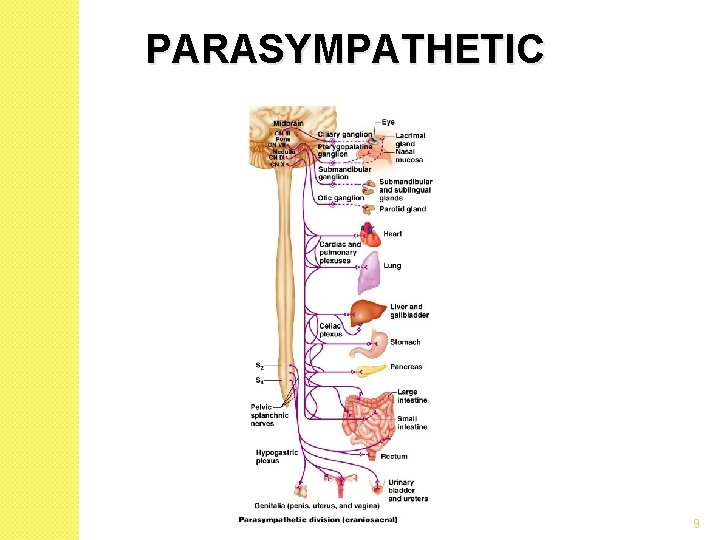
PARASYMPATHETIC 9
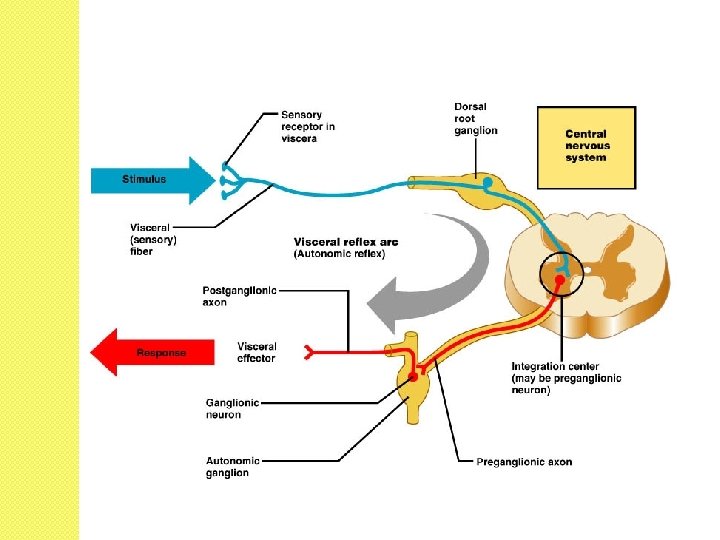
AFFERENTS v The afferent myelinated fibers travel from the viscera to their cell bodies, located either in the sensory ganglia of the cranial nerves or in the posterior root ganglia of the sacrospinal nerves.
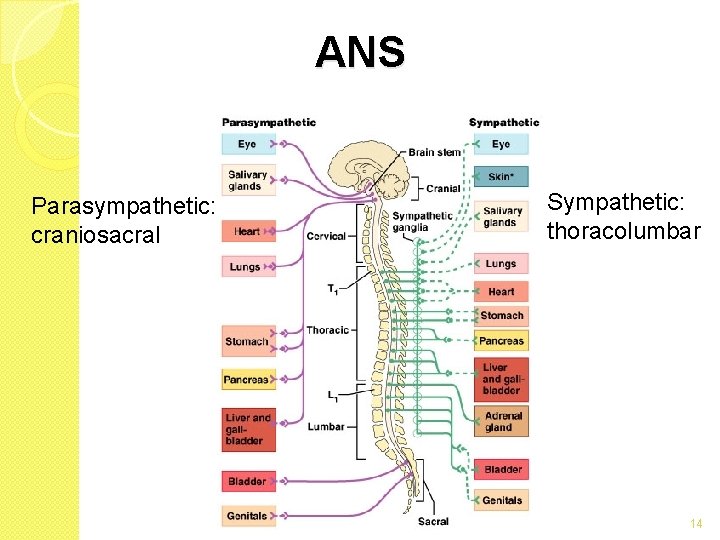
ANS Parasympathetic: craniosacral Sympathetic: thoracolumbar 14
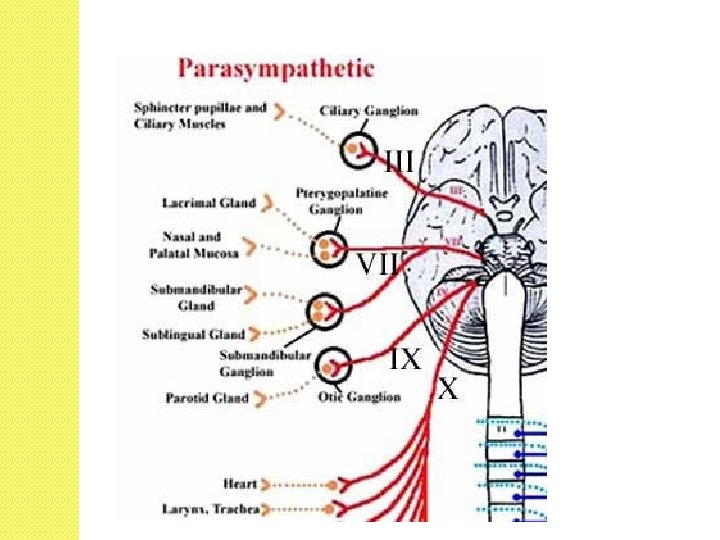
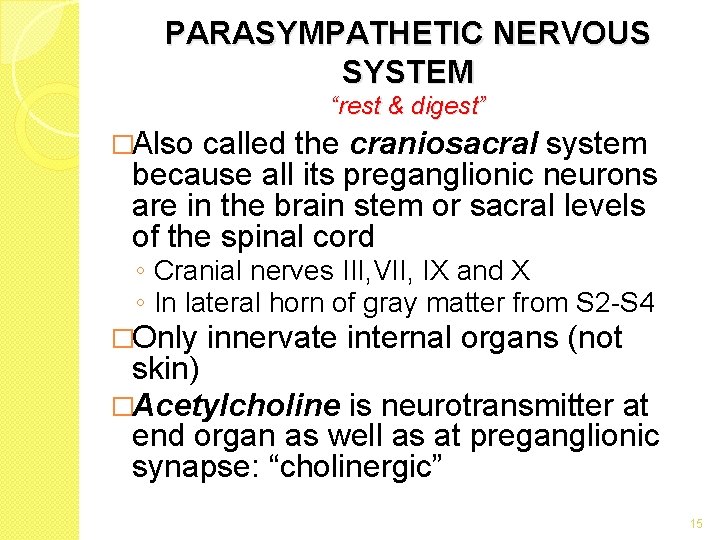
PARASYMPATHETIC NERVOUS SYSTEM “rest & digest” �Also called the craniosacral system because all its preganglionic neurons are in the brain stem or sacral levels of the spinal cord ◦ Cranial nerves III, VII, IX and X ◦ In lateral horn of gray matter from S 2 -S 4 �Only innervate internal organs (not skin) �Acetylcholine is neurotransmitter at end organ as well as at preganglionic synapse: “cholinergic” 15
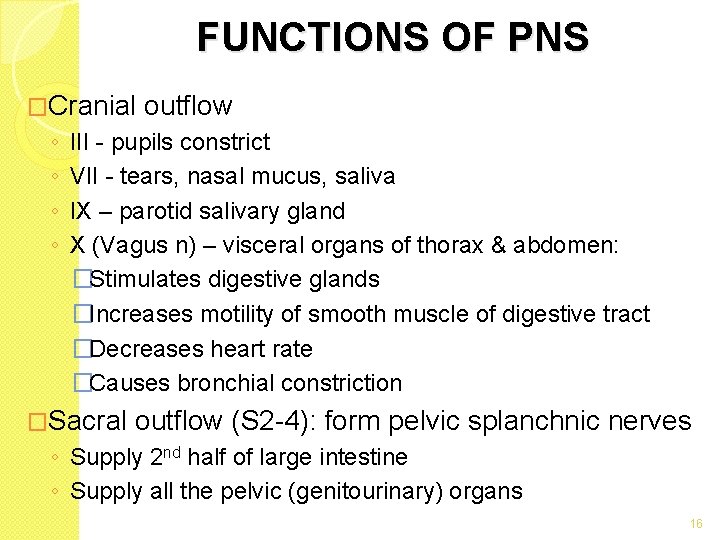
FUNCTIONS OF PNS �Cranial ◦ ◦ outflow III - pupils constrict VII - tears, nasal mucus, saliva IX – parotid salivary gland X (Vagus n) – visceral organs of thorax & abdomen: �Stimulates digestive glands �Increases motility of smooth muscle of digestive tract �Decreases heart rate �Causes bronchial constriction �Sacral outflow (S 2 -4): form pelvic splanchnic nerves ◦ Supply 2 nd half of large intestine ◦ Supply all the pelvic (genitourinary) organs 16
Summary 18