
Parasitology Unit 8 Chapter 47 Protozoa Copyright 2015

- Slides: 29
Parasitology Unit 8 Chapter 47 Protozoa Copyright © 2015 by Mosby, an imprint of Elsevier Inc. All rights reserved.
Protozoa • There about 65, 000 known protozoa in a wide variety of habitats • Only a small part are parasitic • A single celled organism • Parasitic protozoa: three primary phyla • Sarcomastigophora • Apicomplexa • Ciliophora Copyright © 2015 by Mosby, an imprint of Elsevier Inc. All rights reserved. 2
Protozoa (cont. ) • Infect a variety of tissue sites • Usually blood – hemoprotozoa • Most hemoprotozoa in U. S. are found in RBCs • In fecal material – intestinal protozoa • Ticks usually serve as intermediate host and transmit RBCs containing the hemoprotozoa from one animal to the next • Life cycles can be simple or complex • Reproduction may be asexual or sexual Copyright © 2015 by Mosby, an imprint of Elsevier Inc. All rights reserved. 3
Life Cycles • Asexual reproduction • Binary fission, schizogony, budding • Sexual reproduction • Syngamy, conjugation • Sexual stages can be useful in identification • Trophozoite – vegetative form • Stage of feeding, movement, and reproduction Copyright © 2015 by Mosby, an imprint of Elsevier Inc. All rights reserved. 4
Protozoa (cont. ) • Organelles for locomotion • • Flagella – long whiplike structure Cilia – short flagella arranged in rows or tufts Pseudopodia – temporary extensions and retractions of the body wall Undulatory ridges – small snakelike waves that form in the cell membrane and move posteriorly • Locomotor organelles used to help identify the type of protozoa Copyright © 2015 by Mosby, an imprint of Elsevier Inc. All rights reserved. 5
Protozoa (cont. ) • The trophozoite is often too fragile to survive transfer to a new host and usually is not infective • Transmission to a host in the cyst stage • Metabolic functions suspended – cyst • Prevents desiccation • Cyst stage occurs under certain conditions • Lack of nutrients, low oxygen tension, lack of water, low p. H, accumulations of waste, overcrowding Copyright © 2015 by Mosby, an imprint of Elsevier Inc. All rights reserved. 6
Phylum Sarcomastigophora • Amoebas and flagellates • 44, 000 known species – 2300 are parasitic • Amoebas • Move via pseudopods • Have both a trophozoite and cyst stage • Flagellates • One or more flagella in the trophozoite stage Copyright © 2015 by Mosby, an imprint of Elsevier Inc. All rights reserved. 7
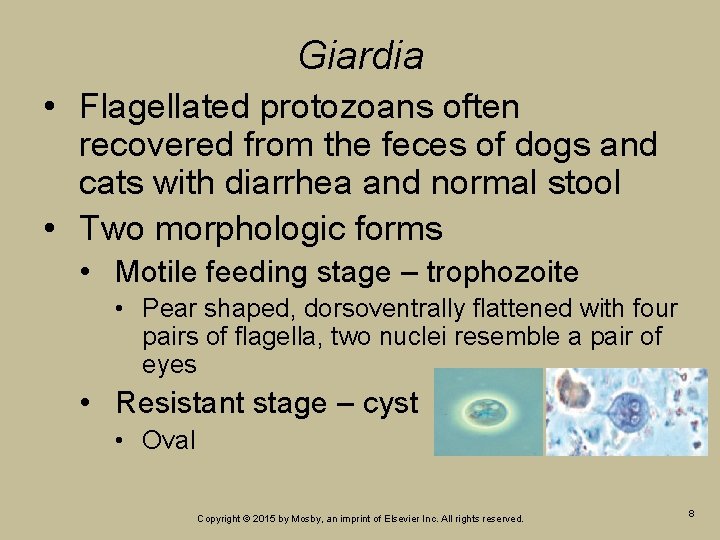
Giardia • Flagellated protozoans often recovered from the feces of dogs and cats with diarrhea and normal stool • Two morphologic forms • Motile feeding stage – trophozoite • Pear shaped, dorsoventrally flattened with four pairs of flagella, two nuclei resemble a pair of eyes • Resistant stage – cyst • Oval Copyright © 2015 by Mosby, an imprint of Elsevier Inc. All rights reserved. 8
Giardia Life Cycle Copyright © 2015 by Mosby, an imprint of Elsevier Inc. All rights reserved. 9
Giardia (cont. ) • Diagnosis • Standard fecal flotation – zinc sulfate • Cysts are often distorted • Motile trophozoites occasionally found in a direct smear of fresh feces with isotonic saline • Lugol stain • Fecal immunodiagnostic tests are commonly used Copyright © 2015 by Mosby, an imprint of Elsevier Inc. All rights reserved. 10
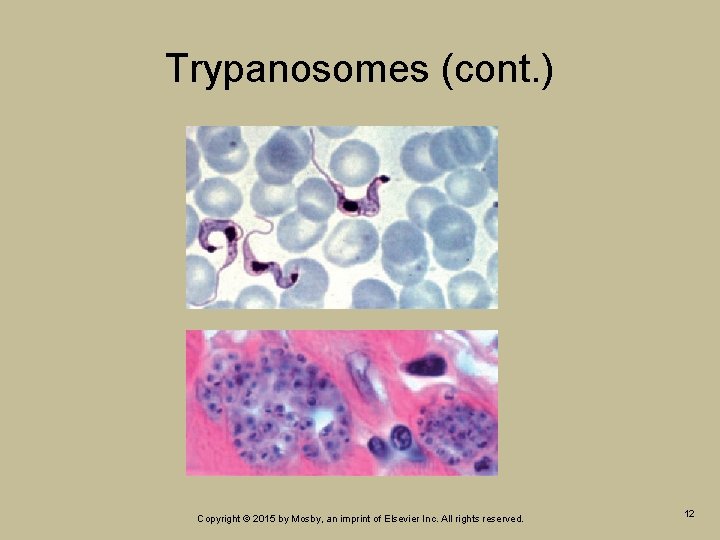
Trypanosomes • Hemoprotozoans – found in southern U. S. • • Trypanosoma cruzi – a parasite of humans and dogs Extracellular and “swim” in the blood 3 to 10 times as long as RBCs Banana shaped Lateral undulating membrane and a flagellum Swimming stage – trypomastigote Cyst stage – amastigote • Also found in cardiac muscle and other tissue Copyright © 2015 by Mosby, an imprint of Elsevier Inc. All rights reserved. 11
Trypanosomes (cont. ) Copyright © 2015 by Mosby, an imprint of Elsevier Inc. All rights reserved. 12
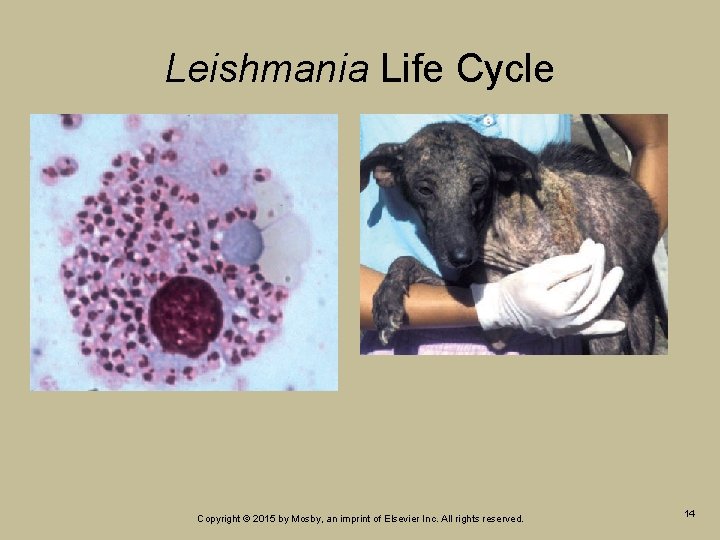
Leishmania • Hemoprotozoans that infect several mammals – dogs, cats, and humans • Southern U. S. • Transmitted by flies of the genera Phlebotomus and Lutzomyia • Two forms of disease are recognized • Mucocutaneous form characterized by skin sores • Leishmania braziliensis • Visceral form affects several internal organs (spleen, liver, and bone marrow) • Leishmania donovani and Leishmania infantum Copyright © 2015 by Mosby, an imprint of Elsevier Inc. All rights reserved. 13
Leishmania Life Cycle Copyright © 2015 by Mosby, an imprint of Elsevier Inc. All rights reserved. 14
Trichomonads • Long, slender organisms with a single flagellum attached to the dorsal surface that forms a saillike structure that ripples as it moves through debris • Tritrichomonas foetus – reproductive tract of cattle • • • Prepuce of bulls and vagina, cervix, and uterus of cows Causes infertility, spontaneous abortions, and pyometra Diagnosis of motile trophozoite in the supernatant of washings from vagina or prepuce Copyright © 2015 by Mosby, an imprint of Elsevier Inc. All rights reserved. 15
Trichomonads (cont. ) • Trichomonas gallinae • Found in crop washings of pigeons, doves, and poultry • Transmitted through drinking water • Ulcerations of esophagus, crop, and proventriculus • Diagnosis – direct saline smear of crop contents • Air dried and stained with Wright stain Copyright © 2015 by Mosby, an imprint of Elsevier Inc. All rights reserved. 16
Histomonas • Histomonas meleagridis • Infects turkeys, chickens, pheasants, and other avians • Transmitted when the bird ingests the ova of the nematode transport host • In turkeys – fatal liver disease • A. k. a. – infectious enterohepatitis • A. k. a. – blackhead Copyright © 2015 by Mosby, an imprint of Elsevier Inc. All rights reserved. 17
Entamoeba • Entamoeba histolytica • Primarily human parasite in tropical regions • Also found in fecal flotations of: • • • Healthy cattle Sheep Goats Horses Swine • Generally no clinical significance • May cause acute or chronic diarrhea in dogs Copyright © 2015 by Mosby, an imprint of Elsevier Inc. All rights reserved. 18
Phylum Apicomplexa • Sporozoans • • 4600 species and all are parasitic Unique characteristics • Entire life cycle is haploid except for the zygote • Oocyst is the name given to the cyst stage • Veterinary importance • • Cystoisospora Toxoplasma Cryptosporidium Cytauxzoon - Sarcocystis - Plasmodium - Babesia - Eimeria Copyright © 2015 by Mosby, an imprint of Elsevier Inc. All rights reserved. 19
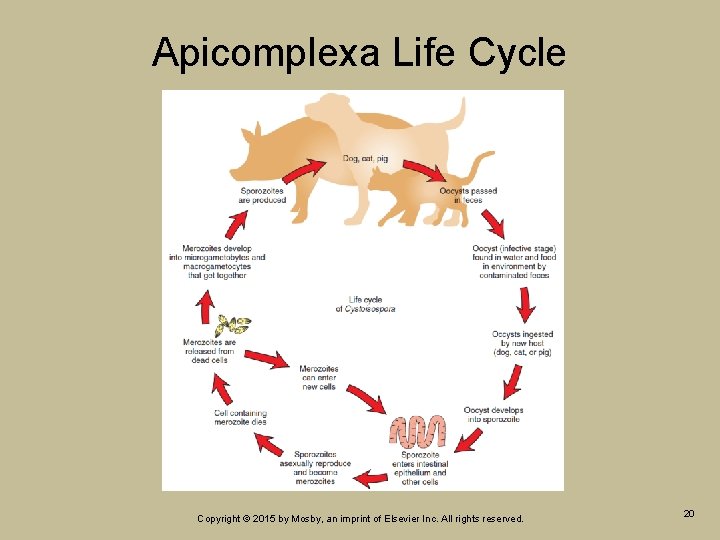
Apicomplexa Life Cycle Copyright © 2015 by Mosby, an imprint of Elsevier Inc. All rights reserved. 20
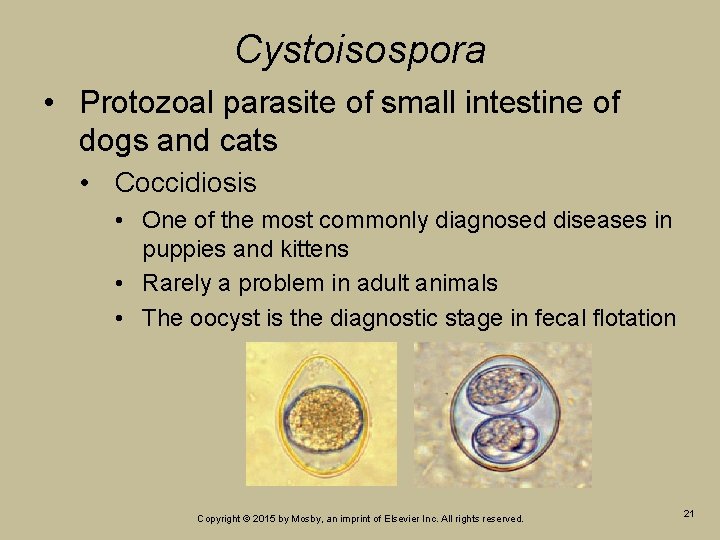
Cystoisospora • Protozoal parasite of small intestine of dogs and cats • Coccidiosis • One of the most commonly diagnosed diseases in puppies and kittens • Rarely a problem in adult animals • The oocyst is the diagnostic stage in fecal flotation Copyright © 2015 by Mosby, an imprint of Elsevier Inc. All rights reserved. 21
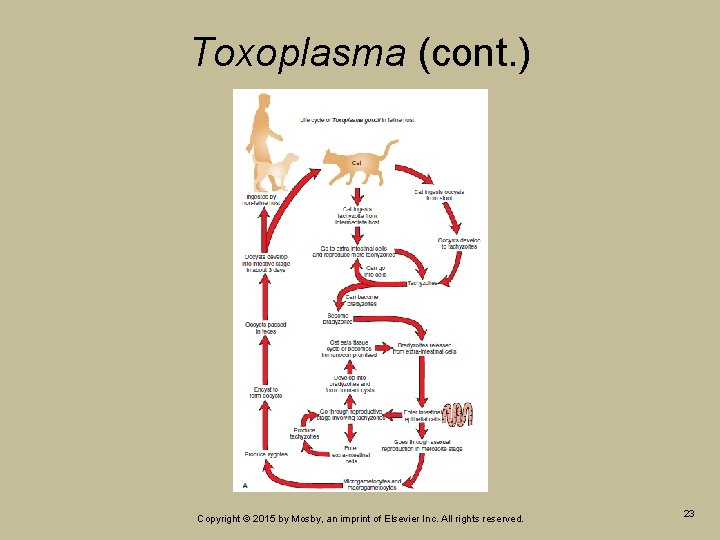
Toxoplasma • Toxoplasma gondii • • • Intestinal coccidian of cats Only shed oocysts for less than 2 weeks for their entire life Diagnosis • Fecal flotation and immunodiagnostic tests • • Not harmful to healthy humans but can cause trouble with pregnant women through litter boxes Some humans can get from undercooked meat Copyright © 2015 by Mosby, an imprint of Elsevier Inc. All rights reserved. 22
Toxoplasma (cont. ) Copyright © 2015 by Mosby, an imprint of Elsevier Inc. All rights reserved. 23
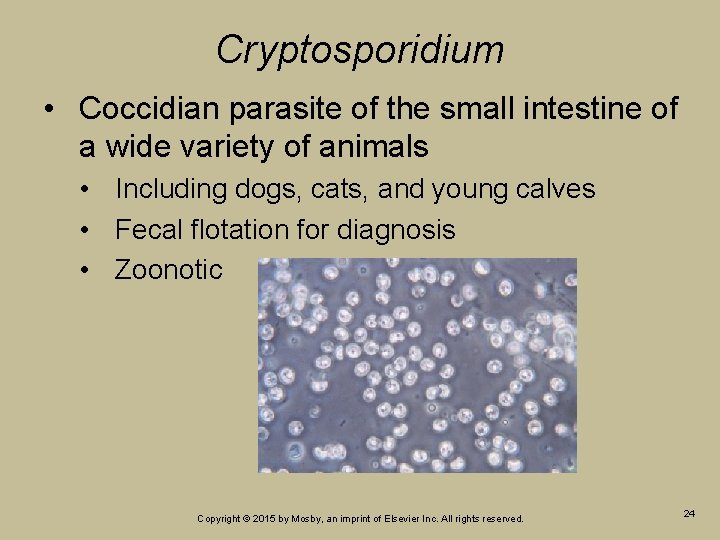
Cryptosporidium • Coccidian parasite of the small intestine of a wide variety of animals • Including dogs, cats, and young calves • Fecal flotation for diagnosis • Zoonotic Copyright © 2015 by Mosby, an imprint of Elsevier Inc. All rights reserved. 24
Sarcocystis • Coccidian of the small intestine • Several species infect dogs and cats • Diagnosis by fresh fecal flotation Copyright © 2015 by Mosby, an imprint of Elsevier Inc. All rights reserved. 25
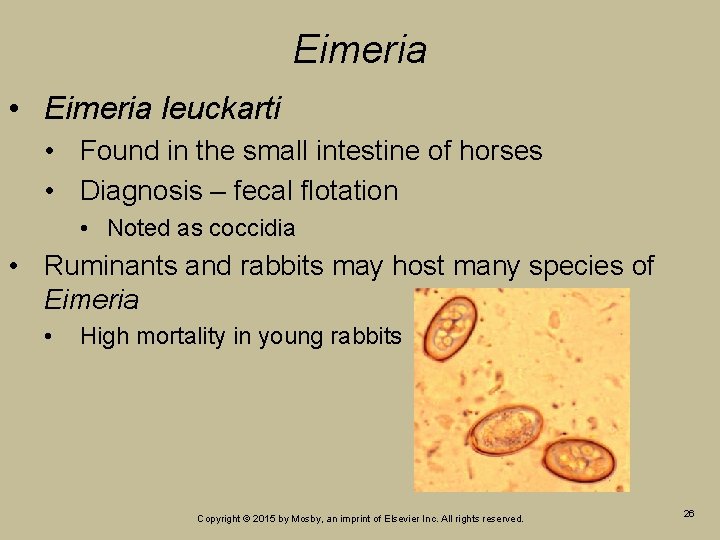
Eimeria • Eimeria leuckarti • Found in the small intestine of horses • Diagnosis – fecal flotation • Noted as coccidia • Ruminants and rabbits may host many species of Eimeria • High mortality in young rabbits Copyright © 2015 by Mosby, an imprint of Elsevier Inc. All rights reserved. 26
Plasmodium • Plasmodium sp. • Malaria in mammals, birds, and reptiles • Transmitted by mosquitos • Diagnosis – blood smear, organ impression smear, or histopathologic examination of the liver and spleen Copyright © 2015 by Mosby, an imprint of Elsevier Inc. All rights reserved. 27
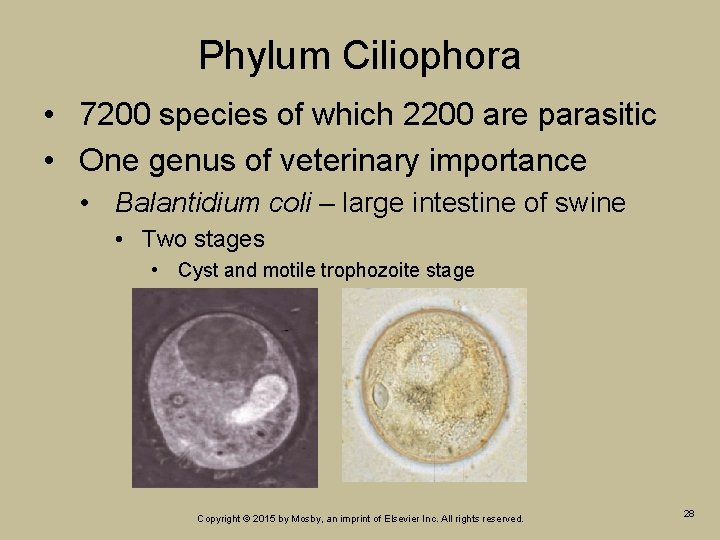
Phylum Ciliophora • 7200 species of which 2200 are parasitic • One genus of veterinary importance • Balantidium coli – large intestine of swine • Two stages • Cyst and motile trophozoite stage Copyright © 2015 by Mosby, an imprint of Elsevier Inc. All rights reserved. 28
Summary • • • Parasitic protozoa are found in three primary phyla – Sarcomastigophora, Apicomplexa, and Ciliophora Protozoal parasites are transmitted to host in the cyst stage Giardia is a common flagellate that can infect many mammals and humans Trypanosomes and Leishmania spp. are zoonotic parasites found in the southern U. S. Tritrichomonas foetus – causes infertility, abortion, and pyometra in cattle Cats are the only definitive host of Toxoplasma gondii that can affect humans Copyright © 2015 by Mosby, an imprint of Elsevier Inc. All rights reserved. 29