
Paraphrasing Tips Tricks to help you paraphrase Shakespeares
- Slides: 8
Paraphrasing Tips & Tricks to help you paraphrase Shakespeare’s Julius Caesar
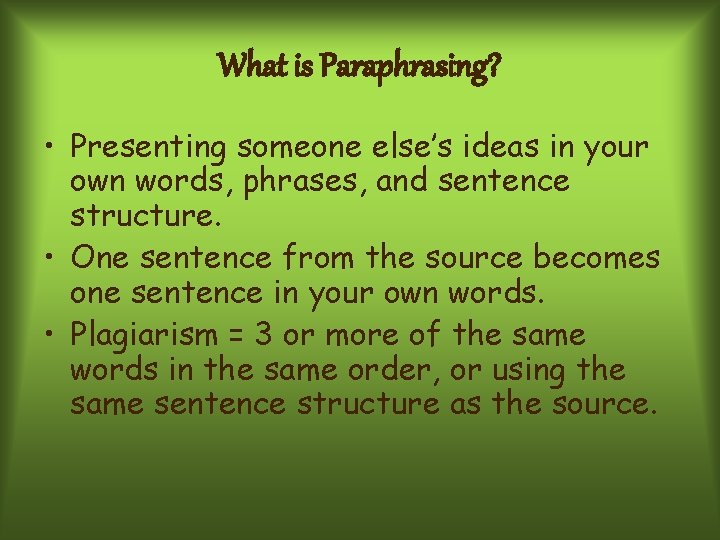
What is Paraphrasing? • Presenting someone else’s ideas in your own words, phrases, and sentence structure. • One sentence from the source becomes one sentence in your own words. • Plagiarism = 3 or more of the same words in the same order, or using the same sentence structure as the source.
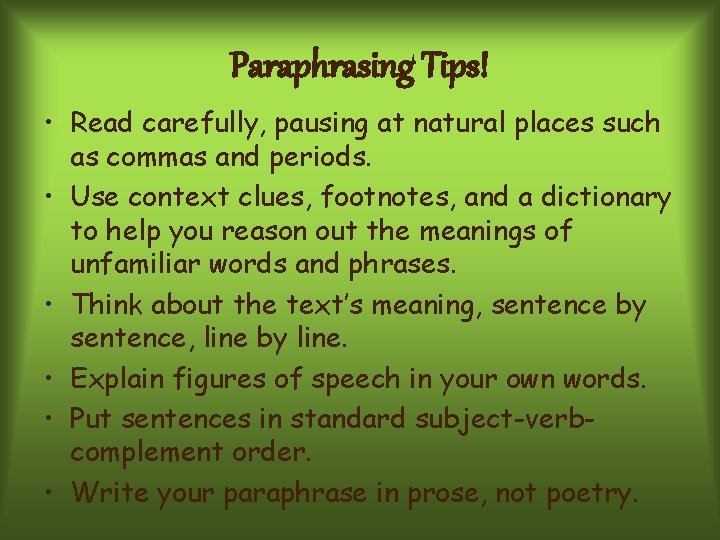
Paraphrasing Tips! • Read carefully, pausing at natural places such as commas and periods. • Use context clues, footnotes, and a dictionary to help you reason out the meanings of unfamiliar words and phrases. • Think about the text’s meaning, sentence by sentence, line by line. • Explain figures of speech in your own words. • Put sentences in standard subject-verbcomplement order. • Write your paraphrase in prose, not poetry.
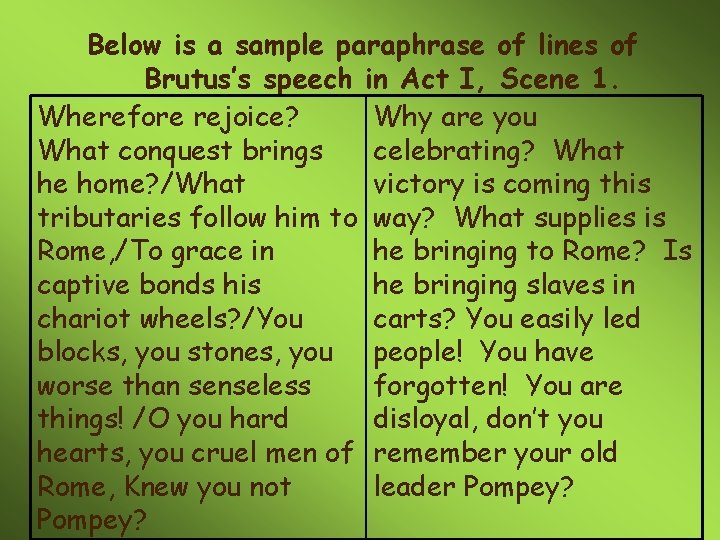
Below is a sample paraphrase of lines of Brutus’s speech in Act I, Scene 1. Wherefore rejoice? Why are you What conquest brings celebrating? What he home? /What victory is coming this tributaries follow him to way? What supplies is Rome, /To grace in he bringing to Rome? Is captive bonds his he bringing slaves in chariot wheels? /You carts? You easily led blocks, you stones, you people! You have worse than senseless forgotten! You are things! /O you hard disloyal, don’t you hearts, you cruel men of remember your old Rome, Knew you not leader Pompey?
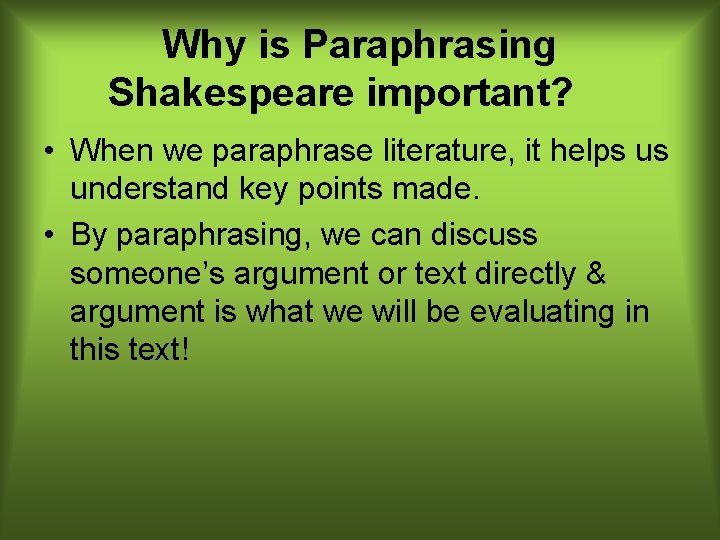
Why is Paraphrasing Shakespeare important? • When we paraphrase literature, it helps us understand key points made. • By paraphrasing, we can discuss someone’s argument or text directly & argument is what we will be evaluating in this text!
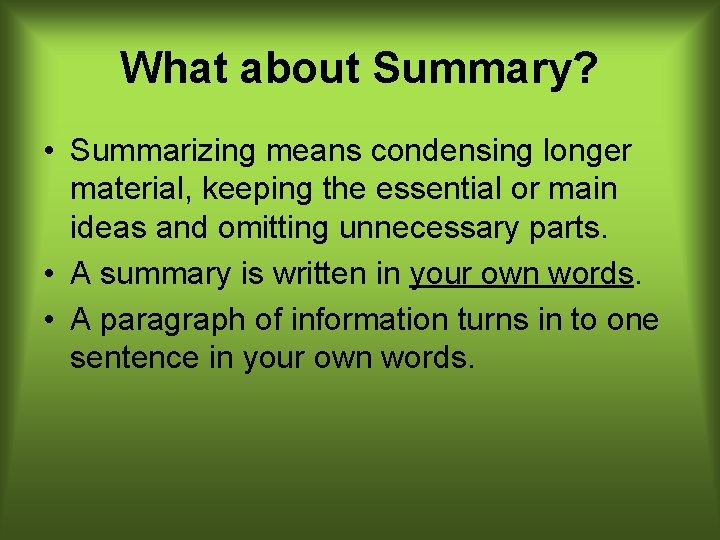
What about Summary? • Summarizing means condensing longer material, keeping the essential or main ideas and omitting unnecessary parts. • A summary is written in your own words. • A paragraph of information turns in to one sentence in your own words.
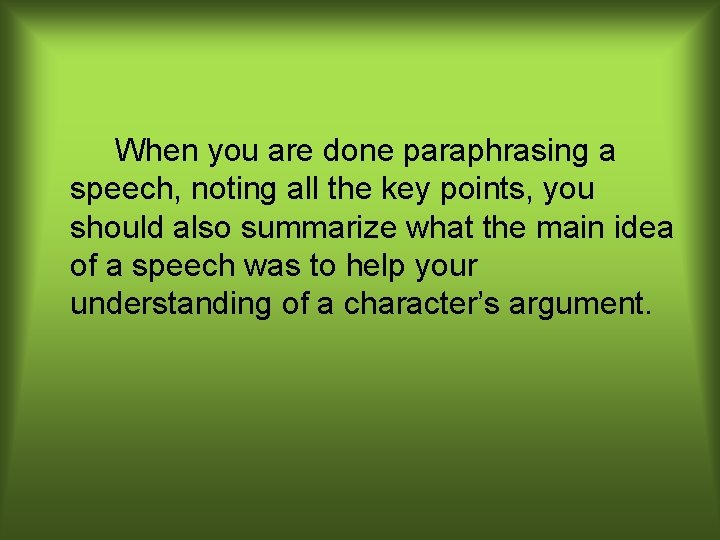
When you are done paraphrasing a speech, noting all the key points, you should also summarize what the main idea of a speech was to help your understanding of a character’s argument.
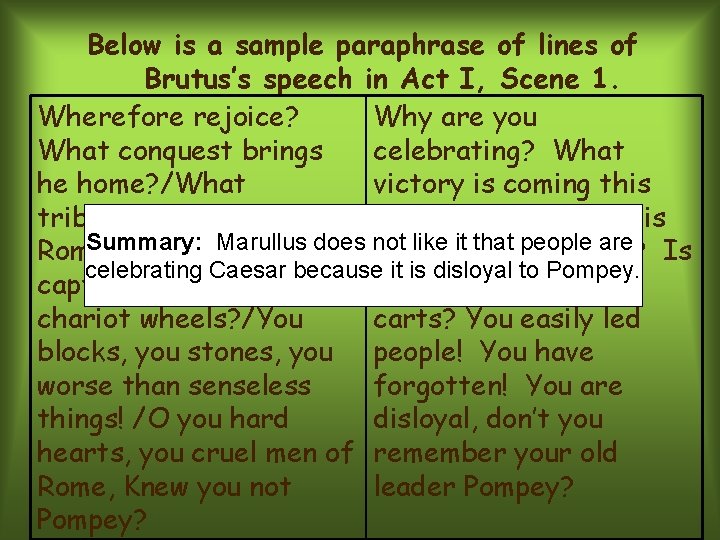
Below is a sample paraphrase of lines of Brutus’s speech in Act I, Scene 1. Wherefore rejoice? Why are you What conquest brings celebrating? What he home? /What victory is coming this tributaries follow him to way? What supplies is Summary: Marullus it that people are Is Rome, /To grace in does not he like bringing to Rome? celebrating Caesar because it is disloyal to Pompey. captive bonds his he bringing slaves in chariot wheels? /You carts? You easily led blocks, you stones, you people! You have worse than senseless forgotten! You are things! /O you hard disloyal, don’t you hearts, you cruel men of remember your old Rome, Knew you not leader Pompey?