
PARAPHRASING restating or explaining something in your own
- Slides: 13
PARAPHRASING restating or explaining something in your own words
Tips for paraphrasing… Try to picture the action to help restate or paraphrase the action.
Another tip… Break down long sentences so that they can be paraphrased (put into your own words).
Paraphrasing helps you read POETRY. Poems often contain figurative language. Remember that these are words used imaginatively instead of literally.
What does a paraphrase include? A paraphrase keeps the meaning of the author’s words, but is SIMPLER.
How to PICTURE THE ACTION to help you paraphrase: 1. Use details in the poem to form a mental image of the characters, setting and actions. 2. Be sure your picture is the SAME as what is described in the poem. 3. Use your OWN WORDS to describe your mental image of the scene and the action.
EXAMPLE: lines of poetry: Blue were her eyes as the fairy-flax/ Her cheeks like the dawn of day/ details in these lines: Her eyes were blue. Her cheeks were red. PARAPHRASE: She had blue eyes and red cheeks.
How to BREAK DOWN LONG SENTENCES SIMPLIFY the text by dividing long sentences into parts, and then paraphrase those parts.
more on BREAKING IT DOWN: l l l Are there multiple subjects and verbs? Try separating those into smaller sentences with one subject and verb each. Are there punctuation marks? such as colons, semicolons, or dashes? Try treating those as periods. Long phrases or passages in parentheses? Turn each one into a separate sentence.
EXAMPLE: ORIGINAL LINES FROM A POEM: I celebrate myself and sing myself, And what I assume you shall assume, For every atom belonging to me as good belongs to you.
These Lines in Smaller Sentences: I celebrate myself. I sing myself. What I assume you shall assume. Every atom belonging to me as good belongs to you.
PARAPHRASE: I celebrate myself and share my joy with you. What is mine is also yours.
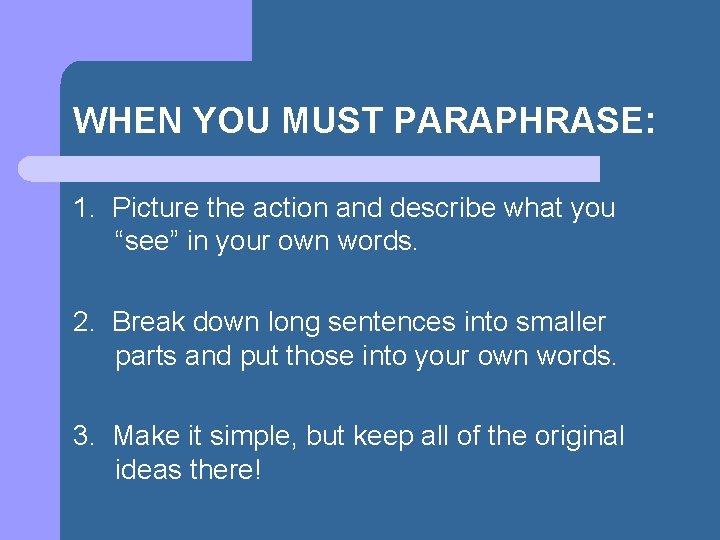
WHEN YOU MUST PARAPHRASE: 1. Picture the action and describe what you “see” in your own words. 2. Break down long sentences into smaller parts and put those into your own words. 3. Make it simple, but keep all of the original ideas there!