
Parametric Nonparametric Models for Tests of Association Models
- Slides: 13
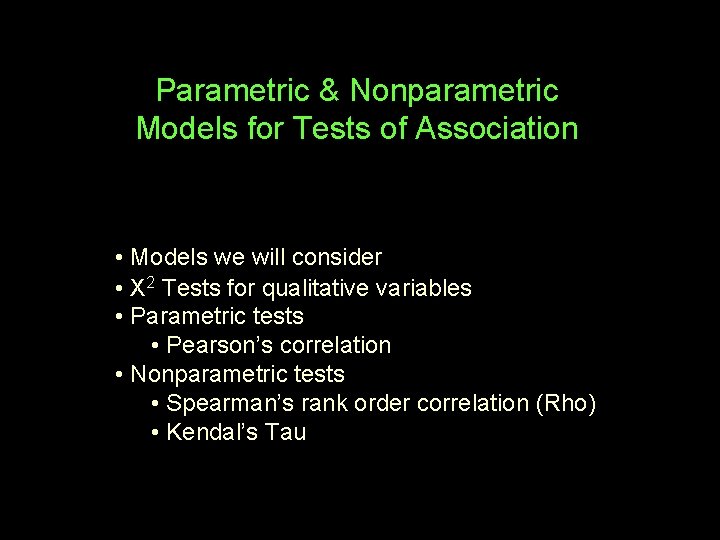
Parametric & Nonparametric Models for Tests of Association • Models we will consider • X 2 Tests for qualitative variables • Parametric tests • Pearson’s correlation • Nonparametric tests • Spearman’s rank order correlation (Rho) • Kendal’s Tau
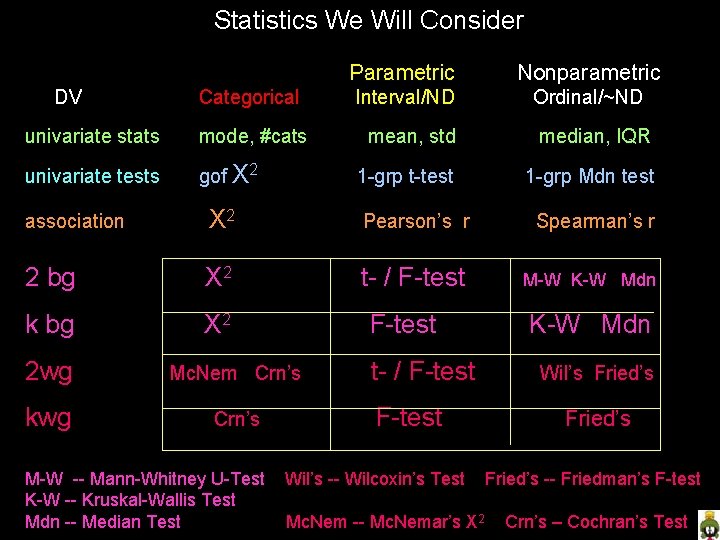
Statistics We Will Consider DV Categorical univariate stats mode, #cats univariate tests gof X 2 Parametric Nonparametric Interval/ND Ordinal/~ND mean, std median, IQR 1 -grp t-test 1 -grp Mdn test association X 2 Pearson’s r Spearman’s r 2 bg X 2 t- / F-test M-W K-W Mdn k bg X 2 F-test 2 wg Mc. Nem Crn’s kwg Crn’s M-W -- Mann-Whitney U-Test K-W -- Kruskal-Wallis Test Mdn -- Median Test t- / F-test Wil’s -- Wilcoxin’s Test Mc. Nem -- Mc. Nemar’s X 2 K-W Mdn Wil’s Fried’s -- Friedman’s F-test Crn’s – Cochran’s Test
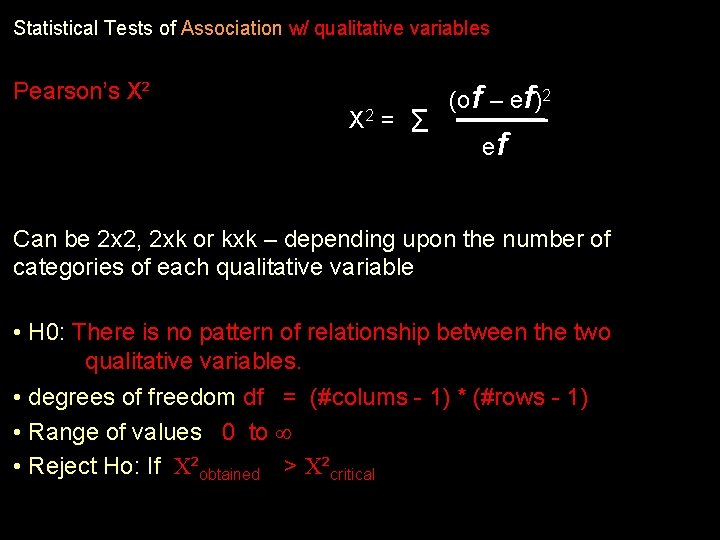
Statistical Tests of Association w/ qualitative variables Pearson’s X² X 2 = Σ (of – ef)2 ef Can be 2 x 2, 2 xk or kxk – depending upon the number of categories of each qualitative variable • H 0: There is no pattern of relationship between the two qualitative variables. • degrees of freedom df = (#colums - 1) * (#rows - 1) • Range of values 0 to • Reject Ho: If ²obtained > ²critical
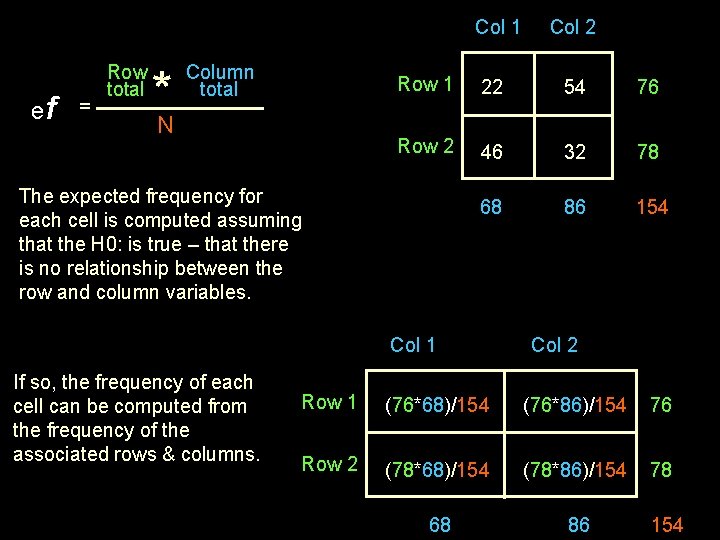
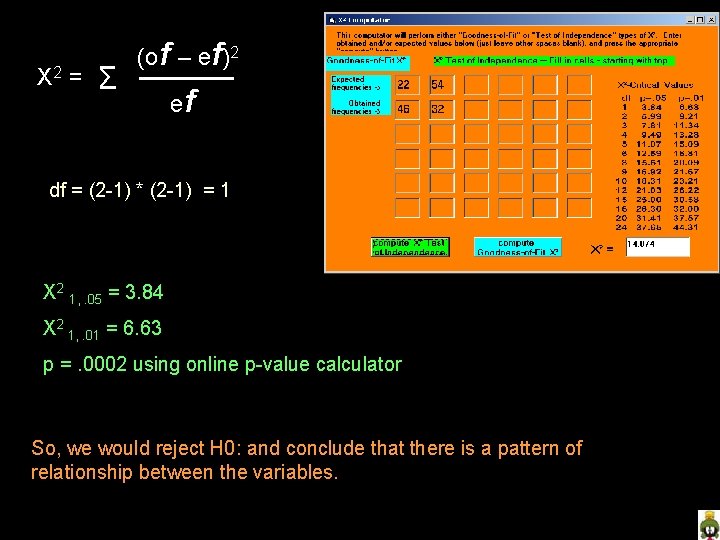
Col 1 ef = Row total *N Column total Row 1 22 54 76 Row 2 46 32 78 68 86 154 The expected frequency for each cell is computed assuming that the H 0: is true – that there is no relationship between the row and column variables. Col 1 If so, the frequency of each cell can be computed from the frequency of the associated rows & columns. Col 2 Row 1 (76*68)/154 (76*86)/154 76 Row 2 (78*68)/154 (78*86)/154 78 68 86 154
X 2 = Σ (of – ef)2 ef df = (2 -1) * (2 -1) = 1 X 2 1, . 05 = 3. 84 X 2 1, . 01 = 6. 63 p =. 0002 using online p-value calculator So, we would reject H 0: and conclude that there is a pattern of relationship between the variables.
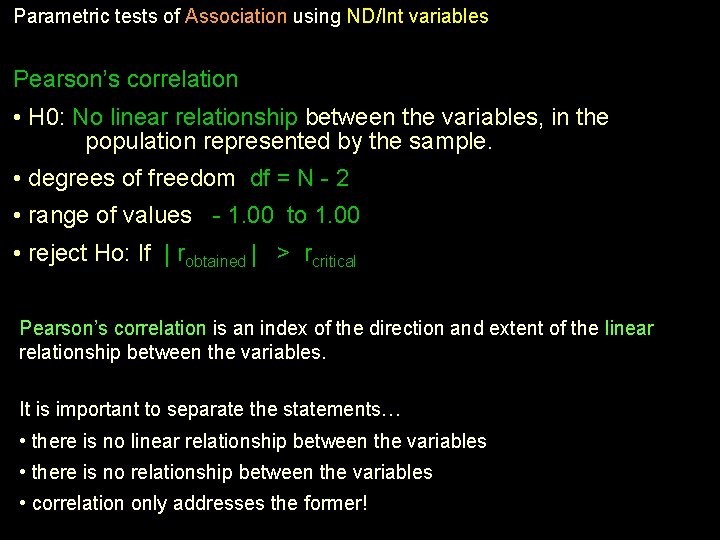
Parametric tests of Association using ND/Int variables Pearson’s correlation • H 0: No linear relationship between the variables, in the population represented by the sample. • degrees of freedom df = N - 2 • range of values - 1. 00 to 1. 00 • reject Ho: If | robtained | > rcritical Pearson’s correlation is an index of the direction and extent of the linear relationship between the variables. It is important to separate the statements… • there is no linear relationship between the variables • there is no relationship between the variables • correlation only addresses the former!
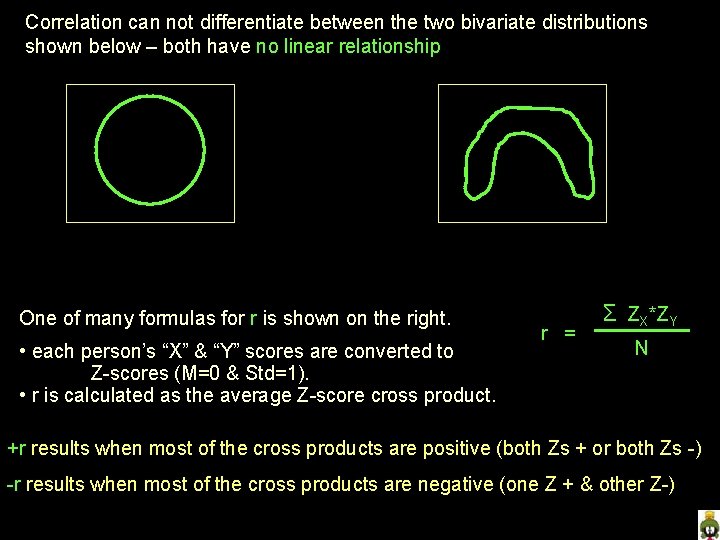
Correlation can not differentiate between the two bivariate distributions shown below – both have no linear relationship One of many formulas for r is shown on the right. • each person’s “X” & “Y” scores are converted to Z-scores (M=0 & Std=1). • r is calculated as the average Z-score cross product. r = Σ ZX*ZY N +r results when most of the cross products are positive (both Zs + or both Zs -) -r results when most of the cross products are negative (one Z + & other Z-)
Nonparametric tests of Association using ~ND/~Int variables Spearman’s Correlation • H 0: No rank order relationship between the variables, in the population represented by the sample. • degrees of freedom df = N - 2 • range of values - 1. 00 to 1. 00 • reject Ho: If | robtained | > rcritical Computing Spearman’s r One way to compute Spearman’s correlation is to convert X & Z values to ranks, and then correlate the ranks using Pearson’s correlation formula, applying it to the ranked data. This demonstrates… • rank data are “better behaved” (i. e. , more interval & more ND) than value data • Spearman’s looks at whether or not there is a linear relationship between the ranks of the two variables
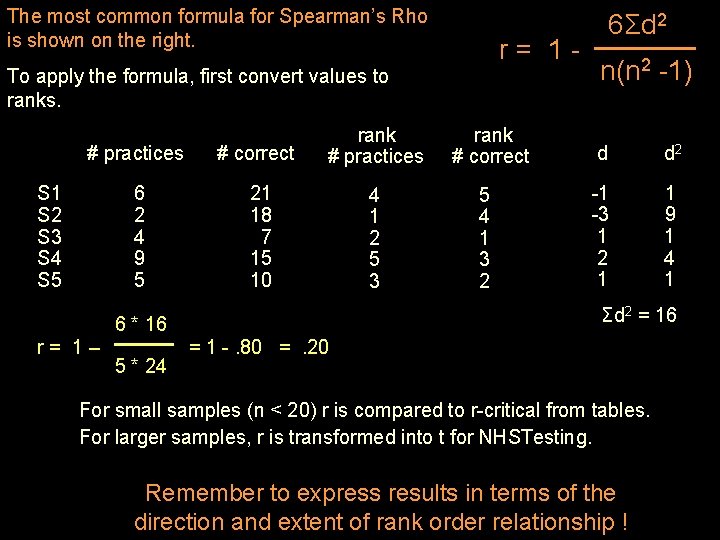
The most common formula for Spearman’s Rho is shown on the right. r= 1 - To apply the formula, first convert values to ranks. # practices # correct rank # practices 6 2 4 9 5 21 18 7 15 10 4 1 2 5 3 S 1 S 2 S 3 S 4 S 5 5 * 24 n(n 2 -1) rank # correct d d 2 5 4 1 3 2 -1 -3 1 2 1 1 9 1 4 1 Σd 2 = 16 6 * 16 r= 1– 6Σd 2 = 1 -. 80 =. 20 For small samples (n < 20) r is compared to r-critical from tables. For larger samples, r is transformed into t for NHSTesting. Remember to express results in terms of the direction and extent of rank order relationship !
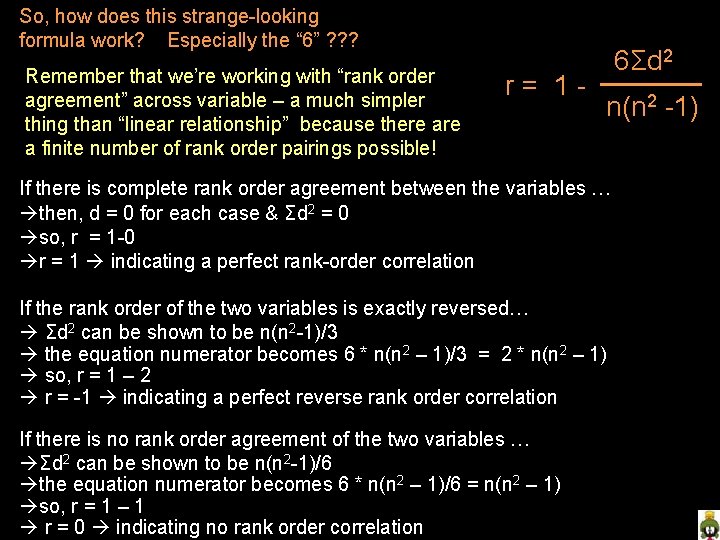
So, how does this strange-looking formula work? Especially the “ 6” ? ? ? Remember that we’re working with “rank order agreement” across variable – a much simpler thing than “linear relationship” because there a finite number of rank order pairings possible! r= 1 - 6Σd 2 n(n 2 -1) If there is complete rank order agreement between the variables … then, d = 0 for each case & Σd 2 = 0 so, r = 1 -0 r = 1 indicating a perfect rank-order correlation If the rank order of the two variables is exactly reversed… Σd 2 can be shown to be n(n 2 -1)/3 the equation numerator becomes 6 * n(n 2 – 1)/3 = 2 * n(n 2 – 1) so, r = 1 – 2 r = -1 indicating a perfect reverse rank order correlation If there is no rank order agreement of the two variables … Σd 2 can be shown to be n(n 2 -1)/6 the equation numerator becomes 6 * n(n 2 – 1)/6 = n(n 2 – 1) so, r = 1 – 1 r = 0 indicating no rank order correlation
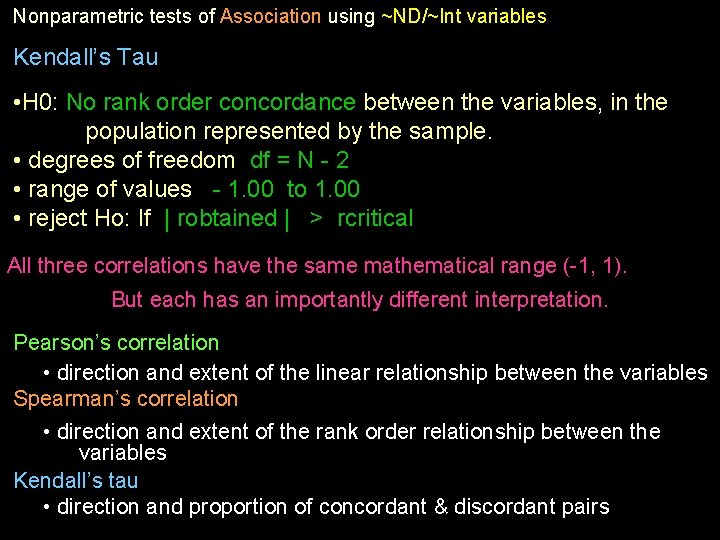
Nonparametric tests of Association using ~ND/~Int variables Kendall’s Tau • H 0: No rank order concordance between the variables, in the population represented by the sample. • degrees of freedom df = N - 2 • range of values - 1. 00 to 1. 00 • reject Ho: If | robtained | > rcritical All three correlations have the same mathematical range (-1, 1). But each has an importantly different interpretation. Pearson’s correlation • direction and extent of the linear relationship between the variables Spearman’s correlation • direction and extent of the rank order relationship between the variables Kendall’s tau • direction and proportion of concordant & discordant pairs
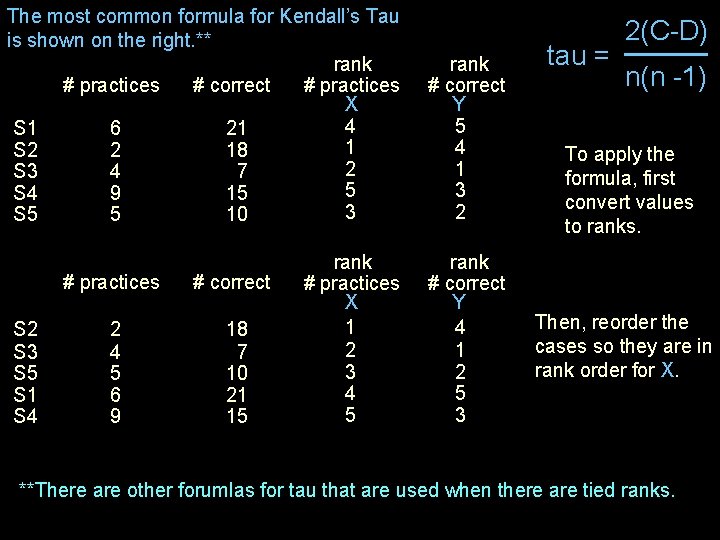
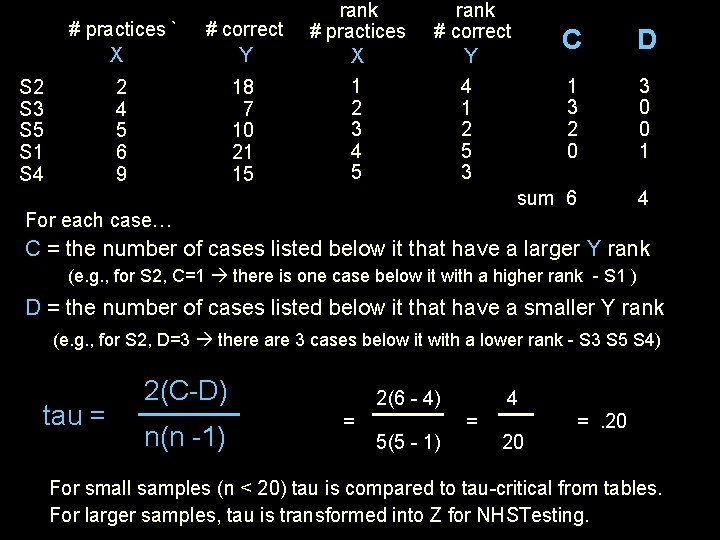
The most common formula for Kendall’s Tau is shown on the right. ** rank # practices # correct # practices X 4 S 1 6 21 1 S 2 2 18 2 S 3 4 7 5 S 4 9 15 3 S 5 5 10 rank # correct Y 5 4 1 3 2 rank # practices X 1 2 3 4 5 rank # correct Y 4 1 2 5 3 S 2 S 3 S 5 S 1 S 4 # practices # correct 2 4 5 6 9 18 7 10 21 15 tau = 2(C-D) n(n -1) To apply the formula, first convert values to ranks. Then, reorder the cases so they are in rank order for X. **There are other forumlas for tau that are used when there are tied ranks.
# practices ` X # correct Y rank # practices X 2 4 5 6 9 18 7 10 21 15 1 2 3 4 5 S 2 S 3 S 5 S 1 S 4 rank # correct Y 4 1 2 5 3 For each case… C D 1 3 2 0 3 0 0 1 sum 6 4 C = the number of cases listed below it that have a larger Y rank (e. g. , for S 2, C=1 there is one case below it with a higher rank - S 1 ) D = the number of cases listed below it that have a smaller Y rank (e. g. , for S 2, D=3 there are 3 cases below it with a lower rank - S 3 S 5 S 4) tau = 2(C-D) n(n -1) 2(6 - 4) = 5(5 - 1) 4 = 20 =. 20 For small samples (n < 20) tau is compared to tau-critical from tables. For larger samples, tau is transformed into Z for NHSTesting.