
Parametric Design Principles 1 2 3 4 5
- Slides: 7
Parametric Design Principles 1. 2. 3. 4. 5. 6. Benefits Initial thought concepts Design principals Example – Fire Truck Compartment Whole assembly principals Example – Fire Truck body
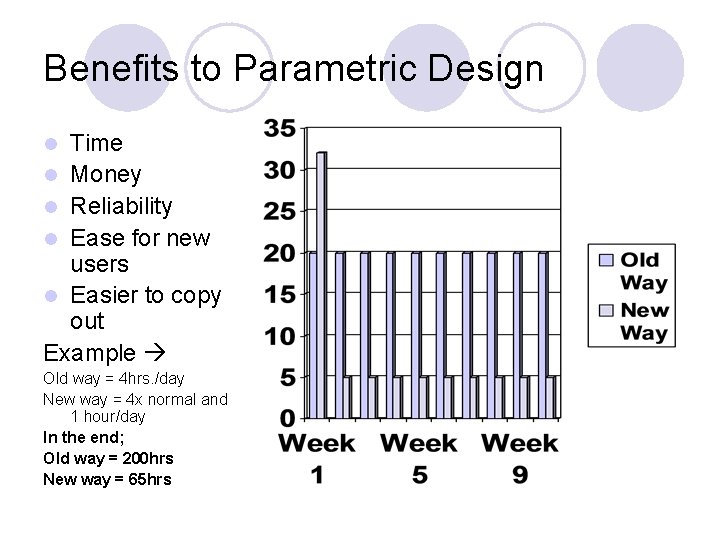
Benefits to Parametric Design Time l Money l Reliability l Ease for new users l Easier to copy out Example l Old way = 4 hrs. /day New way = 4 x normal and 1 hour/day In the end; Old way = 200 hrs New way = 65 hrs
Initial Thought Concepts l Requirements for parametric design ¡ ¡ Is this an assembly very similar to previous assemblies? Are the items that change dimensional? Do items need to be added or taken away? Is this a build that varies by customer? ¡ ¡ ¡ Is the design intent stable? Can you reuse the design and make modifications? Are you interested in a general form that someone can fill out and it give you 80 -90% of the design?
Design Principals l Sketches ¡ No more than 5 -6 dimensions per sketch ¡ Sketch relations are key… the more you have, the happier you’ll be! ¡ USE THE MAPS for relations ¡ Label everything!
Design Principals l Model Features ¡ Label everything!!! ¡ Relate bosses and cuts to maps or other features related assembly components ¡ Make sure all models are “tied” together with references for easier Pack-and-Go operations
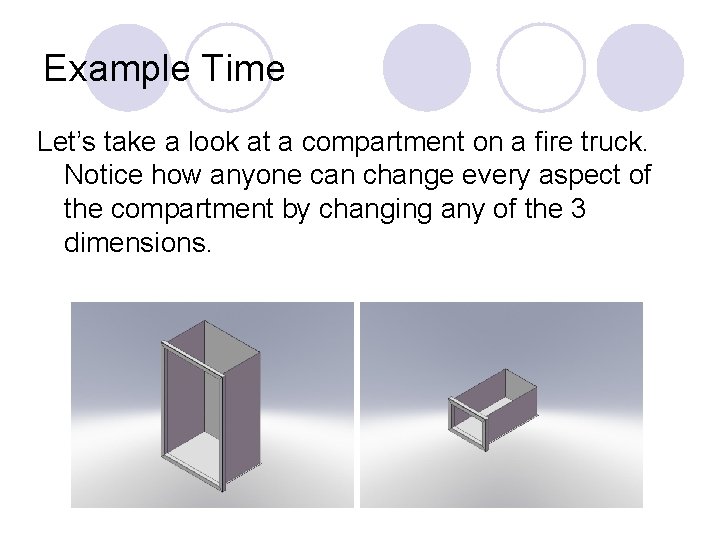
Example Time Let’s take a look at a compartment on a fire truck. Notice how anyone can change every aspect of the compartment by changing any of the 3 dimensions.
Assembly Design Principals l You can have multiple maps ¡ Multiple maps mean you can have many assemblies that can be turned on and off Tie everything together l When you Pack and Go, start with the topmost assembly l Label everything! l Create a “Master” model that you can derive everything else off of. l Take your time to encompass all options. You will forget some things depending on the complexity, so just add it to the Master model. l