
Parametric and Nonparametric Test Parametric Test If the

- Slides: 10
Parametric and Nonparametric Test
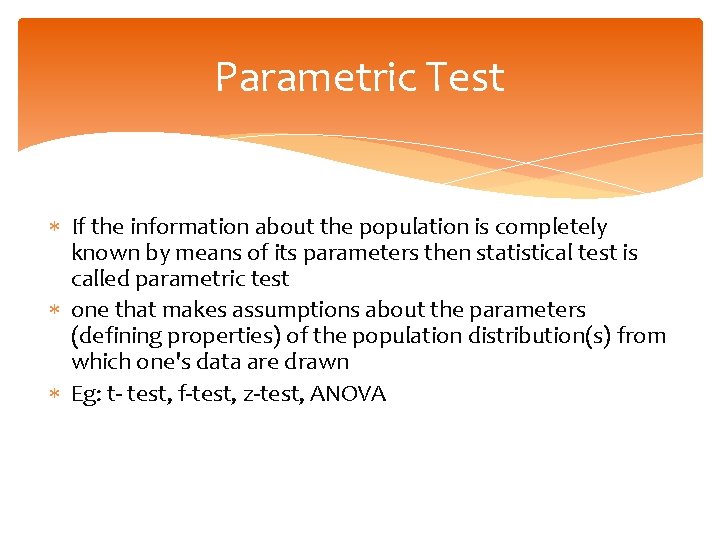
Parametric Test If the information about the population is completely known by means of its parameters then statistical test is called parametric test one that makes assumptions about the parameters (defining properties) of the population distribution(s) from which one's data are drawn Eg: t- test, f-test, z-test, ANOVA
Assumptions of parametric test Observations or values must be independent Population from which samples are selected randomly must be normally distributed Population should have equal variances( if two or more groups/variables in the design) Used for interval data and ratio scales
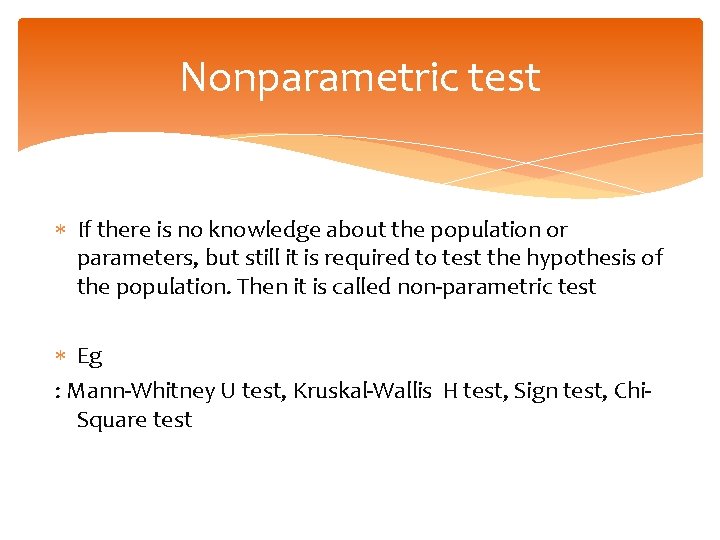
Nonparametric test If there is no knowledge about the population or parameters, but still it is required to test the hypothesis of the population. Then it is called non-parametric test Eg : Mann-Whitney U test, Kruskal-Wallis H test, Sign test, Chi. Square test
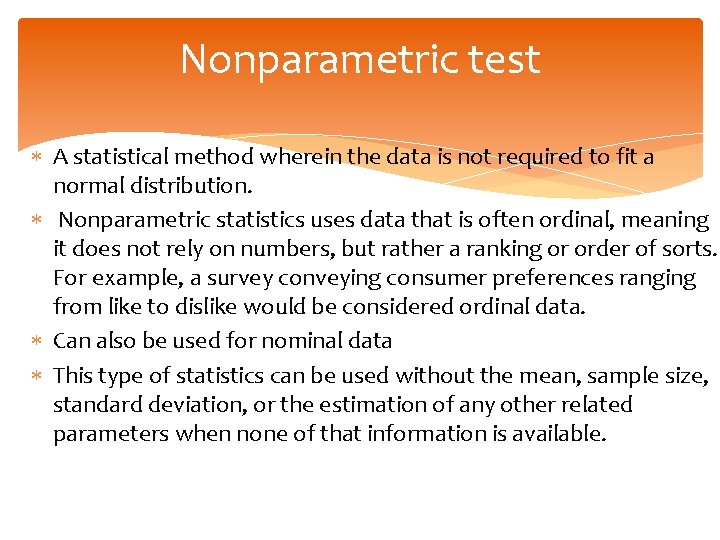
Nonparametric test A statistical method wherein the data is not required to fit a normal distribution. Nonparametric statistics uses data that is often ordinal, meaning it does not rely on numbers, but rather a ranking or order of sorts. For example, a survey conveying consumer preferences ranging from like to dislike would be considered ordinal data. Can also be used for nominal data This type of statistics can be used without the mean, sample size, standard deviation, or the estimation of any other related parameters when none of that information is available.
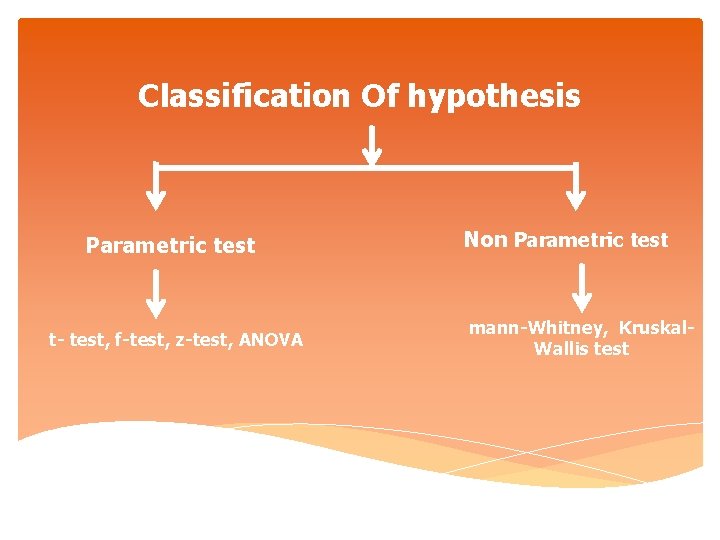
Classification Of hypothesis Parametric test t- test, f-test, z-test, ANOVA Non Parametric test mann-Whitney, Kruskal. Wallis test
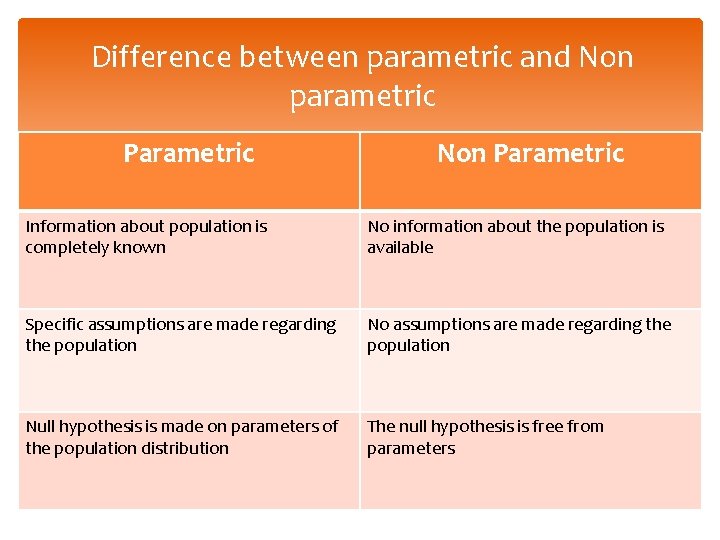
Difference between parametric and Non parametric Parametric Non Parametric Information about population is completely known No information about the population is available Specific assumptions are made regarding the population No assumptions are made regarding the population Null hypothesis is made on parameters of the population distribution The null hypothesis is free from parameters
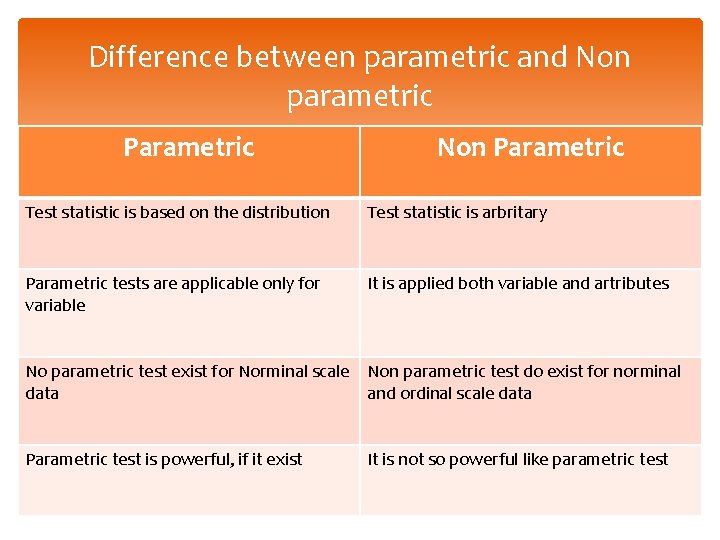
Difference between parametric and Non parametric Parametric Non Parametric Test statistic is based on the distribution Test statistic is arbritary Parametric tests are applicable only for variable It is applied both variable and artributes No parametric test exist for Norminal scale Non parametric test do exist for norminal data and ordinal scale data Parametric test is powerful, if it exist It is not so powerful like parametric test
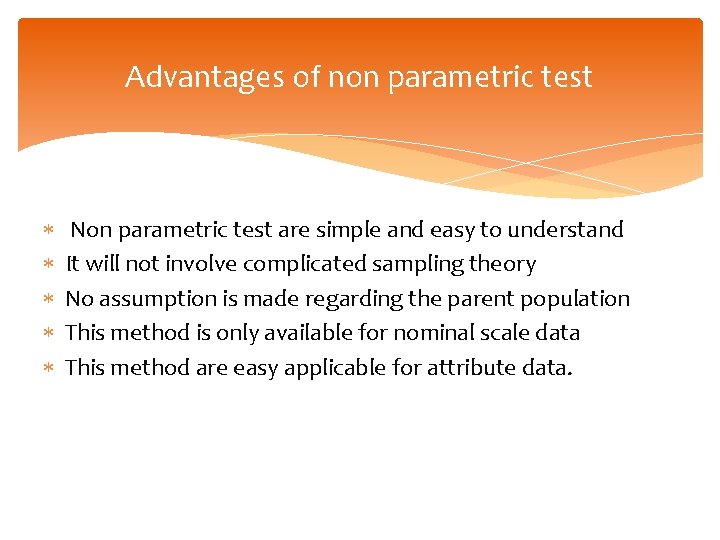
Advantages of non parametric test Non parametric test are simple and easy to understand It will not involve complicated sampling theory No assumption is made regarding the parent population This method is only available for nominal scale data This method are easy applicable for attribute data.
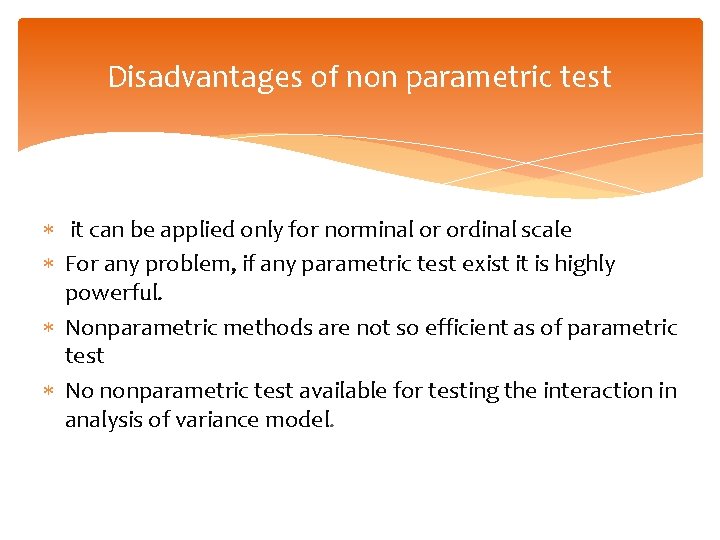
Disadvantages of non parametric test it can be applied only for norminal or ordinal scale For any problem, if any parametric test exist it is highly powerful. Nonparametric methods are not so efficient as of parametric test No nonparametric test available for testing the interaction in analysis of variance model.