
Paramedic Care Principles Practice Volume 3 Medical Emergencies
- Slides: 63
Paramedic Care: Principles & Practice Volume 3 Medical Emergencies Bledsoe et al. , Paramedic Care: Principles & Practice, Volume 3: Medical Emergencies, 3 rd Ed. © 2009 by Pearson Education, Inc. Upper Saddle River, NJ
Chapter 2 Cardiology Bledsoe et al. , Paramedic Care: Principles & Practice, Volume 3: Medical Emergencies, 3 rd Ed. © 2009 by Pearson Education, Inc. Upper Saddle River, NJ
Chapter 2, Part 2 Assessment and Management of the Cardiovascular Patient Bledsoe et al. , Paramedic Care: Principles & Practice, Volume 3: Medical Emergencies, 3 rd Ed. © 2009 by Pearson Education, Inc. Upper Saddle River, NJ
Topics Assessment of the Cardiovascular Patient Management of Cardiovascular Emergencies Managing Specific Cardiovascular Emergencies Bledsoe et al. , Paramedic Care: Principles & Practice, Volume 3: Medical Emergencies, 3 rd Ed. © 2009 by Pearson Education, Inc. Upper Saddle River, NJ
Assessment of the Cardiovascular Patient Cardiovascular diseases may affect the myocardium, the electrical conductive system, the pericardium, or the blood vessels Therapeutic treatments in the field – Administering nitrates, aspirin, and analgesics for symptomatic chest pain – Treating pulmonary edema – Giving analgesics in peripheral vascular emergencies Bledsoe et al. , Paramedic Care: Principles & Practice, Volume 3: Medical Emergencies, 3 rd Ed. © 2009 by Pearson Education, Inc. Upper Saddle River, NJ
Assessment of the Cardiovascular Patient Bledsoe et al. , Paramedic Care: Principles & Practice, Volume 3: Medical Emergencies, 3 rd Ed. © 2009 by Pearson Education, Inc. Upper Saddle River, NJ
Assessment Scene Size-up and Initial Assessment – – Determine scene safety Determine level of responsiveness Airway Breathing: Note breath sounds indicative of cardiovascular problems – Circulation: Note color, temperature, turgor, moisture, mobility, edema – Treat life-threatening problems Bledsoe et al. , Paramedic Care: Principles & Practice, Volume 3: Medical Emergencies, 3 rd Ed. © 2009 by Pearson Education, Inc. Upper Saddle River, NJ
Assessment Focused History – Common Symptoms Chest pain OPQRST history of pain Dyspnea Onset Duration Provocation/palliation Orthopnea Cough Bledsoe et al. , Paramedic Care: Principles & Practice, Volume 3: Medical Emergencies, 3 rd Ed. © 2009 by Pearson Education, Inc. Upper Saddle River, NJ
Other Signs and Symptoms Level of consciousness Diaphoresis Restlessness and anxiety Feeling of impending doom Nausea and/or vomiting Fatigue Palpitations Edema Headache Syncope Behavioral change Anguished facial expression Activity limitations Trauma Bledsoe et al. , Paramedic Care: Principles & Practice, Volume 3: Medical Emergencies, 3 rd Ed. © 2009 by Pearson Education, Inc. Upper Saddle River, NJ
Assessment of the Cardiovascular Patient Allergies Medications – Nitroglycerin, propranolol, digitalis, diuretics, antihypertensives, antidysrhythmics, lipidlowering agents – Compliance – Nonprescription drugs Cocaine Antihistamines Alcohol Bledsoe et al. , Paramedic Care: Principles & Practice, Volume 3: Medical Emergencies, 3 rd Ed. © 2009 by Pearson Education, Inc. Upper Saddle River, NJ
Assessment of the Cardiovascular Patient Past Medical History – – – Cardiac history Heart problems Other medical problems Family cardiac history Modifiable risk factors for heart disease (smoking, etc. ) Last Oral Intake – Caffeinated beverages Events Preceding the Incident – Stress, strenuous or sexual activity Bledsoe et al. , Paramedic Care: Principles & Practice, Volume 3: Medical Emergencies, 3 rd Ed. © 2009 by Pearson Education, Inc. Upper Saddle River, NJ
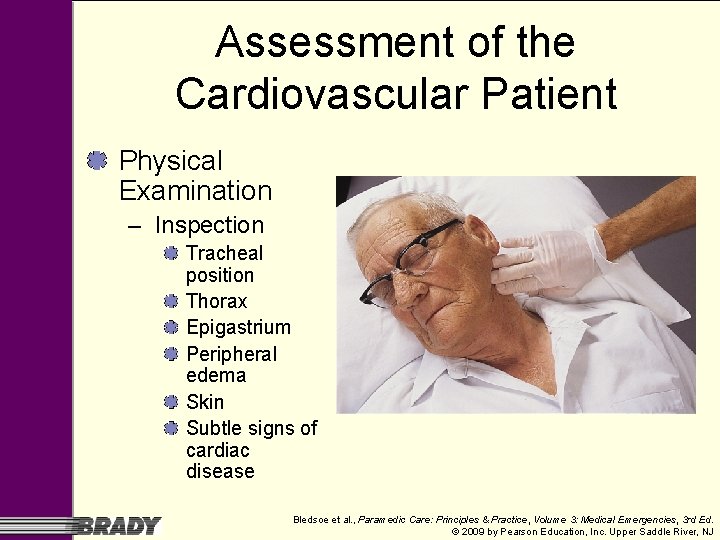
Assessment of the Cardiovascular Patient Physical Examination – Inspection Tracheal position Thorax Epigastrium Peripheral edema Skin Subtle signs of cardiac disease Bledsoe et al. , Paramedic Care: Principles & Practice, Volume 3: Medical Emergencies, 3 rd Ed. © 2009 by Pearson Education, Inc. Upper Saddle River, NJ
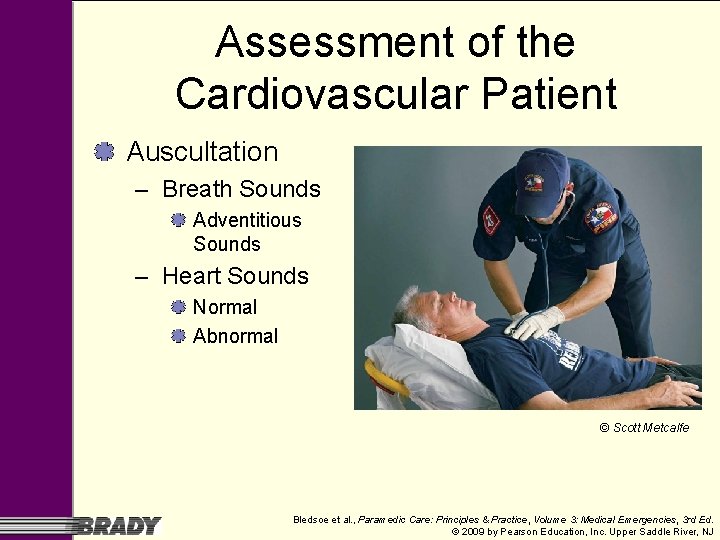
Assessment of the Cardiovascular Patient Auscultation – Breath Sounds Adventitious Sounds – Heart Sounds Normal Abnormal © Scott Metcalfe Bledsoe et al. , Paramedic Care: Principles & Practice, Volume 3: Medical Emergencies, 3 rd Ed. © 2009 by Pearson Education, Inc. Upper Saddle River, NJ
Assessment of the Cardiovascular Patient Heart Sounds – "Lubb" sound represents closing of atrioventricular valves (S 1) – "Dubb" sound represents closing of semilunar valves (S 2) – S 3 associated with CHF – Murmur is the sound of blood flowing turbulently across the valves Bledsoe et al. , Paramedic Care: Principles & Practice, Volume 3: Medical Emergencies, 3 rd Ed. © 2009 by Pearson Education, Inc. Upper Saddle River, NJ
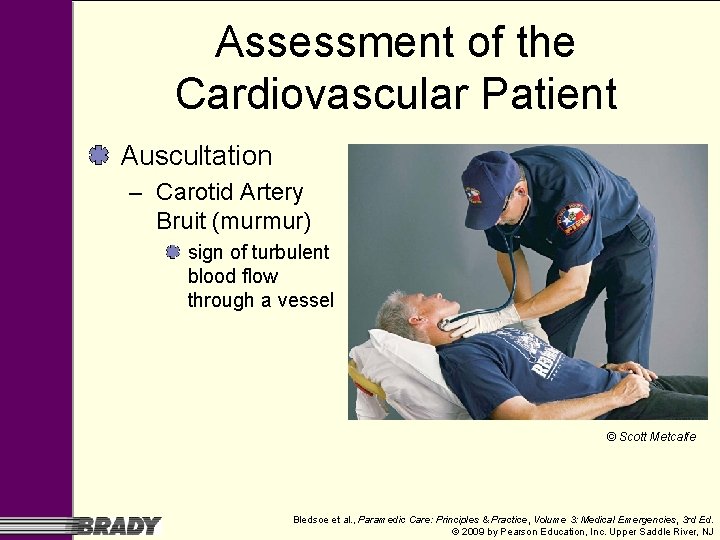
Assessment of the Cardiovascular Patient Auscultation – Carotid Artery Bruit (murmur) sign of turbulent blood flow through a vessel © Scott Metcalfe Bledsoe et al. , Paramedic Care: Principles & Practice, Volume 3: Medical Emergencies, 3 rd Ed. © 2009 by Pearson Education, Inc. Upper Saddle River, NJ
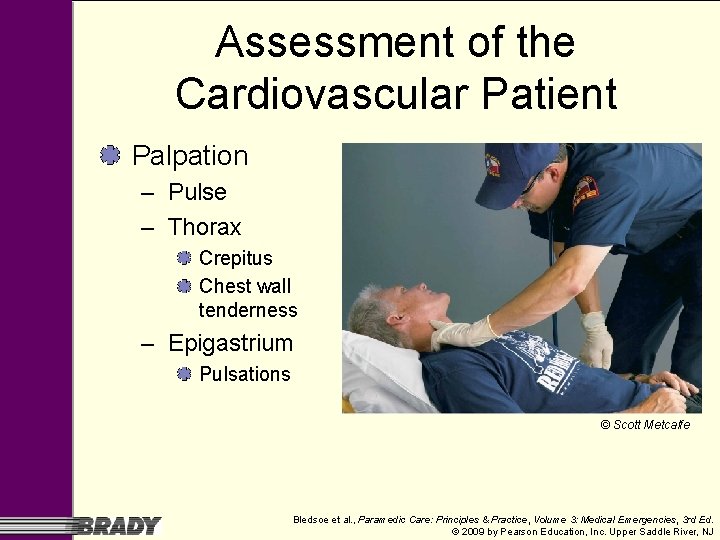
Assessment of the Cardiovascular Patient Palpation – Pulse – Thorax Crepitus Chest wall tenderness – Epigastrium Pulsations © Scott Metcalfe Bledsoe et al. , Paramedic Care: Principles & Practice, Volume 3: Medical Emergencies, 3 rd Ed. © 2009 by Pearson Education, Inc. Upper Saddle River, NJ
Management of Cardiovascular Emergencies Bledsoe et al. , Paramedic Care: Principles & Practice, Volume 3: Medical Emergencies, 3 rd Ed. © 2009 by Pearson Education, Inc. Upper Saddle River, NJ
Management of Cardiovascular Emergencies Basic Life Support – The primary skill for managing serious cardiovascular problems Advanced Life Support – – – – ECG Monitoring Vagal Maneuvers Precordial Thump Pharmacological Management Defibrillation Synchronized Cardioversion Transcutaneous Cardiac Pacing Diagnostic (12 -Lead) ECG Bledsoe et al. , Paramedic Care: Principles & Practice, Volume 3: Medical Emergencies, 3 rd Ed. © 2009 by Pearson Education, Inc. Upper Saddle River, NJ
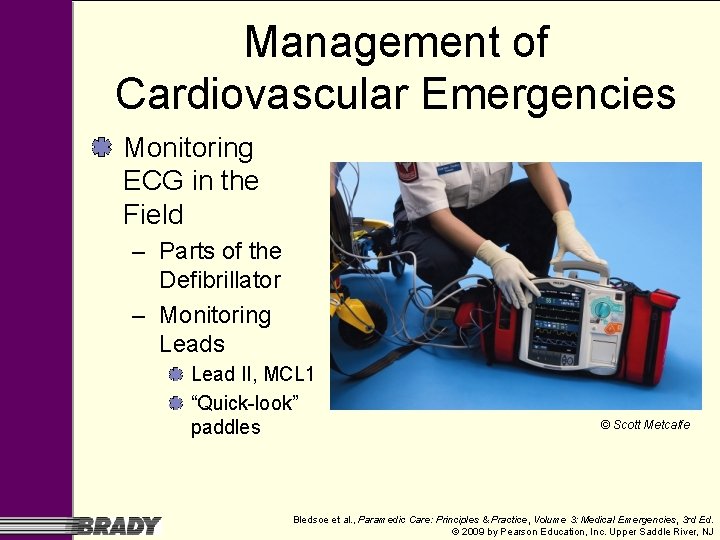
Management of Cardiovascular Emergencies Monitoring ECG in the Field – Parts of the Defibrillator – Monitoring Leads Lead II, MCL 1 “Quick-look” paddles © Scott Metcalfe Bledsoe et al. , Paramedic Care: Principles & Practice, Volume 3: Medical Emergencies, 3 rd Ed. © 2009 by Pearson Education, Inc. Upper Saddle River, NJ
Management of Cardiovascular Emergencies Monitoring ECG in the Field – Causes of Poor Signals Excessive hair, loose or dislodged electrode Dried conductive gel, poor placement, diaphoresis Patient movement or muscle tremor Broken patient cable or lead wire Low battery Faulty grounding Faulty monitor Bledsoe et al. , Paramedic Care: Principles & Practice, Volume 3: Medical Emergencies, 3 rd Ed. © 2009 by Pearson Education, Inc. Upper Saddle River, NJ
Management of Cardiovascular Emergencies Vagal Maneuvers – Indication Stable patient with symptomatic tachycardia – Maneuvers Valsalva maneuvers Coughing Carotid sinus massage Avoid in patients with a history of cerebrovascular or carotid artery disease, or patients with carotid bruits Bledsoe et al. , Paramedic Care: Principles & Practice, Volume 3: Medical Emergencies, 3 rd Ed. © 2009 by Pearson Education, Inc. Upper Saddle River, NJ
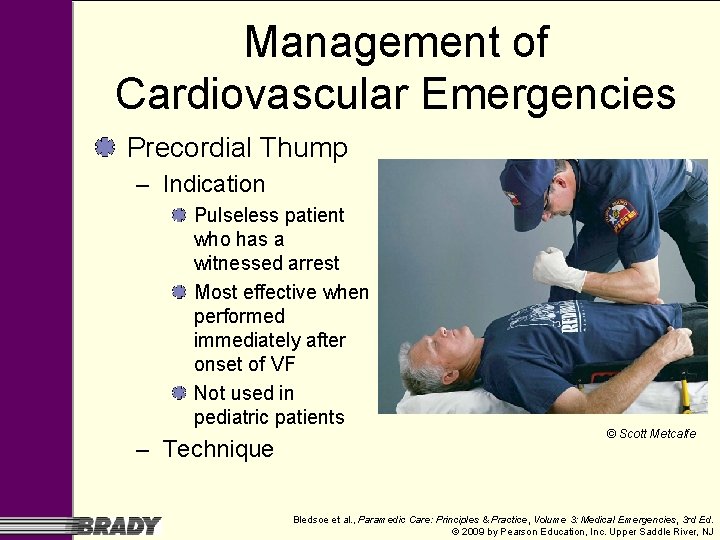
Management of Cardiovascular Emergencies Precordial Thump – Indication Pulseless patient who has a witnessed arrest Most effective when performed immediately after onset of VF Not used in pediatric patients – Technique © Scott Metcalfe Bledsoe et al. , Paramedic Care: Principles & Practice, Volume 3: Medical Emergencies, 3 rd Ed. © 2009 by Pearson Education, Inc. Upper Saddle River, NJ
Management of Cardiovascular Emergencies Pharmacological Agents – Categories Antidysrhythmics Sympathomimetics Drugs used specifically for myocardial ischemia Bledsoe et al. , Paramedic Care: Principles & Practice, Volume 3: Medical Emergencies, 3 rd Ed. © 2009 by Pearson Education, Inc. Upper Saddle River, NJ
Management of Cardiovascular Emergencies Antidysrhythmics – Control or suppress dysrhythmias – Commonly used antidysrhythmics Atropine Lidocaine Adenosine Amiodarone Diltiazem Bledsoe et al. , Paramedic Care: Principles & Practice, Volume 3: Medical Emergencies, 3 rd Ed. © 2009 by Pearson Education, Inc. Upper Saddle River, NJ
Management of Cardiovascular Emergencies Sympathomimetic Agents – Mimic sympathetic nervous system stimulation – Commonly used sympathomimetics Epinephrine Norepinephrine Isoproterenol Dopamine Dobutamine Vasopressin Bledsoe et al. , Paramedic Care: Principles & Practice, Volume 3: Medical Emergencies, 3 rd Ed. © 2009 by Pearson Education, Inc. Upper Saddle River, NJ
Management of Cardiovascular Emergencies Drugs Used for Myocardial Ischemia – – – Oxygen Nitrous oxide Nitroglycerin Morphine sulfate Fentanyl Bledsoe et al. , Paramedic Care: Principles & Practice, Volume 3: Medical Emergencies, 3 rd Ed. © 2009 by Pearson Education, Inc. Upper Saddle River, NJ
Management of Cardiovascular Emergencies Fibrinolytic Agents – Fibrinolytic therapy may be beneficial in the field if long transport necessary – Common agents Aspirin Alteplase Relteplase Tenecteplase Bledsoe et al. , Paramedic Care: Principles & Practice, Volume 3: Medical Emergencies, 3 rd Ed. © 2009 by Pearson Education, Inc. Upper Saddle River, NJ
Management of Cardiovascular Emergencies Other Prehospital Drugs – – Furosemide Diazepam Promethazine Sodium Nitroprusside Bledsoe et al. , Paramedic Care: Principles & Practice, Volume 3: Medical Emergencies, 3 rd Ed. © 2009 by Pearson Education, Inc. Upper Saddle River, NJ
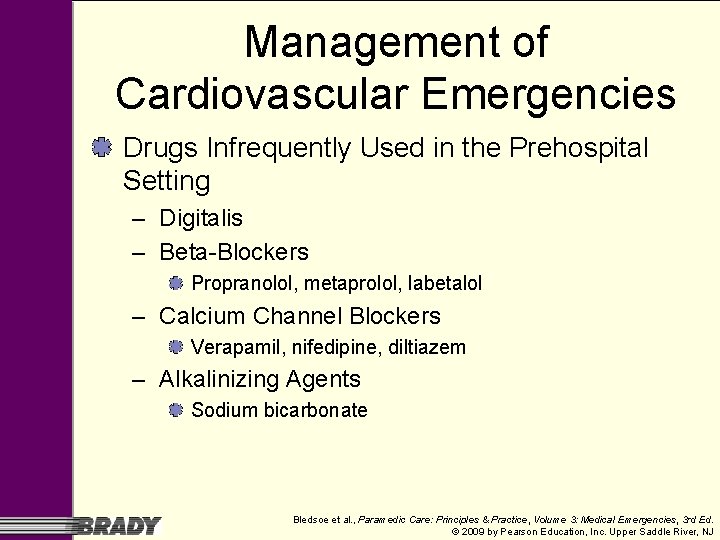
Management of Cardiovascular Emergencies Drugs Infrequently Used in the Prehospital Setting – Digitalis – Beta-Blockers Propranolol, metaprolol, labetalol – Calcium Channel Blockers Verapamil, nifedipine, diltiazem – Alkalinizing Agents Sodium bicarbonate Bledsoe et al. , Paramedic Care: Principles & Practice, Volume 3: Medical Emergencies, 3 rd Ed. © 2009 by Pearson Education, Inc. Upper Saddle River, NJ
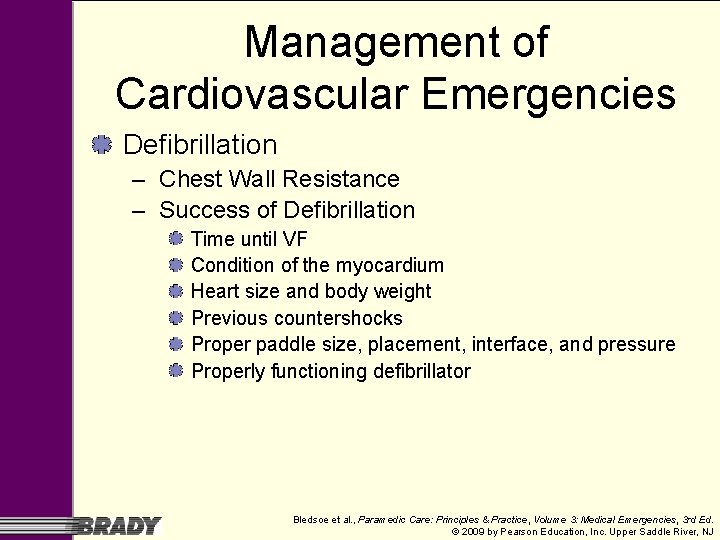
Management of Cardiovascular Emergencies Defibrillation – Chest Wall Resistance – Success of Defibrillation Time until VF Condition of the myocardium Heart size and body weight Previous countershocks Proper paddle size, placement, interface, and pressure Properly functioning defibrillator Bledsoe et al. , Paramedic Care: Principles & Practice, Volume 3: Medical Emergencies, 3 rd Ed. © 2009 by Pearson Education, Inc. Upper Saddle River, NJ
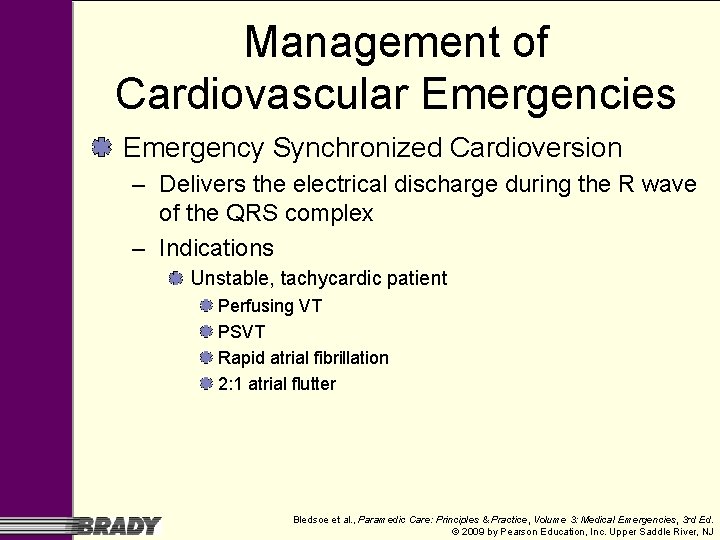
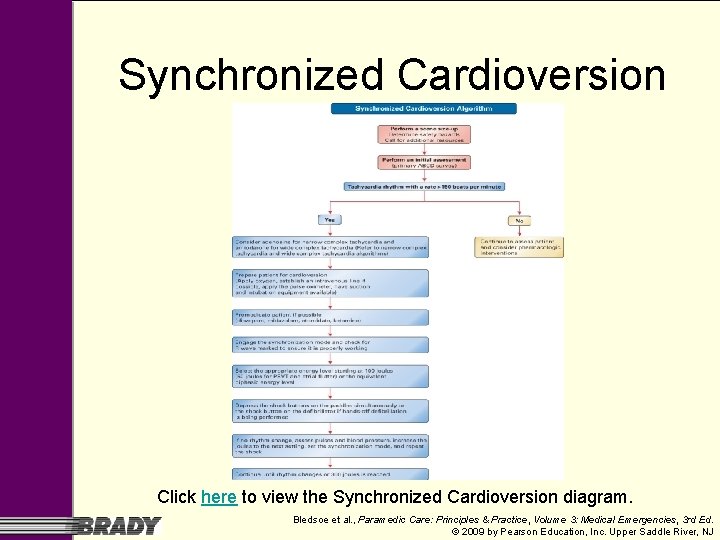
Management of Cardiovascular Emergencies Emergency Synchronized Cardioversion – Delivers the electrical discharge during the R wave of the QRS complex – Indications Unstable, tachycardic patient Perfusing VT PSVT Rapid atrial fibrillation 2: 1 atrial flutter Bledsoe et al. , Paramedic Care: Principles & Practice, Volume 3: Medical Emergencies, 3 rd Ed. © 2009 by Pearson Education, Inc. Upper Saddle River, NJ
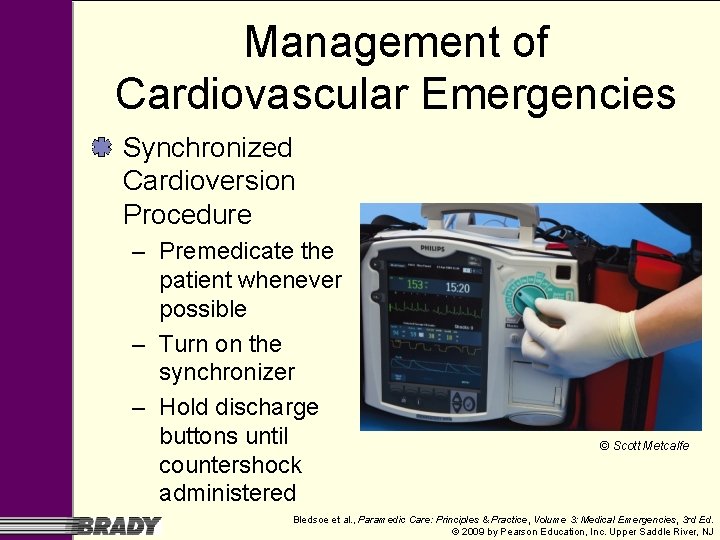
Management of Cardiovascular Emergencies Synchronized Cardioversion Procedure – Premedicate the patient whenever possible – Turn on the synchronizer – Hold discharge buttons until countershock administered © Scott Metcalfe Bledsoe et al. , Paramedic Care: Principles & Practice, Volume 3: Medical Emergencies, 3 rd Ed. © 2009 by Pearson Education, Inc. Upper Saddle River, NJ
Synchronized Cardioversion Click here to view the Synchronized Cardioversion diagram. Bledsoe et al. , Paramedic Care: Principles & Practice, Volume 3: Medical Emergencies, 3 rd Ed. © 2009 by Pearson Education, Inc. Upper Saddle River, NJ
Management of Cardiovascular Emergencies Transcutaneous Cardiac Pacing – Indications Symptomatic, unstable patients who do not respond to pharmacological therapy Symptomatic bradycardias with high-degree AV blocks Atrial fibrillation with a slow ventricular response Other significant bradycardias, including asystole – Procedure Consider sedation Bledsoe et al. , Paramedic Care: Principles & Practice, Volume 3: Medical Emergencies, 3 rd Ed. © 2009 by Pearson Education, Inc. Upper Saddle River, NJ
Management of Cardiovascular Emergencies Carotid Sinus Massage – Indications Paroxysmal supraventricular tachycardia in a stable patient – Complications Do not use in patients with a history of cerebrovascular or carotid artery disease Do not use in patients having carotid bruits Patient may experience bradycardia, nausea, and vomiting Bledsoe et al. , Paramedic Care: Principles & Practice, Volume 3: Medical Emergencies, 3 rd Ed. © 2009 by Pearson Education, Inc. Upper Saddle River, NJ
Management of Cardiovascular Emergencies Support and Communication – Explain your treatment to the patient and his family – Offer emotional support as indicated – Clearly explain your findings to the receiving nurse or physician in a formal verbal briefing Bledsoe et al. , Paramedic Care: Principles & Practice, Volume 3: Medical Emergencies, 3 rd Ed. © 2009 by Pearson Education, Inc. Upper Saddle River, NJ
Managing Specific Cardiovascular Emergencies Bledsoe et al. , Paramedic Care: Principles & Practice, Volume 3: Medical Emergencies, 3 rd Ed. © 2009 by Pearson Education, Inc. Upper Saddle River, NJ
Managing Specific Cardiovascular Emergencies The most common presentation of cardiovascular disorders is chest discomfort Patients may characterize their symptoms not as pain but as another sensation Bledsoe et al. , Paramedic Care: Principles & Practice, Volume 3: Medical Emergencies, 3 rd Ed. © 2009 by Pearson Education, Inc. Upper Saddle River, NJ
Managing Specific Cardiovascular Emergencies Causes of Chest Discomfort – Cardiovascular Cardiac ischemia, pericarditis, thoracic dissection of the aorta – Respiratory Pulmonary embolism, pneumothorax, pneumonia pleural irritation (pleurisy) Bledsoe et al. , Paramedic Care: Principles & Practice, Volume 3: Medical Emergencies, 3 rd Ed. © 2009 by Pearson Education, Inc. Upper Saddle River, NJ
Managing Specific Cardiovascular Emergencies Gastrointestinal Causes – Cholecystitis, pancreatitis, hiatal hernia, esophageal disease, gastroesophageal reflux disease (GERD), peptic ulcer disease, dyspepsia Musculoskeletal causes – Chest wall syndrome, costochondritis, acromioclavicular disease, herpes zoster (shingles), chest wall trauma, chest wall tumors Bledsoe et al. , Paramedic Care: Principles & Practice, Volume 3: Medical Emergencies, 3 rd Ed. © 2009 by Pearson Education, Inc. Upper Saddle River, NJ
Managing Specific Cardiovascular Emergencies Acute Coronary Syndrome – Cause Progressive narrowing of the lumen of the coronary arteries Severity of clinical symptoms is dependent upon the location and extent of narrowing – Includes stable angina, unstable angina and acute myocardial infarction Bledsoe et al. , Paramedic Care: Principles & Practice, Volume 3: Medical Emergencies, 3 rd Ed. © 2009 by Pearson Education, Inc. Upper Saddle River, NJ
Managing Specific Cardiovascular Emergencies Acute Coronary Syndrome – Stable Angina Transient, episodic chest discomfort resulting from myocardial ischemia Relieved by palliative measures – Unstable Angina at rest that lasts longer than 20 minutes New onset angina Crescendo angina (more frequent or longer duration) Bledsoe et al. , Paramedic Care: Principles & Practice, Volume 3: Medical Emergencies, 3 rd Ed. © 2009 by Pearson Education, Inc. Upper Saddle River, NJ
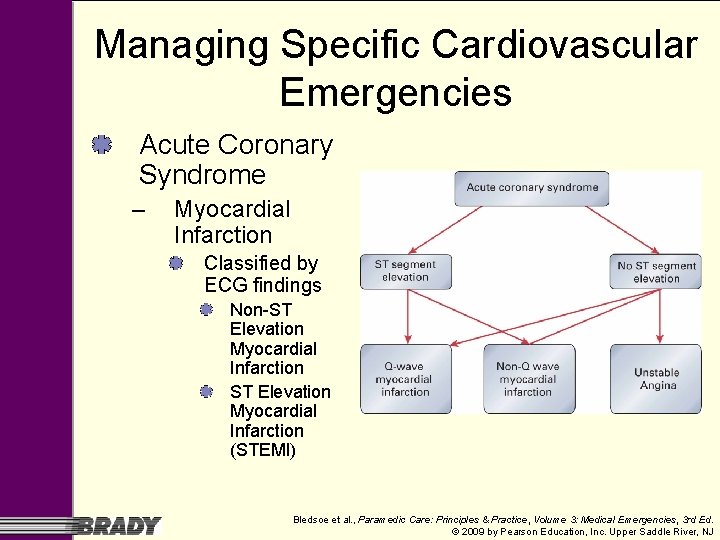
Managing Specific Cardiovascular Emergencies Acute Coronary Syndrome – Myocardial Infarction Classified by ECG findings Non-ST Elevation Myocardial Infarction (STEMI) Bledsoe et al. , Paramedic Care: Principles & Practice, Volume 3: Medical Emergencies, 3 rd Ed. © 2009 by Pearson Education, Inc. Upper Saddle River, NJ
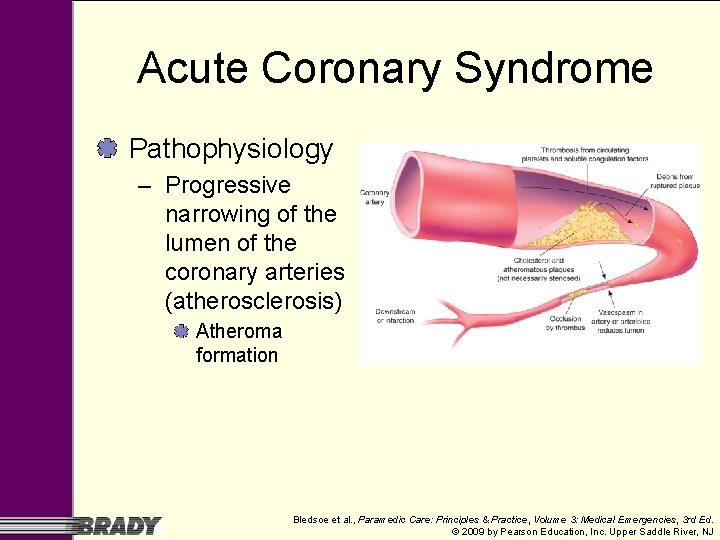
Acute Coronary Syndrome Pathophysiology – Progressive narrowing of the lumen of the coronary arteries (atherosclerosis) Atheroma formation Bledsoe et al. , Paramedic Care: Principles & Practice, Volume 3: Medical Emergencies, 3 rd Ed. © 2009 by Pearson Education, Inc. Upper Saddle River, NJ
Acute Coronary Syndrome Ischemia is caused by an imbalance of oxygen supply and demand – Impaired oxygen delivery is caused by occlusion of the coronary arteries Spasm, stenosis, thrombus, or a combination Other factors Factors that produce low blood pressure, stress Thrombus formation – Initiated by endothelial damage – Leads to platelet aggregation and thrombus formation Bledsoe et al. , Paramedic Care: Principles & Practice, Volume 3: Medical Emergencies, 3 rd Ed. © 2009 by Pearson Education, Inc. Upper Saddle River, NJ
Angina Pectoris Angina occurs when the heart’s demand for oxygen exceeds the blood’s oxygen supply Commonly caused by artherosclerosis May also result from spasm of the coronary arteries (Prinzmetal’s angina) Bledsoe et al. , Paramedic Care: Principles & Practice, Volume 3: Medical Emergencies, 3 rd Ed. © 2009 by Pearson Education, Inc. Upper Saddle River, NJ
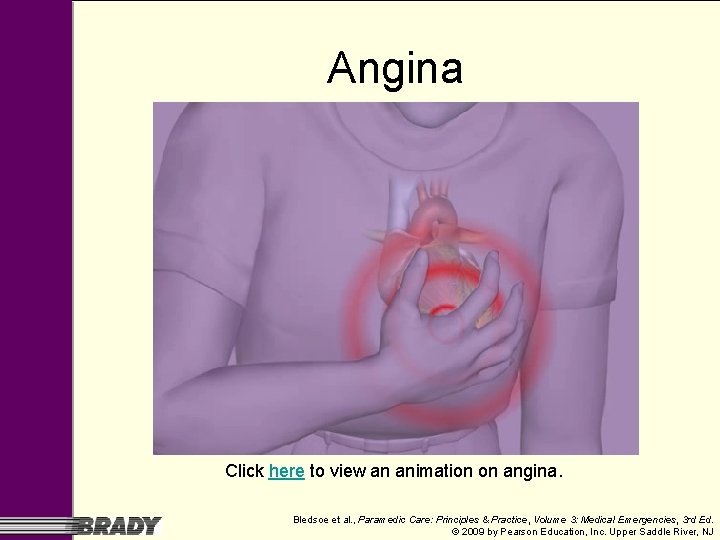
Angina Click here to view an animation on angina. Bledsoe et al. , Paramedic Care: Principles & Practice, Volume 3: Medical Emergencies, 3 rd Ed. © 2009 by Pearson Education, Inc. Upper Saddle River, NJ
Angina Pectoris Stable vs. Unstable Angina – Preinfarction angina Disease Progression – Angina is usually progressive – Accelerates in frequency and duration – Myocardial infarction may follow a single episode of angina Bledsoe et al. , Paramedic Care: Principles & Practice, Volume 3: Medical Emergencies, 3 rd Ed. © 2009 by Pearson Education, Inc. Upper Saddle River, NJ
Angina Pectoris Field Assessment – Signs of Shock – Chest Discomfort Typically sudden onset, which may radiate or be localized to the chest Patient often denies chest pain – Duration Episodes last 3– 5 minutes Pain relieved with rest and/or nitroglycerin Bledsoe et al. , Paramedic Care: Principles & Practice, Volume 3: Medical Emergencies, 3 rd Ed. © 2009 by Pearson Education, Inc. Upper Saddle River, NJ
Angina Pectoris Breathing History – Past episodes of angina: Episodes of angina that are increasing in frequency, duration, or severity are significant ECG – Do not delay scene time – 12 -Lead ECG preferred: Angina typically causes nonspecific ST changes Bledsoe et al. , Paramedic Care: Principles & Practice, Volume 3: Medical Emergencies, 3 rd Ed. © 2009 by Pearson Education, Inc. Upper Saddle River, NJ
Angina Pectoris Management – Relieve anxiety: Place the patient in a position of physical and emotional comfort – – Administer oxygen Establish IV access Monitor ECG Consider medication administration: Nitroglycerin tablets or spray Nifedipine or other calcium channel blockers Morphine sulfate Aspirin Bledsoe et al. , Paramedic Care: Principles & Practice, Volume 3: Medical Emergencies, 3 rd Ed. © 2009 by Pearson Education, Inc. Upper Saddle River, NJ
Angina Pectoris Special Considerations – Patients with new-onset or crescendo angina often require hospitalization. – Symptoms not relieved by rest, nitroglycerin, and oxygen may indicate an overall worsening or the early stages of a myocardial infarction. – Patients may refuse transport after pain is relieved, even though the underlying problem is not addressed. Bledsoe et al. , Paramedic Care: Principles & Practice, Volume 3: Medical Emergencies, 3 rd Ed. © 2009 by Pearson Education, Inc. Upper Saddle River, NJ
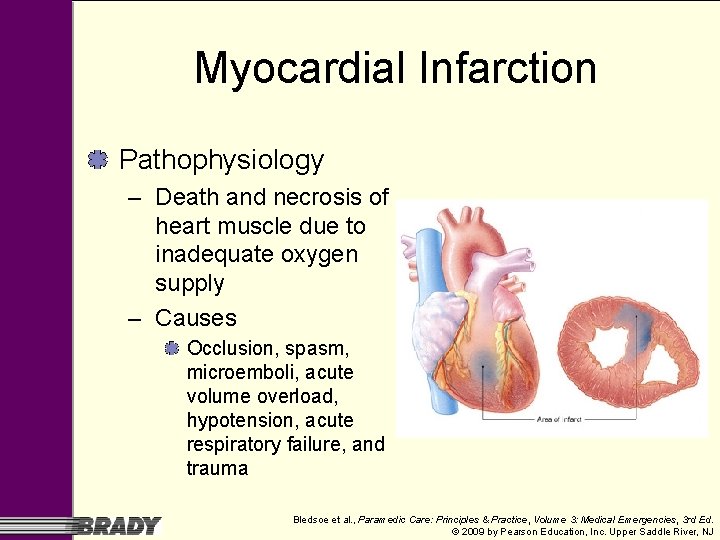
Myocardial Infarction Pathophysiology – Death and necrosis of heart muscle due to inadequate oxygen supply – Causes Occlusion, spasm, microemboli, acute volume overload, hypotension, acute respiratory failure, and trauma Bledsoe et al. , Paramedic Care: Principles & Practice, Volume 3: Medical Emergencies, 3 rd Ed. © 2009 by Pearson Education, Inc. Upper Saddle River, NJ
Myocardial Infarction Location and size dependent on the vessel involved – Left Coronary Artery May result in anterior, lateral, or septal infarcts – Right Coronary Artery Infarctions of the inferior wall, posterior wall, or the right ventricle Bledsoe et al. , Paramedic Care: Principles & Practice, Volume 3: Medical Emergencies, 3 rd Ed. © 2009 by Pearson Education, Inc. Upper Saddle River, NJ
Myocardial Infarction STEMI vs. non-STEMI ACS – Transmural infarct causes immediate ST elevation – Subendocardial infarction occurs with no ST segment change Effects of a Myocardial Infarction – Ischemea – Dysrhythmias – Heart Failure Goal is pain relief and reperfusion Bledsoe et al. , Paramedic Care: Principles & Practice, Volume 3: Medical Emergencies, 3 rd Ed. © 2009 by Pearson Education, Inc. Upper Saddle River, NJ
Myocardial Infarction Field Assessment – Breathing – Signs of Shock – Chief Complaint Typically related to chest pain Evaluate using OPQRST: Discomfort >30 minutes Radiation to arms, neck, back, or epigastric region Patients may minimize symptoms Feelings of “impending doom” Bledsoe et al. , Paramedic Care: Principles & Practice, Volume 3: Medical Emergencies, 3 rd Ed. © 2009 by Pearson Education, Inc. Upper Saddle River, NJ
Myocardial Infarction Auscultate lungs Other Symptoms – Nausea and vomiting – Diaphoresis ECG – Diagnostic ECGs: 12 -lead ECGs S-T segment Pathological Q waves – Dysrhythmias: Asystole, PEA, VF, VT Dysrhythmias are the leading cause of death in ACS Bledsoe et al. , Paramedic Care: Principles & Practice, Volume 3: Medical Emergencies, 3 rd Ed. © 2009 by Pearson Education, Inc. Upper Saddle River, NJ
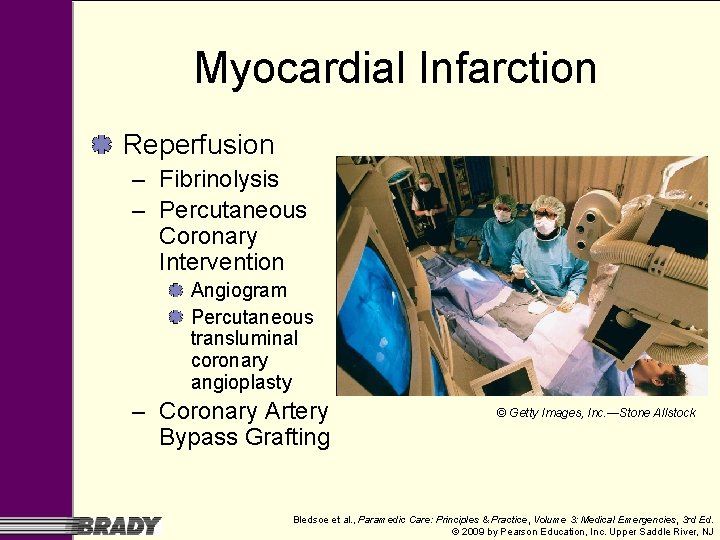
Myocardial Infarction Reperfusion – Fibrinolysis – Percutaneous Coronary Intervention Angiogram Percutaneous transluminal coronary angioplasty – Coronary Artery Bypass Grafting © Getty Images, Inc. —Stone Allstock Bledsoe et al. , Paramedic Care: Principles & Practice, Volume 3: Medical Emergencies, 3 rd Ed. © 2009 by Pearson Education, Inc. Upper Saddle River, NJ
Myocardial Infarction Reperfusion Screening – Reperfusion of ischemic/injured tissue – Time from onset to treatment <6 hours – Absence of history that would exclude thrombolytics Transport – Rapid transport indicated when ACS is suspected Bledsoe et al. , Paramedic Care: Principles & Practice, Volume 3: Medical Emergencies, 3 rd Ed. © 2009 by Pearson Education, Inc. Upper Saddle River, NJ
Myocardial Infarction Management – Prehospital Administer oxygen Establish IV access Consider medication administration: Aspirin Nitroglycerin Morphine sulfate Fentanyl (Sublimaze) Other medications Clopidogrel (Plavix) Heparin Beta blockers Glycoprotein IIb/IIIa inhibitors Bledsoe et al. , Paramedic Care: Principles & Practice, Volume 3: Medical Emergencies, 3 rd Ed. © 2009 by Pearson Education, Inc. Upper Saddle River, NJ
Myocardial Infarction Prehospital Management (cont. ) – – Monitor ECG Rapid transport as indicated Avoid patient refusals if possible Identify candidates for thrombolytic therapy In-Hospital: – – Diagnostic ECGs Enzyme levels Risk assessment Treatment: Cardiac catheterization, PTCA, and CABG Bledsoe et al. , Paramedic Care: Principles & Practice, Volume 3: Medical Emergencies, 3 rd Ed. © 2009 by Pearson Education, Inc. Upper Saddle River, NJ
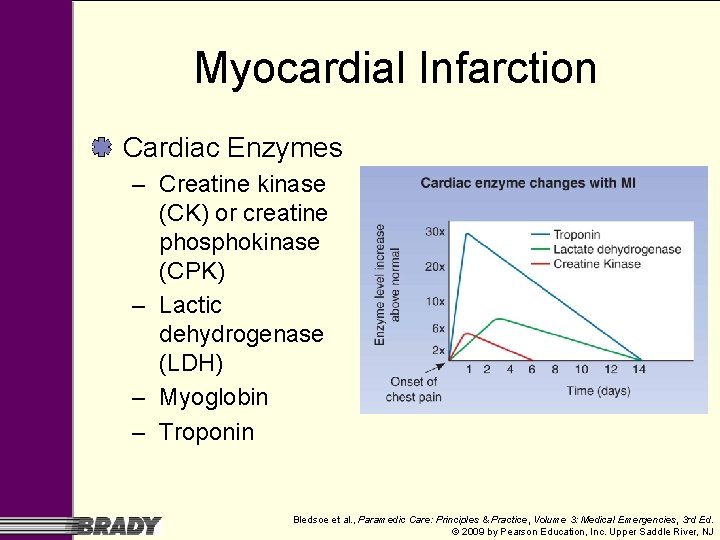
Myocardial Infarction Cardiac Enzymes – Creatine kinase (CK) or creatine phosphokinase (CPK) – Lactic dehydrogenase (LDH) – Myoglobin – Troponin Bledsoe et al. , Paramedic Care: Principles & Practice, Volume 3: Medical Emergencies, 3 rd Ed. © 2009 by Pearson Education, Inc. Upper Saddle River, NJ
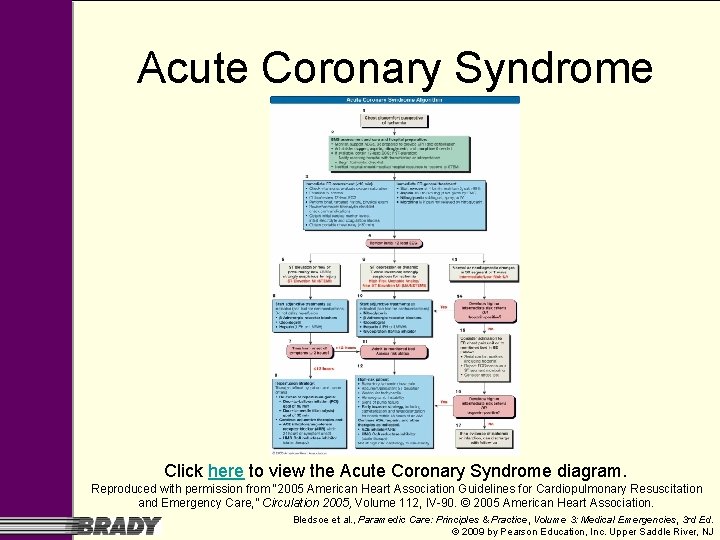
Acute Coronary Syndrome Click here to view the Acute Coronary Syndrome diagram. Reproduced with permission from “ 2005 American Heart Association Guidelines for Cardiopulmonary Resuscitation and Emergency Care, ” Circulation 2005, Volume 112, IV-90. © 2005 American Heart Association. Bledsoe et al. , Paramedic Care: Principles & Practice, Volume 3: Medical Emergencies, 3 rd Ed. © 2009 by Pearson Education, Inc. Upper Saddle River, NJ