
PARALLELAXIS THEOREM RADIUS OF GYRATION MOMENT OF INERTIA
- Slides: 18
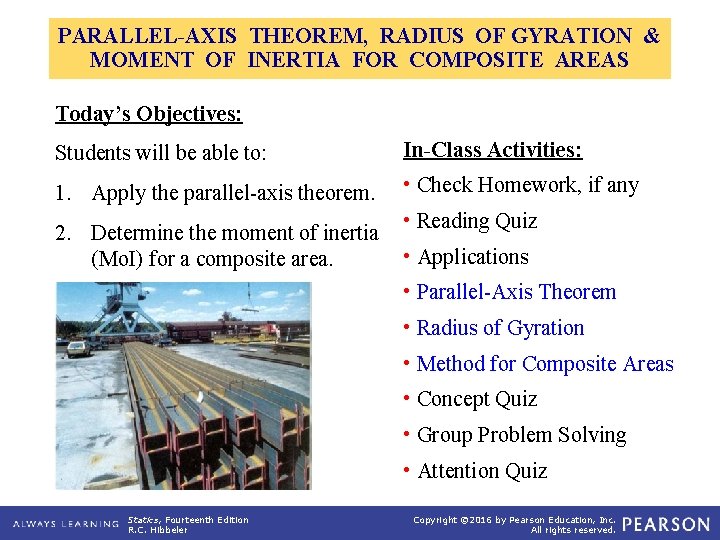
PARALLEL-AXIS THEOREM, RADIUS OF GYRATION & MOMENT OF INERTIA FOR COMPOSITE AREAS Today’s Objectives: Students will be able to: In-Class Activities: 1. Apply the parallel-axis theorem. • Check Homework, if any 2. Determine the moment of inertia (Mo. I) for a composite area. • Reading Quiz • Applications • Parallel-Axis Theorem • Radius of Gyration • Method for Composite Areas • Concept Quiz • Group Problem Solving • Attention Quiz Statics, Fourteenth Edition R. C. Hibbeler Copyright © 2016 by Pearson Education, Inc. All rights reserved.
READING QUIZ 1. The parallel-axis theorem for an area is applied between A) An axis passing through its centroid any corresponding parallel axis. B) Any two parallel axis. C) Two horizontal axes only. D) Two vertical axes only. 2. The moment of inertia of a composite area equals the ____ of the Mo. I of all of its parts. A) vector sum B) algebraic sum (addition or subtraction) C) addition D) product Statics, Fourteenth Edition R. C. Hibbeler Copyright © 2016 by Pearson Education, Inc. All rights reserved.
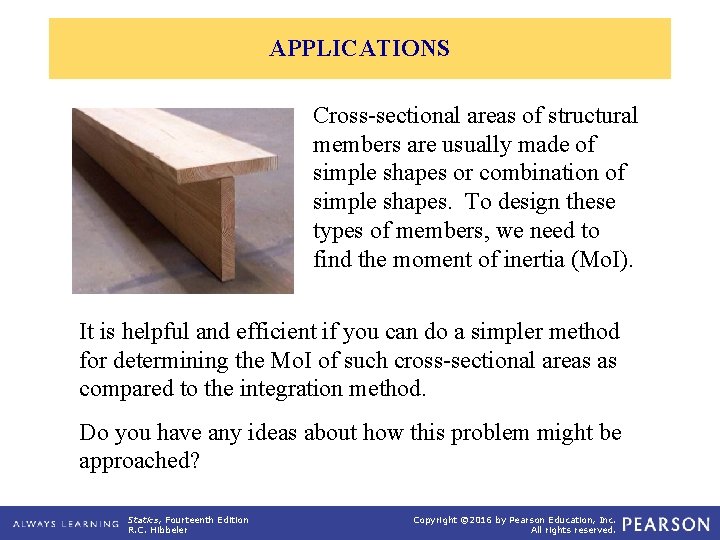
APPLICATIONS Cross-sectional areas of structural members are usually made of simple shapes or combination of simple shapes. To design these types of members, we need to find the moment of inertia (Mo. I). It is helpful and efficient if you can do a simpler method for determining the Mo. I of such cross-sectional areas as compared to the integration method. Do you have any ideas about how this problem might be approached? Statics, Fourteenth Edition R. C. Hibbeler Copyright © 2016 by Pearson Education, Inc. All rights reserved.
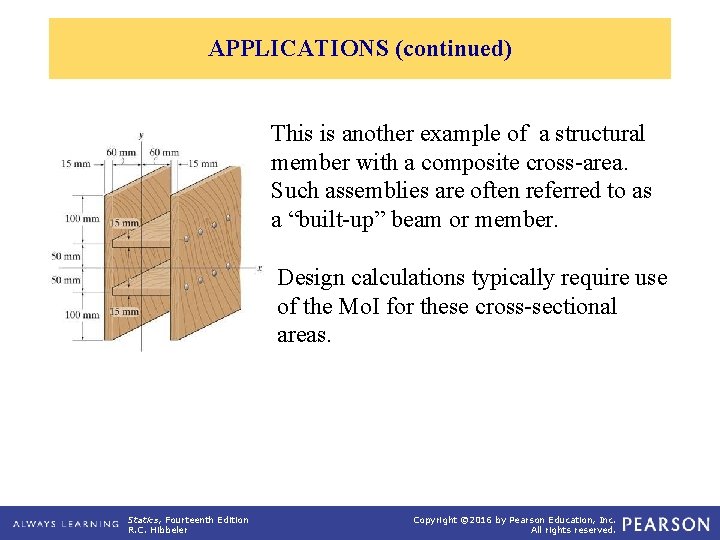
APPLICATIONS (continued) This is another example of a structural member with a composite cross-area. Such assemblies are often referred to as a “built-up” beam or member. Design calculations typically require use of the Mo. I for these cross-sectional areas. Statics, Fourteenth Edition R. C. Hibbeler Copyright © 2016 by Pearson Education, Inc. All rights reserved.
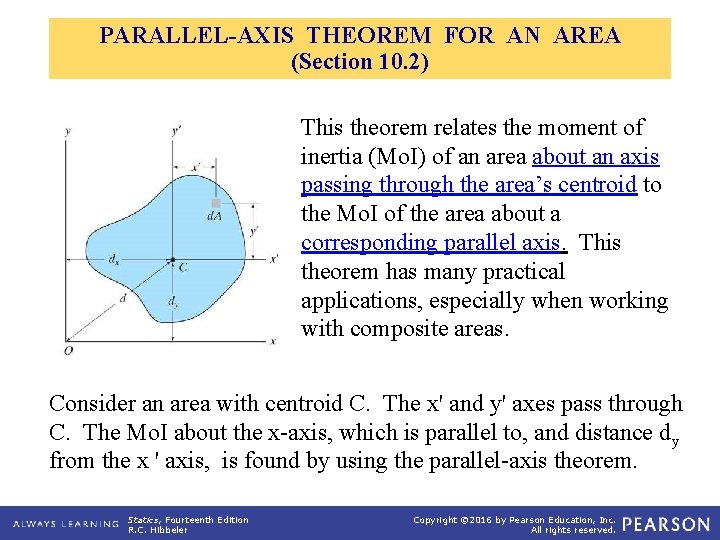
PARALLEL-AXIS THEOREM FOR AN AREA (Section 10. 2) This theorem relates the moment of inertia (Mo. I) of an area about an axis passing through the area’s centroid to the Mo. I of the area about a corresponding parallel axis. This theorem has many practical applications, especially when working with composite areas. Consider an area with centroid C. The x' and y' axes pass through C. The Mo. I about the x-axis, which is parallel to, and distance dy from the x ' axis, is found by using the parallel-axis theorem. Statics, Fourteenth Edition R. C. Hibbeler Copyright © 2016 by Pearson Education, Inc. All rights reserved.
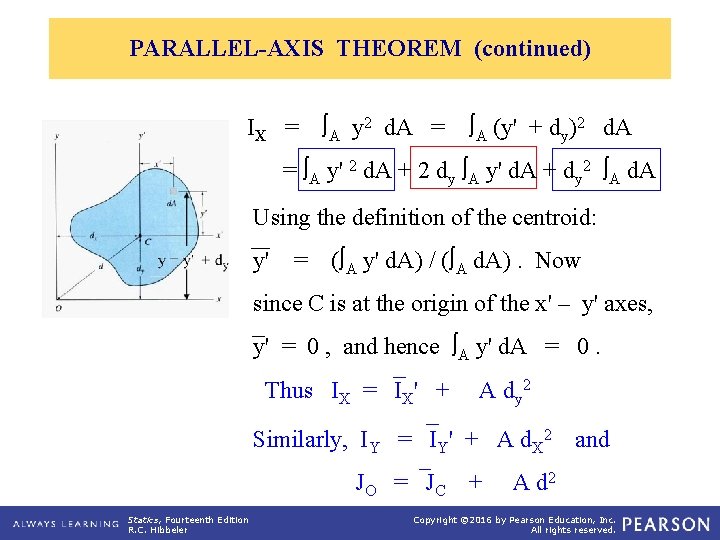
PARALLEL-AXIS THEOREM (continued) IX = A y 2 d. A = A (y' + dy)2 d. A = A y' 2 d. A + 2 dy A y' d. A + dy 2 A d. A Using the definition of the centroid: y' = ( A y' d. A) / ( A d. A). Now since C is at the origin of the x' – y' axes, y' = 0 , and hence A y' d. A = 0. Thus IX = IX' + A dy 2 Similarly, IY = IY' + A d. X 2 JO = J C Statics, Fourteenth Edition R. C. Hibbeler + and A d 2 Copyright © 2016 by Pearson Education, Inc. All rights reserved.
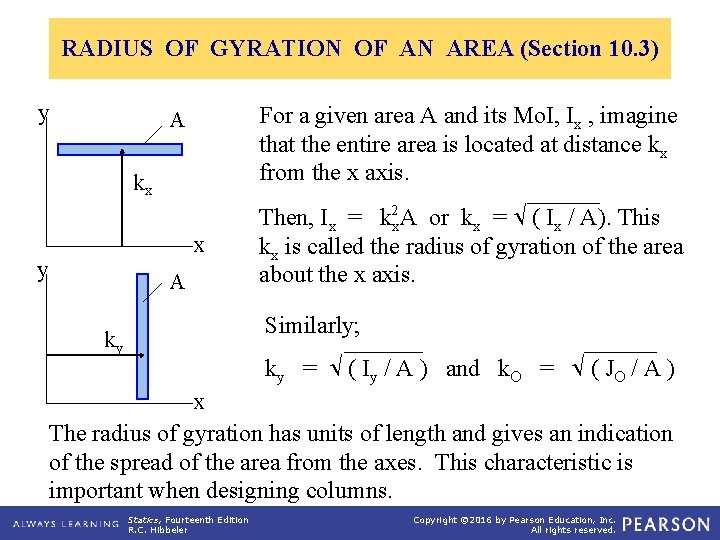
RADIUS OF GYRATION OF AN AREA (Section 10. 3) y For a given area A and its Mo. I, Ix , imagine that the entire area is located at distance kx from the x axis. A kx x y A Then, Ix = k 2 x. A or kx = ( Ix / A). This kx is called the radius of gyration of the area about the x axis. Similarly; ky ky = ( Iy / A ) and k. O = ( JO / A ) x The radius of gyration has units of length and gives an indication of the spread of the area from the axes. This characteristic is important when designing columns. Statics, Fourteenth Edition R. C. Hibbeler Copyright © 2016 by Pearson Education, Inc. All rights reserved.
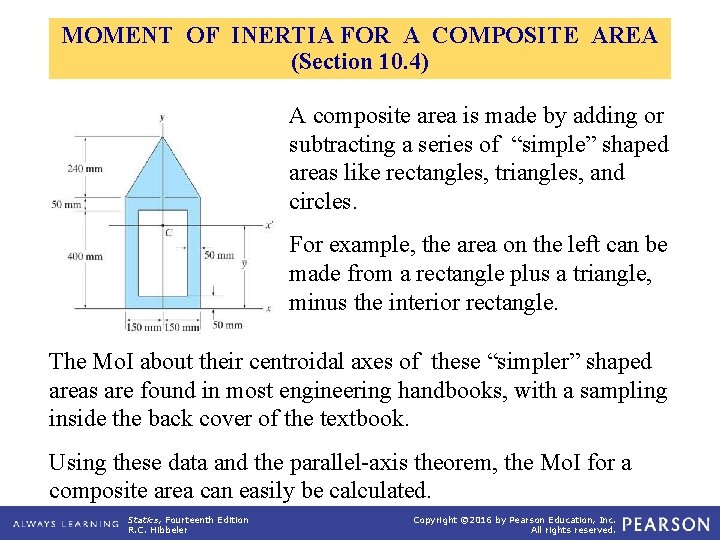
MOMENT OF INERTIA FOR A COMPOSITE AREA (Section 10. 4) A composite area is made by adding or subtracting a series of “simple” shaped areas like rectangles, triangles, and circles. For example, the area on the left can be made from a rectangle plus a triangle, minus the interior rectangle. The Mo. I about their centroidal axes of these “simpler” shaped areas are found in most engineering handbooks, with a sampling inside the back cover of the textbook. Using these data and the parallel-axis theorem, the Mo. I for a composite area can easily be calculated. Statics, Fourteenth Edition R. C. Hibbeler Copyright © 2016 by Pearson Education, Inc. All rights reserved.
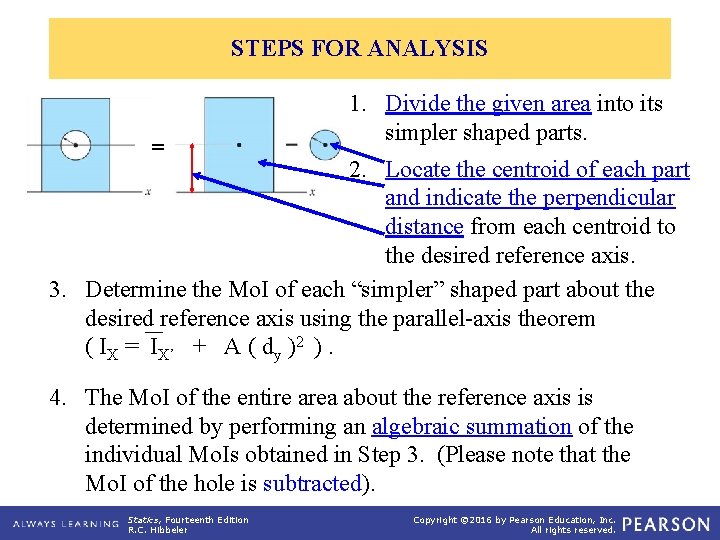
STEPS FOR ANALYSIS = 1. Divide the given area into its simpler shaped parts. 2. Locate the centroid of each part and indicate the perpendicular distance from each centroid to the desired reference axis. 3. Determine the Mo. I of each “simpler” shaped part about the desired reference axis using the parallel-axis theorem ( IX = IX’ + A ( dy )2 ). 4. The Mo. I of the entire area about the reference axis is determined by performing an algebraic summation of the individual Mo. Is obtained in Step 3. (Please note that the Mo. I of the hole is subtracted). Statics, Fourteenth Edition R. C. Hibbeler Copyright © 2016 by Pearson Education, Inc. All rights reserved.
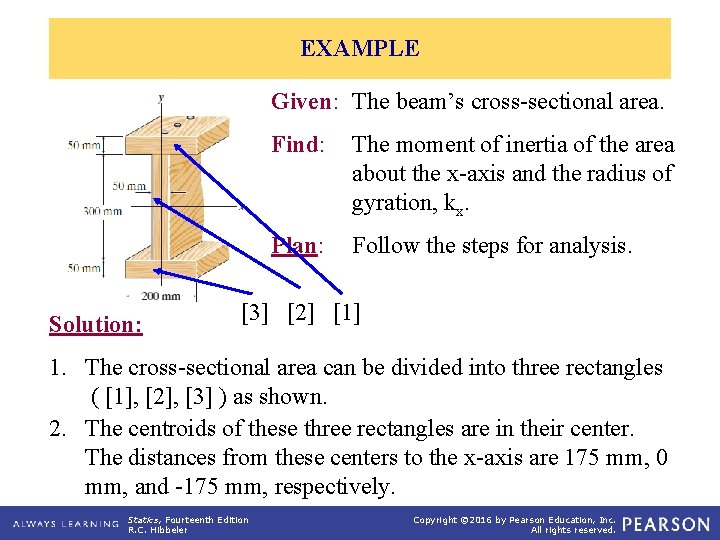
EXAMPLE Given: The beam’s cross-sectional area. Solution: Find: The moment of inertia of the area about the x-axis and the radius of gyration, kx. Plan: Follow the steps for analysis. [3] [2] [1] 1. The cross-sectional area can be divided into three rectangles ( [1], [2], [3] ) as shown. 2. The centroids of these three rectangles are in their center. The distances from these centers to the x-axis are 175 mm, 0 mm, and -175 mm, respectively. Statics, Fourteenth Edition R. C. Hibbeler Copyright © 2016 by Pearson Education, Inc. All rights reserved.
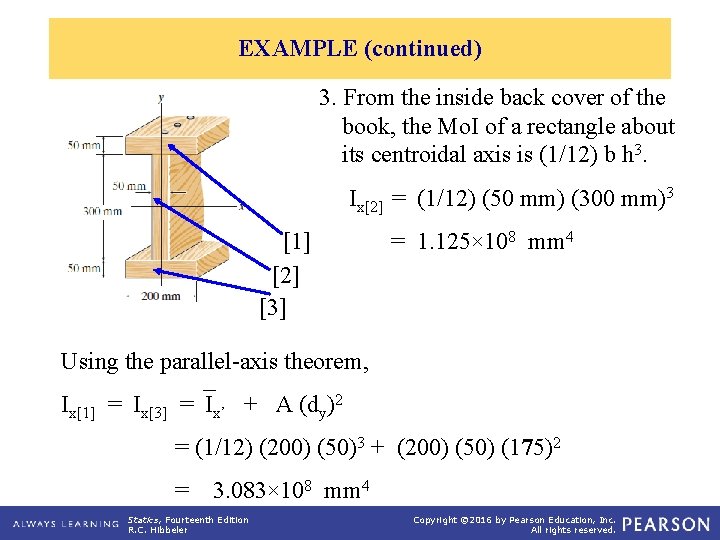
EXAMPLE (continued) 3. From the inside back cover of the book, the Mo. I of a rectangle about its centroidal axis is (1/12) b h 3. Ix[2] = (1/12) (50 mm) (300 mm)3 [1] [2] [3] = 1. 125× 108 mm 4 Using the parallel-axis theorem, Ix[1] = Ix[3] = Ix’ + A (dy)2 = (1/12) (200) (50)3 + (200) (50) (175)2 = 3. 083× 108 mm 4 Statics, Fourteenth Edition R. C. Hibbeler Copyright © 2016 by Pearson Education, Inc. All rights reserved.
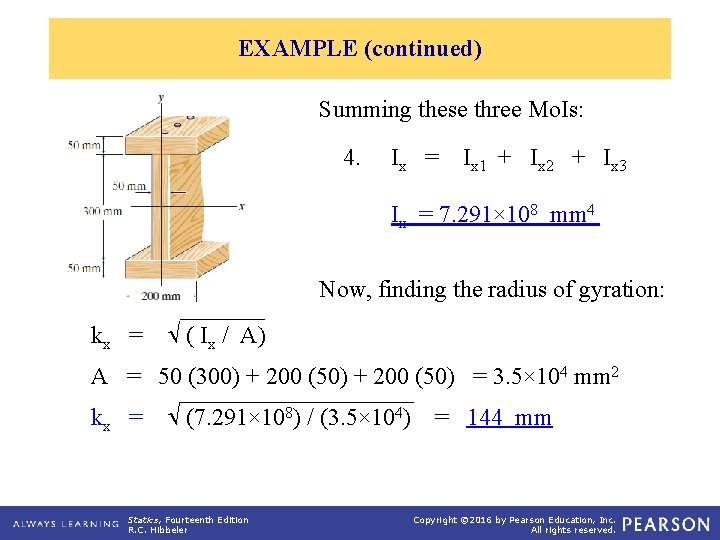
EXAMPLE (continued) Summing these three Mo. Is: 4. Ix = Ix 1 + Ix 2 + Ix 3 Ix = 7. 291× 108 mm 4 Now, finding the radius of gyration: kx = ( Ix / A) A = 50 (300) + 200 (50) = 3. 5× 104 mm 2 kx = (7. 291× 108) / (3. 5× 10⁴) Statics, Fourteenth Edition R. C. Hibbeler = 144 mm Copyright © 2016 by Pearson Education, Inc. All rights reserved.
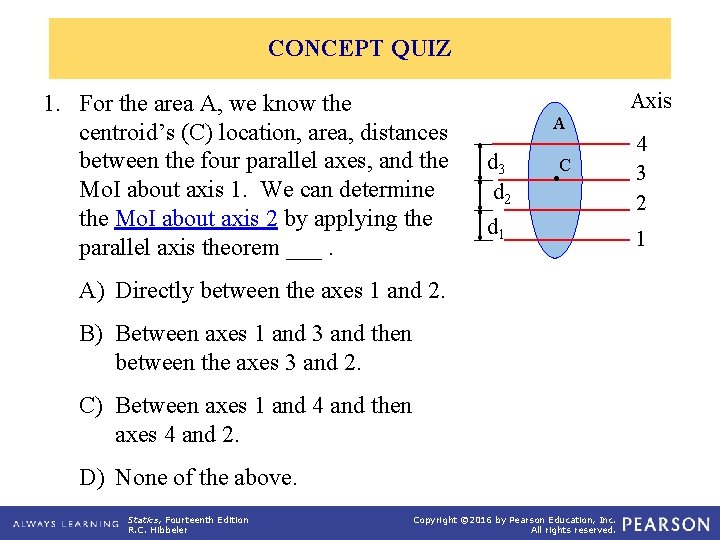
CONCEPT QUIZ 1. For the area A, we know the centroid’s (C) location, area, distances between the four parallel axes, and the Mo. I about axis 1. We can determine the Mo. I about axis 2 by applying the parallel axis theorem ___. Axis A d 3 d 2 C • d 1 A) Directly between the axes 1 and 2. B) Between axes 1 and 3 and then between the axes 3 and 2. C) Between axes 1 and 4 and then axes 4 and 2. D) None of the above. Statics, Fourteenth Edition R. C. Hibbeler Copyright © 2016 by Pearson Education, Inc. All rights reserved. 4 3 2 1
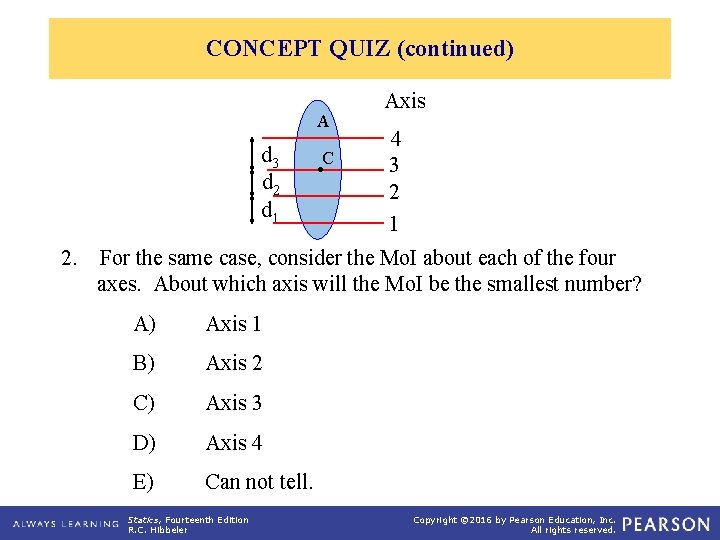
CONCEPT QUIZ (continued) A d 3 d 2 d 1 2. C • Axis 4 3 2 1 For the same case, consider the Mo. I about each of the four axes. About which axis will the Mo. I be the smallest number? A) Axis 1 B) Axis 2 C) Axis 3 D) Axis 4 E) Can not tell. Statics, Fourteenth Edition R. C. Hibbeler Copyright © 2016 by Pearson Education, Inc. All rights reserved.
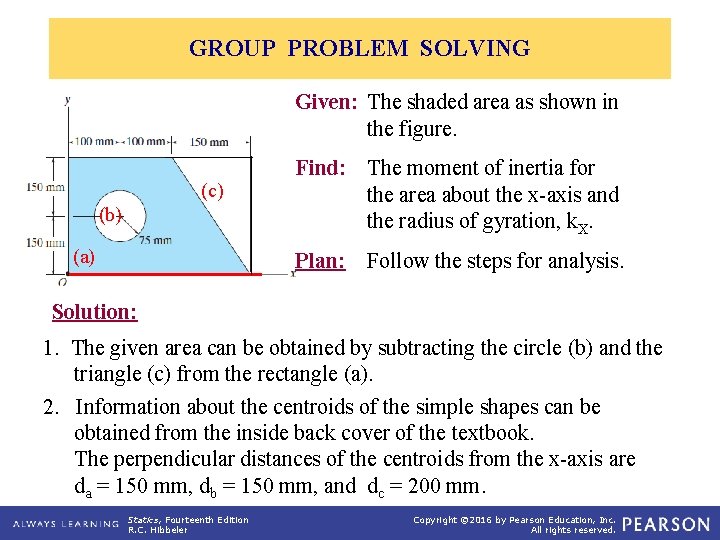
GROUP PROBLEM SOLVING Given: The shaded area as shown in the figure. (c) (b) (a) Find: The moment of inertia for the area about the x-axis and the radius of gyration, k. X. Plan: Follow the steps for analysis. Solution: 1. The given area can be obtained by subtracting the circle (b) and the triangle (c) from the rectangle (a). 2. Information about the centroids of the simple shapes can be obtained from the inside back cover of the textbook. The perpendicular distances of the centroids from the x-axis are da = 150 mm, db = 150 mm, and dc = 200 mm. Statics, Fourteenth Edition R. C. Hibbeler Copyright © 2016 by Pearson Education, Inc. All rights reserved.
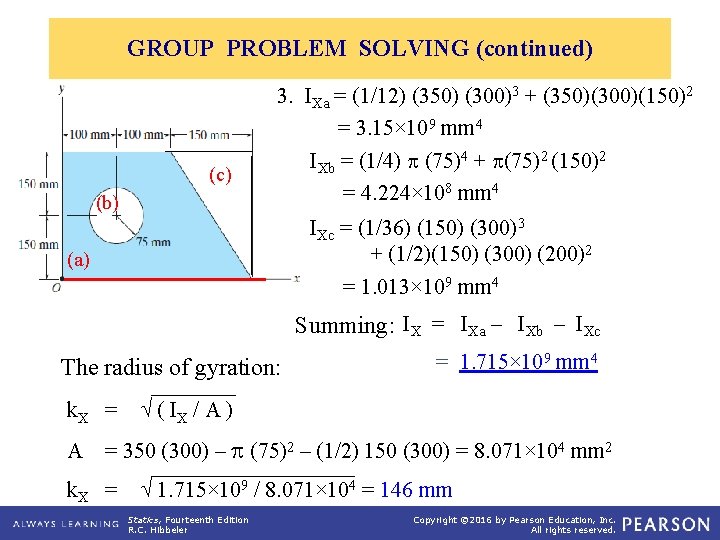
GROUP PROBLEM SOLVING (continued) (c) (b) 3. IXa = (1/12) (350) (300)3 + (350)(300)(150)2 = 3. 15× 109 mm 4 IXb = (1/4) (75)4 + (75)2 (150)2 = 4. 224× 108 mm 4 IXc = (1/36) (150) (300)3 + (1/2)(150) (300) (200)2 = 1. 013× 109 mm 4 (a) Summing: IX = IXa – IXb – IXc The radius of gyration: k. X = A = 1. 715× 109 mm 4 ( IX / A ) = 350 (300) – (75)2 – (1/2) 150 (300) = 8. 071× 104 mm 2 k. X = 1. 715× 109 / 8. 071× 104 = 146 mm Statics, Fourteenth Edition R. C. Hibbeler Copyright © 2016 by Pearson Education, Inc. All rights reserved.
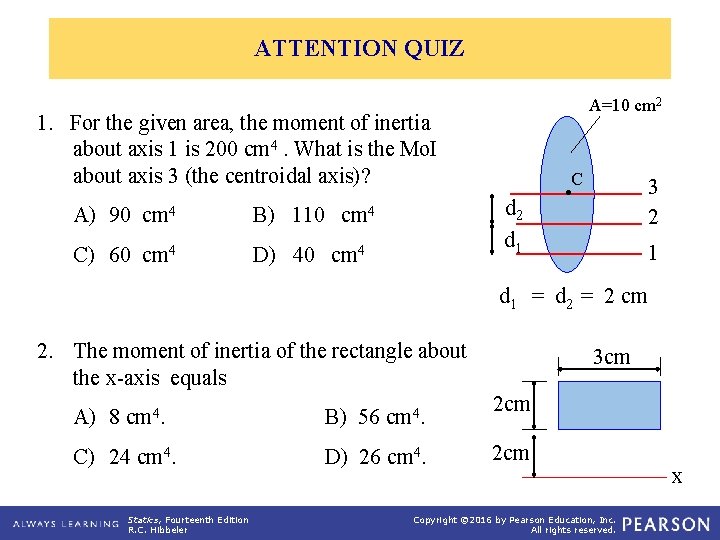
ATTENTION QUIZ A=10 cm 2 1. For the given area, the moment of inertia about axis 1 is 200 cm 4. What is the Mo. I about axis 3 (the centroidal axis)? A) 90 cm 4 B) 110 cm 4 C) 60 cm 4 D) 40 cm 4 d 2 d 1 C C • 3 2 • 1 d 1 = d 2 = 2 cm 2. The moment of inertia of the rectangle about the x-axis equals A) 8 cm 4. C) 24 cm 4. Statics, Fourteenth Edition R. C. Hibbeler B) 56 cm 4. D) 26 cm 4. 3 cm 2 cm Copyright © 2016 by Pearson Education, Inc. All rights reserved. x
Statics, Fourteenth Edition R. C. Hibbeler Copyright © 2016 by Pearson Education, Inc. All rights reserved.