
Parallel System Performance Evaluation Scalability Factors affecting parallel
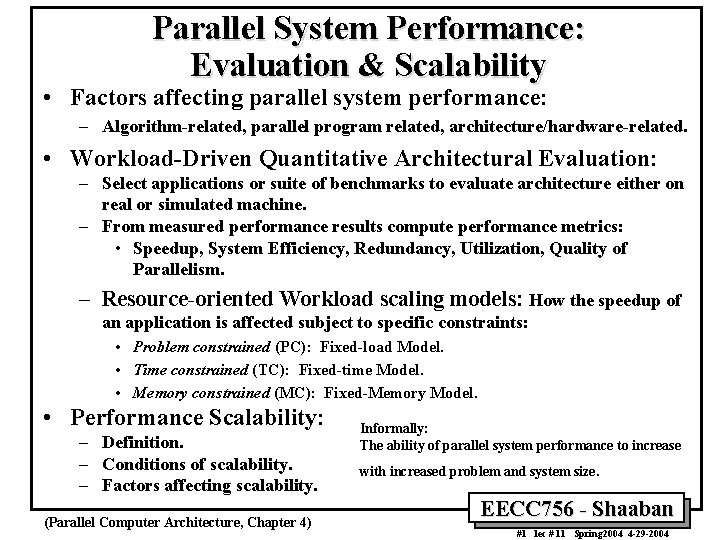
Parallel System Performance: Evaluation & Scalability • Factors affecting parallel system performance: – Algorithm-related, parallel program related, architecture/hardware-related. • Workload-Driven Quantitative Architectural Evaluation: – Select applications or suite of benchmarks to evaluate architecture either on real or simulated machine. – From measured performance results compute performance metrics: • Speedup, System Efficiency, Redundancy, Utilization, Quality of Parallelism. – Resource-oriented Workload scaling models: How the speedup of an application is affected subject to specific constraints: • Problem constrained (PC): Fixed-load Model. • Time constrained (TC): Fixed-time Model. • Memory constrained (MC): Fixed-Memory Model. • Performance Scalability: – Definition. – Conditions of scalability. – Factors affecting scalability. (Parallel Computer Architecture, Chapter 4) Informally: The ability of parallel system performance to increase with increased problem and system size. EECC 756 - Shaaban #1 lec # 11 Spring 2004 4 -29 -2004
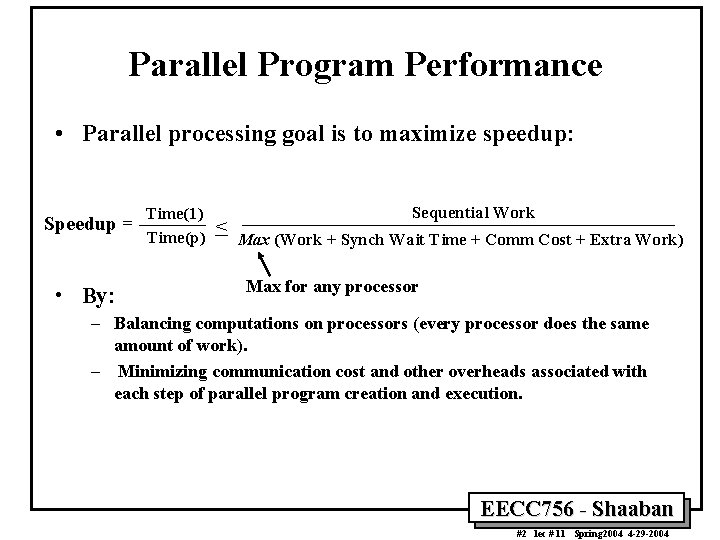
Parallel Program Performance • Parallel processing goal is to maximize speedup: Speedup = • By: Sequential Work Time(1) < Time(p) Max (Work + Synch Wait Time + Comm Cost + Extra Work) Max for any processor – Balancing computations on processors (every processor does the same amount of work). – Minimizing communication cost and other overheads associated with each step of parallel program creation and execution. EECC 756 - Shaaban #2 lec # 11 Spring 2004 4 -29 -2004
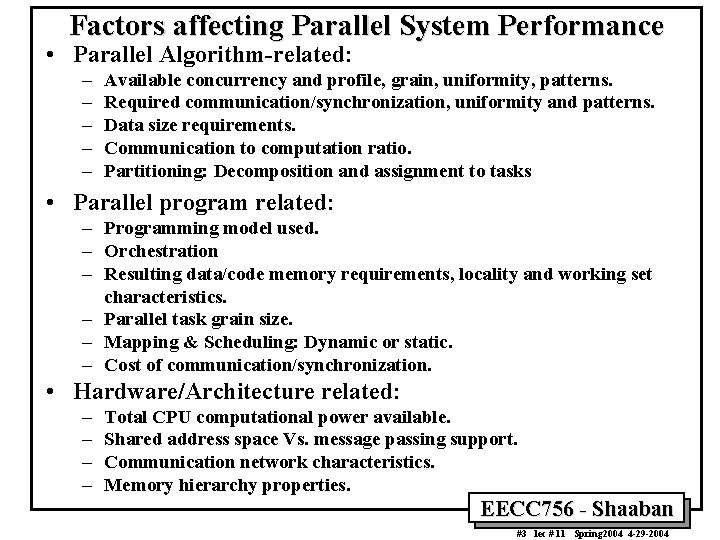
Factors affecting Parallel System Performance • Parallel Algorithm-related: – – – Available concurrency and profile, grain, uniformity, patterns. Required communication/synchronization, uniformity and patterns. Data size requirements. Communication to computation ratio. Partitioning: Decomposition and assignment to tasks • Parallel program related: – Programming model used. – Orchestration – Resulting data/code memory requirements, locality and working set characteristics. – Parallel task grain size. – Mapping & Scheduling: Dynamic or static. – Cost of communication/synchronization. • Hardware/Architecture related: – – Total CPU computational power available. Shared address space Vs. message passing support. Communication network characteristics. Memory hierarchy properties. EECC 756 - Shaaban #3 lec # 11 Spring 2004 4 -29 -2004
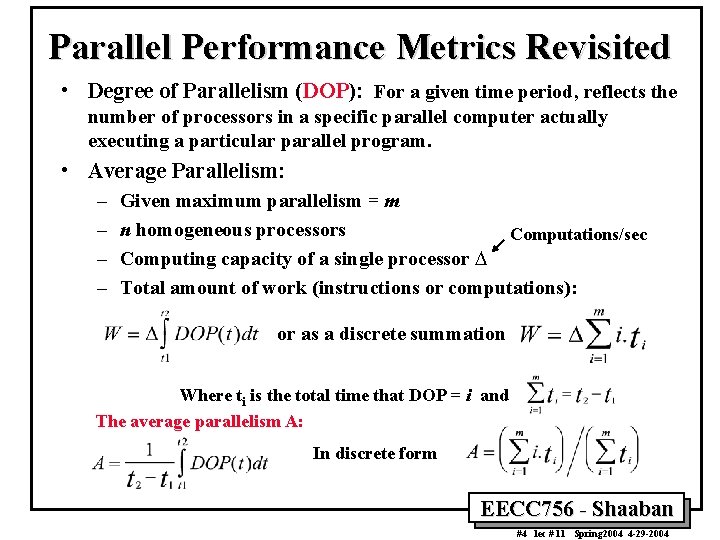
Parallel Performance Metrics Revisited • Degree of Parallelism (DOP): For a given time period, reflects the number of processors in a specific parallel computer actually executing a particular parallel program. • Average Parallelism: – – Given maximum parallelism = m n homogeneous processors Computations/sec Computing capacity of a single processor D Total amount of work (instructions or computations): or as a discrete summation Where ti is the total time that DOP = i and The average parallelism A: In discrete form EECC 756 - Shaaban #4 lec # 11 Spring 2004 4 -29 -2004
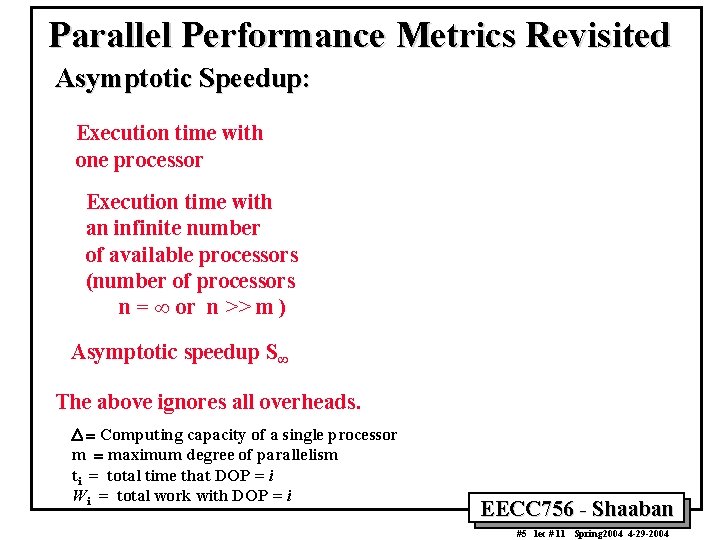
Parallel Performance Metrics Revisited Asymptotic Speedup: Execution time with one processor Execution time with an infinite number of available processors (number of processors n = ¥ or n >> m ) Asymptotic speedup S¥ The above ignores all overheads. D = Computing capacity of a single processor m = maximum degree of parallelism ti = total time that DOP = i Wi = total work with DOP = i EECC 756 - Shaaban #5 lec # 11 Spring 2004 4 -29 -2004
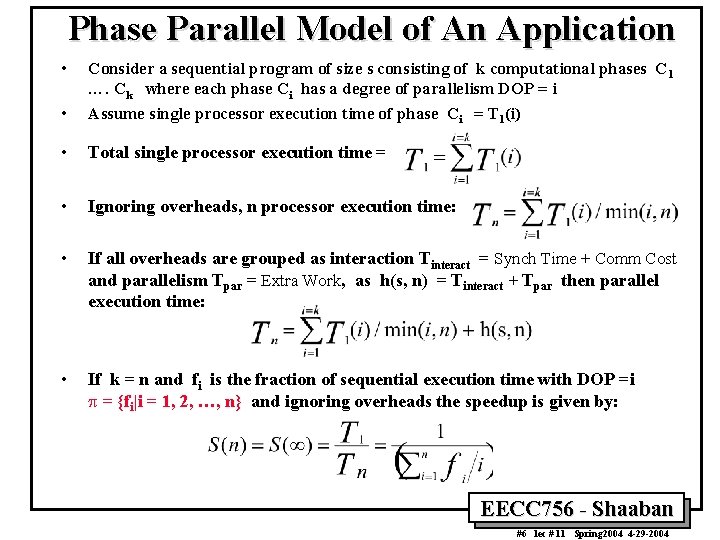
Phase Parallel Model of An Application • • Consider a sequential program of size s consisting of k computational phases C 1 …. Ck where each phase Ci has a degree of parallelism DOP = i Assume single processor execution time of phase Ci = T 1(i) • Total single processor execution time = • Ignoring overheads, n processor execution time: • If all overheads are grouped as interaction Tinteract = Synch Time + Comm Cost and parallelism Tpar = Extra Work, as h(s, n) = Tinteract + Tpar then parallel execution time: • If k = n and fi is the fraction of sequential execution time with DOP =i p = {fi|i = 1, 2, …, n} and ignoring overheads the speedup is given by: EECC 756 - Shaaban #6 lec # 11 Spring 2004 4 -29 -2004
Harmonic Mean Speedup for n Execution Mode Multiprocessor system Fig 3. 2 page 111 See handout EECC 756 - Shaaban #7 lec # 11 Spring 2004 4 -29 -2004
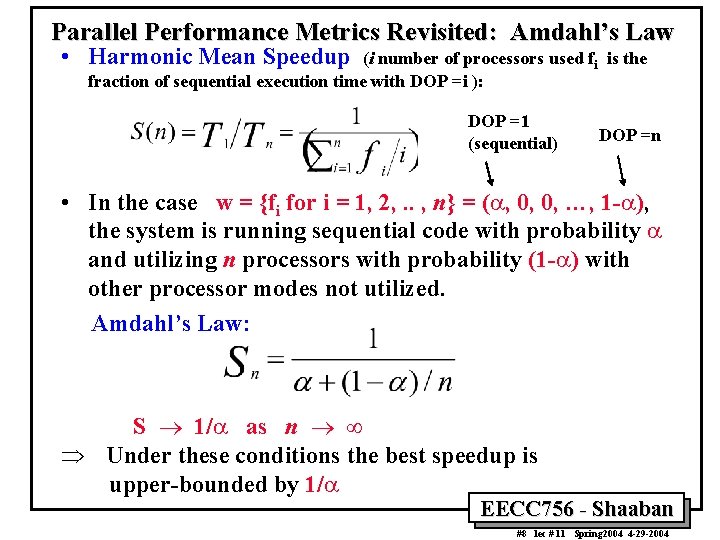
Parallel Performance Metrics Revisited: Amdahl’s Law • Harmonic Mean Speedup (i number of processors used fi is the fraction of sequential execution time with DOP =i ): DOP =1 (sequential) DOP =n • In the case w = {fi for i = 1, 2, . . , n} = (a, 0, 0, …, 1 -a), the system is running sequential code with probability a and utilizing n processors with probability (1 -a) with other processor modes not utilized. Amdahl’s Law: S ® 1/a as n ® ¥ Under these conditions the best speedup is upper-bounded by 1/a EECC 756 - Shaaban #8 lec # 11 Spring 2004 4 -29 -2004
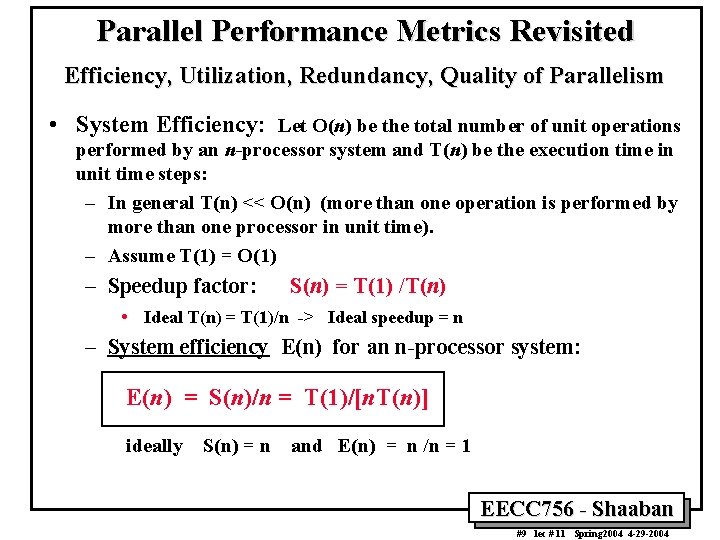
Parallel Performance Metrics Revisited Efficiency, Utilization, Redundancy, Quality of Parallelism • System Efficiency: Let O(n) be the total number of unit operations performed by an n-processor system and T(n) be the execution time in unit time steps: – In general T(n) << O(n) (more than one operation is performed by more than one processor in unit time). – Assume T(1) = O(1) – Speedup factor: S(n) = T(1) /T(n) • Ideal T(n) = T(1)/n -> Ideal speedup = n – System efficiency E(n) for an n-processor system: E(n) = S(n)/n = T(1)/[n. T(n)] ideally S(n) = n and E(n) = n /n = 1 EECC 756 - Shaaban #9 lec # 11 Spring 2004 4 -29 -2004
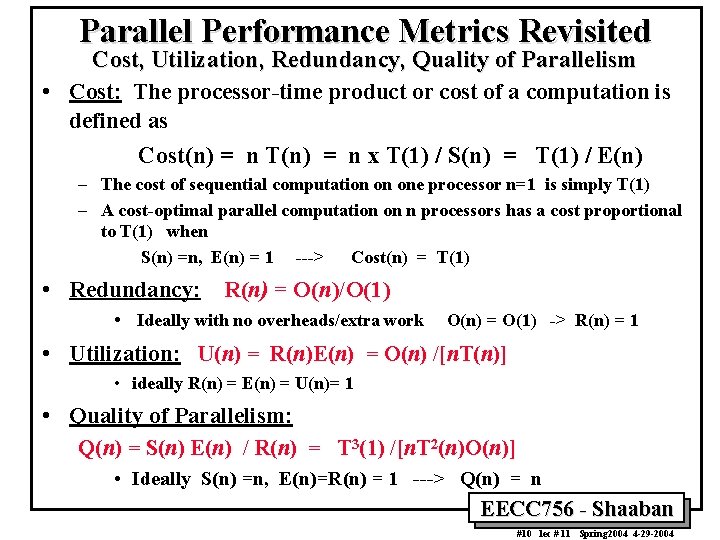
Parallel Performance Metrics Revisited Cost, Utilization, Redundancy, Quality of Parallelism • Cost: The processor-time product or cost of a computation is defined as Cost(n) = n T(n) = n x T(1) / S(n) = T(1) / E(n) – The cost of sequential computation on one processor n=1 is simply T(1) – A cost-optimal parallel computation on n processors has a cost proportional to T(1) when S(n) =n, E(n) = 1 ---> Cost(n) = T(1) • Redundancy: R(n) = O(n)/O(1) • Ideally with no overheads/extra work O(n) = O(1) -> R(n) = 1 • Utilization: U(n) = R(n)E(n) = O(n) /[n. T(n)] • ideally R(n) = E(n) = U(n)= 1 • Quality of Parallelism: Q(n) = S(n) E(n) / R(n) = T 3(1) /[n. T 2(n)O(n)] • Ideally S(n) =n, E(n)=R(n) = 1 ---> Q(n) = n EECC 756 - Shaaban #10 lec # 11 Spring 2004 4 -29 -2004
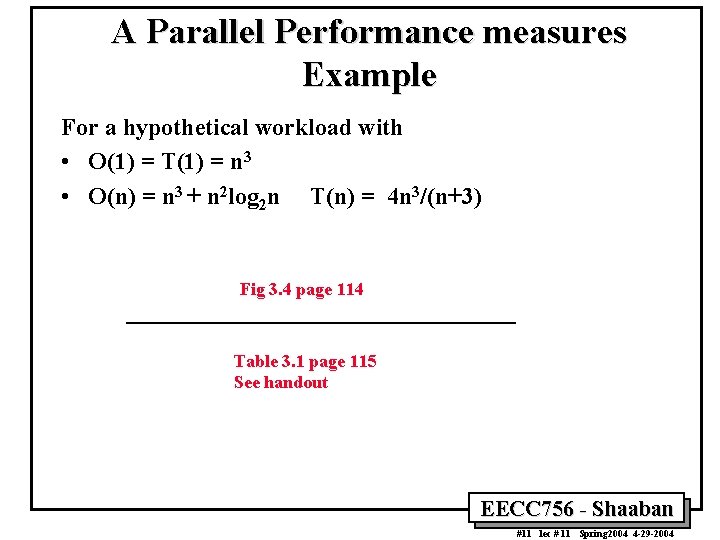
A Parallel Performance measures Example For a hypothetical workload with • O(1) = T(1) = n 3 • O(n) = n 3 + n 2 log 2 n T(n) = 4 n 3/(n+3) Fig 3. 4 page 114 Table 3. 1 page 115 See handout EECC 756 - Shaaban #11 lec # 11 Spring 2004 4 -29 -2004
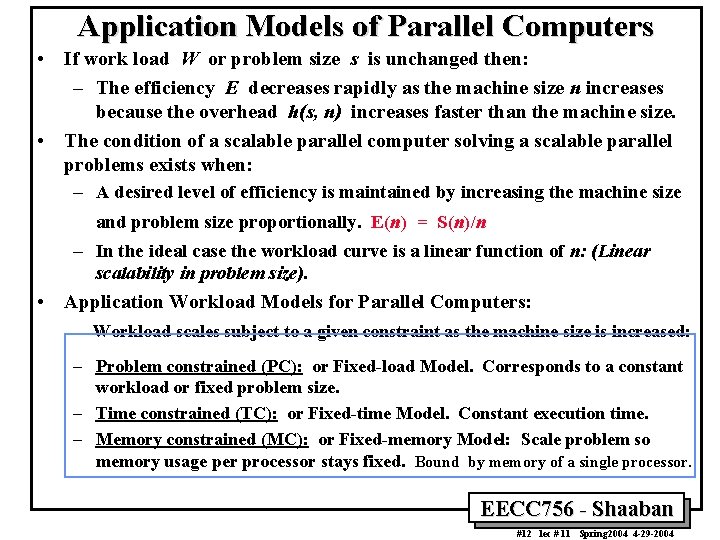
Application Models of Parallel Computers • If work load W or problem size s is unchanged then: – The efficiency E decreases rapidly as the machine size n increases because the overhead h(s, n) increases faster than the machine size. • The condition of a scalable parallel computer solving a scalable parallel problems exists when: – A desired level of efficiency is maintained by increasing the machine size and problem size proportionally. E(n) = S(n)/n • – In the ideal case the workload curve is a linear function of n: (Linear scalability in problem size). Application Workload Models for Parallel Computers: Workload scales subject to a given constraint as the machine size is increased: – Problem constrained (PC): or Fixed-load Model. Corresponds to a constant workload or fixed problem size. – Time constrained (TC): or Fixed-time Model. Constant execution time. – Memory constrained (MC): or Fixed-memory Model: Scale problem so memory usage per processor stays fixed. Bound by memory of a single processor. EECC 756 - Shaaban #12 lec # 11 Spring 2004 4 -29 -2004
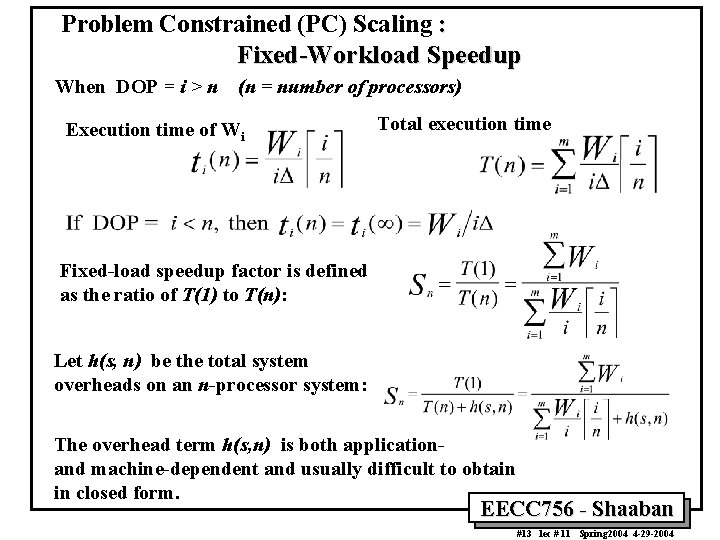
Problem Constrained (PC) Scaling : Fixed-Workload Speedup When DOP = i > n (n = number of processors) Execution time of Wi Total execution time Fixed-load speedup factor is defined as the ratio of T(1) to T(n): Let h(s, n) be the total system overheads on an n-processor system: The overhead term h(s, n) is both applicationand machine-dependent and usually difficult to obtain in closed form. EECC 756 - Shaaban #13 lec # 11 Spring 2004 4 -29 -2004
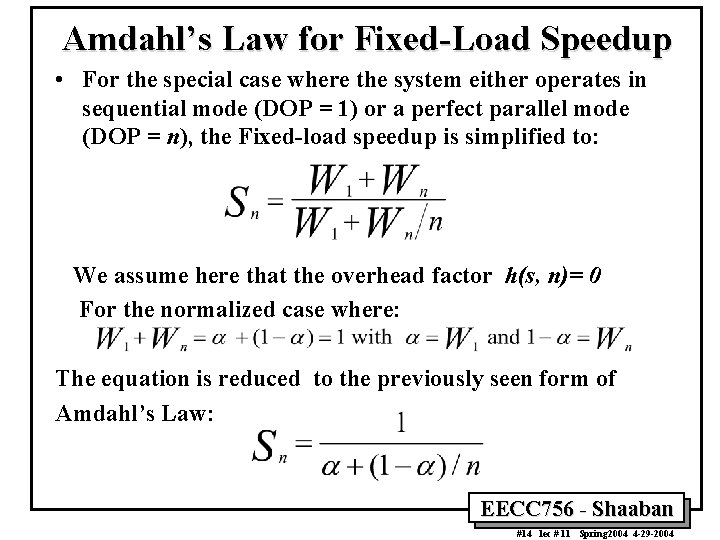
Amdahl’s Law for Fixed-Load Speedup • For the special case where the system either operates in sequential mode (DOP = 1) or a perfect parallel mode (DOP = n), the Fixed-load speedup is simplified to: We assume here that the overhead factor h(s, n)= 0 For the normalized case where: The equation is reduced to the previously seen form of Amdahl’s Law: EECC 756 - Shaaban #14 lec # 11 Spring 2004 4 -29 -2004
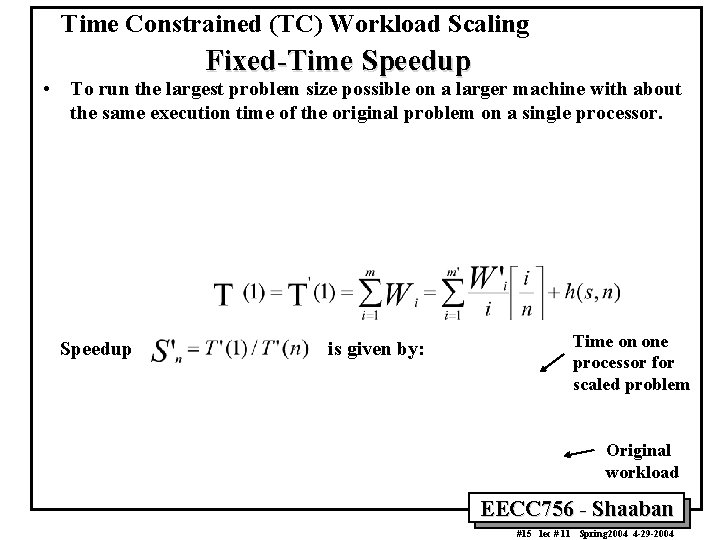
Time Constrained (TC) Workload Scaling Fixed-Time Speedup • To run the largest problem size possible on a larger machine with about the same execution time of the original problem on a single processor. Speedup is given by: Time on one processor for scaled problem Original workload EECC 756 - Shaaban #15 lec # 11 Spring 2004 4 -29 -2004
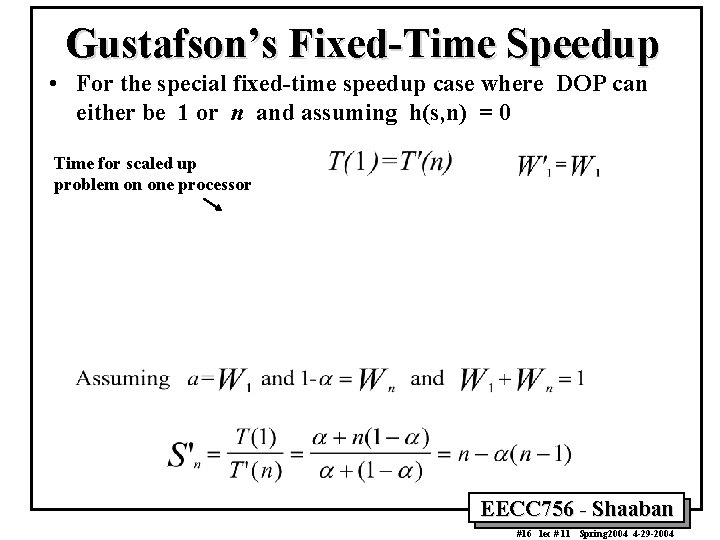
Gustafson’s Fixed-Time Speedup • For the special fixed-time speedup case where DOP can either be 1 or n and assuming h(s, n) = 0 Time for scaled up problem on one processor EECC 756 - Shaaban #16 lec # 11 Spring 2004 4 -29 -2004
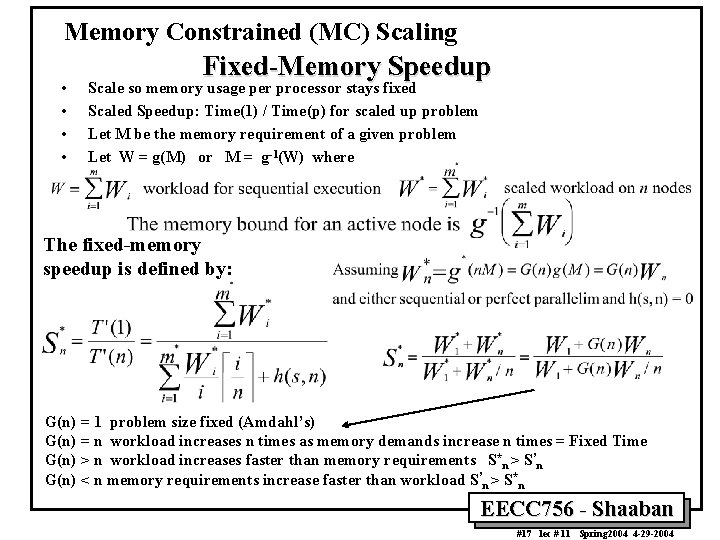
Memory Constrained (MC) Scaling • • Fixed-Memory Speedup Scale so memory usage per processor stays fixed Scaled Speedup: Time(1) / Time(p) for scaled up problem Let M be the memory requirement of a given problem Let W = g(M) or M = g-1(W) where The fixed-memory speedup is defined by: G(n) = 1 problem size fixed (Amdahl’s) G(n) = n workload increases n times as memory demands increase n times = Fixed Time G(n) > n workload increases faster than memory requirements S*n > S’n G(n) < n memory requirements increase faster than workload S’n > S*n EECC 756 - Shaaban #17 lec # 11 Spring 2004 4 -29 -2004
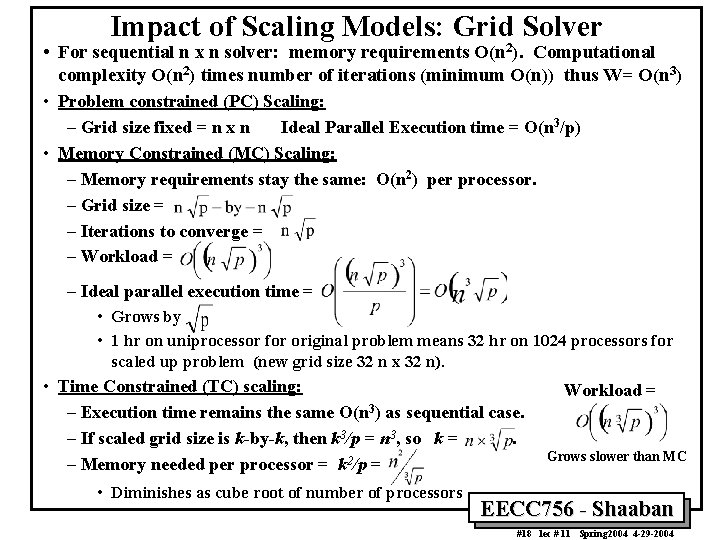
Impact of Scaling Models: Grid Solver • For sequential n x n solver: memory requirements O(n 2). Computational complexity O(n 2) times number of iterations (minimum O(n)) thus W= O(n 3) • Problem constrained (PC) Scaling: – Grid size fixed = n x n Ideal Parallel Execution time = O(n 3/p) • Memory Constrained (MC) Scaling: – Memory requirements stay the same: O(n 2) per processor. – Grid size = – Iterations to converge = – Workload = – Ideal parallel execution time = • Grows by • 1 hr on uniprocessor for original problem means 32 hr on 1024 processors for scaled up problem (new grid size 32 n x 32 n). • Time Constrained (TC) scaling: Workload = – Execution time remains the same O(n 3) as sequential case. – If scaled grid size is k-by-k, then k 3/p = n 3, so k =. Grows slower than MC – Memory needed per processor = k 2/p = • Diminishes as cube root of number of processors EECC 756 - Shaaban #18 lec # 11 Spring 2004 4 -29 -2004
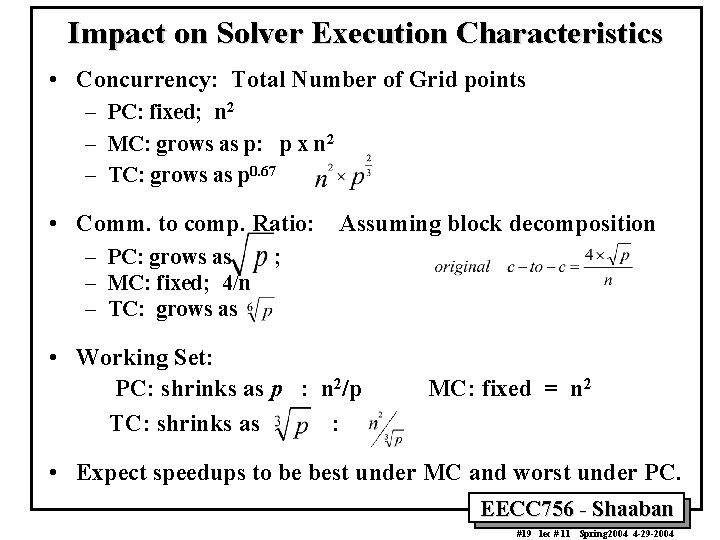
Impact on Solver Execution Characteristics • Concurrency: Total Number of Grid points – PC: fixed; n 2 – MC: grows as p: p x n 2 – TC: grows as p 0. 67 • Comm. to comp. Ratio: Assuming block decomposition – PC: grows as – MC: fixed; 4/n – TC: grows as ; • Working Set: PC: shrinks as p : n 2/p TC: shrinks as : MC: fixed = n 2 • Expect speedups to be best under MC and worst under PC. EECC 756 - Shaaban #19 lec # 11 Spring 2004 4 -29 -2004
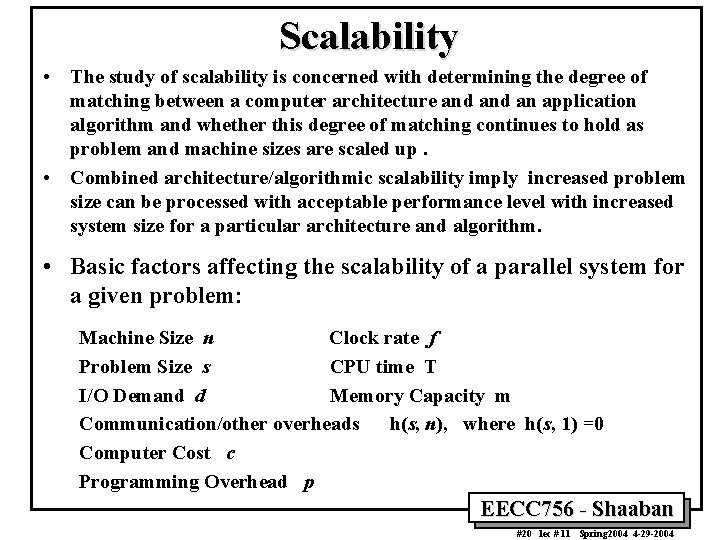
Scalability • The study of scalability is concerned with determining the degree of matching between a computer architecture and an application algorithm and whether this degree of matching continues to hold as problem and machine sizes are scaled up. • Combined architecture/algorithmic scalability imply increased problem size can be processed with acceptable performance level with increased system size for a particular architecture and algorithm. • Basic factors affecting the scalability of a parallel system for a given problem: Machine Size n Clock rate f Problem Size s CPU time T I/O Demand d Memory Capacity m Communication/other overheads h(s, n), where h(s, 1) =0 Computer Cost c Programming Overhead p EECC 756 - Shaaban #20 lec # 11 Spring 2004 4 -29 -2004
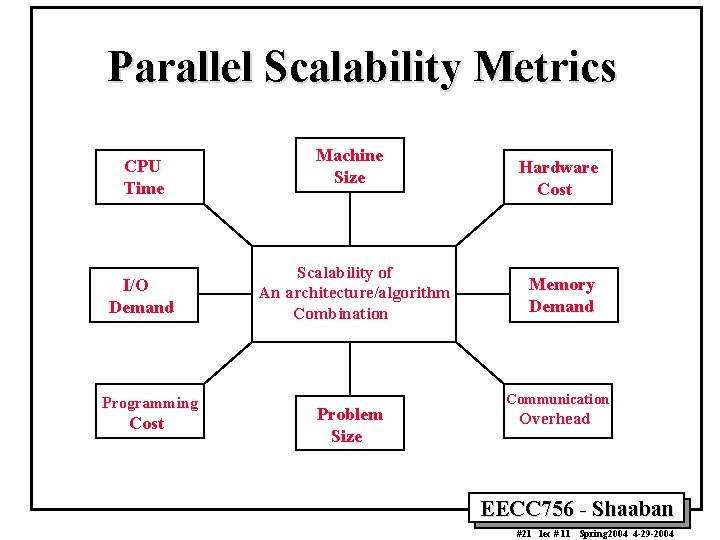
Parallel Scalability Metrics CPU Time I/O Demand Programming Cost Machine Size Scalability of An architecture/algorithm Combination Problem Size Hardware Cost Memory Demand Communication Overhead EECC 756 - Shaaban #21 lec # 11 Spring 2004 4 -29 -2004
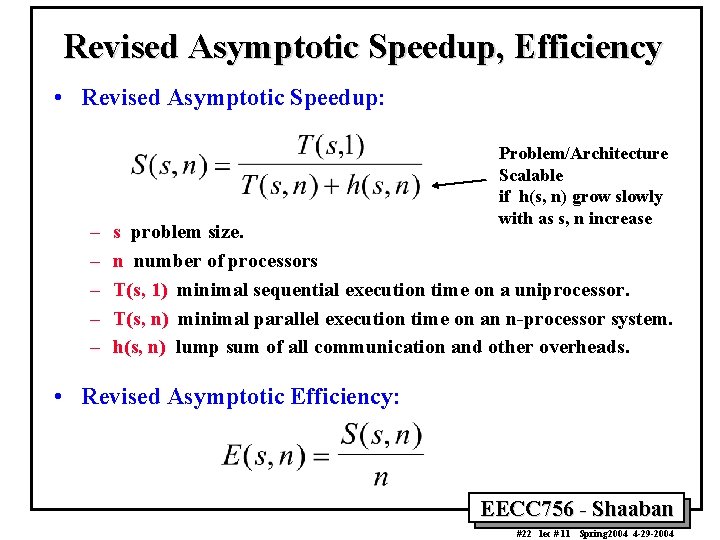
Revised Asymptotic Speedup, Efficiency • Revised Asymptotic Speedup: – – – Problem/Architecture Scalable if h(s, n) grow slowly with as s, n increase s problem size. n number of processors T(s, 1) minimal sequential execution time on a uniprocessor. T(s, n) minimal parallel execution time on an n-processor system. h(s, n) lump sum of all communication and other overheads. • Revised Asymptotic Efficiency: EECC 756 - Shaaban #22 lec # 11 Spring 2004 4 -29 -2004
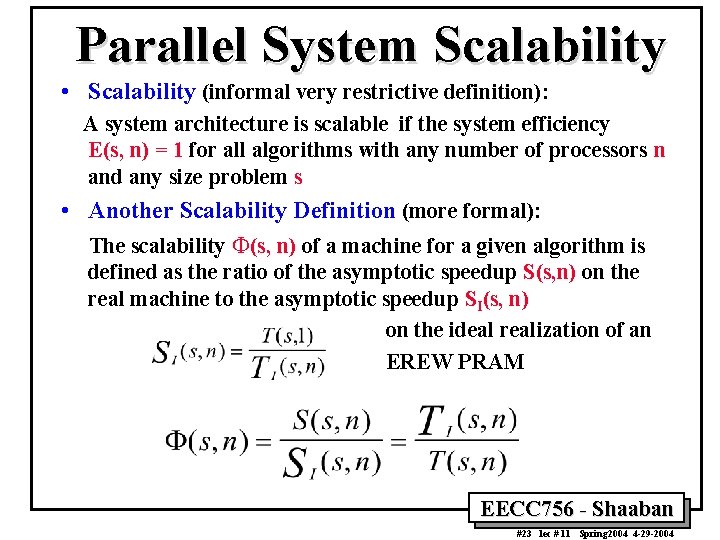
Parallel System Scalability • Scalability (informal very restrictive definition): A system architecture is scalable if the system efficiency E(s, n) = 1 for all algorithms with any number of processors n and any size problem s • Another Scalability Definition (more formal): The scalability F(s, n) of a machine for a given algorithm is defined as the ratio of the asymptotic speedup S(s, n) on the real machine to the asymptotic speedup SI(s, n) on the ideal realization of an EREW PRAM EECC 756 - Shaaban #23 lec # 11 Spring 2004 4 -29 -2004
Example: Scalability of Network Architectures for Parity Calculation Table 3. 7 page 142 see handout EECC 756 - Shaaban #24 lec # 11 Spring 2004 4 -29 -2004
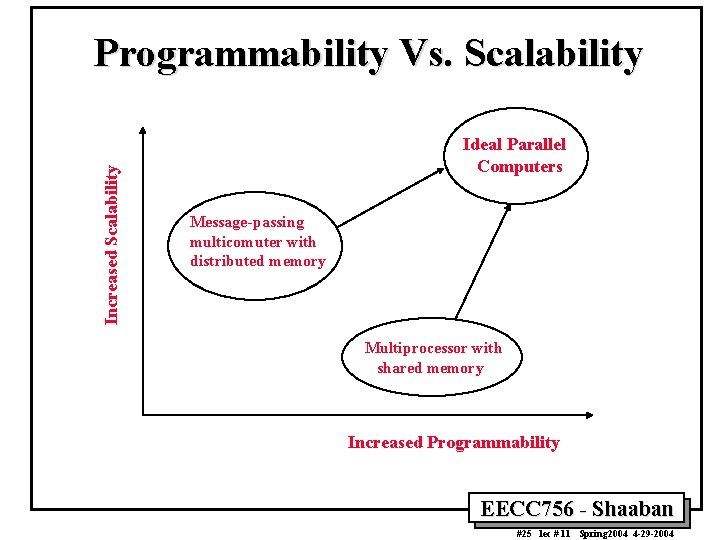
Increased Scalability Programmability Vs. Scalability Ideal Parallel Computers Message-passing multicomuter with distributed memory Multiprocessor with shared memory Increased Programmability EECC 756 - Shaaban #25 lec # 11 Spring 2004 4 -29 -2004
Evaluating a Real Parallel Machine • Performance Isolation using Microbenchmarks • Choosing Workloads • Evaluating a Fixed-size Machine • Varying Machine Size • All these issues, plus more, relevant to evaluating a tradeoff via simulation EECC 756 - Shaaban #26 lec # 11 Spring 2004 4 -29 -2004
Performance Isolation: Microbenchmarks • Microbenchmarks: Small, specially written programs to isolate performance characteristics – – Processing. Local memory. Input/output. Communication and remote access (read/write, send/receive) – Synchronization (locks, barriers). – Contention. EECC 756 - Shaaban #27 lec # 11 Spring 2004 4 -29 -2004
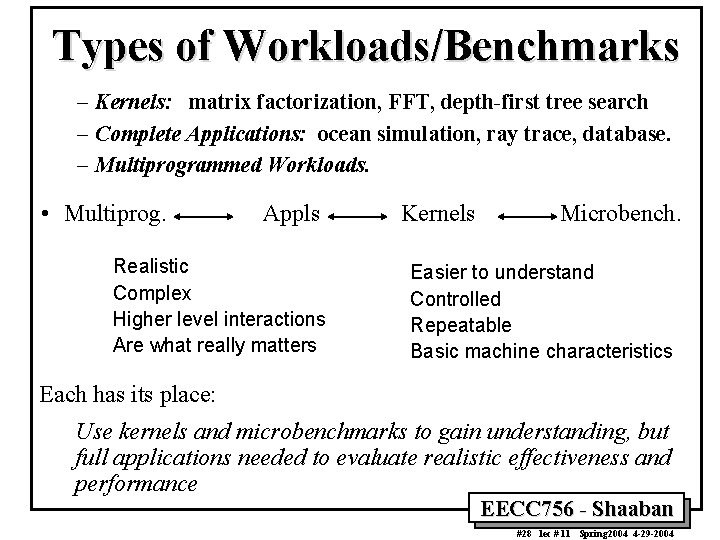
Types of Workloads/Benchmarks – Kernels: matrix factorization, FFT, depth-first tree search – Complete Applications: ocean simulation, ray trace, database. – Multiprogrammed Workloads. • Multiprog. Appls Realistic Complex Higher level interactions Are what really matters Kernels Microbench. Easier to understand Controlled Repeatable Basic machine characteristics Each has its place: Use kernels and microbenchmarks to gain understanding, but full applications needed to evaluate realistic effectiveness and performance EECC 756 - Shaaban #28 lec # 11 Spring 2004 4 -29 -2004

Desirable Properties of Workloads • Representative of application domains • Coverage of behavioral properties • Adequate concurrency EECC 756 - Shaaban #29 lec # 11 Spring 2004 4 -29 -2004
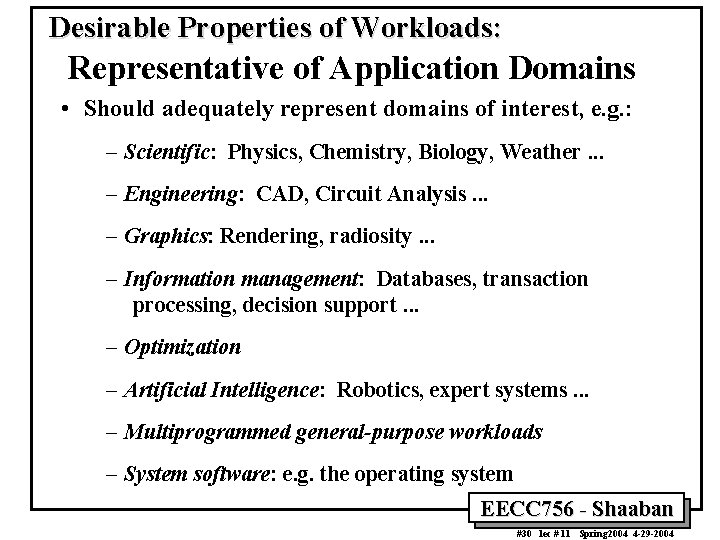
Desirable Properties of Workloads: Representative of Application Domains • Should adequately represent domains of interest, e. g. : – Scientific: Physics, Chemistry, Biology, Weather. . . – Engineering: CAD, Circuit Analysis. . . – Graphics: Rendering, radiosity. . . – Information management: Databases, transaction processing, decision support. . . – Optimization – Artificial Intelligence: Robotics, expert systems. . . – Multiprogrammed general-purpose workloads – System software: e. g. the operating system EECC 756 - Shaaban #30 lec # 11 Spring 2004 4 -29 -2004
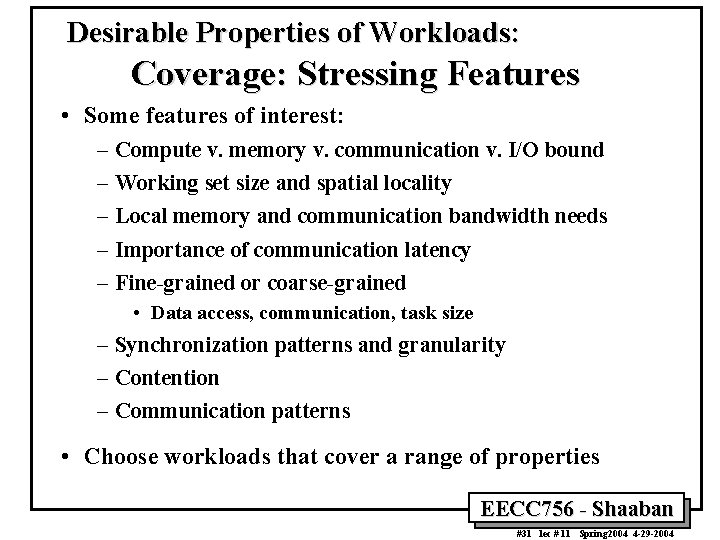
Desirable Properties of Workloads: Coverage: Stressing Features • Some features of interest: – – – Compute v. memory v. communication v. I/O bound Working set size and spatial locality Local memory and communication bandwidth needs Importance of communication latency Fine-grained or coarse-grained • Data access, communication, task size – Synchronization patterns and granularity – Contention – Communication patterns • Choose workloads that cover a range of properties EECC 756 - Shaaban #31 lec # 11 Spring 2004 4 -29 -2004
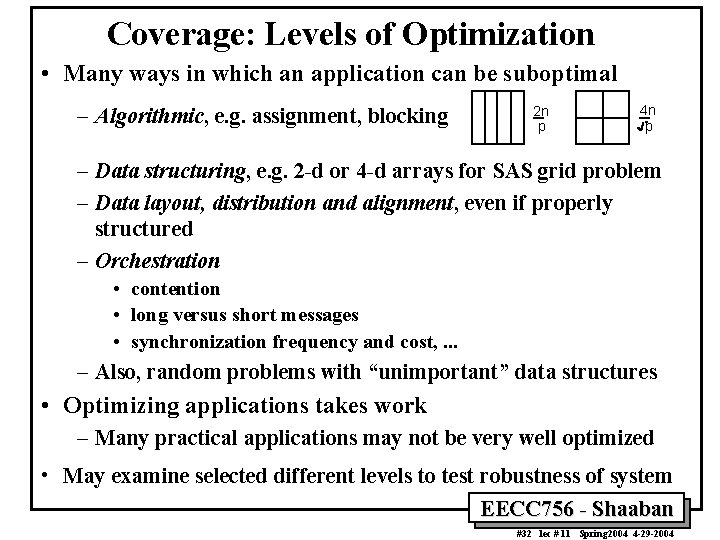
Coverage: Levels of Optimization • Many ways in which an application can be suboptimal – Algorithmic, e. g. assignment, blocking 2 n p 4 n p – Data structuring, e. g. 2 -d or 4 -d arrays for SAS grid problem – Data layout, distribution and alignment, even if properly structured – Orchestration • contention • long versus short messages • synchronization frequency and cost, . . . – Also, random problems with “unimportant” data structures • Optimizing applications takes work – Many practical applications may not be very well optimized • May examine selected different levels to test robustness of system EECC 756 - Shaaban #32 lec # 11 Spring 2004 4 -29 -2004
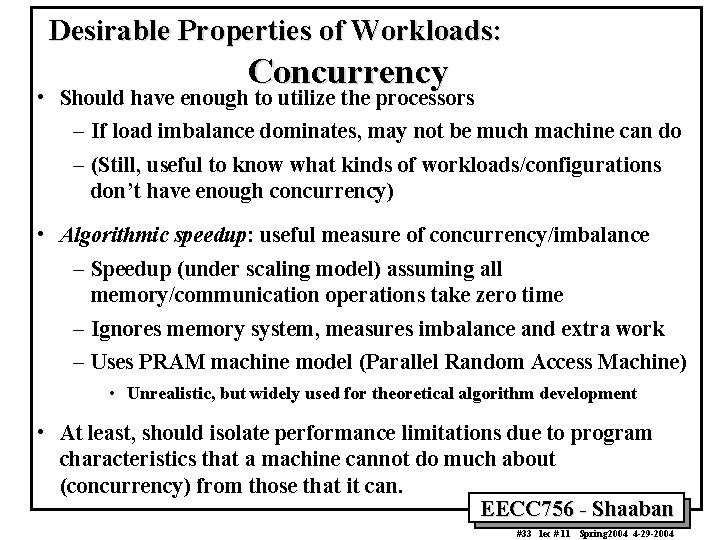
Desirable Properties of Workloads: Concurrency • Should have enough to utilize the processors – If load imbalance dominates, may not be much machine can do – (Still, useful to know what kinds of workloads/configurations don’t have enough concurrency) • Algorithmic speedup: useful measure of concurrency/imbalance – Speedup (under scaling model) assuming all memory/communication operations take zero time – Ignores memory system, measures imbalance and extra work – Uses PRAM machine model (Parallel Random Access Machine) • Unrealistic, but widely used for theoretical algorithm development • At least, should isolate performance limitations due to program characteristics that a machine cannot do much about (concurrency) from those that it can. EECC 756 - Shaaban #33 lec # 11 Spring 2004 4 -29 -2004
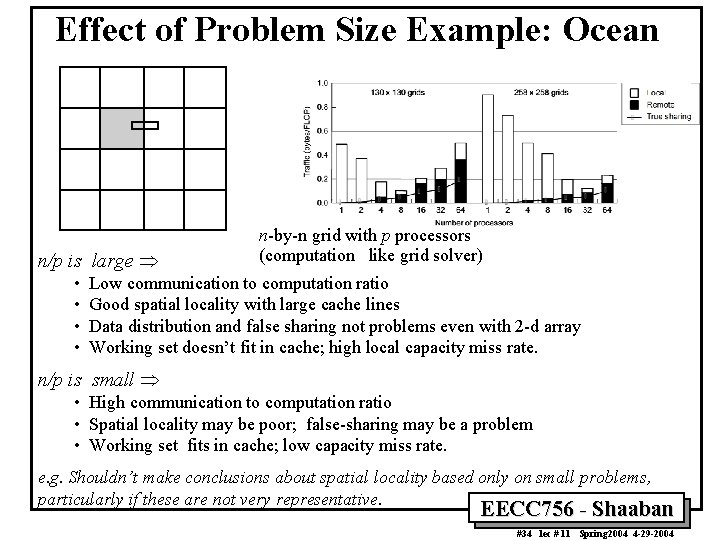
Effect of Problem Size Example: Ocean n/p is large • • n-by-n grid with p processors (computation like grid solver) Low communication to computation ratio Good spatial locality with large cache lines Data distribution and false sharing not problems even with 2 -d array Working set doesn’t fit in cache; high local capacity miss rate. n/p is small • High communication to computation ratio • Spatial locality may be poor; false-sharing may be a problem • Working set fits in cache; low capacity miss rate. e. g. Shouldn’t make conclusions about spatial locality based only on small problems, particularly if these are not very representative. EECC 756 - Shaaban #34 lec # 11 Spring 2004 4 -29 -2004
Sample Workload/Benchmark Suites • Numerical Aerodynamic Simulation (NAS) – Originally pencil and paper benchmarks • SPLASH/SPLASH-2 – Shared address space parallel programs • Park. Bench – Message-passing parallel programs • Sca. Lapack – Message-passing kernels • TPC – Transaction processing – SPEC-HPC • . . . EECC 756 - Shaaban #35 lec # 11 Spring 2004 4 -29 -2004
Multiprocessor Simulation • Simulation runs on a uniprocessor (can be parallelized too) – Simulated processes are interleaved on the processor • Two parts to a simulator: – Reference generator: plays role of simulated processors • And schedules simulated processes based on simulated time – Simulator of extended memory hierarchy • Simulates operations (references, commands) issued by reference generator • Coupling or information flow between the two parts varies – Trace-driven simulation: from generator to simulator – Execution-driven simulation: in both directions (more accurate) • Simulator keeps track of simulated time and detailed statistics. EECC 756 - Shaaban #36 lec # 11 Spring 2004 4 -29 -2004
Execution-Driven Simulation • Memory hierarchy simulator returns simulated time information to reference generator, which is used to schedule simulated processes. EECC 756 - Shaaban #37 lec # 11 Spring 2004 4 -29 -2004
- Slides: 37