
Parallel Structure A key step to becoming an
Parallel Structure A key step to becoming an advanced writer Adapted from Purdue OWL
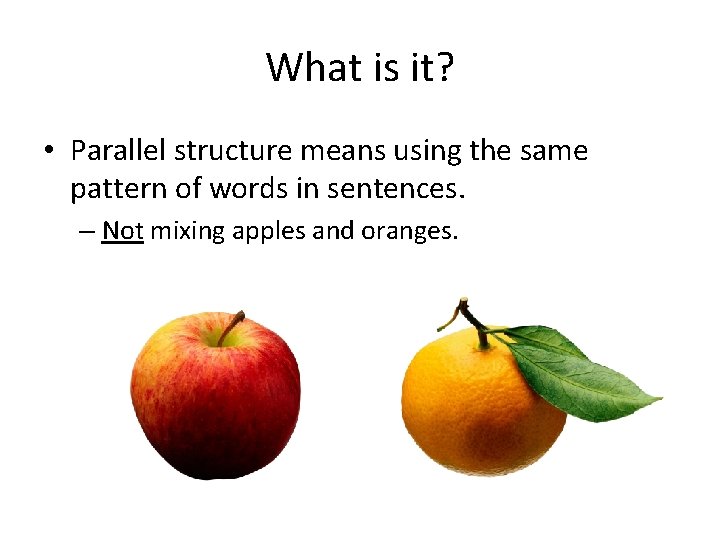
What is it? • Parallel structure means using the same pattern of words in sentences. – Not mixing apples and oranges.

Words and Phrases • Parallel: – John likes hiking, swimming, and biking. • (all gerunds) • Not parallel: – John likes hiking, swimming, and to ride a bike. • (two gerunds and an infinitive)
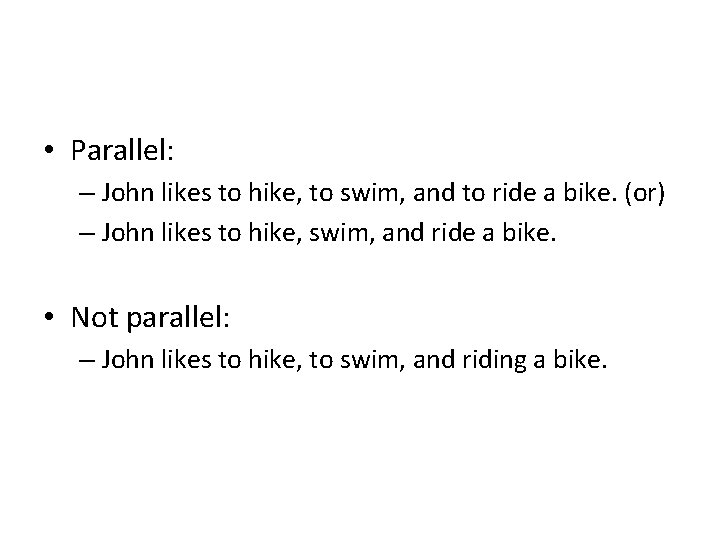
• Parallel: – John likes to hike, to swim, and to ride a bike. (or) – John likes to hike, swim, and ride a bike. • Not parallel: – John likes to hike, to swim, and riding a bike.

• Not parallel: – The student was asked to write his essay quickly, accurately, and with all the details. • (two adverbs and a prepositional phrase) • Parallel: – The student was asked to write his essay quickly, accurately, and thoroughly. • (all adverbs)

• Not parallel: – He was a poor student because he waited until the day before to write his essay, tried to use a comma to join two sentences, and his effort was low. • Parallel: – He was a poor student because he waited until the day before to write his essay, tried to use a comma to join two sentences, and lacked effort.
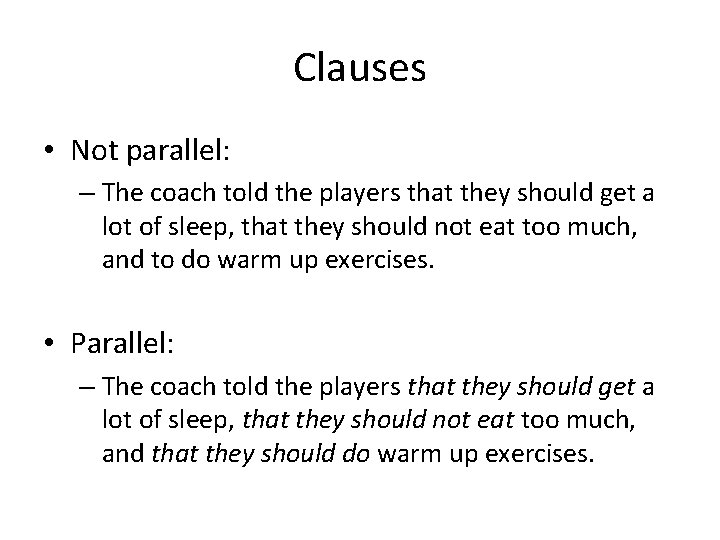
Clauses • Not parallel: – The coach told the players that they should get a lot of sleep, that they should not eat too much, and to do warm up exercises. • Parallel: – The coach told the players that they should get a lot of sleep, that they should not eat too much, and that they should do warm up exercises.

• Also parallel: – The coach told the players that they should get a lot of sleep, not eat too much, and do warm up exercises.
Active vs. Passive Voice • Active: – John threw the ball. • The subject (John) is doing the action of the verb. • Passive: – The ball was thrown by John. • The subject (ball) is having the action done to it.
Active vs. Passive Voice • Not parallel: – Jane expected that she would give her presentation today, that she would have time to set up, and that questions would be asked by the teacher. • Parallel: – Jane expected that she would give her presentation today, that she would have time to set up, and that the teacher would ask questions.
Proofreading Strategies • Pause at the words “and” and “or. ” Check on each side of these words to see whether the items joined are parallel. • Read your writing out loud. Listen for anything that breaks the rhythm.
More than grammar • “The great enemy of the truth is very often not the lie – deliberate, contrived, and dishonest – but the myth – persistent, persuasive, and unrealistic. ” – John F Kennedy
• “In the end, we will remember not the words of our enemies, but the silence of our friends. ” – Martin Luther King Jr.
- Slides: 13