
Parallel robot Stewart Platform Do F N6 xmembri14
Parallel robot
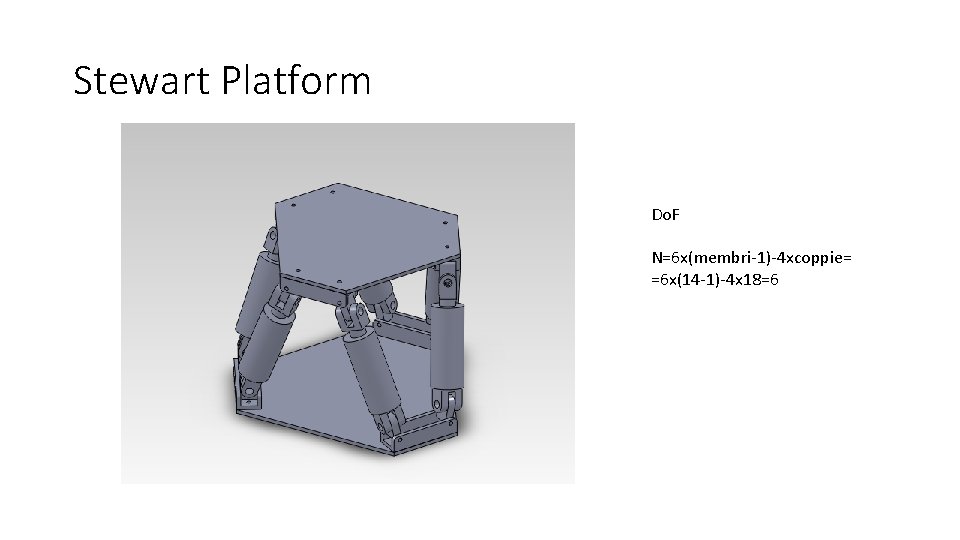
Stewart Platform Do. F N=6 x(membri-1)-4 xcoppie= =6 x(14 -1)-4 x 18=6
Video • Structure • https: //www. youtube. com/watch? v=Wm. Knnp 1 x. TPg • Apelmann (offshore application) https: //www. youtube. com/watch? v=a. Bn 7 w 1 S 8 Mt. Y • Modified Stewart Platform (for simulators) https: //www. youtube. com/watch? v=PIl 8 Epy 9 x. Iw https: //www. youtube. com/watch? v=z. NUBZfr. OXUc&t=28 s
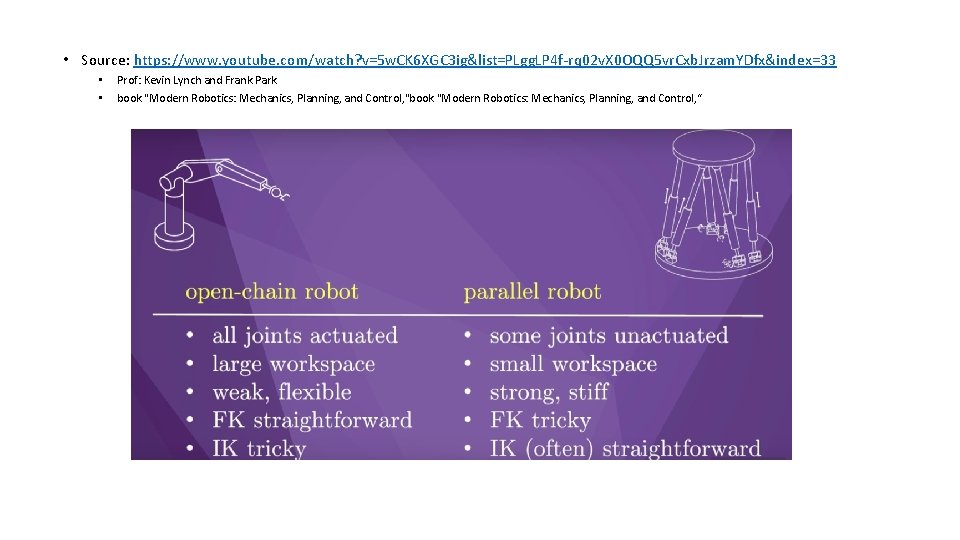
• Source: https: //www. youtube. com/watch? v=5 w. CK 6 XGC 3 ig&list=PLgg. LP 4 f-rq 02 v. X 0 OQQ 5 vr. Cxb. Jrzam. YDfx&index=33 • • Prof: Kevin Lynch and Frank Park book "Modern Robotics: Mechanics, Planning, and Control, "book "Modern Robotics: Mechanics, Planning, and Control, “
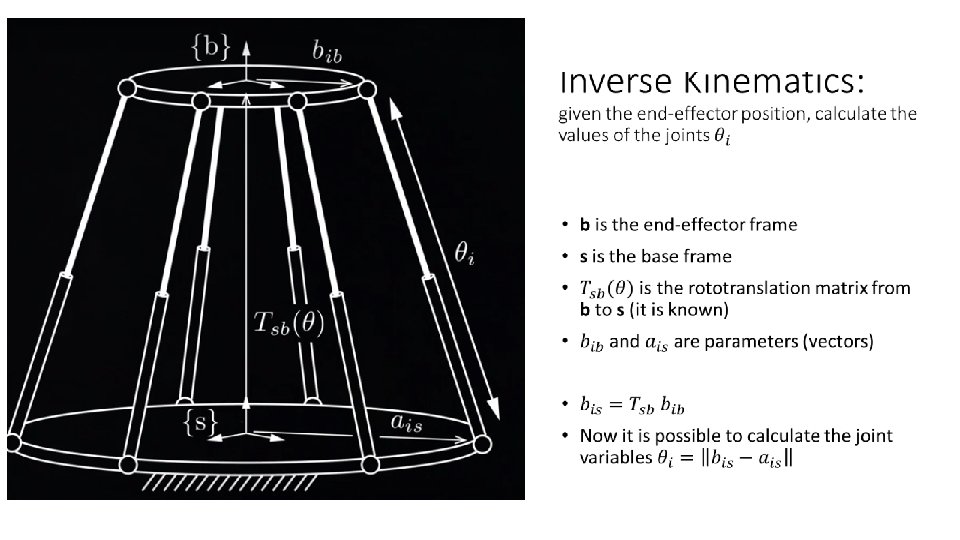
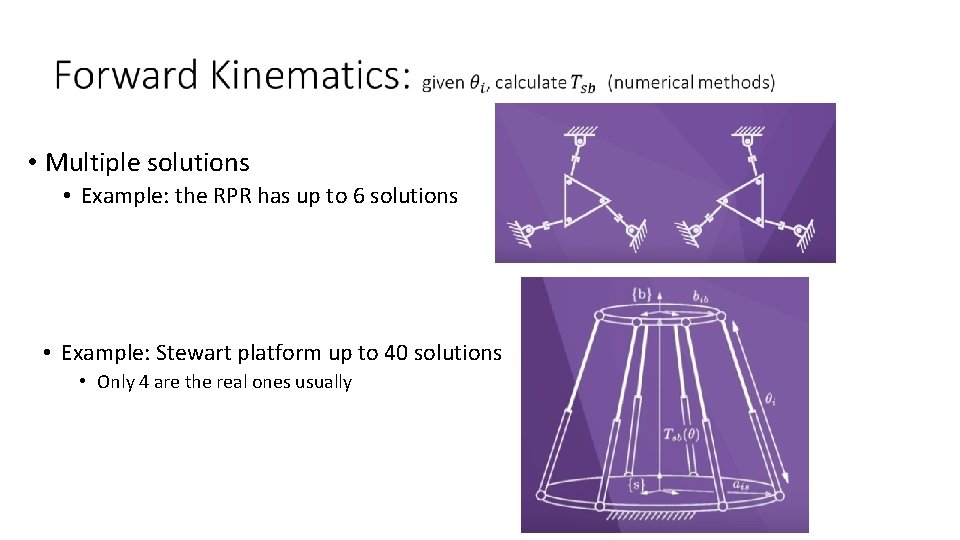
• Multiple solutions • Example: the RPR has up to 6 solutions • Example: Stewart platform up to 40 solutions • Only 4 are the real ones usually
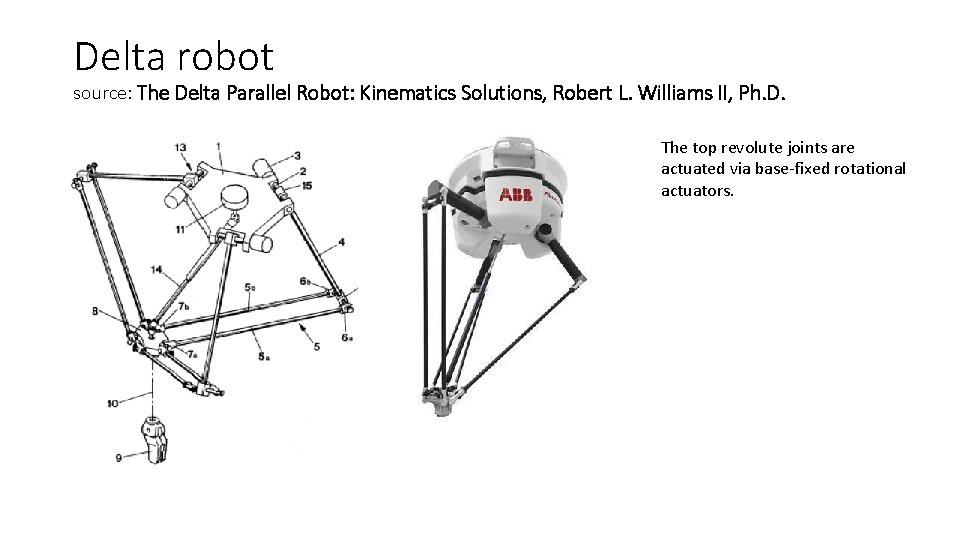
Delta robot source: The Delta Parallel Robot: Kinematics Solutions, Robert L. Williams II, Ph. D. The top revolute joints are actuated via base-fixed rotational actuators.
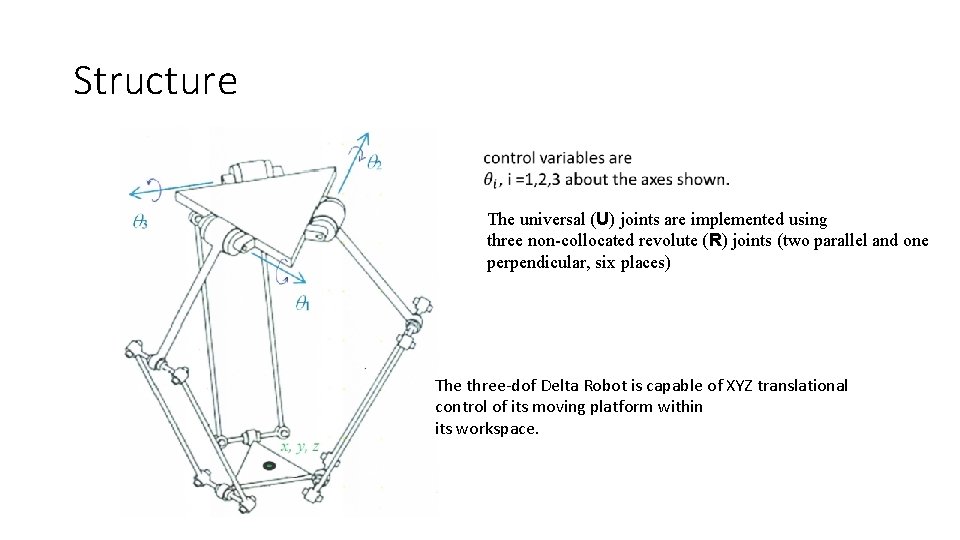
Structure The universal (U) joints are implemented using three non-collocated revolute (R) joints (two parallel and one perpendicular, six places) The three-dof Delta Robot is capable of XYZ translational control of its moving platform within its workspace.
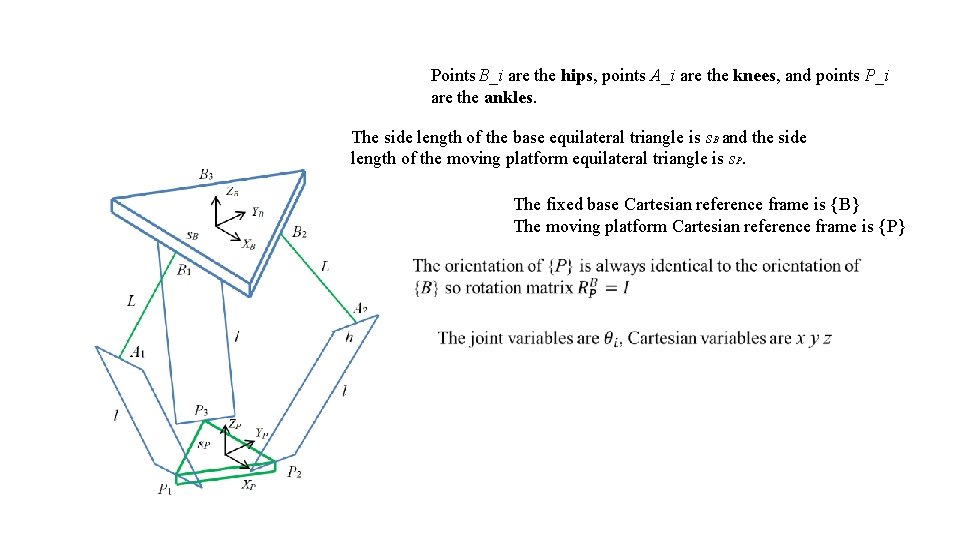
Points B_i are the hips, points A_i are the knees, and points P_i are the ankles. The side length of the base equilateral triangle is s. B and the side length of the moving platform equilateral triangle is s. P. The fixed base Cartesian reference frame is {B} The moving platform Cartesian reference frame is {P}
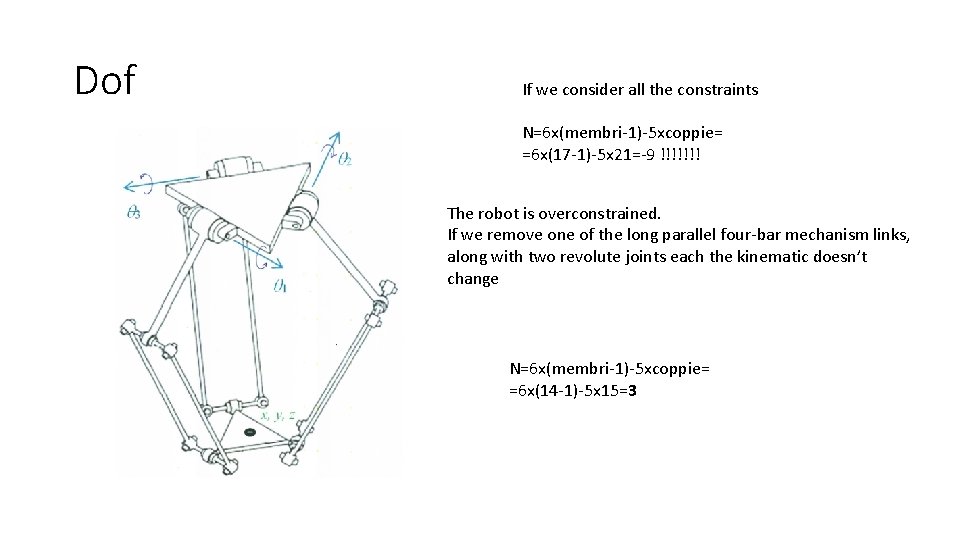
Dof If we consider all the constraints N=6 x(membri-1)-5 xcoppie= =6 x(17 -1)-5 x 21=-9 !!!!!!! The robot is overconstrained. If we remove one of the long parallel four-bar mechanism links, along with two revolute joints each the kinematic doesn’t change N=6 x(membri-1)-5 xcoppie= =6 x(14 -1)-5 x 15=3
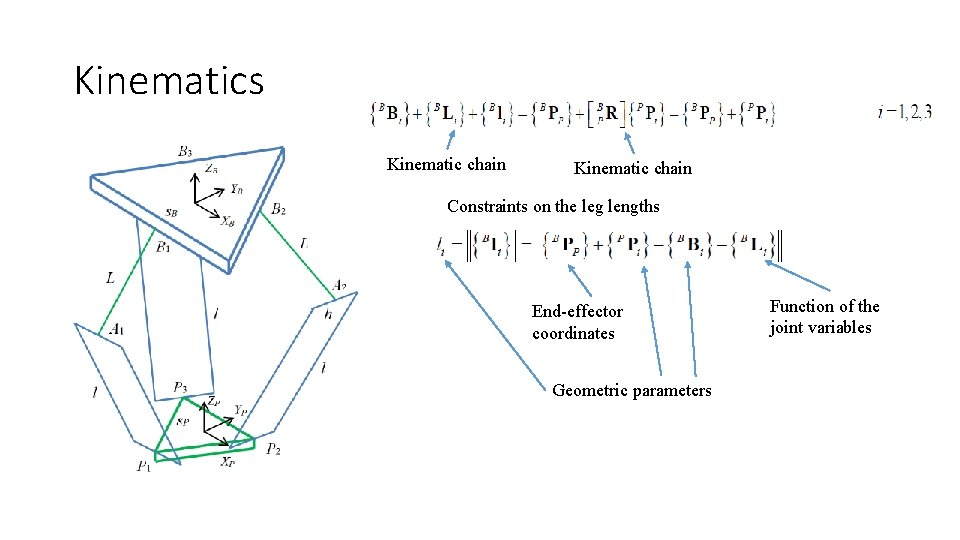
Kinematics Kinematic chain Constraints on the leg lengths End-effector coordinates Geometric parameters Function of the joint variables
Inverse kinematics problem The inverse position kinematics (IPK) problem is: Given the Cartesian position of the moving platform control point (the origin of {P=x, y, z}), calculate the revolute joint angles. The IPK solution for parallel robots is often straightforward but the IPK solution for the Delta Robot is not trivial, but can be found analytically. The IPK problem can be solved independently for each of the three RUU legs. Geometrically, each leg IPK solution is the intersection between a known circle (radius L, centered on B_i) and a known sphere (radius l, centered on the moving platform vertex P_i)
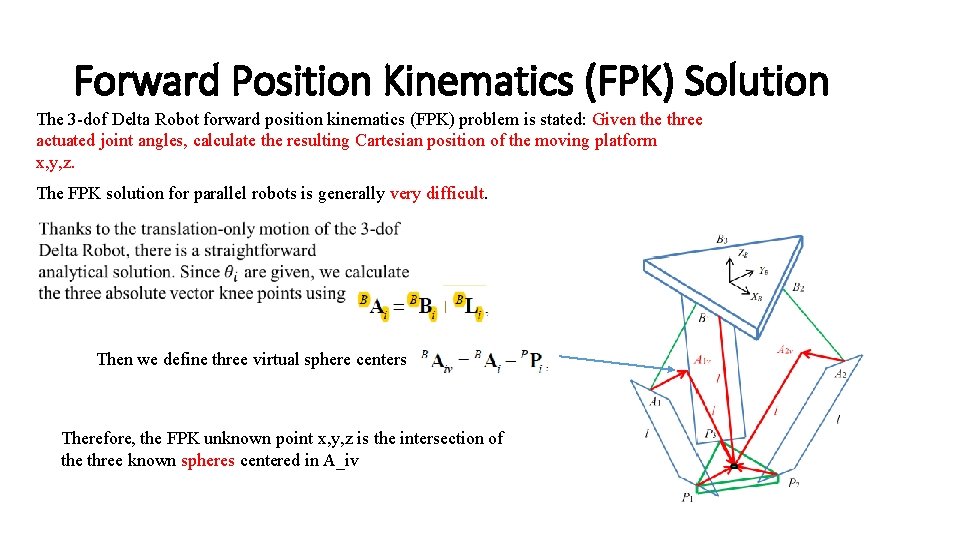
Forward Position Kinematics (FPK) Solution The 3 -dof Delta Robot forward position kinematics (FPK) problem is stated: Given the three actuated joint angles, calculate the resulting Cartesian position of the moving platform x, y, z. The FPK solution for parallel robots is generally very difficult. Then we define three virtual sphere centers Therefore, the FPK unknown point x, y, z is the intersection of the three known spheres centered in A_iv
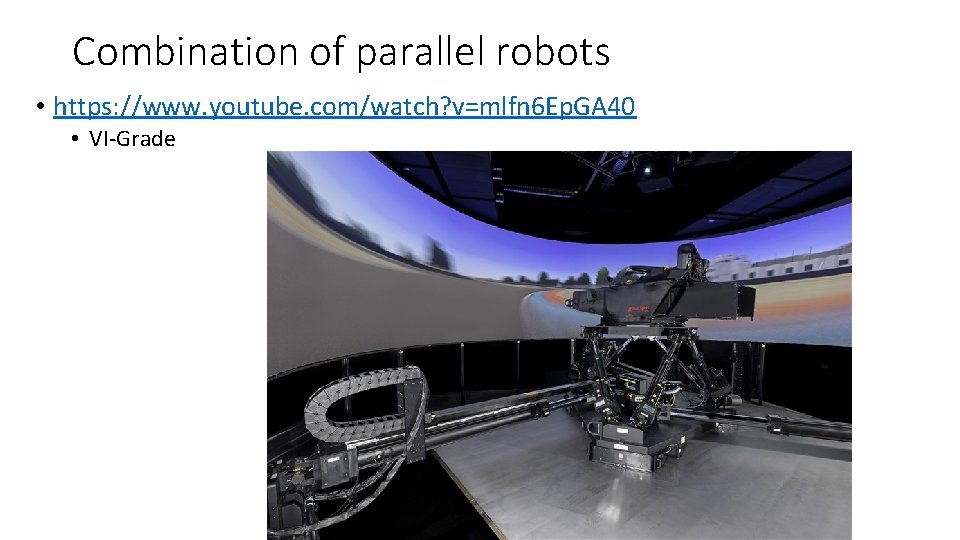
Combination of parallel robots • https: //www. youtube. com/watch? v=mlfn 6 Ep. GA 40 • VI-Grade
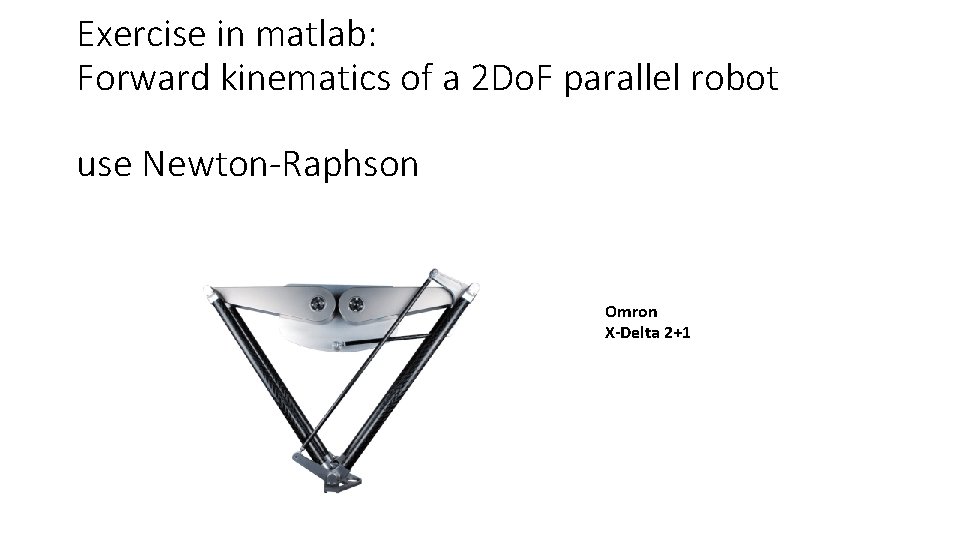
Exercise in matlab: Forward kinematics of a 2 Do. F parallel robot use Newton-Raphson Omron X-Delta 2+1
- Slides: 15