
Parallel Programming With Apache Spark Reynold Xin What
- Slides: 49
Parallel Programming With Apache Spark Reynold Xin
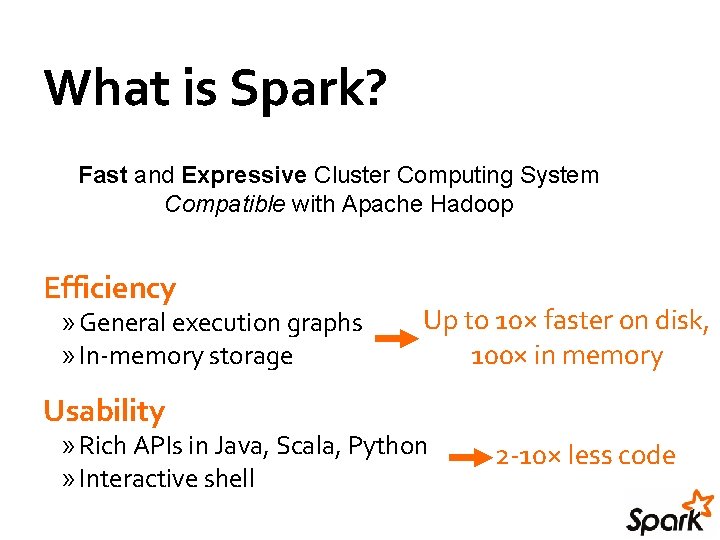
What is Spark? Fast and Expressive Cluster Computing System Compatible with Apache Hadoop Efficiency » General execution graphs » In-memory storage Up to 10× faster on disk, 100× in memory Usability » Rich APIs in Java, Scala, Python » Interactive shell 2 -10× less code
Project History • Spark started in 2009, open sourced 2010 • In use at Intel, Yahoo!, Adobe, Alibaba Taobao, Conviva, Ooyala, Bizo and others • Entered Apache Incubator in June
Open Source Community • 1300+ meetup members • 90+ code contributors • 20 companies contributing
This Talk Introduction to Spark Tour of Spark operations (in Python) Job execution Standalone apps
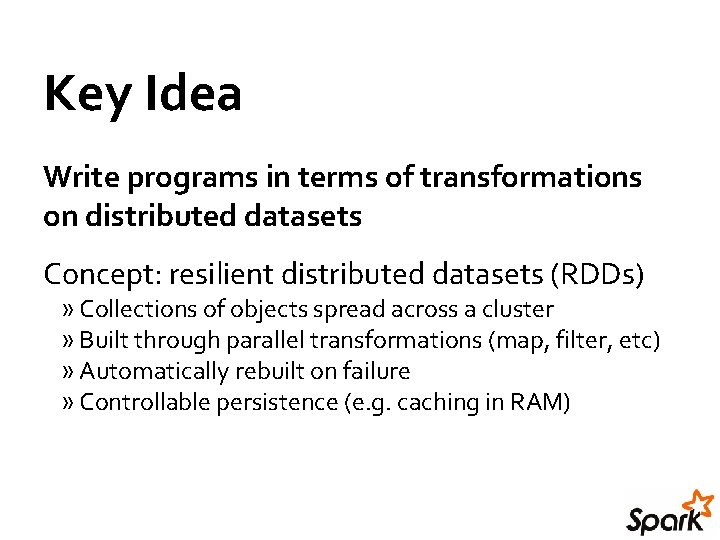
Key Idea Write programs in terms of transformations on distributed datasets Concept: resilient distributed datasets (RDDs) » Collections of objects spread across a cluster » Built through parallel transformations (map, filter, etc) » Automatically rebuilt on failure » Controllable persistence (e. g. caching in RAM)
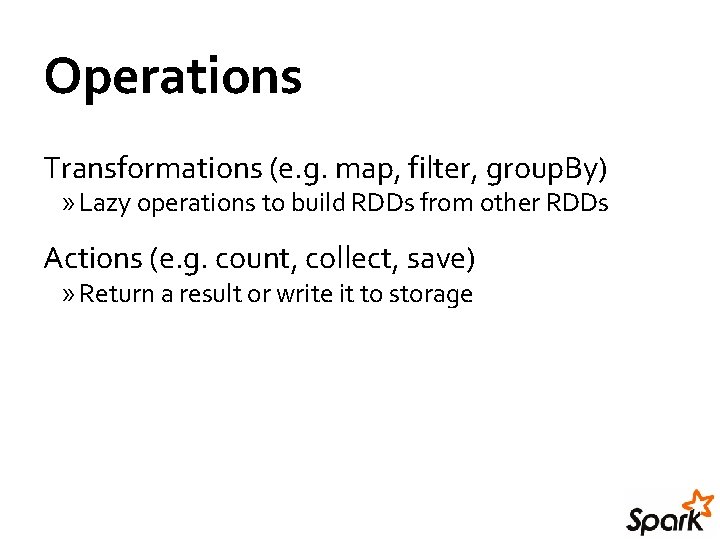
Operations Transformations (e. g. map, filter, group. By) » Lazy operations to build RDDs from other RDDs Actions (e. g. count, collect, save) » Return a result or write it to storage
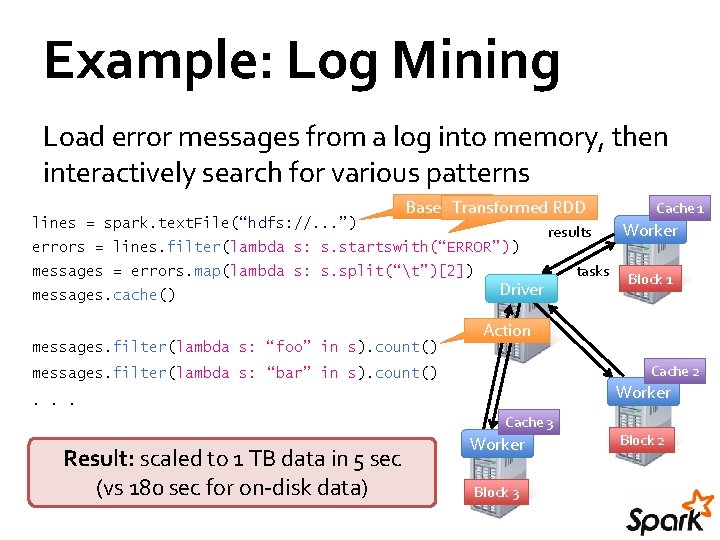
Example: Log Mining Load error messages from a log into memory, then interactively search for various patterns lines = spark. text. File(“hdfs: //. . . ”) Base RDD Transformed RDD errors = lines. filter(lambda s: s. startswith(“ERROR”)) messages = errors. map(lambda s: s. split(“t”)[2]) messages. cache() messages. filter(lambda s: “foo” in s). count() results Driver tasks Cache 1 Worker Block 1 Action Cache 2 messages. filter(lambda s: “bar” in s). count() Worker . . . Cache 3 Result: full-text scaled search to 1 TBof data Wikipedia in 5 secin 0. 5(vs sec 180 (vssec 20 for s for on-disk data) Worker Block 3 Block 2
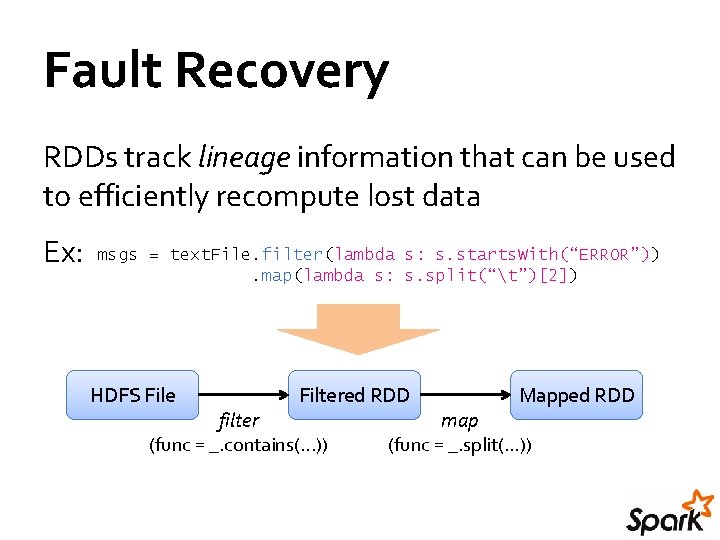
Fault Recovery RDDs track lineage information that can be used to efficiently recompute lost data Ex: msgs = text. File. filter(lambda s: s. starts. With(“ERROR”)). map(lambda s: s. split(“t”)[2]) HDFS File Filtered RDD filter (func = _. contains(. . . )) Mapped RDD map (func = _. split(. . . ))
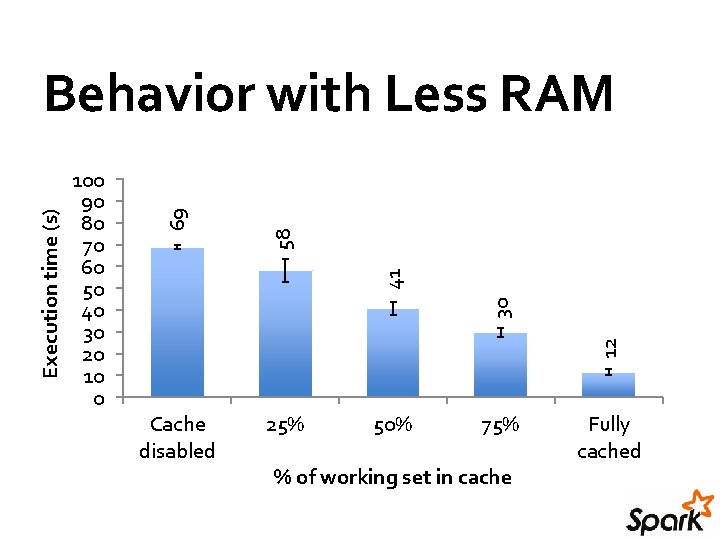
12 30 41 58 100 90 80 70 60 50 40 30 20 10 0 69 Execution time (s) Behavior with Less RAM Cache disabled 25% 50% 75% % of working set in cache Fully cached
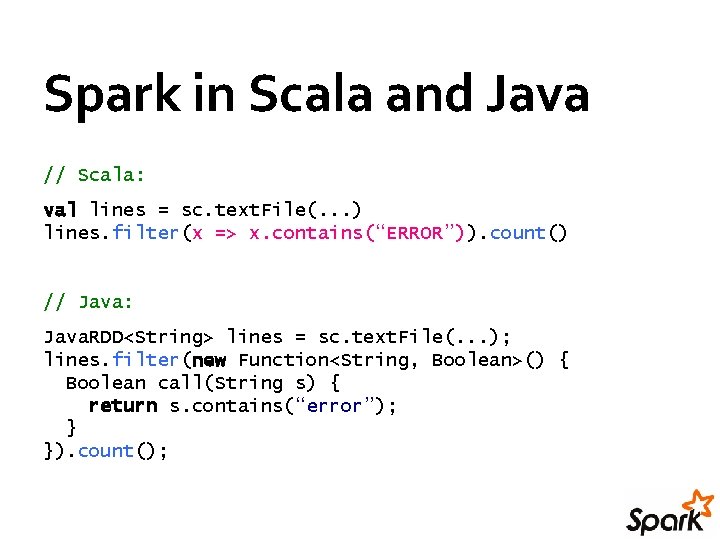
Spark in Scala and Java // Scala: val lines = sc. text. File(. . . ) lines. filter(x => x. contains(“ERROR”)). count() // Java: Java. RDD<String> lines = sc. text. File(. . . ); lines. filter(new Function<String, Boolean>() { Boolean call(String s) { return s. contains(“error”); } }). count();
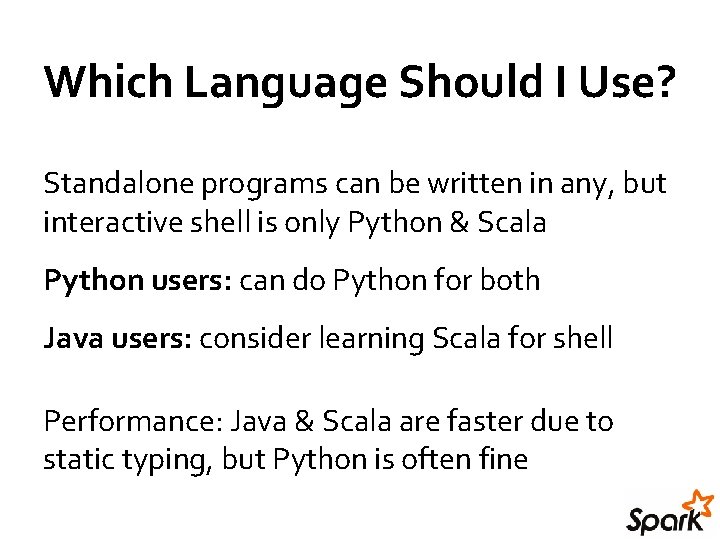
Which Language Should I Use? Standalone programs can be written in any, but interactive shell is only Python & Scala Python users: can do Python for both Java users: consider learning Scala for shell Performance: Java & Scala are faster due to static typing, but Python is often fine
This Talk Introduction to Spark Tour of Spark operations (in Python) Job execution Standalone apps
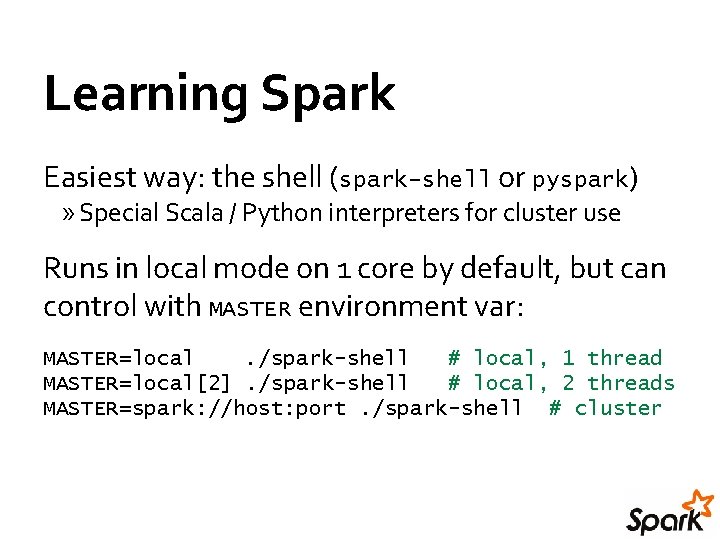
Learning Spark Easiest way: the shell (spark-shell or pyspark) » Special Scala / Python interpreters for cluster use Runs in local mode on 1 core by default, but can control with MASTER environment var: MASTER=local. /spark-shell # local, 1 thread MASTER=local[2]. /spark-shell # local, 2 threads MASTER=spark: //host: port. /spark-shell # cluster
First Stop: Spark. Context Main entry point to Spark functionality Available in shell as variable sc In standalone programs, you’d make your own (see later for details)
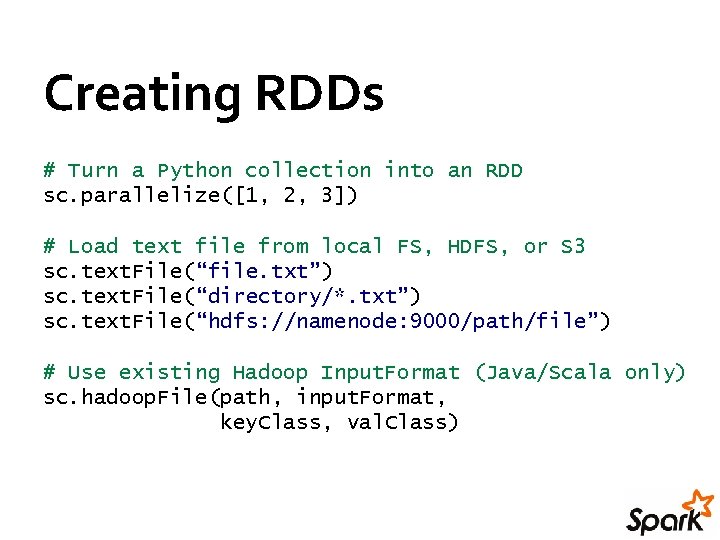
Creating RDDs # Turn a Python collection into an RDD sc. parallelize([1, 2, 3]) # Load text file from local FS, HDFS, or S 3 sc. text. File(“file. txt”) sc. text. File(“directory/*. txt”) sc. text. File(“hdfs: //namenode: 9000/path/file”) # Use existing Hadoop Input. Format (Java/Scala only) sc. hadoop. File(path, input. Format, key. Class, val. Class)
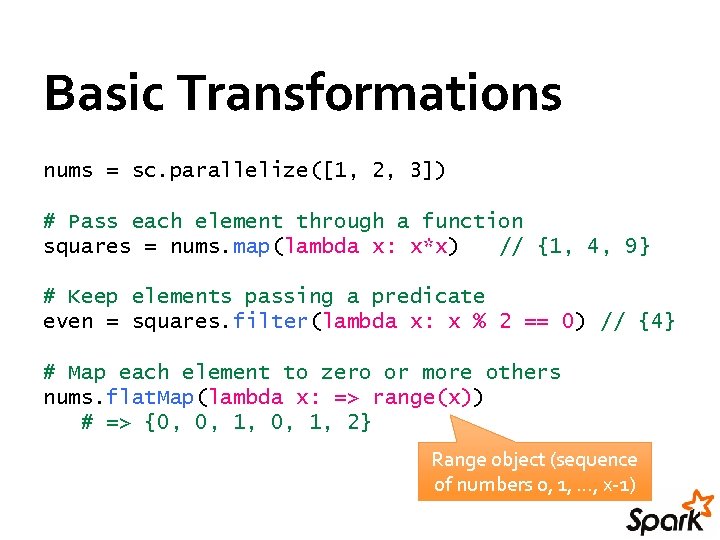
Basic Transformations nums = sc. parallelize([1, 2, 3]) # Pass each element through a function squares = nums. map(lambda x: x*x) // {1, 4, 9} # Keep elements passing a predicate even = squares. filter(lambda x: x % 2 == 0) // {4} # Map each element to zero or more others nums. flat. Map(lambda x: => range(x)) # => {0, 0, 1, 2} Range object (sequence of numbers 0, 1, …, x-1)
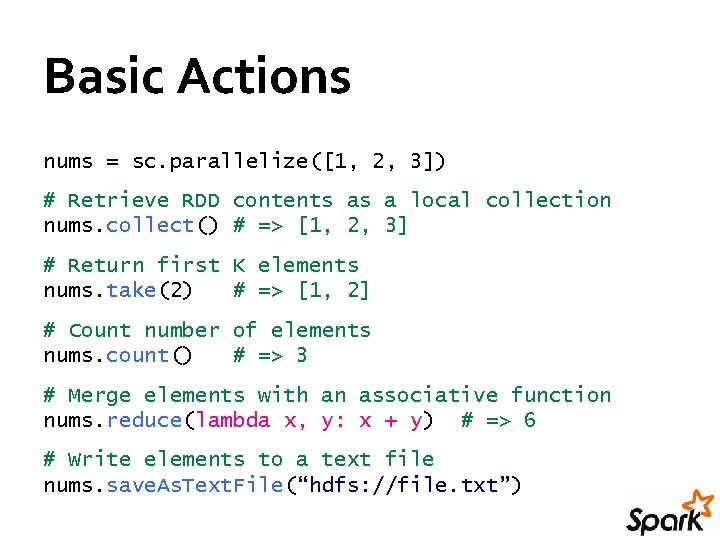
Basic Actions nums = sc. parallelize([1, 2, 3]) # Retrieve RDD contents as a local collection nums. collect() # => [1, 2, 3] # Return first K elements nums. take(2) # => [1, 2] # Count number of elements nums. count() # => 3 # Merge elements with an associative function nums. reduce(lambda x, y: x + y) # => 6 # Write elements to a text file nums. save. As. Text. File(“hdfs: //file. txt”)
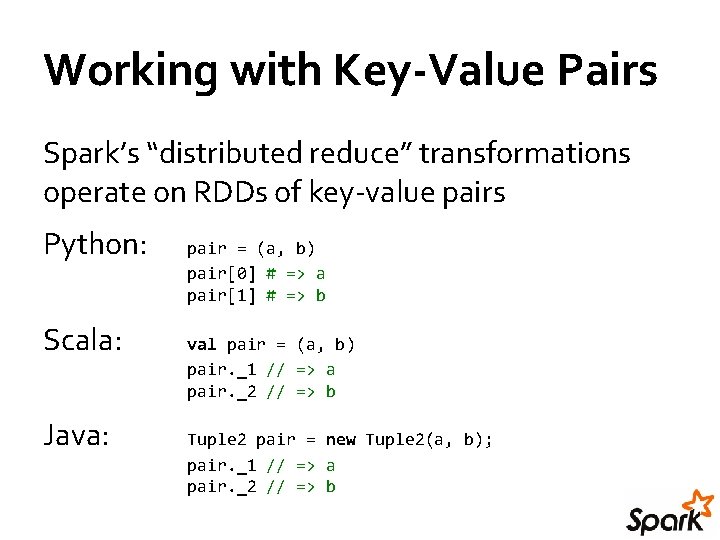
Working with Key-Value Pairs Spark’s “distributed reduce” transformations operate on RDDs of key-value pairs Python: Scala: Java: pair = (a, b) pair[0] # => a pair[1] # => b val pair = (a, b) pair. _1 // => a pair. _2 // => b Tuple 2 pair = new Tuple 2(a, b); pair. _1 // => a pair. _2 // => b
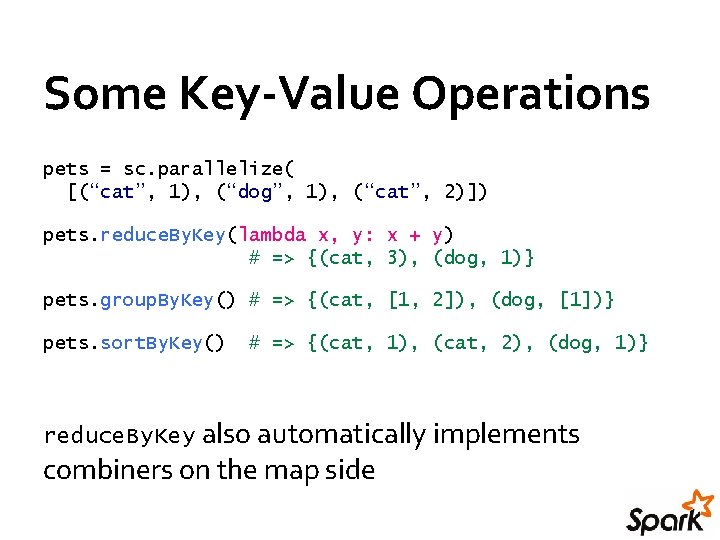
Some Key-Value Operations pets = sc. parallelize( [(“cat”, 1), (“dog”, 1), (“cat”, 2)]) pets. reduce. By. Key(lambda x, y: x + y) # => {(cat, 3), (dog, 1)} pets. group. By. Key() # => {(cat, [1, 2]), (dog, [1])} pets. sort. By. Key() # => {(cat, 1), (cat, 2), (dog, 1)} reduce. By. Key also automatically implements combiners on the map side
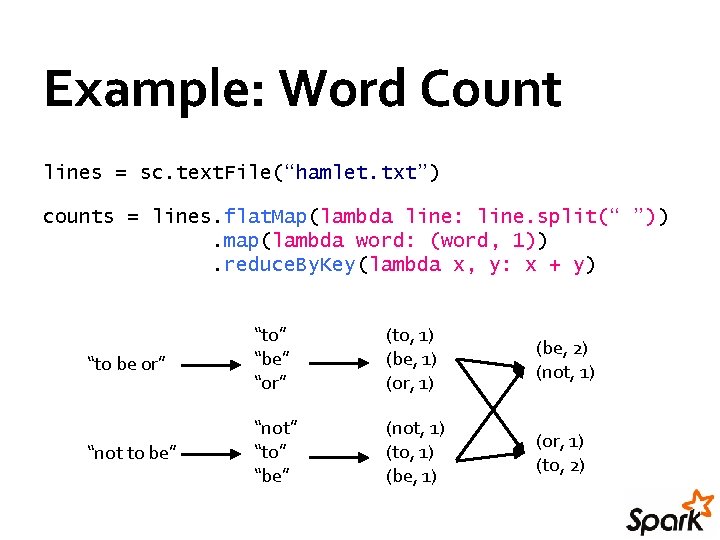
Example: Word Count lines = sc. text. File(“hamlet. txt”) counts = lines. flat. Map(lambda line: line. split(“ ”)). map(lambda word: (word, 1)). reduce. By. Key(lambda x, y: x + y) “to be or” “to” “be” “or” (to, 1) (be, 1) (or, 1) (be, 2) (not, 1) “not to be” “not” “to” “be” (not, 1) (to, 1) (be, 1) (or, 1) (to, 2)
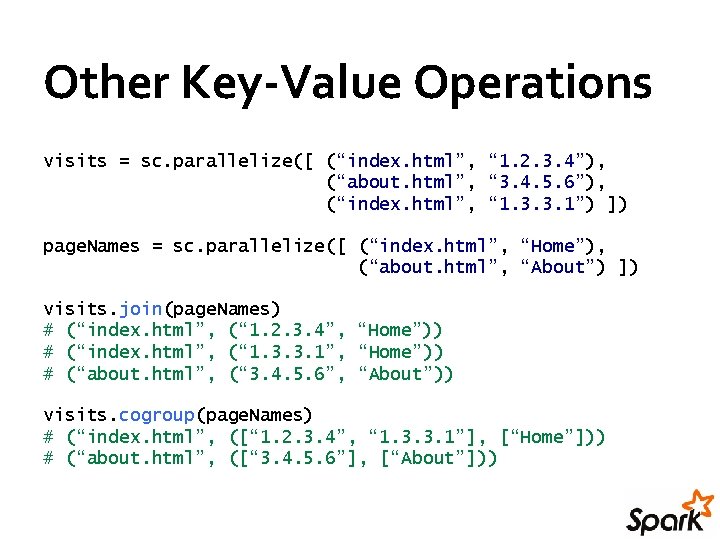
Other Key-Value Operations visits = sc. parallelize([ (“index. html”, “ 1. 2. 3. 4”), (“about. html”, “ 3. 4. 5. 6”), (“index. html”, “ 1. 3. 3. 1”) ]) page. Names = sc. parallelize([ (“index. html”, “Home”), (“about. html”, “About”) ]) visits. join(page. Names) # (“index. html”, (“ 1. 2. 3. 4”, “Home”)) # (“index. html”, (“ 1. 3. 3. 1”, “Home”)) # (“about. html”, (“ 3. 4. 5. 6”, “About”)) visits. cogroup(page. Names) # (“index. html”, ([“ 1. 2. 3. 4”, “ 1. 3. 3. 1”], [“Home”])) # (“about. html”, ([“ 3. 4. 5. 6”], [“About”]))
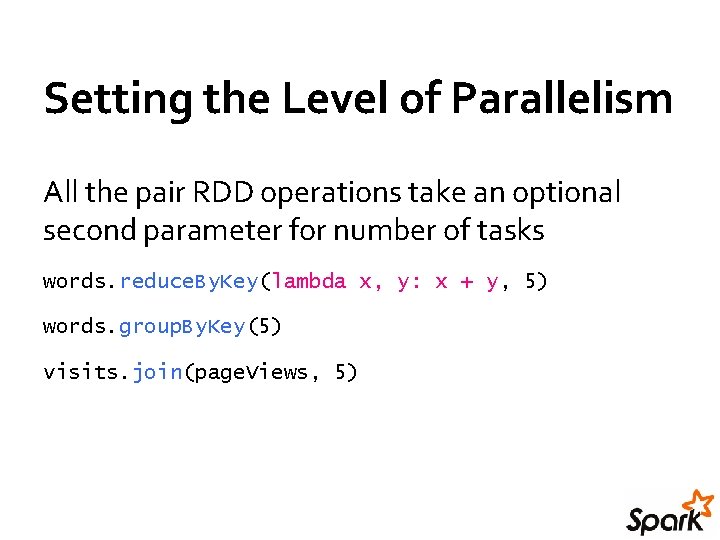
Setting the Level of Parallelism All the pair RDD operations take an optional second parameter for number of tasks words. reduce. By. Key(lambda x, y: x + y, 5) words. group. By. Key(5) visits. join(page. Views, 5)
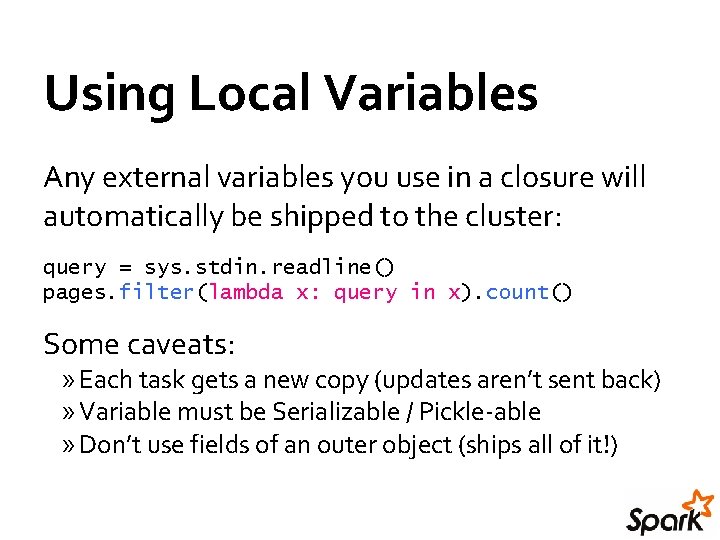
Using Local Variables Any external variables you use in a closure will automatically be shipped to the cluster: query = sys. stdin. readline() pages. filter(lambda x: query in x). count() Some caveats: » Each task gets a new copy (updates aren’t sent back) » Variable must be Serializable / Pickle-able » Don’t use fields of an outer object (ships all of it!)
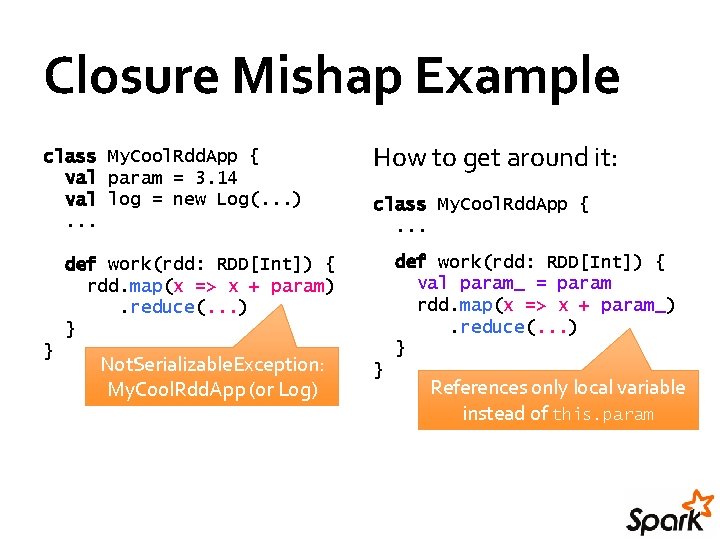
Closure Mishap Example class My. Cool. Rdd. App { val param = 3. 14 val log = new Log(. . . ). . . How to get around it: class My. Cool. Rdd. App {. . . def work(rdd: RDD[Int]) { val param_ = param rdd. map(x => x + param_). reduce(. . . ) } def work(rdd: RDD[Int]) { rdd. map(x => x + param). reduce(. . . ) } } Not. Serializable. Exception: My. Cool. Rdd. App (or Log) } References only local variable instead of this. param
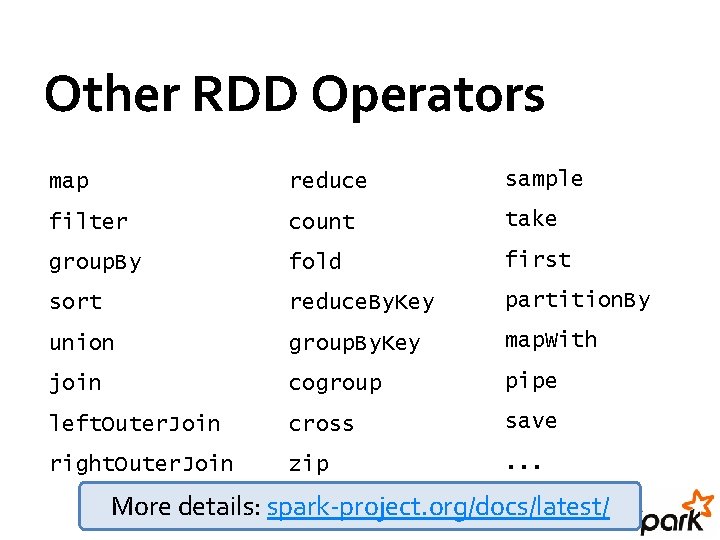
Other RDD Operators map reduce sample filter count take group. By fold first sort reduce. By. Key partition. By union group. By. Key map. With join cogroup pipe left. Outer. Join cross save right. Outer. Join zip . . . More details: spark-project. org/docs/latest/
Demo
This Talk Introduction to Spark Tour of Spark operations Job execution Standalone apps
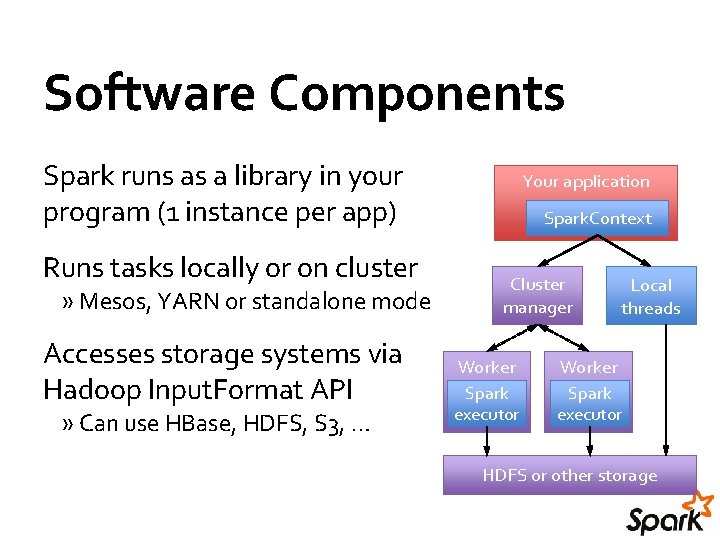
Software Components Spark runs as a library in your program (1 instance per app) Runs tasks locally or on cluster » Mesos, YARN or standalone mode Accesses storage systems via Hadoop Input. Format API » Can use HBase, HDFS, S 3, … Your application Spark. Context Cluster manager Local threads Worker Spark executor HDFS or other storage
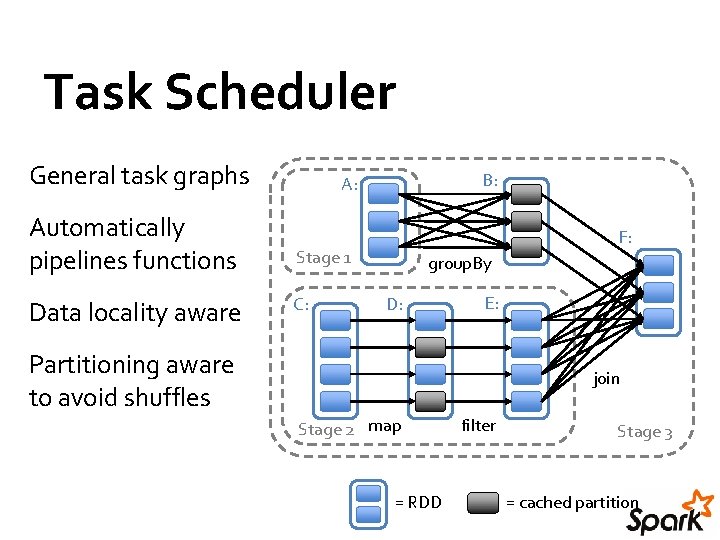
Task Scheduler General task graphs Automatically pipelines functions Data locality aware B: A: F: Stage 1 C: group. By D: E: Partitioning aware to avoid shuffles join Stage 2 map = RDD filter Stage 3 = cached partition
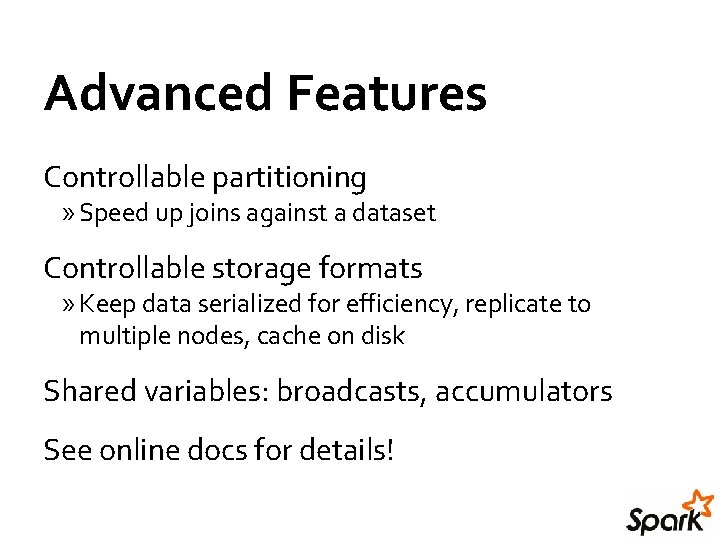
Advanced Features Controllable partitioning » Speed up joins against a dataset Controllable storage formats » Keep data serialized for efficiency, replicate to multiple nodes, cache on disk Shared variables: broadcasts, accumulators See online docs for details!
This Talk Introduction to Spark Tour of Spark operations Job execution Standalone apps
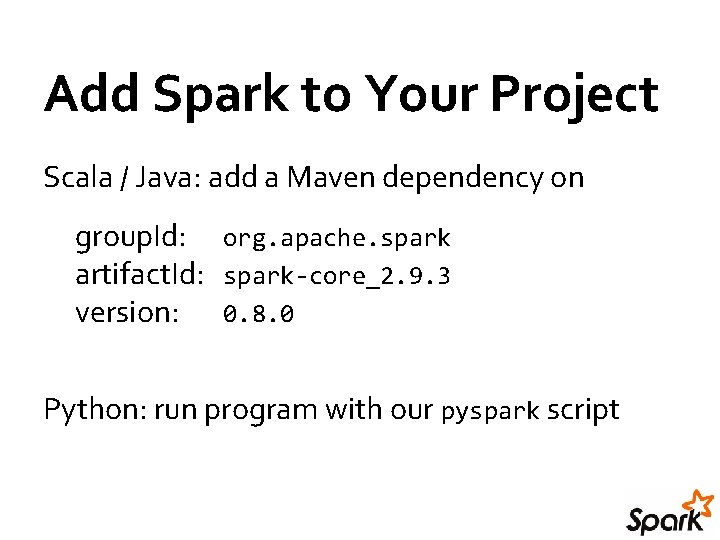
Add Spark to Your Project Scala / Java: add a Maven dependency on group. Id: org. apache. spark artifact. Id: spark-core_2. 9. 3 version: 0. 8. 0 Python: run program with our pyspark script
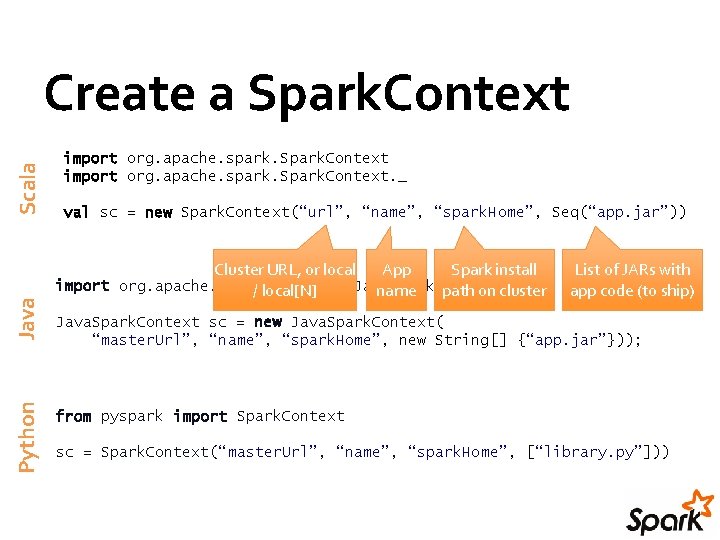
Python Java Scala Create a Spark. Context import org. apache. spark. Spark. Context. _ val sc = new Spark. Context(“url”, “name”, “spark. Home”, Seq(“app. jar”)) Cluster URL, or local App Spark install import org. apache. spark. api. java. Java. Spark. Context; / local[N] name path on cluster List of JARs with app code (to ship) Java. Spark. Context sc = new Java. Spark. Context( “master. Url”, “name”, “spark. Home”, new String[] {“app. jar”})); from pyspark import Spark. Context sc = Spark. Context(“master. Url”, “name”, “spark. Home”, [“library. py”]))
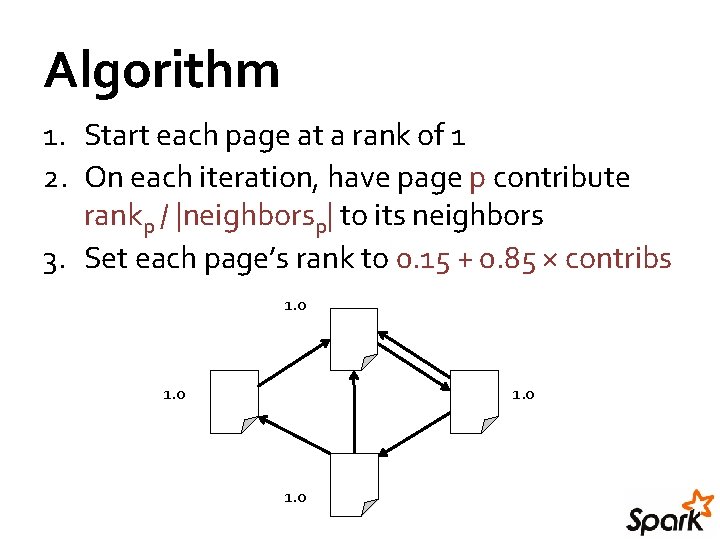
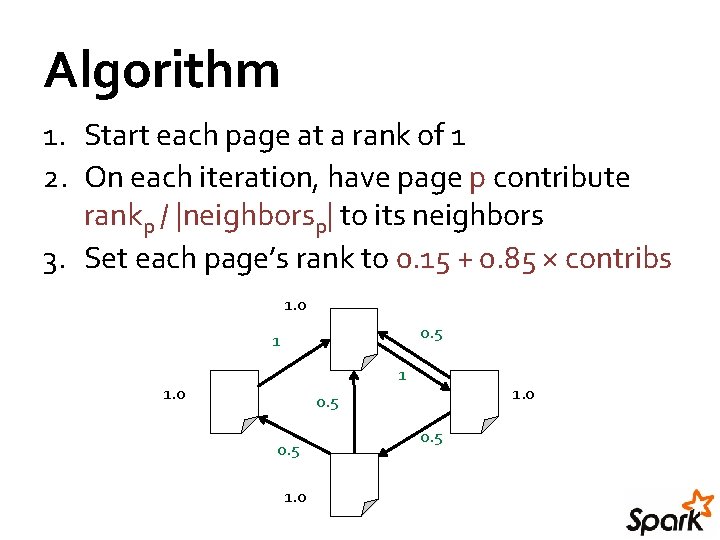
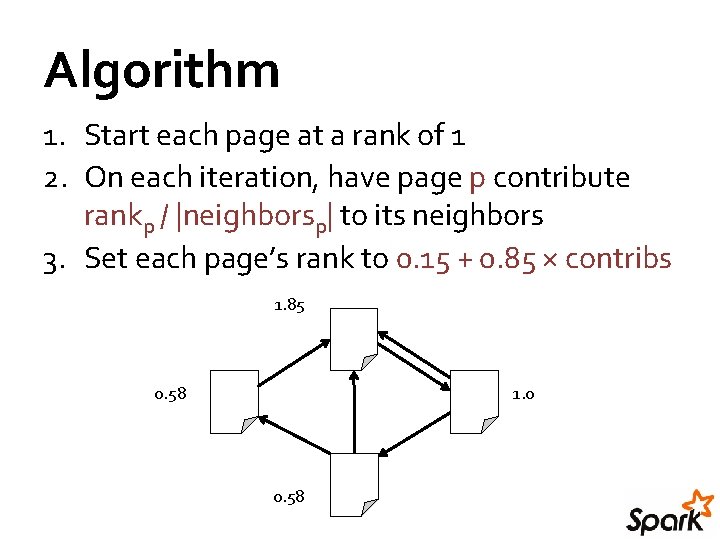
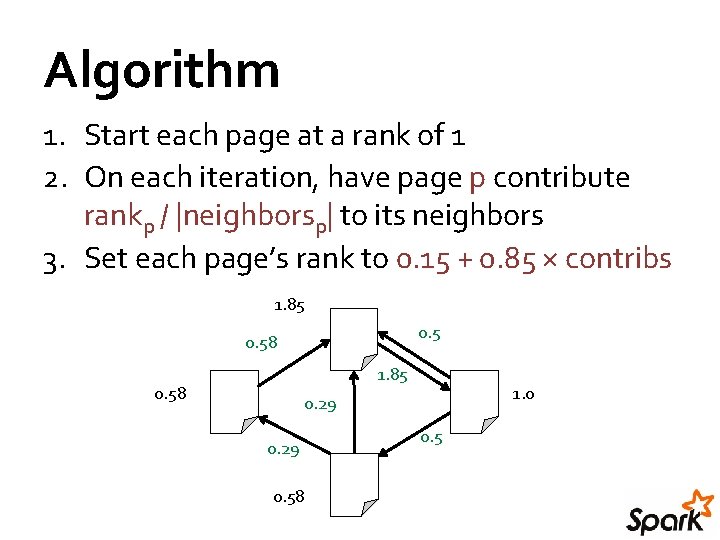
Example: Page. Rank Good example of a more complex algorithm » Multiple stages of map & reduce Benefits from Spark’s in-memory caching » Multiple iterations over the same data
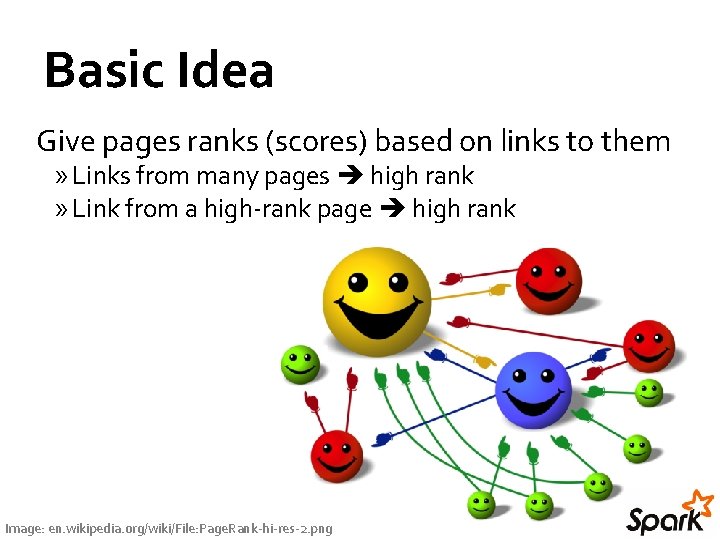
Basic Idea Give pages ranks (scores) based on links to them » Links from many pages high rank » Link from a high-rank page high rank Image: en. wikipedia. org/wiki/File: Page. Rank-hi-res-2. png
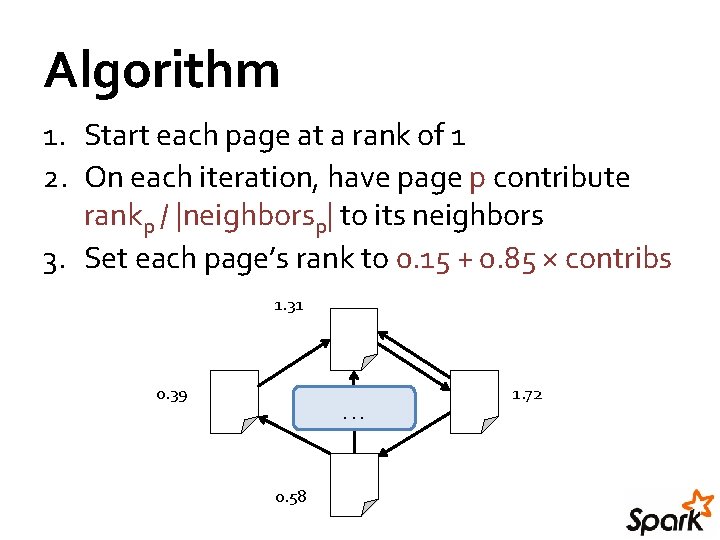
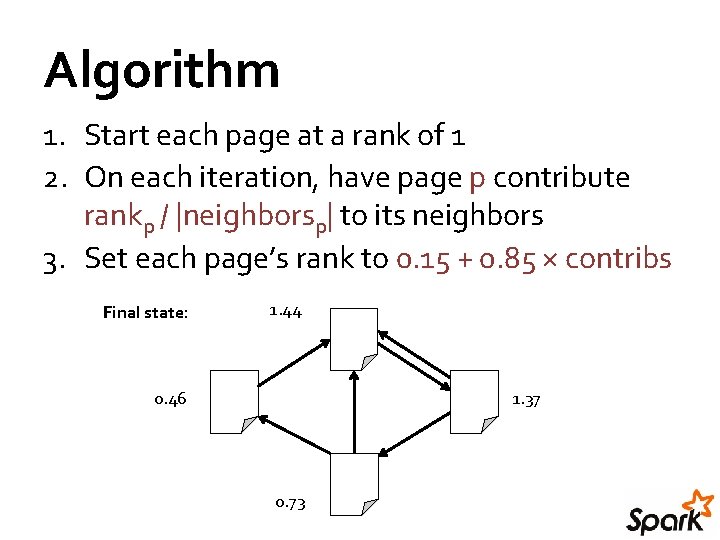
Algorithm 1. Start each page at a rank of 1 2. On each iteration, have page p contribute rankp / |neighborsp| to its neighbors 3. Set each page’s rank to 0. 15 + 0. 85 × contribs 1. 0
Algorithm 1. Start each page at a rank of 1 2. On each iteration, have page p contribute rankp / |neighborsp| to its neighbors 3. Set each page’s rank to 0. 15 + 0. 85 × contribs 1. 0 0. 5 1 1 1. 0 0. 5
Algorithm 1. Start each page at a rank of 1 2. On each iteration, have page p contribute rankp / |neighborsp| to its neighbors 3. Set each page’s rank to 0. 15 + 0. 85 × contribs 1. 85 1. 0 0. 58
Algorithm 1. Start each page at a rank of 1 2. On each iteration, have page p contribute rankp / |neighborsp| to its neighbors 3. Set each page’s rank to 0. 15 + 0. 85 × contribs 1. 85 0. 58 1. 0 0. 29 0. 58 0. 5
Algorithm 1. Start each page at a rank of 1 2. On each iteration, have page p contribute rankp / |neighborsp| to its neighbors 3. Set each page’s rank to 0. 15 + 0. 85 × contribs 1. 31 0. 39 . . . 0. 58 1. 72
Algorithm 1. Start each page at a rank of 1 2. On each iteration, have page p contribute rankp / |neighborsp| to its neighbors 3. Set each page’s rank to 0. 15 + 0. 85 × contribs Final state: 1. 44 1. 37 0. 46 0. 73
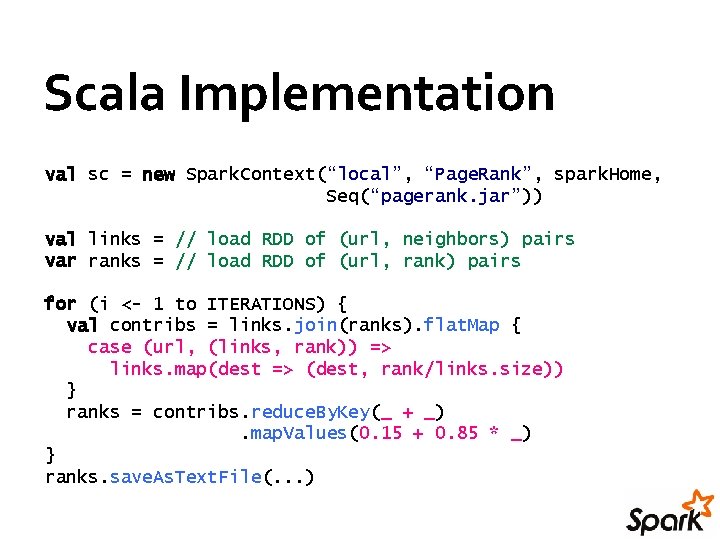
Scala Implementation val sc = new Spark. Context(“local”, “Page. Rank”, spark. Home, Seq(“pagerank. jar”)) val links = // load RDD of (url, neighbors) pairs var ranks = // load RDD of (url, rank) pairs for (i <- 1 to ITERATIONS) { val contribs = links. join(ranks). flat. Map { case (url, (links, rank)) => links. map(dest => (dest, rank/links. size)) } ranks = contribs. reduce. By. Key(_ + _). map. Values(0. 15 + 0. 85 * _) } ranks. save. As. Text. File(. . . )
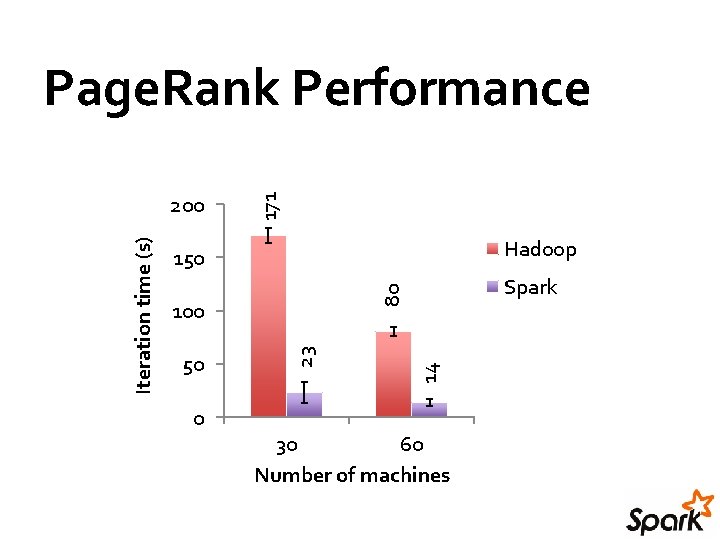
Hadoop 150 0 14 50 Spark 80 100 23 Iteration time (s) 200 171 Page. Rank Performance 30 60 Number of machines
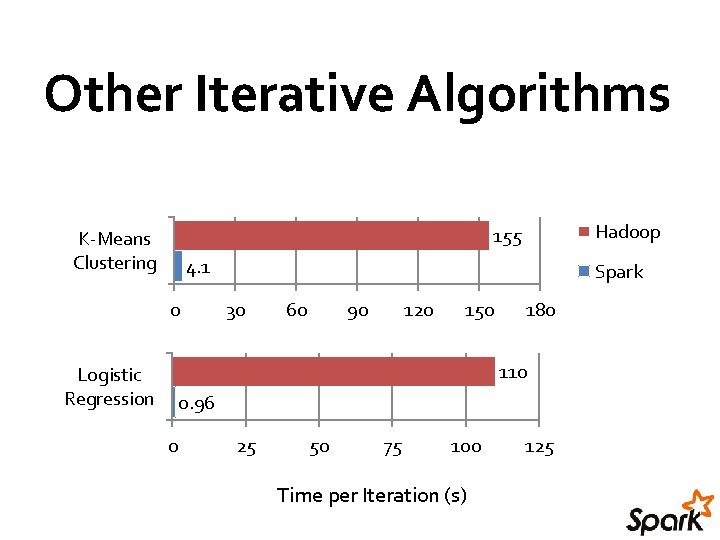
Other Iterative Algorithms Hadoop 155 K-Means Clustering 4. 1 0 Spark 30 60 90 120 150 180 110 Logistic Regression 0. 96 0 25 50 75 100 Time per Iteration (s) 125
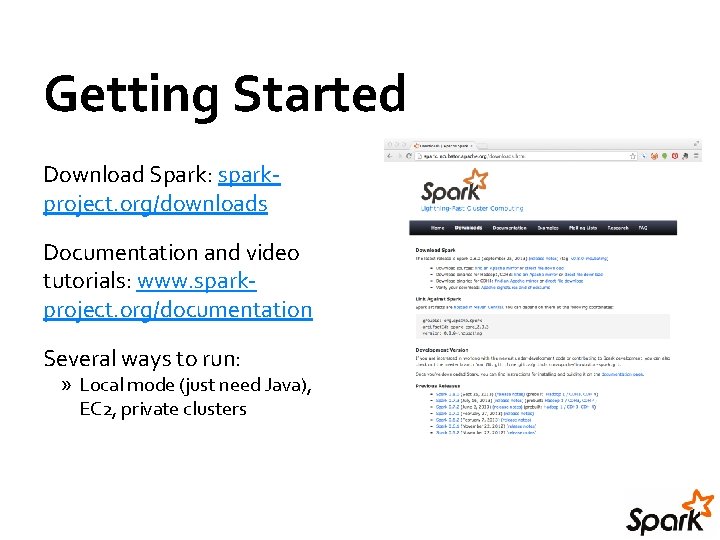
Getting Started Download Spark: sparkproject. org/downloads Documentation and video tutorials: www. sparkproject. org/documentation Several ways to run: » Local mode (just need Java), EC 2, private clusters
Local Execution Just pass local or local[k] as master URL Debug using local debuggers » For Java / Scala, just run your program in a debugger » For Python, use an attachable debugger (e. g. Py. Dev) Great for development & unit tests
Cluster Execution Easiest way to launch is EC 2: . /spark-ec 2 -k keypair –i id_rsa. pem –s slaves [launch|stop|start|destroy] cluster. Name Several options for private clusters: » Standalone mode (similar to Hadoop’s deploy scripts) » Mesos » Hadoop YARN Amazon EMR: tinyurl. com/spark-emr
Conclusion Spark offers a rich API to make data analytics fast: both fast to write and fast to run Achieves 100 x speedups in real applications Growing community with 20+ companies contributing www. spark-project. org