
Parallel Programming in C with MPI and Open
![schedule Clause • Syntax of schedule clause schedule (<type>[, <chunk> ]) • Schedule type](https://slidetodoc.com/presentation_image_h/cc1dfa999de3f2eeb71d39b9c4321217/image-45.jpg "schedule Clause • Syntax of schedule clause schedule (<type>[, <chunk> ]) • Schedule type")
![Sequential Code (1/2) int main (int argc, char *argv[]) { struct job_struct *job_ptr; struct](https://slidetodoc.com/presentation_image_h/cc1dfa999de3f2eeb71d39b9c4321217/image-50.jpg "Sequential Code (1/2) int main (int argc, char *argv[]) { struct job_struct *job_ptr; struct")

- Slides: 84
Parallel Programming in C with MPI and Open. MP Michael J. Quinn
Chapter 17 Shared-memory Programming
Some References • • Primary Reference – Michael Quinn, Parallel Programming, Mc. Graw Hill, 2004, Ch 17 (Textbook). Detailed Reference - Chandra, Rohit, Dagum, Kohr, Maydan, Mc. Donald, and Menon, Parallel Programming in Open. MP, Morgan Kaufmann, 2001. Jack Dongarra, Ian Foster, Geoffrey Fox, William Gropp, Kennedy, Linda Torczon, Andy White (editors), “Sourcebook of Parallel Computing”, Morgan Kaufmann, 2003, pgs 301 -3, 323 -329, Ch 10. Ananth Grama, Anshul Gupta, George Karypis, Vipin Kumar, Introduction to Parallel Computing: Design and Analysis of Algorithms, Second Edition, Addison Wesley, 2003. Harry Jordan and Gita Alaghband, Fundamentals of Parallel Processing: Algorithms, Architectures, Languages, Prentice Hall, 2003. Ohio Supercomputer Center (OSC, www. osc. org) has a online Web. CT course on Open. MP. (Need to create a user name and password) Barry Wilkinson and Michael Allen, Parallel Programming: Techniques and Applications Using Networked Workstations and Parallel Computers, Second Edition, Prentice Hall, 2005.
Outline • • • Open. MP Shared-memory model Parallel for loops Declaring private variables Critical sections Reductions Performance improvements More general data parallelism Functional parallelism
Open. MP • Open. MP: An application programming interface (API) for parallel programming on multiprocessors – Compiler directives – Library of support functions • Open. MP works in conjunction with Fortran, C, or C++
What’s Open. MP Good For? • C + Open. MP sufficient to program multiprocessors • C + MPI + Open. MP a good way to program multicomputers built out of multiprocessors – IBM RS/6000 SP – Fujitsu AP 3000 – Dell High Performance Computing Cluster
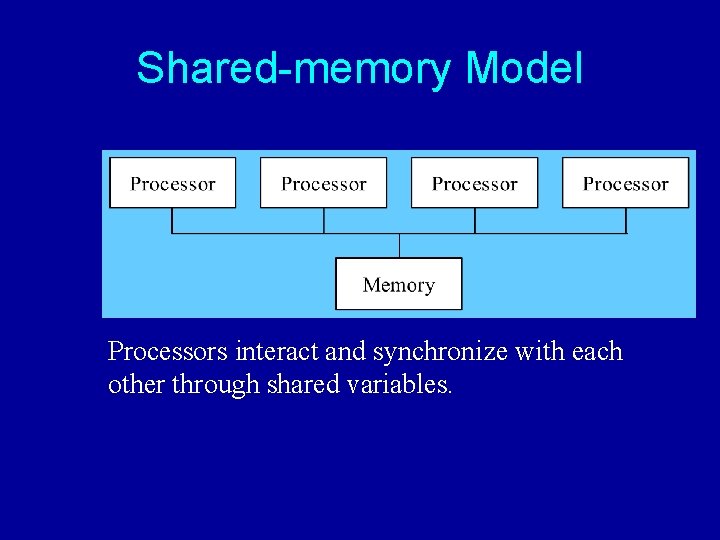
Shared-memory Model Processors interact and synchronize with each other through shared variables.
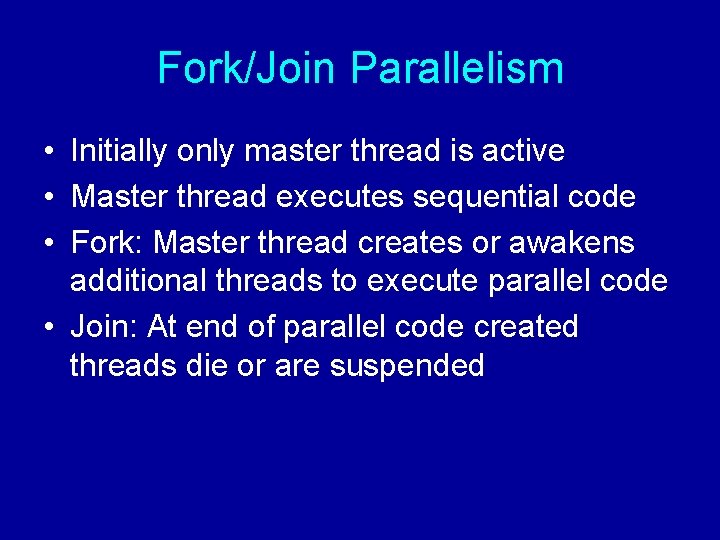
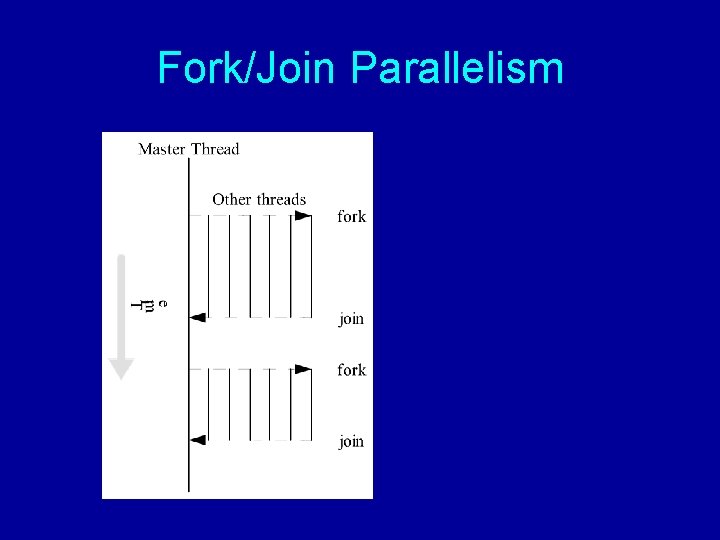
Fork/Join Parallelism • Initially only master thread is active • Master thread executes sequential code • Fork: Master thread creates or awakens additional threads to execute parallel code • Join: At end of parallel code created threads die or are suspended
Fork/Join Parallelism
Shared-memory Model vs. Message-passing Model (#1) • Shared-memory model – One active thread at start and finish of program – Number of active threads inside program changes dynamically during execution • Message-passing model – All processes active throughout execution of program
Incremental Parallelization • Sequential program a special case of a shared-memory parallel program • Parallel shared-memory programs may only have a single parallel loop • Incremental parallelization is the process of converting a sequential program to a parallel program a little bit at a time
Shared-memory Model vs. Message-passing Model (#2) • Shared-memory model – Execute and profile sequential program – Incrementally make it parallel – Stop when further effort not warranted • Message-passing model – Sequential-to-parallel transformation requires major effort – Transformation done in one giant step rather than many tiny steps
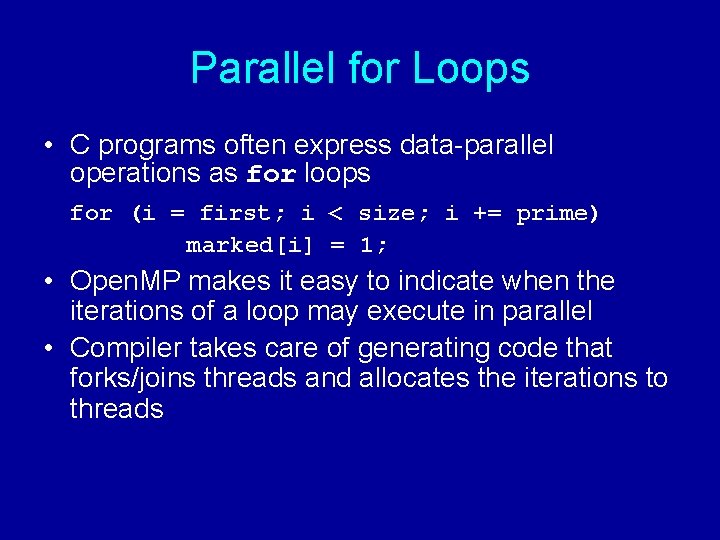
Parallel for Loops • C programs often express data-parallel operations as for loops for (i = first; i < size; i += prime) marked[i] = 1; • Open. MP makes it easy to indicate when the iterations of a loop may execute in parallel • Compiler takes care of generating code that forks/joins threads and allocates the iterations to threads
Pragmas • Pragma: a compiler directive in C or C++ • Stands for “pragmatic information” • A way for the programmer to communicate with the compiler • Compiler free to ignore pragmas • Syntax: #pragma omp <rest of pragma>
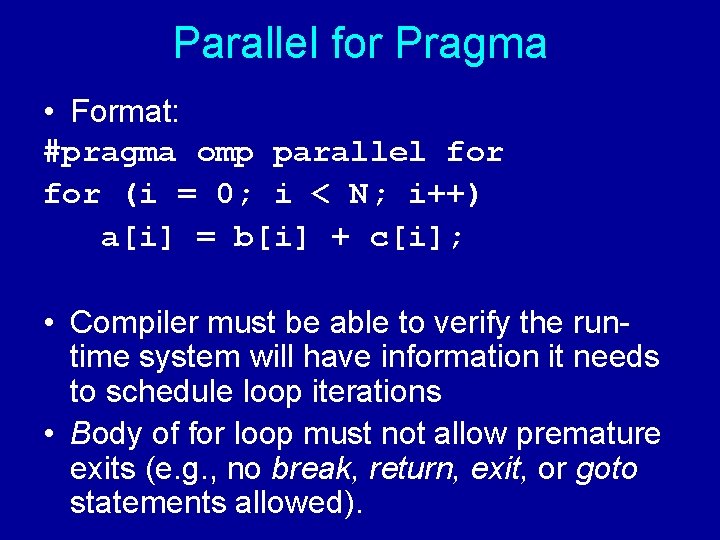
Parallel for Pragma • Format: #pragma omp parallel for (i = 0; i < N; i++) a[i] = b[i] + c[i]; • Compiler must be able to verify the runtime system will have information it needs to schedule loop iterations • Body of for loop must not allow premature exits (e. g. , no break, return, exit, or goto statements allowed).
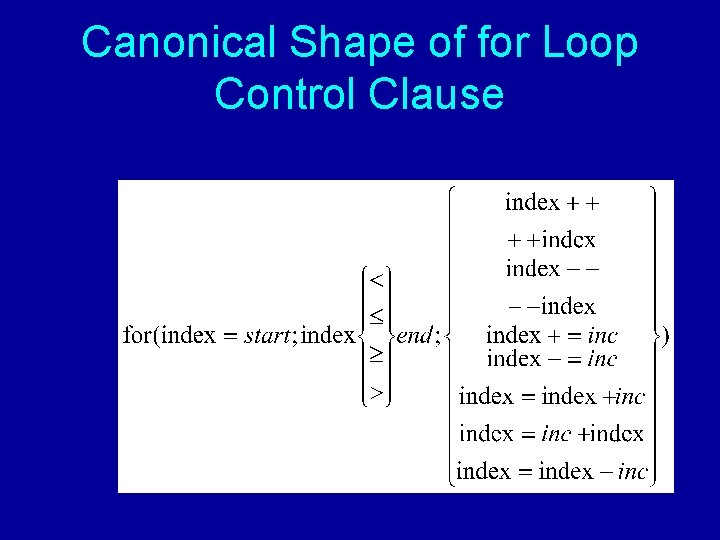
Canonical Shape of for Loop Control Clause
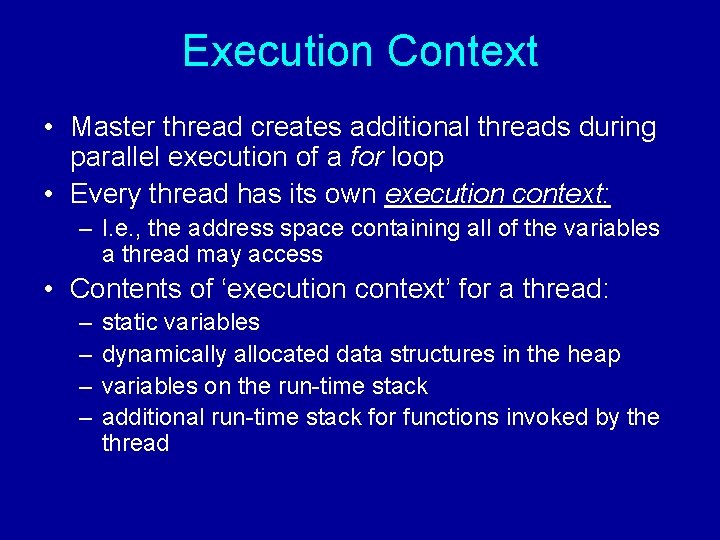
Execution Context • Master thread creates additional threads during parallel execution of a for loop • Every thread has its own execution context: – I. e. , the address space containing all of the variables a thread may access • Contents of ‘execution context’ for a thread: – – static variables dynamically allocated data structures in the heap variables on the run-time stack additional run-time stack for functions invoked by the thread
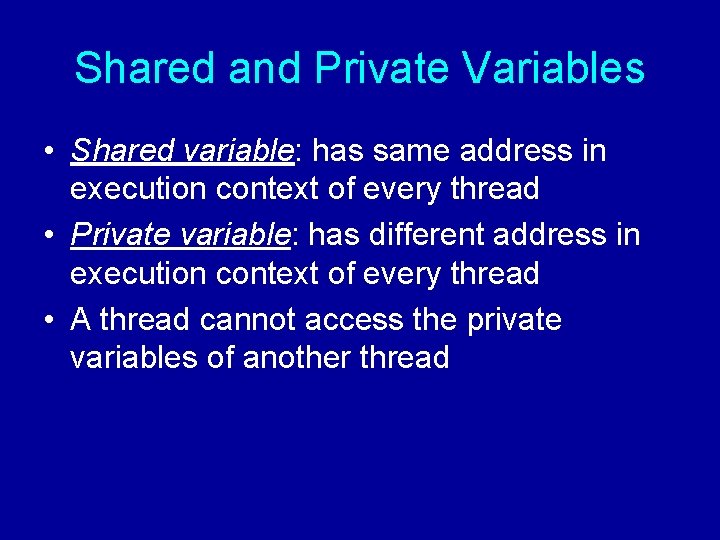
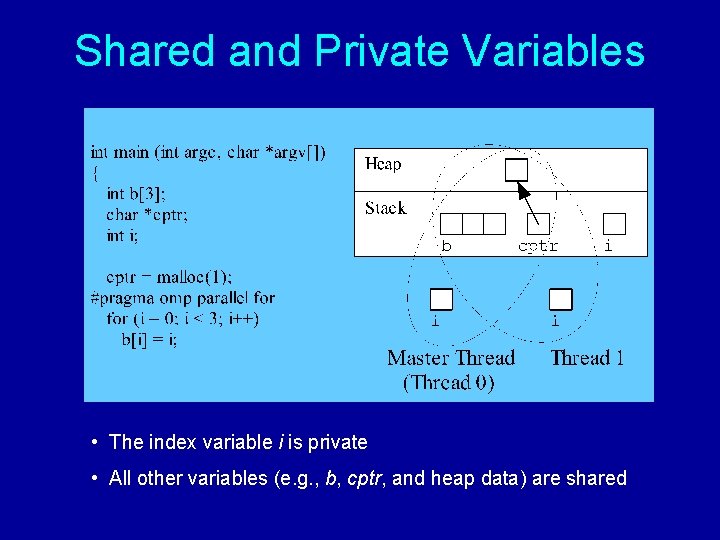
Shared and Private Variables • Shared variable: has same address in execution context of every thread • Private variable: has different address in execution context of every thread • A thread cannot access the private variables of another thread
Shared and Private Variables • The index variable i is private • All other variables (e. g. , b, cptr, and heap data) are shared
Function omp_get_num_procs • Returns number of physical processors available for use by the parallel program • Function Header is int omp_get_num_procs (void)
Function omp_set_num_threads • Uses the parameter value to set the number of threads to be active in parallel sections of code • May be called at multiple points in a program – Allows tailoring level of parallelism to characteristics of the code block. • Function header is void omp_set_num_threads (int t)
Pop Quiz: Write a C program segment that sets the number of threads equal to the number of processors that are available. Answer: Given in textbook
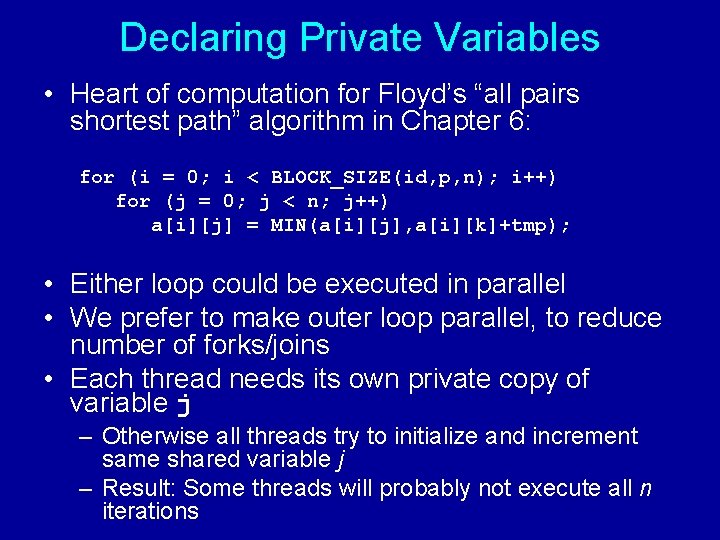
Declaring Private Variables • Heart of computation for Floyd’s “all pairs shortest path” algorithm in Chapter 6: for (i = 0; i < BLOCK_SIZE(id, p, n); i++) for (j = 0; j < n; j++) a[i][j] = MIN(a[i][j], a[i][k]+tmp); • Either loop could be executed in parallel • We prefer to make outer loop parallel, to reduce number of forks/joins • Each thread needs its own private copy of variable j – Otherwise all threads try to initialize and increment same shared variable j – Result: Some threads will probably not execute all n iterations
Grain Size • Grain size is the number of computations performed between communication or synchronization steps • Increasing grain size usually improves performance for MIMD computers
private Clause • Clause - an optional, additional component to a pragma • Private clause - directs compiler to make one or more variables private ( <variable list> )
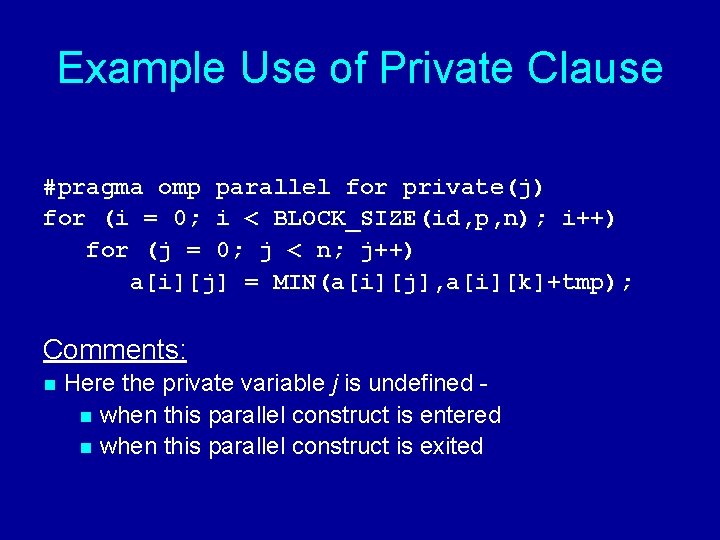
Example Use of Private Clause #pragma omp parallel for private(j) for (i = 0; i < BLOCK_SIZE(id, p, n); i++) for (j = 0; j < n; j++) a[i][j] = MIN(a[i][j], a[i][k]+tmp); Comments: n Here the private variable j is undefined n when this parallel construct is entered n when this parallel construct is exited
firstprivate Clause • Used to create private variables having initial values identical to the variable controlled by the master thread as the loop is entered • Variables are initialized only when thread is created, not once per loop iteration • If a thread modifies a variable’s value in an iteration, subsequent iterations will get the modified value
lastprivate Clause • Sequentially last iteration: iteration that occurs last when the loop is executed sequentially • lastprivate clause: used to copy back to the master thread’s copy of a variable the private copy of the variable from the thread that executed the sequentially last iteration
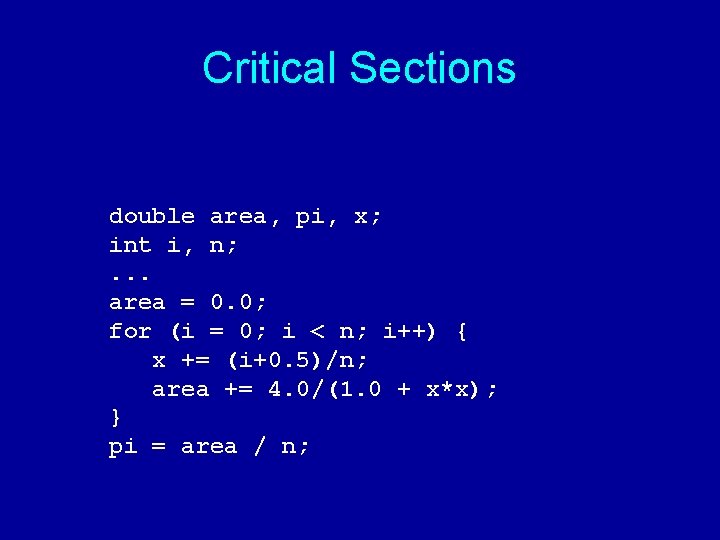
Critical Sections double area, pi, x; int i, n; . . . area = 0. 0; for (i = 0; i < n; i++) { x += (i+0. 5)/n; area += 4. 0/(1. 0 + x*x); } pi = area / n;
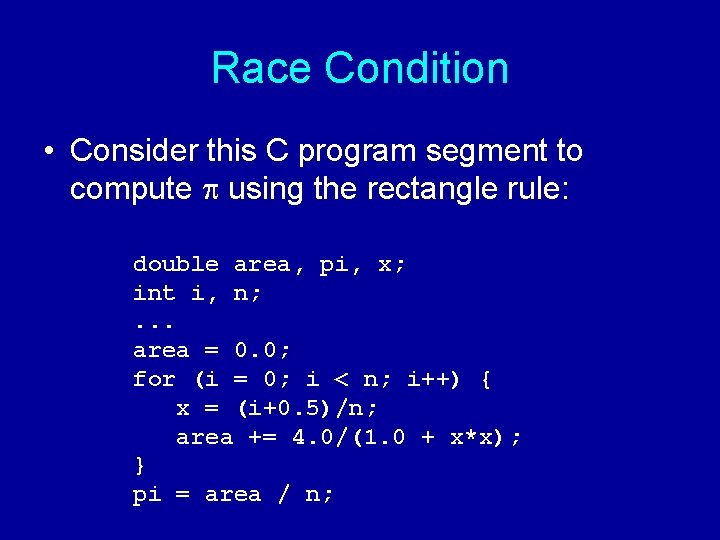
Race Condition • Consider this C program segment to compute using the rectangle rule: double area, pi, x; int i, n; . . . area = 0. 0; for (i = 0; i < n; i++) { x = (i+0. 5)/n; area += 4. 0/(1. 0 + x*x); } pi = area / n;
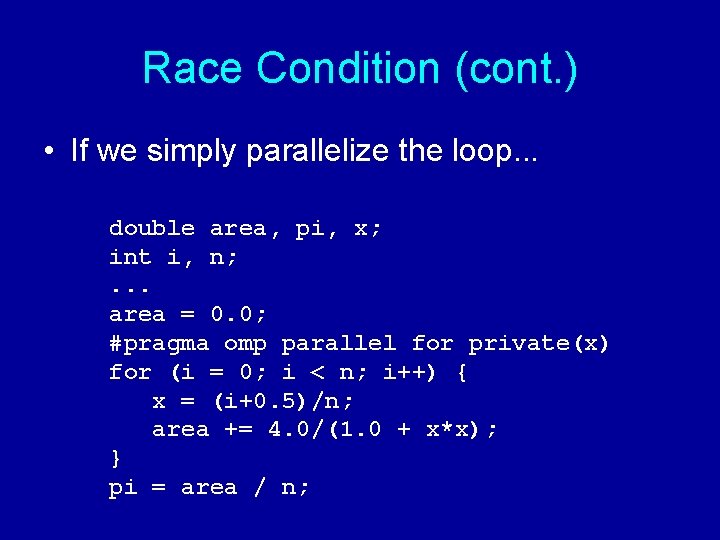
Race Condition (cont. ) • If we simply parallelize the loop. . . double area, pi, x; int i, n; . . . area = 0. 0; #pragma omp parallel for private(x) for (i = 0; i < n; i++) { x = (i+0. 5)/n; area += 4. 0/(1. 0 + x*x); } pi = area / n;
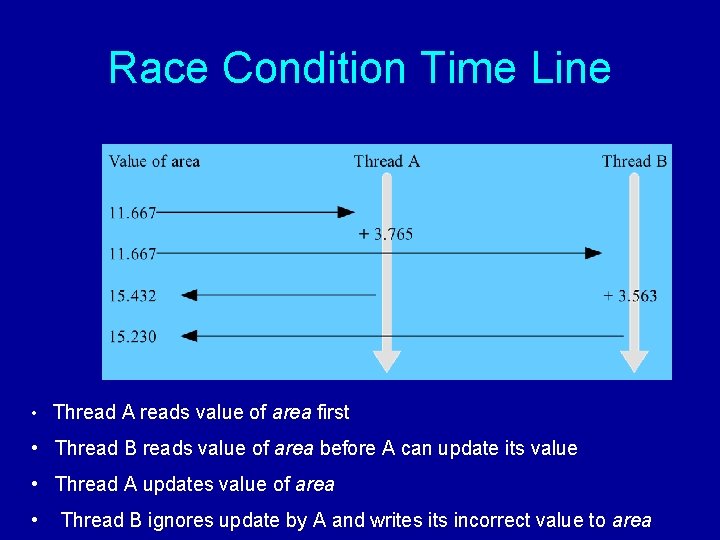
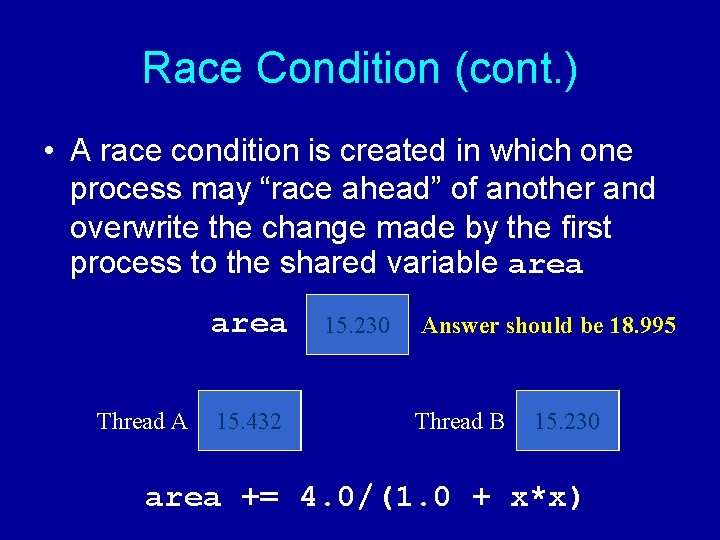
Race Condition Time Line • Thread A reads value of area first • Thread B reads value of area before A can update its value • Thread A updates value of area • Thread B ignores update by A and writes its incorrect value to area
Race Condition (cont. ) • A race condition is created in which one process may “race ahead” of another and overwrite the change made by the first process to the shared variable area Thread A 15. 432 11. 667 15. 432 15. 230 Answer should be 18. 995 Thread B 11. 667 15. 230 area += 4. 0/(1. 0 + x*x)
critical Pragma • Critical section: a portion of code that only thread at a time may execute • We denote a critical section by putting the pragma #pragma omp critical in front of a block of C code
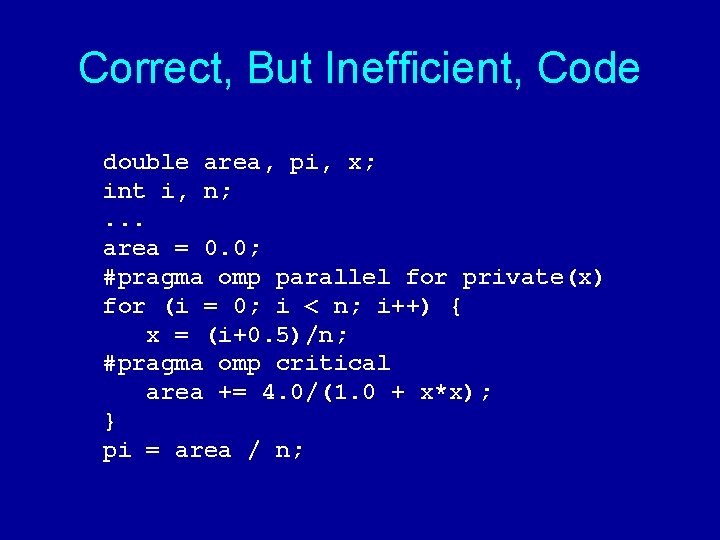
Correct, But Inefficient, Code double area, pi, x; int i, n; . . . area = 0. 0; #pragma omp parallel for private(x) for (i = 0; i < n; i++) { x = (i+0. 5)/n; #pragma omp critical area += 4. 0/(1. 0 + x*x); } pi = area / n;
Source of Inefficiency • Update to area inside a critical section • Only one thread at a time may execute the statement; i. e. , it is sequential code • Time to execute statement significant part of loop • By Amdahl’s Law we know speedup will be severely constrained
Reductions • Reductions are so common that Open. MP provides support for them • May add reduction clause to parallel for pragma • Specify reduction operation and reduction variable • Open. MP takes care of storing partial results in private variables and combining partial results after the loop
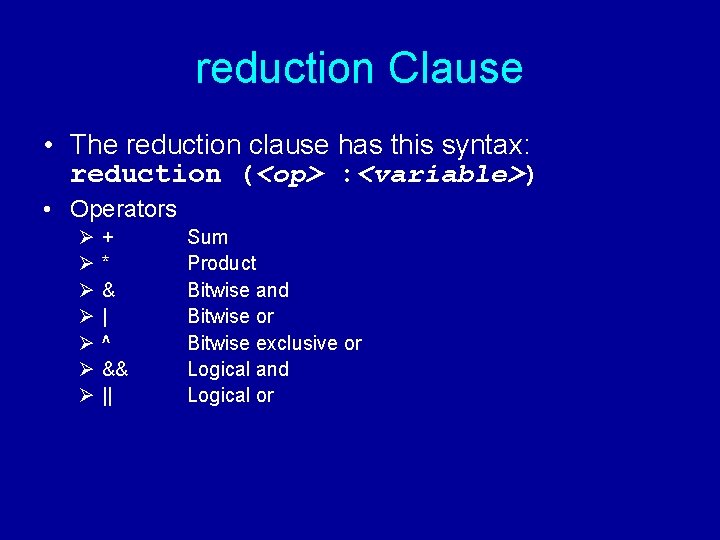
reduction Clause • The reduction clause has this syntax: reduction (<op> : <variable>) • Operators Ø Ø Ø Ø + * & | ^ && || Sum Product Bitwise and Bitwise or Bitwise exclusive or Logical and Logical or
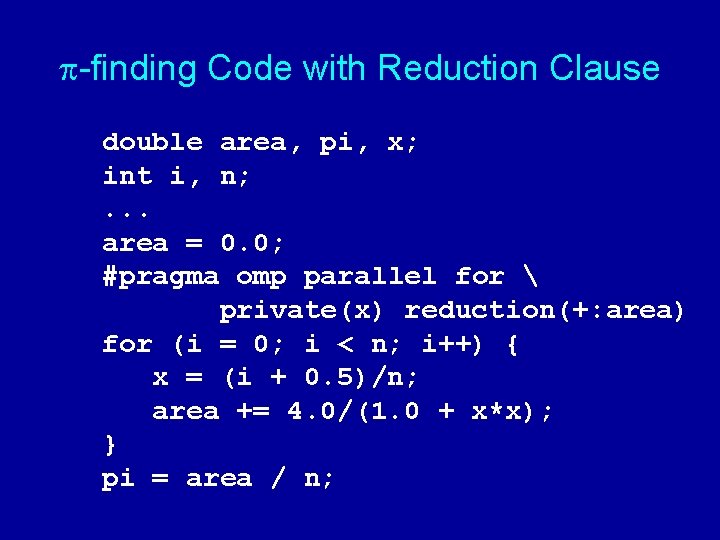
-finding Code with Reduction Clause double area, pi, x; int i, n; . . . area = 0. 0; #pragma omp parallel for private(x) reduction(+: area) for (i = 0; i < n; i++) { x = (i + 0. 5)/n; area += 4. 0/(1. 0 + x*x); } pi = area / n;
Performance Improvement #1 • Too many fork/joins can lower performance • Inverting loops may help performance if – Parallelism is in inner loop – After inversion, the outer loop can be made parallel – Inversion does not significantly lower cache hit rate
Performance Improvement #2 • If loop has too few iterations, fork/join overhead is greater than time savings from parallel execution • The if clause instructs compiler to insert code that determines at run-time whether loop should be executed in parallel; e. g. , #pragma omp parallel for if(n > 5000)
Performance Improvement #3 • We can use schedule clause to specify how iterations of a loop should be allocated to threads • Static schedule: all iterations allocated to threads before any iterations executed • Dynamic schedule: only some iterations allocated to threads at beginning of loop’s execution. Remaining iterations allocated to threads that complete their assigned iterations.
Static vs. Dynamic Scheduling • Static scheduling – Low overhead – May exhibit high workload imbalance • Dynamic scheduling – Higher overhead – Can reduce workload imbalance
Chunks • A chunk is a contiguous range of iterations • Increasing chunk size reduces overhead and may increase cache hit rate • Decreasing chunk size allows finer balancing of workloads
schedule Clause • Syntax of schedule clause schedule (<type>[, <chunk> ]) • Schedule type required, chunk size optional • Allowable schedule types – static: static allocation – dynamic: dynamic allocation • Allocates a block of iterations at a time to threads – guided: guided self-scheduling • Allocates a block of iterations at a time to threads • Size of block decreases exponentially over time – runtime: type chosen at run-time based on value of environment variable OMP_SCHEDULE
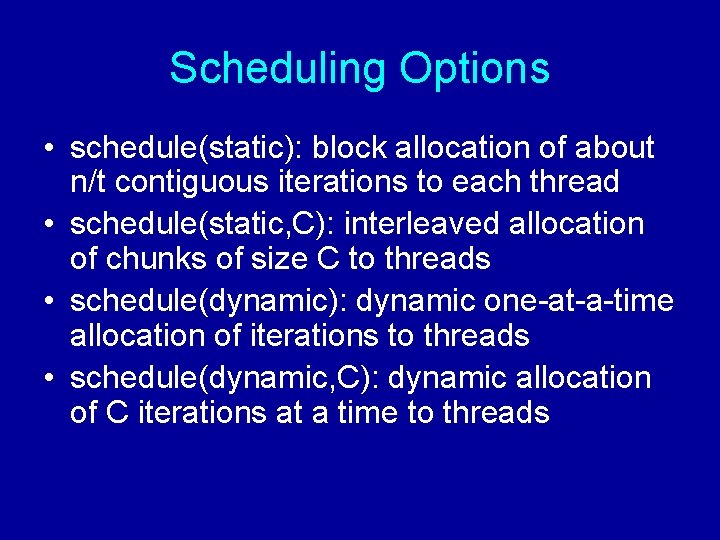
Scheduling Options • schedule(static): block allocation of about n/t contiguous iterations to each thread • schedule(static, C): interleaved allocation of chunks of size C to threads • schedule(dynamic): dynamic one-at-a-time allocation of iterations to threads • schedule(dynamic, C): dynamic allocation of C iterations at a time to threads
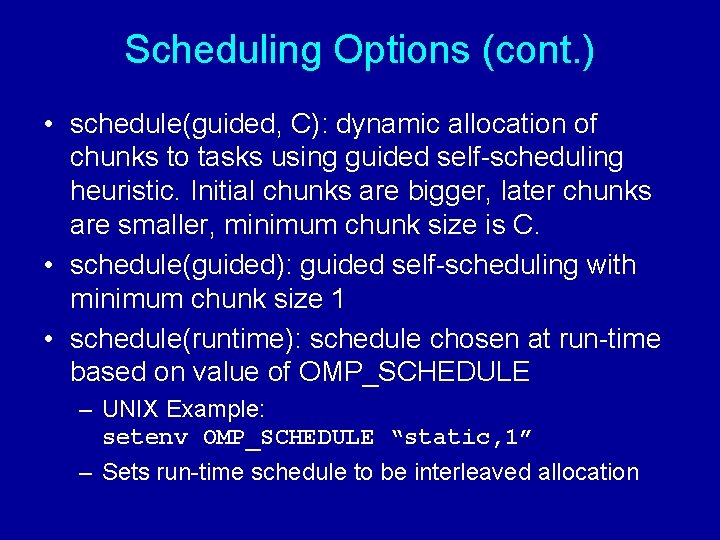
Scheduling Options (cont. ) • schedule(guided, C): dynamic allocation of chunks to tasks using guided self-scheduling heuristic. Initial chunks are bigger, later chunks are smaller, minimum chunk size is C. • schedule(guided): guided self-scheduling with minimum chunk size 1 • schedule(runtime): schedule chosen at run-time based on value of OMP_SCHEDULE – UNIX Example: setenv OMP_SCHEDULE “static, 1” – Sets run-time schedule to be interleaved allocation
More General Data Parallelism • Our focus has been on the parallelization of for loops • Other opportunities for data parallelism – processing items on a “to do” list – for loop + additional code outside of loop
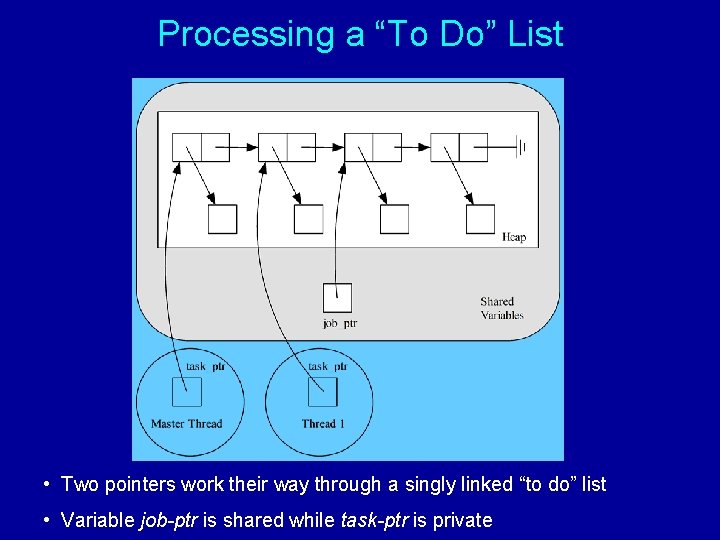
Processing a “To Do” List • Two pointers work their way through a singly linked “to do” list • Variable job-ptr is shared while task-ptr is private
Sequential Code (1/2) int main (int argc, char *argv[]) { struct job_struct *job_ptr; struct task_struct *task_ptr; . . . task_ptr = get_next_task (&job_ptr); while (task_ptr != NULL) { complete_task (task_ptr); task_ptr = get_next_task (&job_ptr); }. . . }
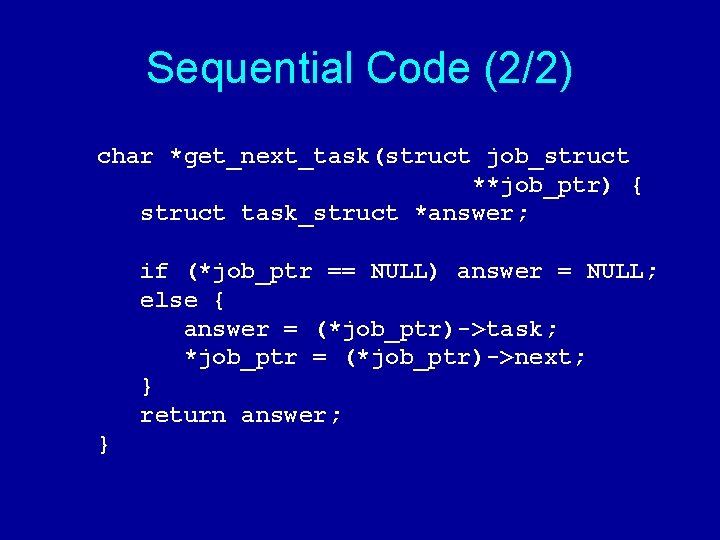
Sequential Code (2/2) char *get_next_task(struct job_struct **job_ptr) { struct task_struct *answer; if (*job_ptr == NULL) answer = NULL; else { answer = (*job_ptr)->task; *job_ptr = (*job_ptr)->next; } return answer; }
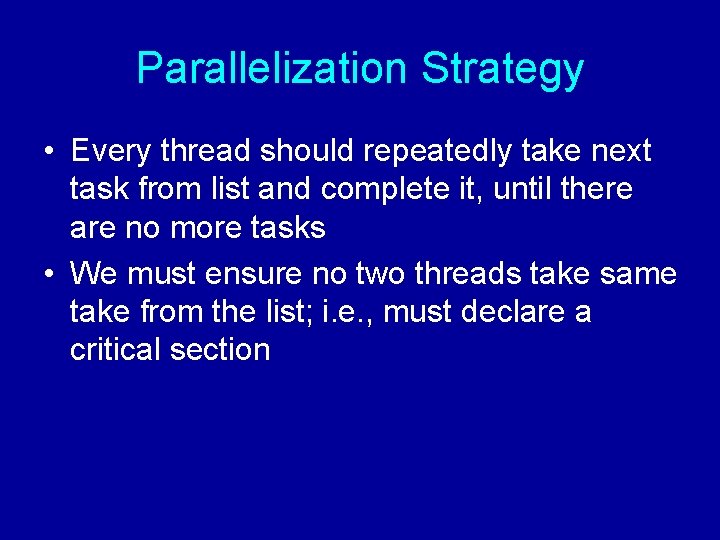
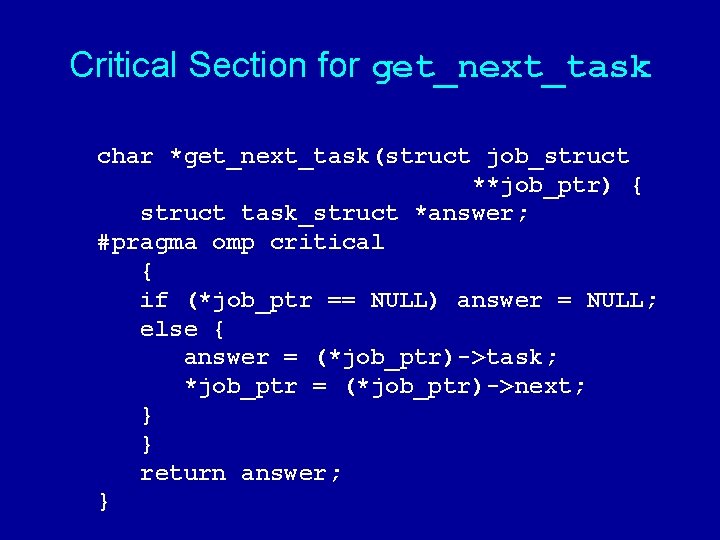
Parallelization Strategy • Every thread should repeatedly take next task from list and complete it, until there are no more tasks • We must ensure no two threads take same take from the list; i. e. , must declare a critical section
parallel Pragma • The parallel pragma precedes a block of code that should be executed by all of the threads • Unlike “parallel for”, the execution is replicated among all threads
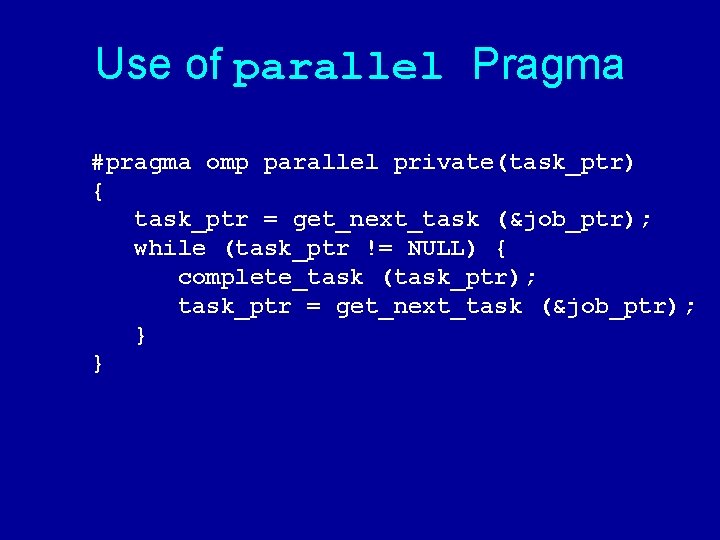
Use of parallel Pragma #pragma omp parallel private(task_ptr) { task_ptr = get_next_task (&job_ptr); while (task_ptr != NULL) { complete_task (task_ptr); task_ptr = get_next_task (&job_ptr); } }
Use of the critical pragma • Need to ensure function get_next-task executes atomically. • Prevents two threads having the same value for task_ptr.
Critical Section for get_next_task char *get_next_task(struct job_struct **job_ptr) { struct task_struct *answer; #pragma omp critical { if (*job_ptr == NULL) answer = NULL; else { answer = (*job_ptr)->task; *job_ptr = (*job_ptr)->next; } } return answer; }
Functions for SPMD-style Programming • The parallel pragma allows us to write SPMD-style programs • In these programs we often need to know number of threads and thread ID number • Open. MP provides functions to retrieve this information • This information is used to divide the iterations among the threads.
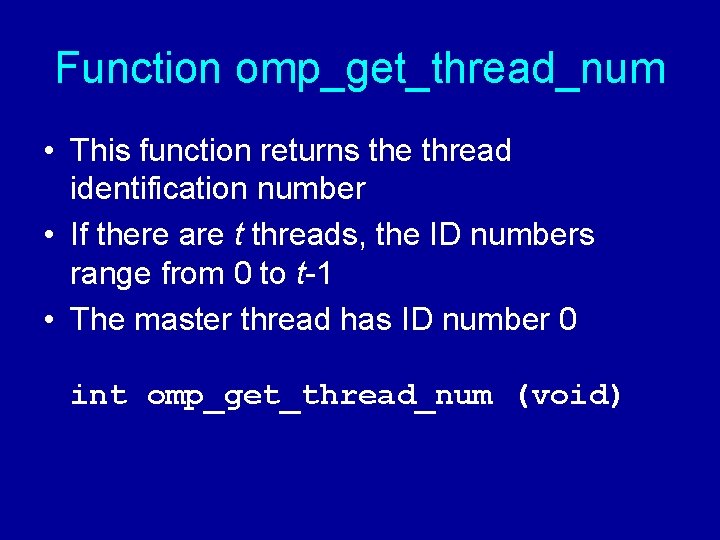
Function omp_get_thread_num • This function returns the thread identification number • If there are t threads, the ID numbers range from 0 to t-1 • The master thread has ID number 0 int omp_get_thread_num (void)
Function omp_get_num_threads • Function omp_get_num_threads returns the number of active threads • If call this function from sequential portion of program, it will return 1 int omp_get_num_threads (void)
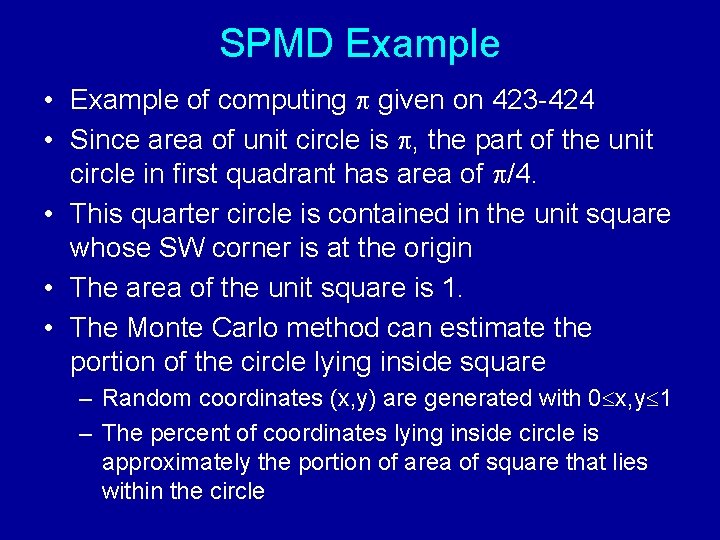
SPMD Example • Example of computing given on 423 -424 • Since area of unit circle is , the part of the unit circle in first quadrant has area of /4. • This quarter circle is contained in the unit square whose SW corner is at the origin • The area of the unit square is 1. • The Monte Carlo method can estimate the portion of the circle lying inside square – Random coordinates (x, y) are generated with 0 x, y 1 – The percent of coordinates lying inside circle is approximately the portion of area of square that lies within the circle
SPMD Example • Multiple threads are used to increase accuracy of approximation of /4 – Different threads generate different sequence of random coordinates in unit square – Each thread computes the same number of random coordinates and a subtotal of those lying within the unit square – The total of these subtotals divided into the total number of coordinates generated is the approximate area of the quarter circle.
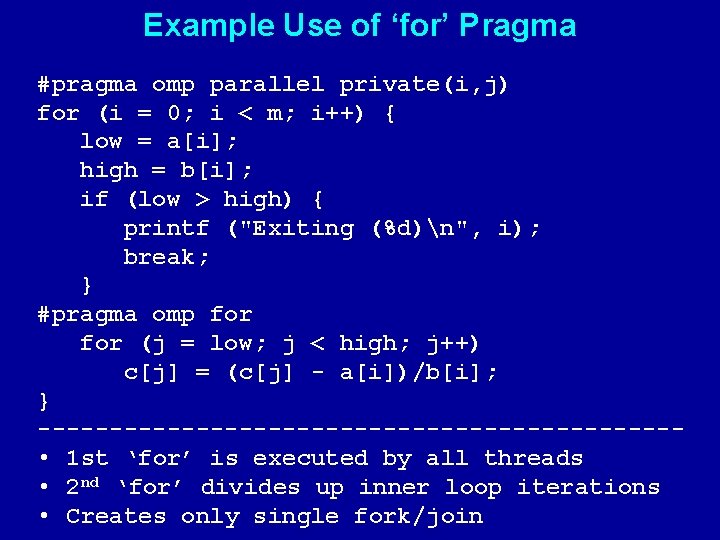
for Pragma • The parallel pragma instructs every thread to execute all of the code inside the block • If we encounter a for loop inside parallel pragma block that we want to divide among threads, we use the for pragma #pragma omp for
Example Use of ‘for’ Pragma #pragma omp parallel private(i, j) for (i = 0; i < m; i++) { low = a[i]; high = b[i]; if (low > high) { printf ("Exiting (%d)n", i); break; } #pragma omp for (j = low; j < high; j++) c[j] = (c[j] - a[i])/b[i]; } ---------------------- • 1 st ‘for’ is executed by all threads • 2 nd ‘for’ divides up inner loop iterations • Creates only single fork/join
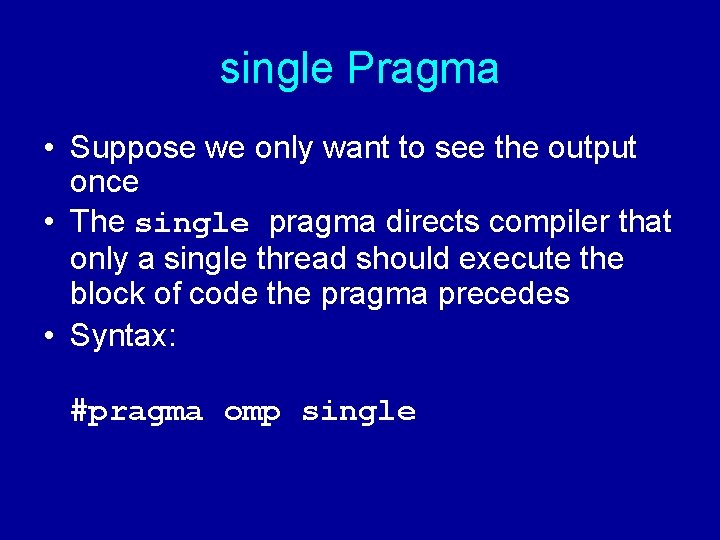
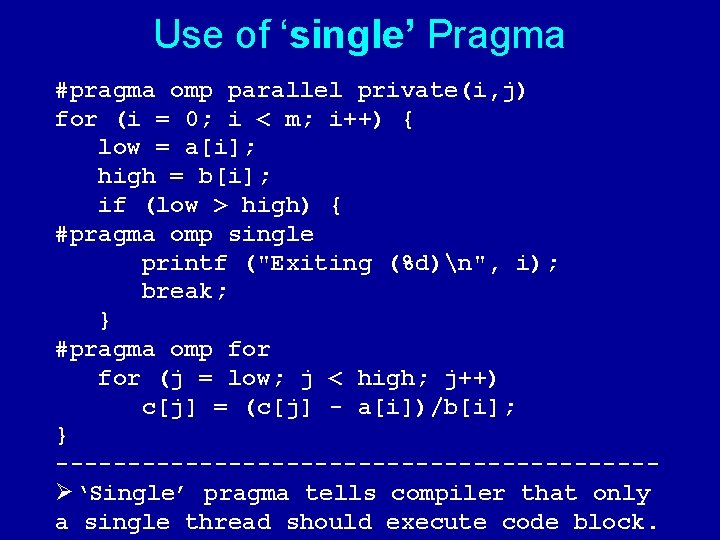
single Pragma • Suppose we only want to see the output once • The single pragma directs compiler that only a single thread should execute the block of code the pragma precedes • Syntax: #pragma omp single
Use of ‘single’ Pragma #pragma omp parallel private(i, j) for (i = 0; i < m; i++) { low = a[i]; high = b[i]; if (low > high) { #pragma omp single printf ("Exiting (%d)n", i); break; } #pragma omp for (j = low; j < high; j++) c[j] = (c[j] - a[i])/b[i]; } ---------------------Ø‘Single’ pragma tells compiler that only a single thread should execute code block.
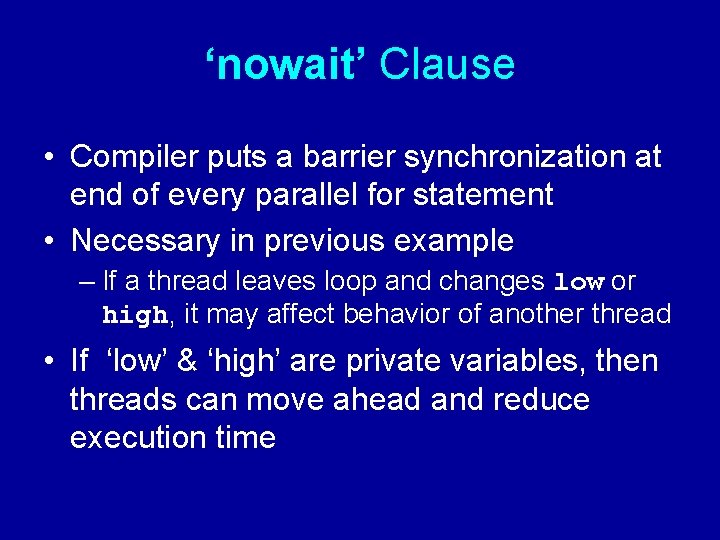
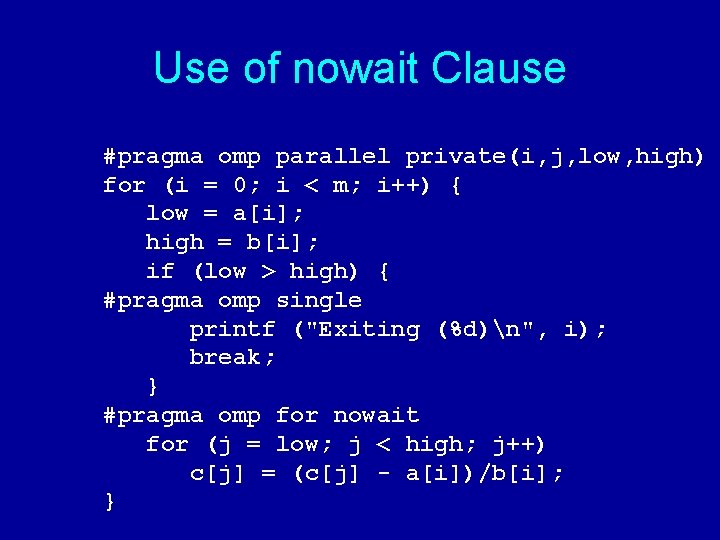
‘nowait’ Clause • Compiler puts a barrier synchronization at end of every parallel for statement • Necessary in previous example – If a thread leaves loop and changes low or high, it may affect behavior of another thread • If ‘low’ & ‘high’ are private variables, then threads can move ahead and reduce execution time
Use of nowait Clause #pragma omp parallel private(i, j, low, high) for (i = 0; i < m; i++) { low = a[i]; high = b[i]; if (low > high) { #pragma omp single printf ("Exiting (%d)n", i); break; } #pragma omp for nowait for (j = low; j < high; j++) c[j] = (c[j] - a[i])/b[i]; }
Functional Parallelism • To this point all of our focus has been on exploiting data parallelism • Open. MP allows us to assign different threads to different portions of code (functional parallelism)
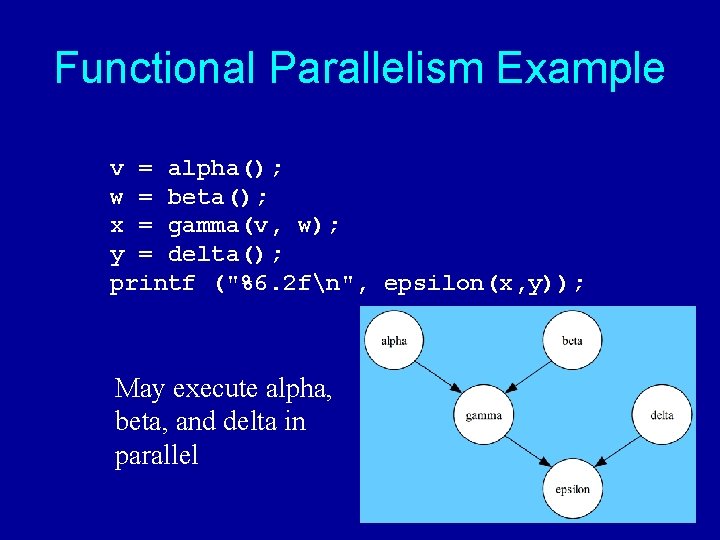
Functional Parallelism Example v = alpha(); w = beta(); x = gamma(v, w); y = delta(); printf ("%6. 2 fn", epsilon(x, y)); May execute alpha, beta, and delta in parallel
parallel sections Pragma • Precedes a block of k blocks of code that may be executed concurrently by k threads • Syntax: #pragma omp parallel sections
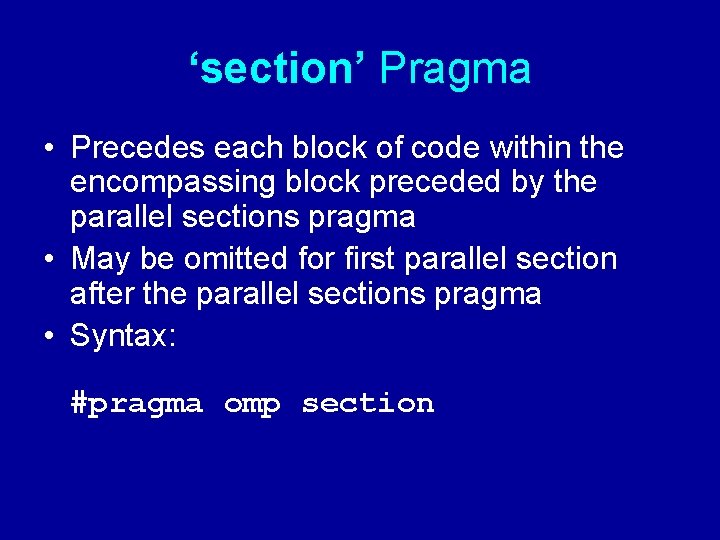
‘section’ Pragma • Precedes each block of code within the encompassing block preceded by the parallel sections pragma • May be omitted for first parallel section after the parallel sections pragma • Syntax: #pragma omp section
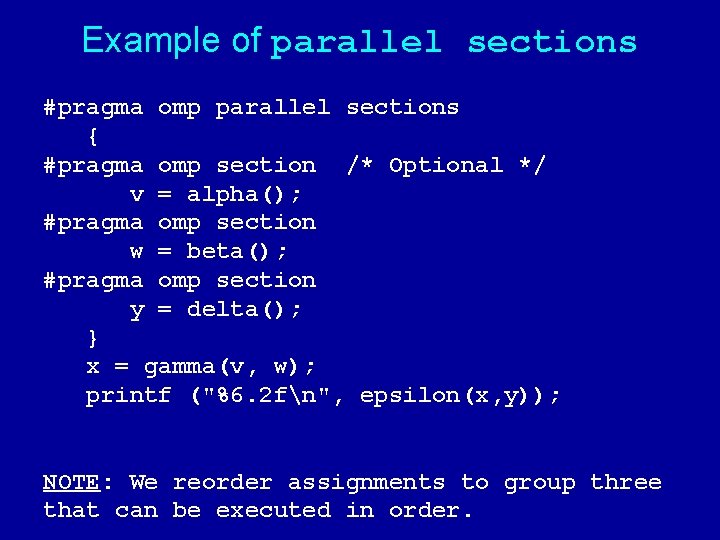
Example of parallel sections #pragma omp parallel sections { #pragma omp section /* Optional */ v = alpha(); #pragma omp section w = beta(); #pragma omp section y = delta(); } x = gamma(v, w); printf ("%6. 2 fn", epsilon(x, y)); NOTE: We reorder assignments to group three that can be executed in order.
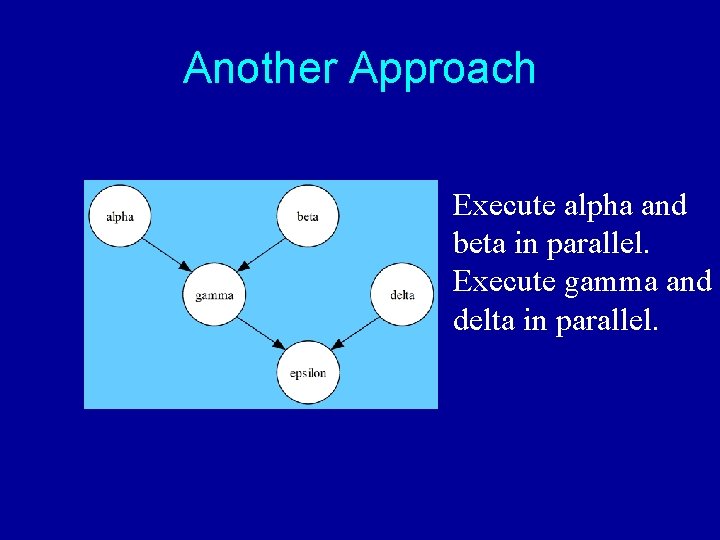
Another Approach Execute alpha and beta in parallel. Execute gamma and delta in parallel.
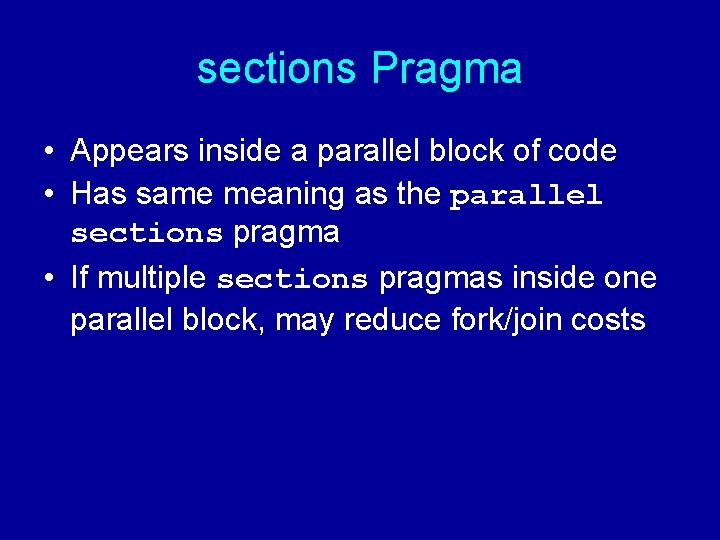
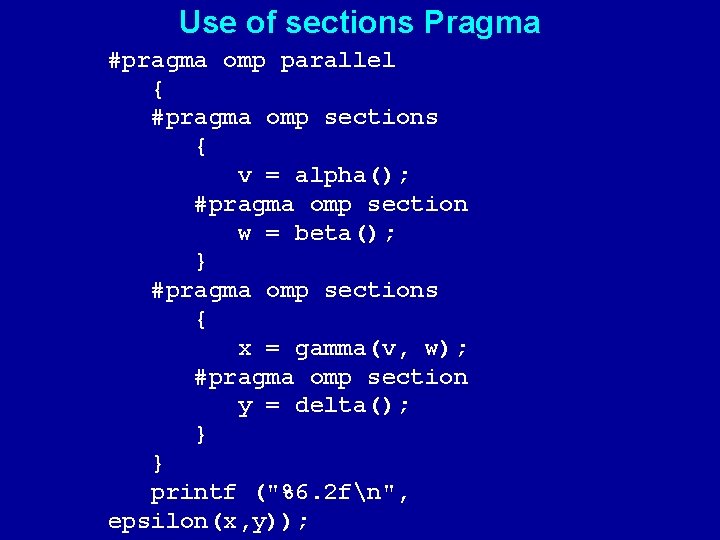
sections Pragma • Appears inside a parallel block of code • Has same meaning as the parallel sections pragma • If multiple sections pragmas inside one parallel block, may reduce fork/join costs
Use of sections Pragma #pragma omp parallel { #pragma omp sections { v = alpha(); #pragma omp section w = beta(); } #pragma omp sections { x = gamma(v, w); #pragma omp section y = delta(); } } printf ("%6. 2 fn", epsilon(x, y));
Quinn Summary (1/3) • Open. MP an API for shared-memory parallel programming • Shared-memory model based on fork/join parallelism • Data parallelism – parallel for pragma – reduction clause
Quinn Summary (2/3) • • Functional parallelism (parallel sections pragma) SPMD-style programming (parallel pragma) Critical sections (critical pragma) Enhancing performance of parallel for loops – Inverting loops – Conditionally parallelizing loops – Changing loop scheduling
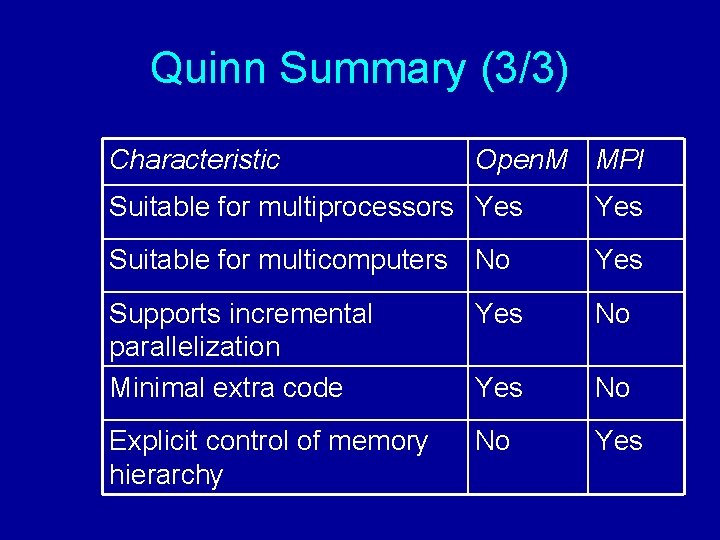
Quinn Summary (3/3) Characteristic Open. M MPI Suitable for multiprocessors Yes Suitable for multicomputers No Yes Supports incremental parallelization Minimal extra code Yes No Explicit control of memory hierarchy No Yes
Some Additional Comments
Open. MP Constructs • Limited to compiler directives and library subroutine calls. • The compiler directive format is such that they will be treated as comments by a sequential compiler. • This allows existing sequential compilers to easily be modified to support Open. MP • Whether a program executes the same computation (or any meaningful computation when executed sequentially) is the responsibility of programmer.
Starting & Forking Execution • Execution starts with a sequential process that forks a fixed number of threads when it reaches a parallel region. • This team of threads execute to the end of the parallel region and then join original process. • The number of threads is constant within a parallel region. • Different parallel regions can have a different number of threads.
Open. MP Synchronization Handled by various methods, including • critical sections • single-point barrier • ordered sections of a parallel loop that have to be performed in the specified order • locks • subroutine calls
Parallelizing Programs Philosophies • Two extreme philosophies for parallelizing programs • In minimum approach, parallel constructs are only placed where large amounts of independent data is processed. – Typically use nested loops – Rest of program is executed sequentially. – One problem is that it may not exploit all of the parallelism available in the program. – The process creation and termination may be invoked many times and cost may be high.
Parallelizing Programs Philosophies (cont) • The other extreme is the SPMD approach, which treats the entire program as parallel code. – Enters a parallel region at the beginning of the main program and exiting it just before the end. – Steps serialized only when required by program logic. • Many programs are a mixture of these two parallelizing extremes.