
Parallel ParticleinCell Simulation on Unstructured Meshes M S
- Slides: 19
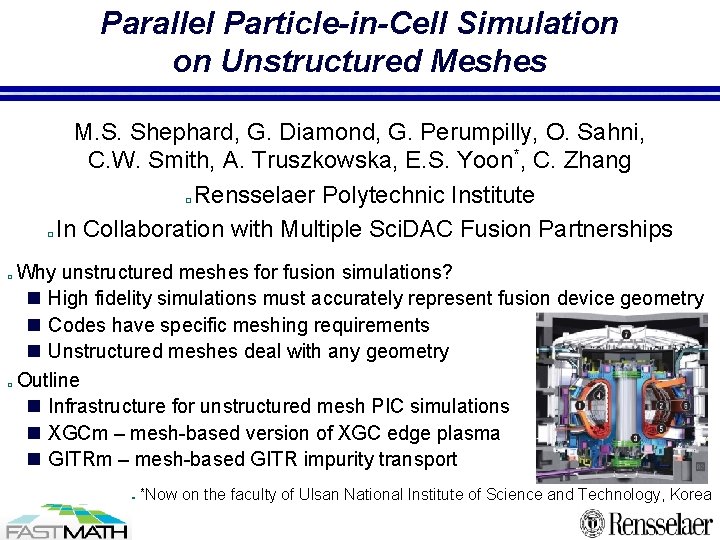
Parallel Particle-in-Cell Simulation on Unstructured Meshes M. S. Shephard, G. Diamond, G. Perumpilly, O. Sahni, C. W. Smith, A. Truszkowska, E. S. Yoon*, C. Zhang Rensselaer Polytechnic Institute In Collaboration with Multiple Sci. DAC Fusion Partnerships � � Why unstructured meshes for fusion simulations? n High fidelity simulations must accurately represent fusion device geometry n Codes have specific meshing requirements n Unstructured meshes deal with any geometry Outline n Infrastructure for unstructured mesh PIC simulations n XGCm – mesh-based version of XGC edge plasma n GITRm – mesh-based GITR impurity transport � *Now on the faculty of Ulsan National Institute of Science and Technology, Korea 1
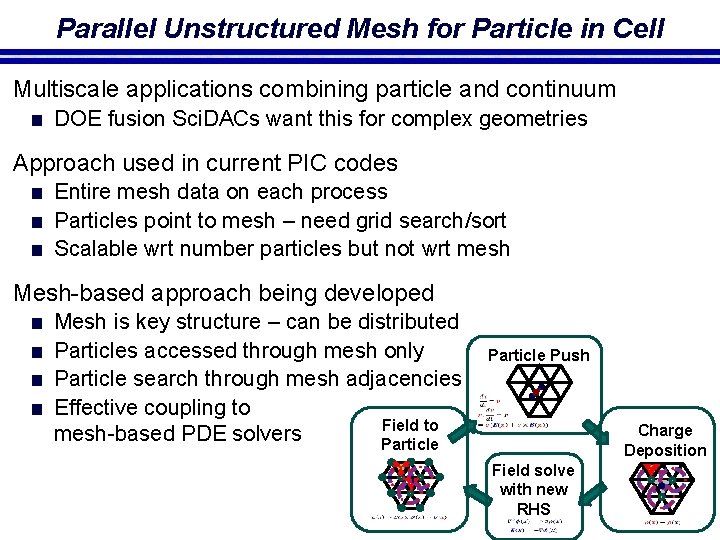
Parallel Unstructured Mesh for Particle in Cell Multiscale applications combining particle and continuum ■ DOE fusion Sci. DACs want this for complex geometries Approach used in current PIC codes ■ Entire mesh data on each process ■ Particles point to mesh – need grid search/sort ■ Scalable wrt number particles but not wrt mesh Mesh-based approach being developed ■ ■ Mesh is key structure – can be distributed Particles accessed through mesh only Particle Push Particle search through mesh adjacencies Effective coupling to Field to mesh-based PDE solvers Particle Field solve with new RHS Charge Deposition
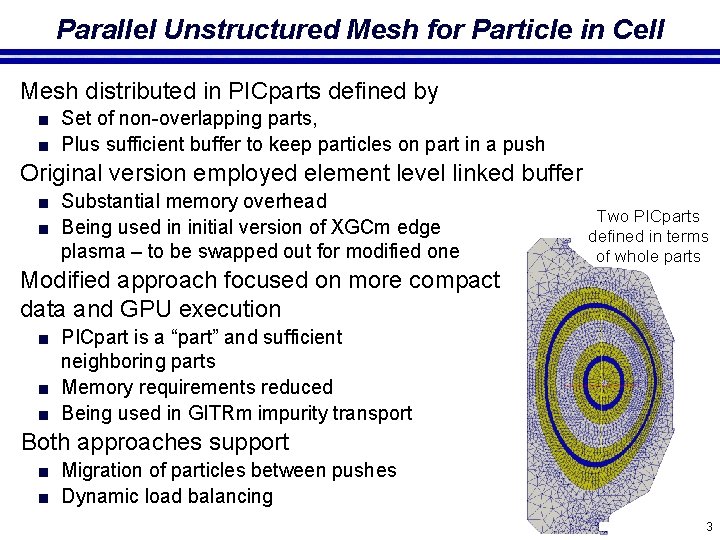
Parallel Unstructured Mesh for Particle in Cell Mesh distributed in PICparts defined by ■ Set of non-overlapping parts, ■ Plus sufficient buffer to keep particles on part in a push Original version employed element level linked buffer ■ Substantial memory overhead ■ Being used in initial version of XGCm edge plasma – to be swapped out for modified one Two PICparts defined in terms of whole parts Modified approach focused on more compact data and GPU execution ■ PICpart is a “part” and sufficient neighboring parts ■ Memory requirements reduced ■ Being used in GITRm impurity transport Both approaches support ■ Migration of particles between pushes ■ Dynamic load balancing 3
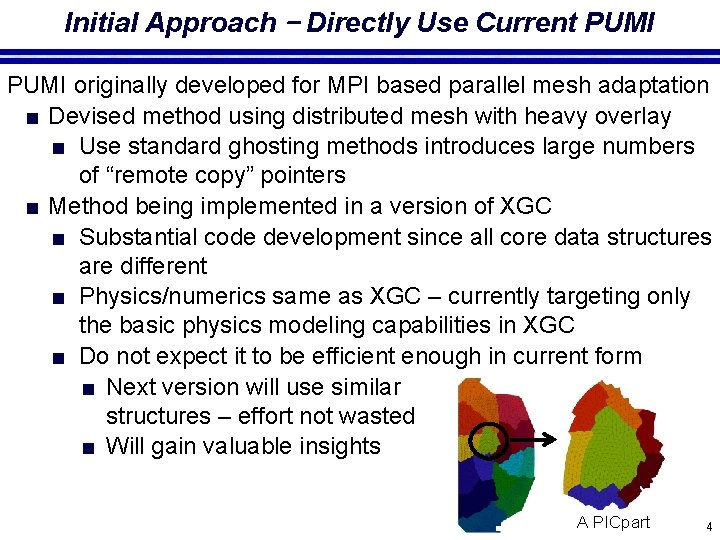
Initial Approach – Directly Use Current PUMI originally developed for MPI based parallel mesh adaptation ■ Devised method using distributed mesh with heavy overlay ■ Use standard ghosting methods introduces large numbers of “remote copy” pointers ■ Method being implemented in a version of XGC ■ Substantial code development since all core data structures are different ■ Physics/numerics same as XGC – currently targeting only the basic physics modeling capabilities in XGC ■ Do not expect it to be efficient enough in current form ■ Next version will use similar structures – effort not wasted ■ Will gain valuable insights A PICpart 4
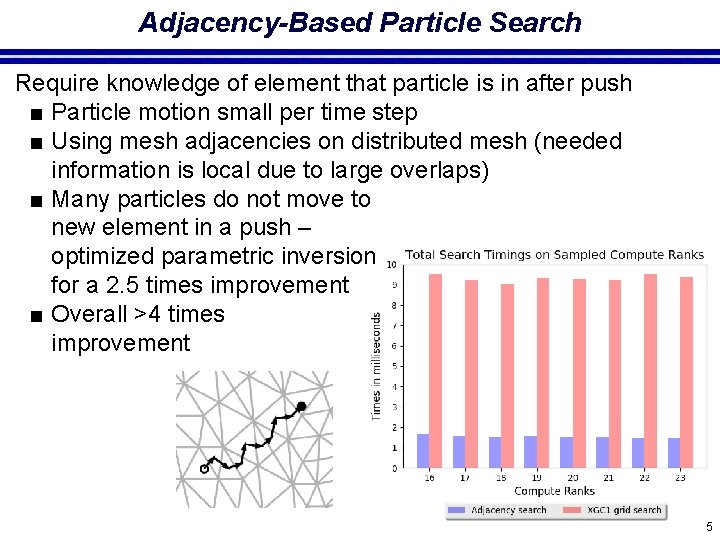
Adjacency-Based Particle Search Require knowledge of element that particle is in after push ■ Particle motion small per time step ■ Using mesh adjacencies on distributed mesh (needed information is local due to large overlaps) ■ Many particles do not move to new element in a push – optimized parametric inversion for a 2. 5 times improvement ■ Overall >4 times improvement 5
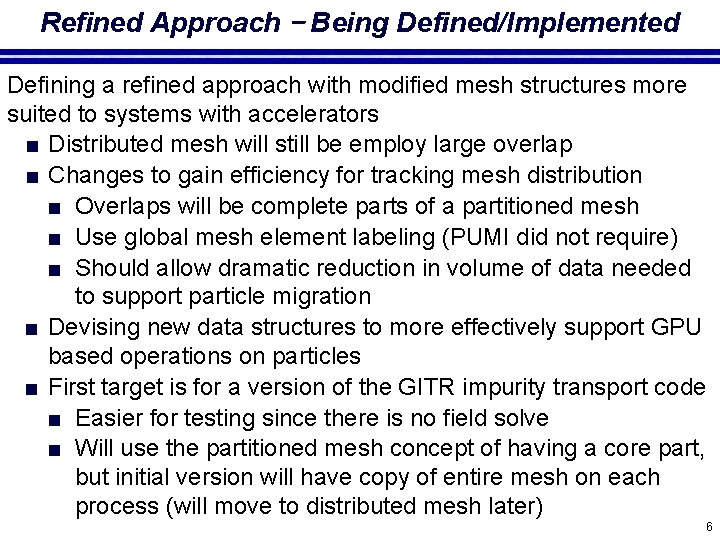
Refined Approach – Being Defined/Implemented Defining a refined approach with modified mesh structures more suited to systems with accelerators ■ Distributed mesh will still be employ large overlap ■ Changes to gain efficiency for tracking mesh distribution ■ Overlaps will be complete parts of a partitioned mesh ■ Use global mesh element labeling (PUMI did not require) ■ Should allow dramatic reduction in volume of data needed to support particle migration ■ Devising new data structures to more effectively support GPU based operations on particles ■ First target is for a version of the GITR impurity transport code ■ Easier for testing since there is no field solve ■ Will use the partitioned mesh concept of having a core part, but initial version will have copy of entire mesh on each process (will move to distributed mesh later) 6
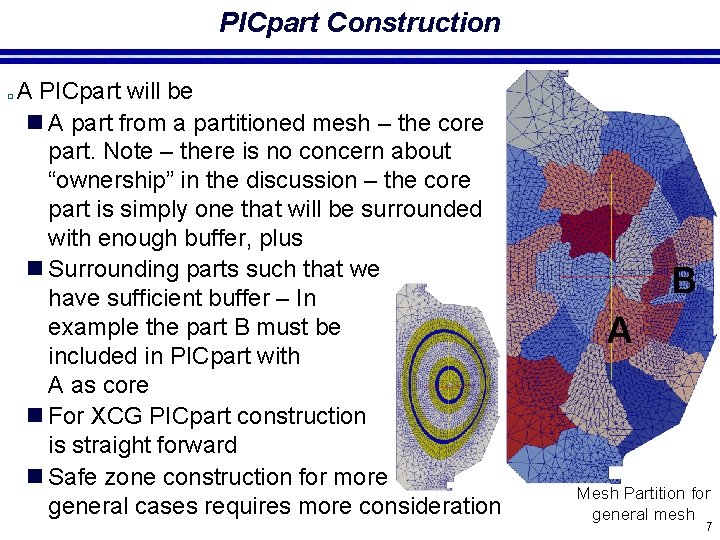
PICpart Construction � A PICpart will be n A part from a partitioned mesh – the core part. Note – there is no concern about “ownership” in the discussion – the core part is simply one that will be surrounded with enough buffer, plus n Surrounding parts such that we have sufficient buffer – In example the part B must be included in PICpart with A as core n For XCG PICpart construction is straight forward n Safe zone construction for more general cases requires more consideration B A Mesh Partition for general mesh 7
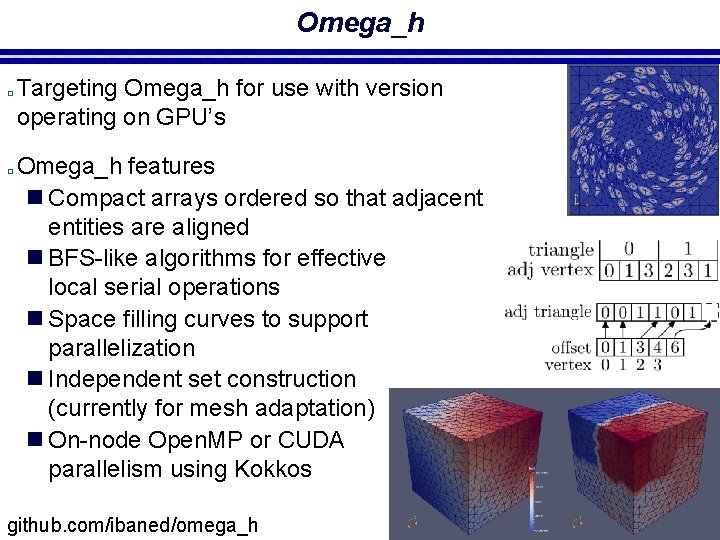
Move to Alternative Mesh Structure � Mesh data structures that support adaptation have evolved n Original structures had object oriented entity level class – bad for GPUs n MDS (current PUMI) stores topology in modifiable, arraybased, linked lists – OK for multi-core, managing array ‘holes’ and the ‘free list’ on GPUs during adapt not well suited for GPU execution n Omega_h is a static mesh representation that has been developed for mesh adaptation on GPU’s – simplex topology, linear geometry, structures rebuilt after changes (adaptation, migration/repartitioning) 8
Omega_h � � Targeting Omega_h for use with version operating on GPU’s Omega_h features n Compact arrays ordered so that adjacent entities are aligned n BFS-like algorithms for effective local serial operations n Space filling curves to support parallelization n Independent set construction (currently for mesh adaptation) n On-node Open. MP or CUDA parallelism using Kokkos github. com/ibaned/omega_h 9
Particle Data Structures � � The layout of particles in memory is critical for high performance push, scatter, and gather operations on GPUs. Particle data structure requirements: n Optimizes push, scatter, and gather operations n Associates particles with mesh elements n Evenly distributes work with a range of particle distributions e. g. ) uniform, Gaussian, exponential, etc. n Stores a lot of particles per GPU – low overhead Mesh data structure requirements: n Provide required adjacency information on GPU n Reduce irregular memory accesses by building arrays of mesh field information needed for particles. We are working with the ECP Co-Design Center for Particle Applications (COPA) on the best structures for our application 10
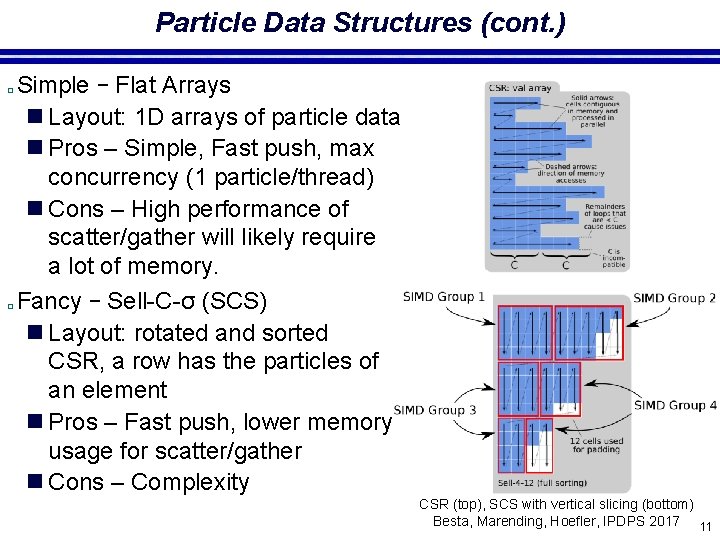
Particle Data Structures (cont. ) � � Simple – Flat Arrays n Layout: 1 D arrays of particle data n Pros – Simple, Fast push, max concurrency (1 particle/thread) n Cons – High performance of scatter/gather will likely require a lot of memory. Fancy – Sell-C-σ (SCS) n Layout: rotated and sorted CSR, a row has the particles of an element n Pros – Fast push, lower memory usage for scatter/gather n Cons – Complexity CSR (top), SCS with vertical slicing (bottom) Besta, Marending, Hoefler, IPDPS 2017 11
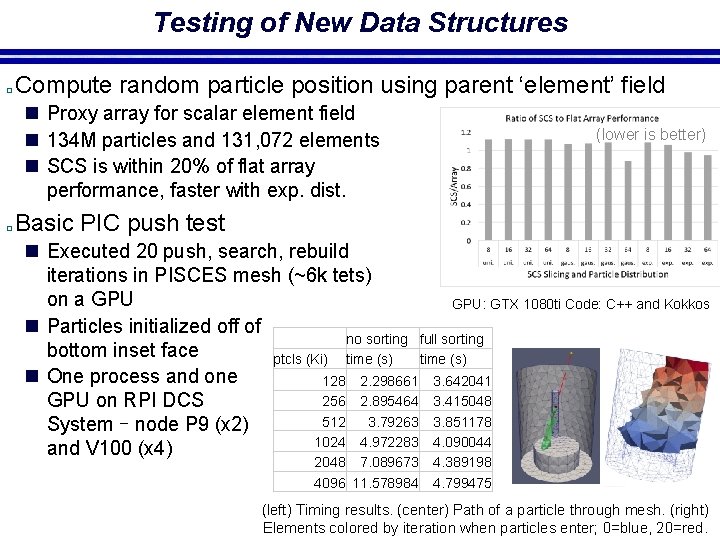
Testing of New Data Structures � Compute random particle position using parent ‘element’ field n Proxy array for scalar element field n 134 M particles and 131, 072 elements n SCS is within 20% of flat array performance, faster with exp. dist. � (lower is better) Basic PIC push test n Executed 20 push, search, rebuild iterations in PISCES mesh (~6 k tets) on a GPU: GTX 1080 ti Code: C++ and Kokkos n Particles initialized off of no sorting full sorting bottom inset face ptcls (Ki) time (s) n One process and one 128 2. 298661 3. 642041 256 2. 895464 3. 415048 GPU on RPI DCS 512 3. 79263 3. 851178 System – node P 9 (x 2) 1024 4. 972283 4. 090044 and V 100 (x 4) 2048 7. 089673 4096 11. 578984 4. 389198 4. 799475 (left) Timing results. (center) Path of a particle through mesh. (right) Elements colored by iteration when particles enter; 0=blue, 20=red.
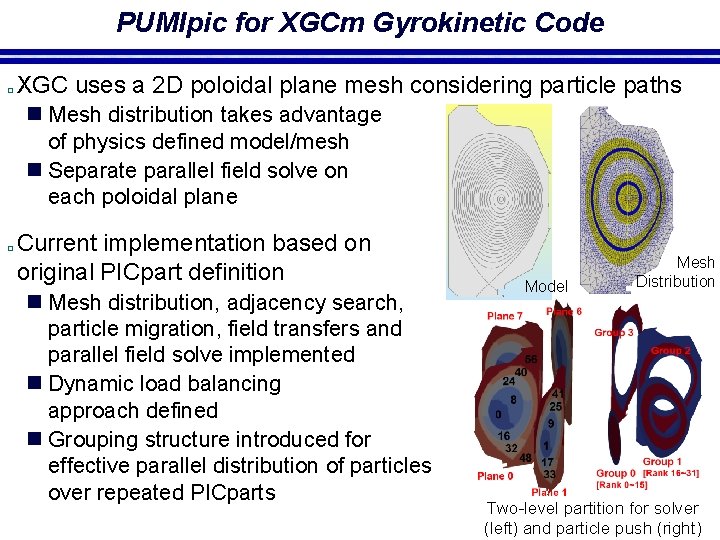
PUMIpic for XGCm Gyrokinetic Code � XGC uses a 2 D poloidal plane mesh considering particle paths n Mesh distribution takes advantage of physics defined model/mesh n Separate parallel field solve on each poloidal plane � Current implementation based on original PICpart definition n Mesh distribution, adjacency search, particle migration, field transfers and parallel field solve implemented n Dynamic load balancing approach defined n Grouping structure introduced for effective parallel distribution of particles over repeated PICparts Model Mesh Distribution Two-level partition for solver (left) and particle push (right)
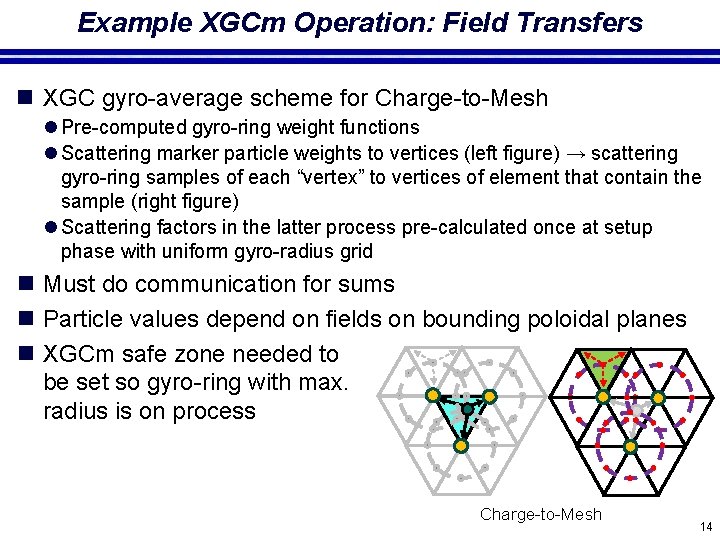
Example XGCm Operation: Field Transfers n XGC gyro-average scheme for Charge-to-Mesh l Pre-computed gyro-ring weight functions l Scattering marker particle weights to vertices (left figure) → scattering gyro-ring samples of each “vertex” to vertices of element that contain the sample (right figure) l Scattering factors in the latter process pre-calculated once at setup phase with uniform gyro-radius grid n Must do communication for sums n Particle values depend on fields on bounding poloidal planes n XGCm safe zone needed to be set so gyro-ring with max. radius is on process Charge-to-Mesh 14
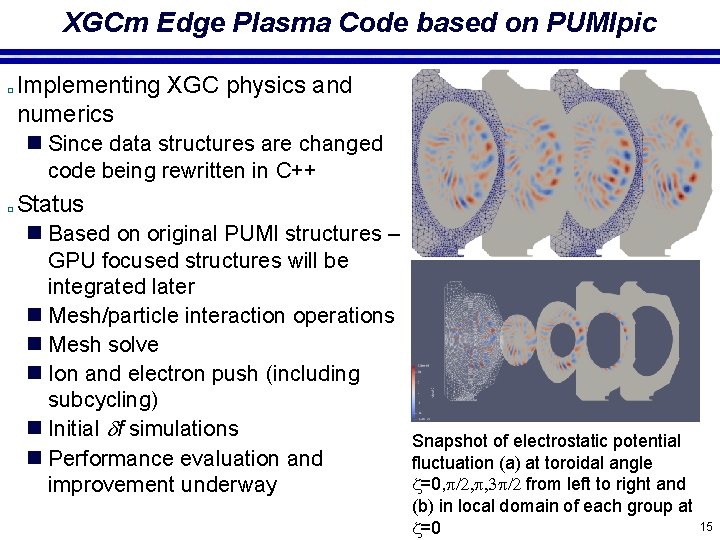
XGCm Edge Plasma Code based on PUMIpic � Implementing XGC physics and numerics n Since data structures are changed code being rewritten in C++ � Status n Based on original PUMI structures – GPU focused structures will be integrated later n Mesh/particle interaction operations n Mesh solve n Ion and electron push (including subcycling) n Initial df simulations n Performance evaluation and improvement underway Snapshot of electrostatic potential fluctuation (a) at toroidal angle z=0, p/2, p, 3 p/2 from left to right and (b) in local domain of each group at z=0 15
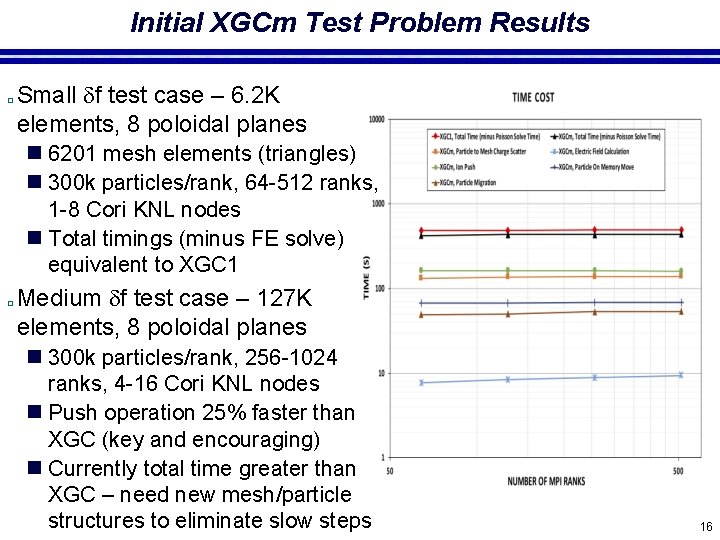
Initial XGCm Test Problem Results � Small df test case – 6. 2 K elements, 8 poloidal planes n 6201 mesh elements (triangles) n 300 k particles/rank, 64 -512 ranks, 1 -8 Cori KNL nodes n Total timings (minus FE solve) equivalent to XGC 1 � Medium df test case – 127 K elements, 8 poloidal planes n 300 k particles/rank, 256 -1024 ranks, 4 -16 Cori KNL nodes n Push operation 25% faster than XGC (key and encouraging) n Currently total time greater than XGC – need new mesh/particle structures to eliminate slow steps 16
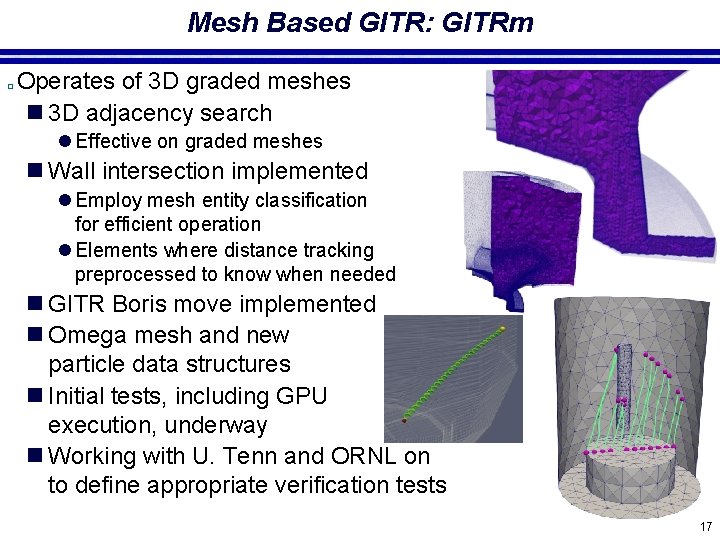
Mesh Based GITR: GITRm � Operates of 3 D graded meshes n 3 D adjacency search l Effective on graded meshes n Wall intersection implemented l Employ mesh entity classification for efficient operation l Elements where distance tracking preprocessed to know when needed n GITR Boris move implemented n Omega mesh and new particle data structures n Initial tests, including GPU execution, underway n Working with U. Tenn and ORNL on to define appropriate verification tests 17
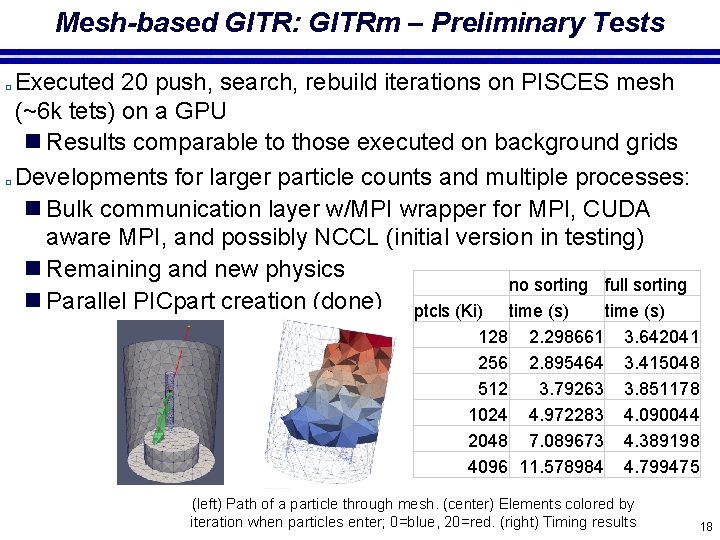
Mesh-based GITR: GITRm – Preliminary Tests � � Executed 20 push, search, rebuild iterations on PISCES mesh (~6 k tets) on a GPU n Results comparable to those executed on background grids Developments for larger particle counts and multiple processes: n Bulk communication layer w/MPI wrapper for MPI, CUDA aware MPI, and possibly NCCL (initial version in testing) n Remaining and new physics no sorting full sorting n Parallel PICpart creation (done) ptcls (Ki) time (s) 128 2. 298661 256 2. 895464 512 3. 79263 1024 4. 972283 2048 7. 089673 4096 11. 578984 3. 642041 3. 415048 3. 851178 4. 090044 4. 389198 4. 799475 (left) Path of a particle through mesh. (center) Elements colored by iteration when particles enter; 0=blue, 20=red. (right) Timing results 18
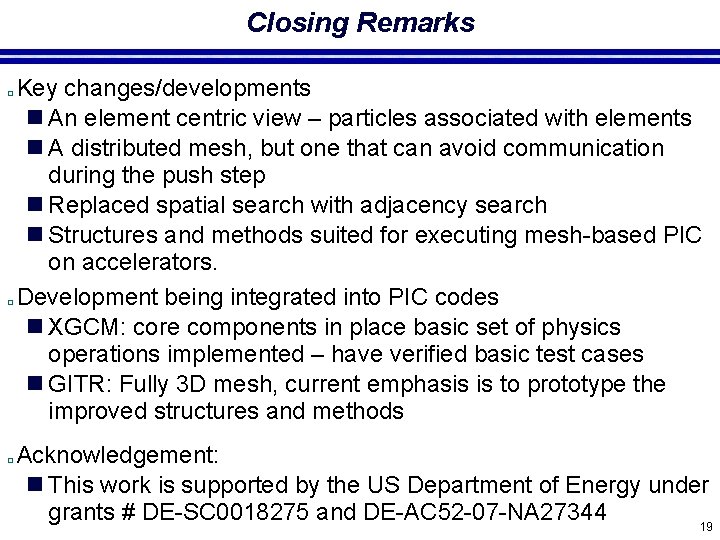
Closing Remarks � � � Key changes/developments n An element centric view – particles associated with elements n A distributed mesh, but one that can avoid communication during the push step n Replaced spatial search with adjacency search n Structures and methods suited for executing mesh-based PIC on accelerators. Development being integrated into PIC codes n XGCM: core components in place basic set of physics operations implemented – have verified basic test cases n GITR: Fully 3 D mesh, current emphasis is to prototype the improved structures and methods Acknowledgement: n This work is supported by the US Department of Energy under grants # DE-SC 0018275 and DE-AC 52 -07 -NA 27344 19