
Parallel Graphics in Frostbite Current Future Johan Andersson
Parallel Graphics in Frostbite – Current & Future Johan Andersson DICE Beyond Programmable Shading 1
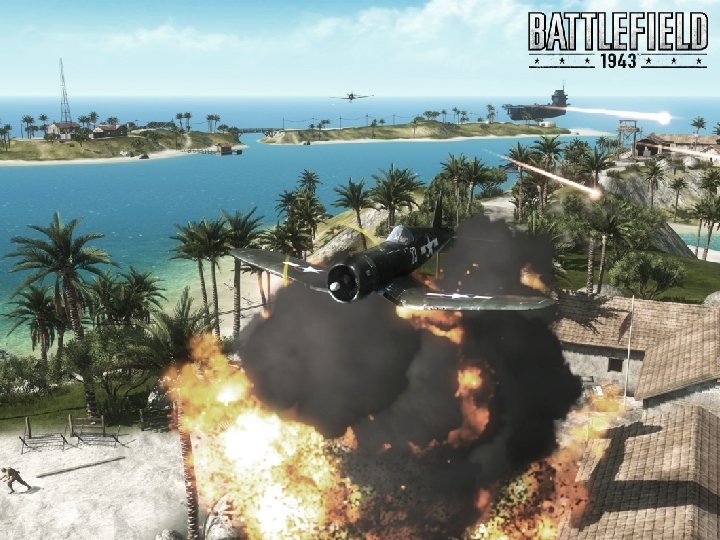
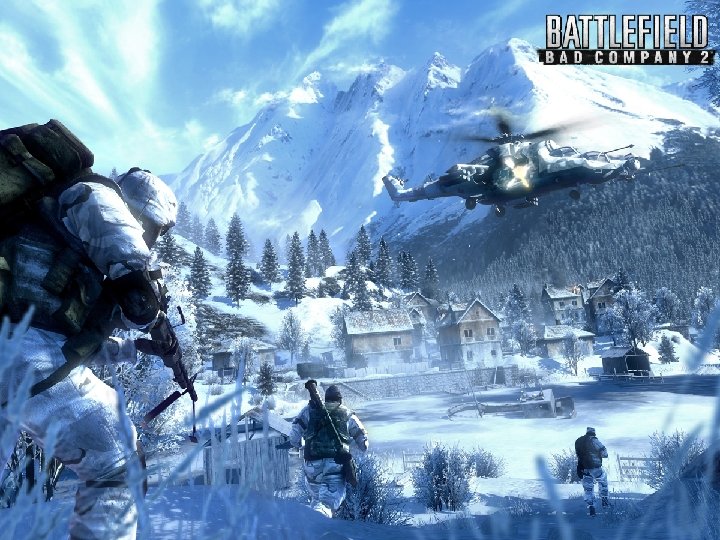
Quick background Frostbite 1. x § § [1][2][3] Xbox 360, PS 3, DX 10 Battlefield: Bad Company Battlefield 1943 Battlefield: Bad Company 2 Frostbite 2 [4][5] § In development § Xbox 360, PS 3 § DX 11 (10. 0, 10. 1, 11) Disclaimer: Unless specified, pictures are from engine tests, not actual games Beyond Programmable Shading 2
Beyond Programmable Shading 3
Beyond Programmable Shading 4
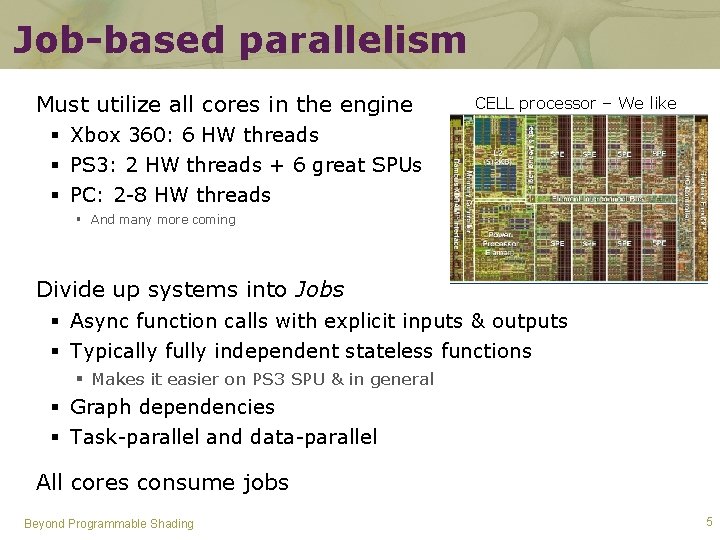
Job-based parallelism Must utilize all cores in the engine CELL processor – We like § Xbox 360: 6 HW threads § PS 3: 2 HW threads + 6 great SPUs § PC: 2 -8 HW threads § And many more coming Divide up systems into Jobs § Async function calls with explicit inputs & outputs § Typically fully independent stateless functions § Makes it easier on PS 3 SPU & in general § Graph dependencies § Task-parallel and data-parallel All cores consume jobs Beyond Programmable Shading 5
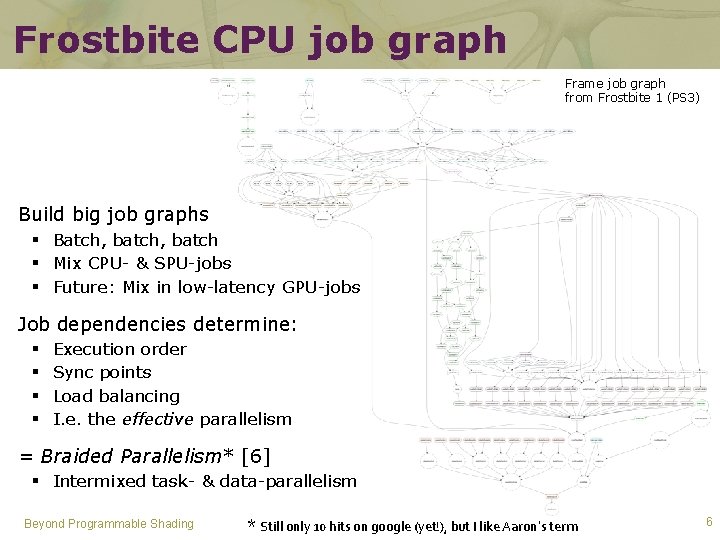
Frostbite CPU job graph Frame job graph from Frostbite 1 (PS 3) Build big job graphs § Batch, batch § Mix CPU- & SPU-jobs § Future: Mix in low-latency GPU-jobs Job dependencies determine: § § Execution order Sync points Load balancing I. e. the effective parallelism = Braided Parallelism* [6] § Intermixed task- & data-parallelism Beyond Programmable Shading * Still only 10 hits on google (yet!), but I like Aaron’s term 6
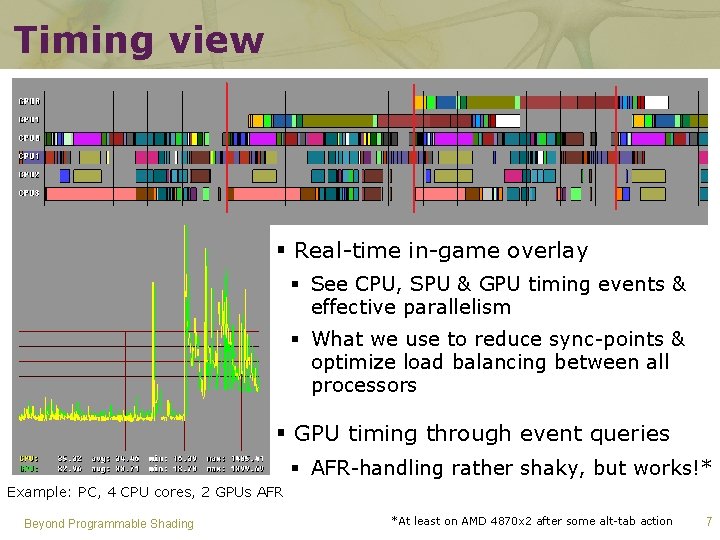
Timing view § Real-time in-game overlay § See CPU, SPU & GPU timing events & effective parallelism § What we use to reduce sync-points & optimize load balancing between all processors § GPU timing through event queries § AFR-handling rather shaky, but works!* Example: PC, 4 CPU cores, 2 GPUs AFR Beyond Programmable Shading *At least on AMD 4870 x 2 after some alt-tab action 7
Rendering jobs Rendering systems are heavily divided up into jobs Most will move to GPU § Eventually. . some have already! § Mostly one-way data flow § Compute shaders++ Jobs: – – – – – Terrain geometry processing Undergrowth generation [2] Decal projection [3] Particle simulation Frustum culling Occlusion rasterization Command buffer generation PS 3: Triangle culling I will talk about a couple of these. . Beyond Programmable Shading 8
Parallel command buffer recording Dispatch draw calls and state to multiple command buffers in parallel – Scales linearly with # cores – 1500 -4000 draw calls per frame Important for all platforms, used on: – Xbox 360 – PS 3 (SPU-based) Previously not possible on PC, but now in DX 11. . . Beyond Programmable Shading 9
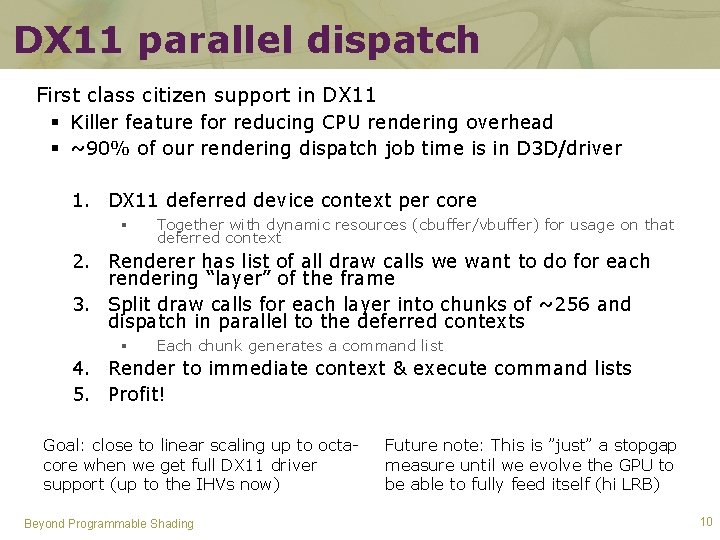
DX 11 parallel dispatch First class citizen support in DX 11 § Killer feature for reducing CPU rendering overhead § ~90% of our rendering dispatch job time is in D 3 D/driver 1. DX 11 deferred device context per core § Together with dynamic resources (cbuffer/vbuffer) for usage on that deferred context 2. Renderer has list of all draw calls we want to do for each rendering “layer” of the frame 3. Split draw calls for each layer into chunks of ~256 and dispatch in parallel to the deferred contexts § Each chunk generates a command list 4. Render to immediate context & execute command lists 5. Profit! Goal: close to linear scaling up to octacore when we get full DX 11 driver support (up to the IHVs now) Beyond Programmable Shading Future note: This is ”just” a stopgap measure until we evolve the GPU to be able to fully feed itself (hi LRB) 10
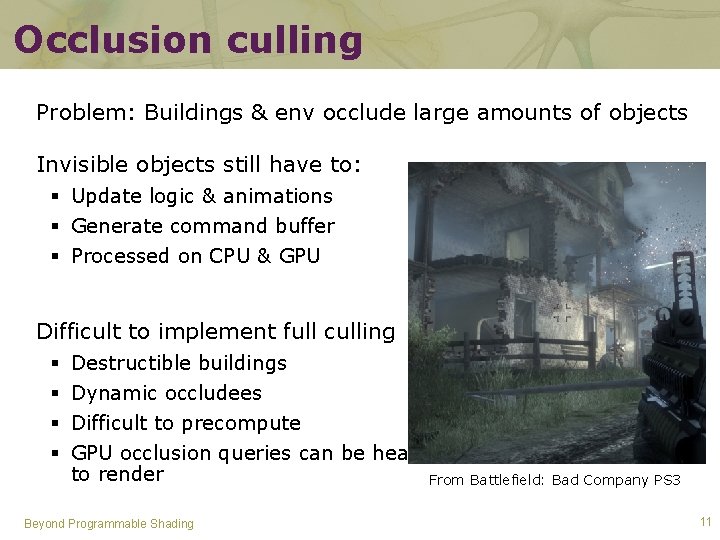
Occlusion culling Problem: Buildings & env occlude large amounts of objects Invisible objects still have to: § Update logic & animations § Generate command buffer § Processed on CPU & GPU Difficult to implement full culling § § Destructible buildings Dynamic occludees Difficult to precompute GPU occlusion queries can be heavy to render From Battlefield: Bad Company PS 3 Beyond Programmable Shading 11
Our solution: Software occlusion rasterization Beyond Programmable Shading 12
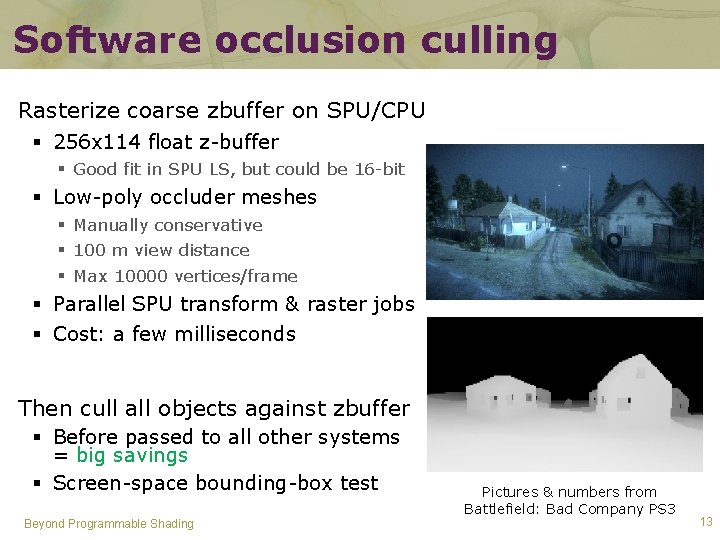
Software occlusion culling Rasterize coarse zbuffer on SPU/CPU § 256 x 114 float z-buffer § Good fit in SPU LS, but could be 16 -bit § Low-poly occluder meshes § Manually conservative § 100 m view distance § Max 10000 vertices/frame § Parallel SPU transform & raster jobs § Cost: a few milliseconds Then cull all objects against zbuffer § Before passed to all other systems = big savings § Screen-space bounding-box test Beyond Programmable Shading Pictures & numbers from Battlefield: Bad Company PS 3 13
GPU occlusion culling Ideally want GPU rasterization & testing, but: § Occlusion queries introduces overhead & latency – Can be manageable, but far from ideal § Conditional rendering only helps GPU – Not CPU, frame memory or draw calls Future 1: Low-latency extra GPU exec. context § Rasterization and testing done on GPU where it belongs § Lockstep with CPU, need to read back data within a few ms § Should be possible on LRB (latency? ), want on all HW Future 2: Move entire cull & rendering to ”GPU” § Scene graph, cull, systems, dispatch. End goal. Beyond Programmable Shading 14

PS 3 geometry processing Problem: Slow GPU triangle & vertex setup on PS 3 GPU § Combined with unique situation with powerful & initially not fully utilized ”free” SPUs! Solution: SPU triangle culling § Trade SPU time for GPU time § Cull all back faces, micro-triangles, out of frustum – Based on Sony’s PS 3 EDGE library [7] § 5 SPU jobs processes frame geometry in parallel § Output is new index buffer for each draw call Many developers are using EDGE (or similar) on PS 3 Beyond Programmable Shading 15
Custom geometry processing Software control opens up great flexibility and programmability! Simple custom culling/processing that we’ve added: § Partition bounding box culling § Mesh part culling § Clip plane triangle trivial accept & reject § Triangle cull volumes (inverse clip planes) Others are doing: Full skinning, morph targets, CLOD Future wish: No explicit vertex & geometry shaders § DIY compute shaders with fixed-func tesselation and triangle setup units § Software-controlled queuing of data between stages § To avoid always spilling out to memory Beyond Programmable Shading 16
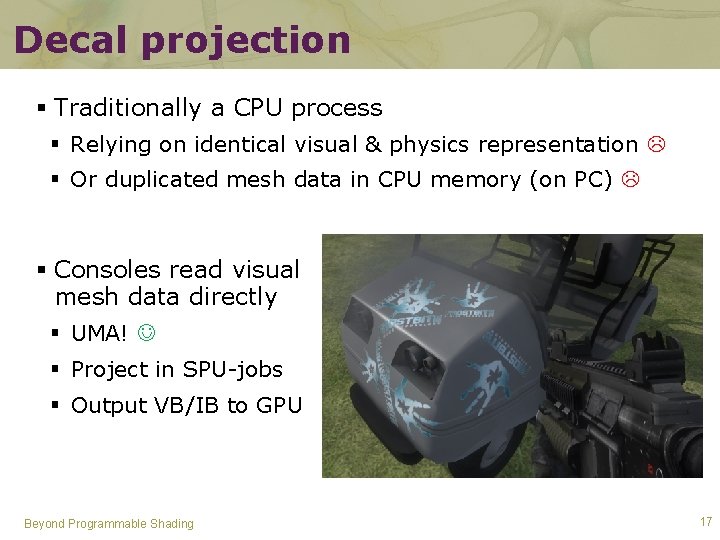
Decal projection § Traditionally a CPU process § Relying on identical visual & physics representation § Or duplicated mesh data in CPU memory (on PC) § Consoles read visual mesh data directly § UMA! § Project in SPU-jobs § Output VB/IB to GPU Beyond Programmable Shading 17
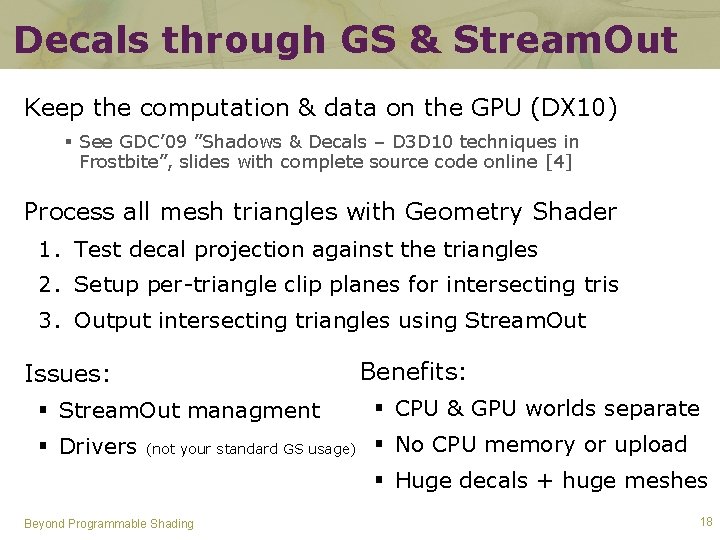
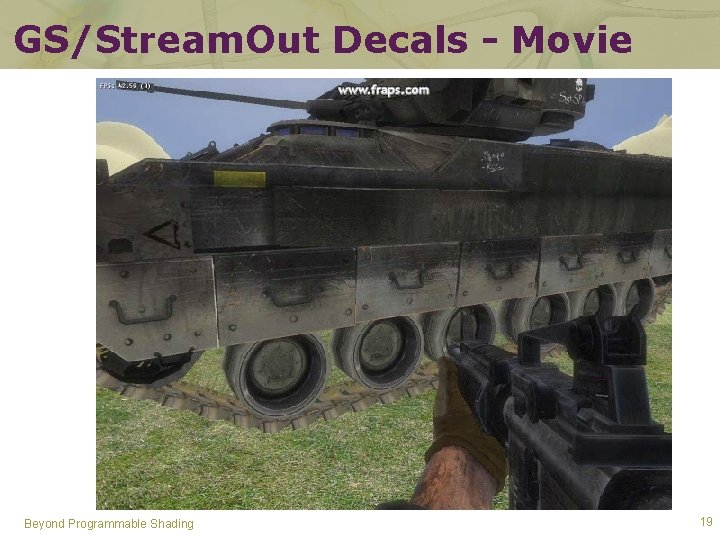
Decals through GS & Stream. Out Keep the computation & data on the GPU (DX 10) § See GDC’ 09 ”Shadows & Decals – D 3 D 10 techniques in Frostbite”, slides with complete source code online [4] Process all mesh triangles with Geometry Shader 1. Test decal projection against the triangles 2. Setup per-triangle clip planes for intersecting tris 3. Output intersecting triangles using Stream. Out Benefits: Issues: § Stream. Out managment § CPU & GPU worlds separate § Drivers § No CPU memory or upload (not your standard GS usage) § Huge decals + huge meshes Beyond Programmable Shading 18
GS/Stream. Out Decals - Movie Beyond Programmable Shading 19
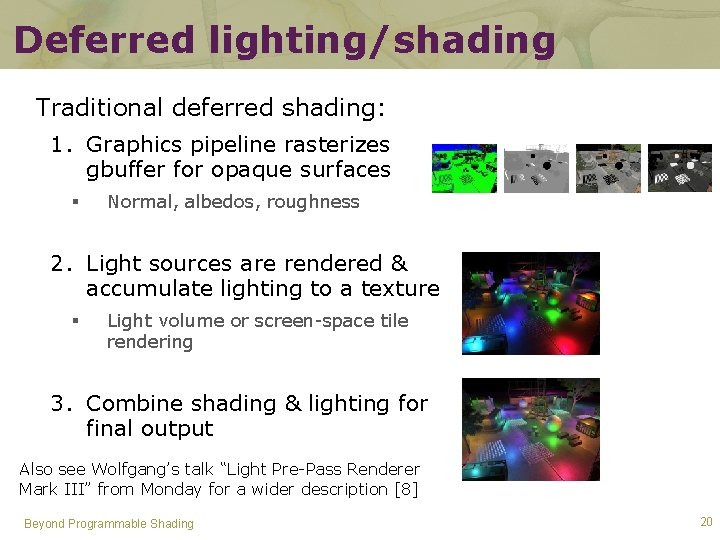
Deferred lighting/shading Traditional deferred shading: 1. Graphics pipeline rasterizes gbuffer for opaque surfaces § Normal, albedos, roughness 2. Light sources are rendered & accumulate lighting to a texture § Light volume or screen-space tile rendering 3. Combine shading & lighting for final output Also see Wolfgang’s talk “Light Pre-Pass Renderer Mark III” from Monday for a wider description [8] Beyond Programmable Shading 20
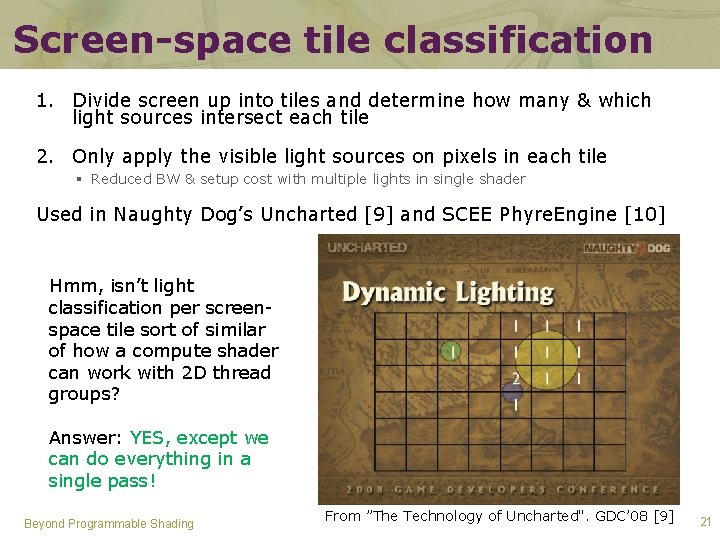
Screen-space tile classification 1. Divide screen up into tiles and determine how many & which light sources intersect each tile 2. Only apply the visible light sources on pixels in each tile § Reduced BW & setup cost with multiple lights in single shader Used in Naughty Dog’s Uncharted [9] and SCEE Phyre. Engine [10] Hmm, isn’t light classification per screenspace tile sort of similar of how a compute shader can work with 2 D thread groups? Answer: YES, except we can do everything in a single pass! Beyond Programmable Shading From ”The Technology of Uncharted". GDC’ 08 [9] 21
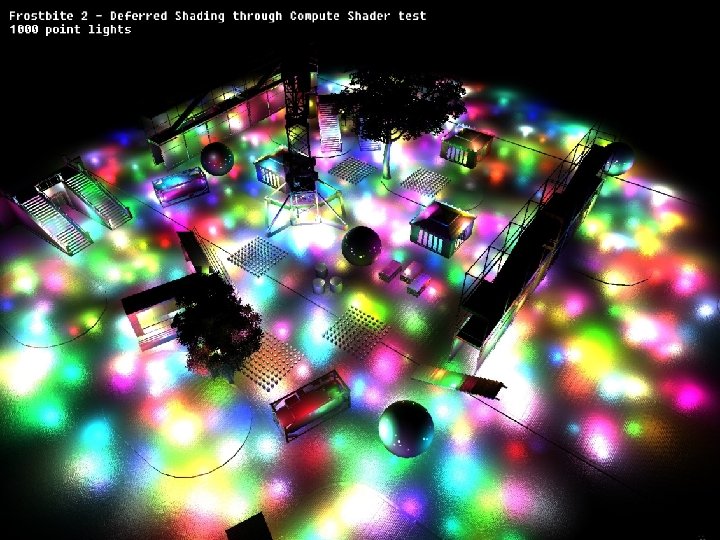
CS-based deferred shading Deferred shading using DX 11 CS § Experimental implementation in Frostbite 2 § Not production tested or optimized § Compute Shader 5. 0 § Assumption: No shadows (for now) New hybrid Graphics/Compute shading pipeline: 1. Graphics pipeline rasterizes gbuffers for opaque surfaces 2. Compute pipeline uses gbuffers, culls light sources, computes lighting & combines with shading (multiple other variants also possible) Beyond Programmable Shading 22
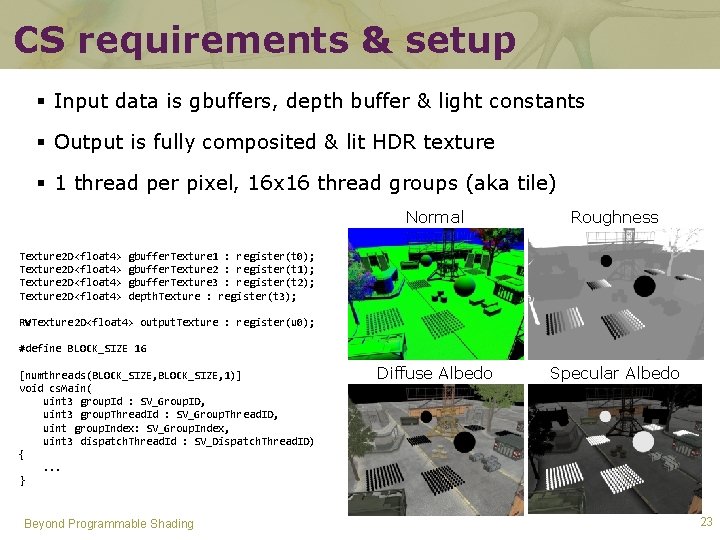
CS requirements & setup § Input data is gbuffers, depth buffer & light constants § Output is fully composited & lit HDR texture § 1 thread per pixel, 16 x 16 thread groups (aka tile) Texture 2 D<float 4> Normal Roughness Diffuse Albedo Specular Albedo gbuffer. Texture 1 : register(t 0); gbuffer. Texture 2 : register(t 1); gbuffer. Texture 3 : register(t 2); depth. Texture : register(t 3); RWTexture 2 D<float 4> output. Texture : register(u 0); #define BLOCK_SIZE 16 [numthreads(BLOCK_SIZE, 1)] void cs. Main( uint 3 group. Id : SV_Group. ID, uint 3 group. Thread. Id : SV_Group. Thread. ID, uint group. Index: SV_Group. Index, uint 3 dispatch. Thread. Id : SV_Dispatch. Thread. ID) {. . . } Beyond Programmable Shading 23
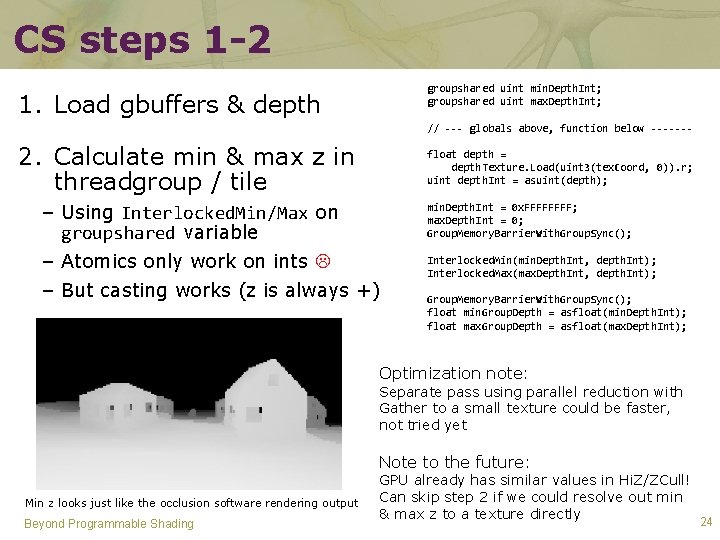
CS steps 1 -2 groupshared uint min. Depth. Int; groupshared uint max. Depth. Int; 1. Load gbuffers & depth // --- globals above, function below ------- 2. Calculate min & max z in threadgroup / tile float depth = depth. Texture. Load(uint 3(tex. Coord, 0)). r; uint depth. Int = asuint(depth); – Using Interlocked. Min/Max on groupshared variable – Atomics only work on ints – But casting works (z is always +) min. Depth. Int = 0 x. FFFF; max. Depth. Int = 0; Group. Memory. Barrier. With. Group. Sync(); Interlocked. Min(min. Depth. Int, depth. Int); Interlocked. Max(max. Depth. Int, depth. Int); Group. Memory. Barrier. With. Group. Sync(); float min. Group. Depth = asfloat(min. Depth. Int); float max. Group. Depth = asfloat(max. Depth. Int); Optimization note: Separate pass using parallel reduction with Gather to a small texture could be faster, not tried yet Note to the future: Min z looks just like the occlusion software rendering output Beyond Programmable Shading GPU already has similar values in Hi. Z/ZCull! Can skip step 2 if we could resolve out min & max z to a texture directly 24
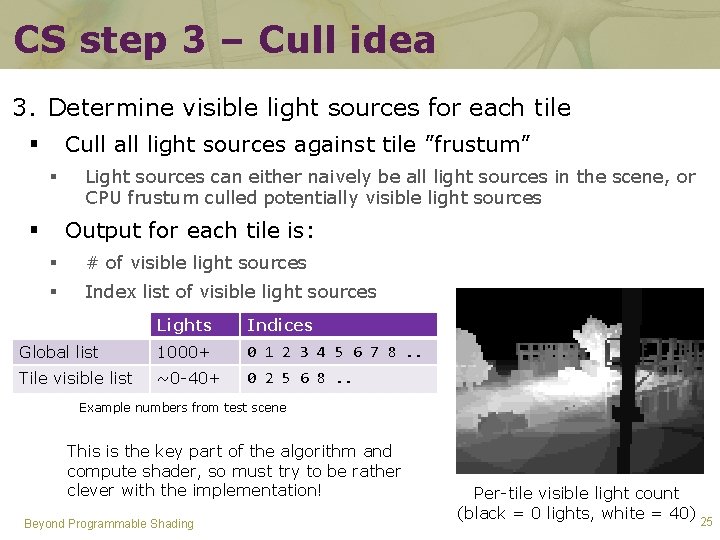
CS step 3 – Cull idea 3. Determine visible light sources for each tile Cull all light sources against tile ”frustum” § § Light sources can either naively be all light sources in the scene, or CPU frustum culled potentially visible light sources Output for each tile is: § § # of visible light sources § Index list of visible light sources Lights Indices Global list 1000+ 0 1 2 3 4 5 6 7 8. . Tile visible list ~0 -40+ 0 2 5 6 8. . Example numbers from test scene This is the key part of the algorithm and compute shader, so must try to be rather clever with the implementation! Beyond Programmable Shading Per-tile visible light count (black = 0 lights, white = 40) 25
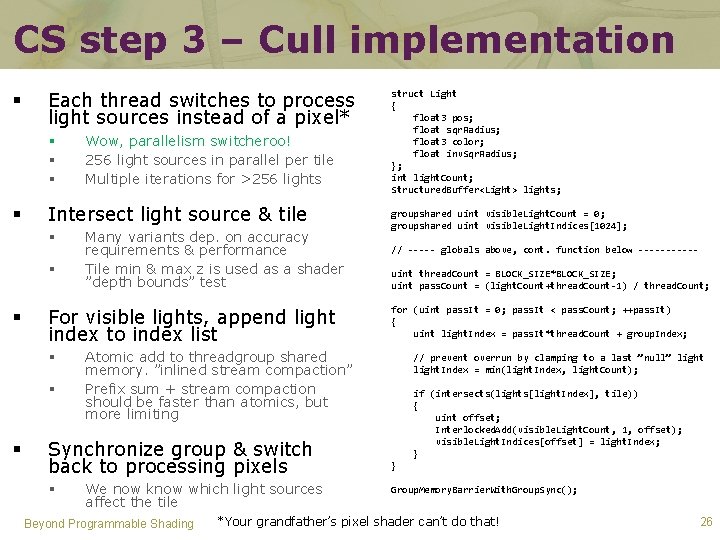
CS step 3 – Cull implementation § Each thread switches to process light sources instead of a pixel* § § Intersect light source & tile § § § Many variants dep. on accuracy requirements & performance Tile min & max z is used as a shader ”depth bounds” test For visible lights, append light index to index list § § § Wow, parallelism switcheroo! 256 light sources in parallel per tile Multiple iterations for >256 lights groupshared uint visible. Light. Count = 0; groupshared uint visible. Light. Indices[1024]; // ----- globals above, cont. function below -----uint thread. Count = BLOCK_SIZE*BLOCK_SIZE; uint pass. Count = (light. Count+thread. Count-1) / thread. Count; for (uint pass. It = 0; pass. It < pass. Count; ++pass. It) { uint light. Index = pass. It*thread. Count + group. Index; Atomic add to threadgroup shared memory. ”inlined stream compaction” Prefix sum + stream compaction should be faster than atomics, but more limiting Synchronize group & switch back to processing pixels § struct Light { float 3 pos; float sqr. Radius; float 3 color; float inv. Sqr. Radius; }; int light. Count; Structured. Buffer<Light> lights; We now know which light sources affect the tile Beyond Programmable Shading // prevent overrun by clamping to a last ”null” light. Index = min(light. Index, light. Count); if (intersects(lights[light. Index], tile)) { uint offset; Interlocked. Add(visible. Light. Count, 1, offset); visible. Light. Indices[offset] = light. Index; } } Group. Memory. Barrier. With. Group. Sync(); *Your grandfather’s pixel shader can’t do that! 26
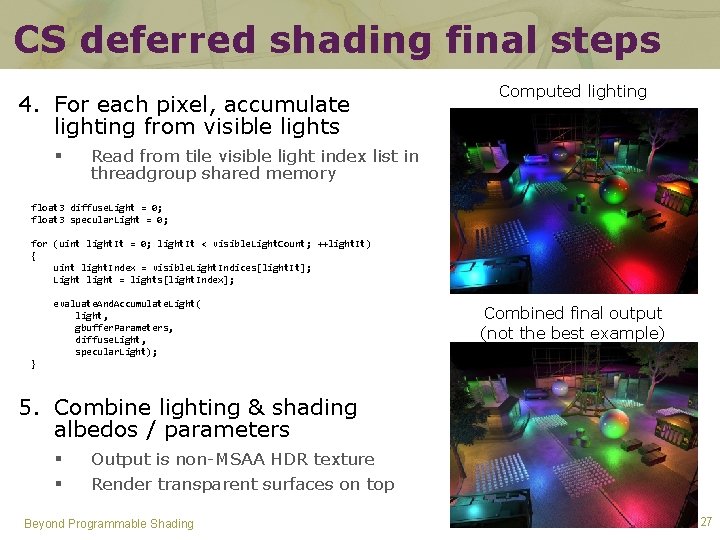
CS deferred shading final steps 4. For each pixel, accumulate lighting from visible lights § Computed lighting Read from tile visible light index list in threadgroup shared memory float 3 diffuse. Light = 0; float 3 specular. Light = 0; for (uint light. It = 0; light. It < visible. Light. Count; ++light. It) { uint light. Index = visible. Light. Indices[light. It]; Light light = lights[light. Index]; evaluate. And. Accumulate. Light( light, gbuffer. Parameters, diffuse. Light, specular. Light); Combined final output (not the best example) } 5. Combine lighting & shading albedos / parameters § § Output is non-MSAA HDR texture Render transparent surfaces on top Beyond Programmable Shading 27
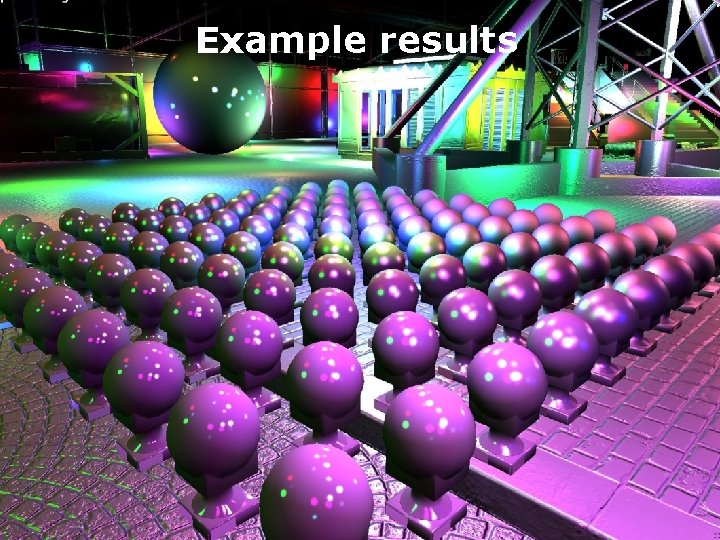
Example results Beyond Programmable Shading 28
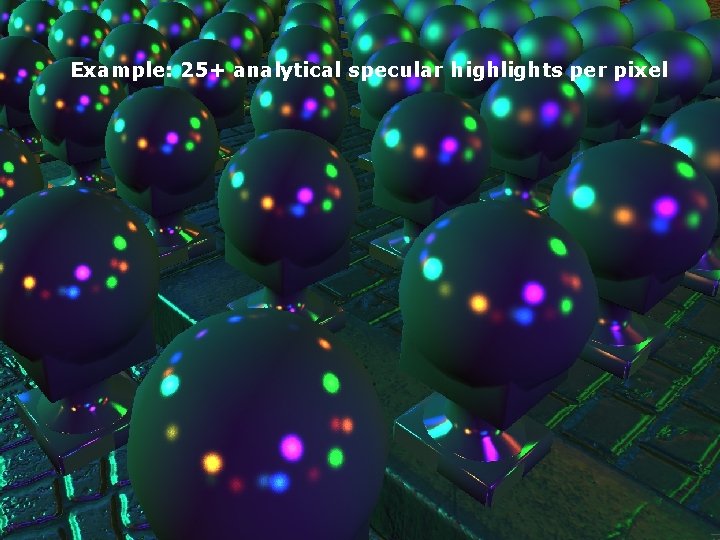
Example: 25+ analytical specular highlights per pixel Beyond Programmable Shading 29
Beyond Programmable Shading 30
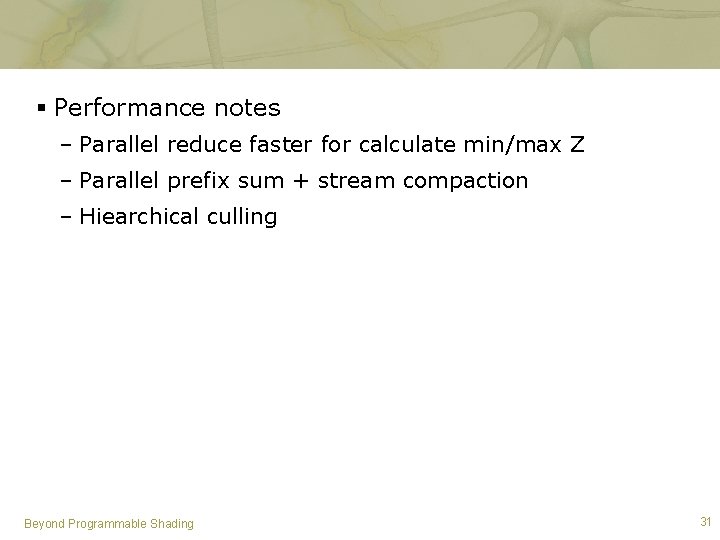
§ Performance notes – Parallel reduce faster for calculate min/max Z – Parallel prefix sum + stream compaction – Hiearchical culling Beyond Programmable Shading 31
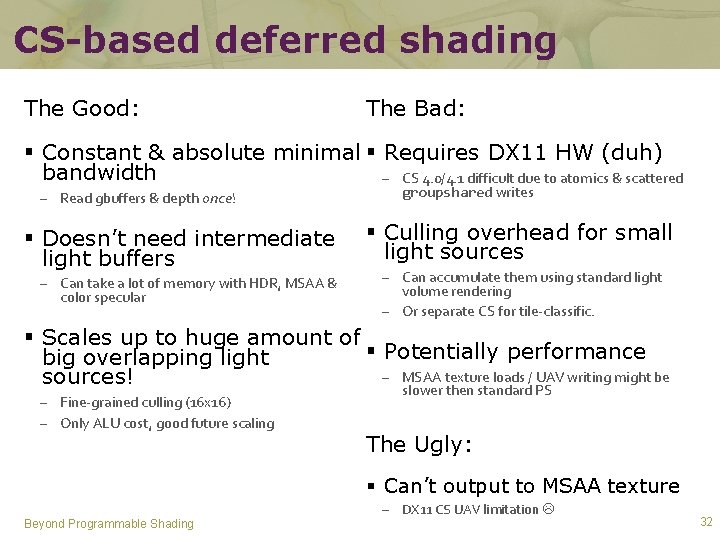
CS-based deferred shading The Good: The Bad: § Constant & absolute minimal § Requires DX 11 HW (duh) bandwidth – CS 4. 0/4. 1 difficult due to atomics & scattered – Read gbuffers & depth once! § Doesn’t need intermediate light buffers – Can take a lot of memory with HDR, MSAA & color specular groupshared writes § Culling overhead for small light sources – Can accumulate them using standard light volume rendering – Or separate CS for tile-classific. § Scales up to huge amount of § Potentially performance big overlapping light – MSAA texture loads / UAV writing might be sources! slower then standard PS – Fine-grained culling (16 x 16) – Only ALU cost, good future scaling The Ugly: § Can’t output to MSAA texture Beyond Programmable Shading – DX 11 CS UAV limitation 32
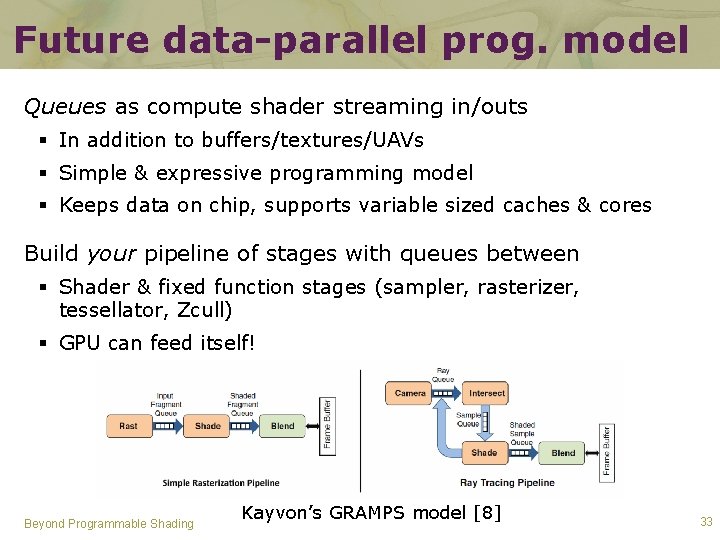
Future data-parallel prog. model Queues as compute shader streaming in/outs § In addition to buffers/textures/UAVs § Simple & expressive programming model § Keeps data on chip, supports variable sized caches & cores Build your pipeline of stages with queues between § Shader & fixed function stages (sampler, rasterizer, tessellator, Zcull) § GPU can feed itself! Beyond Programmable Shading Kayvon’s GRAMPS model [8] 33
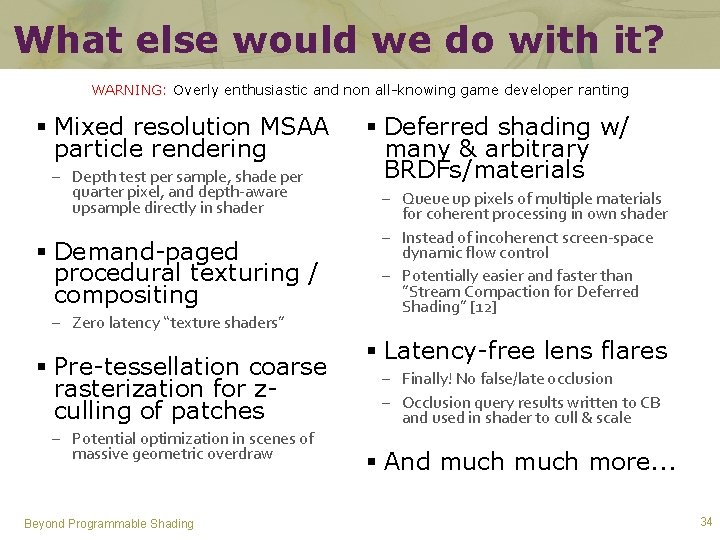
What else would we do with it? WARNING: Overly enthusiastic and non all-knowing game developer ranting § Mixed resolution MSAA particle rendering – Depth test per sample, shade per quarter pixel, and depth-aware upsample directly in shader § Demand-paged procedural texturing / compositing – Zero latency “texture shaders” § Pre-tessellation coarse rasterization for zculling of patches – Potential optimization in scenes of massive geometric overdraw Beyond Programmable Shading § Deferred shading w/ many & arbitrary BRDFs/materials – Queue up pixels of multiple materials for coherent processing in own shader – Instead of incoherenct screen-space dynamic flow control – Potentially easier and faster than ”Stream Compaction for Deferred Shading” [12] § Latency-free lens flares – Finally! No false/late occlusion – Occlusion query results written to CB and used in shader to cull & scale § And much more. . . 34
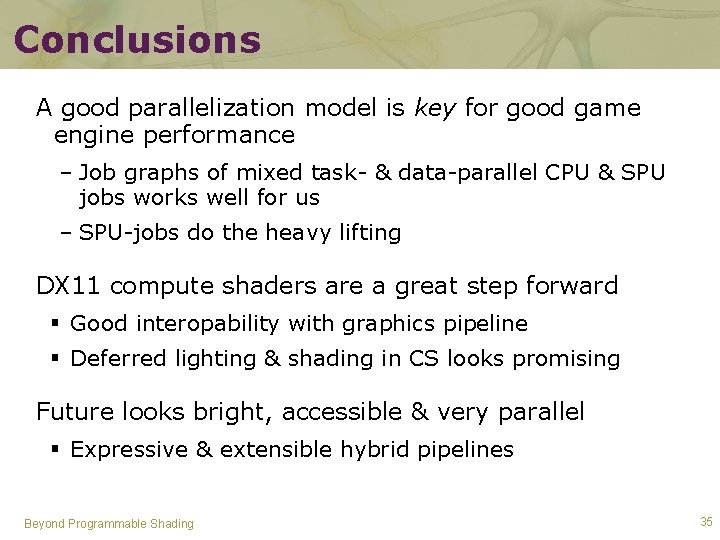
Conclusions A good parallelization model is key for good game engine performance – Job graphs of mixed task- & data-parallel CPU & SPU jobs works well for us – SPU-jobs do the heavy lifting DX 11 compute shaders are a great step forward § Good interopability with graphics pipeline § Deferred lighting & shading in CS looks promising Future looks bright, accessible & very parallel § Expressive & extensible hybrid pipelines Beyond Programmable Shading 35
Acknowledgements § DICE & Frostbite team § Nicolas Thibieroz, Mark Leather § Miguel Sainz, Yury Uralsky § Kayvon Fatahalian § Matt Swoboda, Pål-Kristian Engstad § Timothy Farrar, Jake Cannell Beyond Programmable Shading 36
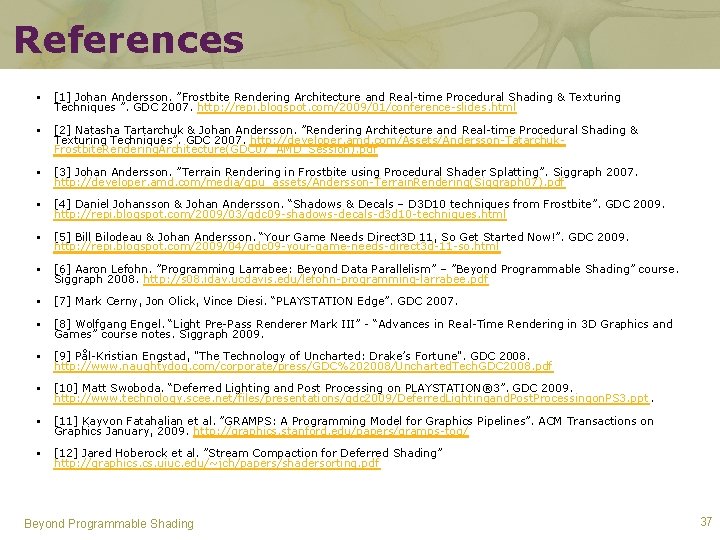
References § [1] Johan Andersson. ”Frostbite Rendering Architecture and Real-time Procedural Shading & Texturing Techniques ”. GDC 2007. http: //repi. blogspot. com/2009/01/conference-slides. html § [2] Natasha Tartarchuk & Johan Andersson. ”Rendering Architecture and Real-time Procedural Shading & Texturing Techniques”. GDC 2007. http: //developer. amd. com/Assets/Andersson-Tatarchuk. Frostbite. Rendering. Architecture(GDC 07_AMD_Session). pdf § [3] Johan Andersson. ”Terrain Rendering in Frostbite using Procedural Shader Splatting”. Siggraph 2007. http: //developer. amd. com/media/gpu_assets/Andersson-Terrain. Rendering(Siggraph 07). pdf § [4] Daniel Johansson & Johan Andersson. “Shadows & Decals – D 3 D 10 techniques from Frostbite”. GDC 2009. http: //repi. blogspot. com/2009/03/gdc 09 -shadows-decals-d 3 d 10 -techniques. html § [5] Bill Bilodeau & Johan Andersson. “Your Game Needs Direct 3 D 11, So Get Started Now!”. GDC 2009. http: //repi. blogspot. com/2009/04/gdc 09 -your-game-needs-direct 3 d-11 -so. html § [6] Aaron Lefohn. ”Programming Larrabee: Beyond Data Parallelism” – ”Beyond Programmable Shading” course. Siggraph 2008. http: //s 08. idav. ucdavis. edu/lefohn-programming-larrabee. pdf § [7] Mark Cerny, Jon Olick, Vince Diesi. “PLAYSTATION Edge”. GDC 2007. § [8] Wolfgang Engel. “Light Pre-Pass Renderer Mark III” - “Advances in Real-Time Rendering in 3 D Graphics and Games” course notes. Siggraph 2009. § [9] Pål-Kristian Engstad, "The Technology of Uncharted: Drake’s Fortune". GDC 2008. http: //www. naughtydog. com/corporate/press/GDC%202008/Uncharted. Tech. GDC 2008. pdf § [10] Matt Swoboda. “Deferred Lighting and Post Processing on PLAYSTATION® 3”. GDC 2009. http: //www. technology. scee. net/files/presentations/gdc 2009/Deferred. Lightingand. Post. Processingon. PS 3. ppt. § [11] Kayvon Fatahalian et al. ”GRAMPS: A Programming Model for Graphics Pipelines”. ACM Transactions on Graphics January, 2009. http: //graphics. stanford. edu/papers/gramps-tog/ § [12] Jared Hoberock et al. ”Stream Compaction for Deferred Shading” http: //graphics. uiuc. edu/~jch/papers/shadersorting. pdf Beyond Programmable Shading 37

Oh btw, we’re hiring senior developers Beyond Programmable Shading 38

Questions? § Please fill in the course evaluation at: http: //www. siggraph. org/courses_evaluation § You could win a Siggraph’ 09 mug (yey!) § One winner per course, notified by email in the evening Beyond Programmable Shading igetyourfail. com Email: johan. andersson@dice. se Blog: http: //repi. se Twitter: http: //twitter. com/repi 39
- Slides: 39