
PARALLEL FLOW VISUALIZATION PROJECT 1 NAESB BPS UPDATE
PARALLEL FLOW VISUALIZATION PROJECT 1 NAESB BPS UPDATE TO EXECUTIVE COMMITTEE AUGUST 21, 2012 BY NARINDER K SAINI ED SKIBA BPS-CO-CHAIRS
OVERVIEW 2 �Background �Parallel Flow Visualization Objectives �NAESB Responsibility �IDC Input �Proposed Solution �Issues NAESB External �Next Steps
Background: IRO-006 Transmission Loading Relief 3 �Each Reliability Coordinator and Balancing Authority that receives a request pursuant to an Interconnectionwide transmission loading relief procedure (such as Eastern Interconnection TLR, WECC Unscheduled Flow Mitigation, or congestion management procedures from the ERCOT Protocols) from any Reliability Coordinator, Balancing Authority, or Transmission Operator in another Interconnection to curtail an Interchange Transaction that crosses an Interconnection boundary shall comply with the request, unless it provides a reliability reason to the requestor why it cannot comply with the request.
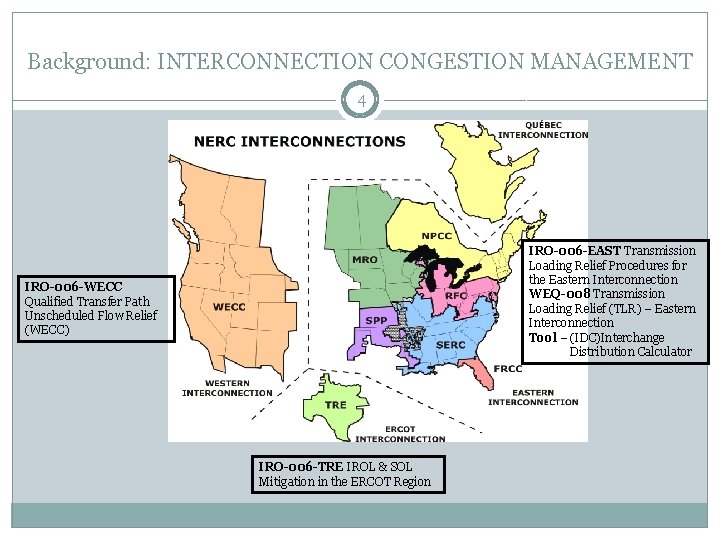
Background: INTERCONNECTION CONGESTION MANAGEMENT 4 IRO-006 -EAST Transmission Loading Relief Procedures for the Eastern Interconnection WEQ-008 Transmission Loading Relief (TLR) – Eastern Interconnection Tool – (IDC)Interchange Distribution Calculator IRO-006 -WECC Qualified Transfer Path Unscheduled Flow Relief (WECC) IRO-006 -TRE IROL & SOL Mitigation in the ERCOT Region
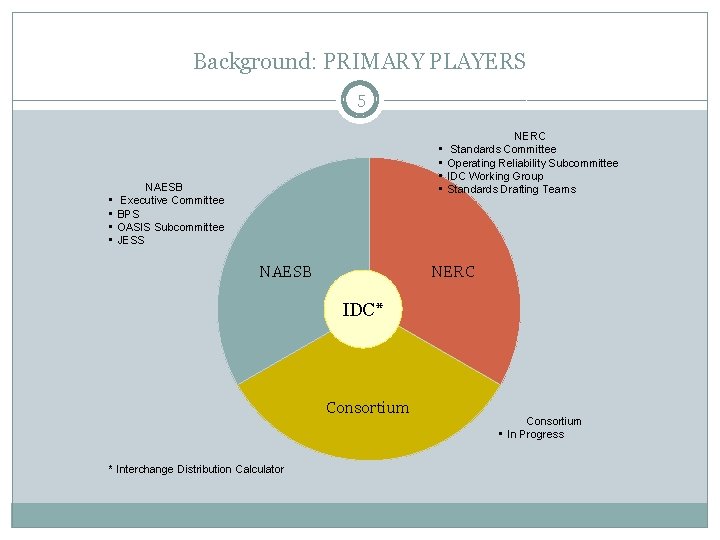
Background: PRIMARY PLAYERS 5 • • NAESB Executive Committee BPS OASIS Subcommittee JESS NAESB NERC Standards Committee Operating Reliability Subcommittee IDC Working Group Standards Drafting Teams NERC IDC* Consortium * Interchange Distribution Calculator Consortium • In Progress
Parallel Flow Visualization Objectives 6 �Generation to load (GTL) impacts reported to the IDC on a real-time basis �More accurate assignment of relief obligations to entities causing congestion Near real-time data using generator output provided by RC Include impacts of intra-BA generation-to-load and point-topoint transactions Differentiate between intra-BA firm and non-firm transmission service IDC has better data to perform calculations for TLR Levels 3 and 5
NAESB RESPONSIBILITY 7 �NAESB will establish methodology for assigning the generation to load flows into the appropriate buckets.
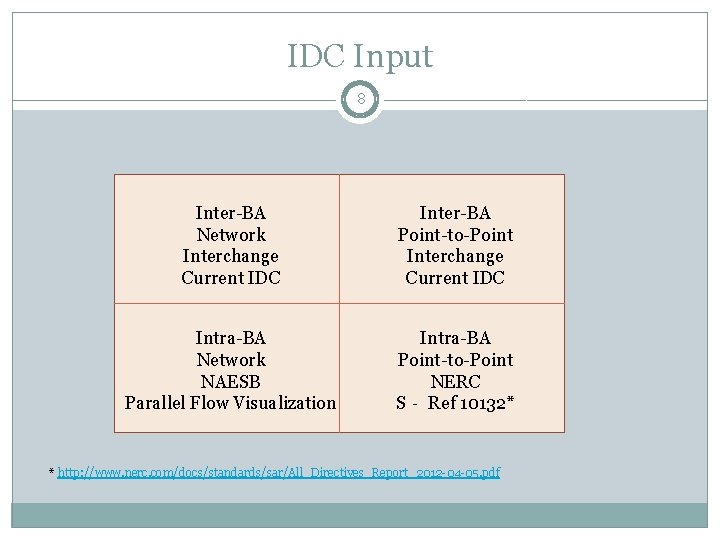
IDC Input 8 Inter-BA Network Interchange Current IDC Inter-BA Point-to-Point Interchange Current IDC Intra-BA Network NAESB Parallel Flow Visualization Intra-BA Point-to-Point NERC S‐ Ref 10132* * http: //www. nerc. com/docs/standards/sar/All_Directives_Report_2012 -04 -05. pdf
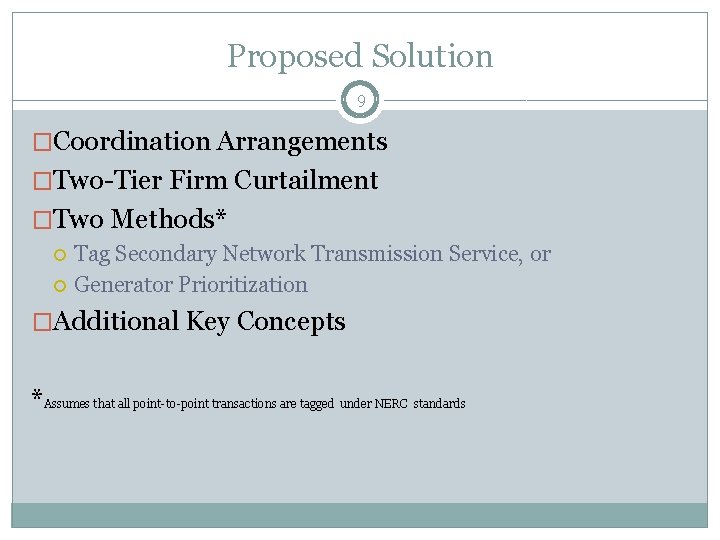
Proposed Solution 9 �Coordination Arrangements �Two-Tier Firm Curtailment �Two Methods* Tag Secondary Network Transmission Service, or Generator Prioritization �Additional Key Concepts *Assumes that all point-to-point transactions are tagged under NERC standards
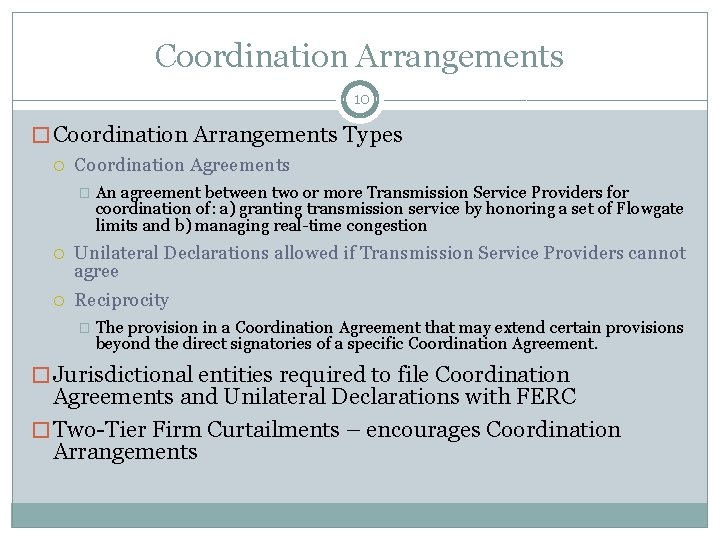
Coordination Arrangements 10 � Coordination Arrangements Types Coordination Agreements � An agreement between two or more Transmission Service Providers for coordination of: a) granting transmission service by honoring a set of Flowgate limits and b) managing real-time congestion Unilateral Declarations allowed if Transmission Service Providers cannot agree Reciprocity � The provision in a Coordination Agreement that may extend certain provisions beyond the direct signatories of a specific Coordination Agreement. � Jurisdictional entities required to file Coordination Agreements and Unilateral Declarations with FERC � Two-Tier Firm Curtailments – encourages Coordination Arrangements
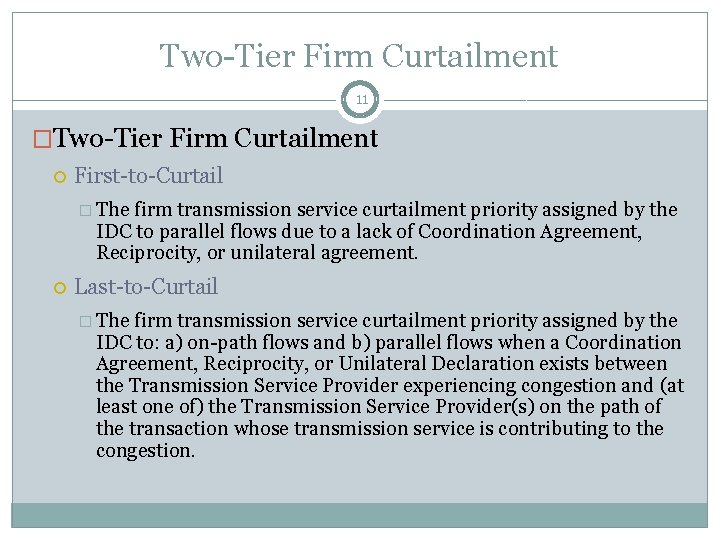
Two-Tier Firm Curtailment 11 �Two-Tier Firm Curtailment First-to-Curtail � The firm transmission service curtailment priority assigned by the IDC to parallel flows due to a lack of Coordination Agreement, Reciprocity, or unilateral agreement. Last-to-Curtail � The firm transmission service curtailment priority assigned by the IDC to: a) on-path flows and b) parallel flows when a Coordination Agreement, Reciprocity, or Unilateral Declaration exists between the Transmission Service Provider experiencing congestion and (at least one of) the Transmission Service Provider(s) on the path of the transaction whose transmission service is contributing to the congestion.
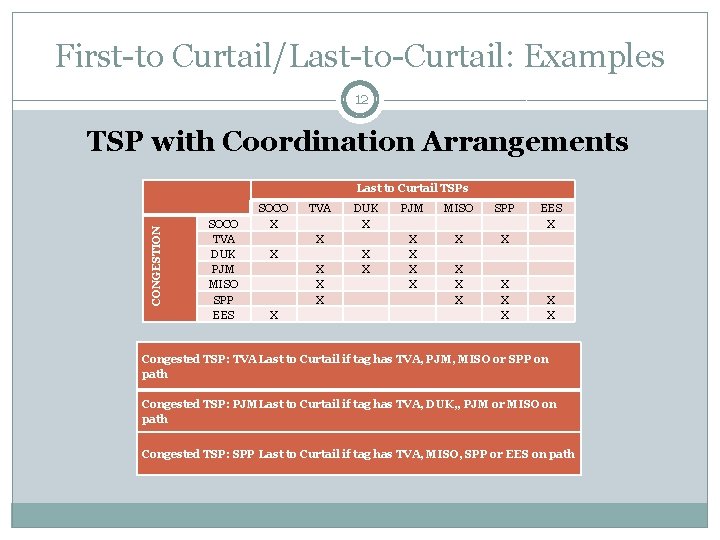
First-to Curtail/Last-to-Curtail: Examples 12 TSP with Coordination Arrangements CONGESTION Last to Curtail TSPs SOCO TVA DUK PJM MISO SPP EES SOCO X TVA DUK X X X X X PJM MISO SPP X X X EES X X X Congested TSP: TVA Last to Curtail if tag has TVA, PJM, MISO or SPP on path Congested TSP: PJMLast to Curtail if tag has TVA, DUK, , PJM or MISO on path Congested TSP: SPP Last to Curtail if tag has TVA, MISO, SPP or EES on path
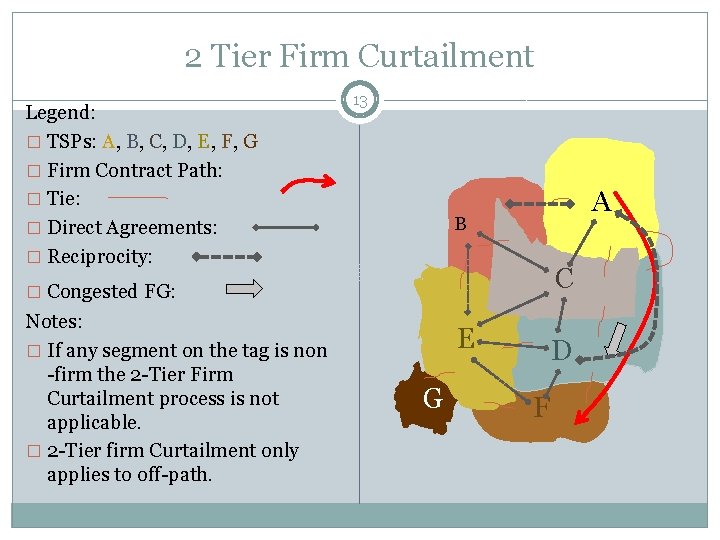
2 Tier Firm Curtailment Legend: � TSPs: A, B, C, D, E, F, G � Firm Contract Path: � Tie: � Direct Agreements: � Reciprocity: 13 A B C � Congested FG: Notes: � If any segment on the tag is non -firm the 2 -Tier Firm Curtailment process is not applicable. � 2 -Tier firm Curtailment only applies to off-path. E G D F
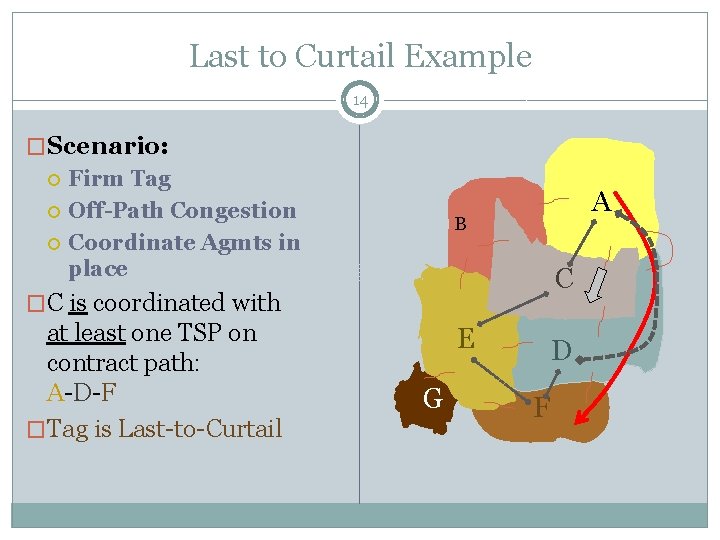
Last to Curtail Example 14 �Scenario: Firm Tag Off-Path Congestion Coordinate Agmts in place A B C �C is coordinated with at least one TSP on contract path: A-D-F �Tag is Last-to-Curtail E G D F
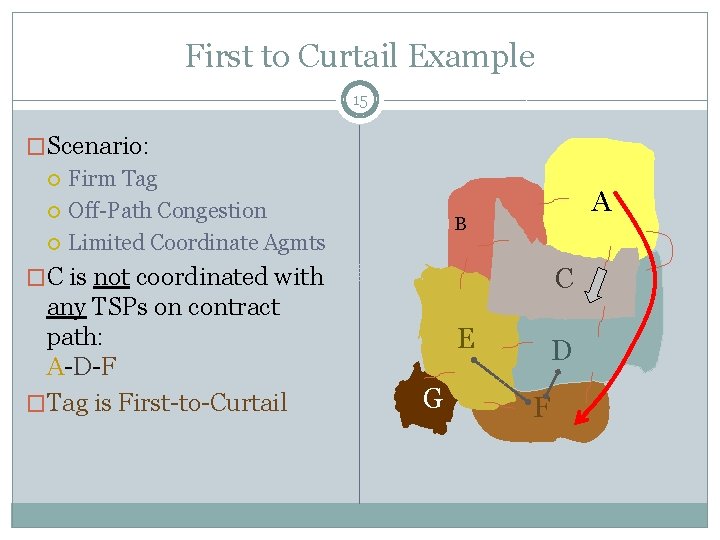
First to Curtail Example 15 �Scenario: Firm Tag Off-Path Congestion Limited Coordinate Agmts A B �C is not coordinated with any TSPs on contract path: A-D-F �Tag is First-to-Curtail C E G D F
Methods for Intra-BA Transactions 16 �Tag Secondary Network Transmission Service Method A method used to submit to the IDC transmission service curtailment priority of the Secondary Network Transmission Service using electronic tags. �Generator Prioritization Method A method used to submit to the IDC transmission service curtailment priority of the generator output. �Difference between what is reported and the real- time generator output is firm
Additional Key Concepts 17 �Balancing Authority to choose either one but not both Methods (Balancing Authority can switch) �Transactions or generation-to-load impacting 5% or greater considered for assigning relief obligations �Credit for Redispatch �IDC Processing Sub-priorities Reloads of Curtailed Transactions �Pseudo-Ties (generator physically in one BA but electrically located in another)
Issues: NAESB 18 �Coordination Arrangements Penalty versus incentive - Subcommittee members perception Level of detail in Coordination Arrangements – high level requirements �Two-Tier Firm Curtailment – Managing Committee Direction �Transparency of curtailments (OASIS templates) Non-tagged transactions First-to-Curtail/Last-to-Curtail �Access to data during parallel test �Full Staffing concerns
Issues: External 19 �NERC Standards (reliability issue/priority) INT standards modified to require tagging on all intra-BA point-to-point transactions IRO-006 -EAST modified to allow a Reliability Coordinator to request curtailments on intra-BAA point-to-point tags �IDC transitioning from NERC How funding/implementation for change orders to accommodate Parallel Flow Visualization will be handled/prioritized? NAESB/Consortium coordination unknown
Next Steps 20 � Documentation Recommendation (in progress) IDC changes supporting document NERC standard changes supporting document � Posting for informal comments (after October meeting) – In Jeopardy � Modifications to recommendation (November/December) - ? ? ? � Post formal comments by end of year Meetings � Sept 12 -13 – Houston, TX (hosted by NAESB) � October 17 -18 – Las Vegas, NV (hosted by OATI) � November 14 -15 – Houston, TX (hosted by NAESB) � December 11 -12 – Houston, TX (hosted by NAESB)

QUESTIONS 21 ?
- Slides: 21