
Parallel Debugging Techniques Introduction to Totalview Le Yan
Parallel Debugging Techniques & Introduction to Totalview Le Yan Louisiana Optical Network Initiative 7/6/2010 Scaling to Petascale Virtual Summer School
Outline • Overview of parallel debugging – Challenges – Tools – Strategies • Get familiar with Total. View through hands-on exercises 7/6/2010 Scaling to Petascale Virtual Summer School 1
Outline • Overview of parallel debugging – Challenges – Tools – Strategies • Get familiar with Total. View through hands-on exercises 7/6/2010 Scaling to Petascale Virtual Summer School 2
Bugs in Parallel Programming • Parallel programs are prone to the usual bugs found in sequential programs – Improper pointer usage – Stepping over array bounds – Infinite loops –… • Plus… 7/6/2010 Scaling to Petascale Virtual Summer School 3
Common Types of Bugs in Parallel Programming • Erroneous use of language features – Mismatched parameters, missing mandatory calls etc. • • Defective space decomposition Incorrect/improper synchronization Hidden serialization …… http: //www. hpcbugbase. org/index. php/Main_Page 7/6/2010 Scaling to Petascale Virtual Summer School 4

Debugging Essentials • Reproducibility – Find the scenario where the error is reproducible • Reduction – Reduce the problem to its essence • Deduction – Form hypotheses on what the problem might be • Experimentation – Filter out invalid hypotheses Terrence Parr, Learn The Essentials of Debugging http: //www. ibm. com/developerworks/web/library/wa-debug. html? ca=dgr-lnxw 03 Dbug 7/6/2010 Scaling to Petascale Virtual Summer School 5
Challenges in Parallel Debugging • Reproducibility – Many problems cannot be easily reproduced • Reduction – Smallest scale might still be too large and complex to handle • Deduction – Need to consider concurrent and interdependent program instances • Experimentation – Cyclic debugging might be very expensive 7/6/2010 Scaling to Petascale Virtual Summer School 6
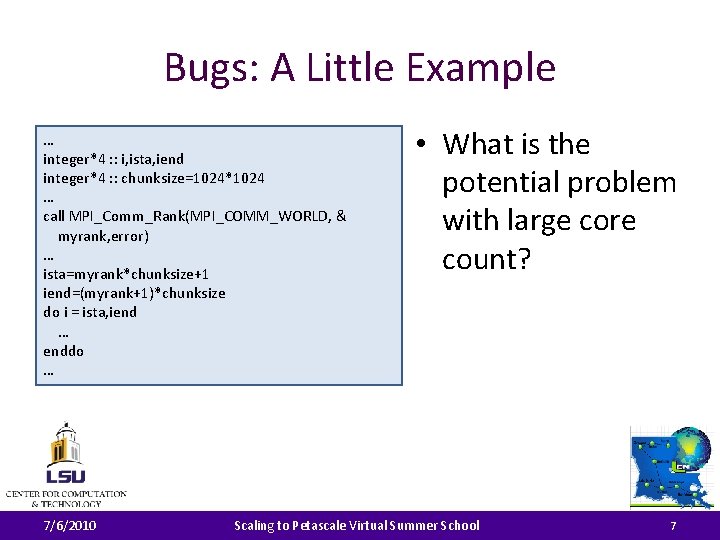
Bugs: A Little Example … integer*4 : : i, ista, iend integer*4 : : chunksize=1024*1024 … call MPI_Comm_Rank(MPI_COMM_WORLD, & myrank, error) … ista=myrank*chunksize+1 iend=(myrank+1)*chunksize do i = ista, iend … enddo … 7/6/2010 • What is the potential problem with large core count? Scaling to Petascale Virtual Summer School 7
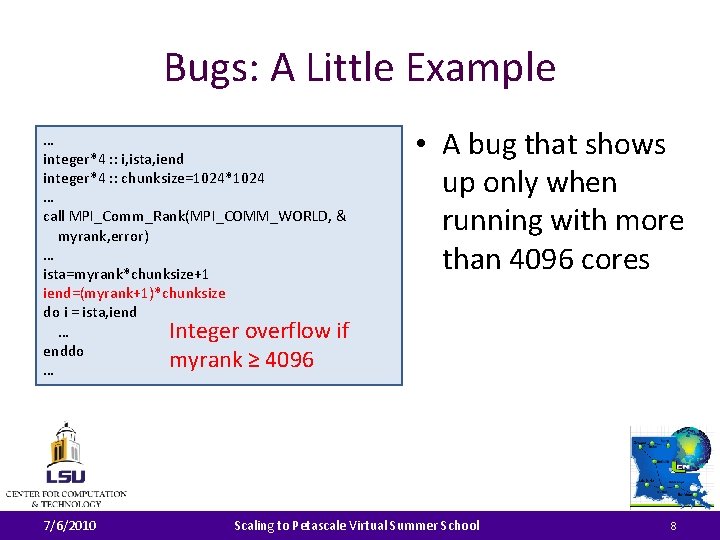
Bugs: A Little Example … integer*4 : : i, ista, iend integer*4 : : chunksize=1024*1024 … call MPI_Comm_Rank(MPI_COMM_WORLD, & myrank, error) … ista=myrank*chunksize+1 iend=(myrank+1)*chunksize do i = ista, iend … Integer overflow if enddo myrank ≥ 4096 … 7/6/2010 • A bug that shows up only when running with more than 4096 cores Scaling to Petascale Virtual Summer School 8
Debugging with write/printf • Very easy to use and most portable, but… – Need to edit, recompile and rerun when additional information is desired – May change program behavior – Only capable of displaying a subset of the program’s state – Output size grows rapidly with increasing core count and harder to comprehend • Not recommended 7/6/2010 Scaling to Petascale Virtual Summer School 9
Compilers Can Help • Most compilers can (at runtime) – Check array bounds – Trap floating operation errors – Provide traceback information • Relatively scalable, but… – Overhead added – Limited capability – Non-interactive 7/6/2010 Scaling to Petascale Virtual Summer School 10
Parallel Debuggers • Capable of what serials debuggers can do – Control program execution – Set action points – View/edit values of variables • More importantly – Control program execution at various levels • Group/process/thread – Display communication status between processes 7/6/2010 Scaling to Petascale Virtual Summer School 11
An Ideal Parallel Debugger • Should allow easy process/thread control and navigation • Should support multiple high performance computing platforms • Should not limit the number of processes being debugged and should allow it to vary at runtime 7/6/2010 Scaling to Petascale Virtual Summer School 12
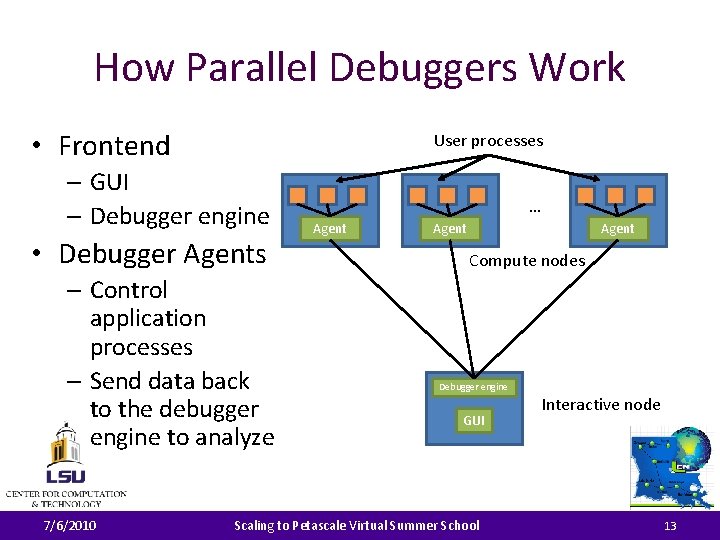
How Parallel Debuggers Work • Frontend User processes – GUI – Debugger engine • Debugger Agents – Control application processes – Send data back to the debugger engine to analyze 7/6/2010 … Agent Compute nodes Debugger engine GUI Scaling to Petascale Virtual Summer School Interactive node 13
Debugging at Very Large Scale • The debugger itself becomes a large parallel application • Bottlenecks – Debugger framework startup cost – Communication between frontend agents – Access to shared resources, e. g. file system 7/6/2010 Scaling to Petascale Virtual Summer School 14
Validation Is Crucial • Have a solid validation procedure to check the correctness • Test smaller components before putting them together 7/6/2010 Scaling to Petascale Virtual Summer School 15
General Parallel Debugging Strategy • Incremental debugging – Downscale if possible • Participating processes, problem size and/or number of iterations • Example: run with one single thread to detect scope errors in Open. MP programs – Add more instances to reveal other issues • Example: run MPI programs on more than one node to detect problems introduced by network delays 7/6/2010 Scaling to Petascale Virtual Summer School 16
Strategy at Large Scale • Again, downscale if possible • Reduce the number of processes to which the debugger is attached – Reduces overhead – Reduces the required number of license seats as well • Focus on one or a small number of processes/threads – Analyze call path and message queues to find problematic processes – Control the execution of as few processes/threads as possible while keeping others running • Provides the context where the error occurs 7/6/2010 Scaling to Petascale Virtual Summer School 17
Trends in Debugging Technology • Lightweight trace analysis tools – Help to identify processes/threads that have similar behavior and reduce the search space – Complementary to full feature debuggers – Example: Stack Trace Analysis Tool (STAT) • Replay/Reverse execution – Replay. Engine now available from Total. View • Post-mortem statistical analysis – Detect anomalies by analyzing profile dissimilarity of multiple runs 7/6/2010 Scaling to Petascale Virtual Summer School 18
Outline • Overview of parallel debugging – Challenges – Tools – Strategies • Get familiar with Total. View through hands-on exercises 7/6/2010 Scaling to Petascale Virtual Summer School 19
What Is Total. View • A powerful debugger for both serial and parallel programs – Support Fortran, C/C++ and Assembler – Supported on most platforms – Both graphic and command line interface • Features – Common debugging functions such as execution control and breakpoints – Memory debugging – Reverse debugging – Batch mode debugging – Remote debugging client – … 7/6/2010 Scaling to Petascale Virtual Summer School 20
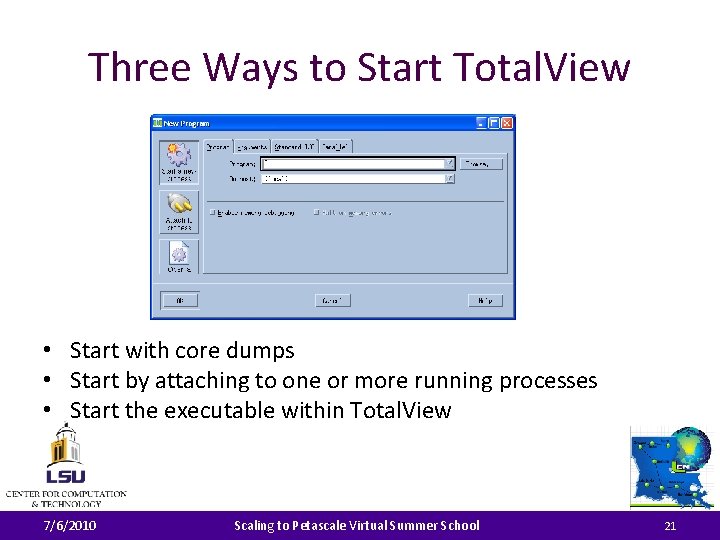
Three Ways to Start Total. View • Start with core dumps • Start by attaching to one or more running processes • Start the executable within Total. View 7/6/2010 Scaling to Petascale Virtual Summer School 21
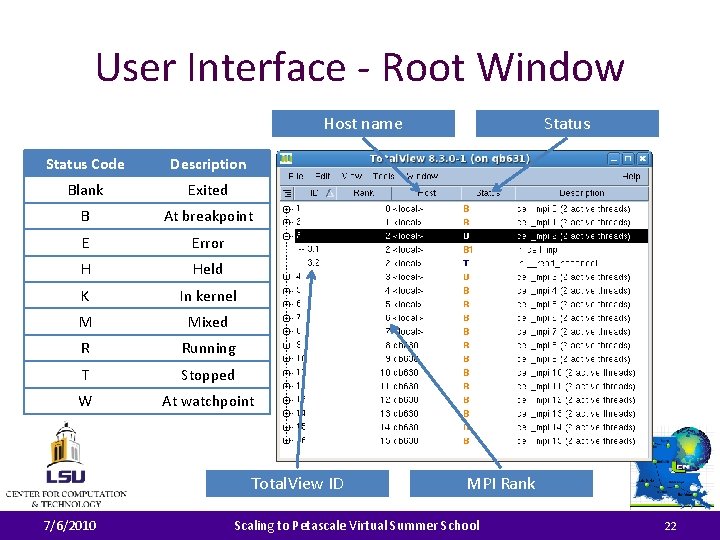
User Interface - Root Window Host name Status Code Description Blank Exited B At breakpoint E Error H Held K In kernel M Mixed R Running T Stopped W At watchpoint Total. View ID 7/6/2010 Status MPI Rank Scaling to Petascale Virtual Summer School 22
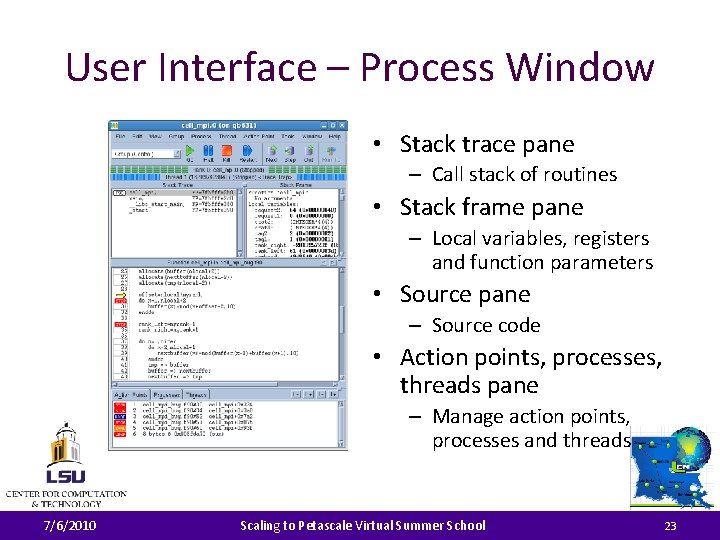
User Interface – Process Window • Stack trace pane – Call stack of routines • Stack frame pane – Local variables, registers and function parameters • Source pane – Source code • Action points, processes, threads pane – Manage action points, processes and threads 7/6/2010 Scaling to Petascale Virtual Summer School 23
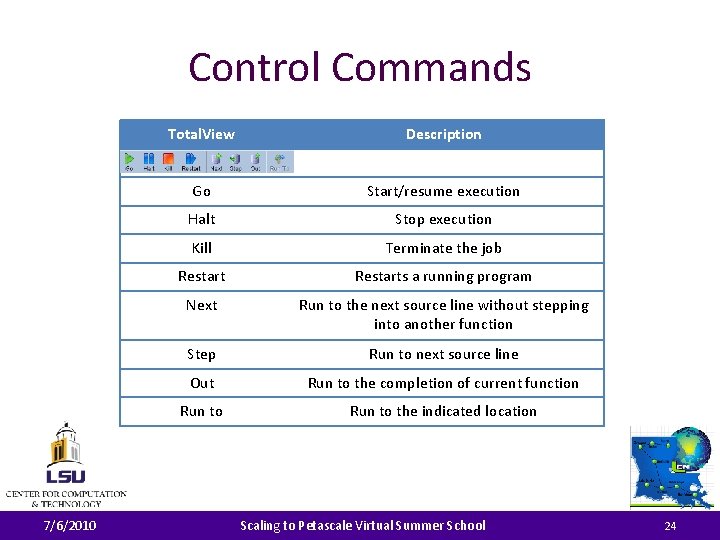
Control Commands 7/6/2010 Total. View Description Go Start/resume execution Halt Stop execution Kill Terminate the job Restarts a running program Next Run to the next source line without stepping into another function Step Run to next source line Out Run to the completion of current function Run to the indicated location Scaling to Petascale Virtual Summer School 24
Controlling Execution • The process window always focuses on one process/thread • Switch between processes/threads – p+/p-, t+/t-, double click in root window, process/thread tab • Need to set the appropriate scope when – Giving control commands – Setting action points 7/6/2010 Scaling to Petascale Virtual Summer School 25
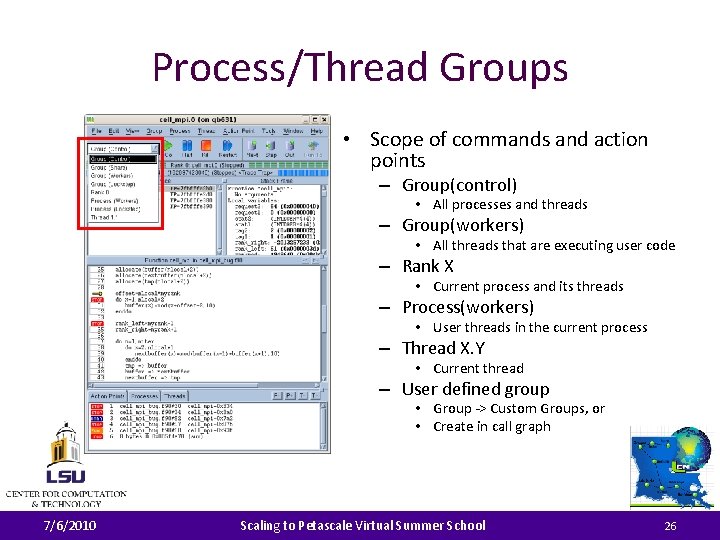
Process/Thread Groups • Scope of commands and action points – Group(control) • All processes and threads – Group(workers) • All threads that are executing user code – Rank X • Current process and its threads – Process(workers) • User threads in the current process – Thread X. Y • Current thread – User defined group • Group -> Custom Groups, or • Create in call graph 7/6/2010 Scaling to Petascale Virtual Summer School 26
Types of Action Points • Breakpoints stop the execution of the processes and threads that reach it • Evaluation points: stop and execute a code fragment when reached – Useful when testing small patches • Process barrier points synchronize a set of processes or threads • Watchpoints monitor a location in memory and stop execution when its value changes – Unconditional – Conditional 7/6/2010 Scaling to Petascale Virtual Summer School 27
Setting Action Points • Breakpoints – Right click on a source line -> Set breakpoint – Click on the line number • Watch points – Right click on a variable -> Create watchpoint • Barrier points – Right click on a source line -> Set barrier • Edit action point property – Right click on a action point in the Action Points tab -> Properties 7/6/2010 Scaling to Petascale Virtual Summer School 28
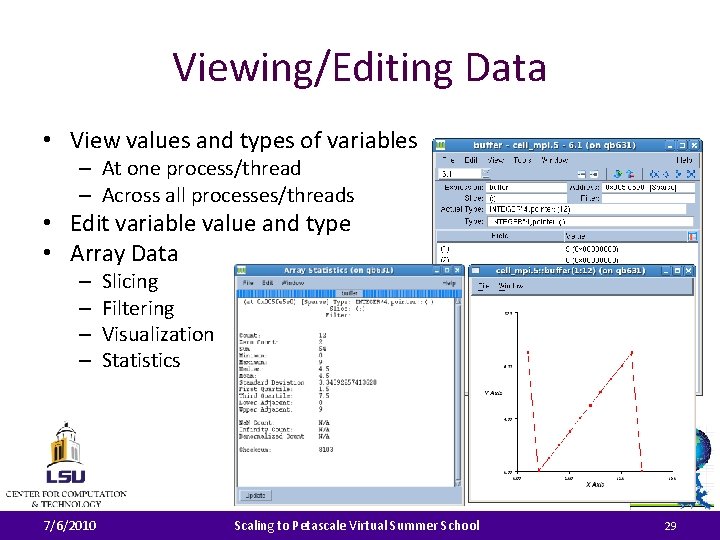
Viewing/Editing Data • View values and types of variables – At one process/thread – Across all processes/threads • Edit variable value and type • Array Data – – 7/6/2010 Slicing Filtering Visualization Statistics Scaling to Petascale Virtual Summer School 29
Viewing Dynamic Arrays in C/C++ • Edit “type” in the variable window • Tell Total. View how to access the memory from a starting location • Example – To view an array of 100 integers • Change “Int *” to “int[100]*” 7/6/2010 Scaling to Petascale Virtual Summer School 30
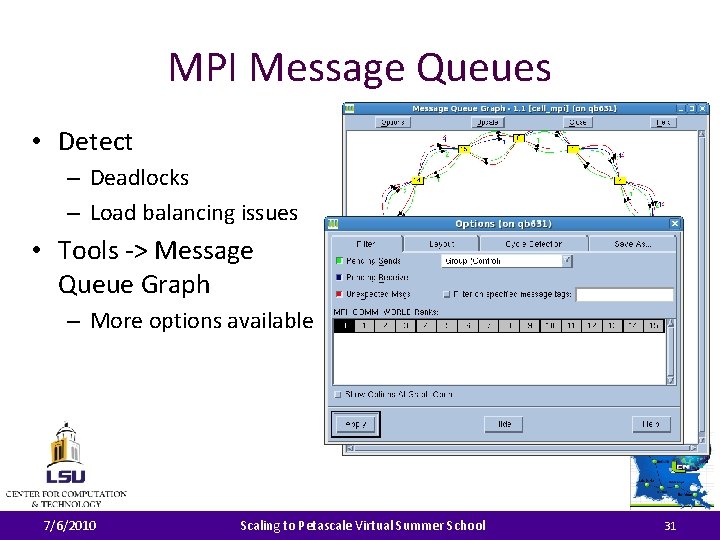
MPI Message Queues • Detect – Deadlocks – Load balancing issues • Tools -> Message Queue Graph – More options available 7/6/2010 Scaling to Petascale Virtual Summer School 31
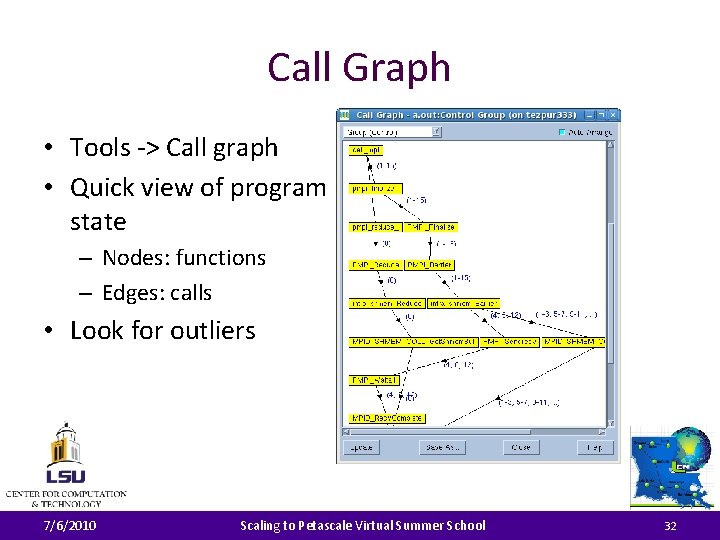
Call Graph • Tools -> Call graph • Quick view of program state – Nodes: functions – Edges: calls • Look for outliers 7/6/2010 Scaling to Petascale Virtual Summer School 32
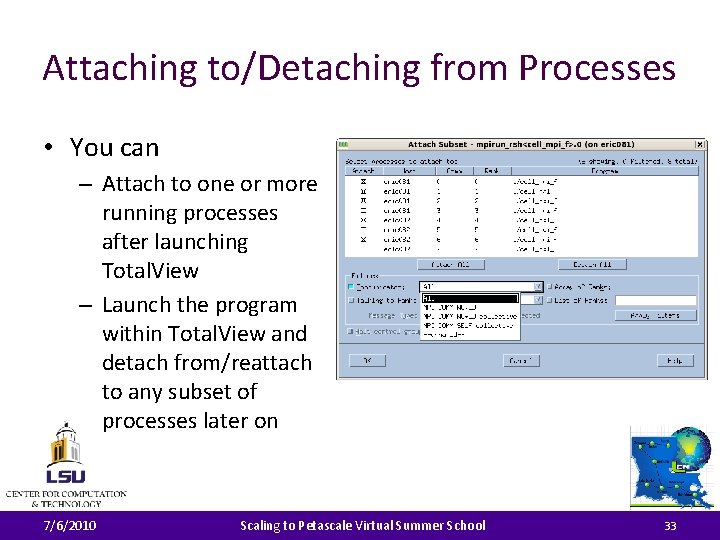
Attaching to/Detaching from Processes • You can – Attach to one or more running processes after launching Total. View – Launch the program within Total. View and detach from/reattach to any subset of processes later on 7/6/2010 Scaling to Petascale Virtual Summer School 33
Memory Debugging • Features – Memory usage report – Error detection • Memory leak • Dangling pointer • Memory corruption – Event notification • Deallocation/reallocation – Memory comparison between processes 7/6/2010 Scaling to Petascale Virtual Summer School 34
Memory Debugging - Usage • Need to link to the Total. View heap library to monitor heap status – The name of the library is platform dependent • To access memory debugging functions – Prior to 8. 7 • Tools -> Memory debugging – Since 8. 7 • Debug -> Open Memory. Scape 7/6/2010 Scaling to Petascale Virtual Summer School 35
References • Total. View user manual – http: //www. totalviewtech. com/support/documentation/t otalview/index. html • LLNL Total. View tutorial – https: //computing. llnl. gov/tutorials/totalview • NCSA Cyberinfrastructure Tutor – “Debugging Serial and Parallel Codes” course • HPCBug. Base – http: //hpcbugbase. org/index. php/Main_Page 7/6/2010 Scaling to Petascale Virtual Summer School 36
Hands-on Exercise • Debug MPI and Open. MP programs that solve a simple problem to get familiar with – Basic functionalities of parallel debuggers • Total. View: Big. Red, Kraken, Steele and Queen Bee • DDT: Big. Red, Kraken, Ranger and Lonestar – Some common types of bugs in parallel programming • Programs and instructions can be found at http: //www. cct. lsu. edu/~lyan 1/summerschool 10 7/6/2010 Scaling to Petascale Virtual Summer School 37
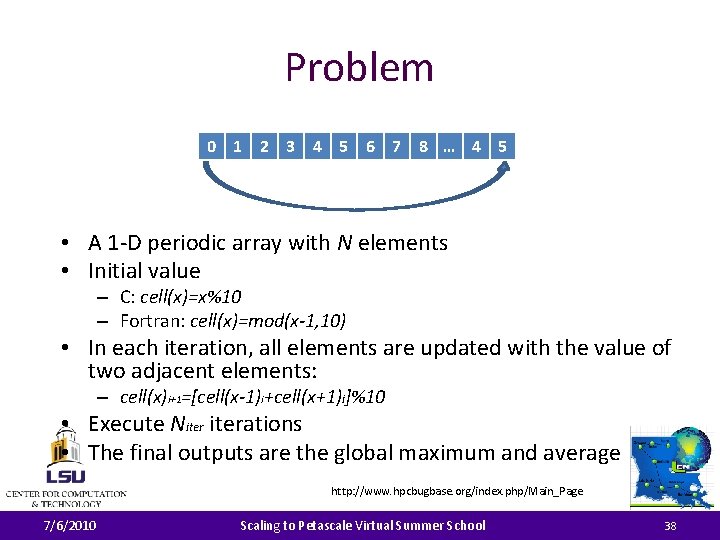
Problem 0 1 2 3 4 5 6 7 8 … 4 5 • A 1 -D periodic array with N elements • Initial value – C: cell(x)=x%10 – Fortran: cell(x)=mod(x-1, 10) • In each iteration, all elements are updated with the value of two adjacent elements: – cell(x)i+1=[cell(x-1)i+cell(x+1)i]%10 • Execute Niterations • The final outputs are the global maximum and average http: //www. hpcbugbase. org/index. php/Main_Page 7/6/2010 Scaling to Petascale Virtual Summer School 38
Sequential Program • Use an integer array to hold current values • Use another integer array to hold the calculated values • Swap the pointers at the end of each iteration • The result is used to check the correctness of the parallel programs – Chances are that we will not have such a luxury for large jobs 7/6/2010 Scaling to Petascale Virtual Summer School 39
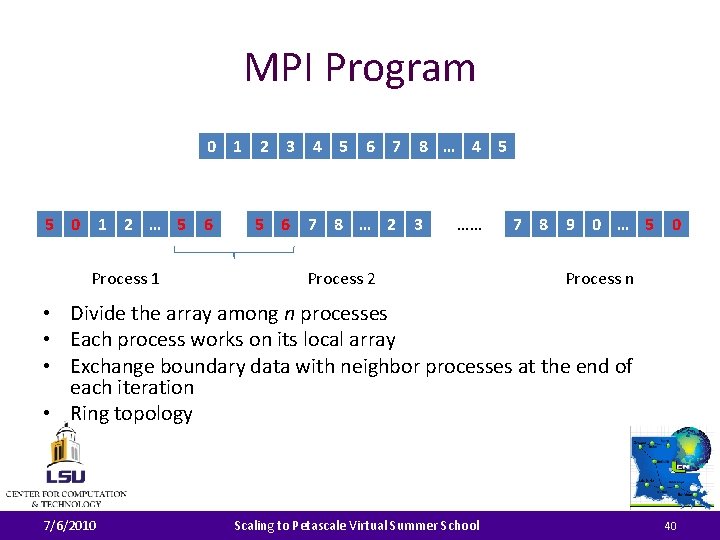
MPI Program 0 1 2 3 4 5 6 7 8 … 4 5 5 0 1 2 … 5 6 7 8 … 2 3 Process 1 Process 2 …… 7 8 9 0 … 5 0 Process n • Divide the array among n processes • Each process works on its local array • Exchange boundary data with neighbor processes at the end of each iteration • Ring topology 7/6/2010 Scaling to Petascale Virtual Summer School 40
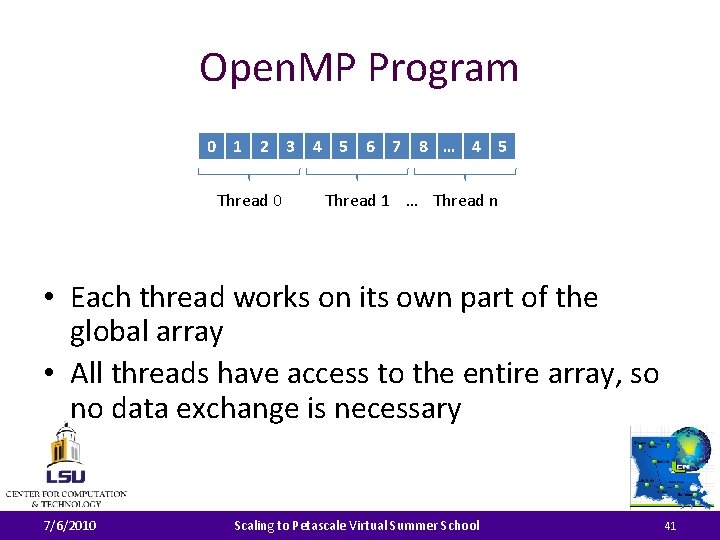
Open. MP Program 0 1 2 3 4 5 6 7 8 … 4 5 Thread 0 Thread 1 … Thread n • Each thread works on its own part of the global array • All threads have access to the entire array, so no data exchange is necessary 7/6/2010 Scaling to Petascale Virtual Summer School 41
- Slides: 42