
Parallel DB 101 David J De Witt Microsoft
Parallel DB 101 David J. De. Witt Microsoft Jim Gray Systems Lab Madison, Wisconsin dewitt@microsoft. com © 2008 Microsoft Corporation. All rights reserved. This presentation is for informational purposes only. Microsoft makes no warranties, express or implied in this presentation.
This talk is mission impossible I did not enter on a motorcycle I have no new product announcements to make I have no slick demos to give There is no final exam 2
Who is this guy? Spent 32 years as a computer science professor at the University of Wisconsin n n Which explains why my slides are so bad Joined Microsoft in March 2008 Taught Peter Spiro everything he knows about database systems Built 3 different parallel DB systems while a professor n n n DIRECT (1979 -1983) Gamma (1983 -1990) Paradise (1994 -2000) – sold to NCR/Teradata Did first relational DBMS benchmark (1983) n Got Larry Ellison very, very mad at me 3
Jim Gray Systems Lab Named after Jim Gray, a pioneer of the DB field, who was a Microsoft Technical Fellow when he was lost at sea in January 2007 Lab’s mission is to explore technologies to advance Microsoft’s mission to be the premier supplier of database systems software Closely affiliated with the Univ. of Wisconsin – the top academic database research group in the world 4
What an audience! About a factor of 100 larger then what I used to get on a Friday morning for an 8: 50 A. M class 5
There will be a quiz at the end! Seriously, n The goal of this talk is to teach you the fundamentals of how parallel database systems work n The key mechanisms are actually pretty simple n Understanding these mechanisms will help you use systems like Project Madison (DATAllegro) more effectively 6
Talk Outline Alternative parallel DB architectures n Why “shared nothing” has emerged as the standard Partitioned tables n The basis for scalable execution Partitioned parallelism n Software building blocks for scalable database systems Other technical challenges Summary and conclusions 7
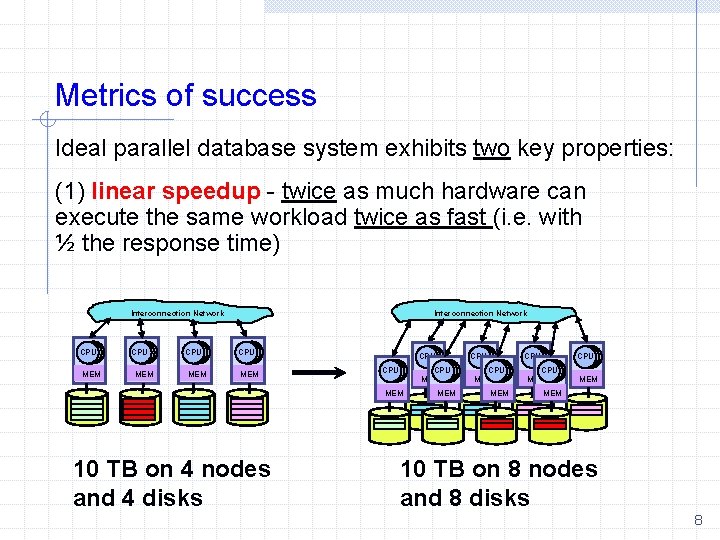
Metrics of success Ideal parallel database system exhibits two key properties: (1) linear speedup - twice as much hardware can execute the same workload twice as fast (i. e. with ½ the response time) Interconnection Network CPU MEM CPU CPU MEM 10 TB on 4 nodes and 4 disks CPU MEM CPU CPU MEM MEM 10 TB on 8 nodes and 8 disks 8
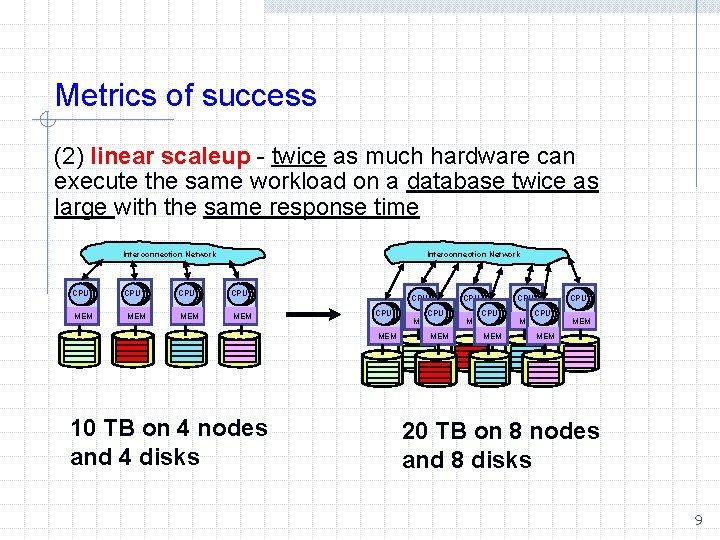
Metrics of success (2) linear scaleup - twice as much hardware can execute the same workload on a database twice as large with the same response time Interconnection Network CPU MEM CPU MEM 10 TB on 4 nodes and 4 disks CPU MEM MEM CPU CPU MEM MEM 20 TB on 8 nodes and 8 disks 9
The Real Benefit of Linear Scaleup: System can be grown incrementally: 1) If your DB grows by 10% you can maintain constant response times for your applications by adding 10% additional hardware resources 2) If you add a new application you can incrementally hardware resources to achieve the desired response times for all your applications 10
Barriers to linear speedup and scaleup Startup n n time needed to start a parallel operation can dominate actual execution time with 100 s of processors Interference n the slowdown each new process imposes on all others when accessing shared resources Skew n service time of a job is the service time of the slowest step of the job 11
How to architect a petabyte? Petabyte data warehouses are here today n n 100 s of “Nodes” and 1000 s of drives One of DATAllegro’s customers has a 400 TB warehouse What to do with a 1000, 1 TB drives? Simple taxonomy for describing the spectrum of possible designs: (1) Shared-memory (2) Shared-disk (3) Shared-nothing 12
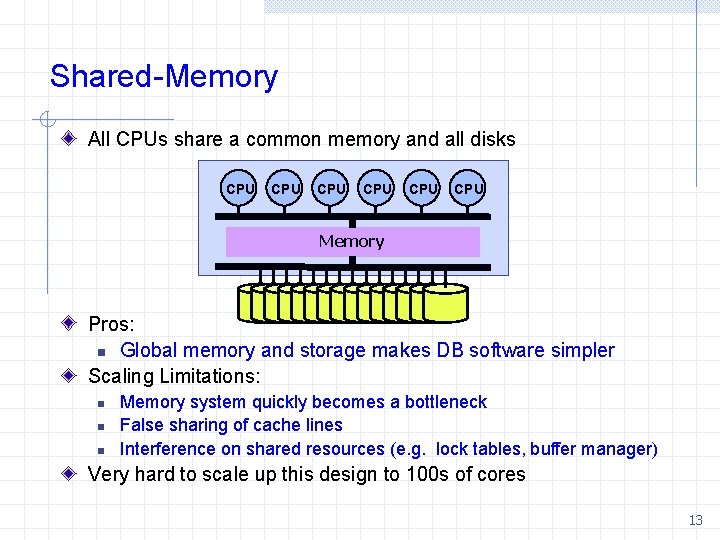
Shared-Memory All CPUs share a common memory and all disks CPU CPU CPU Memory Pros: n Global memory and storage makes DB software simpler Scaling Limitations: n n n Memory system quickly becomes a bottleneck False sharing of cache lines Interference on shared resources (e. g. lock tables, buffer manager) Very hard to scale up this design to 100 s of cores 13
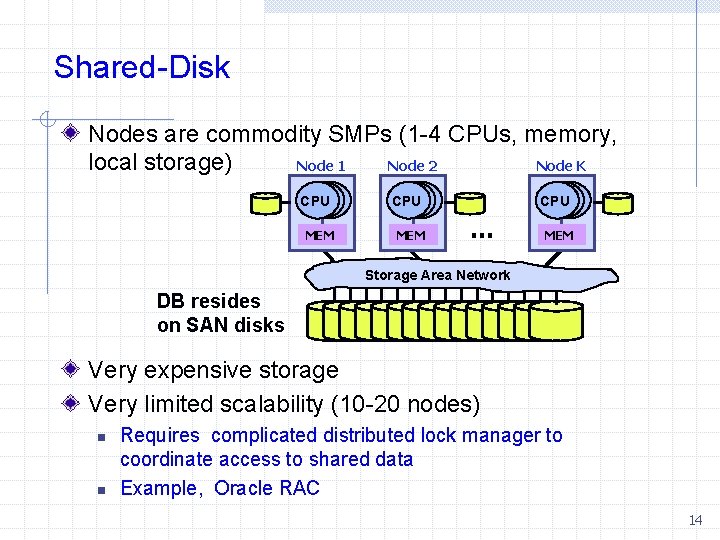
Shared-Disk Nodes are commodity SMPs (1 -4 CPUs, memory, local storage) Node 1 Node 2 Node K CPU MEM CPU … MEM Storage Area Network DB resides on SAN disks Very expensive storage Very limited scalability (10 -20 nodes) n n Requires complicated distributed lock manager to coordinate access to shared data Example, Oracle RAC 14
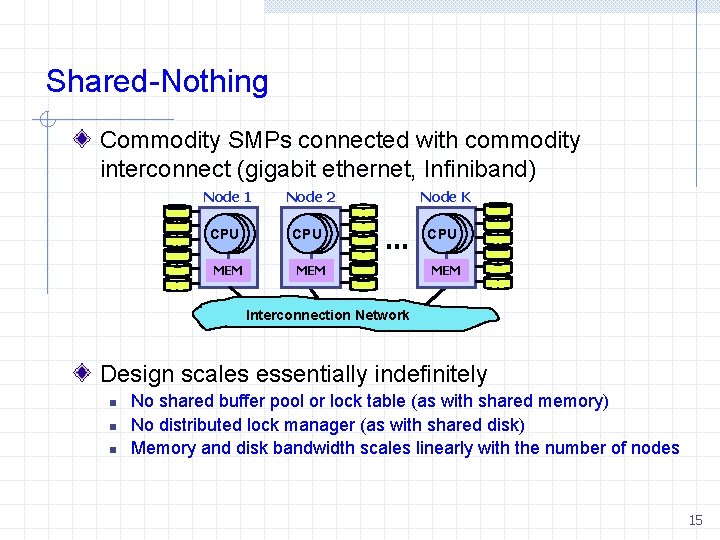
Shared-Nothing Commodity SMPs connected with commodity interconnect (gigabit ethernet, Infiniband) Node 1 CPU MEM Node 2 CPU Node K … MEM CPU MEM Interconnection Network Design scales essentially indefinitely n n n No shared buffer pool or lock table (as with shared memory) No distributed lock manager (as with shared disk) Memory and disk bandwidth scales linearly with the number of nodes 15
Shared-Nothing (cont. ) Database systems based on this architectural model pioneered by Teradata and Gamma (Univ. of Wisconsin) in early 1980 s. n n n IBM DB 2/PE – mid 1990 s Informix XPS – late 1990 s Recently: DATAllegro, Greenplum, Netezza, Vertica, Aster Same hardware model used by all search engines (MSN Live, Yahoo, Google) n n 10, 000 node clusters have become commonplace Dealing with failures is a real challenge Sometimes such hardware configurations are referred to as “clusters”, or “grids” n Oracle 10 g is “grid” in name only 16
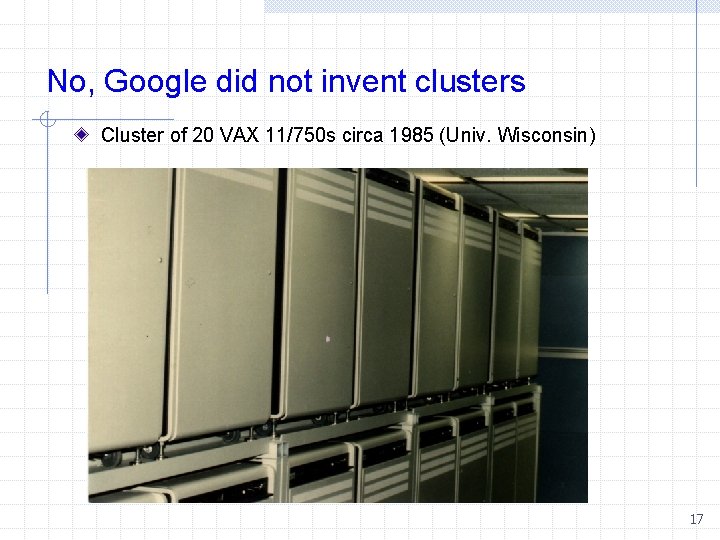
No, Google did not invent clusters Cluster of 20 VAX 11/750 s circa 1985 (Univ. Wisconsin) 17
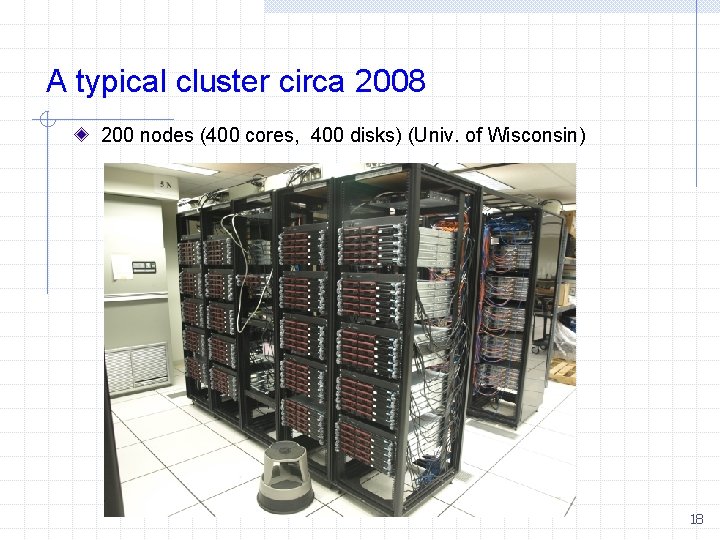
A typical cluster circa 2008 200 nodes (400 cores, 400 disks) (Univ. of Wisconsin) 18
Shared-Nothing Summary Pros n n n Commodity components throughout Hardware can be incrementally scaled Fault tolerant No hot spots (buffer pools, lock tables) SQL performance provides linear speedup and scaleup Cons n n n Manageability – providing a single system image Wider variety of physical DB design alternatives to consider Software to deal with failures and data skew is more complicated 19
Talk Outline Alternative parallel DB architectures n Why “shared nothing” has emerged as the standard Partitioned tables n The basis for scalable execution Partitioned parallelism n Software building blocks for scalable database systems Other technical challenges Summary and Conclusions 20
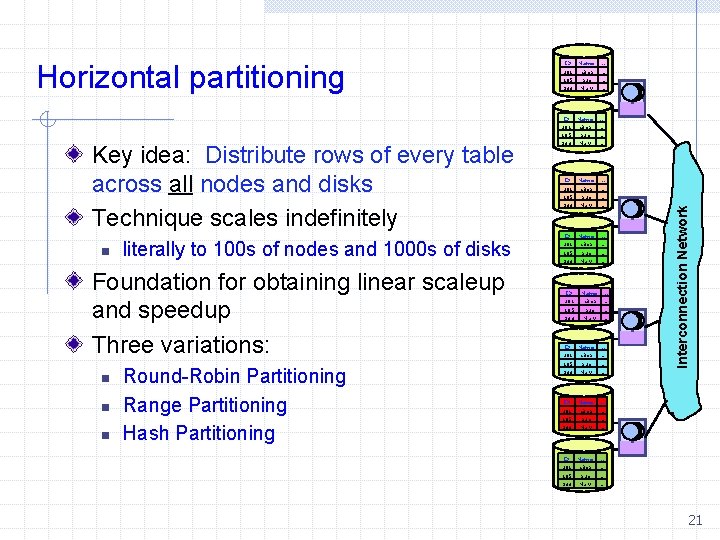
Key idea: Distribute rows of every table across all nodes and disks Technique scales indefinitely n literally to 100 s of nodes and 1000 s of disks Foundation for obtaining linear scaleup and speedup Three variations: n n n Round-Robin Partitioning Range Partitioning Hash Partitioning Name … c. Bob … 105 Sue … 933 Mary … ID Name … 201 c. Bob … 105 Sue … 933 Mary … Interconnection Network Horizontal partitioning ID 201 21
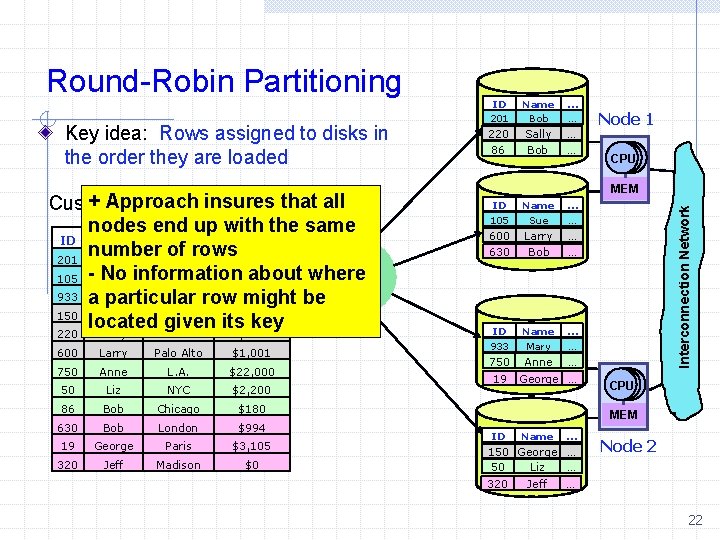
Key idea: Rows assigned to disks in the order they are loaded + Approach that all Customer data setinsures to be loaded nodes end up with the same ID Name City Balance number of rows 201 Bob Madison $3, 000 about where 105 - No Sue information San Fran $110 ETL 933 a. Mary Seattle row $40, 000 particular might be 150 George Seattle $60 located given its key 220 Sally Mtn View $990 600 Larry Palo Alto $1, 001 750 Anne L. A. $22, 000 50 Liz NYC $2, 200 86 Bob Chicago $180 630 Bob London $994 19 George Paris $3, 105 320 Jeff Madison $0 ID 201 Name Bob … … 220 86 Sally Bob … … Node 1 CPU MEM ID 105 Name Sue … … 600 630 Larry Bob … ID 933 Name Mary … … 750 Anne … 19 Interconnection Network Round-Robin Partitioning … George … CPU MEM ID Name … 150 George … 50 Liz … 320 Jeff Node 2 … 22
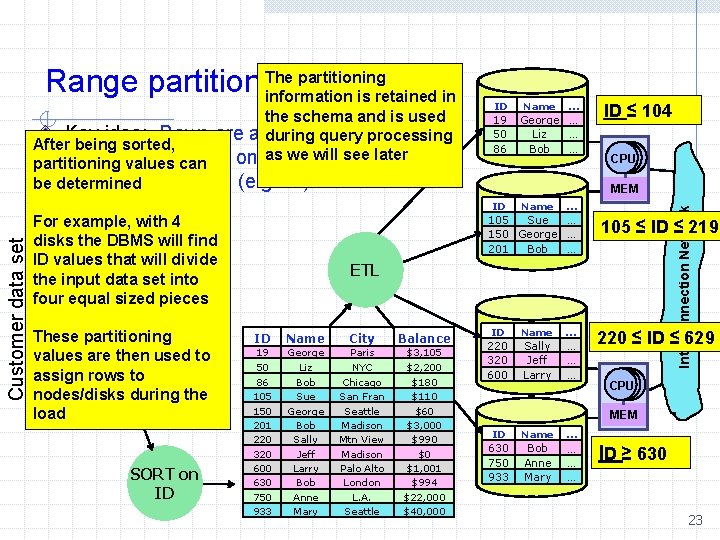
the schema and is used Key idea: Rows are assigned to processing during query After being sorted, as we will see later nodes/disks on the value of their partitioning values based can partitioning column (e. g. ID) be determined Customer data set Bob Madison $3, 000 nodes/disks during the load SORT on ID … Name ID ≤ 104 Node 1 CPU … 105 Sue … 150 George … 201 Bob … disks will$110 find 105 the Sue DBMS San Fran Mary that Seattle $40, 000 ID 933 values will divide 150 George Seattle $60 the input data set into 220 Sally Mtn View $990 four pieces 600 equal Larry sized Palo Alto $1, 001 750 Anne L. A. $22, 000 50 Liz NYC $2, 200 These partitioning 86 Bob Chicago $180 values are then used$994 to 630 Bob London 19 George $3, 105 assign rows Paris to 320 Jeff Madison 00 Name George … Liz … Bob … MEM ID ID example, Name City For with Balance 4 201 ID 19 50 86 Interconnection Network The partitioning Range partitioning information is retained in 105 ≤ ID ≤ 219 ETL ID Name City Balance 19 50 George Liz Paris NYC $3, 105 $2, 200 86 105 150 201 220 320 600 630 750 933 Bob Sue George Bob Sally Jeff Larry Bob Anne Mary Chicago San Fran Seattle Madison Mtn View Madison Palo Alto London L. A. Seattle $180 $110 $60 $3, 000 $990 $0 $1, 001 $994 $22, 000 $40, 000 ID Name 220 320 600 Sally Jeff Larry … … 220 ≤ ID ≤ 629 CPU MEM ID Name 630 750 933 Bob Anne Mary … … Node 2 ID ≥ 630 23
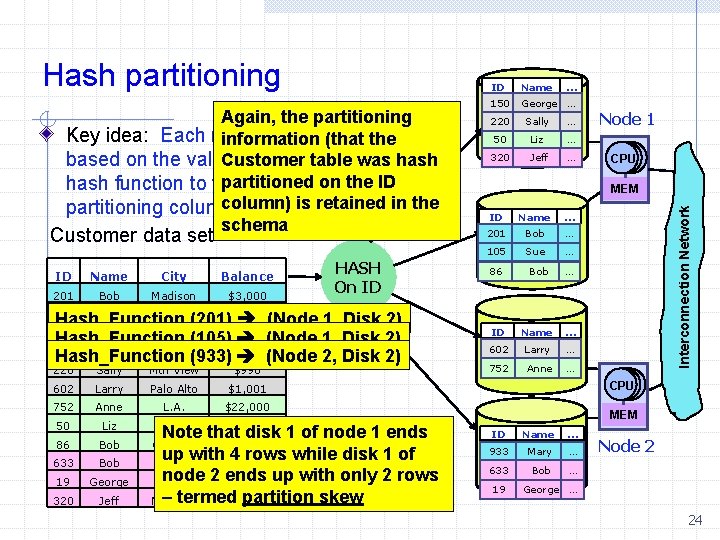
Again, the partitioning Key idea: Each row is assigned tothe a disk information (that based on the value produced by applying Customer table was hasha partitioned hash function to the value of on thethe ID column) is retained in the partitioning column (e. g. ID) schema Customer data set ID Name City Balance 201 Bob Madison $3, 000 HASH On ID Sue San Fran Hash_Function (201) $110 (Node 1, Disk 2) 933 Mary Seattle $40, 000 Hash_Function (105) (Node 1, Disk 2) 150 George Seattle $60 Hash_Function (933) (Node 2, Disk 2) ID Name … 150 George … 220 Sally … 50 Liz … 320 Jeff … Node 1 CPU MEM ID Name … 201 Bob … 105 Sue … 86 Bob … ID Name … 602 Larry … 752 Anne … Interconnection Network Hash partitioning 105 220 Sally Mtn View $990 602 Larry Palo Alto $1, 001 752 Anne L. A. $22, 000 50 Liz NYC $2, 200 86 Bob 633 Bob 19 George 320 Jeff Note that disk 1 of node 1 ends $180 up with 4 rows while disk 1 of London $994 node 2 ends Paris $3, 105 up with only 2 rows – termed $0 partition skew Madison Chicago CPU MEM ID Name … 933 Mary … 633 Bob … 19 Node 2 George … 24
Talk Outline Alternative parallel db architectures n Why “shared nothing” has emerged as the standard Partitioned tables n The basis for scalable execution Partitioned parallelism n Software building blocks for scalable database systems Other technical challenges Summary and Conclusions 25
Partitioned Parallelism Parallel execution of relational operators n Unlike systems based on a shared-memory and shared-disk architectures, there is NO shared lock table, NO shared buffer pool, and NO distributed lock manager to limit scalability Extensive use of pipelining of rows between relational operators n Avoid intermediate files and disk I/Os whenever possible 26
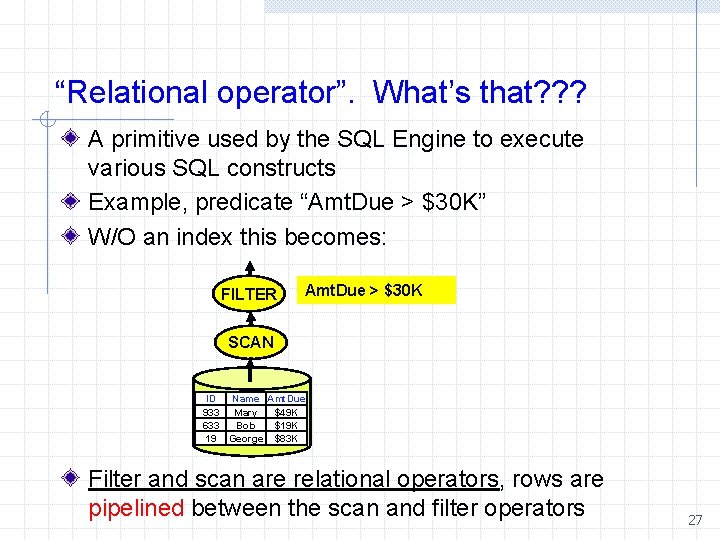
“Relational operator”. What’s that? ? ? A primitive used by the SQL Engine to execute various SQL constructs Example, predicate “Amt. Due > $30 K” W/O an index this becomes: FILTER Amt. Due > $30 K SCAN ID Name Amt. Due 933 Mary $49 K 633 Bob $19 K 19 George $83 K Filter and scan are relational operators, rows are pipelined between the scan and filter operators 27
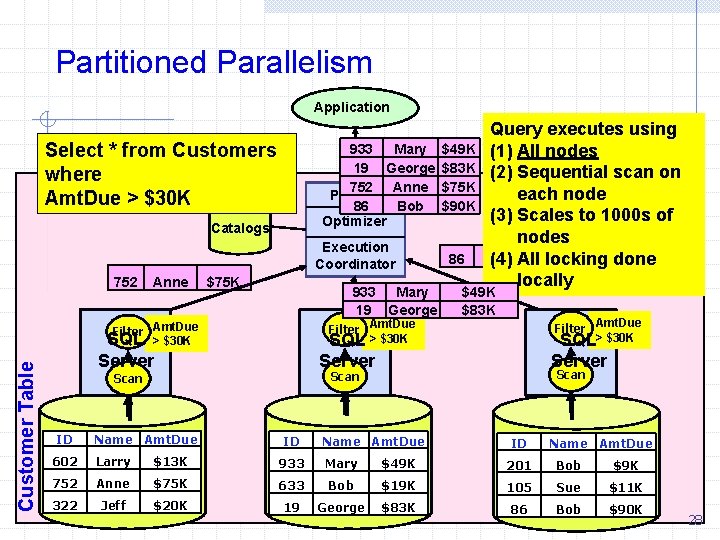
Partitioned Parallelism Application Select * from Customers where Amt. Due > $30 K 933 Mary 19 George 752 Anne Parser 86 Bob Optimizer Catalogs Execution Coordinator 752 Anne $75 K 933 Mary 19 George Filter Amt. Due SQL > $30 K Customer Table Filter Amt. Due SQL > $30 K Server Name Amt. Due 86 $49 K $83 K Filter Amt. Due SQL> $30 K Server Scan ID $49 K $83 K $75 K $90 K Query executes using (1) All nodes (2) Sequential scan on each node (3) Scales to 1000 s of nodes Bob $90 K (4) All locking done locally ID Name Amt. Due 602 Larry $13 K 933 Mary $49 K 201 Bob $9 K 752 Anne $75 K 633 Bob $19 K 105 Sue $11 K 322 Jeff $20 K 19 George $83 K 86 Bob $90 K 28
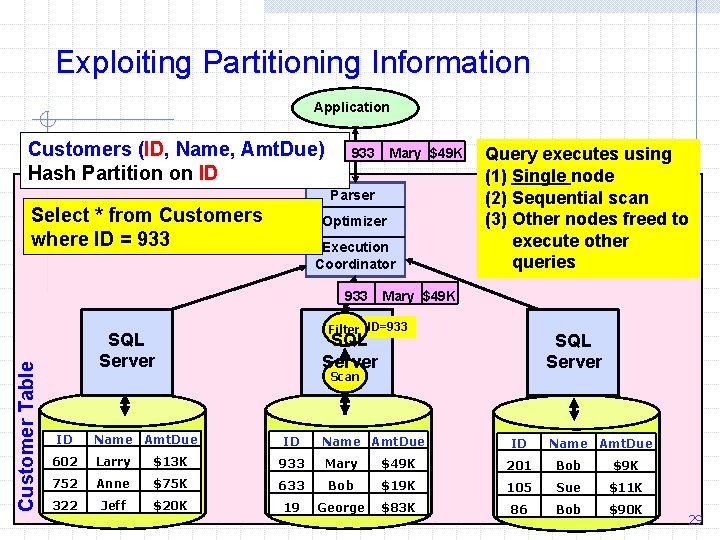
Exploiting Partitioning Information Application Customers (ID, Name, Amt. Due) Hash Partition on ID 933 Mary $49 K Parser Select * from Customers where ID = 933 Optimizer Execution Coordinator Query executes using (1) Single node (2) Sequential scan (3) Other nodes freed to execute other queries Customer Table 933 Mary $49 K Filter ID=933 SQL Server ID Name Amt. Due SQL Server Scan ID Name Amt. Due 602 Larry $13 K 933 Mary $49 K 201 Bob $9 K 752 Anne $75 K 633 Bob $19 K 105 Sue $11 K 322 Jeff $20 K 19 George $83 K 86 Bob $90 K 29
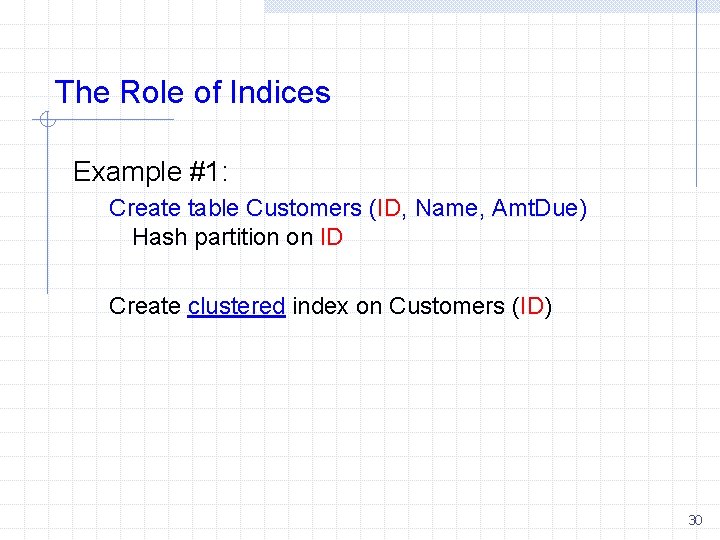
The Role of Indices Example #1: Create table Customers (ID, Name, Amt. Due) Hash partition on ID Create clustered index on Customers (ID) 30
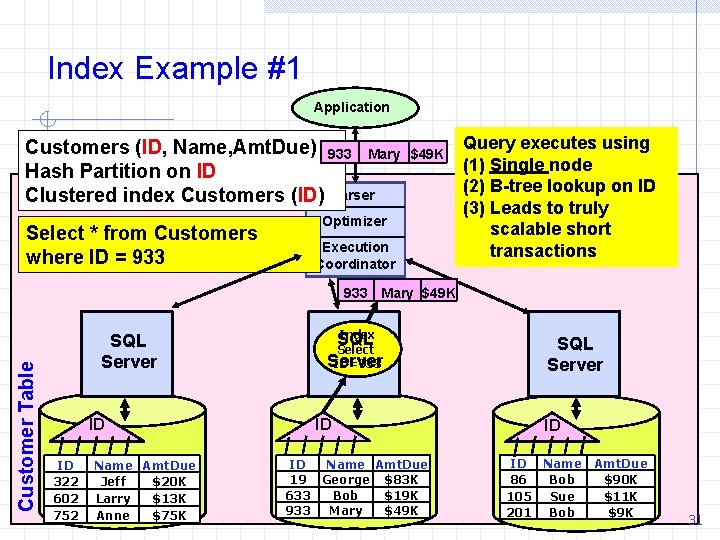
Index Example #1 Application Customers (ID, Name, Amt. Due) 933 Mary Hash Partition on ID Clustered index Customers (ID) Parser Select * from Customers where ID = 933 $49 K Optimizer Execution Coordinator Query executes using (1) Single node (2) B-tree lookup on ID (3) Leads to truly scalable short transactions Customer Table 933 Mary $49 K SQL Server ID ID 322 602 752 Name Amt. Due Jeff $20 K Larry $13 K Anne $75 K Index SQL Select Server ID=933 ID ID Name Amt. Due 19 George $83 K 633 Bob $19 K 933 Mary $49 K SQL Server ID ID Name 86 Bob 105 Sue 201 Bob Amt. Due $90 K $11 K $9 K 31
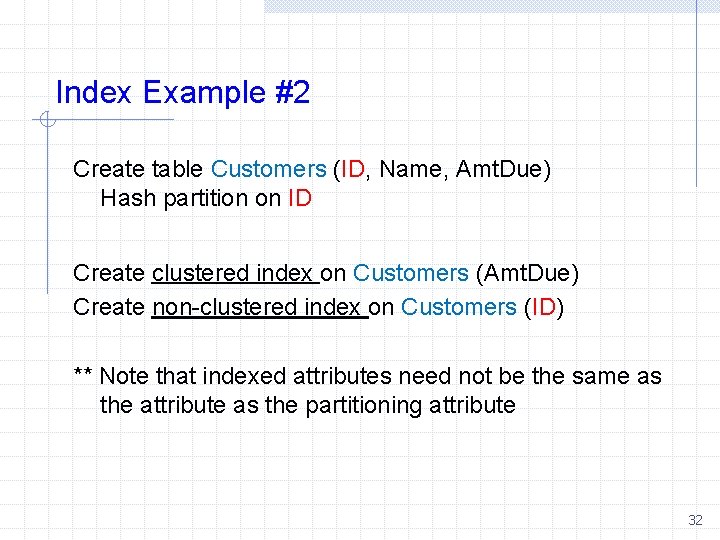
Index Example #2 Create table Customers (ID, Name, Amt. Due) Hash partition on ID Create clustered index on Customers (Amt. Due) Create non-clustered index on Customers (ID) ** Note that indexed attributes need not be the same as the attribute as the partitioning attribute 32
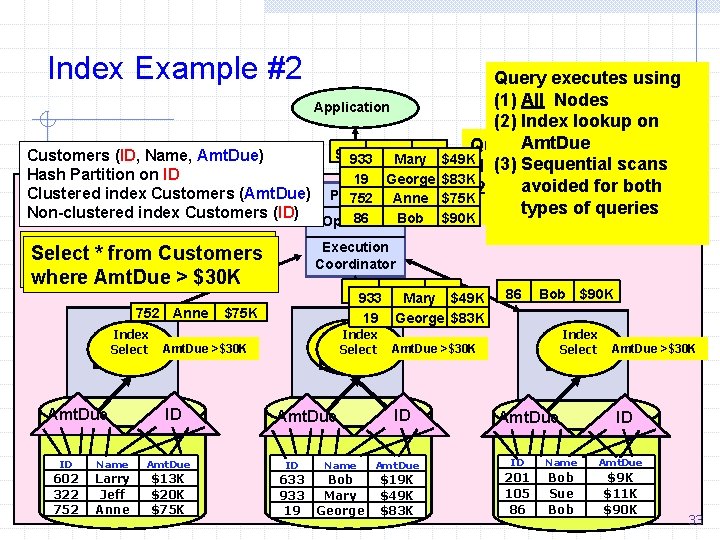
Index Example #2 Query executes using (1) All Nodes Application (2) Index lookup on Query. Amt. Due executes using 933 $49 K Customers (ID, Name, Amt. Due) 933 Mary Sequential (1) (3) Single node scans Hash Partition on ID 19 George $83 K avoided foron both (2) Index lookup ID Clustered index Customers (Amt. Due) Parser 752 Anne $75 K types of queries Non-clustered index Customers (ID) 86 Bob Optimizer Select ** from Customers where = 933 > $30 K where ID Amt. Due 752 Anne Index SQL Select Engine Amt. Due $90 K Execution Coordinator 933 $49 K 933 Mary $49 K 19 George $83 K $75 K 86 Index SQL Select ID=933 Engine Amt. Due >$30 K ID ID Name Amt. Due 602 322 752 Larry Jeff Anne $13 K $20 K $75 K Amt. Due Bob $90 K Index SQL Select Engine Amt. Due >$30 K ID ID Name Amt. Due 633 933 19 Bob Mary George $19 K $49 K $83 K Amt. Due >$30 K ID ID Name Amt. Due 201 105 86 Bob Sue Bob $9 K $11 K $90 K 33
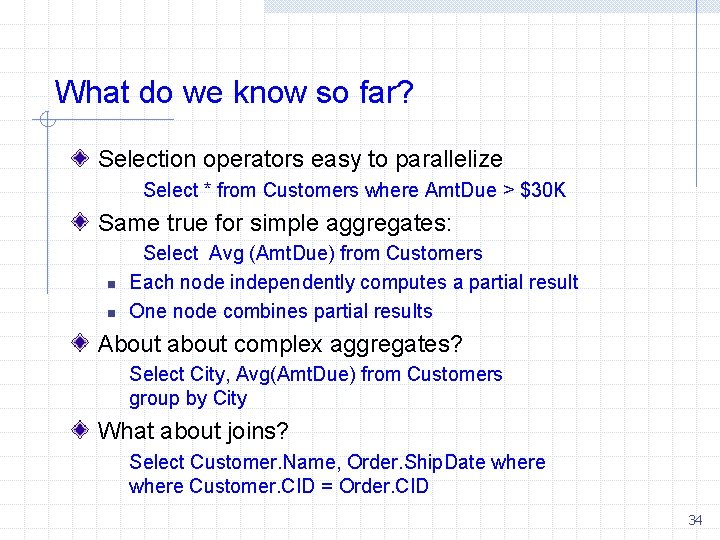
What do we know so far? Selection operators easy to parallelize Select * from Customers where Amt. Due > $30 K Same true for simple aggregates: n n Select Avg (Amt. Due) from Customers Each node independently computes a partial result One node combines partial results About about complex aggregates? Select City, Avg(Amt. Due) from Customers group by City What about joins? Select Customer. Name, Order. Ship. Date where Customer. CID = Order. CID 34
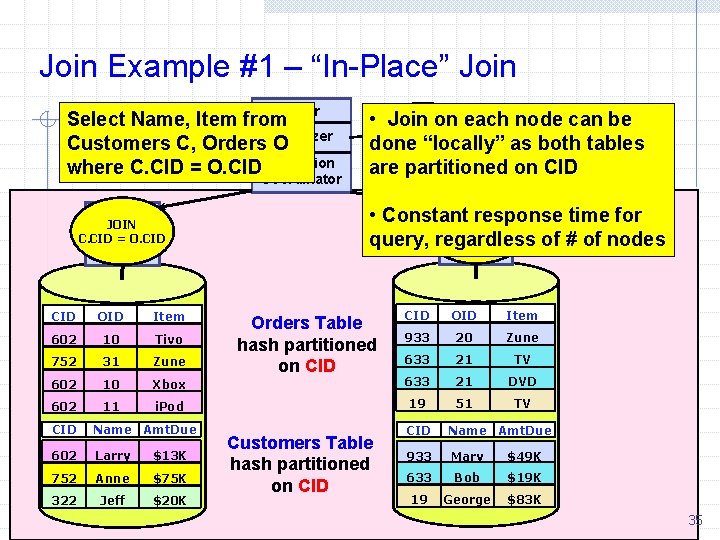
Join Example #1 – “In-Place” Join Parser Select Name, Item from Application. C, Orders Optimizer Customers O where C. CID = O. CID Execution Coordinator JOIN SQL C. CID = O. CID Engine • Join on each node can be Catalogs done “locally” as both tables are partitioned on CID • Constant. SQL response time for JOIN = O. CID query, C. CID regardless of # of nodes Engine CID OID Item 933 20 Zune 633 21 TV Xbox 633 21 DVD i. Pod 19 51 TV CID OID Item 602 10 Tivo 752 31 Zune 602 10 602 11 CID Name Amt. Due 602 Larry $13 K 752 Anne $75 K 322 Jeff $20 K Orders Table hash partitioned on CID Customers Table hash partitioned on CID Name Amt. Due 933 Mary $49 K 633 Bob $19 K 19 George $83 K 35
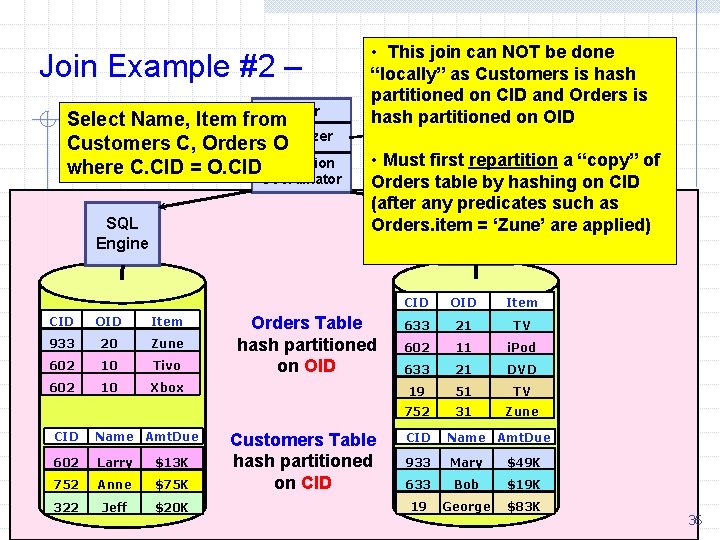
Join Example #2 – Parser Select Name, Item from Application. C, Orders Optimizer Customers O where C. CID = O. CID Execution Coordinator SQL Engine • This join can NOT be done “locally” as Customers is hash partitioned on CID and Orders is hash partitioned on OID Catalogs • Must first repartition a “copy” of Orders table by hashing on CID (after any predicates such as SQL Orders. item = ‘Zune’ are applied) Engine CID OID Item 933 20 Zune 602 10 Tivo 602 10 Xbox CID Name Amt. Due 602 Larry $13 K 752 Anne $75 K 322 Jeff $20 K Orders Table hash partitioned on OID Customers Table hash partitioned on CID OID Item 633 21 TV 602 11 i. Pod 633 21 DVD 19 51 TV 752 31 Zune CID Name Amt. Due 933 Mary $49 K 633 Bob $19 K 19 George $83 K 36
Table Repartitioning Fundamental mechanism for n n Joins when the input tables are not both partitioned on the joining attributes Aggregates with group by Conceptually 3 phases n n n Split phase: each node splits portion of the table to be repartitioned (shuffled) into N fragments (N is # of nodes) Shuffle phase: each node sends its fragments to the other nodes (it keeps one for itself) Combine phase: each node combines the fragments it receives into a single temporary table In practice, the 3 phases occur concurrently and pipelining is used to avoid materializing intermediate files
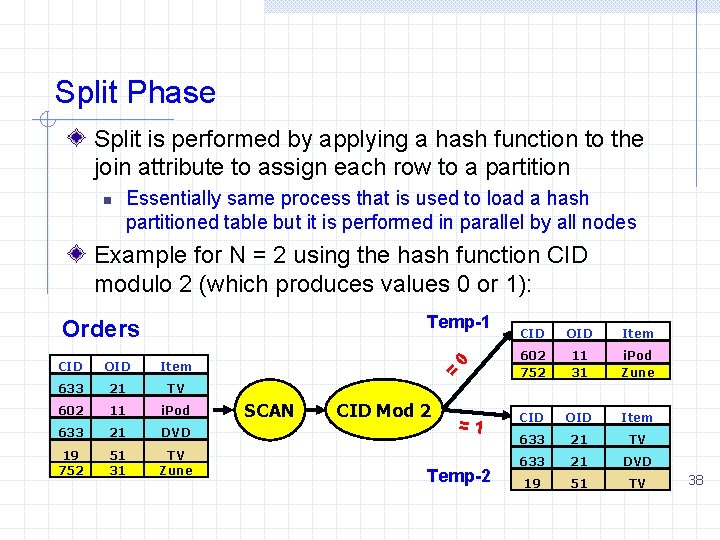
Split Phase Split is performed by applying a hash function to the join attribute to assign each row to a partition n Essentially same process that is used to load a hash partitioned table but it is performed in parallel by all nodes Example for N = 2 using the hash function CID modulo 2 (which produces values 0 or 1): Temp-1 OID Item 633 21 TV 602 11 i. Pod 633 21 DVD 19 752 51 31 TV Zune = CID 0 Orders SCAN CID Mod 2 =1 Temp-2 CID OID Item 602 752 11 31 i. Pod Zune CID OID Item 633 21 TV 633 21 DVD 19 51 TV 38
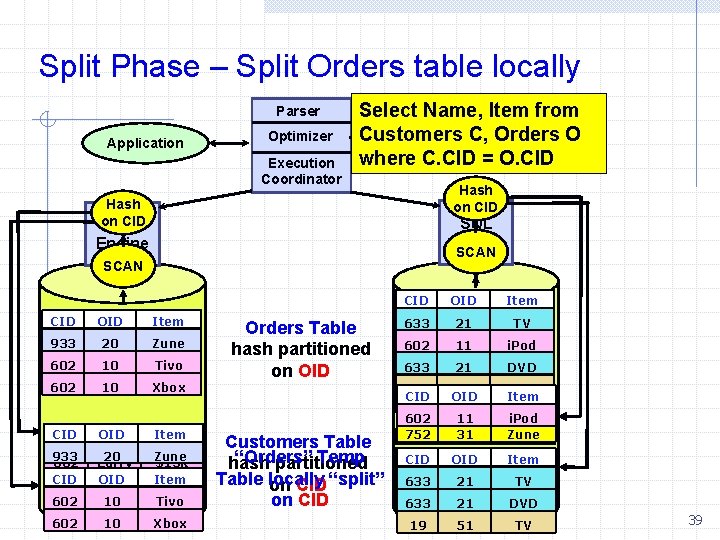
Split Phase – Split Orders table locally Parser Application Optimizer Execution Coordinator Select Name, Item from Customers Catalogs C, Orders O where C. CID = O. CID Hash on CID SQL Engine SCAN CID OID Item 933 20 Zune 602 10 Tivo 602 10 Xbox CID OID Item Name Amt. Due 933 602 CID 752 20 Larry OID Anne Zune $13 K Item $75 K 602 322 602 10 Jeff 10 Tivo $20 K Xbox Orders Table hash partitioned on OID Customers Table “Orders” Temp hash partitioned Table locally on CID “split” on CID OID Item 633 21 TV 602 11 i. Pod 633 21 DVD 19 CID 752 602 752 CID 51 TV OID Item 31 Zune 11 i. Pod 31 Zune Name Amt. Due CID 933 OID Mary Item $49 K 633 21 Bob TV $19 K 633 19 21 George DVD $83 K 19 51 TV 39
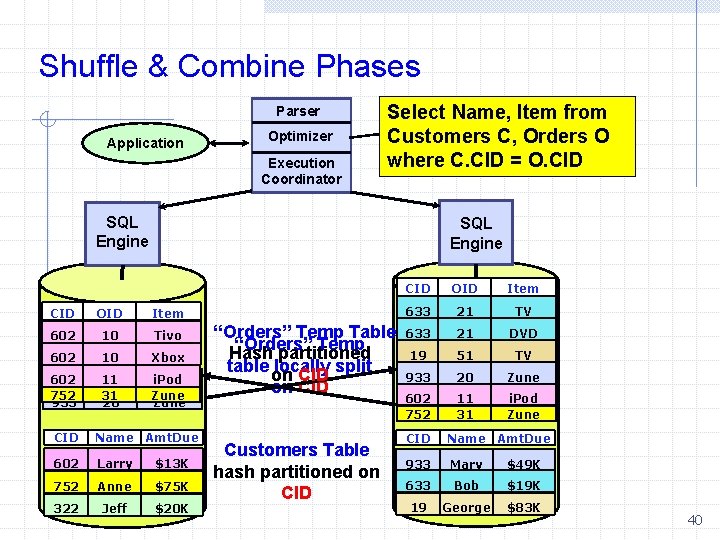
Shuffle & Combine Phases Parser Application Optimizer Execution Coordinator Select Name, Item from Catalogs Customers C, Orders O where C. CID = O. CID SQL Engine CID OID Item 602 10 Tivo 602 10 Xbox 602 CID 752 933 11 OID 31 20 i. Pod Item Zune CID Name Amt. Due 602 Larry $13 K 752 Anne $75 K 322 Jeff $20 K “Orders” Temp Table “Orders” Temp Hash partitioned table on locally CID split on CID Customers Table hash partitioned on CID OID Item 633 21 TV 633 21 DVD 19 51 TV CID 933 OID 20 Item Zune 602 752 11 31 i. Pod Zune CID Name Amt. Due 933 Mary $49 K 633 Bob $19 K 19 George $83 K 40
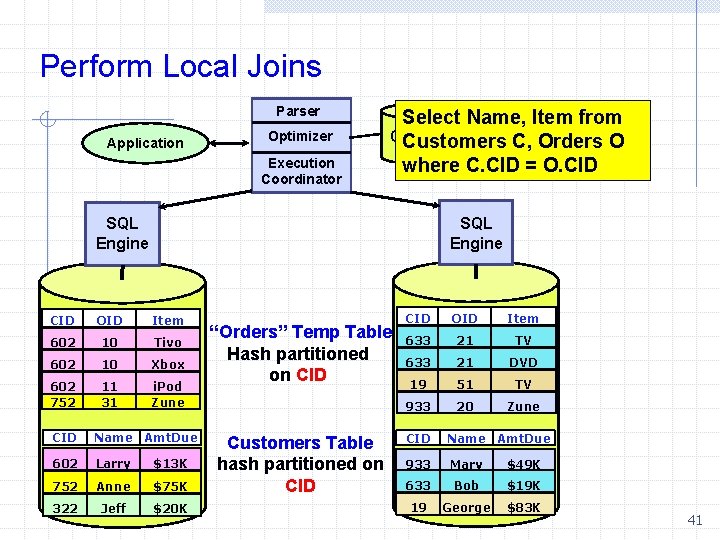
Perform Local Joins Parser Application Optimizer Execution Coordinator Select Name, Item from Catalogs Customers C, Orders O where C. CID = O. CID SQL Engine CID OID Item 602 10 Tivo 602 10 Xbox 602 752 11 31 i. Pod Zune CID Name Amt. Due 602 Larry $13 K 752 Anne $75 K 322 Jeff $20 K “Orders” Temp Table Hash partitioned on CID Customers Table hash partitioned on CID OID Item 633 21 TV 633 21 DVD 19 51 TV 933 20 Zune CID Name Amt. Due 933 Mary $49 K 633 Bob $19 K 19 George $83 K 41
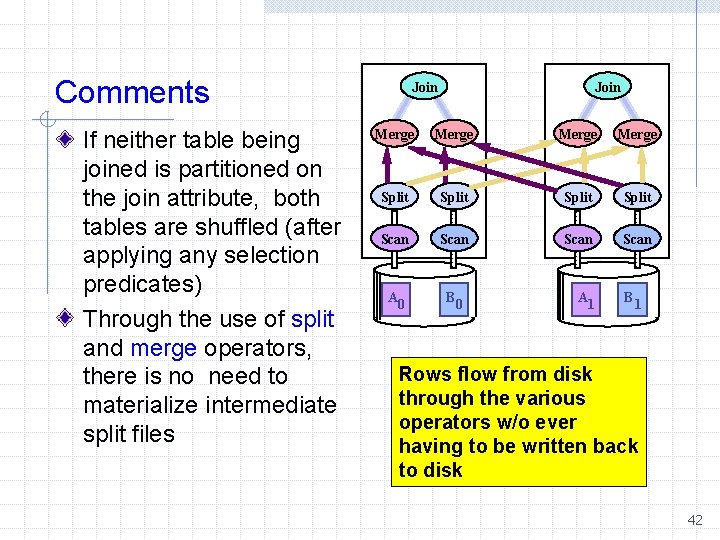
Comments If neither table being joined is partitioned on the join attribute, both tables are shuffled (after applying any selection predicates) Through the use of split and merge operators, there is no need to materialize intermediate split files Join Merge Split Scan A 0 B 0 A 1 B 1 Rows flow from disk through the various operators w/o ever having to be written back to disk 42
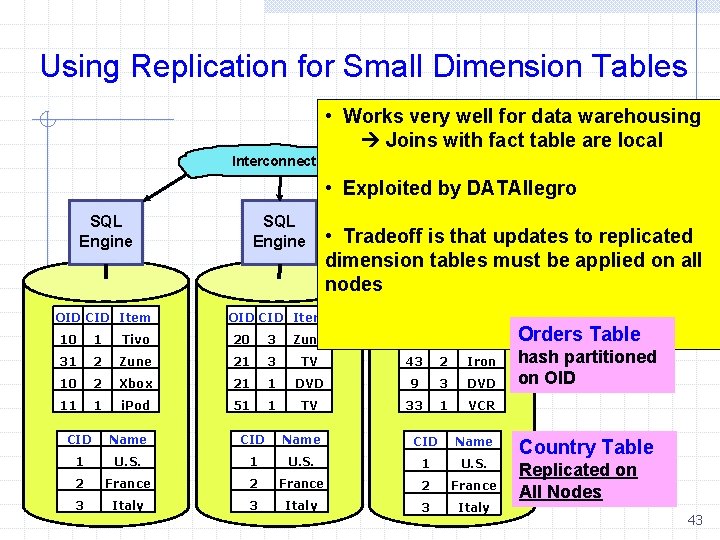
Using Replication for Small Dimension Tables • Works very well for data warehousing Joins with fact table are local Interconnection Network • Exploited by DATAllegro SQL Engine OID CID Item SQL Tradeoff Engine is that • updates to replicated dimension tables must be applied on all nodes OID CID Item 10 1 Tivo 20 3 Zune 40 2 i. Pod 31 2 Zune 21 3 TV 43 2 Iron 10 2 Xbox 21 1 DVD 9 3 DVD 11 1 i. Pod 51 1 TV 33 1 VCR CID Name 1 U. S. 2 France 3 Italy Orders Table hash partitioned on OID Country Table Replicated on All Nodes 43
Talk Outline Alternative parallel db architectures n Why “shared nothing” has emerged as the standard Partitioned tables n The basis for scalable execution Partitioned parallelism n Software building blocks for scalable database systems Other technical challenges Summary and Conclusions 44
Other Technical Challenges Hardware failures Avoiding skew Query Optimization Manageability 45
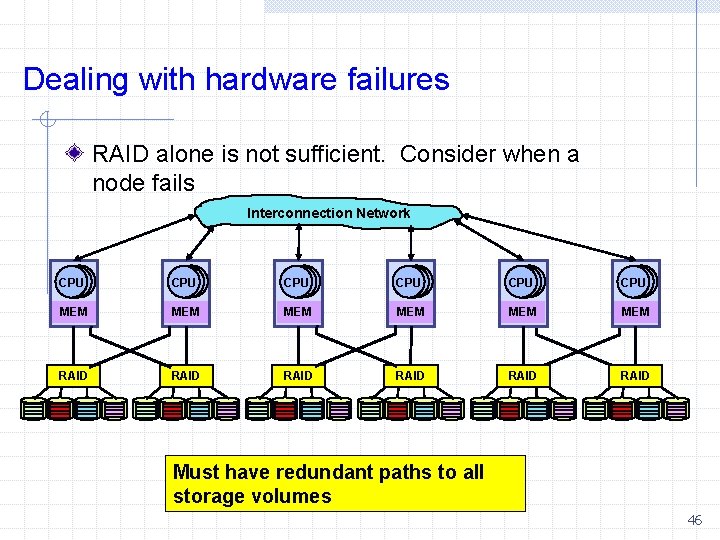
Dealing with hardware failures RAID alone is not sufficient. Consider when a node fails Interconnection Network CPU CPU CPU MEM MEM MEM RAID RAID Must have redundant paths to all storage volumes 46
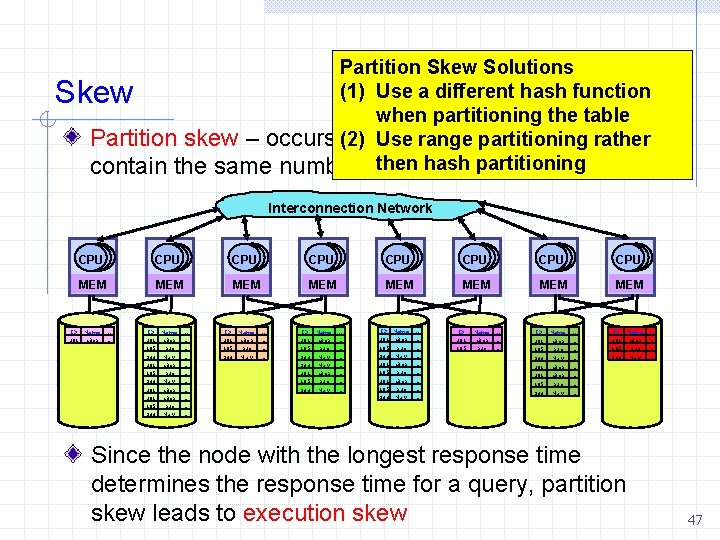
Partition Skew Solutions (1) Use a different hash function when partitioning the table Partition skew – occurs (2) when do not rather Usefragments range partitioning hash partitioning contain the same number ofthen rows Skew Interconnection Network CPU CPU MEM MEM ID Name … ID Name … 201 c. Bob … 201 c. Bob … 105 Sue … 105 Sue … 933 Mary … 933 Mary … 201 c. Bob … … … Sue c. Bob 105 201 933 Mary … 105 Sue … 201 c. Bob … 933 Mary … 105 Sue … 201 c. Bob … 933 Mary … 105 Sue … 933 Mary … Since the node with the longest response time determines the response time for a query, partition skew leads to execution skew 47
Parallel Query Optimization As you all know too well, query optimizers are “fragile” Optimization of parallel queries for shared-nothing architectures is even harder n n n Estimating the amount of data to be redistributed between nodes during query execution Increased number of physical DB design alternatives Skew Typical approach is to “parallelize” the best single node plan Gray Systems Lab is working with the DATAllegro team to build a world-class parallel optimizer 48
Manageability Huge challenge. Goals include n Providing a single system image to the DBA n Have the ability to upgrade DB software one node at a time w/o taking the system down n Automatic management of node and disk failures 49
Conclusions Parallelism is indeed the future of high performance SQL query processing Shared-nothing architectures will dominate as they provide truly scalable parallelism using commodity components The techniques of data partitioning and partitioned execution is the key to providing scalable query execution with linear scaleup and speedup Microsoft intends to become the premier supplier of scalable database systems for data warehousing 50
Time for the Quiz Explain how hash partitioning and range partitioning differ? Is it possible to join two tables that are not partitioned identically on the join attribute? What does linear scaleup mean? What are the two key mechanisms used by a parallel database systems to achieve scalability Google invented parallel database systems. True or false? 51
Finally Thanks for listening I hope you learned something useful Feel free to send me email if you have questions (dewitt@microsoft. com) 52
Backup slides 53
Parallel DBMSs – the start was very rocky 1975 -1985 – A decade of failures n n n Focus on exotic technologies (e. g. bubble memories, CCD memories, head per track disks) Essentially no software building blocks to start with (e. g. networking stacks such as TCP/IP) Misguided, overly complex designs 54
Talk Outline Alternative parallel db architectures n Why “shared nothing” has emerged as the standard Partitioned tables n The basis for scalable execution Partitioned parallelism n Software building blocks for scalable database systems Other technical challenges Summary and Conclusions 55
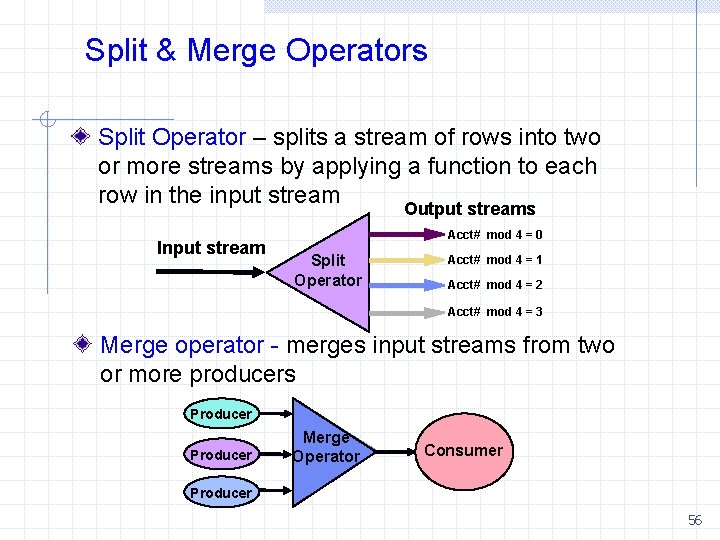
Split & Merge Operators Split Operator – splits a stream of rows into two or more streams by applying a function to each row in the input stream Output streams Input stream Acct# mod 4 = 0 Split Operator Acct# mod 4 = 1 Acct# mod 4 = 2 Acct# mod 4 = 3 Merge operator - merges input streams from two or more producers Producer Merge Operator Consumer Producer 56
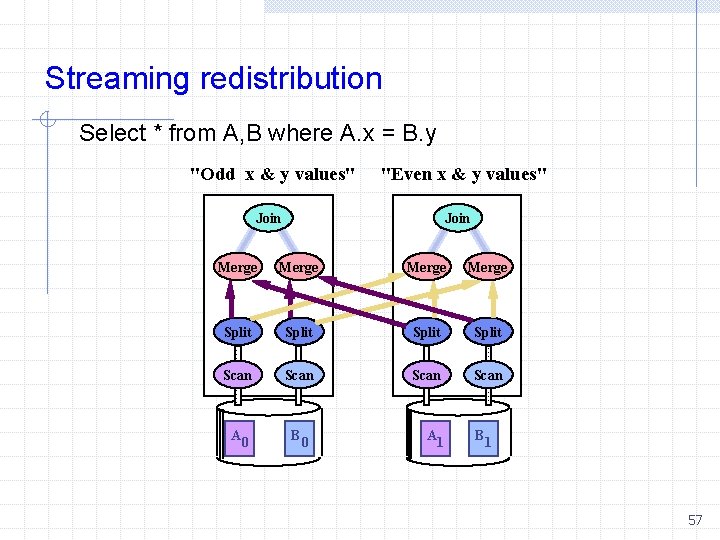
Streaming redistribution Select * from A, B where A. x = B. y "Odd x & y values" "Even x & y values" Join Merge Split Scan A B 0 0 A 1 B 1 57
Parallel DB vs. Map Reduce Parallel database focused on providing the scalable execution of complex SQL Queries Map Reduce n n Computing paradigm developed first at Google for processing massive data sets on massive clusters Borrows many key ideas from parallel database systems including the use of partitioned data sets and the use of hashing to redistribute records with identical key values to the same node for subsequent processing Inferior to relational data model in many ways including no declarative query language and no schema Fault tolerance to hardware failures is superior 58
Partitioning Summary Partitioning the rows of a table is the key to parallel database scalability: n n All partitions can be scanned in parallel e. g. 100 nodes with 8 disks/node provides an aggregated bandwidth of 60 GB/second => 3. 6 TB/minute DB can be scaled essentially indefinitely w while maintaining constant response times n The combination of indexing and partitioning alternatives provides a multitude of physical design alternatives w DBAs will be assisted by DB design wizards 59
Parallelizing Relational Operators Only 3 simple mechanisms are needed: n n n Operator replication – we have seen this Split operator for splitting streams of rows Merge operator for merging multiple streams of rows into a single stream Result is a parallel DBMS capable of providing linear speedup and scaleup! 60
- Slides: 60