
Parallel Computing on Manycore GPUs Vinod Grover NVIDIA

- Slides: 25
Parallel Computing on Manycore GPUs Vinod Grover NVIDIA Research
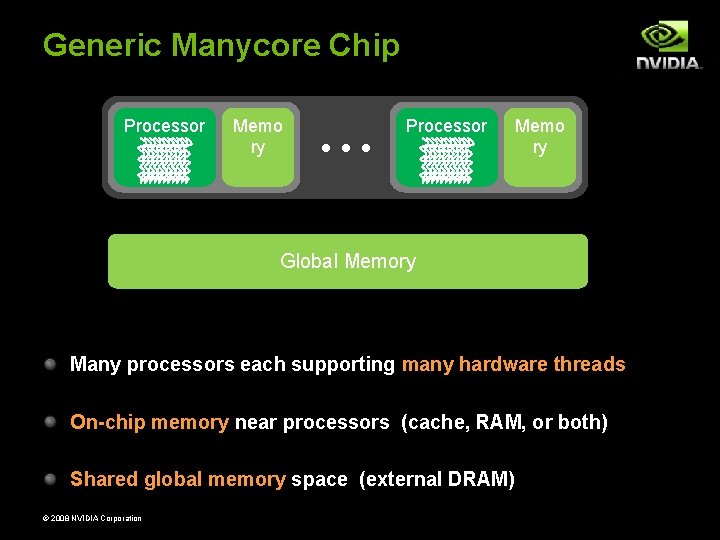
Generic Manycore Chip Processor Memo ry • • • Processor Memo ry Global Memory Many processors each supporting many hardware threads On-chip memory near processors (cache, RAM, or both) Shared global memory space (external DRAM) © 2008 NVIDIA Corporation
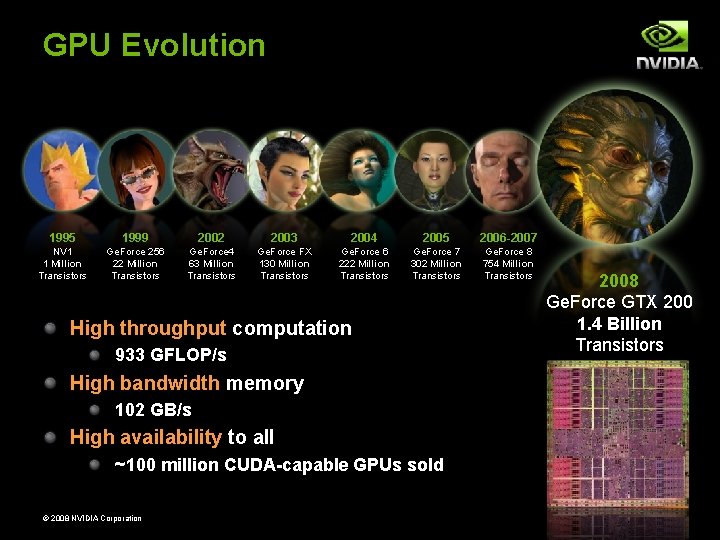
GPU Evolution 1995 1999 2002 2003 2004 2005 2006 -2007 NV 1 1 Million Transistors Ge. Force 256 22 Million Transistors Ge. Force 4 63 Million Transistors Ge. Force FX 130 Million Transistors Ge. Force 6 222 Million Transistors Ge. Force 7 302 Million Transistors Ge. Force 8 754 Million Transistors High throughput computation 933 GFLOP/s High bandwidth memory 102 GB/s High availability to all ~100 million CUDA-capable GPUs sold © 2008 NVIDIA Corporation 2008 Ge. Force GTX 200 1. 4 Billion Transistors
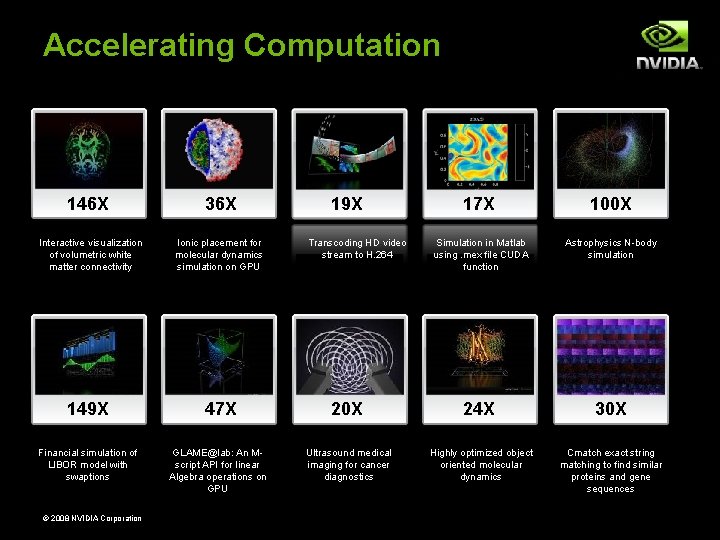
Accelerating Computation 146 X 36 X Interactive visualization of volumetric white matter connectivity Ionic placement for molecular dynamics simulation on GPU 149 X 47 X Financial simulation of LIBOR model with swaptions © 2008 NVIDIA Corporation GLAME@lab: An Mscript API for linear Algebra operations on GPU 19 X 17 X 100 X Simulation in Matlab using. mex file CUDA function Astrophysics N-body simulation 20 X 24 X 30 X Ultrasound medical imaging for cancer diagnostics Highly optimized object oriented molecular dynamics Cmatch exact string matching to find similar proteins and gene sequences Transcoding HD video stream to H. 264
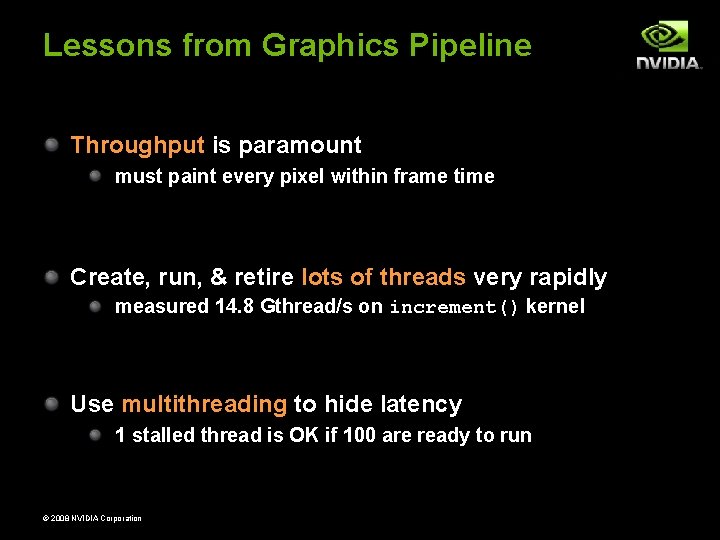
Lessons from Graphics Pipeline Throughput is paramount must paint every pixel within frame time Create, run, & retire lots of threads very rapidly measured 14. 8 Gthread/s on increment() kernel Use multithreading to hide latency 1 stalled thread is OK if 100 are ready to run © 2008 NVIDIA Corporation
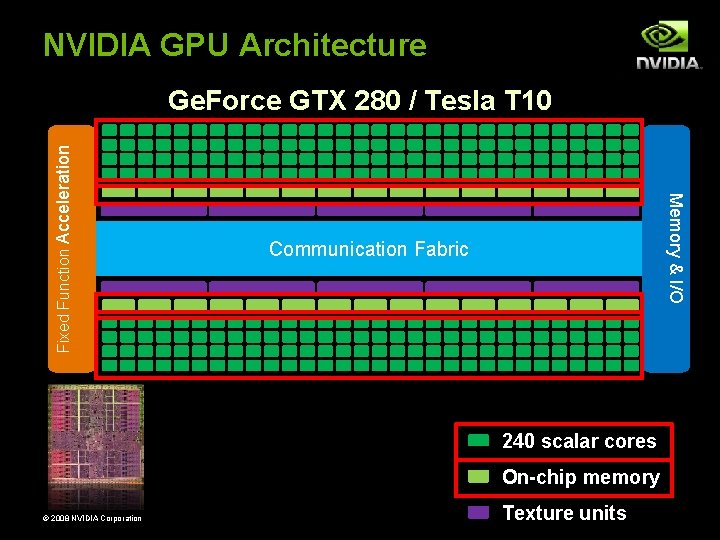
NVIDIA GPU Architecture Memory & I/O Fixed Function Acceleration Ge. Force GTX 280 / Tesla T 10 Communication Fabric 240 scalar cores On-chip memory © 2008 NVIDIA Corporation Texture units
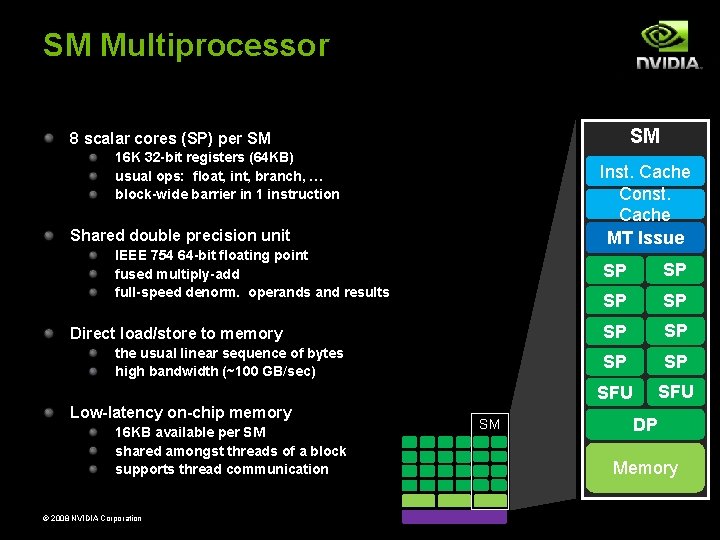
SM Multiprocessor SM 8 scalar cores (SP) per SM 16 K 32 -bit registers (64 KB) usual ops: float, int, branch, … block-wide barrier in 1 instruction Inst. Cache Const. Cache MT Issue Shared double precision unit IEEE 754 64 -bit floating point fused multiply-add full-speed denorm. operands and results Direct load/store to memory the usual linear sequence of bytes high bandwidth (~100 GB/sec) Low-latency on-chip memory 16 KB available per SM shared amongst threads of a block supports thread communication © 2008 NVIDIA Corporation SM SP SP SFU DP Memory
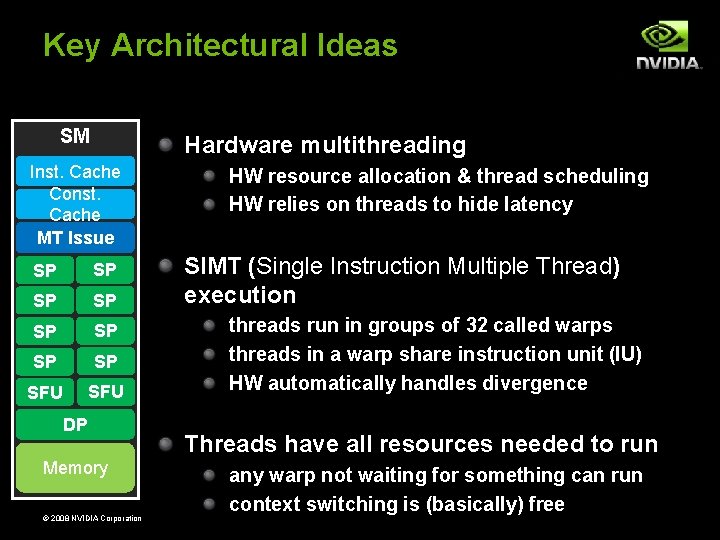
Key Architectural Ideas SM Hardware multithreading Inst. Cache Const. Cache MT Issue SP SP SFU DP Memory © 2008 NVIDIA Corporation HW resource allocation & thread scheduling HW relies on threads to hide latency SIMT (Single Instruction Multiple Thread) execution threads run in groups of 32 called warps threads in a warp share instruction unit (IU) HW automatically handles divergence Threads have all resources needed to run any warp not waiting for something can run context switching is (basically) free
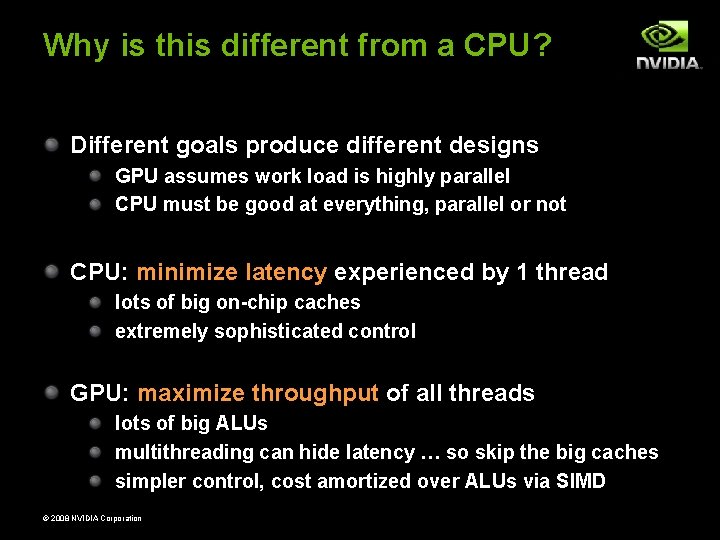
Why is this different from a CPU? Different goals produce different designs GPU assumes work load is highly parallel CPU must be good at everything, parallel or not CPU: minimize latency experienced by 1 thread lots of big on-chip caches extremely sophisticated control GPU: maximize throughput of all threads lots of big ALUs multithreading can hide latency … so skip the big caches simpler control, cost amortized over ALUs via SIMD © 2008 NVIDIA Corporation
CUDA: Scalable parallel programming Augment C/C++ with minimalist abstractions let programmers focus on parallel algorithms not mechanics of a parallel programming language Provide straightforward mapping onto hardware good fit to GPU architecture maps well to multi-core CPUs too Scale to 100’s of cores & 10, 000’s of parallel threads GPU threads are lightweight — create / switch is free GPU needs 1000’s of threads for full utilization © 2008 NVIDIA Corporation
Key Parallel Abstractions in CUDA Hierarchy of concurrent threads Lightweight synchronization primitives Shared memory model for cooperating threads © 2008 NVIDIA Corporation
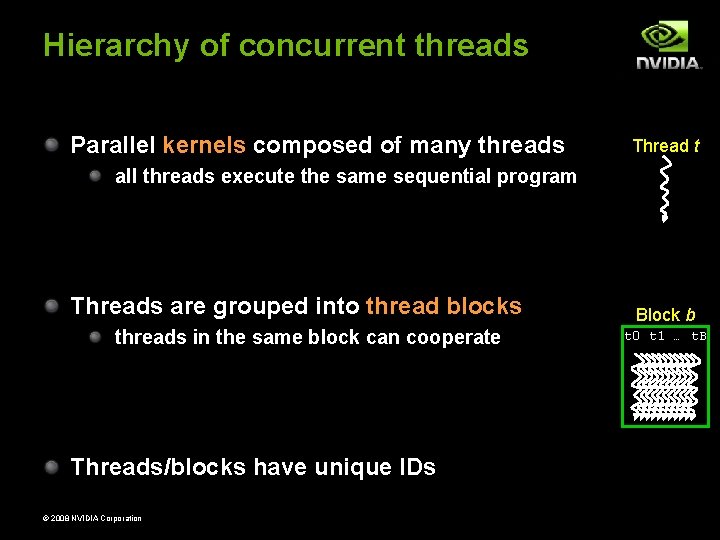
Hierarchy of concurrent threads Parallel kernels composed of many threads Thread t all threads execute the same sequential program Threads are grouped into thread blocks threads in the same block can cooperate Threads/blocks have unique IDs © 2008 NVIDIA Corporation Block b t 0 t 1 … t. B
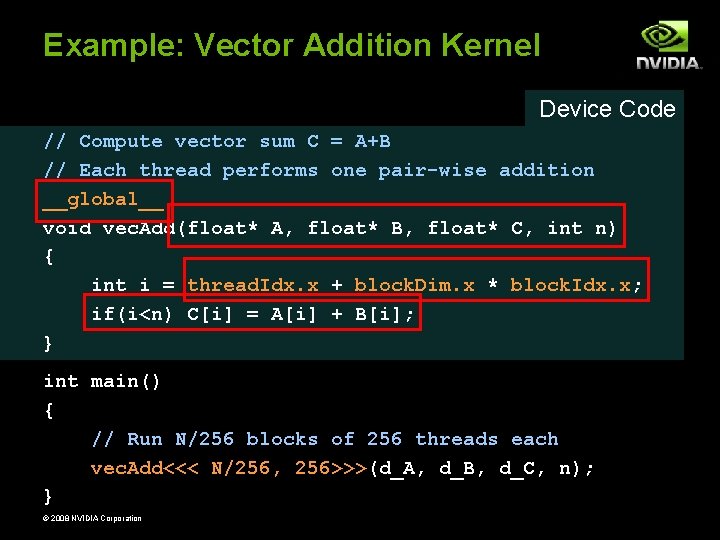
Example: Vector Addition Kernel Device Code // Compute vector sum C = A+B // Each thread performs one pair-wise addition __global__ void vec. Add(float* A, float* B, float* C, int n) { int i = thread. Idx. x + block. Dim. x * block. Idx. x; if(i<n) C[i] = A[i] + B[i]; } int main() { // Run N/256 blocks of 256 threads each vec. Add<<< N/256, 256>>>(d_A, d_B, d_C, n); } © 2008 NVIDIA Corporation
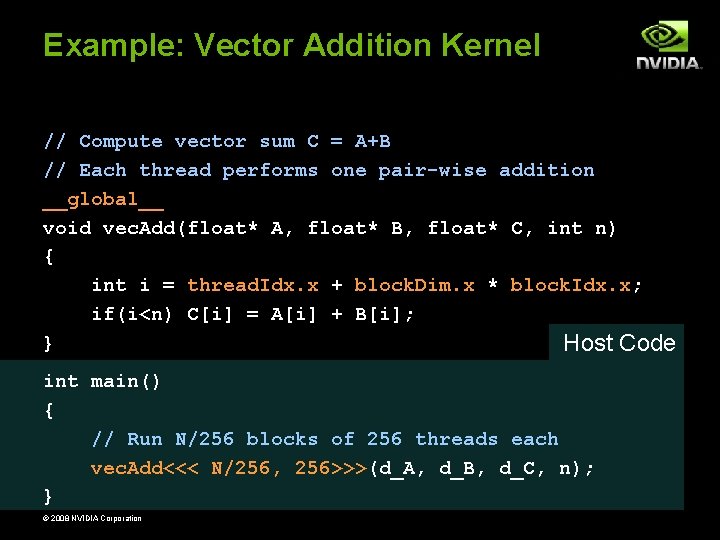
Example: Vector Addition Kernel // Compute vector sum C = A+B // Each thread performs one pair-wise addition __global__ void vec. Add(float* A, float* B, float* C, int n) { int i = thread. Idx. x + block. Dim. x * block. Idx. x; if(i<n) C[i] = A[i] + B[i]; } Host Code int main() { // Run N/256 blocks of 256 threads each vec. Add<<< N/256, 256>>>(d_A, d_B, d_C, n); } © 2008 NVIDIA Corporation
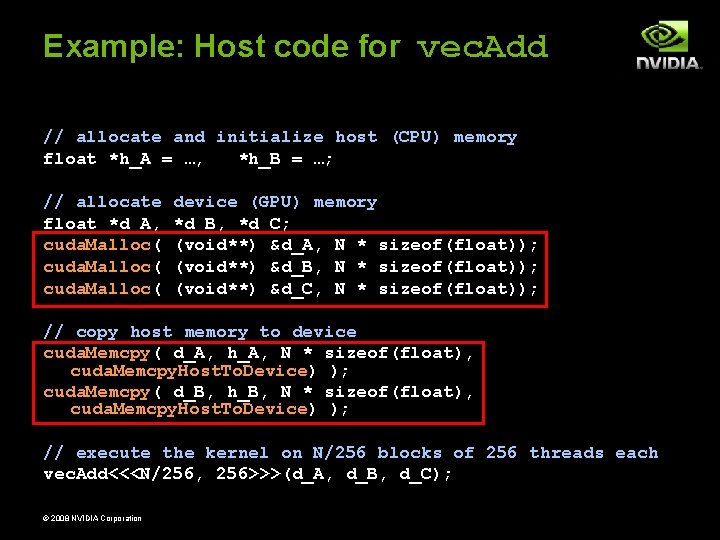
Example: Host code for vec. Add // allocate and initialize host (CPU) memory float *h_A = …, *h_B = …; // allocate float *d_A, cuda. Malloc( device (GPU) memory *d_B, *d_C; (void**) &d_A, N * sizeof(float)); (void**) &d_B, N * sizeof(float)); (void**) &d_C, N * sizeof(float)); // copy host memory to device cuda. Memcpy( d_A, h_A, N * sizeof(float), cuda. Memcpy. Host. To. Device) ); cuda. Memcpy( d_B, h_B, N * sizeof(float), cuda. Memcpy. Host. To. Device) ); // execute the kernel on N/256 blocks of 256 threads each vec. Add<<<N/256, 256>>>(d_A, d_B, d_C); © 2008 NVIDIA Corporation
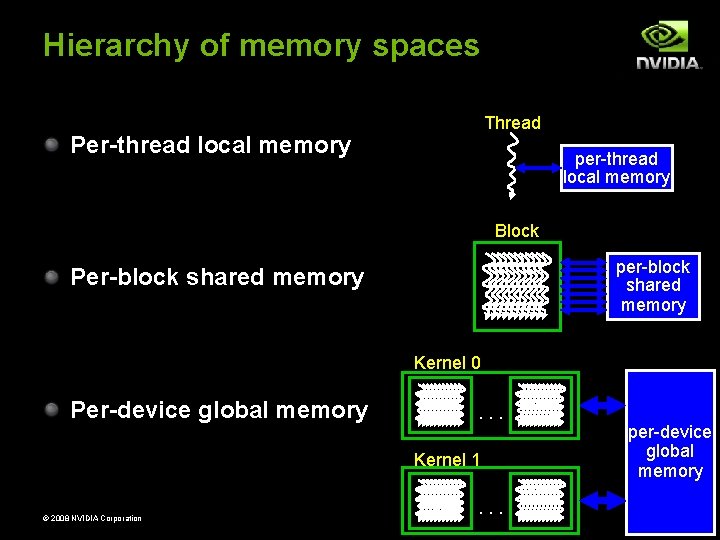
Hierarchy of memory spaces Thread Per-thread local memory per-thread local memory Block per-block shared memory Per-block shared memory Kernel 0 Per-device global memory . . . Kernel 1 © 2008 NVIDIA Corporation . . . per-device global memory
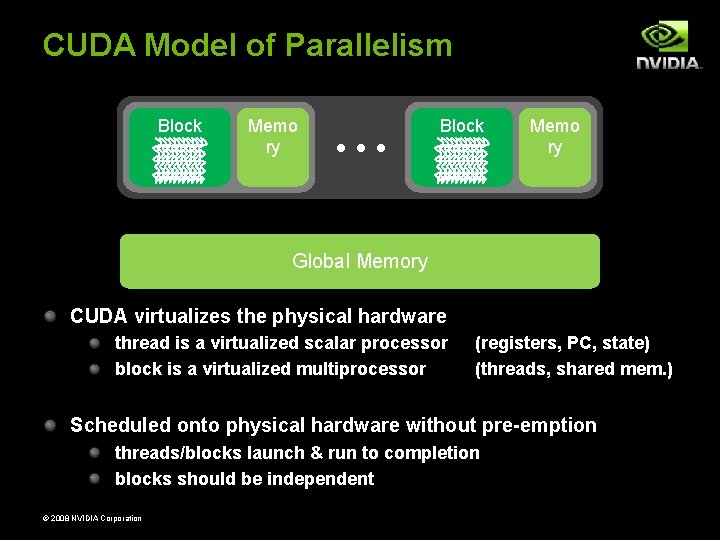
CUDA Model of Parallelism Block Memo ry • • • Block Memo ry Global Memory CUDA virtualizes the physical hardware thread is a virtualized scalar processor block is a virtualized multiprocessor (registers, PC, state) (threads, shared mem. ) Scheduled onto physical hardware without pre-emption threads/blocks launch & run to completion blocks should be independent © 2008 NVIDIA Corporation
Thread = virtualized scalar processor Independent thread of execution has its own PC, variables (registers), processor state, etc. no implication about how threads are scheduled CUDA threads might be physical threads as on NVIDIA GPUs CUDA threads might be virtual threads might pick 1 block = 1 physical thread on multicore CPU © 2008 NVIDIA Corporation
Block = virtualized multiprocessor Provides programmer flexibility freely choose processors to fit data freely customize for each kernel launch Thread block = a (data) parallel task all blocks in kernel have the same entry point but may execute any code they want Thread blocks of kernel must be independent tasks program valid for any interleaving of block executions © 2008 NVIDIA Corporation
Blocks must be independent Any possible interleaving of blocks should be valid presumed to run to completion without pre-emption can run in any order … concurrently OR sequentially Blocks may coordinate but not synchronize shared queue pointer: OK shared lock: BAD … can easily deadlock Independence requirement gives scalability © 2008 NVIDIA Corporation
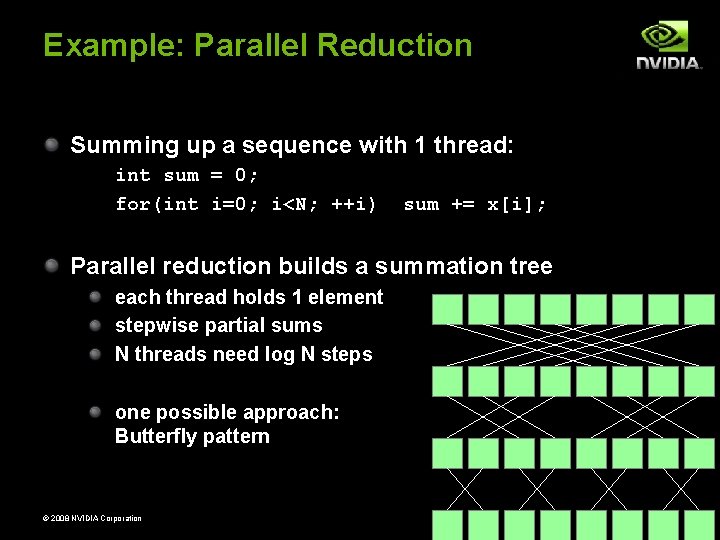
Example: Parallel Reduction Summing up a sequence with 1 thread: int sum = 0; for(int i=0; i<N; ++i) sum += x[i]; Parallel reduction builds a summation tree each thread holds 1 element stepwise partial sums N threads need log N steps one possible approach: Butterfly pattern © 2008 NVIDIA Corporation
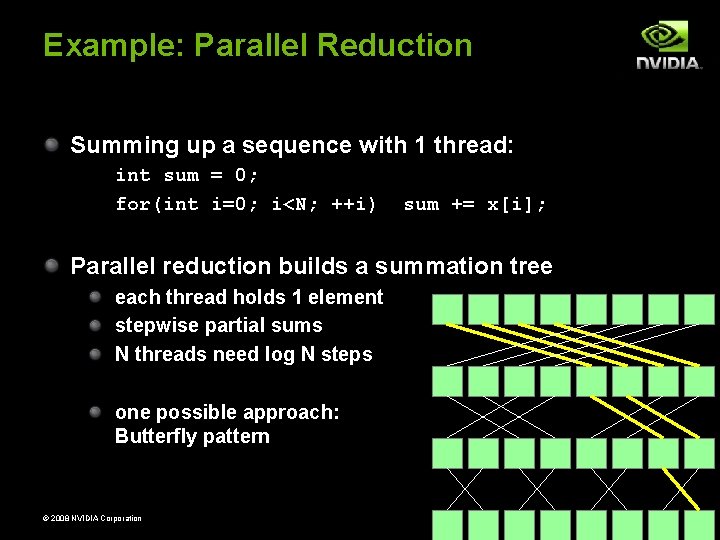
Example: Parallel Reduction Summing up a sequence with 1 thread: int sum = 0; for(int i=0; i<N; ++i) sum += x[i]; Parallel reduction builds a summation tree each thread holds 1 element stepwise partial sums N threads need log N steps one possible approach: Butterfly pattern © 2008 NVIDIA Corporation
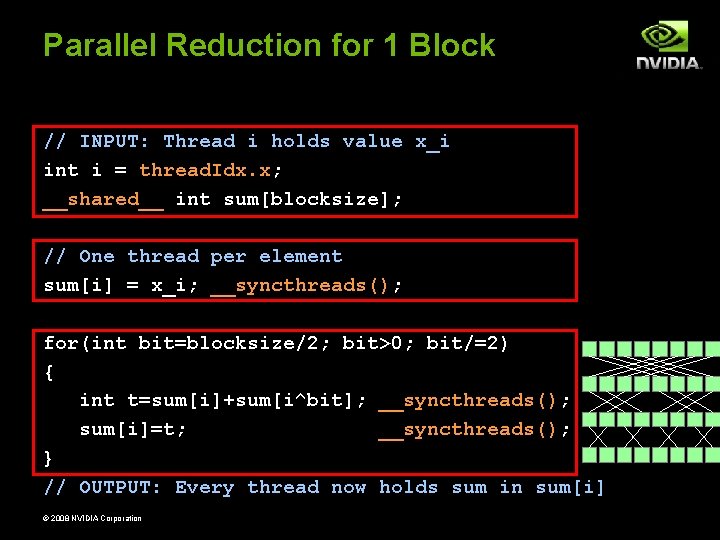
Parallel Reduction for 1 Block // INPUT: Thread i holds value x_i int i = thread. Idx. x; __shared__ int sum[blocksize]; // One thread per element sum[i] = x_i; __syncthreads(); for(int bit=blocksize/2; bit>0; bit/=2) { int t=sum[i]+sum[i^bit]; __syncthreads(); sum[i]=t; __syncthreads(); } // OUTPUT: Every thread now holds sum in sum[i] © 2008 NVIDIA Corporation
Final Thoughts GPUs are throughput-oriented microprocessors manycore architecture massive hardware multithreading ubiquitous commodity hardware CUDA programming model is simple yet powerful traditional scalar execution model with transparent SIMD simple extensions to existing sequential language Many important research opportunities not to speak of the educational challenges © 2008 NVIDIA Corporation
Questions? vgrover@nvidia. com http: //www. nvidia. com/CUDA © 2008 NVIDIA Corporation