
Parallel Computing in SAS Genetic Algorithms Application Alejandro


- Slides: 15
Parallel Computing in SAS. Genetic Algorithms Application Alejandro Correa, Banco Colpatria Andrés González, Banco Colpatria Darwin Amézquita, Banco Colpatria
Contents § Introduction § General concepts § SAS PROC CONNECT § Genetic Algorithm § Parallel Genetic Algorithm § Methodology § Results § Conclusion
Introduction § Mitigate impact of credit risk. § Multi-Layer Perceptron (MLP) neural network as an tool for mitigate losses. § Architecture optimization by Genetic Algorithms (GA) § Correa, A. Gonzalez, C. Ladino. Genetic Algorithm Optimization for Selecting the Best Architecture of a Multi-Layer Perceptron Neural Network: A Credit Scoring Case. § PROC CONNECT SAS procedure. § Parallel Genetic Algorithm (PGA).
The problem § Reach the GA optimum results § Reduce expenditure of time in GA application
The solution § Parallelization § Optimize GA § Use full computational resources in a multi core computer § PROC CONNECT SAS procedure
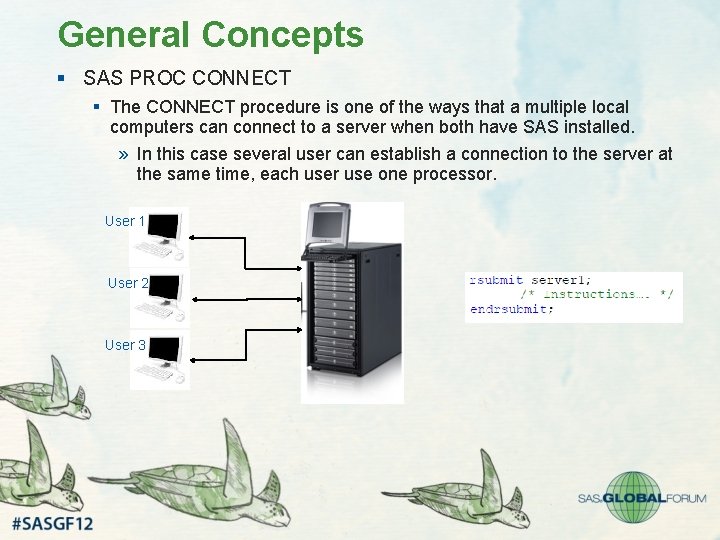
General Concepts § SAS PROC CONNECT § The CONNECT procedure is one of the ways that a multiple local computers can connect to a server when both have SAS installed. » In this case several user can establish a connection to the server at the same time, each user use one processor. User 1 User 2 User 3
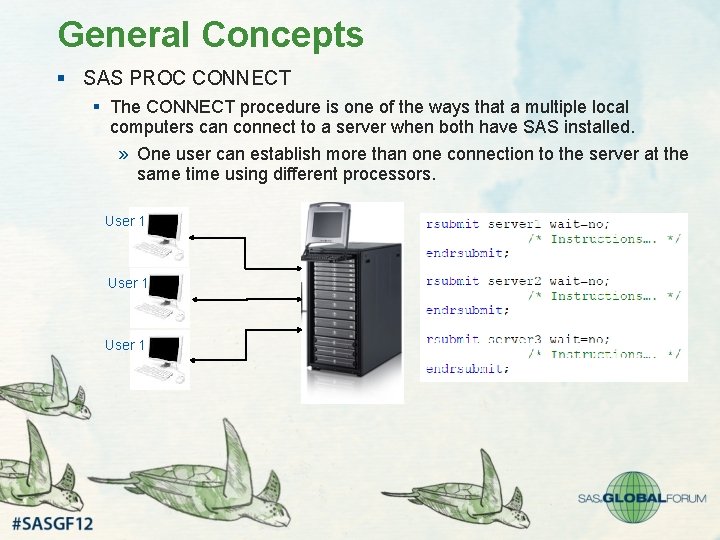
General Concepts § SAS PROC CONNECT § The CONNECT procedure is one of the ways that a multiple local computers can connect to a server when both have SAS installed. » One user can establish more than one connection to the server at the same time using different processors. User 1
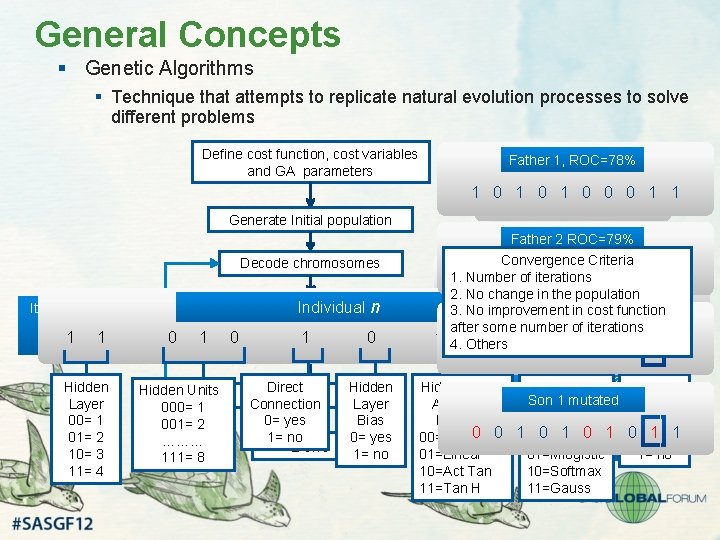
General Concepts § Genetic Algorithms § Technique that attempts to replicate natural evolution processes to solve different problems Define cost function, cost variables and GA parameters Father 1, Cost ROC=78% Individual 1 1 0 1 0 0 1 1 ROC Generate Initial population Father 2 ROC=79% Individual 2 Convergence Criteria Decode chromosomes GAiterations 0 1 1 Parameters 0 1 1 0 0 1 1. Number 0 of 2. No change in the population 1 improvement 0 1 in 0 cost 1 function 0 1 1 Find cost for each chromosome Individual n Iterative process 3. No Son 1 3 Individual that emulates after some number of iterations 1 1 0 1 0 1 4. 0 Others 1 1 1 evolution Hidden activation Mating/Mutation 0 0 1 1 0 1 0 0 1 Gene Function Target Hidden. Input Layer. Bias Target 00: Linear Layer Hidden Direct Hidden Units Convergence Check 10: Logistic Individual 4 1 mutated Layer Activation Layer Connection Layer 1: Yes Son 000= 1 01: Arc Tan Bias Function Bias 0= yes 00= 1 0: No 001= 2 Tan 0 0 1 00=Logistic 0 111: Hiperbolic 10 1 00=01 yes 1 00=Logistic 0= yes 1= no 01= 2 ……… Done 1= no 01=Linear 01=Mlogistic 1= no 10= 3 111= 8 10=Act Tan 10=Softmax 11= 4 11=Tan H 11=Gauss
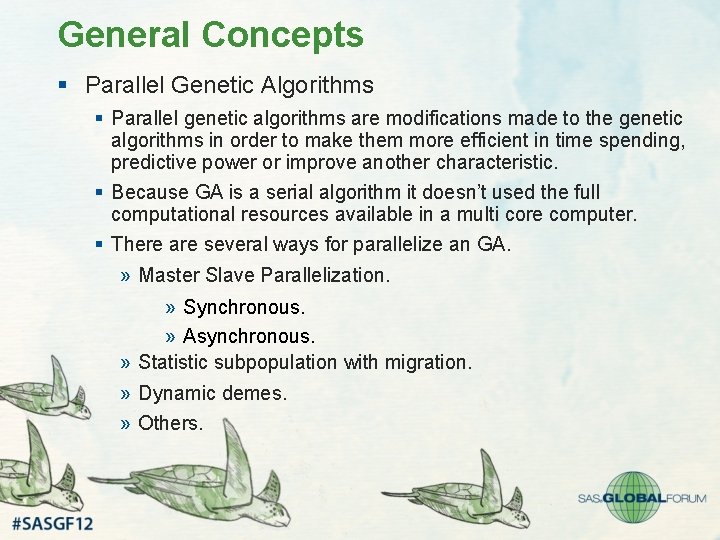
General Concepts § Parallel Genetic Algorithms § Parallel genetic algorithms are modifications made to the genetic algorithms in order to make them more efficient in time spending, predictive power or improve another characteristic. § Because GA is a serial algorithm it doesn’t used the full computational resources available in a multi core computer. § There are several ways for parallelize an GA. » Master Slave Parallelization. » Synchronous. » Asynchronous. » Statistic subpopulation with migration. » Dynamic demes. » Others.
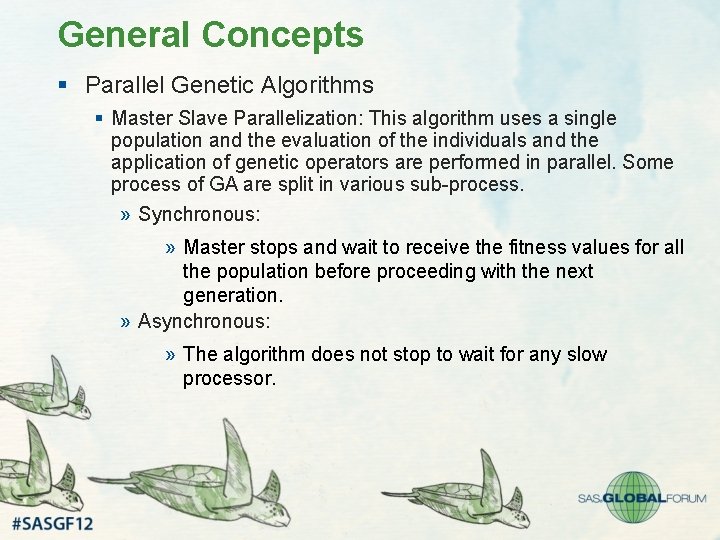
General Concepts § Parallel Genetic Algorithms § Master Slave Parallelization: This algorithm uses a single population and the evaluation of the individuals and the application of genetic operators are performed in parallel. Some process of GA are split in various sub-process. » Synchronous: » Master stops and wait to receive the fitness values for all the population before proceeding with the next generation. » Asynchronous: » The algorithm does not stop to wait for any slow processor.
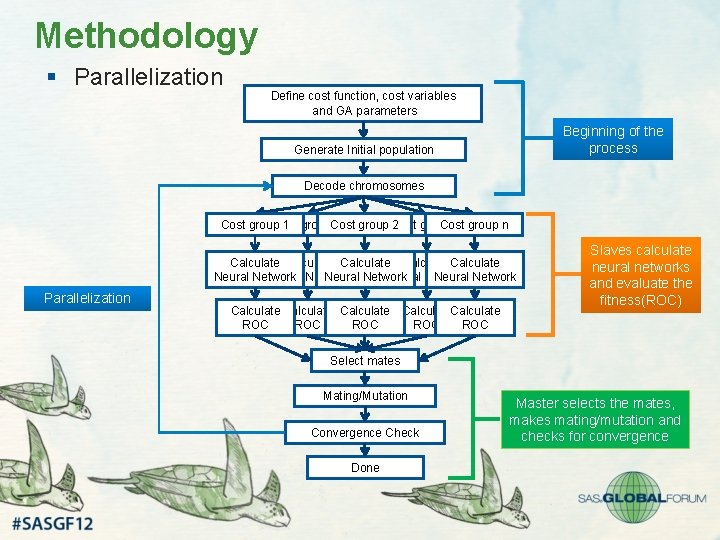
Methodology § Parallelization Define cost function, cost variables and GA parameters Beginning of the process Generate Initial population Decode chromosomes group 2 group n Cost group Cost 1 2 Cost Calculate Neural Network Neural Network Parallelization Calculate ROC ROC ROC Slaves calculate neural networks and evaluate the fitness(ROC) Select mates Mating/Mutation Convergence Check Done Master selects the mates, makes mating/mutation and checks for convergence
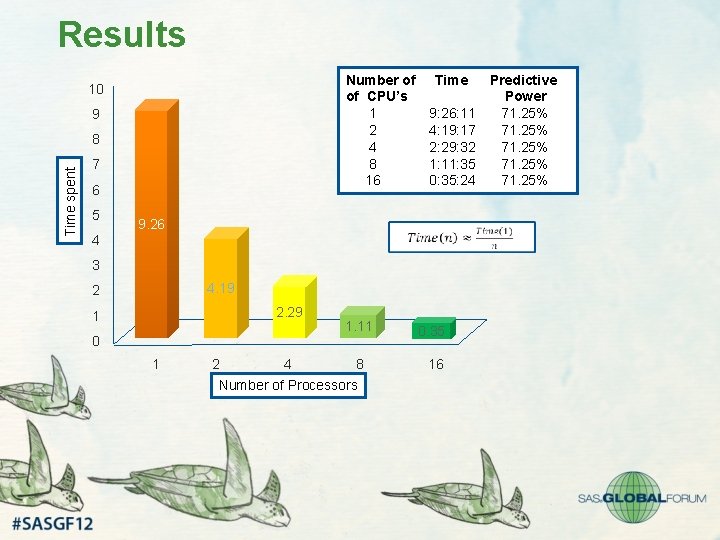
Results Number of of CPU’s 1 2 4 8 16 10 9 Time spent 8 7 6 5 Time 9: 26: 11 4: 19: 17 2: 29: 32 1: 11: 35 0: 35: 24 9. 26 4 3 4. 19 2 2. 29 1 0 1 2 4 1. 11 8 Number of Processors 0. 35 16 Predictive Power 71. 25%
Conclusions § The experimental results have shown that using PGA to optimize the architecture of a MLP neural network reach to the same result as the serial GA, but the time spent is reduced drastically. § The time reduction will depend of the number of slaves used to parallelize de GA. § Spent time is reduced from 9 to 1 hours using 16 slaves, which represents a reduction of 900%. § There’s still room for testing different parallelized versions of the GA.
THANK YOU
Contact information Darwin Amézquita Andrés González Colpatria – Scotia Bank Bogotá, Colombia (+57) 310 -3595239 (+57) 301 -3372763 amezqud@colpatria. com gonzalean@colpatria. com Alejandro Correa Colpatria – Scotia Bank Bogotá, Colombia (+57) 320 -8306606 al. bahnsen@gmail. com