
Parallel Computation Patterns Reduction Slide credit Slides adapted




- Slides: 20
Parallel Computation Patterns (Reduction) Slide credit: Slides adapted from © David Kirk/NVIDIA and Wen-mei W. Hwu, 2007 -2016
“Partition and Summarize” – A commonly used strategy for processing large input data sets – There is no required order of processing elements in a data set (associative and commutative) – Partition the data set into smaller chunks – Have each thread to process a chunk – Use a reduction tree to summarize the results from each chunk into the final answer – E. G. , Google and Hadoop Map. Reduce frameworks support this strategy – We will focus on the reduction tree step for now
Reduction enables other techniques – Reduction is also needed to clean up after some commonly used parallelizing transformations – Privatization – Multiple threads write into an output location – Replicate the output location so that each thread has a private output location (privatization) – Use a reduction tree to combine the values of private locations into the original output location
What is a reduction computation? – Summarize a set of input values into one value using a “reduction operation” – – Max Min Sum Product – Often used with a user defined reduction operation function as long as the operation – Is associative and commutative – Has a well-defined identity value (e. g. , 0 for sum) – For example, the user may supply a custom “max” function for 3 D coordinate data sets where the magnitude for the each coordinate data tuple is the distance from the origin. An example of “collective operation”
An Efficient Sequential Reduction O(N) – Initialize the result as an identity value for the reduction operation – – Smallest possible value for max reduction Largest possible value for min reduction 0 for sum reduction 1 for product reduction – Iterate through the input and perform the reduction operation between the result value and the current input value – N reduction operations performed for N input values – Each input value is only visited once – an O(N) algorithm – This is a computationally efficient algorithm. 5
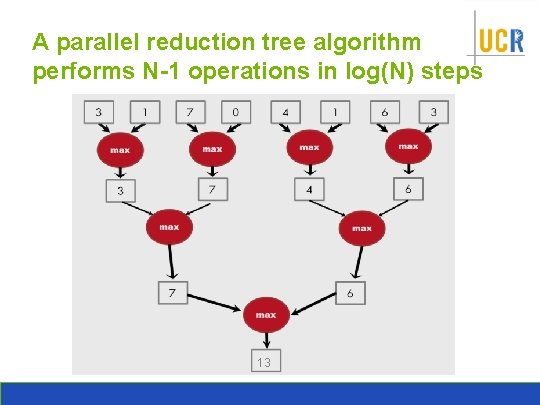
A parallel reduction tree algorithm performs N-1 operations in log(N) steps 13
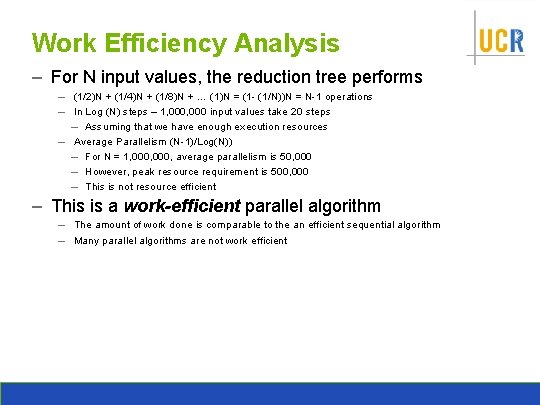
Work Efficiency Analysis – For N input values, the reduction tree performs – (1/2)N + (1/4)N + (1/8)N + … (1)N = (1 - (1/N))N = N-1 operations – In Log (N) steps – 1, 000 input values take 20 steps – Assuming that we have enough execution resources – Average Parallelism (N-1)/Log(N)) – For N = 1, 000, average parallelism is 50, 000 – However, peak resource requirement is 500, 000 – This is not resource efficient – This is a work-efficient parallel algorithm – The amount of work done is comparable to the an efficient sequential algorithm – Many parallel algorithms are not work efficient
BASIC REDUCTION KERNEL
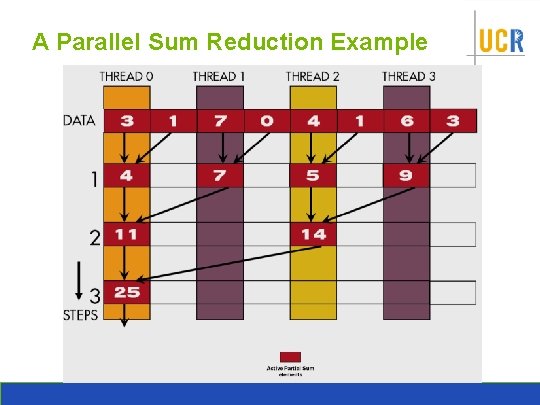
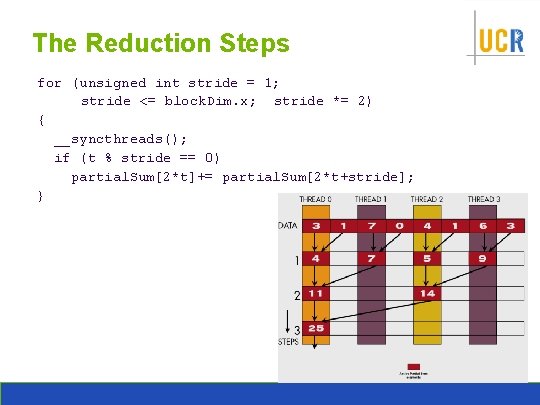
Parallel Sum Reduction – Parallel implementation – Each thread adds two values in each step – – Recursively halve # of threads Takes log(n) steps for n elements, requires n/2 threads
A Parallel Sum Reduction Example
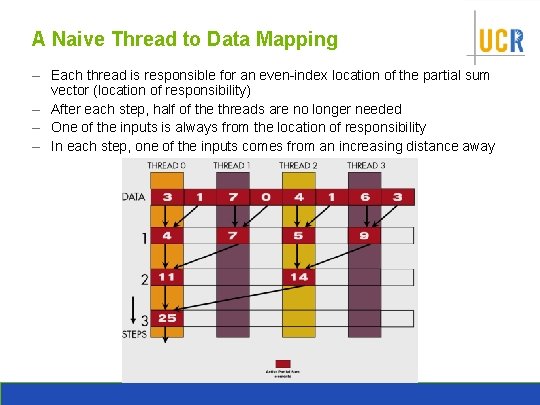
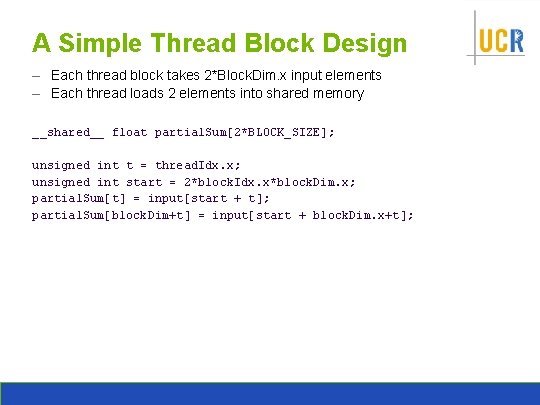
A Naive Thread to Data Mapping – Each thread is responsible for an even-index location of the partial sum vector (location of responsibility) – After each step, half of the threads are no longer needed – One of the inputs is always from the location of responsibility – In each step, one of the inputs comes from an increasing distance away
A Simple Thread Block Design – Each thread block takes 2*Block. Dim. x input elements – Each thread loads 2 elements into shared memory __shared__ float partial. Sum[2*BLOCK_SIZE]; unsigned int t = thread. Idx. x; unsigned int start = 2*block. Idx. x*block. Dim. x; partial. Sum[t] = input[start + t]; partial. Sum[block. Dim+t] = input[start + block. Dim. x+t];
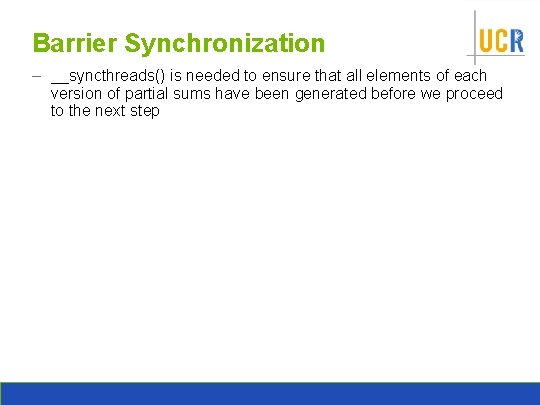
The Reduction Steps for (unsigned int stride = 1; stride <= block. Dim. x; stride *= 2) { __syncthreads(); if (t % stride == 0) partial. Sum[2*t]+= partial. Sum[2*t+stride]; } Why do we need __syncthreads()?
Barrier Synchronization – __syncthreads() is needed to ensure that all elements of each version of partial sums have been generated before we proceed to the next step
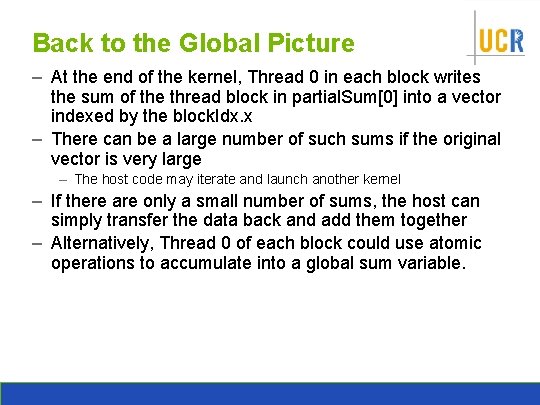
Back to the Global Picture – At the end of the kernel, Thread 0 in each block writes the sum of the thread block in partial. Sum[0] into a vector indexed by the block. Idx. x – There can be a large number of such sums if the original vector is very large – The host code may iterate and launch another kernel – If there are only a small number of sums, the host can simply transfer the data back and add them together – Alternatively, Thread 0 of each block could use atomic operations to accumulate into a global sum variable. 16
A BETTER REDUCTION MODEL
Some Observations on the naïve reduction kernel – In each iteration, two control flow paths will be sequentially traversed for each warp – Threads that perform addition and threads that do not – Threads that do not perform addition still consume execution resources – Half or fewer of threads will be executing after the first step – All odd-index threads are disabled after first step – After the 5 th step, entire warps in each block will fail the if test, poor resource utilization but no divergence – This can go on for a while, up to 6 more steps (stride = 32, 64, 128, 256, 512, 1024), where each active warp only has one productive thread until all warps in a block retire
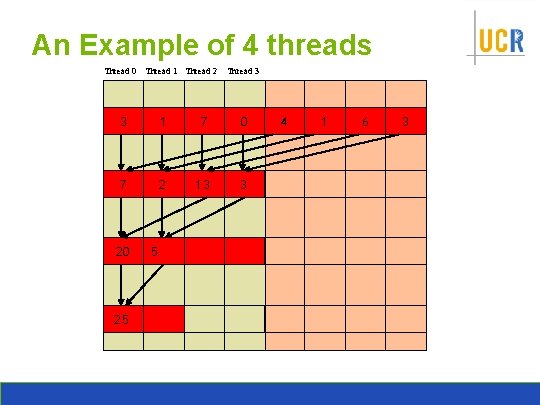
Thread Index Usage Matters – In some algorithms, one can shift the index usage to improve the divergence behavior – Commutative and associative operators – Keep the active threads consecutive – Always compact the partial sums into the front locations in the partial. Sum[ ] array 19
An Example of 4 threads Thread 0 Thread 1 Thread 2 Thread 3 3 1 7 0 7 2 13 3 20 25 5 4 1 6 3
A Quick Analysis – For a 1024 thread block – No divergence in the first 5 steps – 1024, 512, 256, 128, 64, 32 consecutive threads are active in each step – All threads in each warp either all active or all inactive – The final 5 steps will still have divergence 21