
Parallel Cluster Computing 1 Topics Covered Introduction What
- Slides: 31
Parallel & Cluster Computing 1
Topics Covered : • • Introduction What is cluster computing? Classification of Cluster Computing Technologies: – Beowulf cluster – Construction of Beowulf Cluster – The use of cluster computing in Bioinformatics & Parallel Computing – Folding@Home Project • High performance clusters (HPC) a 256 -processor Sun cluster. • Build Your Own Cluster! 2
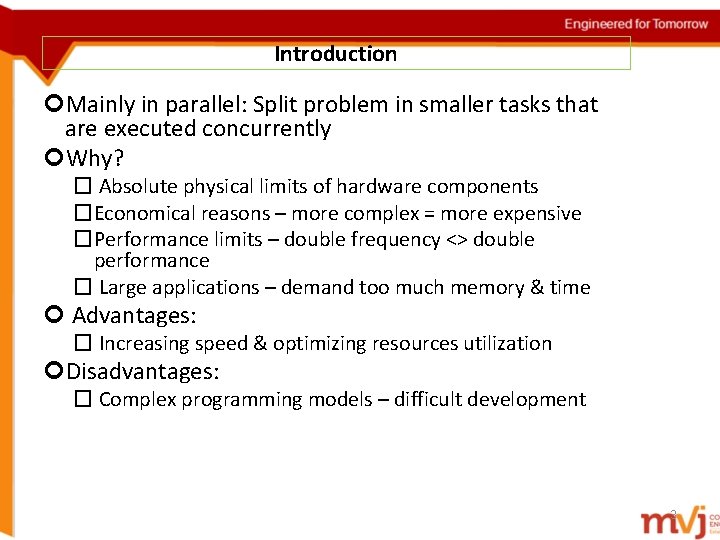
Introduction Mainly in parallel: Split problem in smaller tasks that are executed concurrently Why? � Absolute physical limits of hardware components �Economical reasons – more complex = more expensive �Performance limits – double frequency <> double performance � Large applications – demand too much memory & time Advantages: � Increasing speed & optimizing resources utilization Disadvantages: � Complex programming models – difficult development 3
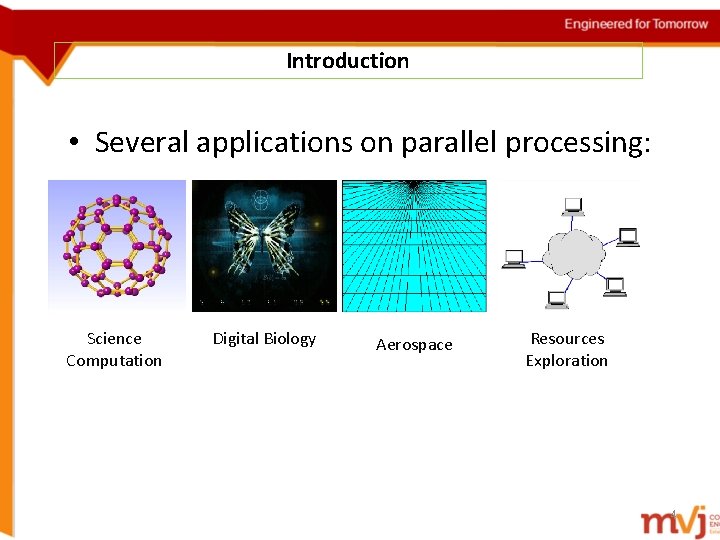
Introduction • Several applications on parallel processing: Science Computation Digital Biology Aerospace Resources Exploration 4
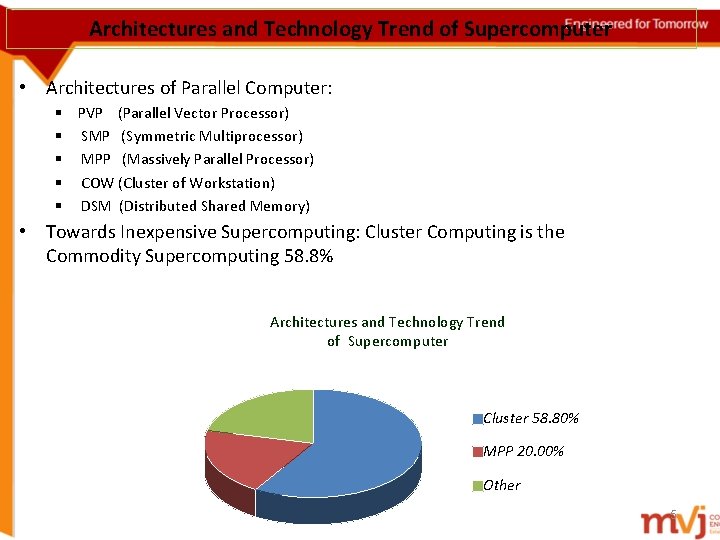
Architectures and Technology Trend of Supercomputer • Architectures of Parallel Computer: § PVP (Parallel Vector Processor) § SMP (Symmetric Multiprocessor) § MPP (Massively Parallel Processor) § COW (Cluster of Workstation) § DSM (Distributed Shared Memory) • Towards Inexpensive Supercomputing: Cluster Computing is the Commodity Supercomputing 58. 8% Architectures and Technology Trend of Supercomputer Cluster 58. 80% MPP 20. 00% Other 5
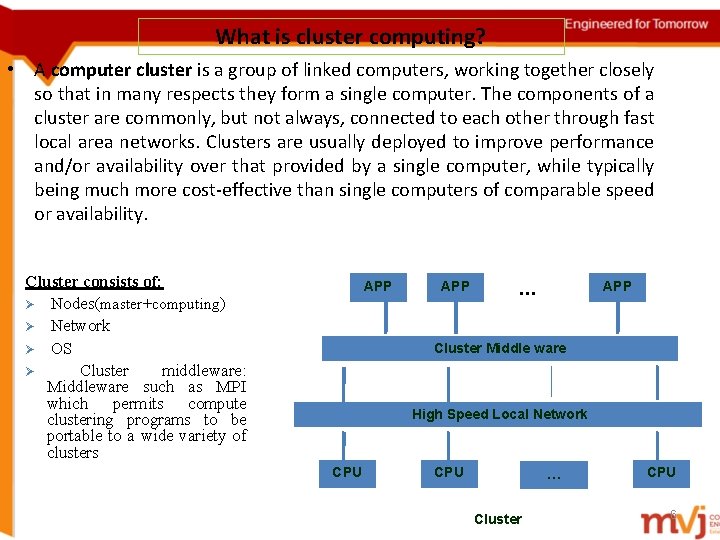
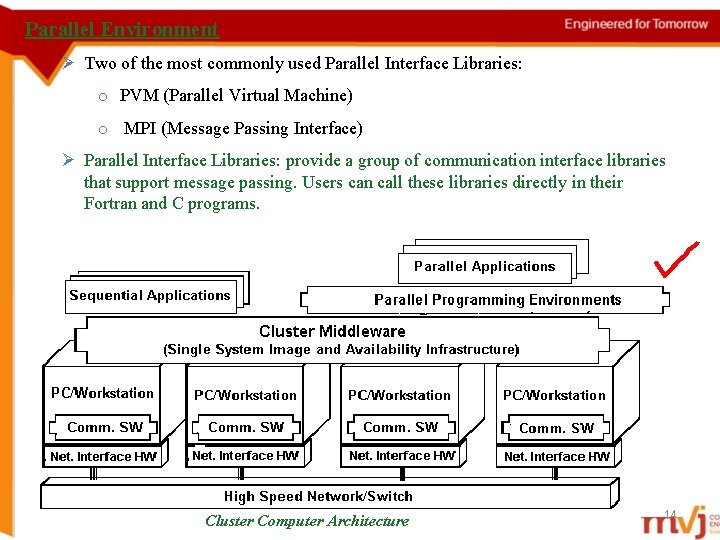
What is cluster computing? • A computer cluster is a group of linked computers, working together closely so that in many respects they form a single computer. The components of a cluster are commonly, but not always, connected to each other through fast local area networks. Clusters are usually deployed to improve performance and/or availability over that provided by a single computer, while typically being much more cost-effective than single computers of comparable speed or availability. Cluster consists of: Ø Nodes(master+computing) Ø Network Ø OS Ø Cluster middleware: Middleware such as MPI which permits compute clustering programs to be portable to a wide variety of clusters APP APP … Cluster Middle ware High Speed Local Network CPU … Cluster CPU 6
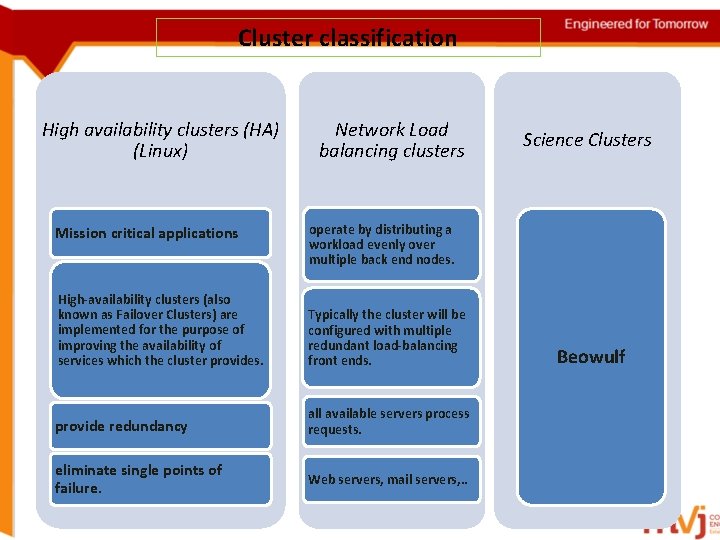
Cluster classification High availability clusters (HA) (Linux) Mission critical applications Network Load balancing clusters Science Clusters operate by distributing a workload evenly over multiple back end nodes. High-availability clusters (also known as Failover Clusters) are implemented for the purpose of improving the availability of services which the cluster provides. Typically the cluster will be configured with multiple redundant load-balancing front ends. provide redundancy all available servers process requests. eliminate single points of failure. Web servers, mail servers, . . Beowulf 7
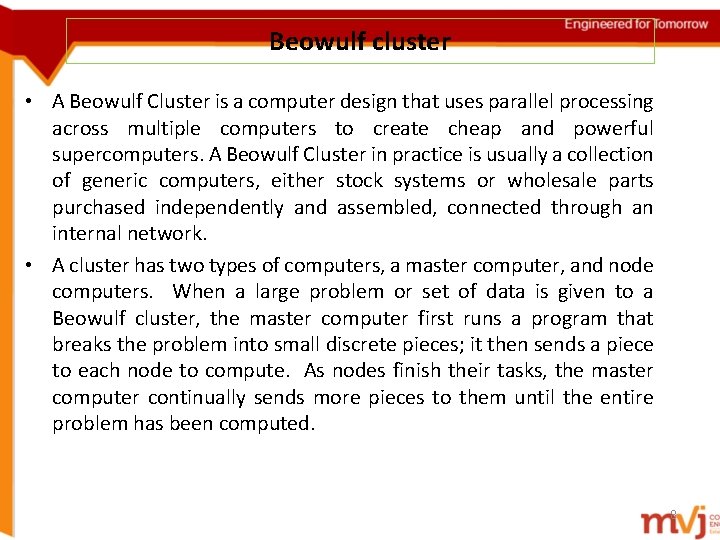
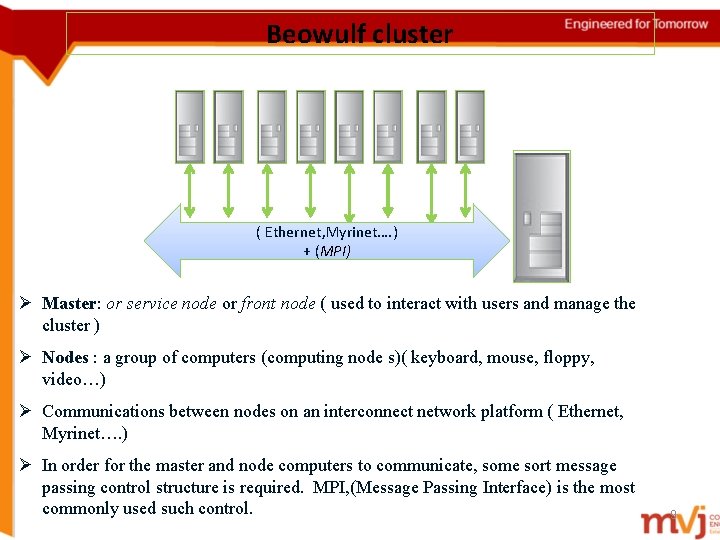
Beowulf cluster • A Beowulf Cluster is a computer design that uses parallel processing across multiple computers to create cheap and powerful supercomputers. A Beowulf Cluster in practice is usually a collection of generic computers, either stock systems or wholesale parts purchased independently and assembled, connected through an internal network. • A cluster has two types of computers, a master computer, and node computers. When a large problem or set of data is given to a Beowulf cluster, the master computer first runs a program that breaks the problem into small discrete pieces; it then sends a piece to each node to compute. As nodes finish their tasks, the master computer continually sends more pieces to them until the entire problem has been computed. 8
Beowulf cluster ( Ethernet, Myrinet…. ) + (MPI) Ø Master: or service node or front node ( used to interact with users and manage the cluster ) Ø Nodes : a group of computers (computing node s)( keyboard, mouse, floppy, video…) Ø Communications between nodes on an interconnect network platform ( Ethernet, Myrinet…. ) Ø In order for the master and node computers to communicate, some sort message passing control structure is required. MPI, (Message Passing Interface) is the most commonly used such control. 9
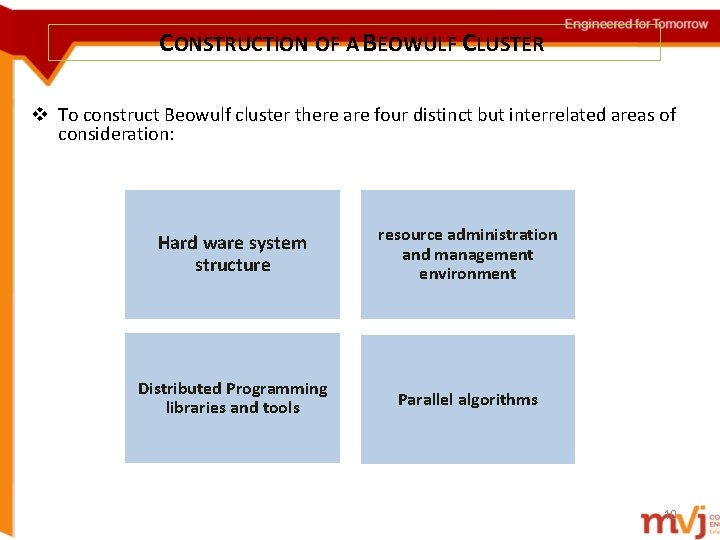
CONSTRUCTION OF A BEOWULF CLUSTER v To construct Beowulf cluster there are four distinct but interrelated areas of consideration: Hard ware system structure resource administration and management environment Distributed Programming libraries and tools Parallel algorithms 10
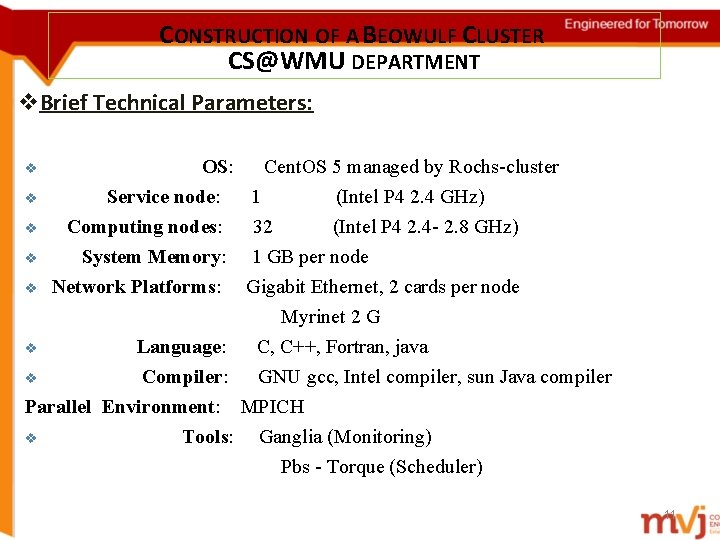
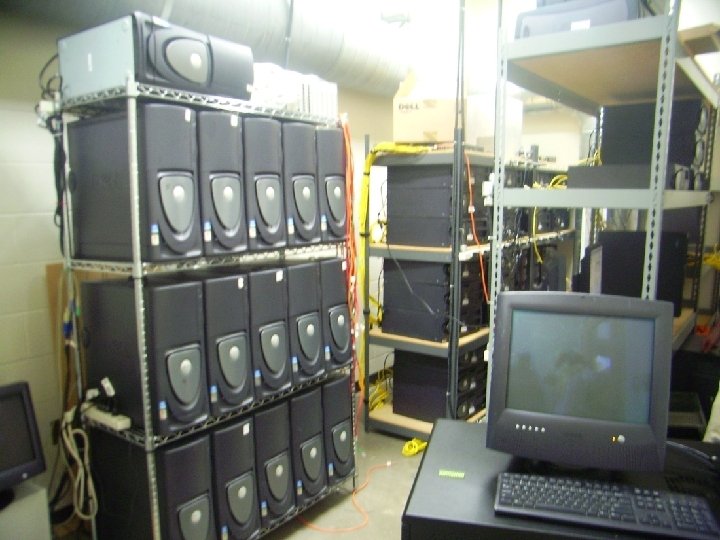
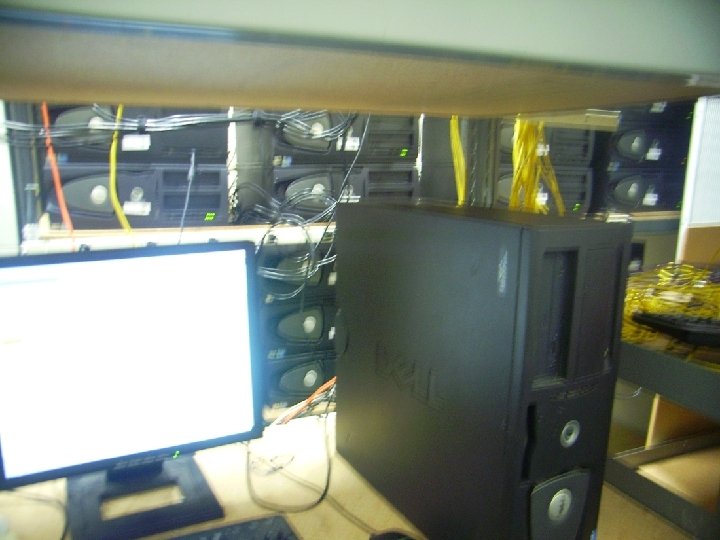
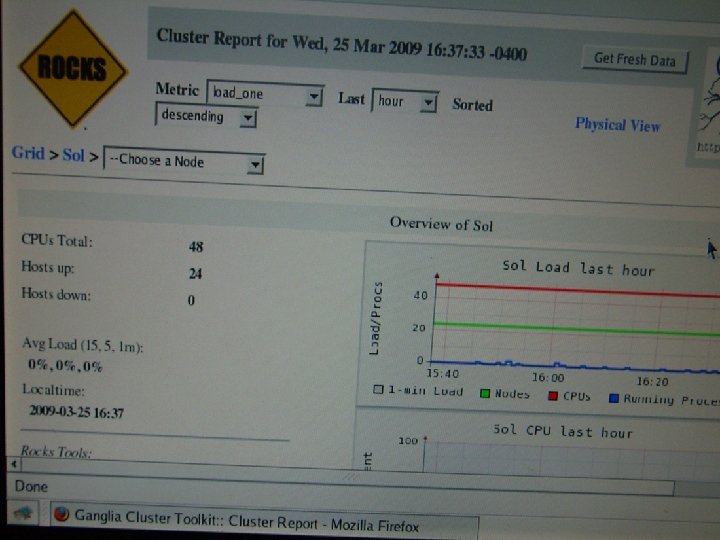
CONSTRUCTION OF A BEOWULF CLUSTER CS@WMU DEPARTMENT v. Brief Technical Parameters: v v v OS: Service node: Computing nodes: System Memory: Network Platforms: Language: v Compiler: Parallel Environment: v Tools: v Cent. OS 5 managed by Rochs-cluster 1 (Intel P 4 2. 4 GHz) 32 (Intel P 4 2. 4 - 2. 8 GHz) 1 GB per node Gigabit Ethernet, 2 cards per node Myrinet 2 G C, C++, Fortran, java GNU gcc, Intel compiler, sun Java compiler MPICH Ganglia (Monitoring) Pbs - Torque (Scheduler) 11
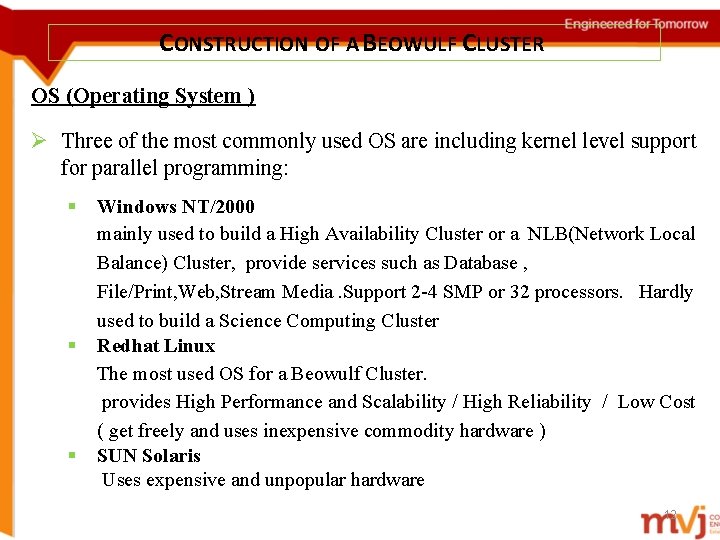
CONSTRUCTION OF A BEOWULF CLUSTER OS (Operating System ) Ø Three of the most commonly used OS are including kernel level support for parallel programming: § § § Windows NT/2000 mainly used to build a High Availability Cluster or a NLB(Network Local Balance) Cluster, provide services such as Database , File/Print, Web, Stream Media. Support 2 -4 SMP or 32 processors. Hardly used to build a Science Computing Cluster Redhat Linux The most used OS for a Beowulf Cluster. provides High Performance and Scalability / High Reliability / Low Cost ( get freely and uses inexpensive commodity hardware ) SUN Solaris Uses expensive and unpopular hardware 12
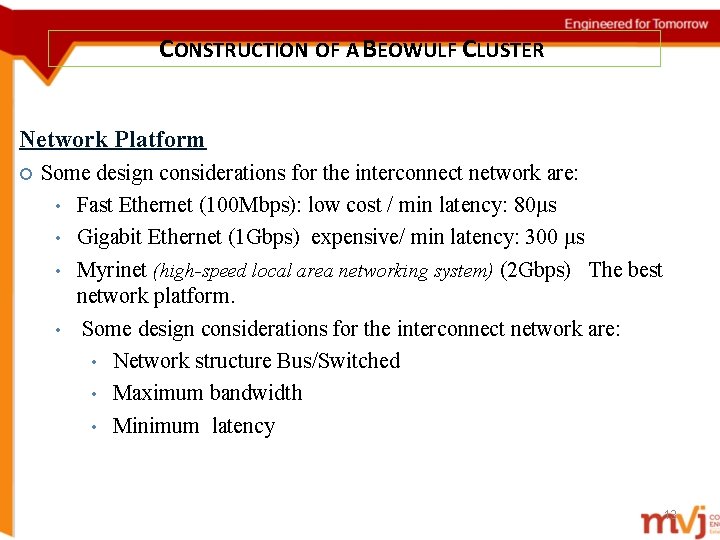
CONSTRUCTION OF A BEOWULF CLUSTER Network Platform Some design considerations for the interconnect network are: • Fast Ethernet (100 Mbps): low cost / min latency: 80µs • Gigabit Ethernet (1 Gbps) expensive/ min latency: 300 µs • Myrinet (high-speed local area networking system) (2 Gbps) The best network platform. • Some design considerations for the interconnect network are: • Network structure Bus/Switched • Maximum bandwidth • Minimum latency 13
Parallel Environment Ø Two of the most commonly used Parallel Interface Libraries: o PVM (Parallel Virtual Machine) o MPI (Message Passing Interface) Ø Parallel Interface Libraries: provide a group of communication interface libraries that support message passing. Users can call these libraries directly in their Fortran and C programs. Cluster Computer Architecture 14
15
16
17
18
19
Beowulf Systems for … • HPC platform for scientific applications • Storage and processing of large data – Satellites image processing – Information Retrieval, Data Mining • Computing systems in an academic environment • Geologists also use clusters to emulate and predict earthquakes and model the interior of the Earth and sea floor • clusters are even used to render and manipulate high-resolution graphics in 20
THE USE OF CLUSTER COMPUTING INBIOINFORMATICS • What is Bioinformatics: – Also called “biomedical computing”. The application of computer science and technology to problems in the biomolecular sciences. • Cluster Uses: – The Beowulf cluster computing design is been used by parallel processing computer systems projects to build a powerful computer that could assist in Bioinformatics research and data analysis. – In bioinformatics Clusters are used to run DNA string matching algorithms or to run protein folding applications. It also use a computer 21
THE USE OF CLUSTER COMPUTING INBIOINFORMATICS • For Bioinfomatics MPICH 2 is used which is an implementation of MPI that was specifically designed for use with cluster computing systems and parallel processing. It is an open source set of libraries for various high level programming languages that give programmers tools to easily control how large problems are broken apart and distributed to the various computers in a cluster. 22
Folding@Home Project • Protein folding and how is folding linked to disease? – Proteins are biology's workhorses -- its "nanomachines. " Before proteins can carry out these important functions, they assemble themselves, or "fold. " The process of protein folding, while critical and fundamental to virtually all of biology, in many ways remains a mystery. – when proteins do not fold correctly: • Alzheimer's, Mad Cow • How? – Folding@home is a distributed computing project -- people from throughout the world download and run software to band together to make one of the largest supercomputers in the world. In each computer Folding@home uses novel computational methods coupled to distributed computing, to simulate problems. – the results get back to the main server as you computer will automatically upload the results to the server each time it finishes a work unit, and download a new job at that time. 23
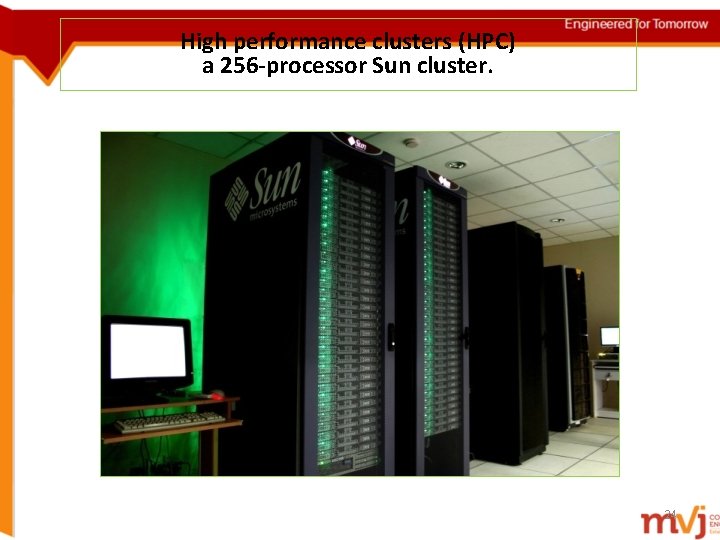
High performance clusters (HPC) a 256 -processor Sun cluster. 24
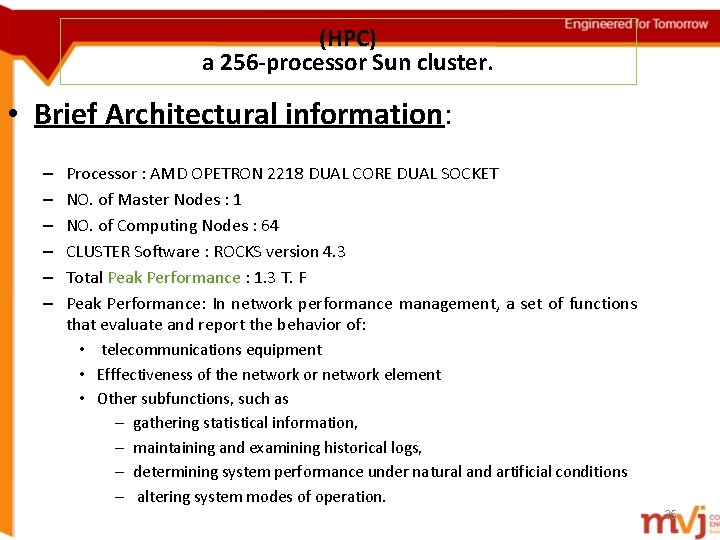
(HPC) a 256 -processor Sun cluster. • Brief Architectural information: – – – Processor : AMD OPETRON 2218 DUAL CORE DUAL SOCKET NO. of Master Nodes : 1 NO. of Computing Nodes : 64 CLUSTER Software : ROCKS version 4. 3 Total Peak Performance : 1. 3 T. F Peak Performance: In network performance management, a set of functions that evaluate and report the behavior of: • telecommunications equipment • Efffectiveness of the network or network element • Other subfunctions, such as – gathering statistical information, – maintaining and examining historical logs, – determining system performance under natural and artificial conditions – altering system modes of operation. 25
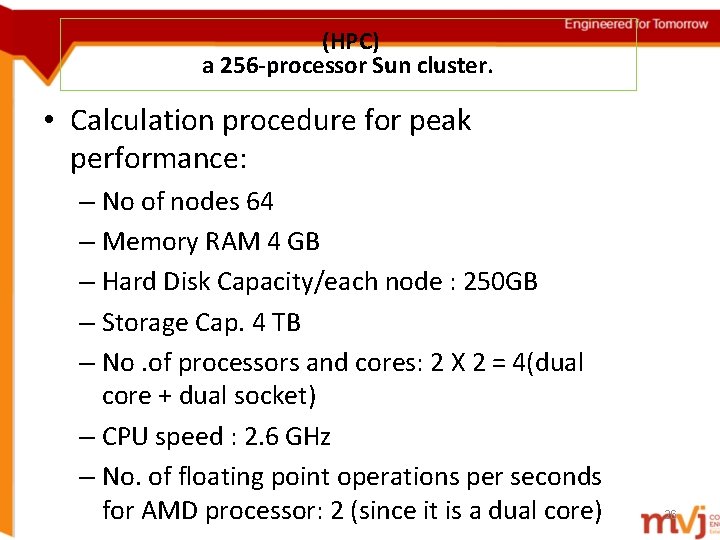
(HPC) a 256 -processor Sun cluster. • Calculation procedure for peak performance: – No of nodes 64 – Memory RAM 4 GB – Hard Disk Capacity/each node : 250 GB – Storage Cap. 4 TB – No. of processors and cores: 2 X 2 = 4(dual core + dual socket) – CPU speed : 2. 6 GHz – No. of floating point operations per seconds for AMD processor: 2 (since it is a dual core) 26
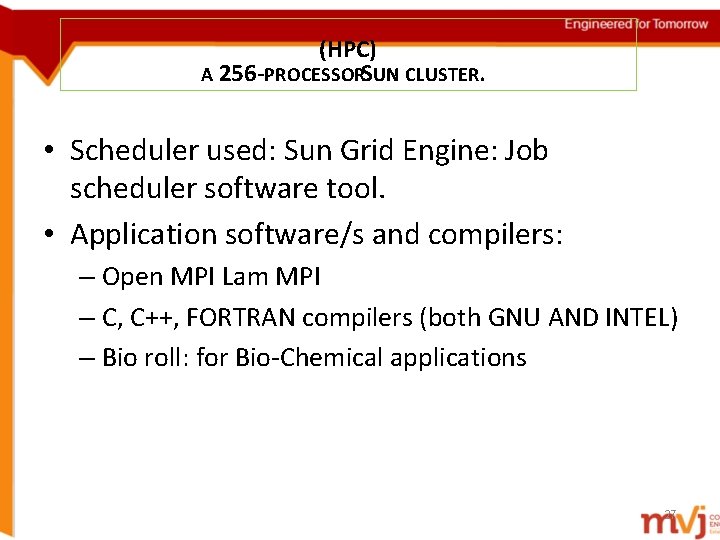
(HPC) A 256 -PROCESSORSUN CLUSTER. • Scheduler used: Sun Grid Engine: Job scheduler software tool. • Application software/s and compilers: – Open MPI Lam MPI – C, C++, FORTRAN compilers (both GNU AND INTEL) – Bio roll: for Bio-Chemical applications 27
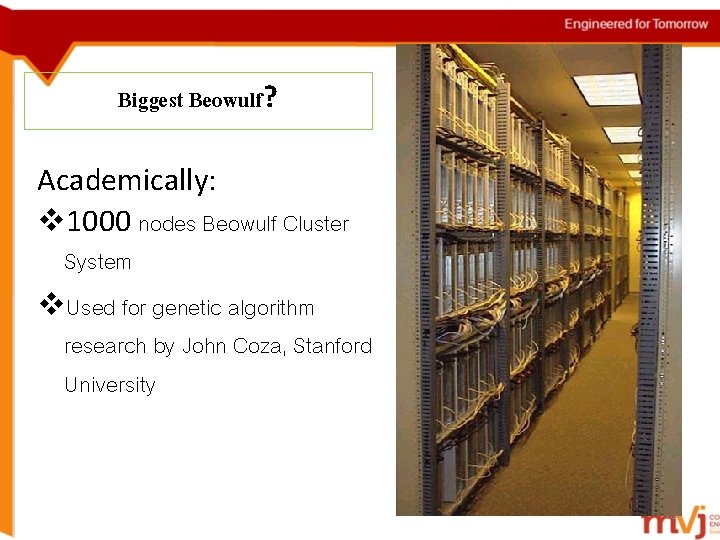
Biggest Beowulf? Academically: v 1000 nodes Beowulf Cluster System v. Used for genetic algorithm research by John Coza, Stanford University 28
Build Your Own Cluster! • http: //www. pssclabs. com/products_power wulf. asp 29
Q & A presentation (2) Ø Parallel Environments are used in building clusters? Ø Two of the most commonly used Parallel Interface Libraries: Ø PVM (Parallel Virtual Machine) Ø MPI (Message passing Interface) Ø Why MPI over PVM? 1. MPI has more than one freely available, quality implementation (LAM, MPICH and CHIMP). 2. MPI defines a 3 rd party profiling mechanism. 3. MPI has full asynchronous communication. 4. MPI groups are solid, efficient, and deterministic. 5. MPI efficiently manages message buffers. 6. MPI synchronization protects 3 rd party software. 7. MPI can efficiently program MPP and clusters. 8. MPI is totally portable. 9. MPI is formally specified. 10. MPI is a standard, can be implemented with Linux, NT, on many supercomputers 30
References • WMU e-books library: – Beowulf Cluster Computing with Windows: Thomas Sterling, ISBN: 9780262692755. • Construction of a Beowulf Cluster System for Parallel Computing Kun Feng, Jiaqi Dong, Jinhua Zhang • http: //cs. wmich. edu/ • http: //www. wikipedia. org/ • http: //folding. stanford. edu/ 31