
Parallel and Distributed Systems in Machine Learning Haichuan
Parallel and Distributed Systems in Machine Learning Haichuan Yang
Outline • Background: Machine Learning • Data Parallelism • Model Parallelism • Examples • Future Trends
Background: Machine Learning • Machine learning is a field of computer science that uses statistical techniques to give computer systems the ability to "learn”. (From Wikipedia) • Simply can be understand as the program that: “magic” function • Feed in historical <data, label> pairs (training set); • After some computation (training), it can provide a model that: • Takes a new data item without label, predict its corresponding label (inference).
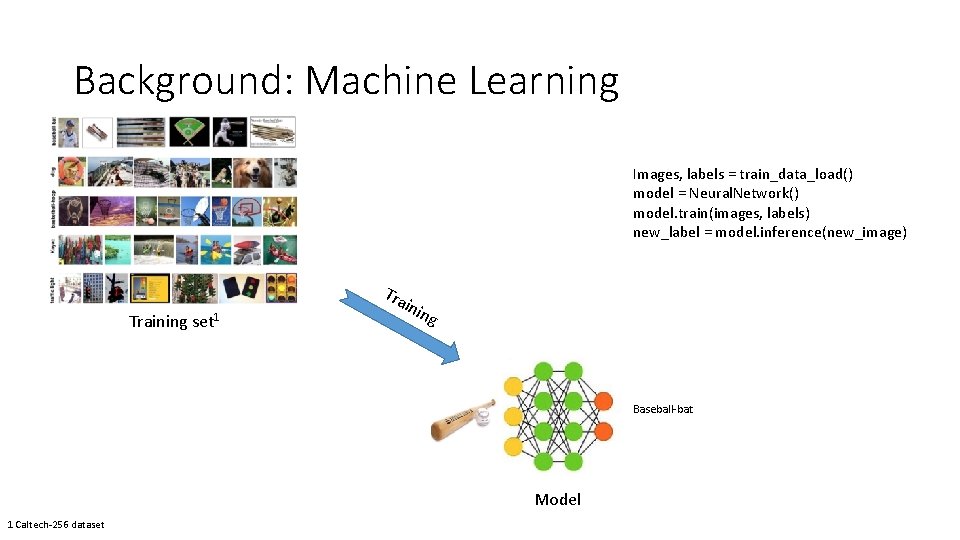
Background: Machine Learning Images, labels = train_data_load() model = Neural. Network() model. train(images, labels) new_label = model. inference(new_image) Training set 1 Tra inin g Baseball-bat Model 1 Caltech-256 dataset
Background: Machine Learning • Problem: training process is usually time consuming, especially when training set / model size is large. What parallel and distributed systems are good at!
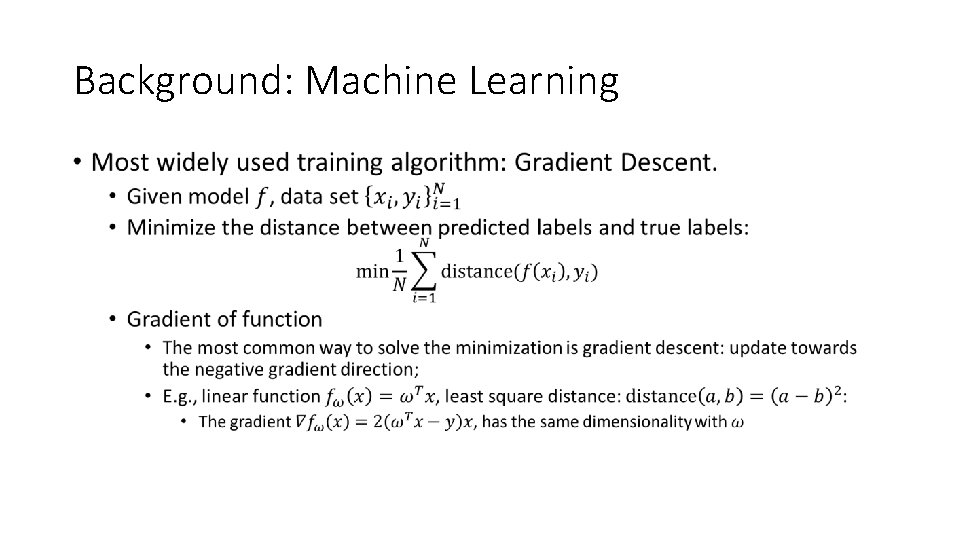
Background: Machine Learning •
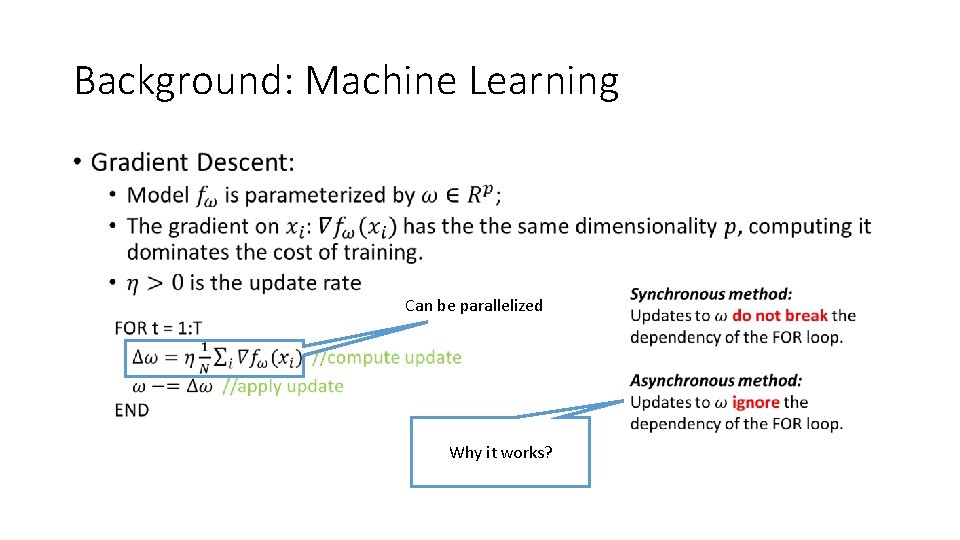
Background: Machine Learning • Can be parallelized Why it works?
Outline • Background: Machine Learning • Data Parallelism • Model Parallelism • Examples • Future Trends
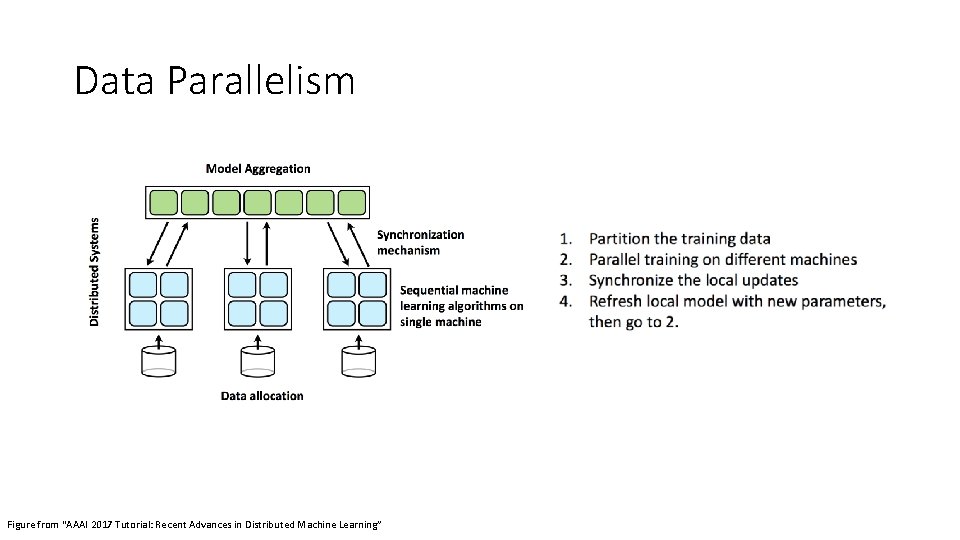
Data Parallelism Figure from “AAAI 2017 Tutorial: Recent Advances in Distributed Machine Learning”
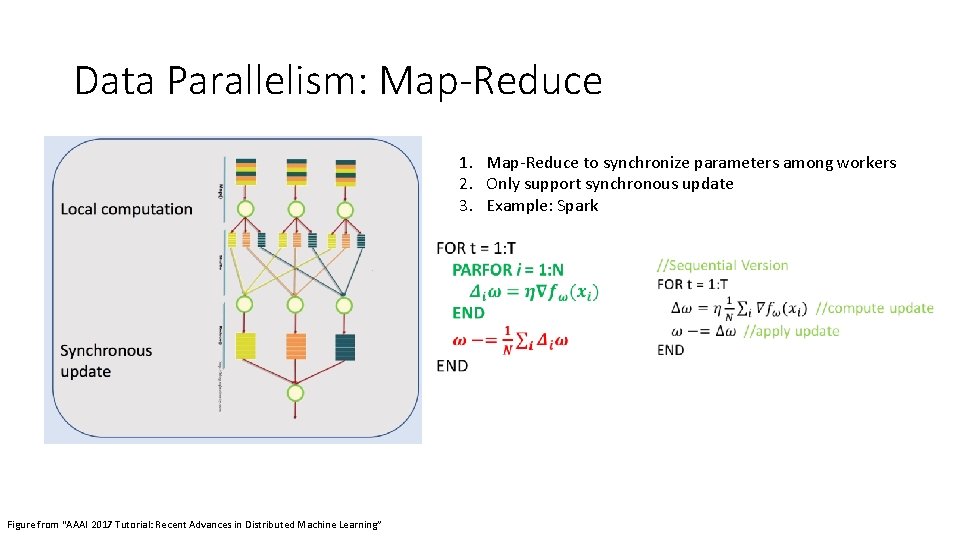
Data Parallelism: Map-Reduce 1. Map-Reduce to synchronize parameters among workers 2. Only support synchronous update 3. Example: Spark Figure from “AAAI 2017 Tutorial: Recent Advances in Distributed Machine Learning”
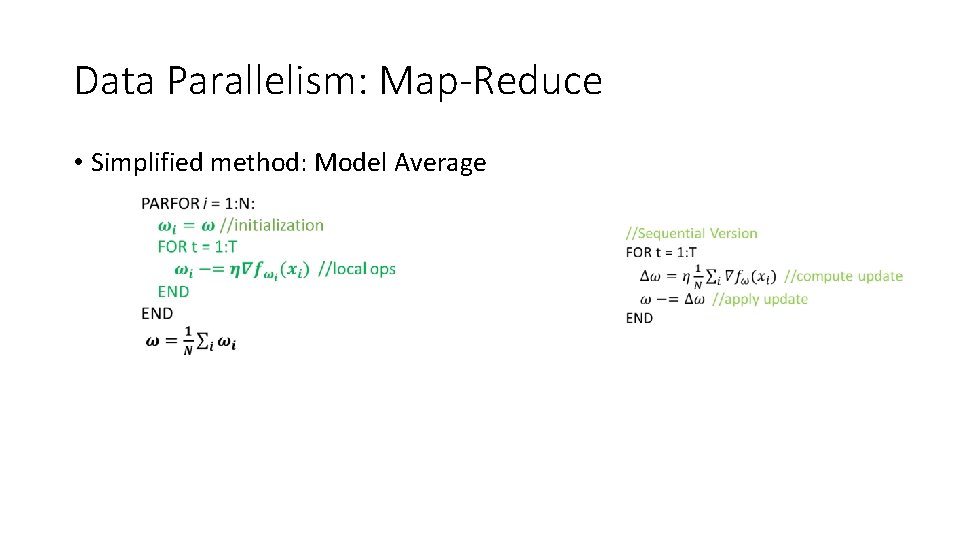
Data Parallelism: Map-Reduce • Simplified method: Model Average
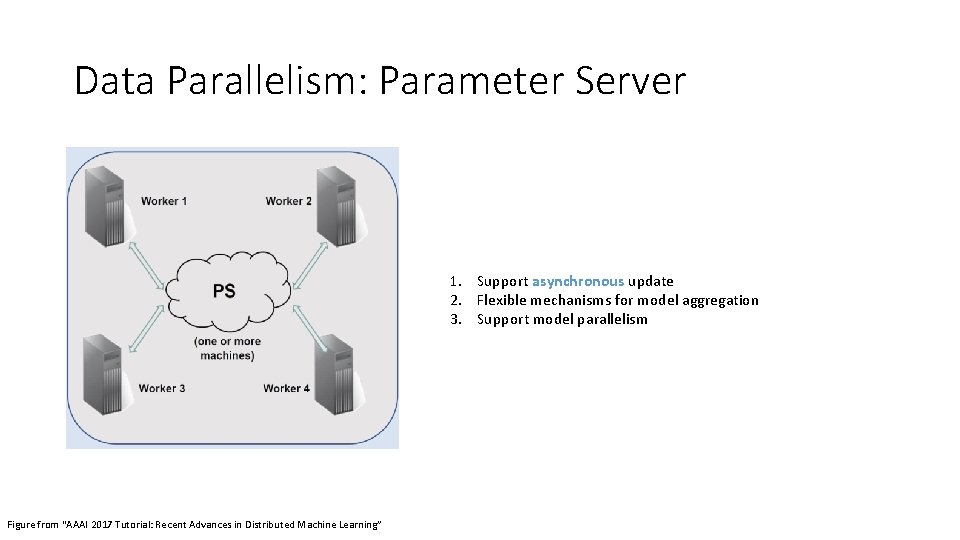
Data Parallelism: Parameter Server 1. Support asynchronous update 2. Flexible mechanisms for model aggregation 3. Support model parallelism Figure from “AAAI 2017 Tutorial: Recent Advances in Distributed Machine Learning”
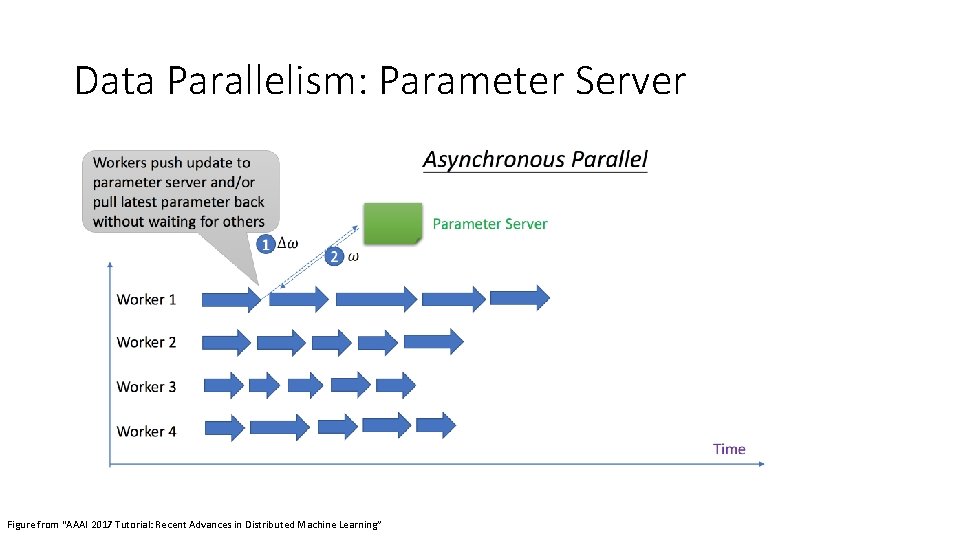
Data Parallelism: Parameter Server Figure from “AAAI 2017 Tutorial: Recent Advances in Distributed Machine Learning”
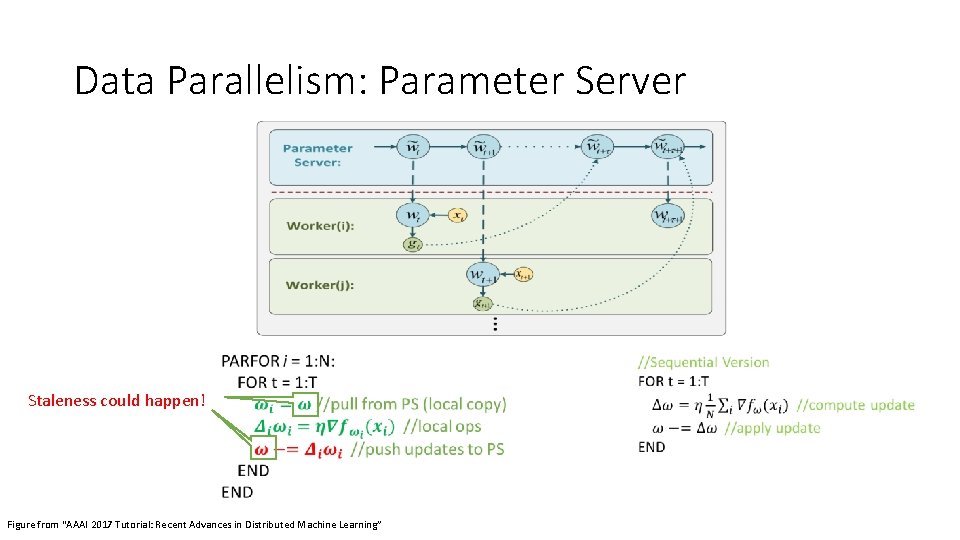
Data Parallelism: Parameter Server Staleness could happen! Figure from “AAAI 2017 Tutorial: Recent Advances in Distributed Machine Learning”
Outline • Background: Machine Learning • Data Parallelism • Model Parallelism • Examples • Future Trends

Model Parallelism •
Model Parallelism • Synchronous model parallelization • High communication cost • always need the most fresh intermediate data • Sensitive to communication delay & machine failure • Low efficient when machines have different speed
Model Parallelism • Asynchronous model slicing • Intermediate data from other machine are cached locally; • Periodically update the cached data;
Model Parallelism • Cons of the asynchronous method: • Cache contains stale information, which hurt the accuracy of updates • When we allow the stale information? • If the update is very small (in magnitude) • Strategy: Model block scheduling • Synchronize the parameters in different frequency, based on the magnitude of update
Outline • Background: Machine Learning • Data Parallelism • Model Parallelism • Examples • Future Trends
Examples • Map. Reduce – Spark Mllib • Machine learning library in Spark • Provide implemented algorithms in classification, regression, recommendation, clustering, etc. • Simple interface • Only support synchronous method • Only support data parallelism
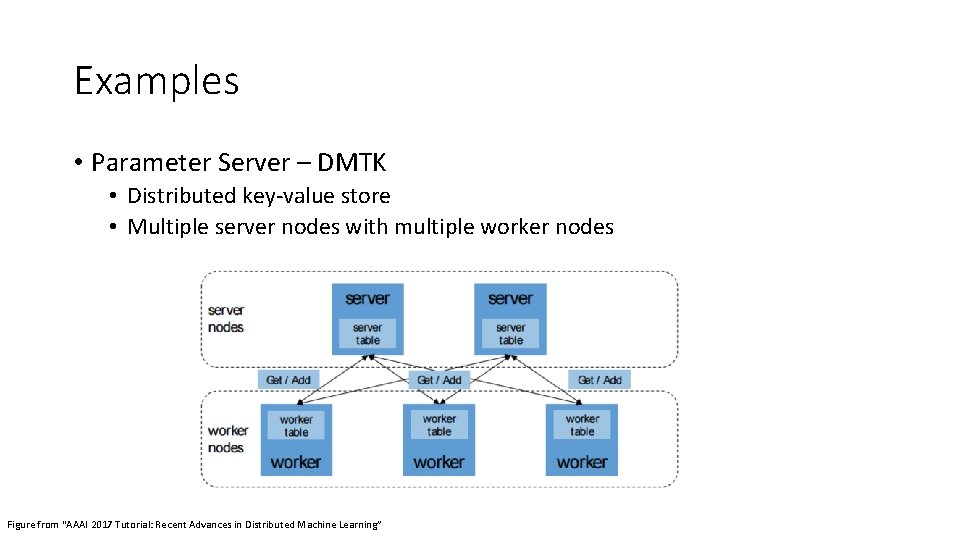
Examples • Parameter Server – DMTK • Distributed key-value store • Multiple server nodes with multiple worker nodes Figure from “AAAI 2017 Tutorial: Recent Advances in Distributed Machine Learning”
Examples • Data Flow – Tensor. Flow • • Use graph to represent math ops and data flow; Support different hardwares, e. g. cpu, gpu; Support data and model parallelism; Auto differential tool
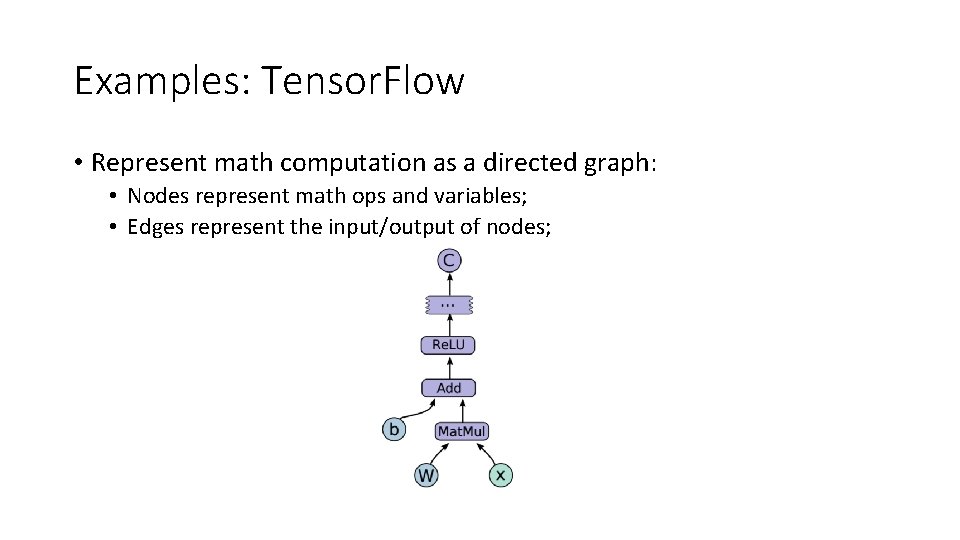
Examples: Tensor. Flow • Represent math computation as a directed graph: • Nodes represent math ops and variables; • Edges represent the input/output of nodes;
Examples: Tensor. Flow • Node placement • Manually assign to devices • Done by programmer • Automatically assignment • Simulation based on cost estimation (computation, communication) • Start with source node, assign each node to the device which can finish fastest
Outline • Background: Machine Learning • Data Parallelism • Model Parallelism • Examples • Future Trends
Future Trends • Flexibility • Friendly to programmer/data scientist; • Extension to very customized task; • Efficiency • Optimization to specified task/framework; • Consistent/optimal efficiency to different customized task; • Accuracy • Different to traditional deterministic computation task; • The relation between accuracy and complexity (computation, communication, energy consumption, etc. )
Reference • Tie-Yan Liu, Wei Chen, Taifeng Wang. Recent Advances in Distributed Machine Learning, AAAI 2017 Tutorial. • Lian X, Huang Y, Liu J. Asynchronous parallel stochastic gradient for nonconvex optimization. In Advances in Neural Information Processing Systems 2015 (pp. 2737 -2745). • Abadi M, Barham P, Chen J, Chen Z, Davis A, Dean J, Devin M, Ghemawat S, Irving G, Isard M, Kudlur M. Tensor. Flow: A System for Large-Scale Machine Learning. In. OSDI 2016 Nov 2 (Vol. 16, pp. 265 -283).
- Slides: 28