
Parallel Algorithms Lecture Notes Motivation Programs face two

- Slides: 20
Parallel Algorithms Lecture Notes
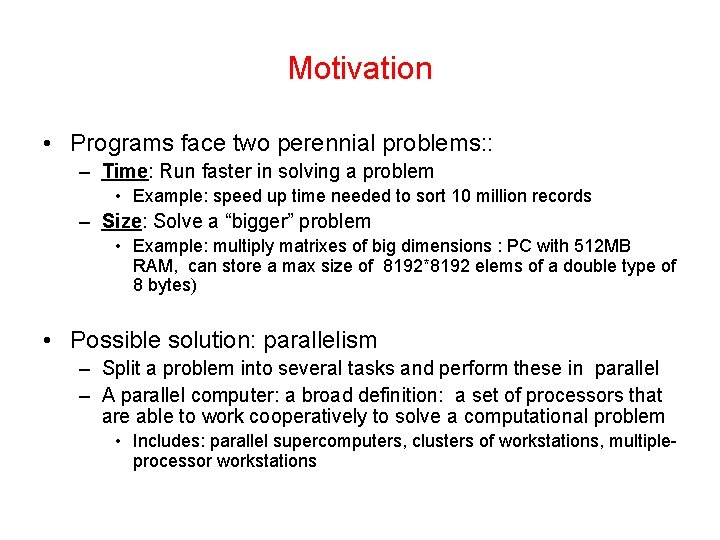
Motivation • Programs face two perennial problems: : – Time: Run faster in solving a problem • Example: speed up time needed to sort 10 million records – Size: Solve a “bigger” problem • Example: multiply matrixes of big dimensions : PC with 512 MB RAM, can store a max size of 8192*8192 elems of a double type of 8 bytes) • Possible solution: parallelism – Split a problem into several tasks and perform these in parallel – A parallel computer: a broad definition: a set of processors that are able to work cooperatively to solve a computational problem • Includes: parallel supercomputers, clusters of workstations, multipleprocessor workstations
Concepts …
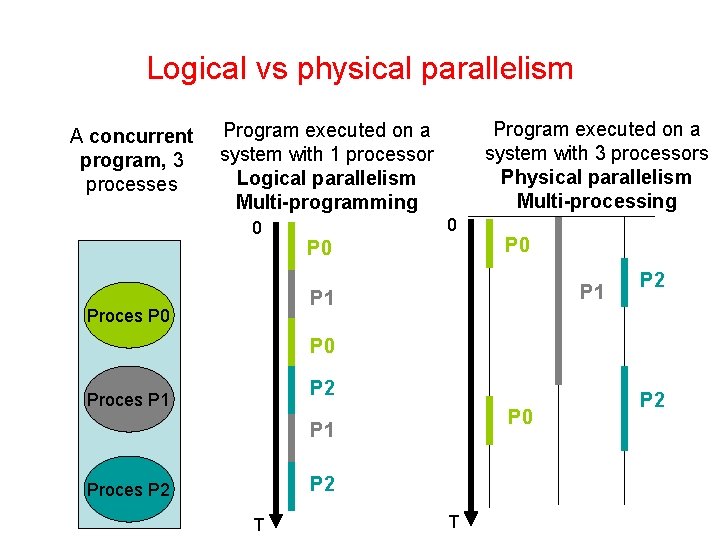
Logical vs physical parallelism A concurrent program, 3 processes Program executed on a system with 3 processors Physical parallelism Multi-processing Program executed on a system with 1 processor Logical parallelism Multi-programming 0 0 P 0 P 1 Proces P 0 P 2 Proces P 1 P 0 P 1 P 2 Proces P 2 T T P 2
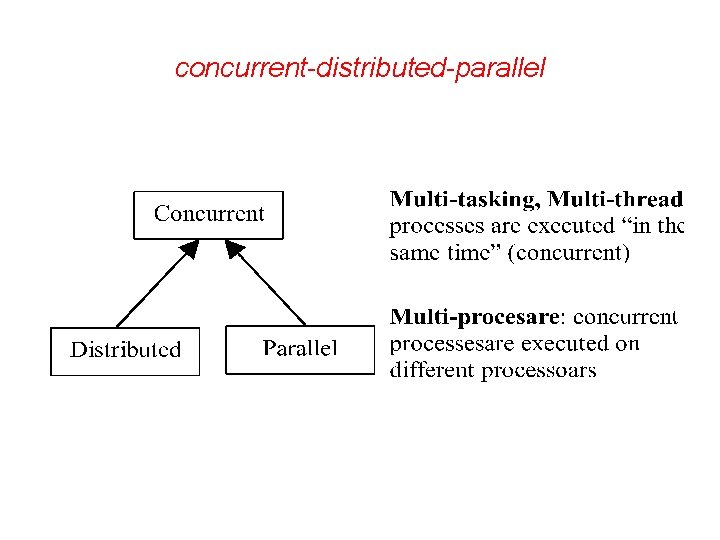
concurrent-distributed-parallel
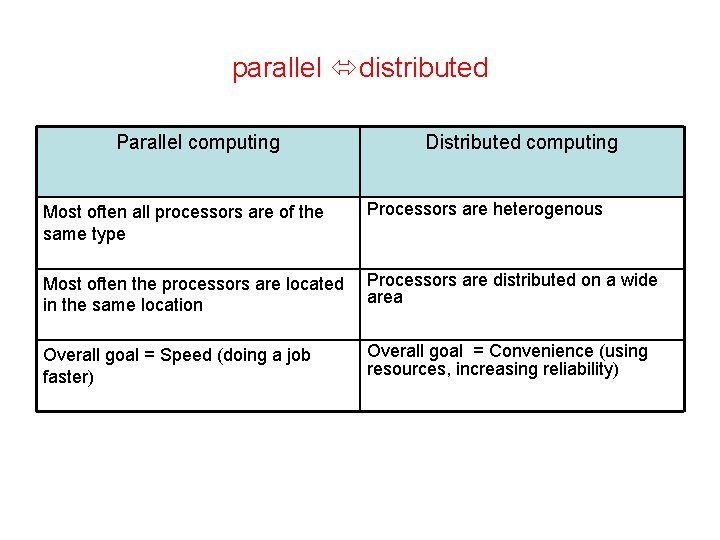
parallel distributed Parallel computing Distributed computing Most often all processors are of the same type Processors are heterogenous Most often the processors are located in the same location Processors are distributed on a wide area Overall goal = Speed (doing a job faster) Overall goal = Convenience (using resources, increasing reliability)
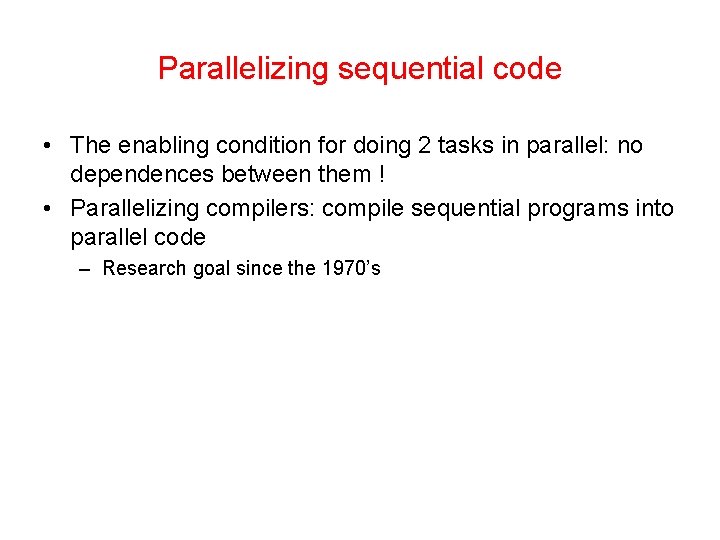
Parallelizing sequential code • The enabling condition for doing 2 tasks in parallel: no dependences between them ! • Parallelizing compilers: compile sequential programs into parallel code – Research goal since the 1970’s
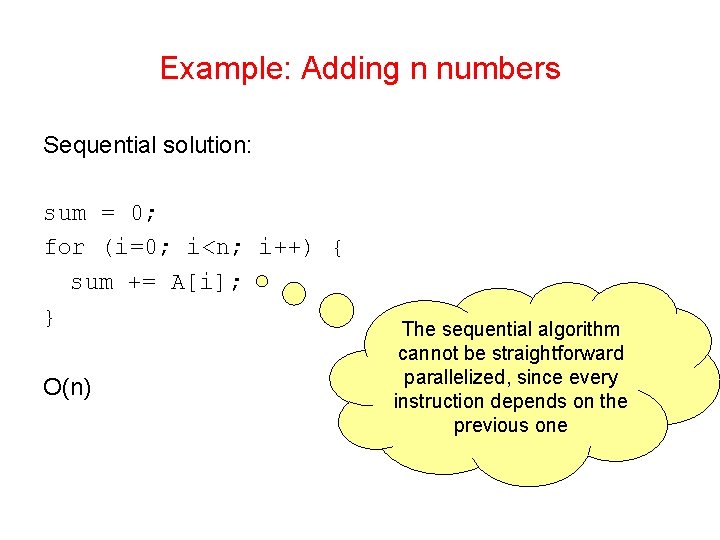
Example: Adding n numbers Sequential solution: sum = 0; for (i=0; i<n; i++) { sum += A[i]; } O(n) The sequential algorithm cannot be straightforward parallelized, since every instruction depends on the previous one
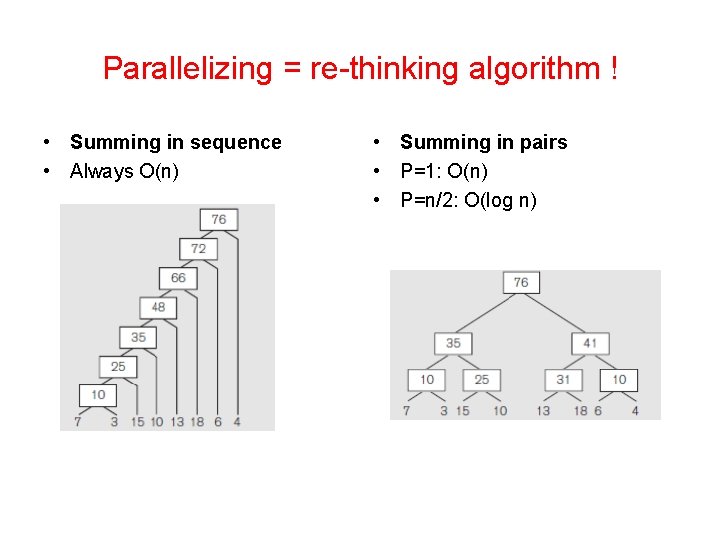
Parallelizing = re-thinking algorithm ! • Summing in sequence • Always O(n) • Summing in pairs • P=1: O(n) • P=n/2: O(log n)
• It’s not likely a compiler will produce a good parallel code from a sequential specification any time soon… • Fact: For most computations, a “best” sequential solution (practically, not theoretically) and a “best” parallel solution are usually fundamentally different … • Different solution paradigms imply computations are not “simply” related • Compiler transformations generally preserve the solution paradigm • Therefore the programmer must discover the parallel solution !!!
Sequential vs parallel programming • • • Has different costs, different advantages Requires different, unfamiliar algorithms Must use different abstractions More complex to understand a program’s behavior More difficult to control the interactions of the program’s components • Knowledge/tools/understanding more primitive
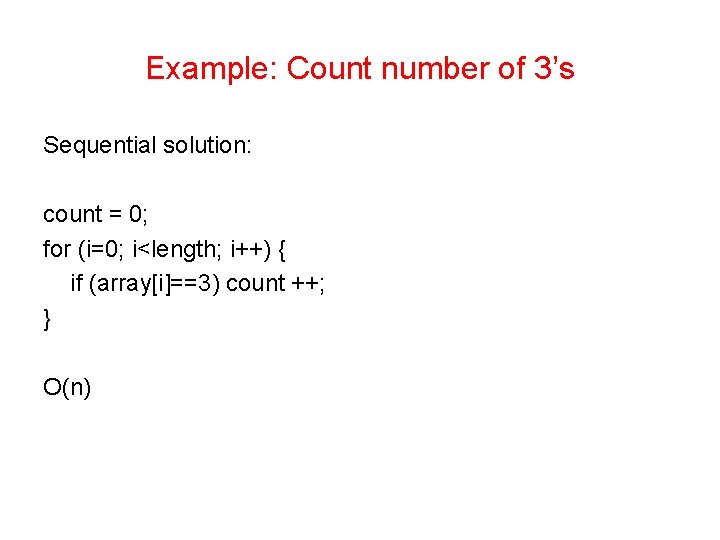
Example: Count number of 3’s Sequential solution: count = 0; for (i=0; i<length; i++) { if (array[i]==3) count ++; } O(n)
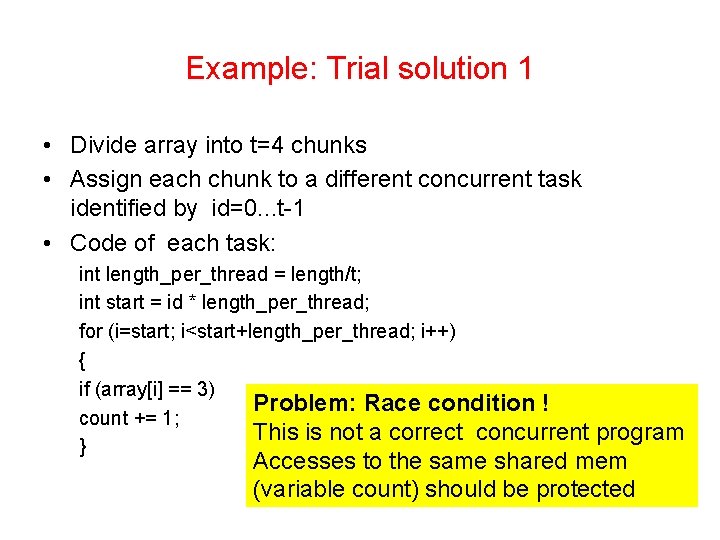
Example: Trial solution 1 • Divide array into t=4 chunks • Assign each chunk to a different concurrent task identified by id=0. . . t-1 • Code of each task: int length_per_thread = length/t; int start = id * length_per_thread; for (i=start; i<start+length_per_thread; i++) { if (array[i] == 3) Problem: Race condition ! count += 1; This is not a correct concurrent } program Accesses to the same shared mem (variable count) should be protected
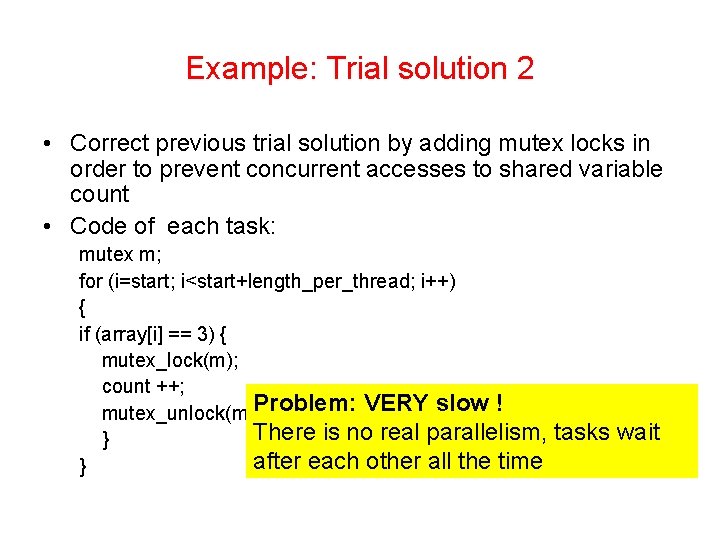
Example: Trial solution 2 • Correct previous trial solution by adding mutex locks in order to prevent concurrent accesses to shared variable count • Code of each task: mutex m; for (i=start; i<start+length_per_thread; i++) { if (array[i] == 3) { mutex_lock(m); count ++; mutex_unlock(m); Problem: VERY slow ! There is no real parallelism, } after each other all the time } tasks wait
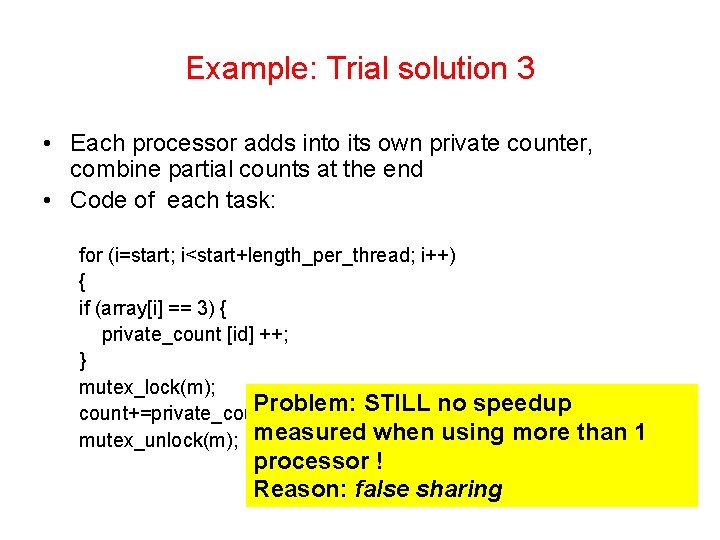
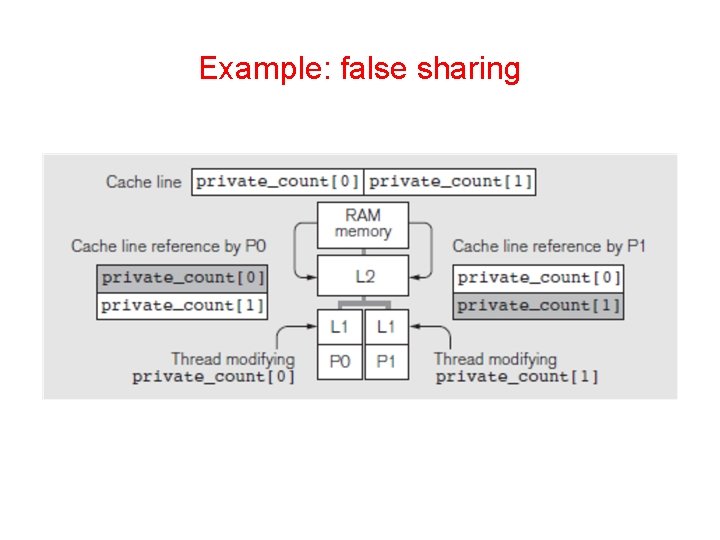
Example: Trial solution 3 • Each processor adds into its own private counter, combine partial counts at the end • Code of each task: for (i=start; i<start+length_per_thread; i++) { if (array[i] == 3) { private_count [id] ++; } mutex_lock(m); Problem: STILL no speedup count+=private_count[id]; mutex_unlock(m); measured when using more than processor ! Reason: false sharing 1
Example: false sharing
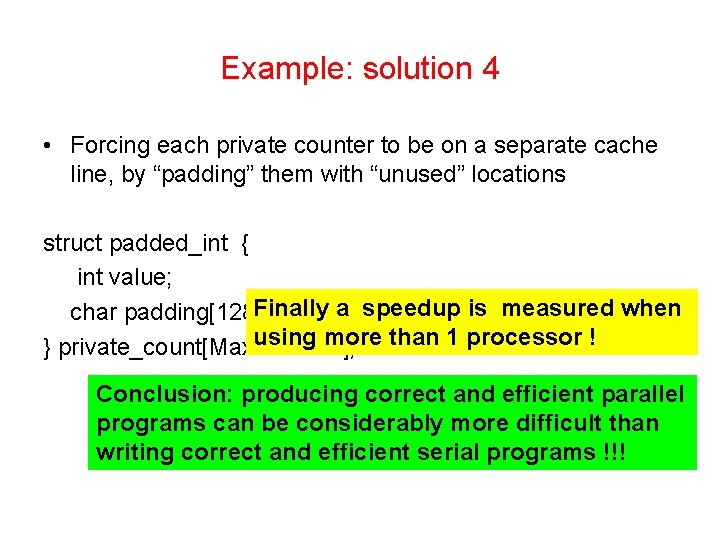
Example: solution 4 • Forcing each private counter to be on a separate cache line, by “padding” them with “unused” locations struct padded_int { int value; Finally a speedup is measured when char padding[128]; using more than 1 processor ! } private_count[Max. Threads]; Conclusion: producing correct and efficient parallel programs can be considerably more difficult than writing correct and efficient serial programs !!!
Sequential vs parallel programming • • • Has different costs, different advantages Requires different, unfamiliar algorithms Must use different abstractions More complex to understand a program’s behavior More difficult to control the interactions of the program’s components • Knowledge/tools/understanding more primitive
Goals of Parallel Programming • Performance: Parallel program runs faster than its sequential counterpart (a speedup is measured) • Scalability: as the size of the problem grows, more processors can be “usefully” added to solve the problem faster • Portability: The solutions run well on different parallel platforms