
Parallel Algorithms I 6 Pavel Krmer Dept of


- Slides: 42
Parallel Algorithms I / 6 Pavel Krömer, Dept. of Computer Science, VSB – Technical University of Ostrava
Agenda • Programming distributed memory systems • MPI and friends • Literature • Peter Pacheco, An Introduction to Parallel Programming, Elsevier, 2011 (Ch. 3) • Alexander Supalov, Inside the message passing interface, De. Gruyter
Distributed memory systems
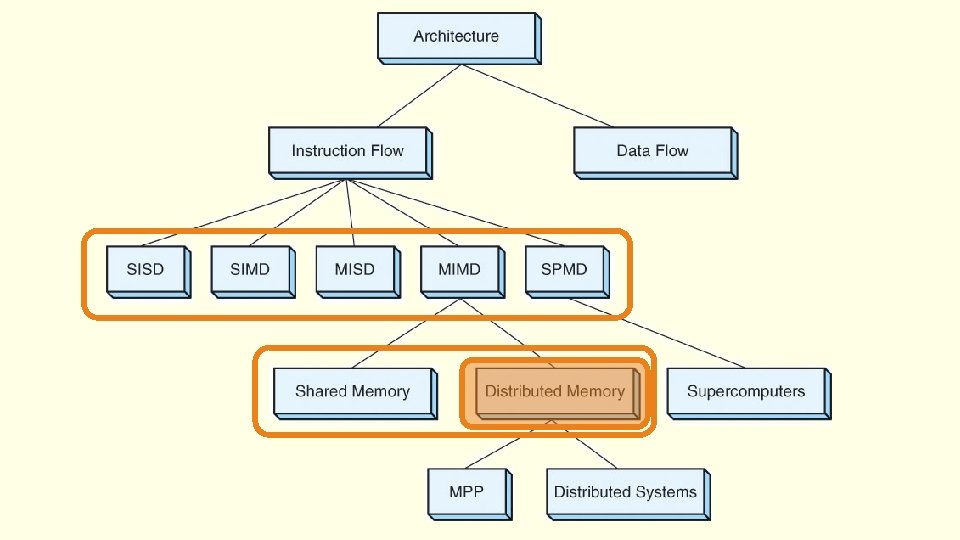
Programming Distributed Memory systems Need for a different model than shared memory systems • loosely coupled systems • no (physical) shared memory • communication/coordi nation by hand or using a framework/tool
Message Passing Interface A unified approach to the design and implementation of distributed applications • an industry standard, stewarded by the MPI Forum (over 40 organizations) • similar roles (different tools) as Open. MP for shared memory programming A standard of distributed applications (not only) for HPC • apps very often (but not exclusively) following the SPMD model • syntax and semantics of a standard set of library functions covering common communication scenarios • Interface and implementation de-coupled • Open-source vs. Commercial MPIs • Bindings) for C/C++, Fortran 77/95 • M(VA)PICH(2), LAM/MPI, Open. MPI
MPI: Main features Standardization • the only message passing library that can be considered a standard. It is supported on virtually all HPC platforms, has replaced all previous message passing libraries. Portability • Little or no need to modify your source code when you port your application to a different platform that supports (and is compliant with) the MPI standard. Performance Opportunities • Vendor implementations can exploit native hardware features to optimize performance. Any implementation is free to develop optimized algorithms. Functionality • over 430 routines defined in MPI-3 (superset of MPI-2 and MPI-1). Most MPI programs can be written using a dozen or less routines.
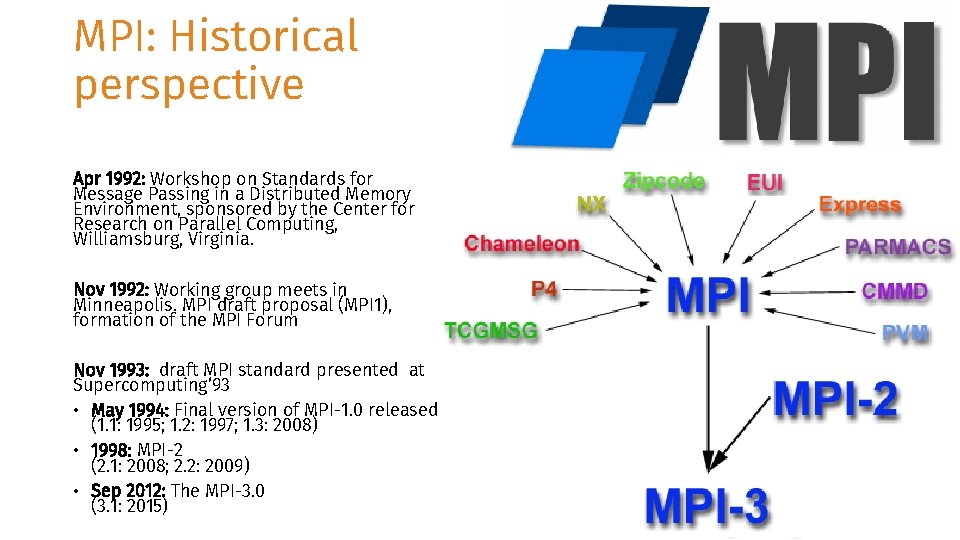
MPI: Historical perspective Apr 1992: Workshop on Standards for Message Passing in a Distributed Memory Environment, sponsored by the Center for Research on Parallel Computing, Williamsburg, Virginia. Nov 1992: Working group meets in Minneapolis. MPI draft proposal (MPI 1), formation of the MPI Forum Nov 1993: draft MPI standard presented at Supercomputing’ 93 • May 1994: Final version of MPI-1. 0 released (1. 1: 1995; 1. 2: 1997; 1. 3: 2008) • 1998: MPI-2 (2. 1: 2008; 2. 2: 2009) • Sep 2012: The MPI-3. 0 (3. 1: 2015)
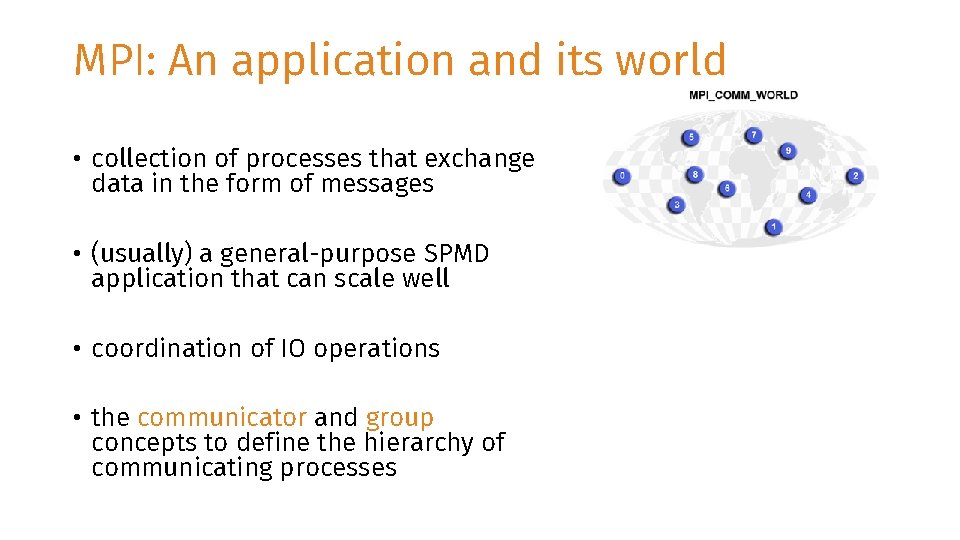
MPI: An application and its world • collection of processes that exchange data in the form of messages • (usually) a general-purpose SPMD application that can scale well • coordination of IO operations • the communicator and group concepts to define the hierarchy of communicating processes
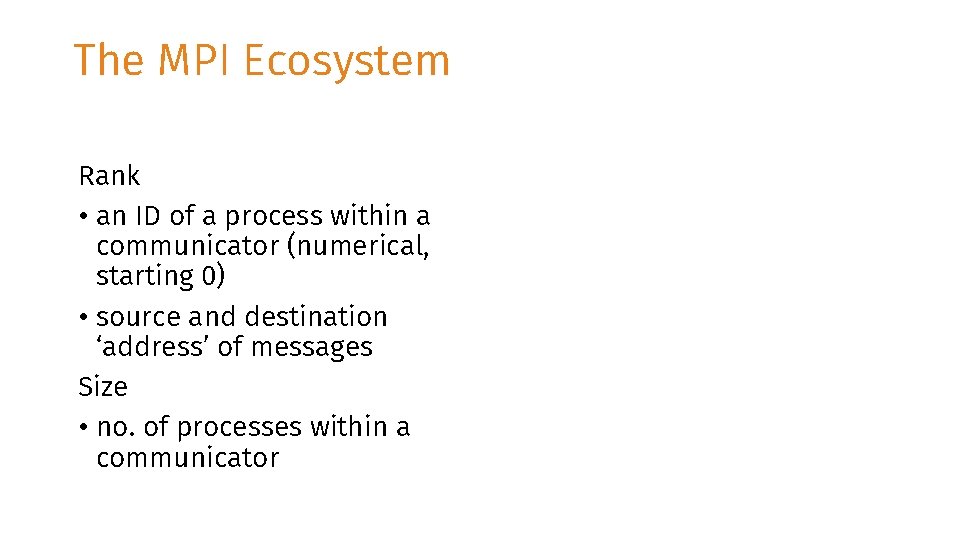
The MPI Ecosystem Rank • an ID of a process within a communicator (numerical, starting 0) • source and destination ‘address’ of messages Size • no. of processes within a communicator
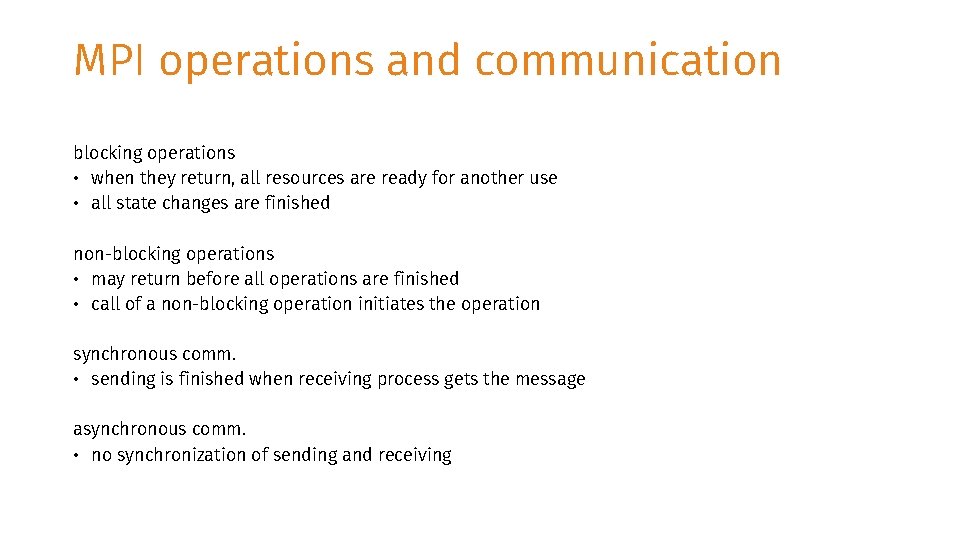
MPI operations and communication blocking operations • when they return, all resources are ready for another use • all state changes are finished non-blocking operations • may return before all operations are finished • call of a non-blocking operation initiates the operation synchronous comm. • sending is finished when receiving process gets the message asynchronous comm. • no synchronization of sending and receiving
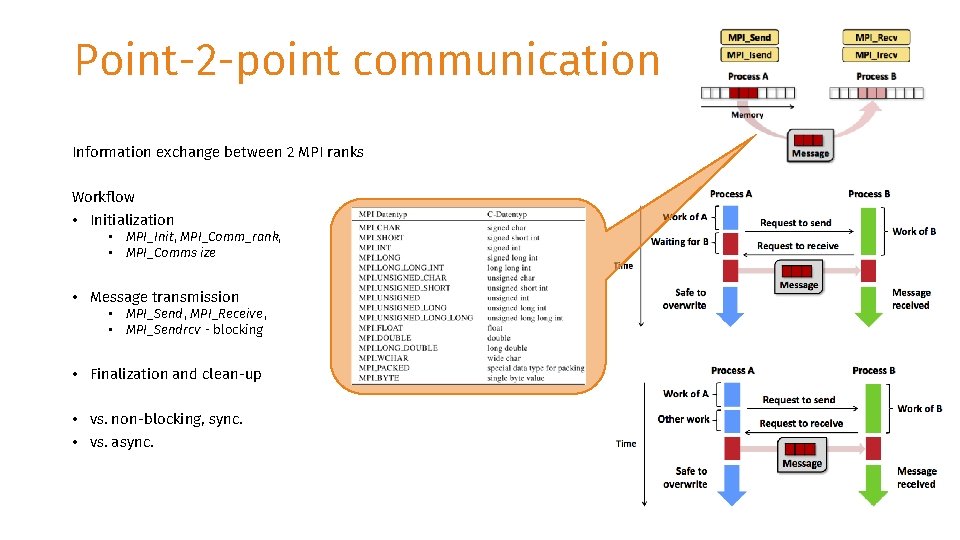
Point-2 -point communication Information exchange between 2 MPI ranks Workflow • Initialization • MPI_Init, MPI_Comm_rank, • MPI_Comms ize • Message transmission • MPI_Send, MPI_Receive , • MPI_Sendrcv - blocking • Finalization and clean-up • vs. non-blocking, sync. • vs. async.
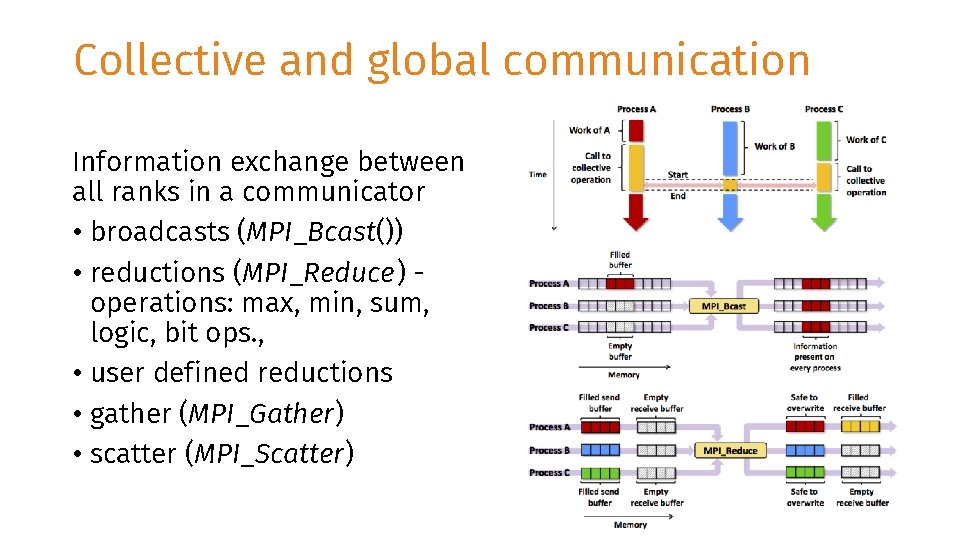
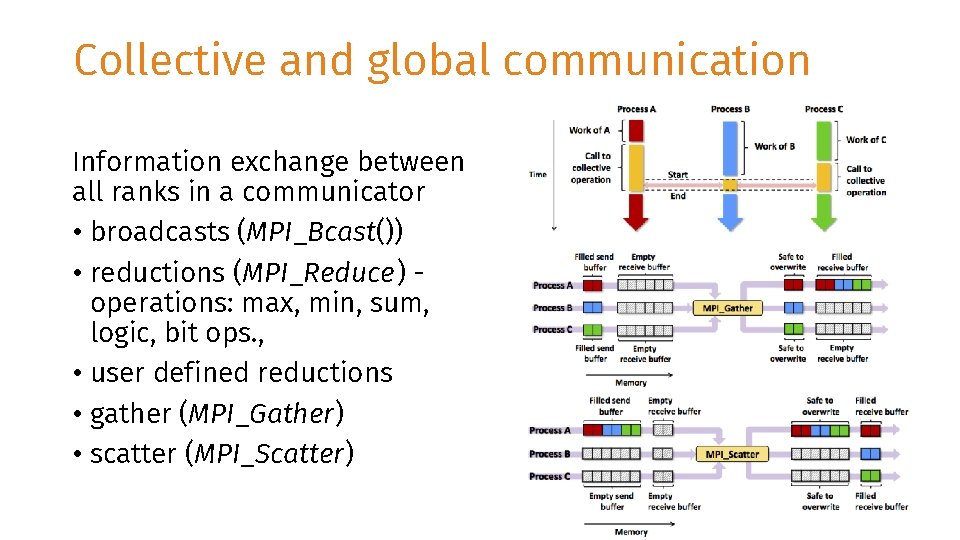
Collective and global communication Information exchange between all ranks in a communicator • broadcasts (MPI_Bcast()) • reductions (MPI_Reduce) operations: max, min, sum, logic, bit ops. , • user defined reductions • gather (MPI_Gather) • scatter (MPI_Scatter)
Collective and global communication Information exchange between all ranks in a communicator • broadcasts (MPI_Bcast()) • reductions (MPI_Reduce) operations: max, min, sum, logic, bit ops. , • user defined reductions • gather (MPI_Gather) • scatter (MPI_Scatter)
MPI Caveats • order of messages (not guaranteed) • deadlocks • implementation and runtime agnostic programs
MPI Implementations
Partitioned Global Address Space
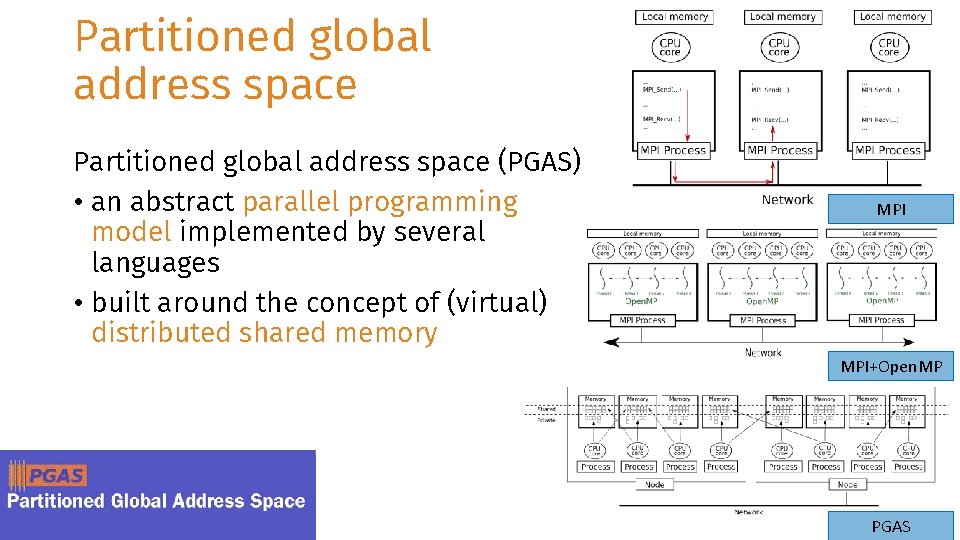
Partitioned global address space Motivation • MPI provides an industry standard for programming of distributed systems • its bare-bones nature makes the app development for MPI harder than dev. for shared memory systems (longer code = more space for errors) • there are efforts to bring shared memory programming concepts to distributed memory programming • data and computation locality must be considered
Partitioned global address space (PGAS) • an abstract parallel programming model implemented by several languages • built around the concept of (virtual) distributed shared memory MPI+Open. MP PGAS
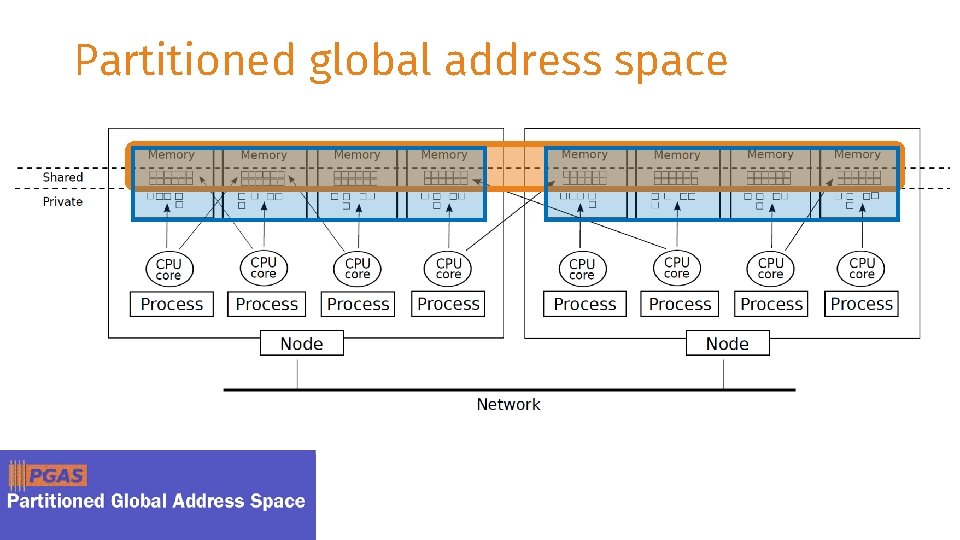
Partitioned global address space
PGAS application Structure • each application is composed of multiple threads, each of them knows its identity • barriers, loop work sharing, parallel control libraries Memory • private and shared memory • each thread has its own private memory • each thread can access any data in the shared memory; this, however, might be much more expensive • shared and private pointers
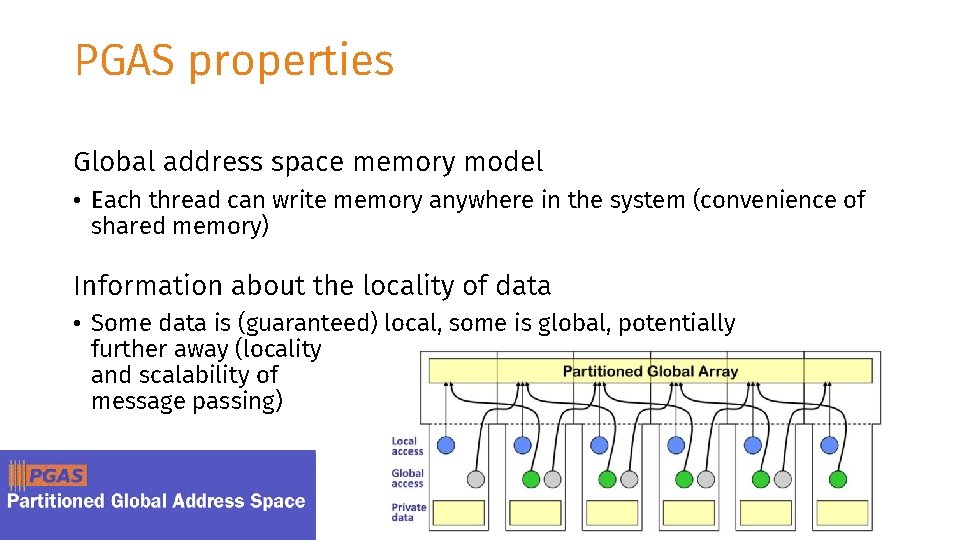
PGAS properties Global address space memory model • Each thread can write memory anywhere in the system (convenience of shared memory) Information about the locality of data • Some data is (guaranteed) local, some is global, potentially further away (locality and scalability of message passing)
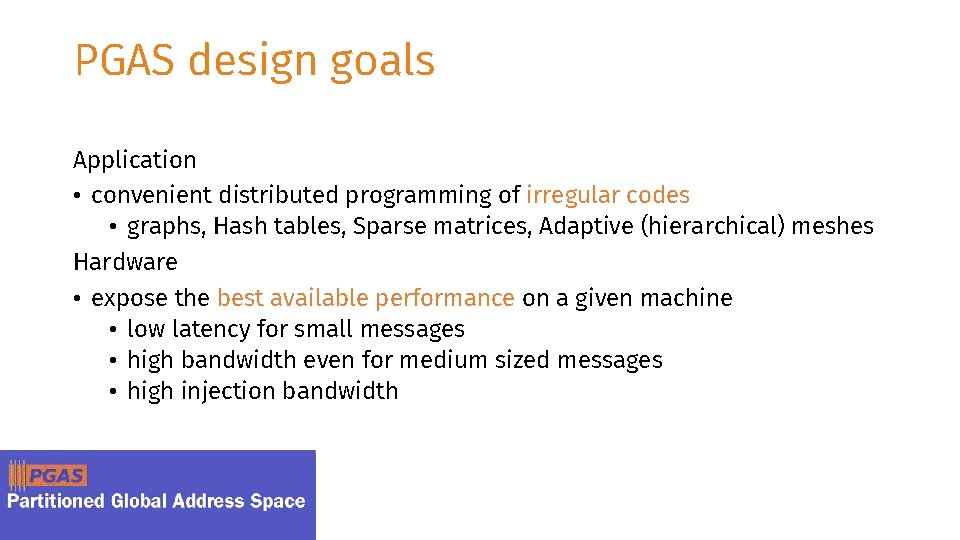
PGAS design goals Application • convenient distributed programming of irregular codes • graphs, Hash tables, Sparse matrices, Adaptive (hierarchical) meshes Hardware • expose the best available performance on a given machine • low latency for small messages • high bandwidth even for medium sized messages • high injection bandwidth
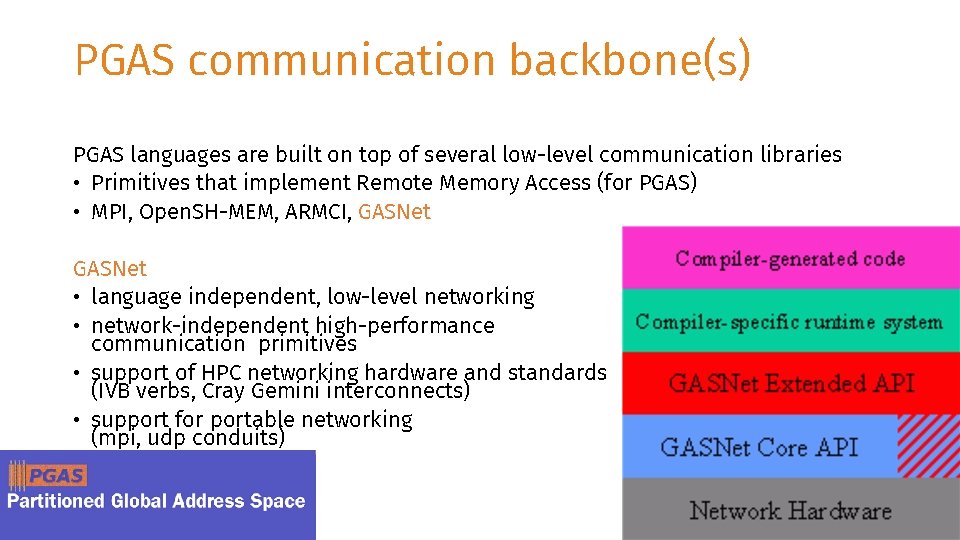
PGAS communication backbone(s) PGAS languages are built on top of several low-level communication libraries • Primitives that implement Remote Memory Access (for PGAS) • MPI, Open. SH-MEM, ARMCI, GASNet • language independent, low-level networking • network-independent high-performance communication primitives • support of HPC networking hardware and standards (IVB verbs, Cray Gemini interconnects) • support for portable networking (mpi, udp conduits)
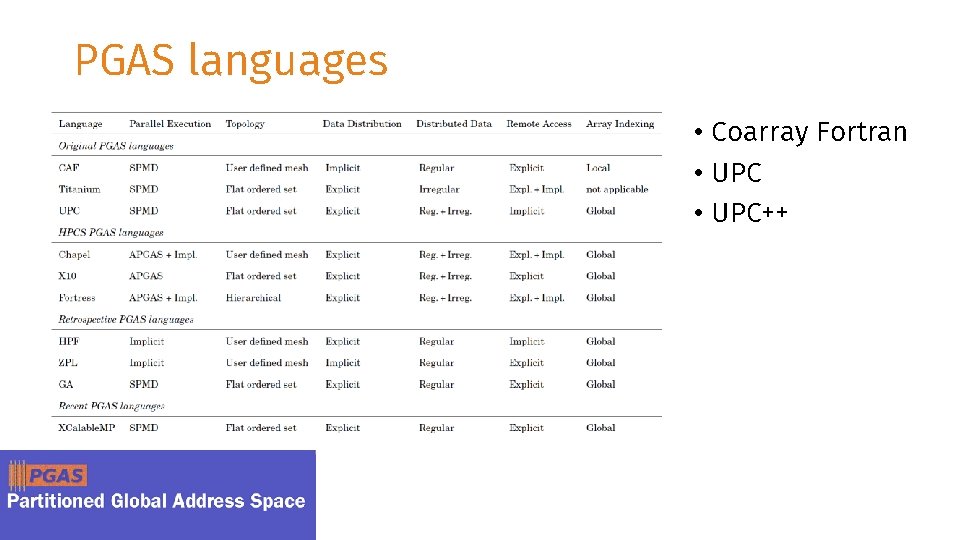
PGAS languages • Coarray Fortran • UPC++
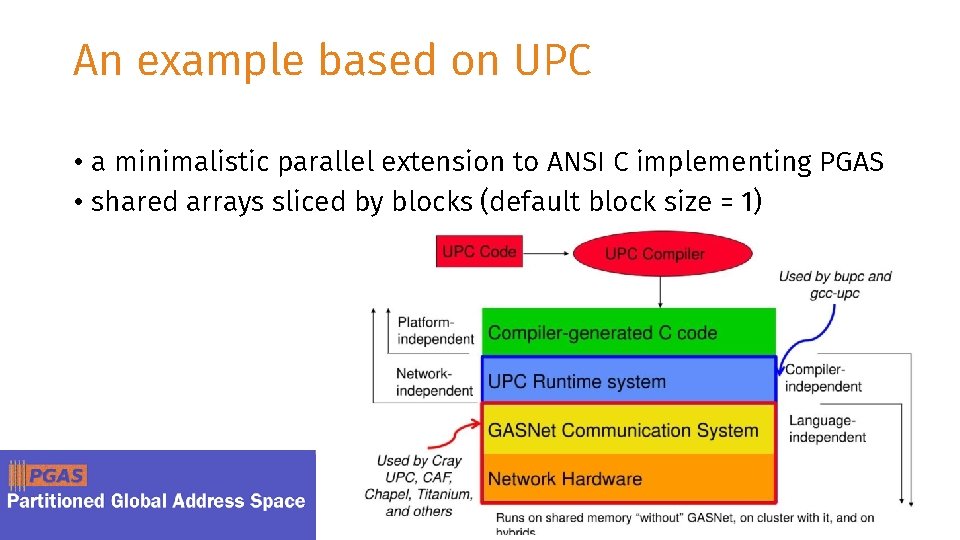
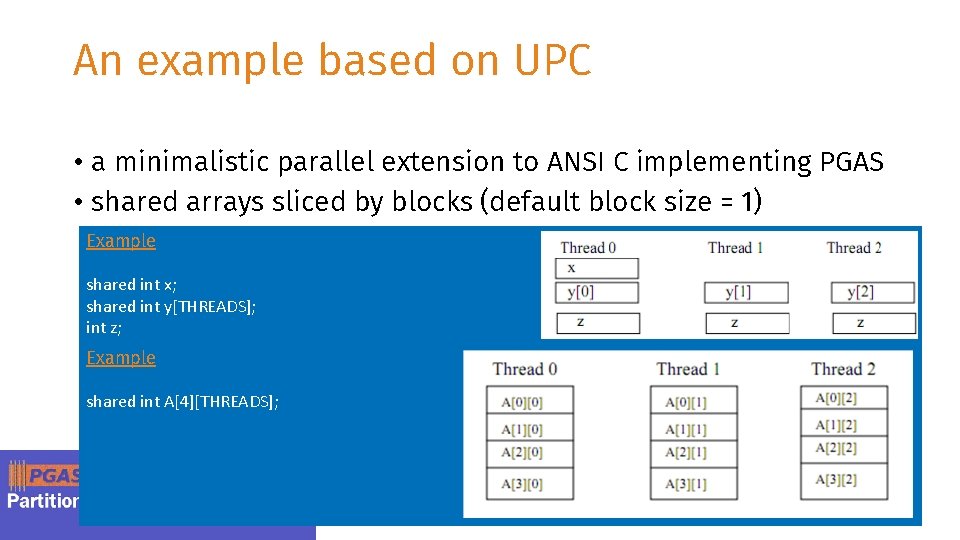
An example based on UPC • a minimalistic parallel extension to ANSI C implementing PGAS • shared arrays sliced by blocks (default block size = 1)
An example based on UPC • a minimalistic parallel extension to ANSI C implementing PGAS • shared arrays sliced by blocks (default block size = 1) Example shared int x; shared int y[THREADS]; int z; Example shared int A[4][THREADS];
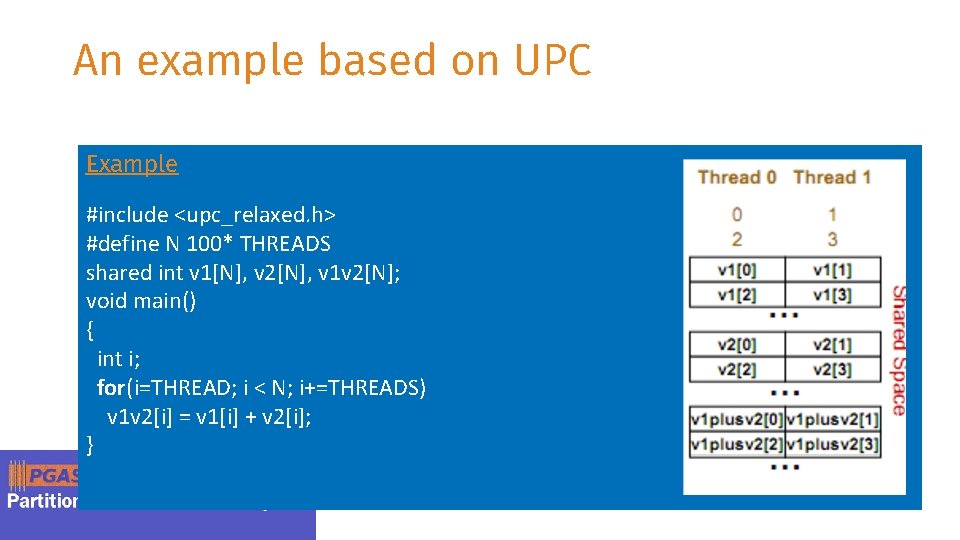
An example based on UPC Example #include <upc_relaxed. h> #define N 100* THREADS shared int v 1[N], v 2[N], v 1 v 2[N]; void main() { int i; for(i=THREAD; i < N; i+=THREADS) v 1 v 2[i] = v 1[i] + v 2[i]; }
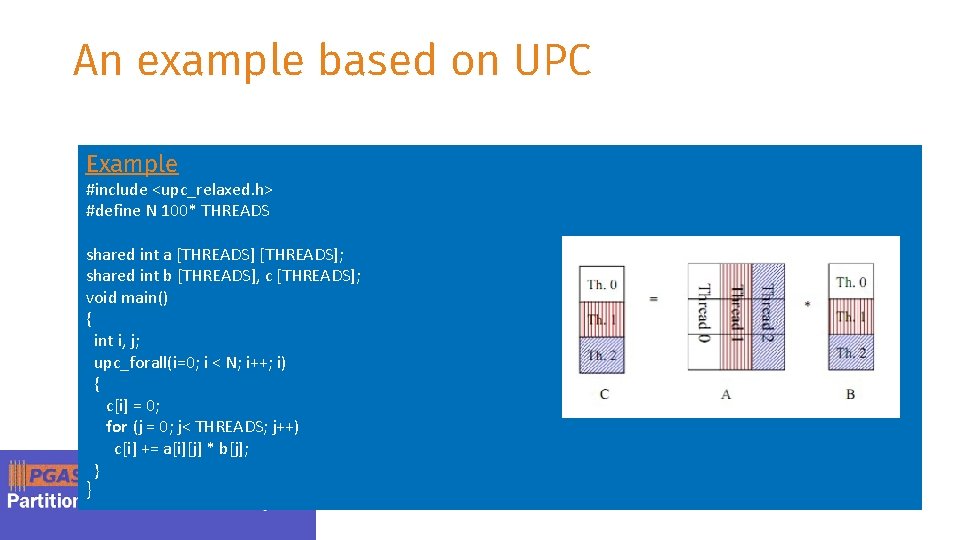
An example based on UPC Example #include <upc_relaxed. h> #define N 100* THREADS shared int a [THREADS]; shared int b [THREADS], c [THREADS]; void main() { int i, j; upc_forall(i=0; i < N; i++; i) { c[i] = 0; for (j = 0; j< THREADS; j++) c[i] += a[i][j] * b[j]; } }
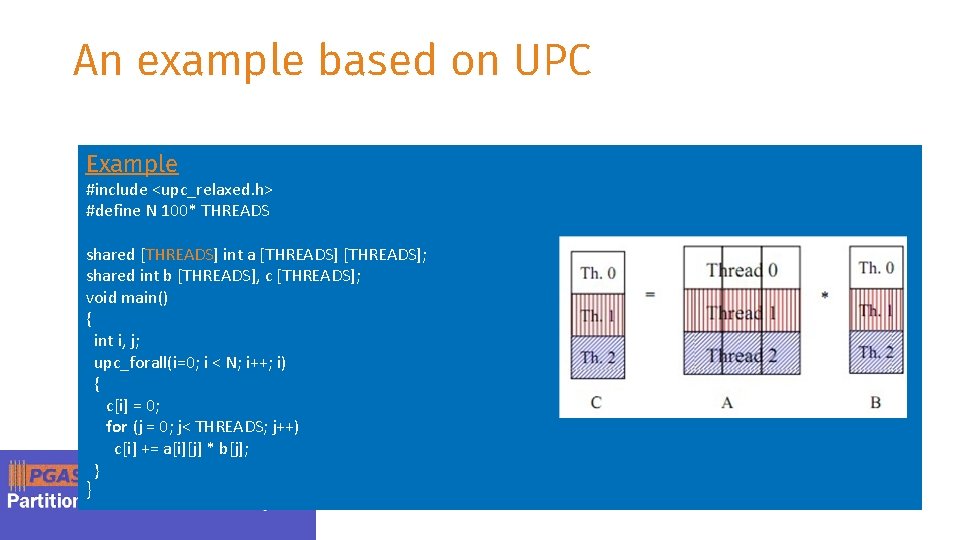
An example based on UPC Example #include <upc_relaxed. h> #define N 100* THREADS shared [THREADS] int a [THREADS]; shared int b [THREADS], c [THREADS]; void main() { int i, j; upc_forall(i=0; i < N; i++; i) { c[i] = 0; for (j = 0; j< THREADS; j++) c[i] += a[i][j] * b[j]; } }
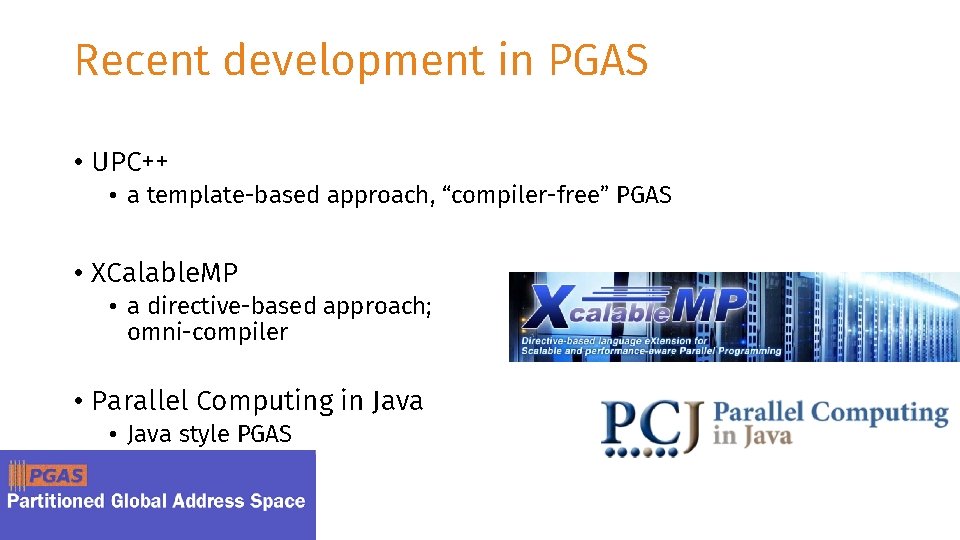
Recent development in PGAS • UPC++ • a template-based approach, “compiler-free” PGAS • XCalable. MP • a directive-based approach; omni-compiler • Parallel Computing in Java • Java style PGAS
Bulk Synchronous Parallel
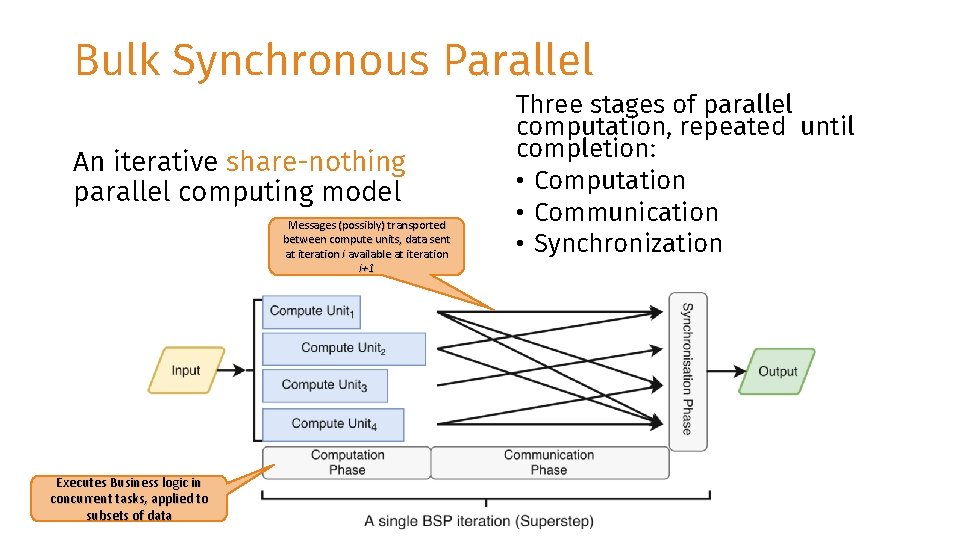
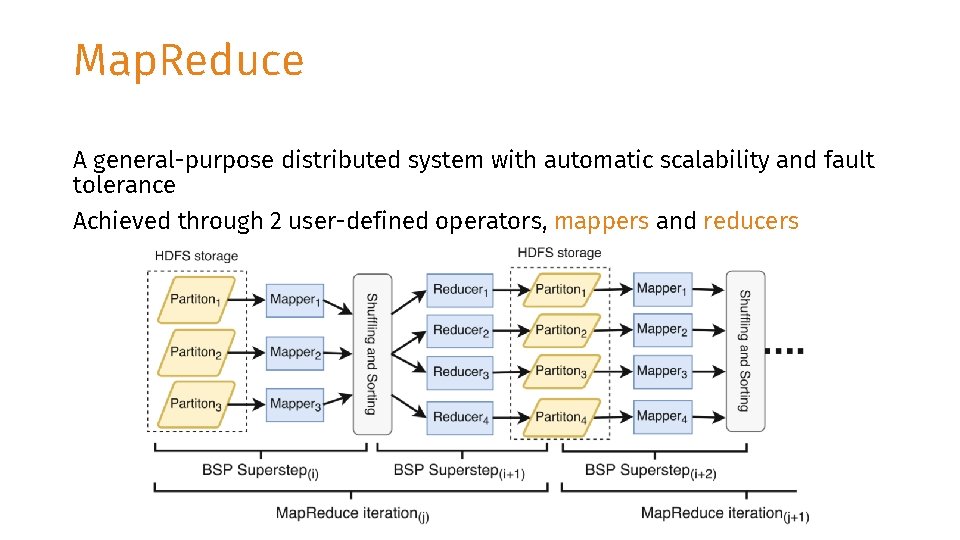
Bulk Synchronous Parallel An iterative share-nothing parallel computing model Messages (possibly) transported between compute units, data sent at iteration i available at iteration i+1 Executes Business logic in concurrent tasks, applied to subsets of data Three stages of parallel computation, repeated until completion: • Computation • Communication • Synchronization
Bulk Synchronous Parallel BSP advantages BSP disadvantages • simplifies parallel computation • restrictive model (code must be autonomous and independent) • automated balancing and scaling • suitable for heterogeneous environments • explicit synchronization hard to achieve • slow computing units slow the whole computation Sounds familiar? MAPREDUCE But also Pregel, SPARK etc.
Map. Reduce A general-purpose distributed system with automatic scalability and fault tolerance Achieved through 2 user-defined operators, mappers and reducers
Structure of a Map. Reduce job • processing of data divided into two phases, mapping and reducing • map function processes a key/value pair to generate a set of intermediate key/value pairs • reduce function merges all intermediate values associated with the same intermediate key • embraces distribution of data and parallel processing as well as aggregation of similar patterns Config
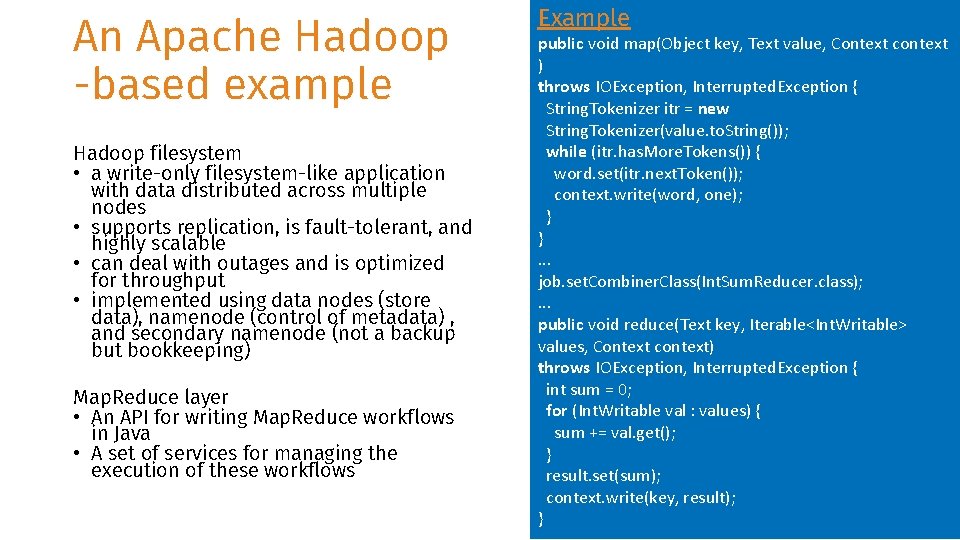
An Apache Hadoop -based example Hadoop filesystem • a write-only filesystem-like application with data distributed across multiple nodes • supports replication, is fault-tolerant, and highly scalable • can deal with outages and is optimized for throughput • implemented using data nodes (store data), namenode (control of metadata) , and secondary namenode (not a backup but bookkeeping) Map. Reduce layer • An API for writing Map. Reduce workflows in Java • A set of services for managing the execution of these workflows Example public void map(Object key, Text value, Context context ) throws IOException, Interrupted. Exception { String. Tokenizer itr = new String. Tokenizer(value. to. String()); while (itr. has. More. Tokens()) { word. set(itr. next. Token()); context. write(word, one); } }. . . job. set. Combiner. Class(Int. Sum. Reducer. class); . . . public void reduce(Text key, Iterable<Int. Writable> values, Context context) throws IOException, Interrupted. Exception { int sum = 0; for (Int. Writable val : values) { sum += val. get(); } result. set(sum); context. write(key, result); }
Python: DASK
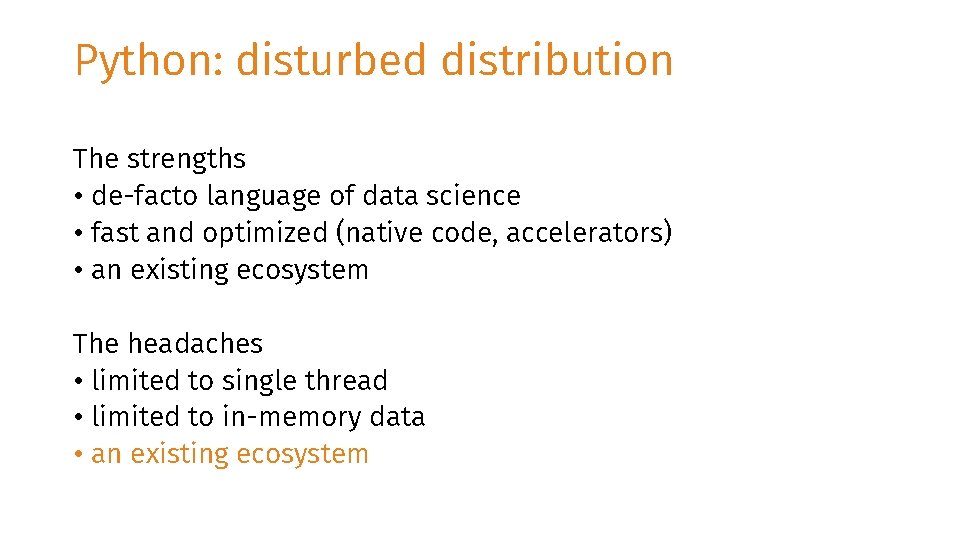
Python: disturbed distribution The strengths • de-facto language of data science • fast and optimized (native code, accelerators) • an existing ecosystem The headaches • limited to single thread • limited to in-memory data • an existing ecosystem
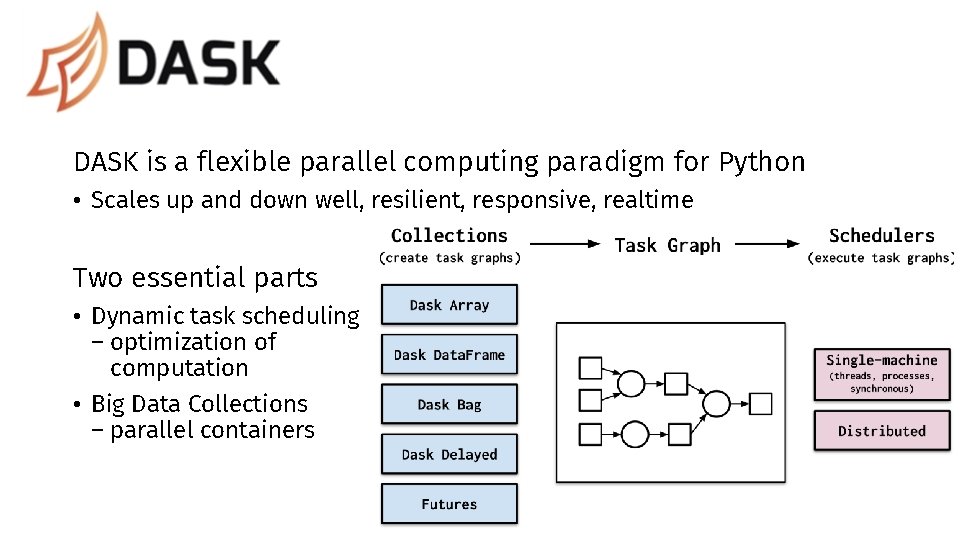
DASK is a flexible parallel computing paradigm for Python • Scales up and down well, resilient, responsive, realtime Two essential parts • Dynamic task scheduling – optimization of computation • Big Data Collections – parallel containers
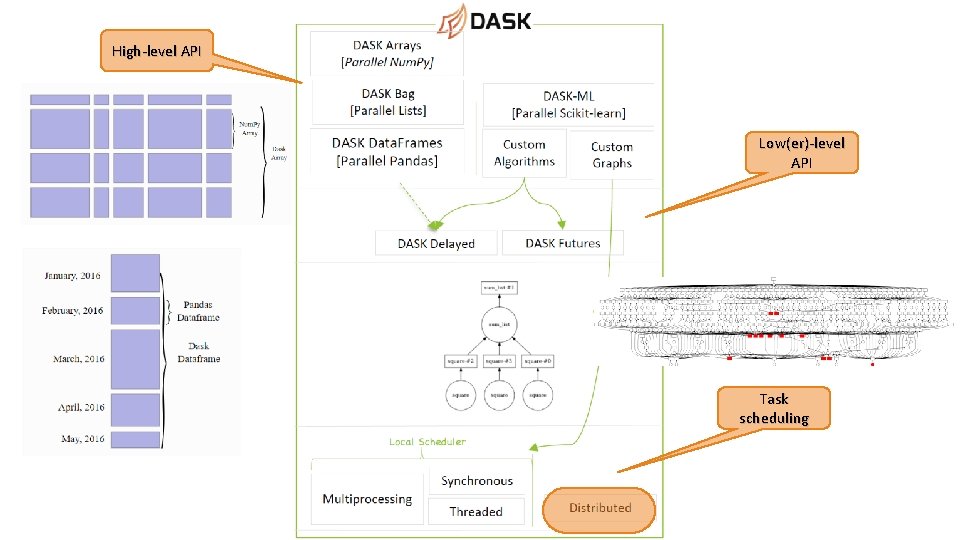
High-level API Low(er)-level API Task scheduling
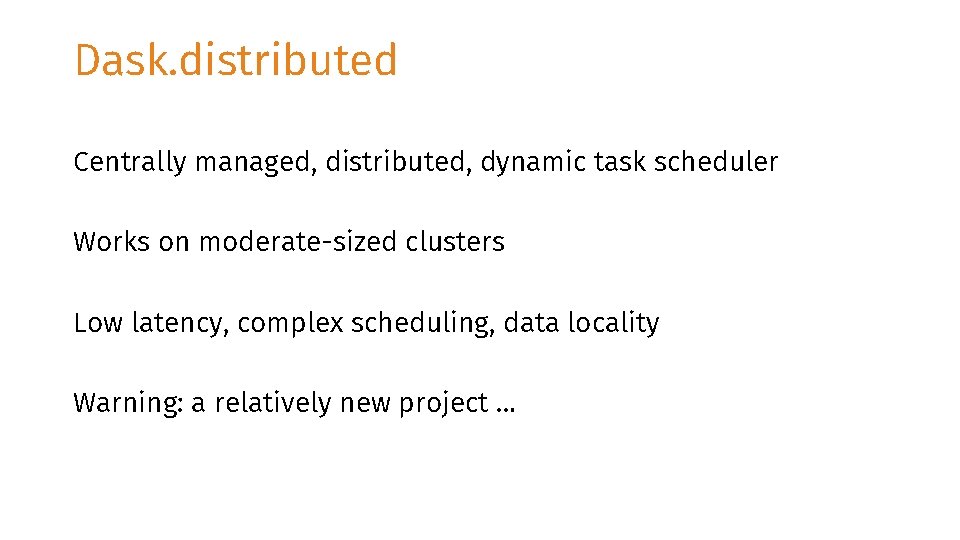
Dask. distributed Centrally managed, distributed, dynamic task scheduler Works on moderate-sized clusters Low latency, complex scheduling, data locality Warning: a relatively new project …