
Parallel Algorithms for Submodular Function Maximization Chandra Chekuri
Parallel Algorithms for Submodular Function Maximization Chandra Chekuri Univ. of Illinois, Urbana-Champaign Joint work with Kent Quanrud (UIUC → Purdue) RIMS Kyoto, Jan 13, 2020
Based on two recent papers • Submodular Function Maximization in Parallel via the Multilinear Relaxation (SODA 2019) • Parallelizing Greedy for Submodular Set Function Maximization in Matroids and Beyond (STOC 19)
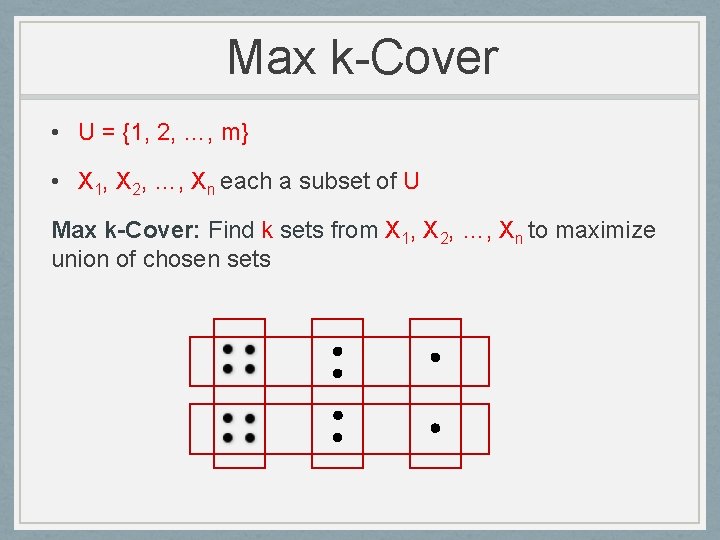
Max k-Cover • U = {1, 2, …, m} • X 1, X 2, …, Xn each a subset of U Max k-Cover: Find k sets from X 1, X 2, …, Xn to maximize union of chosen sets
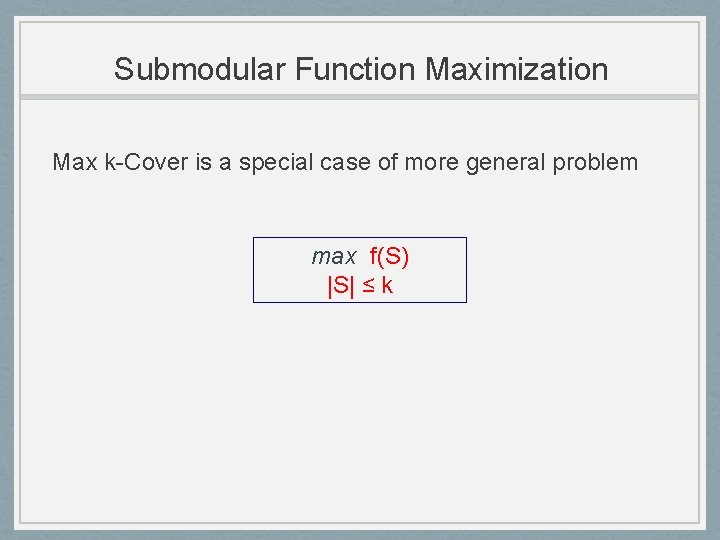
Submodular Function Maximization Max k-Cover is a special case of more general problem max f(S) |S| ≤ k
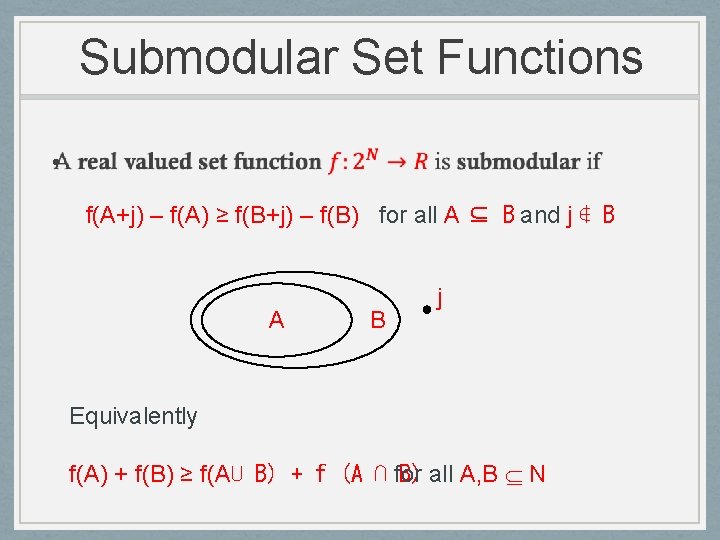
Submodular Set Functions • f(A+j) – f(A) ≥ f(B+j) – f(B) for all A ⊆ B and j ∉ B A B j Equivalently f(A) + f(B) ≥ f(A⋃ B) + f (A ⋂ for all A, B N B)
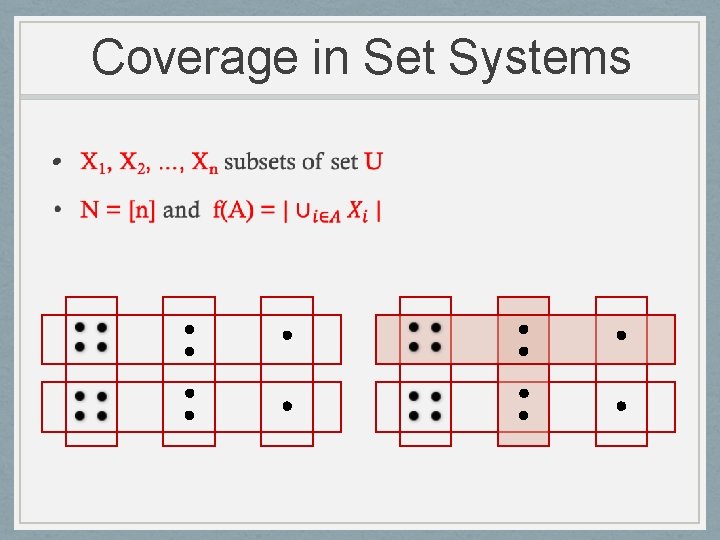
Coverage in Set Systems •
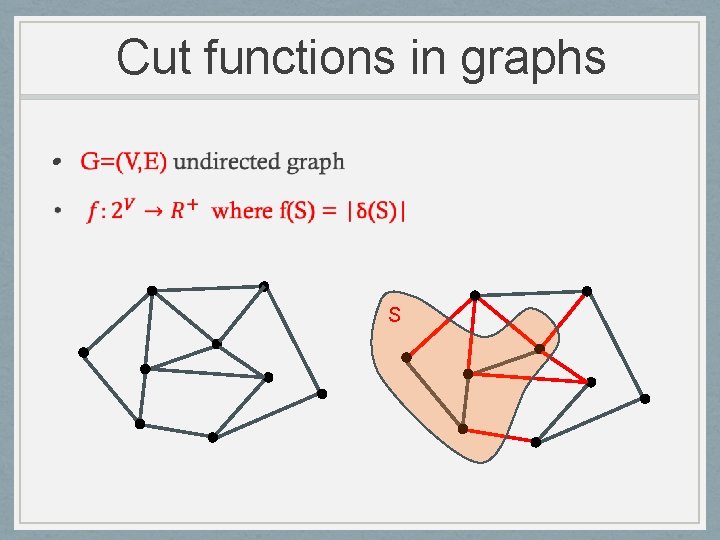
Cut functions in graphs • S
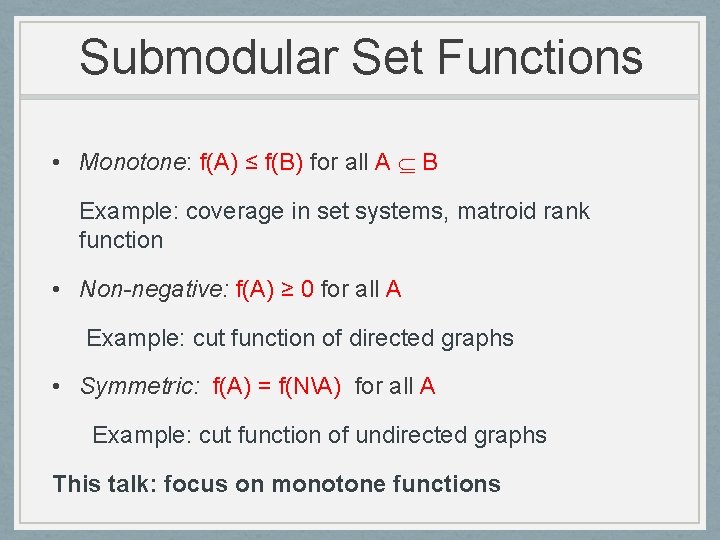
Submodular Set Functions • Monotone: f(A) ≤ f(B) for all A B Example: coverage in set systems, matroid rank function • Non-negative: f(A) ≥ 0 for all A Example: cut function of directed graphs • Symmetric: f(A) = f(NA) for all A Example: cut function of undirected graphs This talk: focus on monotone functions
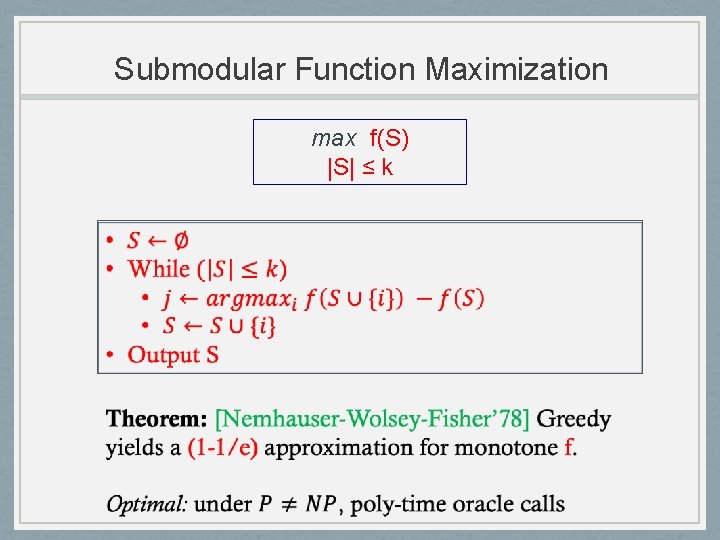
Submodular Function Maximization max f(S) |S| ≤ k
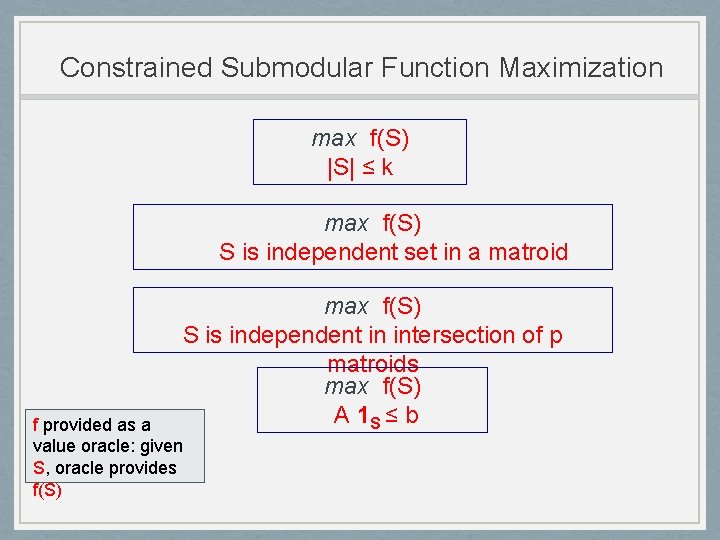
Constrained Submodular Function Maximization max f(S) |S| ≤ k max f(S) S is independent set in a matroid max f(S) S is independent in intersection of p matroids max f(S) A 1 S ≤ b f provided as a value oracle: given S, oracle provides f(S)
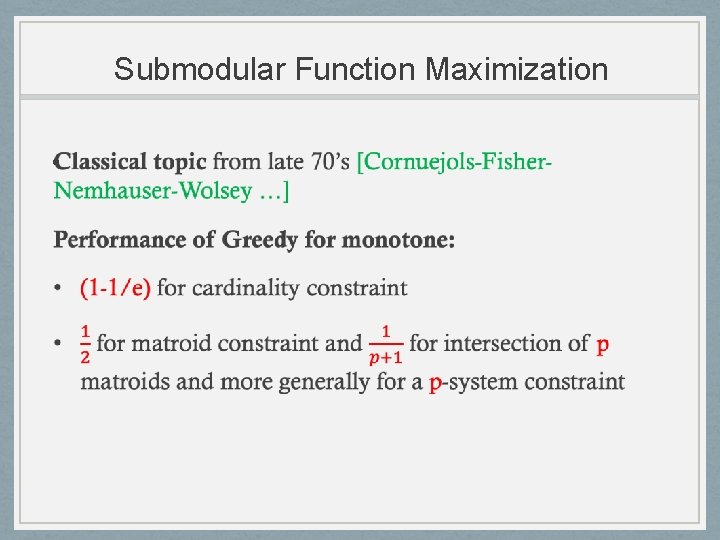
Submodular Function Maximization •
Submodular Function Maximization • Much progress in (approximation) algorithms and hardness in the last 15 years. • Non-negative functions • Local search • Math. programming approach via multilinear relaxation • Many new applications: algorithmic game theory, machine learning, data summarization and others • Ongoing work … CAVEAT: will not be able to mention many refs
![Mathematical programming approach For submodular func maximization [Calinescu-C-Pal. Vondrak’ 07] • Initial goal: to](http://slidetodoc.com/presentation_image_h/9df286f63362274bfcbf2bb50ff250d4/image-13.jpg "Mathematical programming approach For submodular func maximization [Calinescu-C-Pal. Vondrak’ 07] • Initial goal: to")
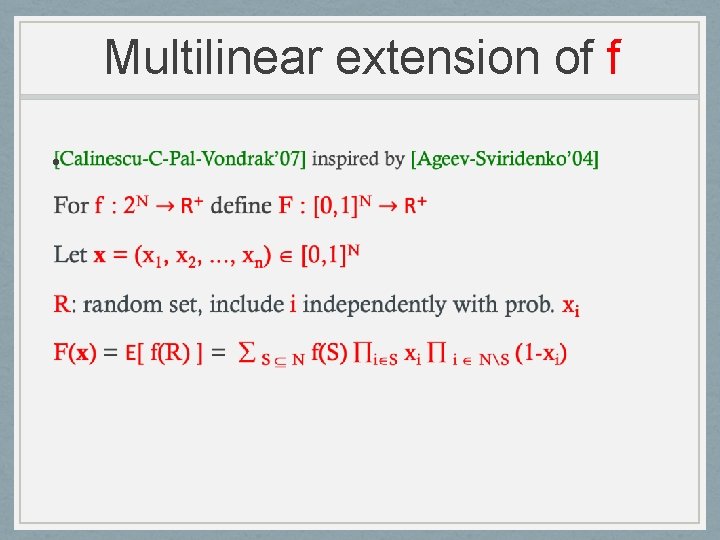
Mathematical programming approach For submodular func maximization [Calinescu-C-Pal. Vondrak’ 07] • Initial goal: to improve ½ for matroid constraint to (1 -1/e) • Necessary for handing more complicated sets of constraints • Many developments including structural results, lower bounds, concentration properties, …
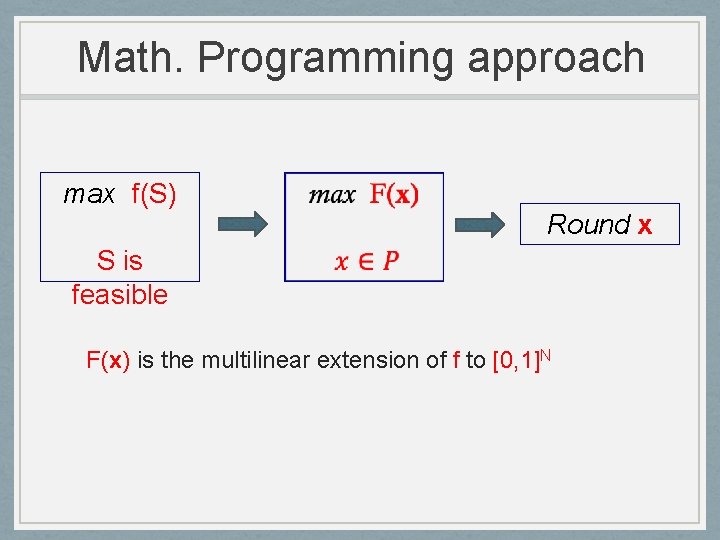
Math. Programming approach max f(S) Round x S is feasible F(x) is the multilinear extension of f to [0, 1]N
![Recent Question [Balkanski-Singer’ 18] Can we parallelize submodular function maximization? Roughly same as: are](http://slidetodoc.com/presentation_image_h/9df286f63362274bfcbf2bb50ff250d4/image-15.jpg "Recent Question [Balkanski-Singer’ 18] Can we parallelize submodular function maximization? Roughly same as: are")
Recent Question [Balkanski-Singer’ 18] Can we parallelize submodular function maximization? Roughly same as: are there low adaptivity algorithms for submodular function maximization? Greedy, local search and math programming approach appear inherently sequential
![Prior work • First parallel approx. algorithm for Set Cover [Berger. Rompel-Shor’ 89] •](http://slidetodoc.com/presentation_image_h/9df286f63362274bfcbf2bb50ff250d4/image-16.jpg "Prior work • First parallel approx. algorithm for Set Cover [Berger. Rompel-Shor’ 89] •")
Prior work • First parallel approx. algorithm for Set Cover [Berger. Rompel-Shor’ 89] • Parallel positive LP solving [Luby-Nisan’ 93] improved by [Young’ 00] which also leads to algorithms for Set Cover • Parallel for. Max k-Cover not considered explicitly until more recently [Chierchetti-Kumar-Tomkins’ 10] but ideas implicit in Set Cover parallel algorithms
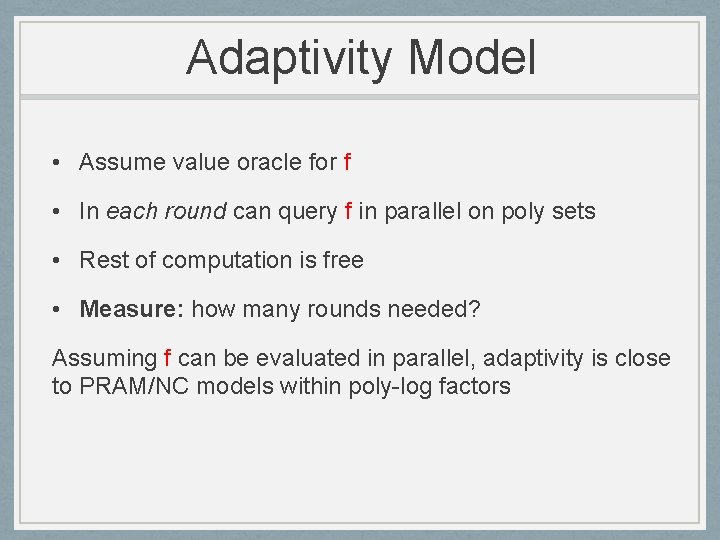
Adaptivity Model • Assume value oracle for f • In each round can query f in parallel on poly sets • Rest of computation is free • Measure: how many rounds needed? Assuming f can be evaluated in parallel, adaptivity is close to PRAM/NC models within poly-log factors
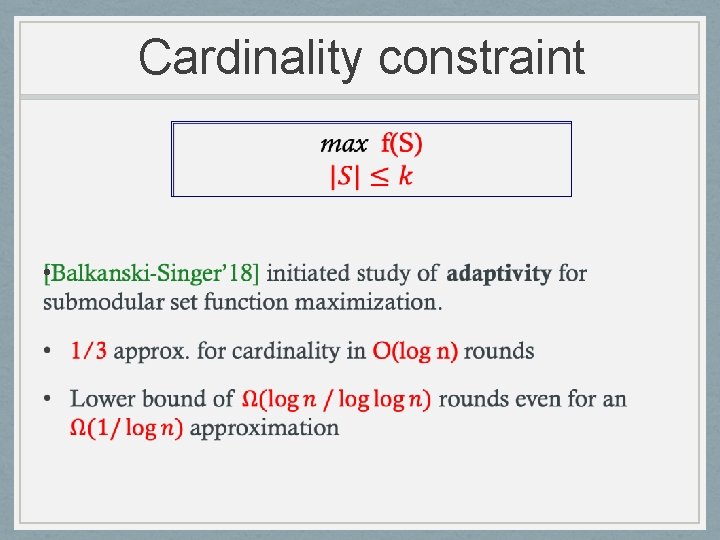
Cardinality constraint •
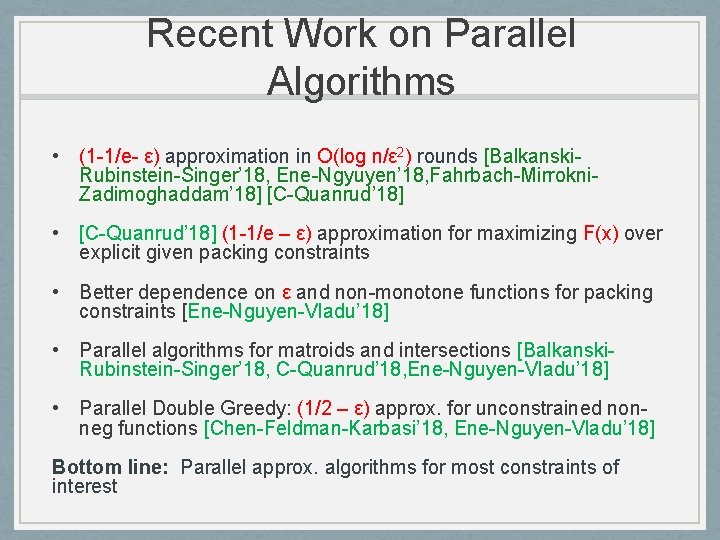
Recent Work on Parallel Algorithms • (1 -1/e- ε) approximation in O(log n/ε 2) rounds [Balkanski. Rubinstein-Singer’ 18, Ene-Ngyuyen’ 18, Fahrbach-Mirrokni. Zadimoghaddam’ 18] [C-Quanrud’ 18] • [C-Quanrud’ 18] (1 -1/e – ε) approximation for maximizing F(x) over explicit given packing constraints • Better dependence on ε and non-monotone functions for packing constraints [Ene-Nguyen-Vladu’ 18] • Parallel algorithms for matroids and intersections [Balkanski. Rubinstein-Singer’ 18, C-Quanrud’ 18, Ene-Nguyen-Vladu’ 18] • Parallel Double Greedy: (1/2 – ε) approx. for unconstrained nonneg functions [Chen-Feldman-Karbasi’ 18, Ene-Nguyen-Vladu’ 18] Bottom line: Parallel approx. algorithms for most constraints of interest
![Our Approach [C-Quanrud’ 18] • Continuous optimization approach based on multilinear relaxation. Clean and](http://slidetodoc.com/presentation_image_h/9df286f63362274bfcbf2bb50ff250d4/image-20.jpg "Our Approach [C-Quanrud’ 18] • Continuous optimization approach based on multilinear relaxation. Clean and")
Our Approach [C-Quanrud’ 18] • Continuous optimization approach based on multilinear relaxation. Clean and simple • Generalizes to packing constraints • Inspired subsequent work on matroids etc
![Parallel Algorithm Can round x without loss for matroid constraint [CCPV’ 07]](http://slidetodoc.com/presentation_image_h/9df286f63362274bfcbf2bb50ff250d4/image-21.jpg "Parallel Algorithm Can round x without loss for matroid constraint [CCPV’ 07]")
Parallel Algorithm Can round x without loss for matroid constraint [CCPV’ 07]
Multilinear extension of f •
Notation •
Properties of F •
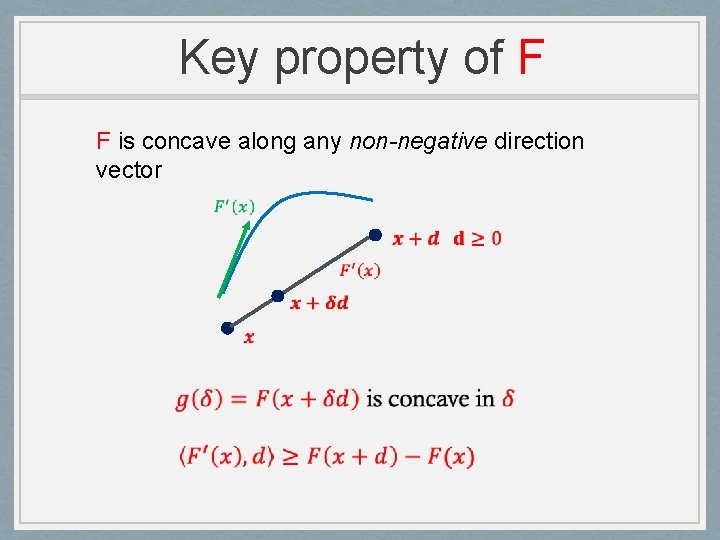
Key property of F F is concave along any non-negative direction vector
![Sequential Greedy [Wolsey’ 82 Vondrak’ 08] Theorem: For monotone f, F(x) ≥ (1 -1/e)](http://slidetodoc.com/presentation_image_h/9df286f63362274bfcbf2bb50ff250d4/image-26.jpg "Sequential Greedy [Wolsey’ 82 Vondrak’ 08] Theorem: For monotone f, F(x) ≥ (1 -1/e)")
Sequential Greedy [Wolsey’ 82 Vondrak’ 08] Theorem: For monotone f, F(x) ≥ (1 -1/e) OPT
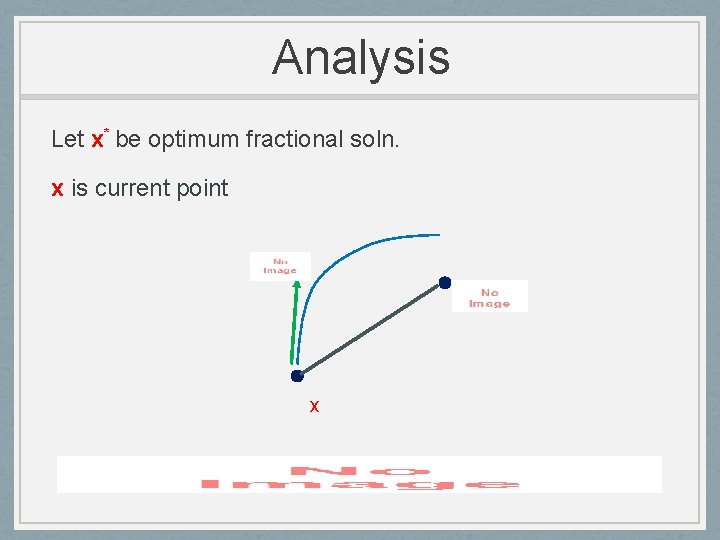
Analysis Let x* be optimum fractional soln. x is current point x

Analysis •

Analysis •

Analysis •
![Continuous Greedy • For cardinality constraint continuous-greedy boils down to standard greedy ([Wolsey’ 82])](http://slidetodoc.com/presentation_image_h/9df286f63362274bfcbf2bb50ff250d4/image-31.jpg "Continuous Greedy • For cardinality constraint continuous-greedy boils down to standard greedy ([Wolsey’ 82])")
Continuous Greedy • For cardinality constraint continuous-greedy boils down to standard greedy ([Wolsey’ 82]) • Power comes from its version for arbitrary polytope ([Vondrak’ 08])
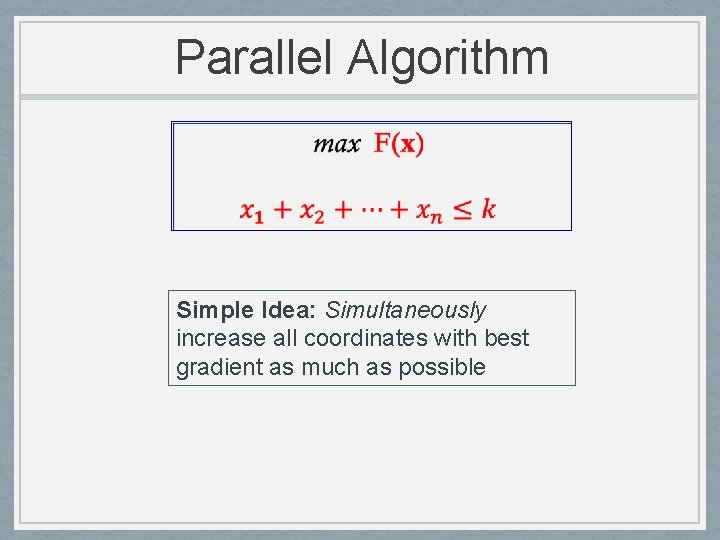
Parallel Algorithm Simple Idea: Simultaneously increase all coordinates with best gradient as much as possible
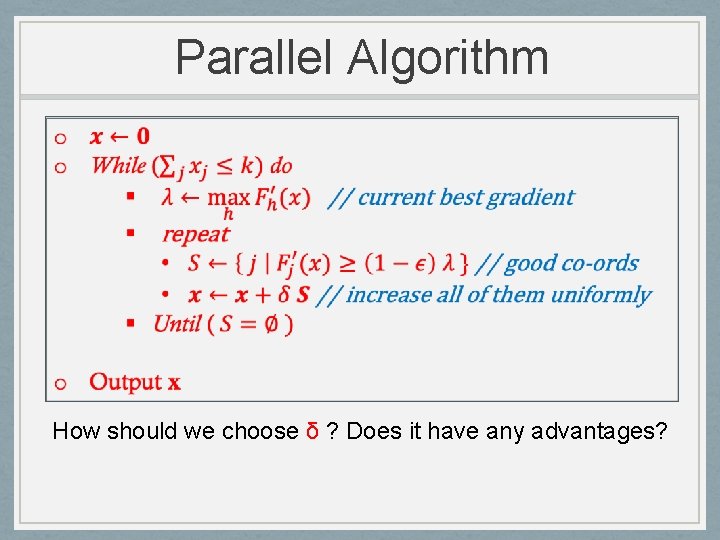
Parallel Algorithm How should we choose δ ? Does it have any advantages?
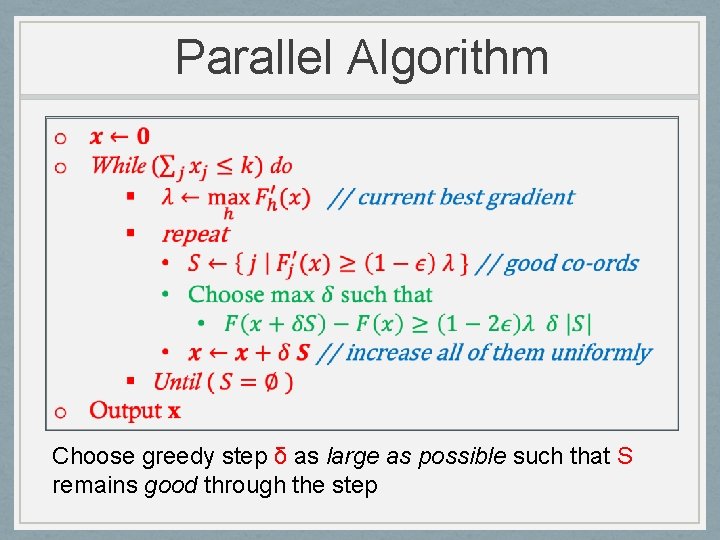
Parallel Algorithm Choose greedy step δ as large as possible such that S remains good through the step
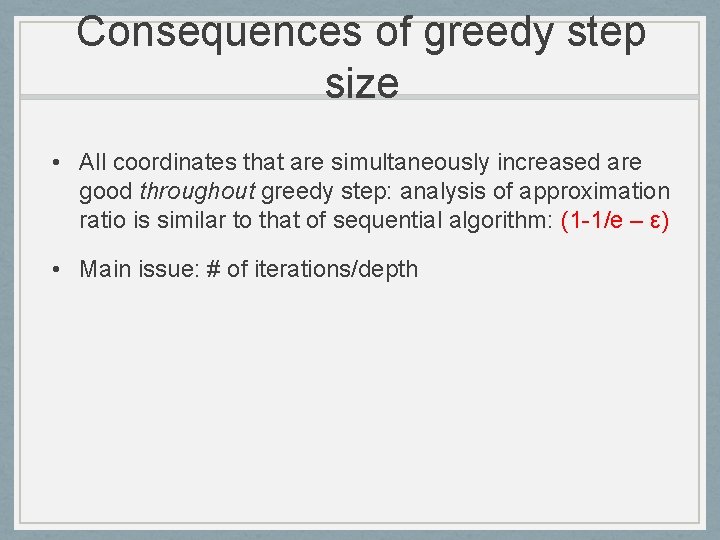
Consequences of greedy step size • All coordinates that are simultaneously increased are good throughout greedy step: analysis of approximation ratio is similar to that of sequential algorithm: (1 -1/e – ε) • Main issue: # of iterations/depth
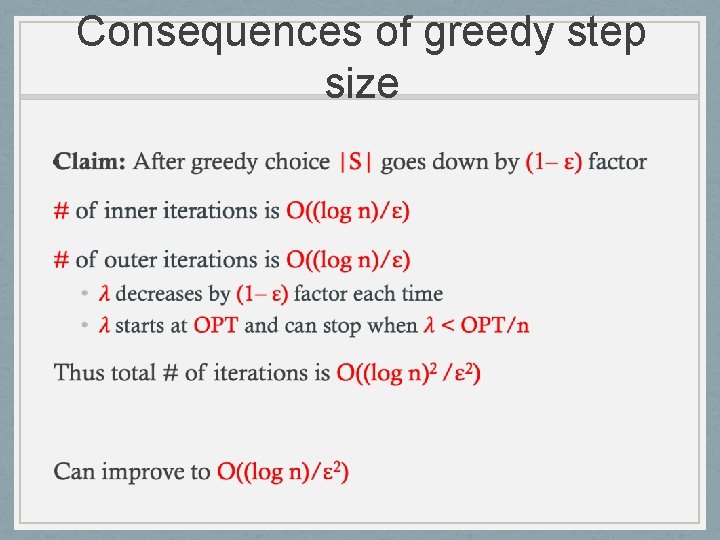
Consequences of greedy step size •
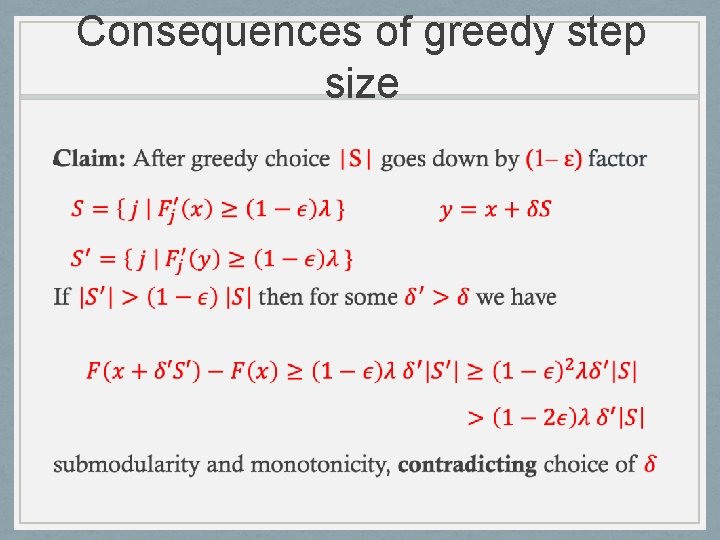
Consequences of greedy step size •
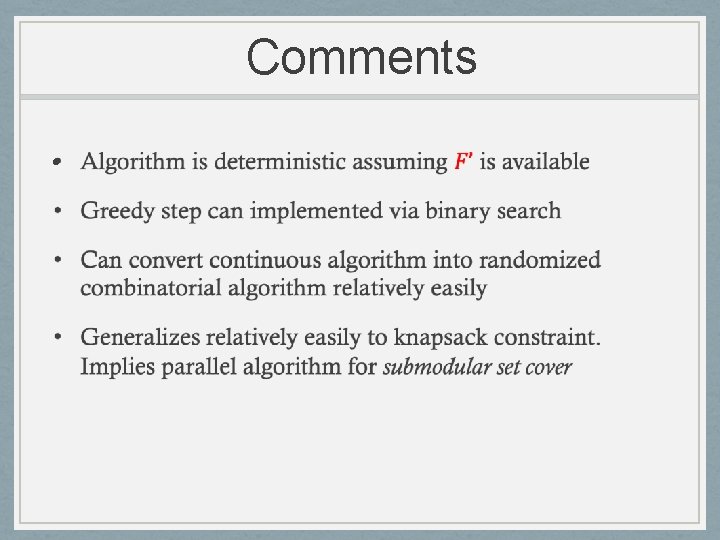
Comments •
A Combinatorial Algorithm
Generalizing • Multiple Packing Constraints • Matroid Constraint(s)
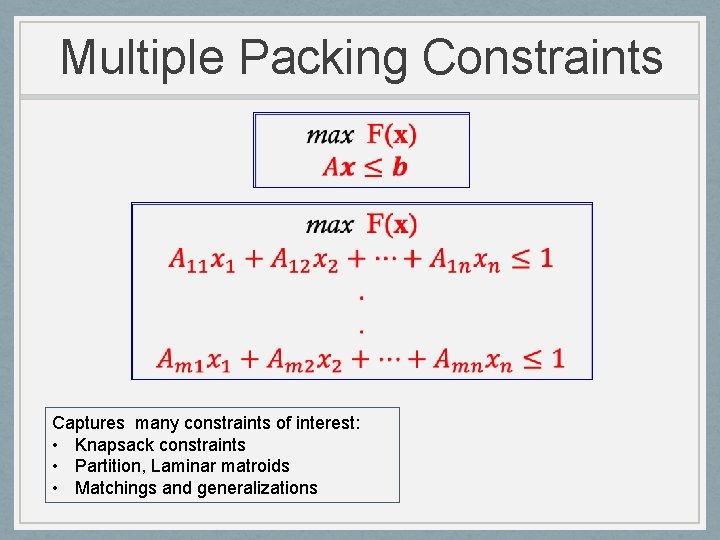
Multiple Packing Constraints Captures many constraints of interest: • Knapsack constraints • Partition, Laminar matroids • Matchings and generalizations
Multiple Packing Constraints • Adapt multiplicative weight update (MWU) techniques to “essentially” reduce to single cardinality constraint • [C-Jayram-Vondrak 2015] adapted MWU in sequential setting to multilinear relaxation • [C-Quanrud’ 18] combine ideas from parallel algorithms for positive LP solving due to [Luby-Nisan’ 94, Young’ 00] and combine with [C-J-V’ 15] and cardinality constraint insights Theorem: O( (log m log n)/ε 2) rounds for (1 -1/e – ε) approximation for monotone f
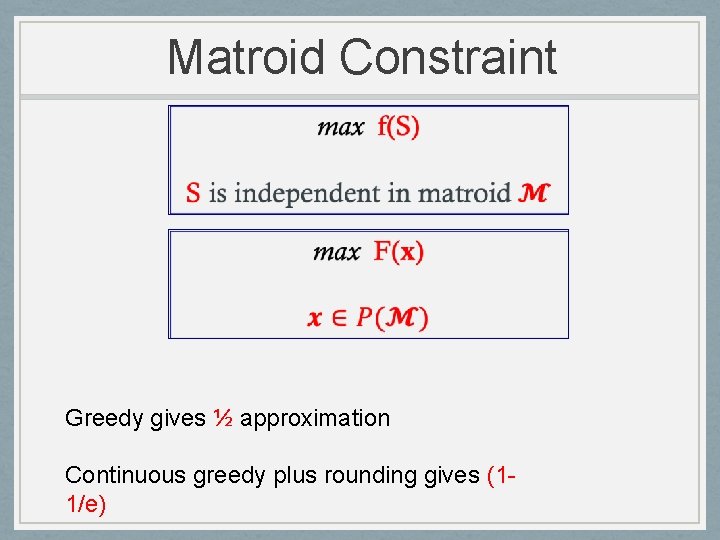
Matroid Constraint Greedy gives ½ approximation Continuous greedy plus rounding gives (11/e)
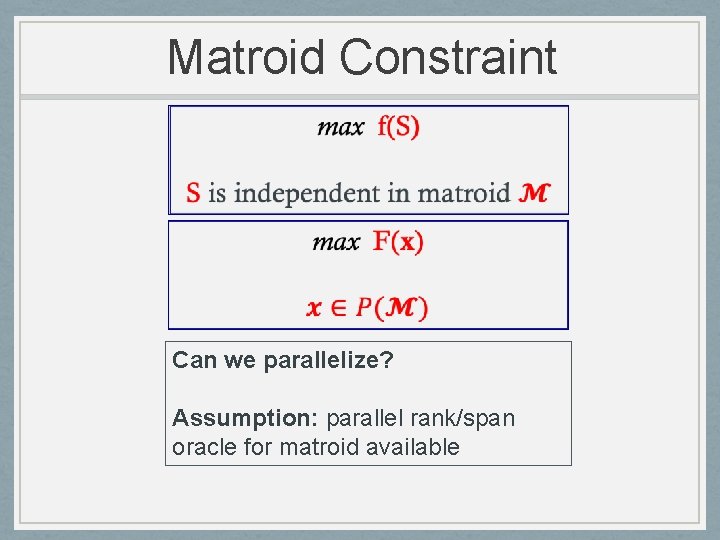
Matroid Constraint Can we parallelize? Assumption: parallel rank/span oracle for matroid available
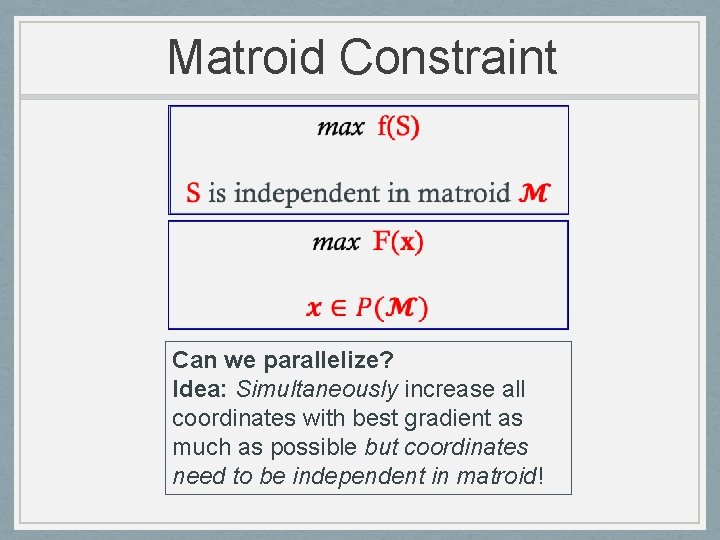
Matroid Constraint Can we parallelize? Idea: Simultaneously increase all coordinates with best gradient as much as possible but coordinates need to be independent in matroid!
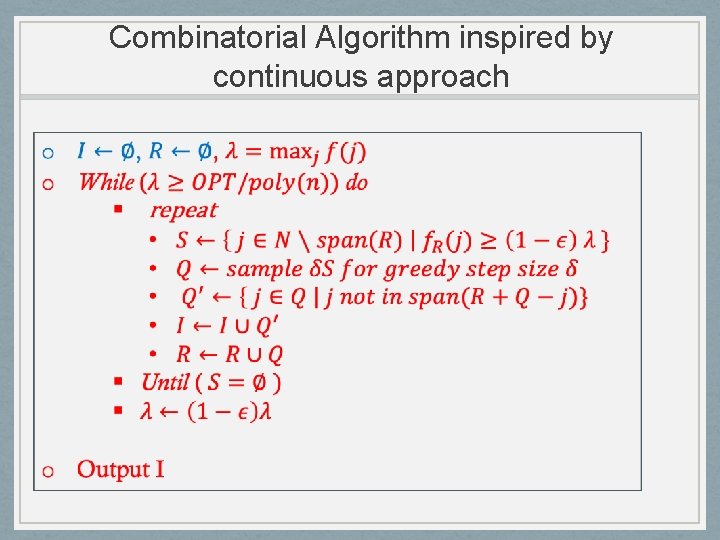
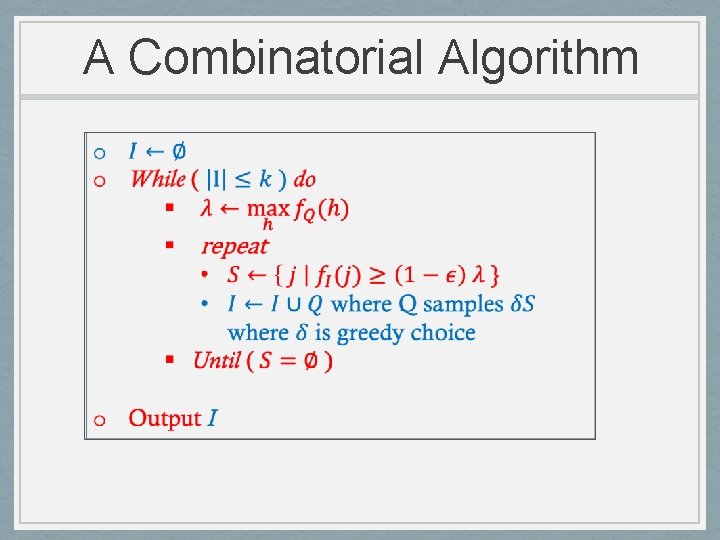
Combinatorial Algorithm inspired by continuous approach
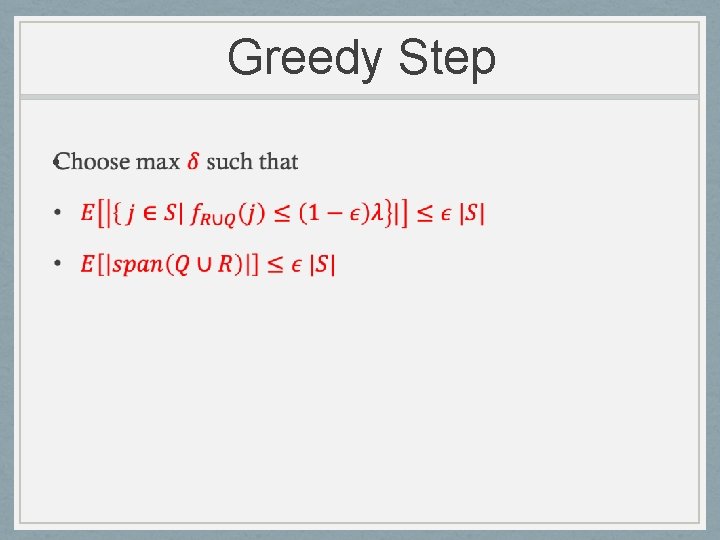
Greedy Step •
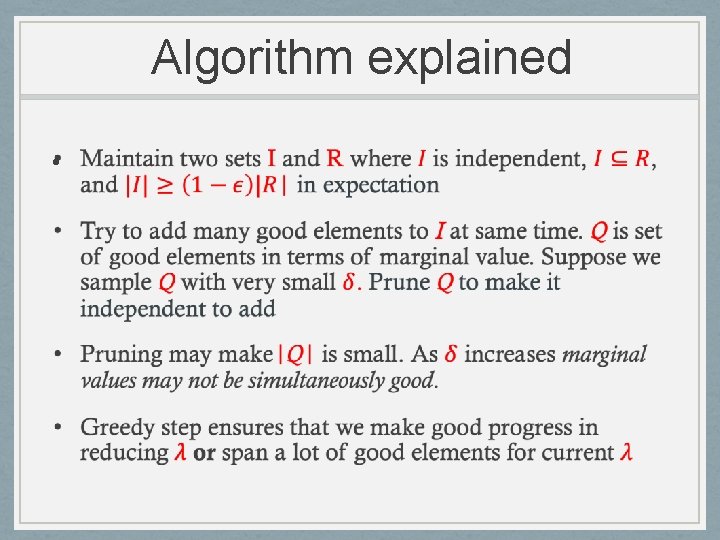
Algorithm explained •
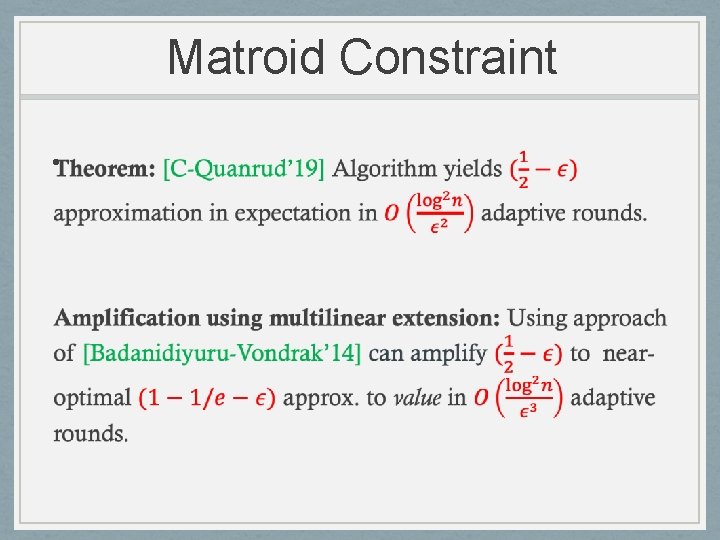
Matroid Constraint •
Other Results • Can generalize from monotone to non-negative functions using some ideas from sequential setting • Handle multiple matroids and matchoid constraints etc. Many results from sequential setting can be generalized to parallel setting with comparable approximation ratios.
Conclusions Continuous approach for submodular function maximization has proved to be very successful. This talk showed utility in parallelization as well. Some open directions: • Is randomization necessary? • Can we extend continuous approach to relaxed notions submodularity and other classes of functions? • Multilinear relaxation approach can be slow due to sampling. Fast algorithms that can avoid this bottleneck?

THANKS
- Slides: 52