
PARAGUAY Moving Towards Contraceptive Security SemiAnnual Meeting of
- Slides: 16
PARAGUAY Moving Towards Contraceptive Security Semi-Annual Meeting of the Reproductive Health Supplies Coalition Washington, D. C. October, 2007
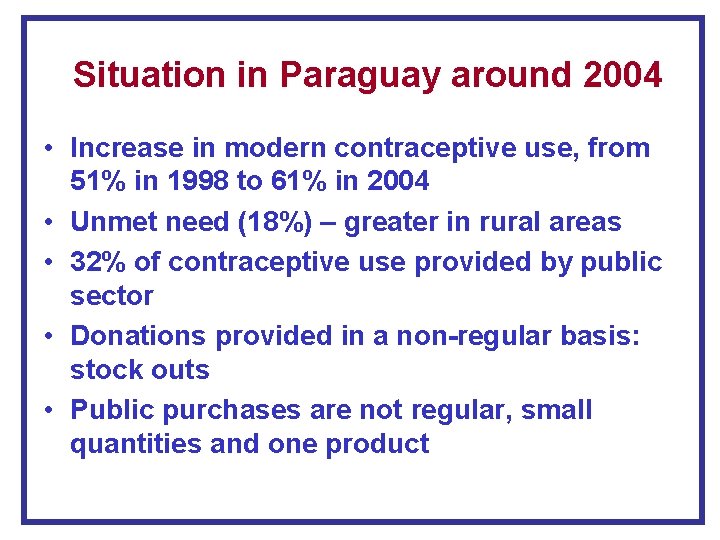
Situation in Paraguay around 2004 • Increase in modern contraceptive use, from 51% in 1998 to 61% in 2004 • Unmet need (18%) – greater in rural areas • 32% of contraceptive use provided by public sector • Donations provided in a non-regular basis: stock outs • Public purchases are not regular, small quantities and one product
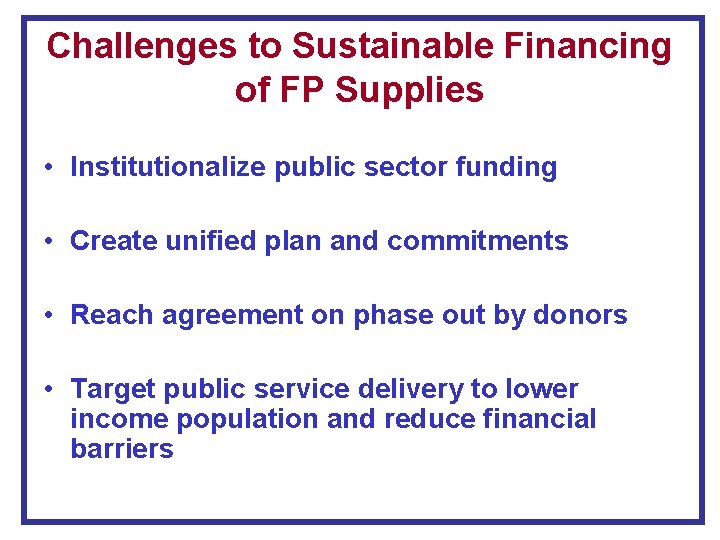
Challenges to Sustainable Financing of FP Supplies • Institutionalize public sector funding • Create unified plan and commitments • Reach agreement on phase out by donors • Target public service delivery to lower income population and reduce financial barriers
Initial Steps • Creation of CS Committee (Managua 2003 and after) • March 2004 CS Assessment – Identified need for budget line for contraceptive procurement
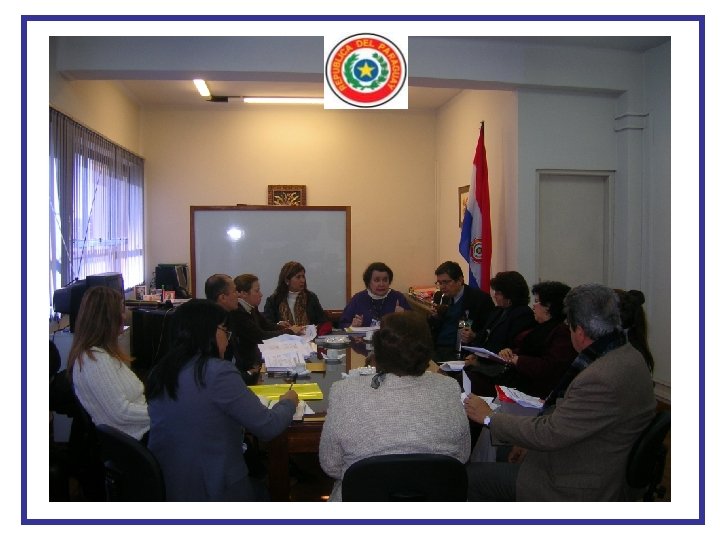
Multisectoral Approach • Members of CS Committee (Sexual & Reproductive Health National Council) – Health Program Director and team, MOH – USAID- Health Officer – UNFPA- Reproductive Health Officer, – Executive Director-IPPF Affiliate (CEPEP) – Social Marketing of Contraceptives (PROMESA) – Paraguayan Chamber of Pharmacies (CAFAPAR) – Social Security (IPS) – USAID | DELIVER PROJECT-Advisor
Current Achievements • Approval of Law 2907 (Secured budget for MOH Reproductive Health Programs and Birth Kits Provision) • CS Plan approved by National SRH Council • Tripartite Plan of Gradual Phase Out of Contraceptive Donations • Procurement agreement UNFPA-MOH • Free contraceptives and consultation • MOH provided US$ 261, 573 for contraceptive procurement in 2006 and committed US$ 551, 000 in 2007
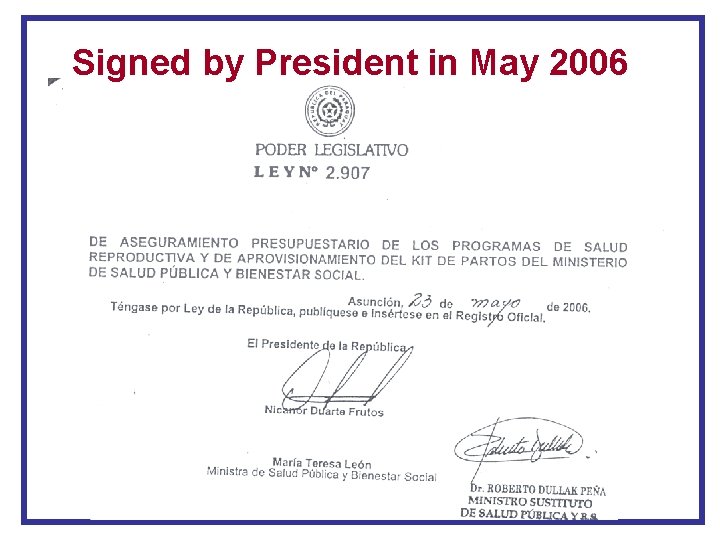
Signed by President in May 2006
What does Law 2907 say? • Reserves funds for the procurement, storage and distribution of contraceptives based on MOH requirements • Makes decentralized financing of contraceptives possible • Mandates Social Security to procure its own supplies • Establishes permanent budget line item for contraceptives and delivery kits
Approval process for Law 2907 • • • Alliances with key Congresspersons Draft Bill Frame FP within constitutional rights Avoid public confrontation Link contraceptives with birth kits to reduce resistance • Monitor the Bill through its different steps
A Successful Combination • CS members with direct access to the Legislative and Executive Branches of Government • Analysis of similar legal frameworks • Advocacy with key allies and political authorities • Discussions and presentations with MOH stakeholders • Coordinating meetings/CS Committee Planning
Impact • Political commitment to support CS • Legal framework for funding • Optimization of financial resources procuring at lower prices • Self-sustainability in the medium term • Guaranteed access for low income users
Lessons Learned • Follow critical path for approval of law doing advocacy with stakeholders • Strategic management of the political environment • Advocacy done before process of passing of the law helped sensitize political actors • Empowerment of key Congresspersons • A law must not only guarantee funds but also the procurement mechanism
Recent Challenges • Frequent changes in administrative officials at MOH • Legal barriers to non-competitive procurement by MOH • Difficulties at the Social Security Institute to approve non-competitive procurement of contraceptive
CHALLENGES AND NEXT STEPS • Create an effective system without barriers for the contraceptive procurement process • Implementation of the Tripartite Plan of Gradual Contraceptive Donations’ Substitution • Institutionalization of FP services at SS (IPS) • Continuous monitoring of the process • Strengthen monitoring and control systems