
Paragraphs Focus Your Paragraphs Readers expect sentences in
- Slides: 13
Paragraphs
Focus Your Paragraphs • Readers expect sentences in a paragraph to be closely related to one another. • Paragraphs confuse readers when they go in different directions.
Topic Sentences • Topic sentences alert readers to the focus of a paragraph. • Topic sentences help writers stay on topic. • Topic sentences should explain the focus of the paragraph and situate the paragraph in the larger argument. • : Topic sentences do not have to begin paragraphs, and they do not need to be just one sentence.
Topic Sentences at the Beginning • Topic sentences at the beginning of a paragraph quickly orient readers, preparing them for the sentences to come. • Each sentence that follows elucidates the topic sentence.
Topic Sentences at the End • When a paragraph builds to make a particular point, the topic sentence may be more effective at the end of the paragraph.
Implied Topic Sentences • In some cases, writers omit explicit topic sentences because they would clash with the tone or style of the paragraph. • These paragraphs use tightly connected, focused sentences to make the topic implicitly clear. • This is particularly effective in narrative prose.
Organize Your Paragraphs • Well-organized paragraphs in essays usually follow a pattern similar to that of a well-organized paper (but in miniature). Most likely you will use a combination of these strategies in order to get your point across. • • Description Narration Comparison and contrast Definition Examples and illustrations Cause and effect Classification and divisions
Make Your Paragraphs Coherent • Writing that “flows” is coherent, which means readers understand how sentences fit together. • Reiterate key terms and phrases • Signal relationships with transitional terms • Be sure to use transitional terms accurately in order to signal the relationships between your sentences (transitional terms serve different functions)
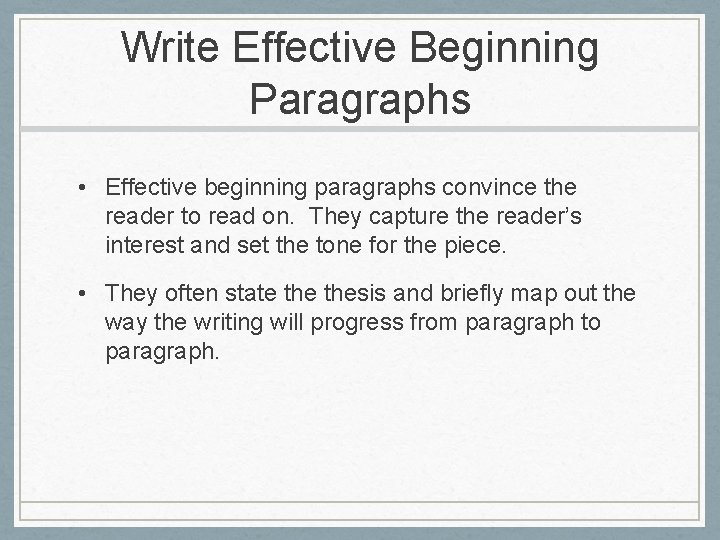
Write Effective Beginning Paragraphs • Effective beginning paragraphs convince the reader to read on. They capture the reader’s interest and set the tone for the piece. • They often state thesis and briefly map out the way the writing will progress from paragraph to paragraph.
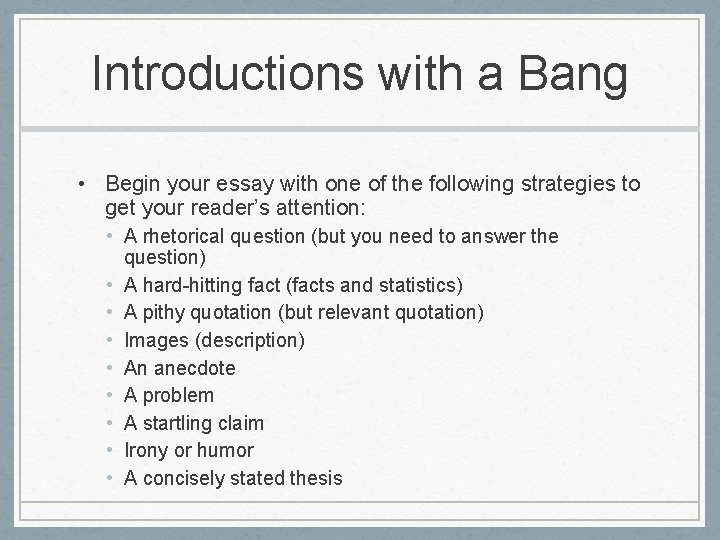
Introductions with a Bang • Begin your essay with one of the following strategies to get your reader’s attention: • A rhetorical question (but you need to answer the question) • A hard-hitting fact (facts and statistics) • A pithy quotation (but relevant quotation) • Images (description) • An anecdote • A problem • A startling claim • Irony or humor • A concisely stated thesis
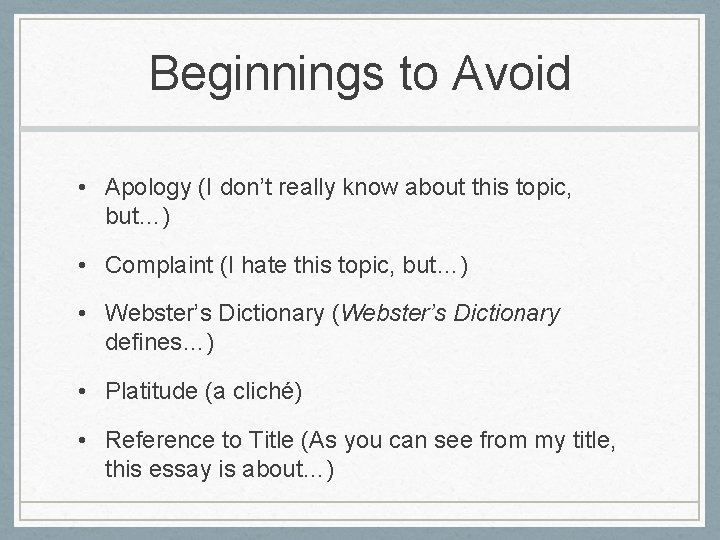
Beginnings to Avoid • Apology (I don’t really know about this topic, but…) • Complaint (I hate this topic, but…) • Webster’s Dictionary (Webster’s Dictionary defines…) • Platitude (a cliché) • Reference to Title (As you can see from my title, this essay is about…)
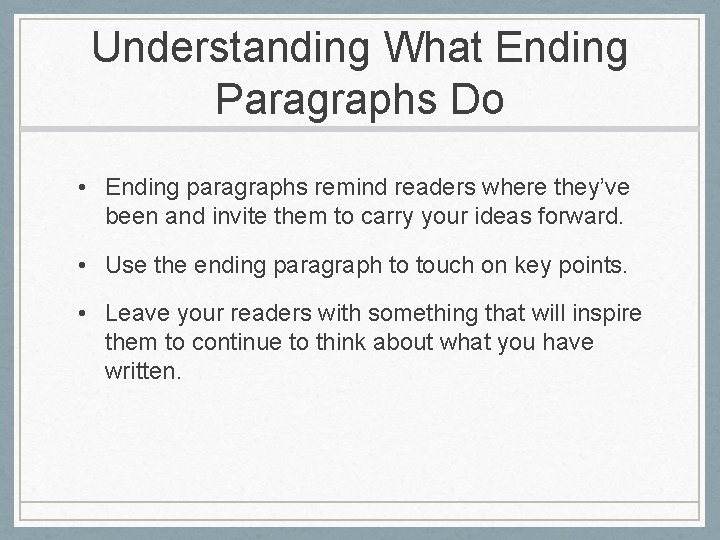
Understanding What Ending Paragraphs Do • Ending paragraphs remind readers where they’ve been and invite them to carry your ideas forward. • Use the ending paragraph to touch on key points. • Leave your readers with something that will inspire them to continue to think about what you have written.
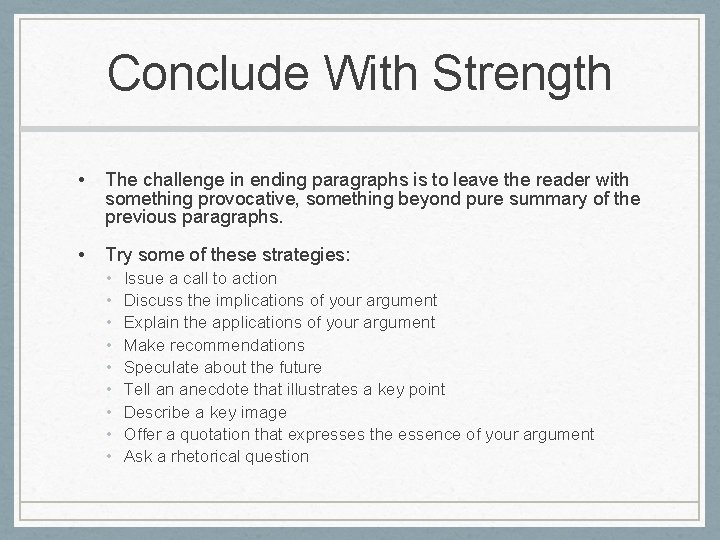
Conclude With Strength • The challenge in ending paragraphs is to leave the reader with something provocative, something beyond pure summary of the previous paragraphs. • Try some of these strategies: • • • Issue a call to action Discuss the implications of your argument Explain the applications of your argument Make recommendations Speculate about the future Tell an anecdote that illustrates a key point Describe a key image Offer a quotation that expresses the essence of your argument Ask a rhetorical question