
Paragraphs and Sentence Structure Developmental Writing II Writing


- Slides: 23
Paragraphs and Sentence Structure Developmental Writing II
Writing a Complete Paragraph • Each paragraph you write should include – A topic sentence • This will state the central idea of your paragraph. • Should be located in the first sentence or at the very least early in the paragraph. – Note**Some paragraphs will not have a thesis statement, but the topic will be clearly implied. At this point in this class you need one in each paragraph you write.
Paragraphs should also include… • Details – This will be the main part of your paragraph and will support the topic sentence. These details are what makes your writing interesting.
Paragraphs also need… • A closing statement – This statement let’s the reader know that you have completed discussing the current topic and you are moving on to the next. – This is a good time to lead into your next topic…if you can.
Introductions • Sometimes it is easier to write your introduction last. • Use a hook to gain the attention of the reader. • May give the reader some background on your topic. • Introduces the writer • Presents thesis statement and organization of the essay.
Examples of Hooks • • Question Shocking story or anecdote Quotation Striking statement or fact
Conclusion Paragraphs • • Remember: This is your last impression. Restatement of your thesis in a new way. Predictions or recommendations on your proposal Solutions to problems you have raised Quotation to support your ideas Reference to your introduction story Restatement of your main ideas
Things not to do in a conclusion… • Do not repeat your thesis statement • Do not introduce a new topic • Do not list your main ideas
Switching Gears…Sentences • Each sentence needs a subject and a verb – In most cases your subject is a noun – The verb is the action being expressed in the sentence – The subject and the verb must match the form of the subject…based on verb tense.
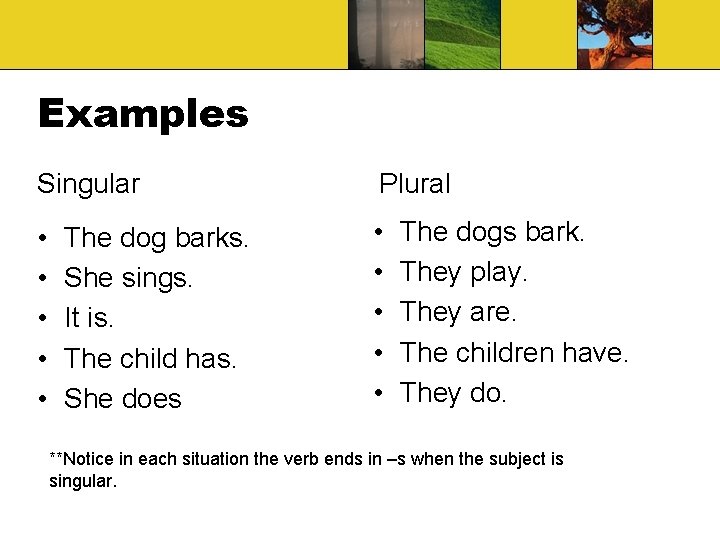
Verb Tenses • Present Tense – When writing in the present tense you will be writing in the first person. The items will be discussed as thought they are occurring now. – Most present-tense verbs that have singular subjects in in –s. Most present-tense verbs that have plural subjects do not end in –s.
Examples Singular Plural • • • The dog barks. She sings. It is. The child has. She does The dogs bark. They play. They are. The children have. They do. **Notice in each situation the verb ends in –s when the subject is singular.
Problem Areas • The wrong word is identified as the subject. • Or the writer has mistaken whether the verb is singular or plural.
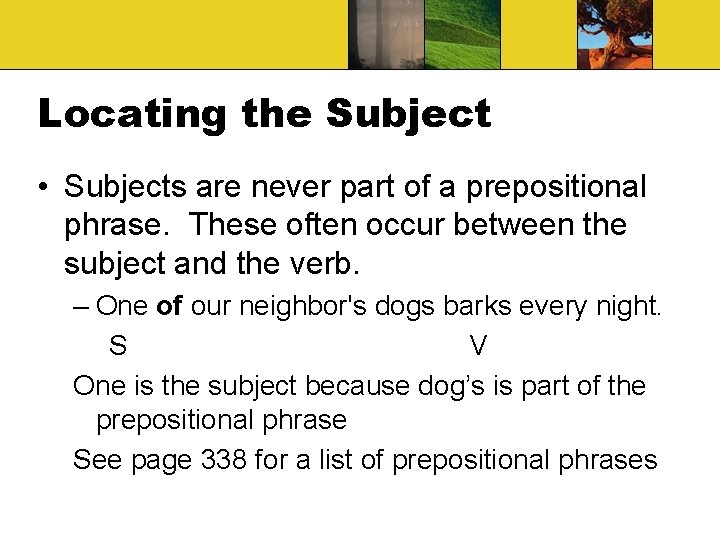
Locating the Subject • Subjects are never part of a prepositional phrase. These often occur between the subject and the verb. – One of our neighbor's dogs barks every night. S V One is the subject because dog’s is part of the prepositional phrase See page 338 for a list of prepositional phrases
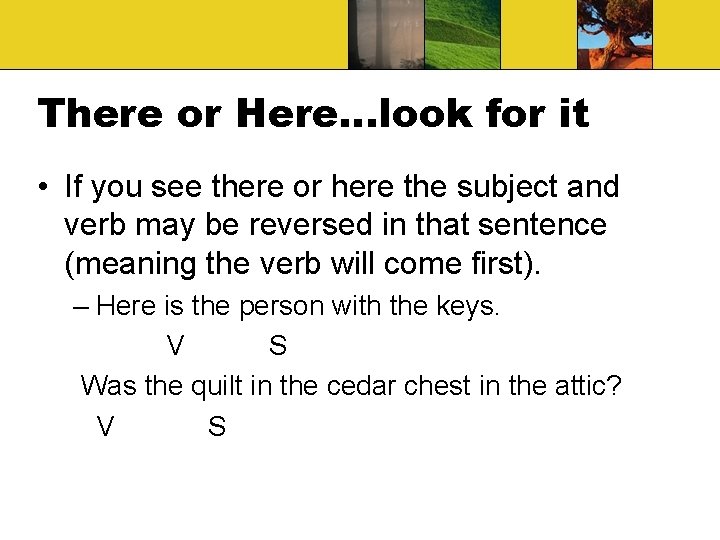
There or Here…look for it • If you see there or here the subject and verb may be reversed in that sentence (meaning the verb will come first). – Here is the person with the keys. V S Was the quilt in the cedar chest in the attic? V S
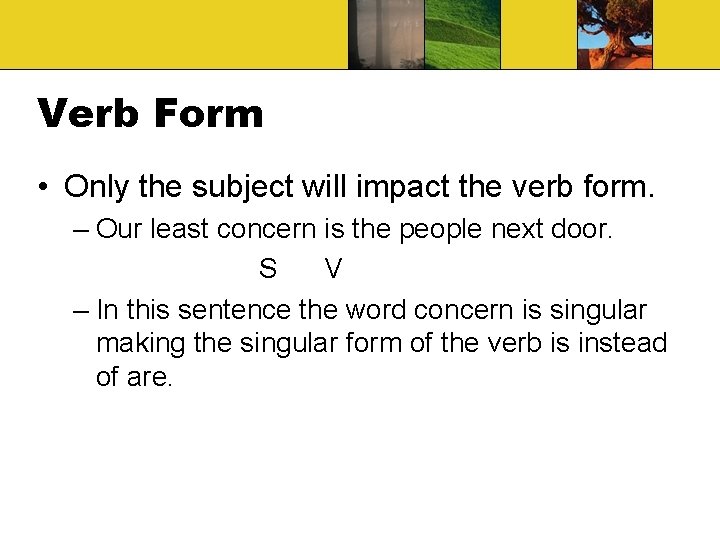
Verb Form • Only the subject will impact the verb form. – Our least concern is the people next door. S V – In this sentence the word concern is singular making the singular form of the verb is instead of are.
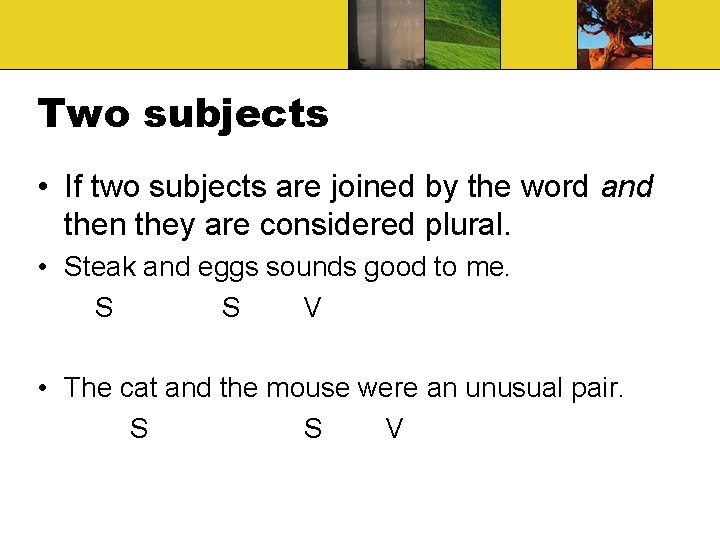
Two subjects • If two subjects are joined by the word and then they are considered plural. • Steak and eggs sounds good to me. S S V • The cat and the mouse were an unusual pair. S S V
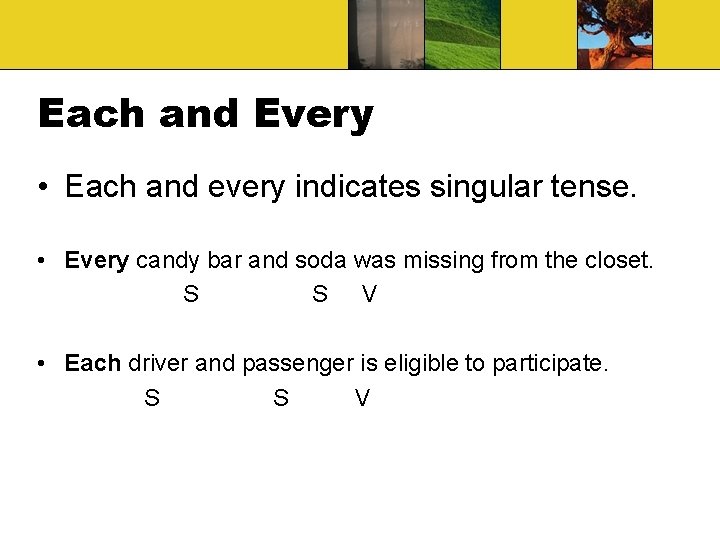
Each and Every • Each and every indicates singular tense. • Every candy bar and soda was missing from the closet. S S V • Each driver and passenger is eligible to participate. S S V
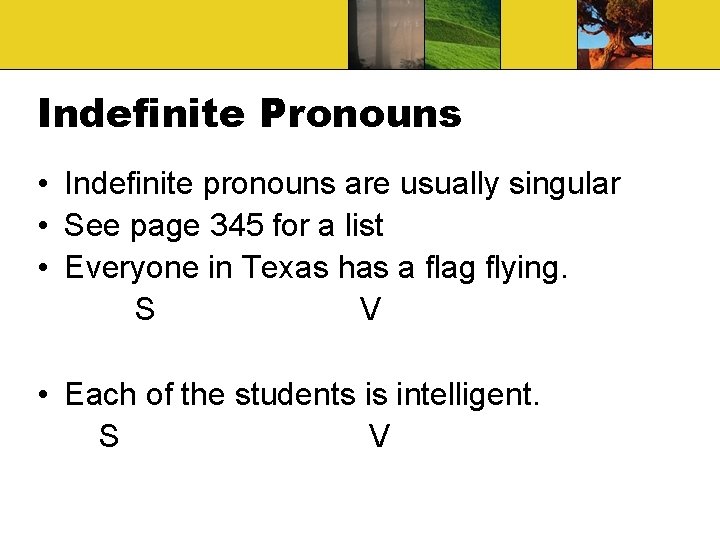
Indefinite Pronouns • Indefinite pronouns are usually singular • See page 345 for a list • Everyone in Texas has a flag flying. S V • Each of the students is intelligent. S V
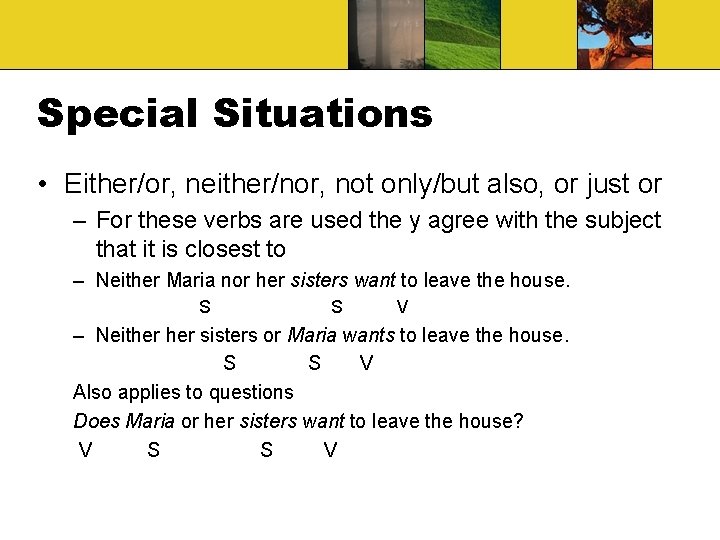
Special Situations • Either/or, neither/nor, not only/but also, or just or – For these verbs are used the y agree with the subject that it is closest to – Neither Maria nor her sisters want to leave the house. S S V – Neither sisters or Maria wants to leave the house. S S V Also applies to questions Does Maria or her sisters want to leave the house? V S S V
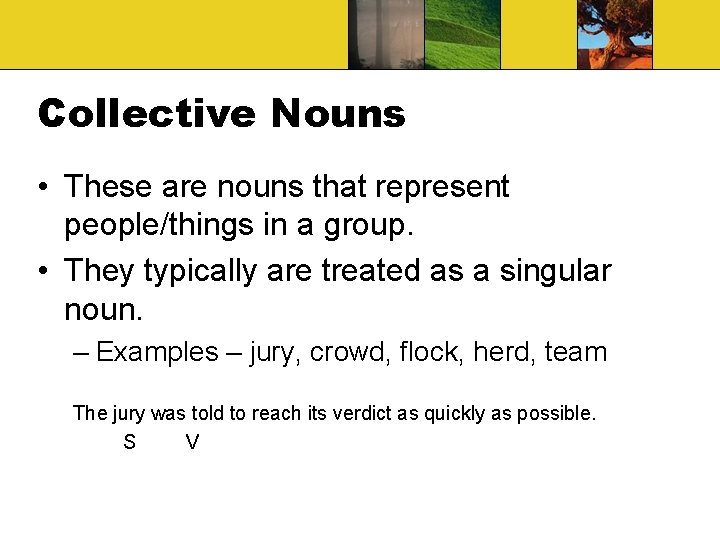
Collective Nouns • These are nouns that represent people/things in a group. • They typically are treated as a singular noun. – Examples – jury, crowd, flock, herd, team The jury was told to reach its verdict as quickly as possible. S V
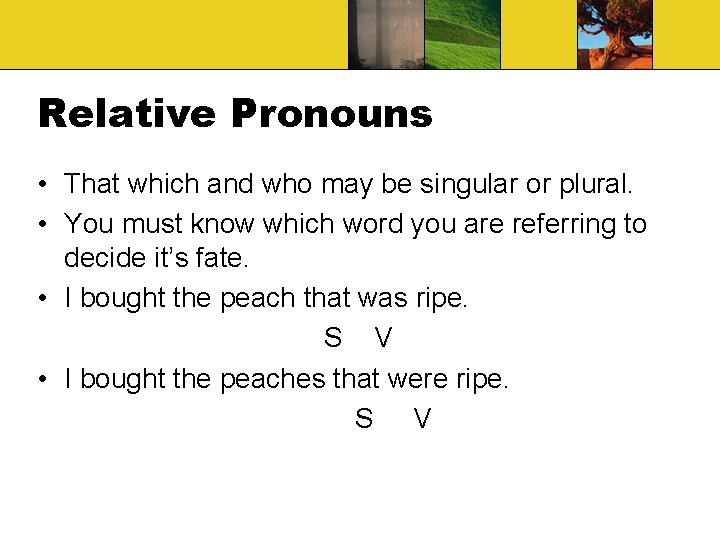
Relative Pronouns • That which and who may be singular or plural. • You must know which word you are referring to decide it’s fate. • I bought the peach that was ripe. S V • I bought the peaches that were ripe. S V
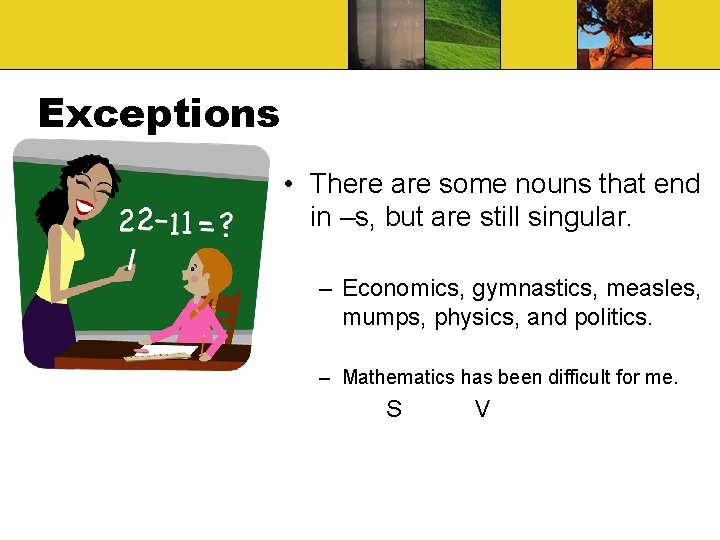
Exceptions • There are some nouns that end in –s, but are still singular. – Economics, gymnastics, measles, mumps, physics, and politics. – Mathematics has been difficult for me. S V
Units of Measurement • When units of measurement for distance, time, volume, height, weight, money, and so on are used as subjects, they usually take the singular verb form. • Five dollars is too much to pay for a gallon of gas. S V