
Paradox of Modernity Growing Connectedness of the world
- Slides: 21
Paradox of Modernity Growing Connectedness of the world is the most important social fact of our times. Increased mobility and increasing complexity Greater integration Increased capacity for aggregation and control 1
Paradox of Modernity But…. Growing dependence On effective functioning of multiple networks Increased social vulnerability in the face of accidental and intentional disruption 2
Increasing complexity of global flows Large number of interacting components Show emergent properties difficult to anticipate Critical thresholds Adaptability to random disruptions, but. . Highly vulnerable to widespread failure 3
Governance structures Capitalism is global, but governance is local WTO et al UN Treaties No central coordinating mechanism except interacting markets The sinful heart is ever the same, but sin changes its quality as society develops. Modern sin takes its character from the mutualism of our time. Under our present manner of living, how many of my vital interests I must entrust to others! …But this spread-out manner of life lays snares for the weak and opens doors to the wicked. Interdependence puts us, as it were, at one another’s mercy, and so ushers in a multitude of new forms of wrongdoing. …Every new fiduciary relation is a fresh opportunity for breach of trust. E. A. Ross, 1902 4
This exposes us to: • Risk: • Combination of: • • Exposure Uncertainty • Known knowns • Known unknowns • Unknown unknowns • Several iterations and levels 5
Exposure How resilient is the global system? Near total dependence on global flows Top 20% of countries and top 20% of population in others Catastrophic consequences of breakdown of flows 6
Sources of Risk Inside, outside and all around. 7
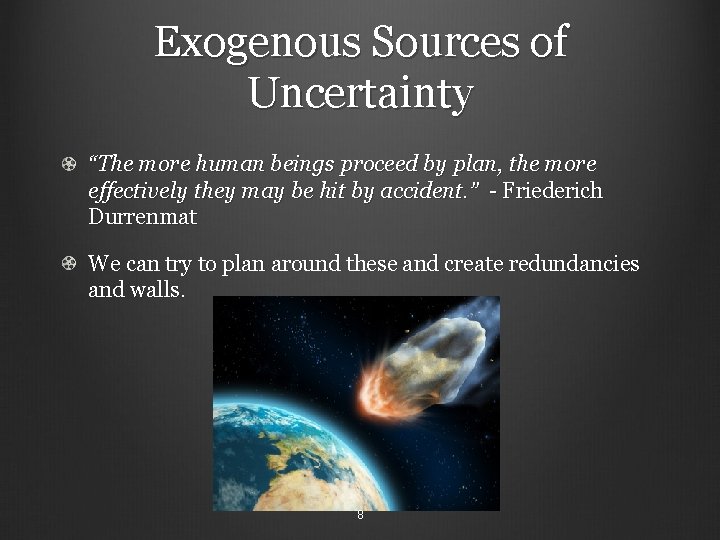
Exogenous Sources of Uncertainty “The more human beings proceed by plan, the more effectively they may be hit by accident. ” - Friederich Durrenmat We can try to plan around these and create redundancies and walls. 8
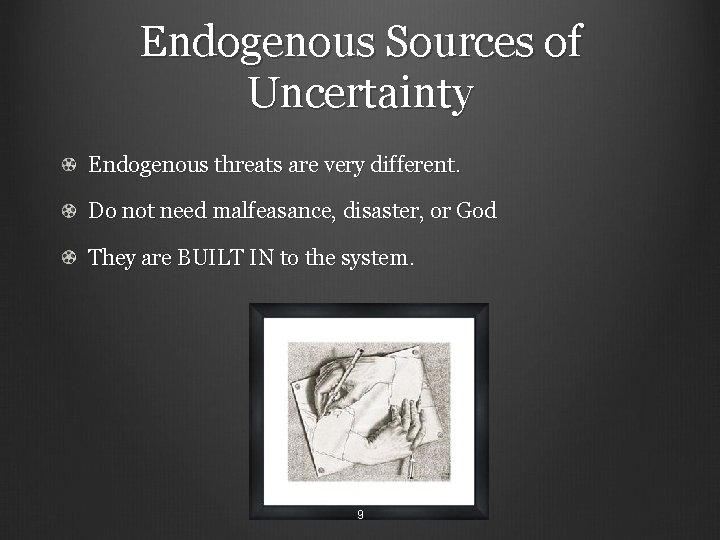
Endogenous Sources of Uncertainty Endogenous threats are very different. Do not need malfeasance, disaster, or God They are BUILT IN to the system. 9
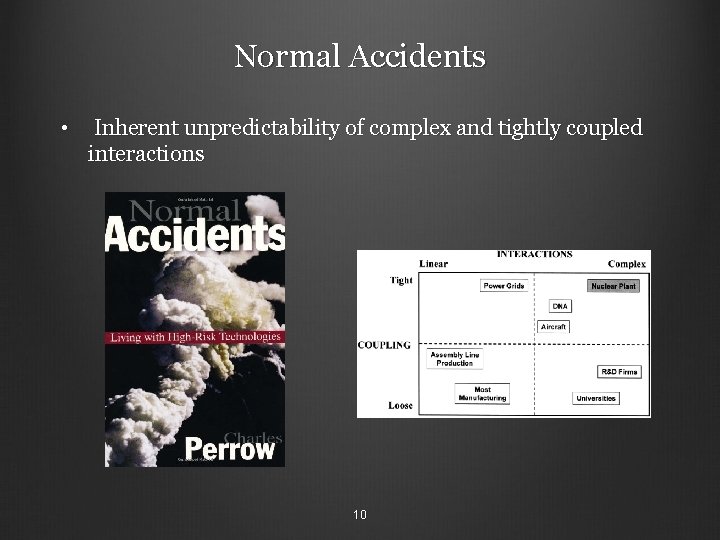
Normal Accidents • Inherent unpredictability of complex and tightly coupled interactions 10
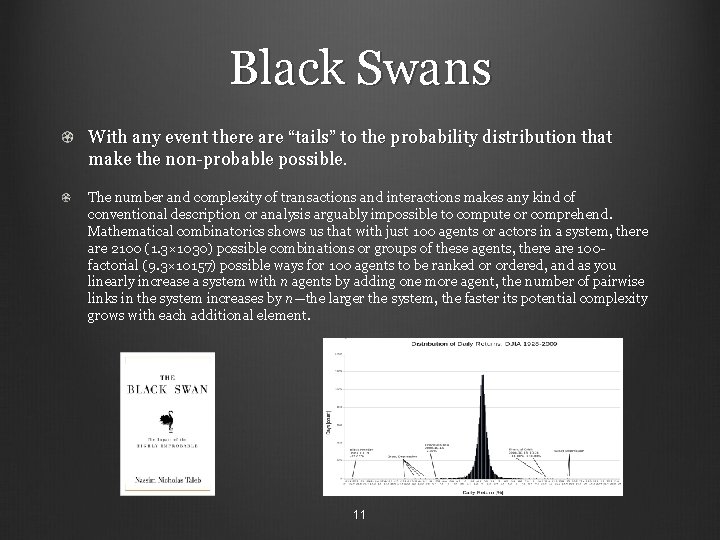
Black Swans With any event there are “tails” to the probability distribution that make the non-probable possible. The number and complexity of transactions and interactions makes any kind of conventional description or analysis arguably impossible to compute or comprehend. Mathematical combinatorics shows us that with just 100 agents or actors in a system, there are 2100 (1. 3× 1030) possible combinations or groups of these agents, there are 100 factorial (9. 3× 10157) possible ways for 100 agents to be ranked or ordered, and as you linearly increase a system with n agents by adding one more agent, the number of pairwise links in the system increases by n—the larger the system, the faster its potential complexity grows with each additional element. 11
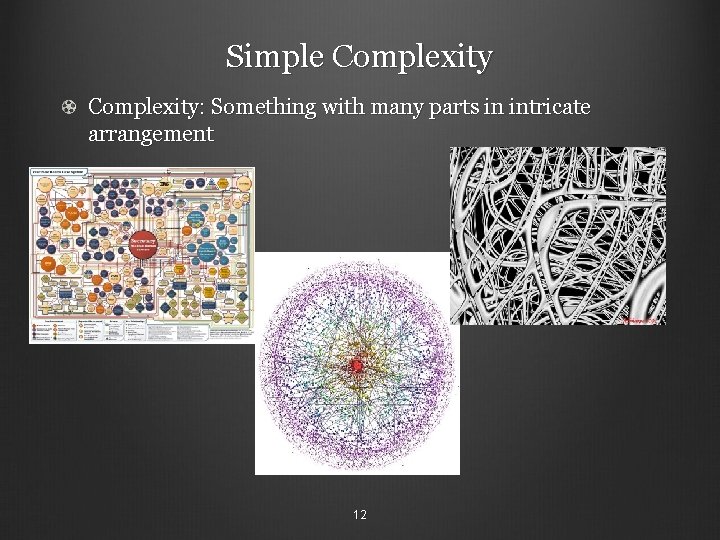
Simple Complexity: Something with many parts in intricate arrangement 12
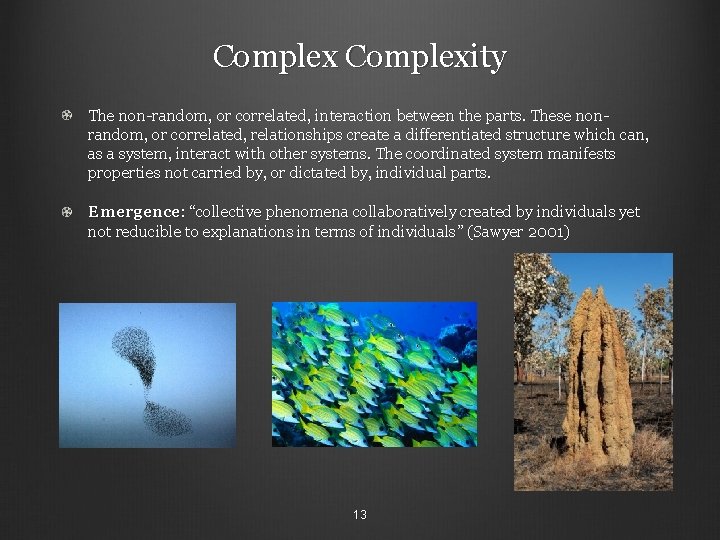
Complexity The non-random, or correlated, interaction between the parts. These nonrandom, or correlated, relationships create a differentiated structure which can, as a system, interact with other systems. The coordinated system manifests properties not carried by, or dictated by, individual parts. Emergence: “collective phenomena collaboratively created by individuals yet not reducible to explanations in terms of individuals” (Sawyer 2001) 13
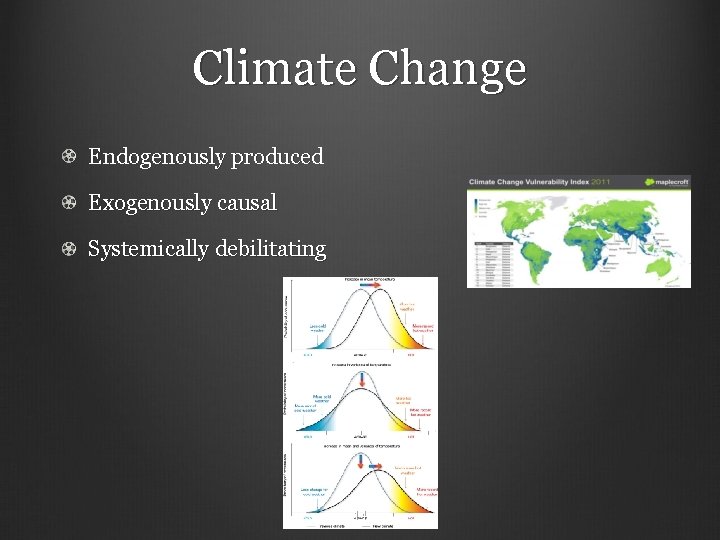
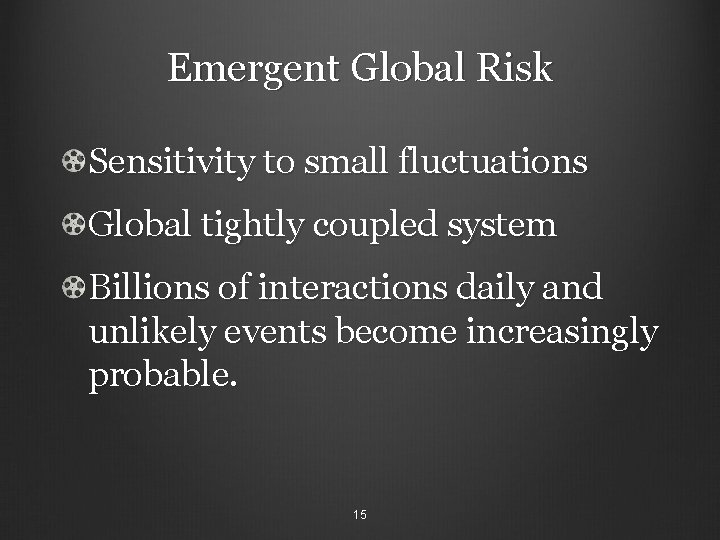
Climate Change Endogenously produced Exogenously causal Systemically debilitating 14
Emergent Global Risk Sensitivity to small fluctuations Global tightly coupled system Billions of interactions daily and unlikely events become increasingly probable. 15
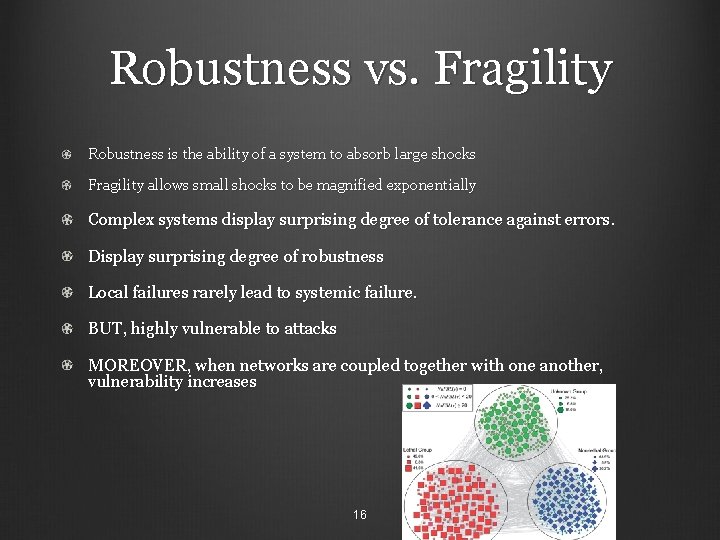
Robustness vs. Fragility Robustness is the ability of a system to absorb large shocks Fragility allows small shocks to be magnified exponentially Complex systems display surprising degree of tolerance against errors. Display surprising degree of robustness Local failures rarely lead to systemic failure. BUT, highly vulnerable to attacks MOREOVER, when networks are coupled together with one another, vulnerability increases 16
Systemic and Emergent Risk Systemic risk is risk to the “system” that is posed by the interconnections or network of its constituent parts. Systemic risk, therefore, is about connections, cascades and thresholds; it is about how local risk scales up to and develops as global risk. Emergent risk is a “social fact” with its own rules. Emergent risk arises from how individual parts are connected to form the whole, but – and this is the distinguishing point from systemic risk – it is not reducible to the individual components (Sawyer 2002; 2003). 17
Systemic and Emergent Risk What our emergent risk framework argues is that the structure of the networks that connect the parts to the whole also constitute autonomous higher-level systems that have their own dynamics and forces. The main implication is that higher-level systems could have an intra-level dynamic of their own that is independent of its lower-level constituent parts. The trajectory of change in the higher-level system would then exert a force on the lower-level parts that is unlikely to have been anticipated if one took a purely systemic approach to risk 18
Unavoidable Risks? Is there a “conservation of risk” similar to the conservation of energy? Risk can be moved around, but it cannot be eliminated from the system Example: If you purchase fire insurance on your house, you have traded fire-loss risk for the risk that your insurance company fails to deliver “counterparty risk” AIG & Lehman Brothers: Many counterparties had false sense that they had eliminated certain risks by selling those risks to counterparties, which failed Other members of the system—including taxpayers— paid consequences of the externalities 19
We are interested risks resulting from the connections between and among domains Energy exploration and production Electricity transmission Food and water supplies Agriculture (famine & crop diseases) Food production & distribution Financial system Healthcare & epidemiology Infrastructure Transportation Human travel Shipping Manufacturing & production Energy Commodities & critical inputs
Agenda for project Is emergent risk “real”? Does the system pay for its efficiency and robustness with high levels of fragility? Does it help us better understand systemic risk? Can we create a generalizable model of emergent risk? Are there any policies or institutions that would reduce it? 21