
PARABOLIC CATENARY BY Dr L BENEDICT MICHAEL RAJ

PARABOLIC CATENARY BY Dr. L. BENEDICT � � MICHAEL RAJ HEAD & ASSOCIATE PROFESSOR PG & RESEARCH DEPT. OF � MATHEMATICS � � ST. JOSEPH’S COLLEGE(AUTONOMOUS), TIRUCHIRAPPALLI – 620 002
PARABOLIC CATENARY
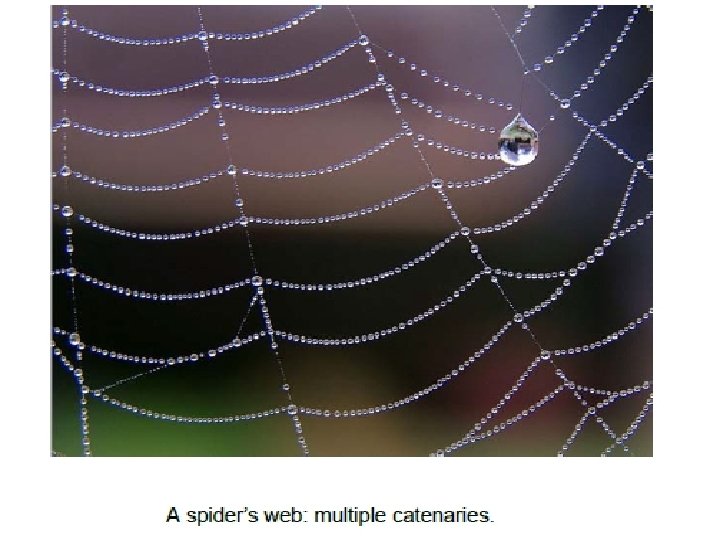
Dear Students, In today’s life, we see many real life examples of a Parabola. Some of them are 1. Suspension Bridges. 2. Flight of a Base ball. 3. Satellite dishes. 4. Smiles 5. A spider’s web (multiple catenaries)and many more…

Before we proceed to parabolic Catenary, let us see the difference between Catenary and Parabolic Catenary.
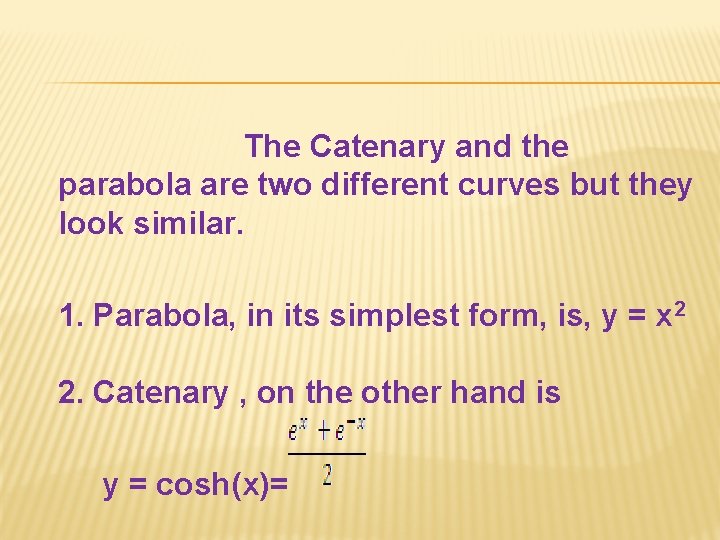
The Catenary and the parabola are two different curves but they look similar. 1. Parabola, in its simplest form, is, y = x 2 2. Catenary , on the other hand is y = cosh(x)=
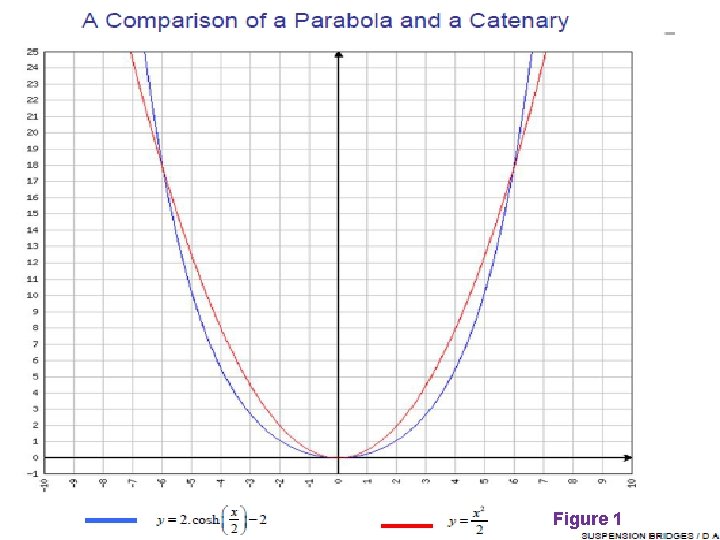
Figure 1
In the common catenary, the load per unit length of chain is constant. When a wire is stretched tightly between two points, its weight may be considered to be uniformly distributed across the span. We shall now prove the following proposition.
A string hangs under gravity and is so loaded that the weight on each element of it is proportional to the horizontal projection of that element; show that it will hang in the form of a parabola.
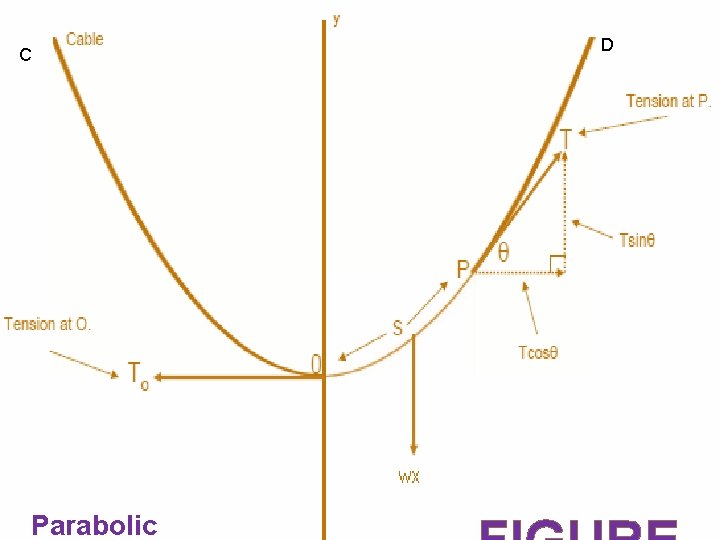
Let the string be hung from the point C and D, let A be its lowest point and take the horizontal and vertical through O as axes of x and y respectively,
C Parabolic D
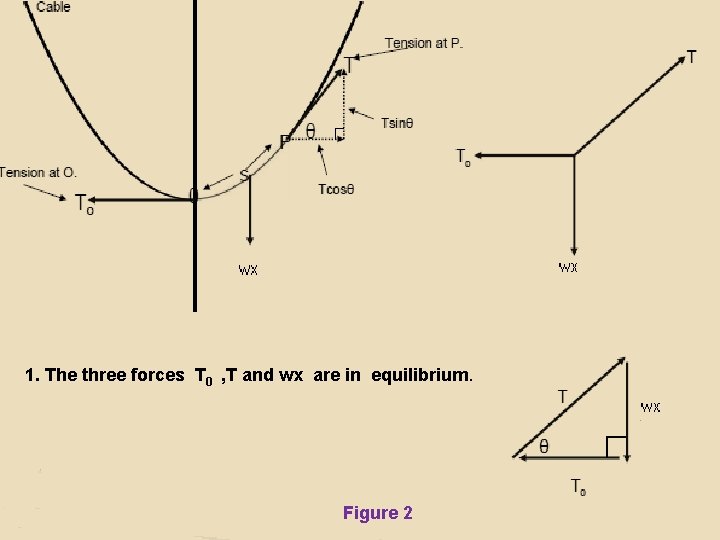
1. The three forces T 0 , T and wx are in equilibrium. Figure 2
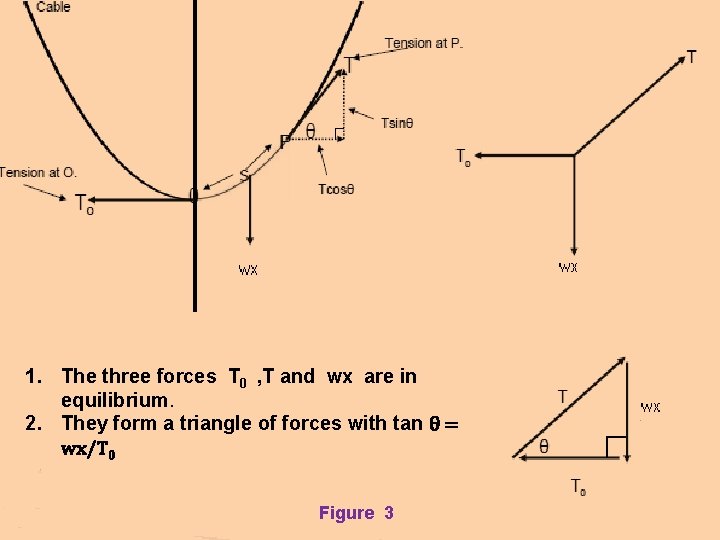
1. The three forces T 0 , T and wx are in equilibrium. 2. They form a triangle of forces with tan θ = wx/T 0 Figure 3
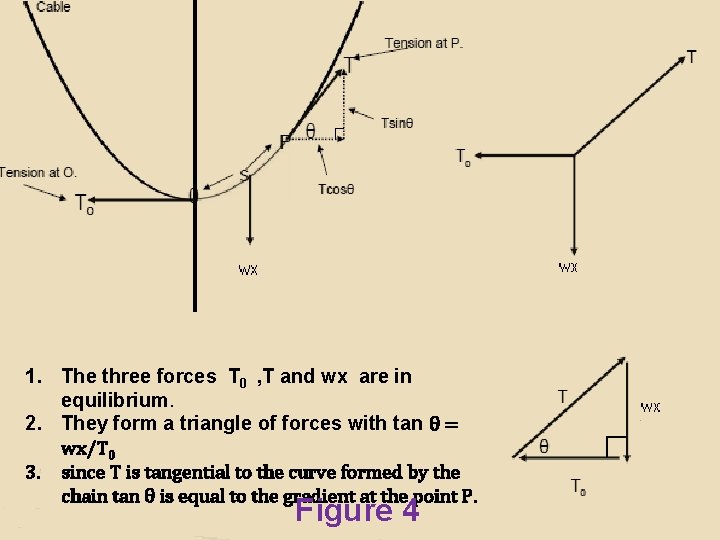
1. The three forces T 0 , T and wx are in equilibrium. 2. They form a triangle of forces with tan θ = wx/T 0 3. since T is tangential to the curve formed by the chain tan θ is equal to the gradient at the point P. Figure 4
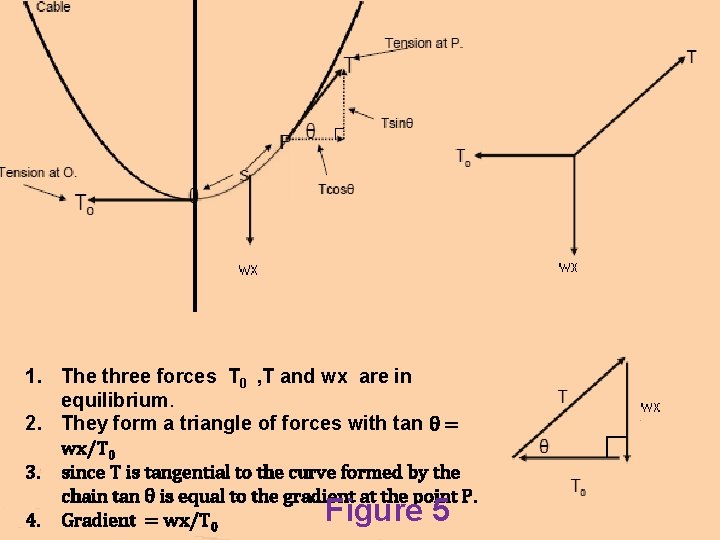
1. The three forces T 0 , T and wx are in equilibrium. 2. They form a triangle of forces with tan θ = wx/T 0 3. since T is tangential to the curve formed by the chain tan θ is equal to the gradient at the point P. Figure 5 4. Gradient = wx/T 0
Consider the equilibrium of a finite portion OP of the string and let p be (x, y). Let w be the weight per unit length of the string measured horizontally.
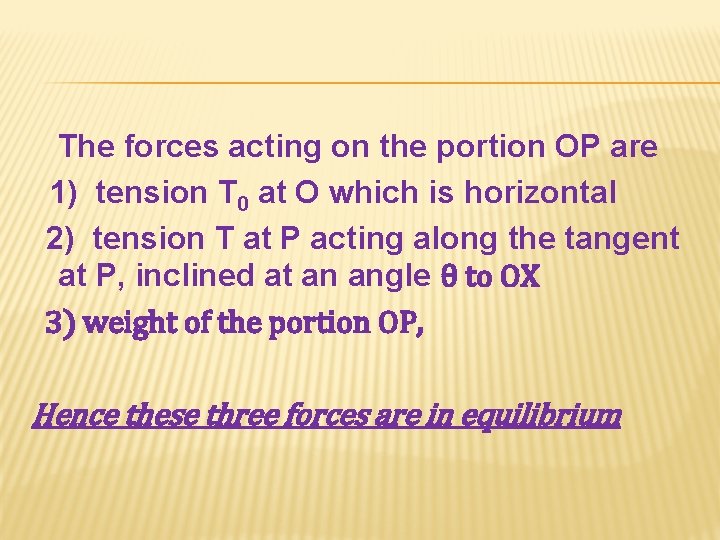
The forces acting on the portion OP are 1) tension T 0 at O which is horizontal 2) tension T at P acting along the tangent at P, inclined at an angle θ to OX 3) weight of the portion OP, Hence these three forces are in equilibrium
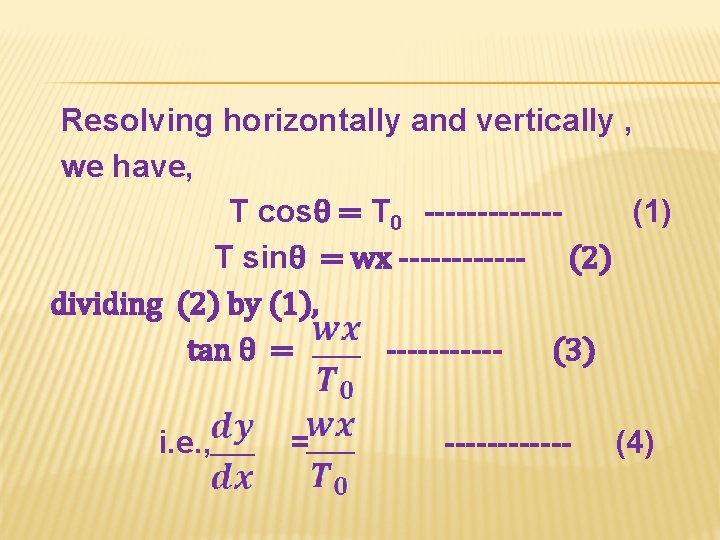
Resolving horizontally and vertically , we have, T cosθ = T 0 ------(1) T sinθ = wx ------ (2) dividing (2) by (1), tan θ = -----(3) i. e. , = ------ (4)
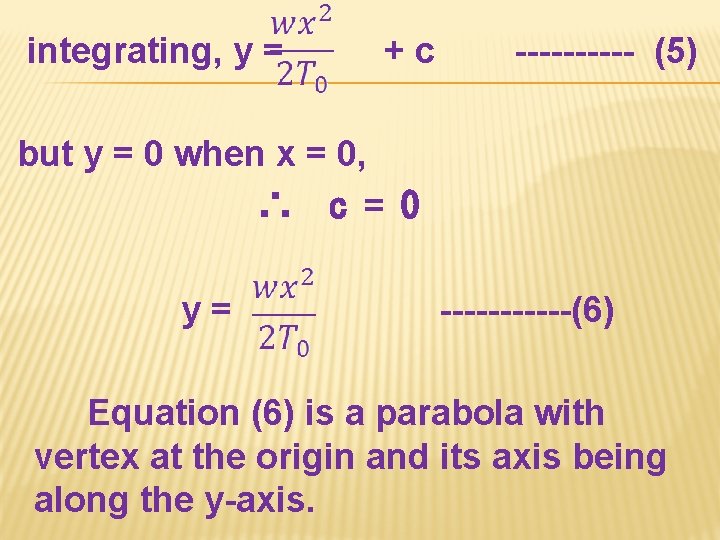
integrating, y = +c ----- (5) but y = 0 when x = 0, ∴ c = 0 y= ------(6) Equation (6) is a parabola with vertex at the origin and its axis being along the y-axis.
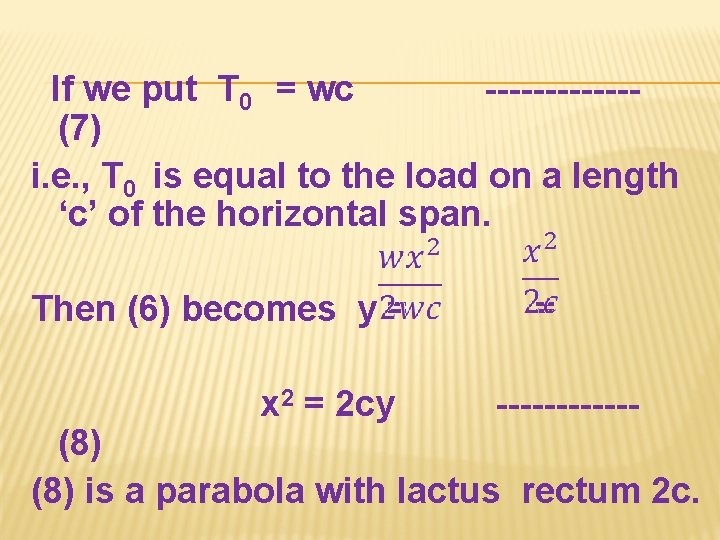
If we put T 0 = wc ------(7) i. e. , T 0 is equal to the load on a length ‘c’ of the horizontal span. Then (6) becomes y = x 2 = 2 cy = ------ (8) is a parabola with lactus rectum 2 c.
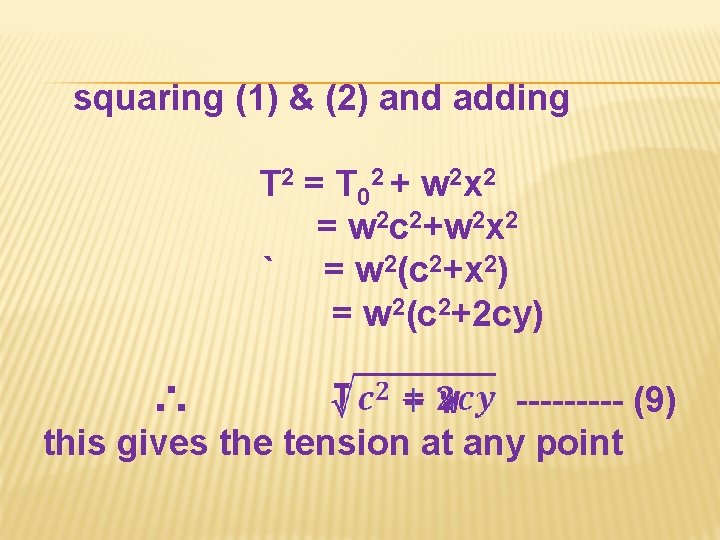
squaring (1) & (2) and adding T 2 = T 02 + w 2 x 2 = w 2 c 2+w 2 x 2 ` = w 2(c 2+x 2) = w 2(c 2+2 cy) ∴ T = w ----- (9) this gives the tension at any point
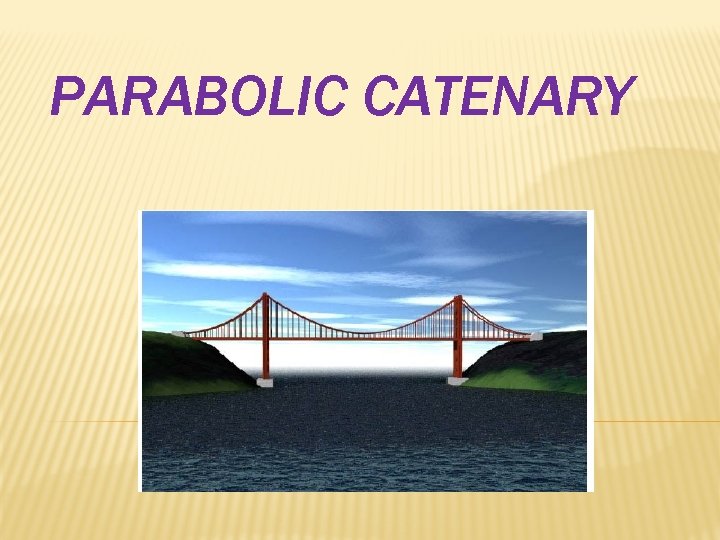
Now , we discuss about one of the real life parabola (i. e. , ) Suspension Bridges.
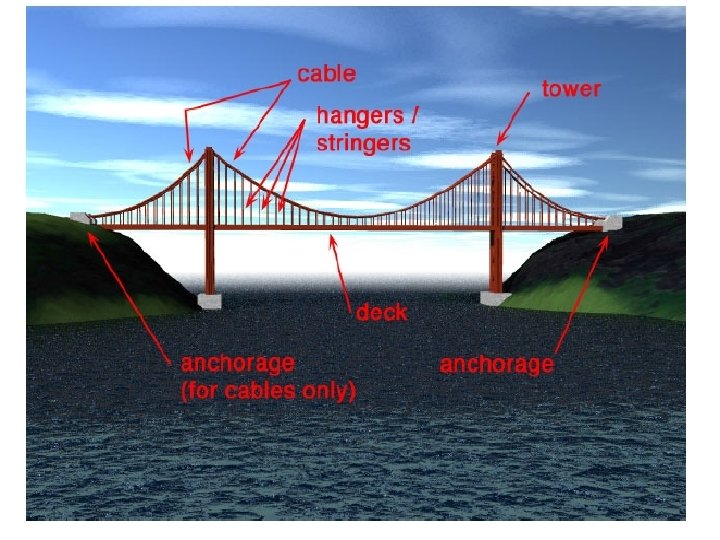
The weight of the chain itself and the weights of the supporting rods may be neglected in comparison with that of the horizontal roadway. The weight supported by each of the rods may therefore be taken to be the weight of equal portions of the roadway. Thus , we have the case of parabolic catenary.
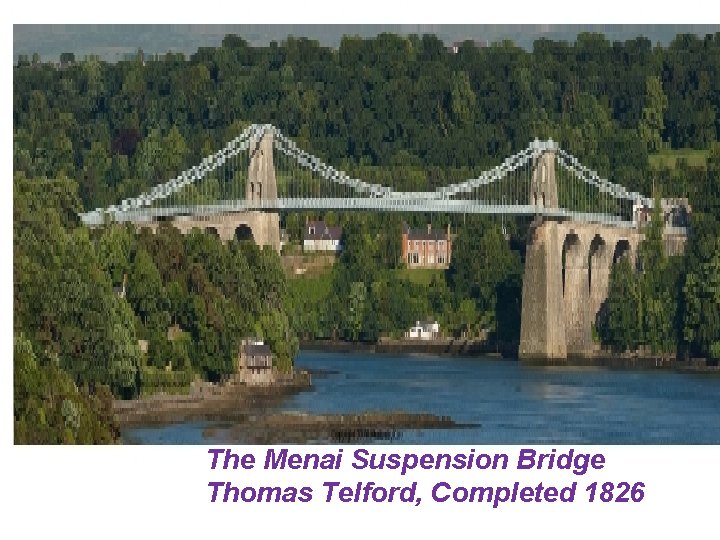
The Menai Suspension Bridge Thomas Telford, Completed 1826
Hence the figure of each chain of a suspension bridge approximates very closely to that of a parabola. We will have therefore two parallel parabolas.
- Slides: 26