
PAPR Reduction for BandwidthAggregated OFDM and SCFDMA Systems
PAPR Reduction for Bandwidth-Aggregated OFDM and SC-FDMA Systems Chen-Yu Wen M 10107618 Date: 102. 11. 28 1
Outline n n Uplink System Model Proposed PAPR Reduction Scheme u u n PAPR Optimization Interval Group Selection PAPR Reduction 2
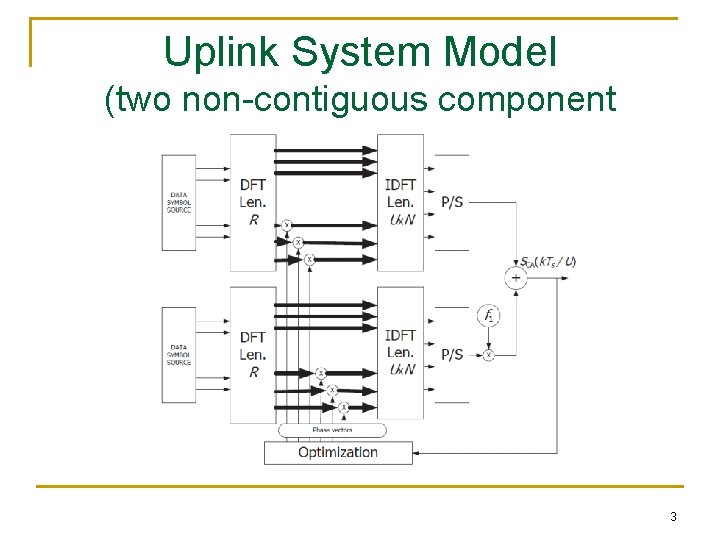
Uplink System Model (two non-contiguous component carriers) 3
Proposed PAPR Reduction Scheme n 提出的方法稱為partial SLM (PSLM),結合使 用Optimization Interval 及Group selection。 4
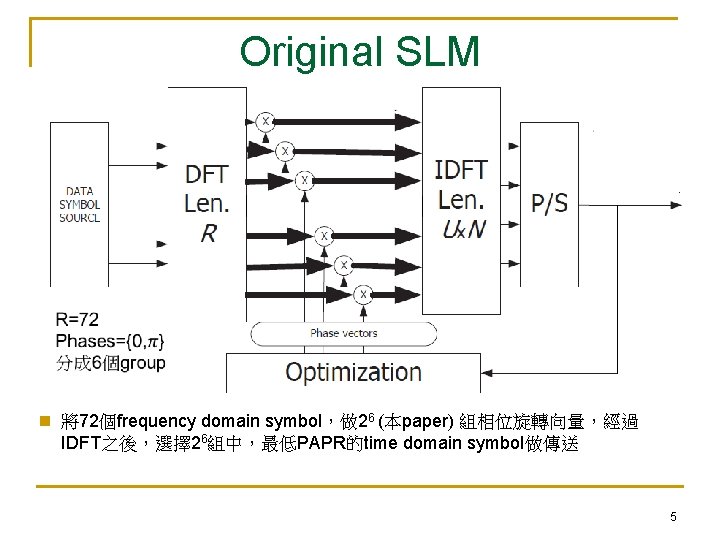
Original SLM n 將72個frequency domain symbol,做 26 (本paper) 組相位旋轉向量,經過 IDFT之後,選擇26組中,最低PAPR的time domain symbol做傳送 5
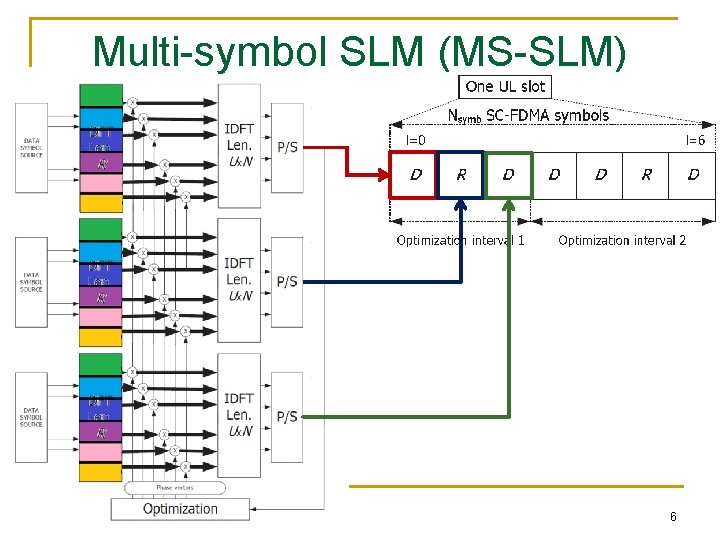
Multi-symbol SLM (MS-SLM) 6
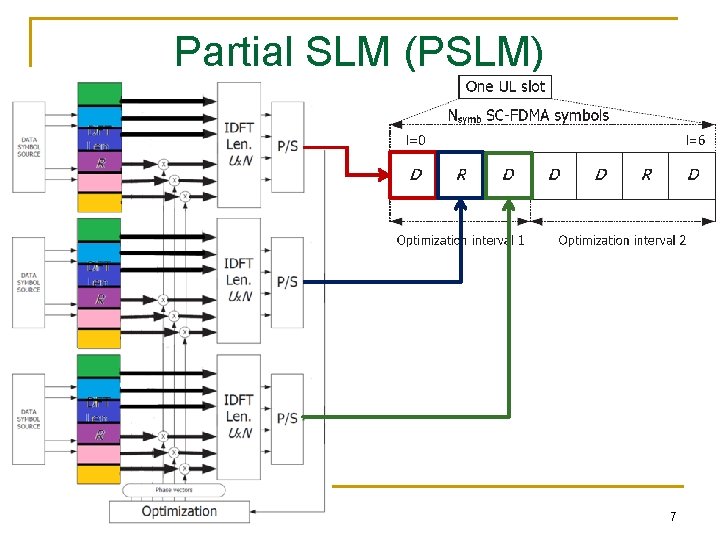
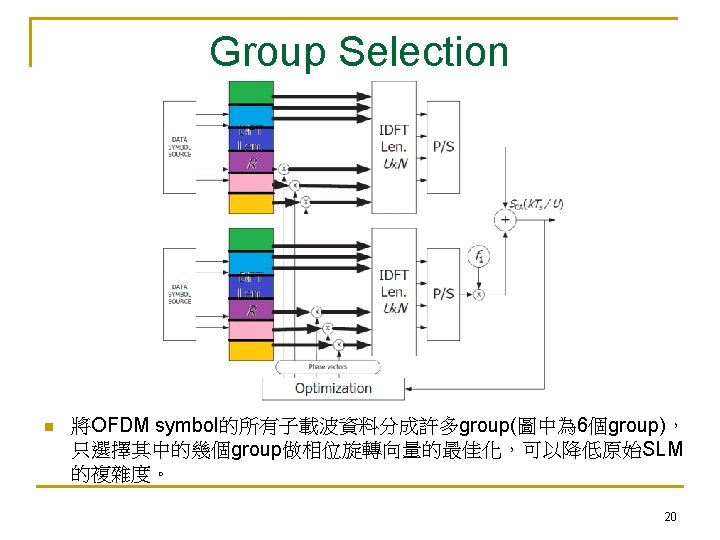
Partial SLM (PSLM) 7
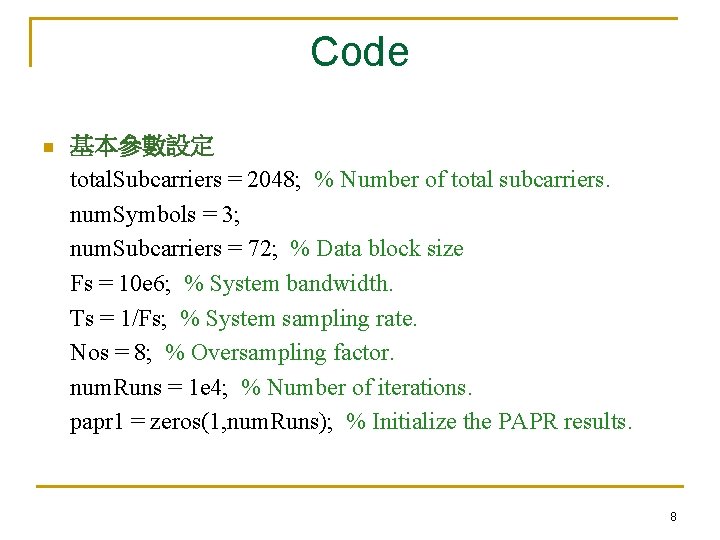
Code n 基本參數設定 total. Subcarriers = 2048; % Number of total subcarriers. num. Symbols = 3; num. Subcarriers = 72; % Data block size Fs = 10 e 6; % System bandwidth. Ts = 1/Fs; % System sampling rate. Nos = 8; % Oversampling factor. num. Runs = 1 e 4; % Number of iterations. papr 1 = zeros(1, num. Runs); % Initialize the PAPR results. 8
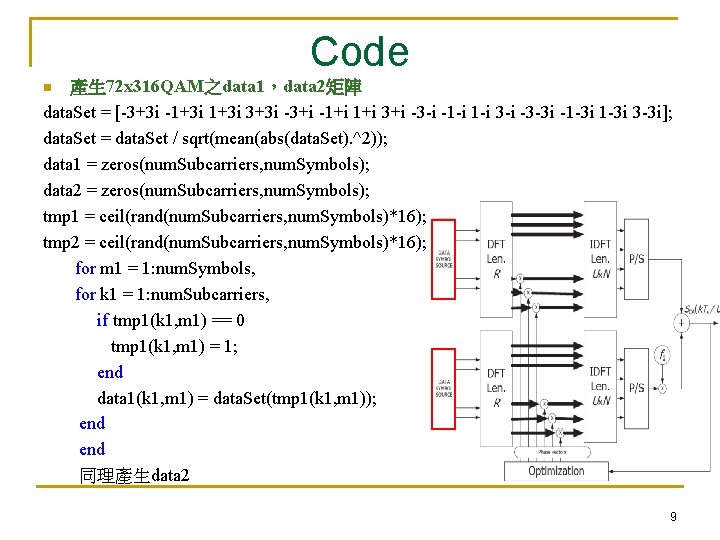
Code 產生 72 x 316 QAM之data 1,data 2矩陣 data. Set = [-3+3 i -1+3 i 3+3 i -3+i -1+i 3+i -3 -i -1 -i 3 -i -3 -3 i -1 -3 i 3 -3 i]; data. Set = data. Set / sqrt(mean(abs(data. Set). ^2)); data 1 = zeros(num. Subcarriers, num. Symbols); data 2 = zeros(num. Subcarriers, num. Symbols); tmp 1 = ceil(rand(num. Subcarriers, num. Symbols)*16); tmp 2 = ceil(rand(num. Subcarriers, num. Symbols)*16); for m 1 = 1: num. Symbols, for k 1 = 1: num. Subcarriers, if tmp 1(k 1, m 1) == 0 tmp 1(k 1, m 1) = 1; end data 1(k 1, m 1) = data. Set(tmp 1(k 1, m 1)); end 同理產生data 2 n 9
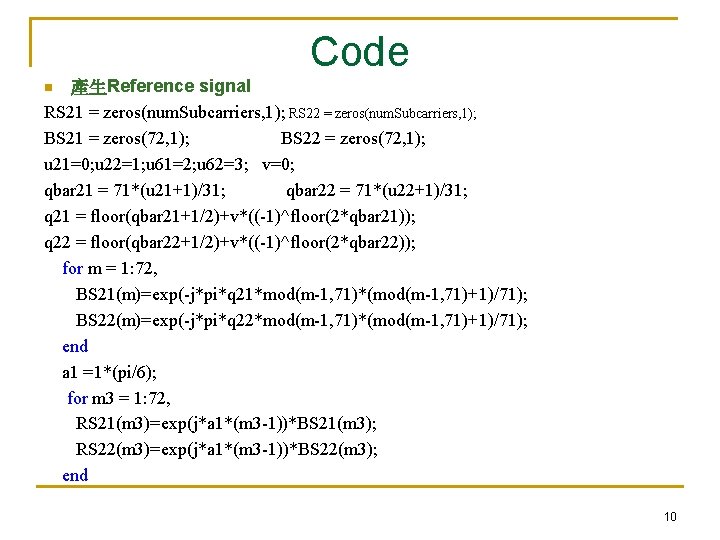
Code 產生Reference signal RS 21 = zeros(num. Subcarriers, 1); RS 22 = zeros(num. Subcarriers, 1); BS 21 = zeros(72, 1); BS 22 = zeros(72, 1); u 21=0; u 22=1; u 61=2; u 62=3; v=0; qbar 21 = 71*(u 21+1)/31; qbar 22 = 71*(u 22+1)/31; q 21 = floor(qbar 21+1/2)+v*((-1)^floor(2*qbar 21)); q 22 = floor(qbar 22+1/2)+v*((-1)^floor(2*qbar 22)); for m = 1: 72, BS 21(m)=exp(-j*pi*q 21*mod(m-1, 71)*(mod(m-1, 71)+1)/71); BS 22(m)=exp(-j*pi*q 22*mod(m-1, 71)*(mod(m-1, 71)+1)/71); end a 1 =1*(pi/6); for m 3 = 1: 72, RS 21(m 3)=exp(j*a 1*(m 3 -1))*BS 21(m 3); RS 22(m 3)=exp(j*a 1*(m 3 -1))*BS 22(m 3); end n 10
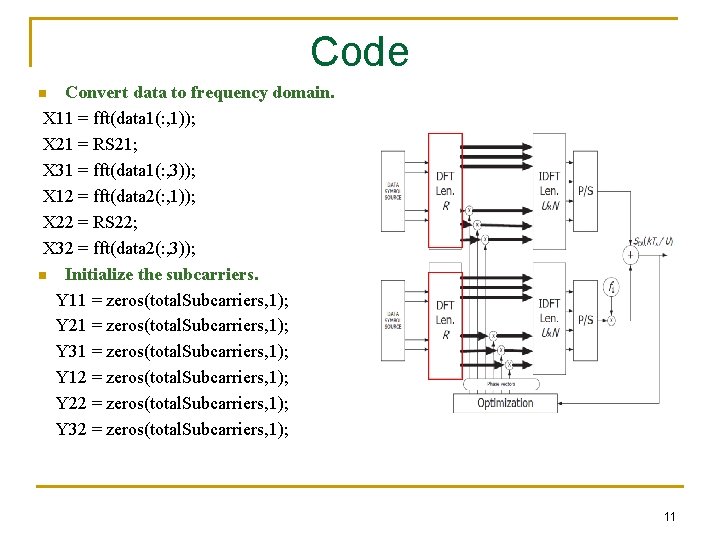
Code Convert data to frequency domain. X 11 = fft(data 1(: , 1)); X 21 = RS 21; X 31 = fft(data 1(: , 3)); X 12 = fft(data 2(: , 1)); X 22 = RS 22; X 32 = fft(data 2(: , 3)); n Initialize the subcarriers. Y 11 = zeros(total. Subcarriers, 1); Y 21 = zeros(total. Subcarriers, 1); Y 31 = zeros(total. Subcarriers, 1); Y 12 = zeros(total. Subcarriers, 1); Y 22 = zeros(total. Subcarriers, 1); Y 32 = zeros(total. Subcarriers, 1); n 11
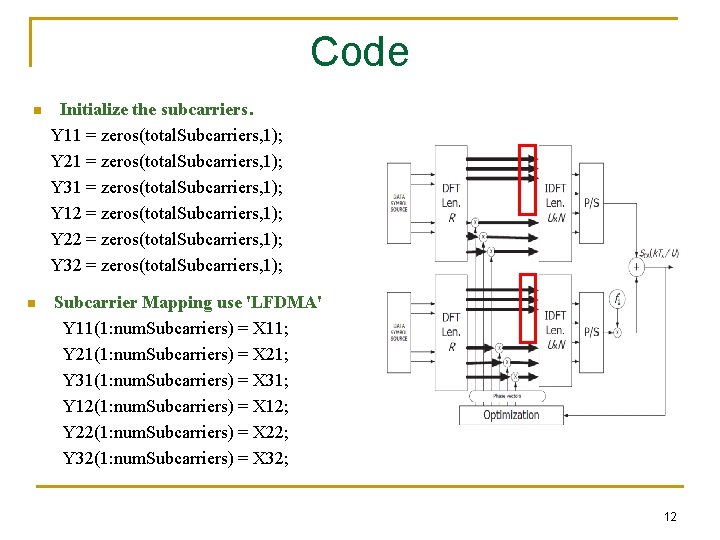
Code Initialize the subcarriers. Y 11 = zeros(total. Subcarriers, 1); Y 21 = zeros(total. Subcarriers, 1); Y 31 = zeros(total. Subcarriers, 1); Y 12 = zeros(total. Subcarriers, 1); Y 22 = zeros(total. Subcarriers, 1); Y 32 = zeros(total. Subcarriers, 1); n Subcarrier Mapping use 'LFDMA' Y 11(1: num. Subcarriers) = X 11; Y 21(1: num. Subcarriers) = X 21; Y 31(1: num. Subcarriers) = X 31; Y 12(1: num. Subcarriers) = X 12; Y 22(1: num. Subcarriers) = X 22; Y 32(1: num. Subcarriers) = X 32; n 12
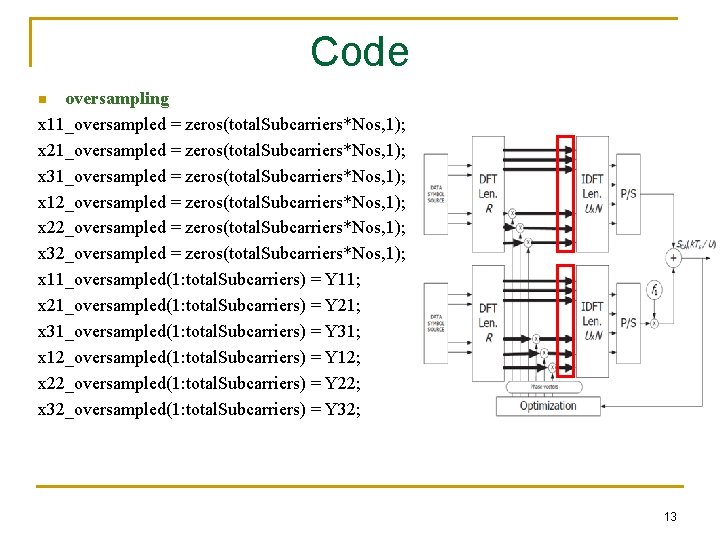
Code oversampling x 11_oversampled = zeros(total. Subcarriers*Nos, 1); x 21_oversampled = zeros(total. Subcarriers*Nos, 1); x 31_oversampled = zeros(total. Subcarriers*Nos, 1); x 12_oversampled = zeros(total. Subcarriers*Nos, 1); x 22_oversampled = zeros(total. Subcarriers*Nos, 1); x 32_oversampled = zeros(total. Subcarriers*Nos, 1); x 11_oversampled(1: total. Subcarriers) = Y 11; x 21_oversampled(1: total. Subcarriers) = Y 21; x 31_oversampled(1: total. Subcarriers) = Y 31; x 12_oversampled(1: total. Subcarriers) = Y 12; x 22_oversampled(1: total. Subcarriers) = Y 22; x 32_oversampled(1: total. Subcarriers) = Y 32; n 13
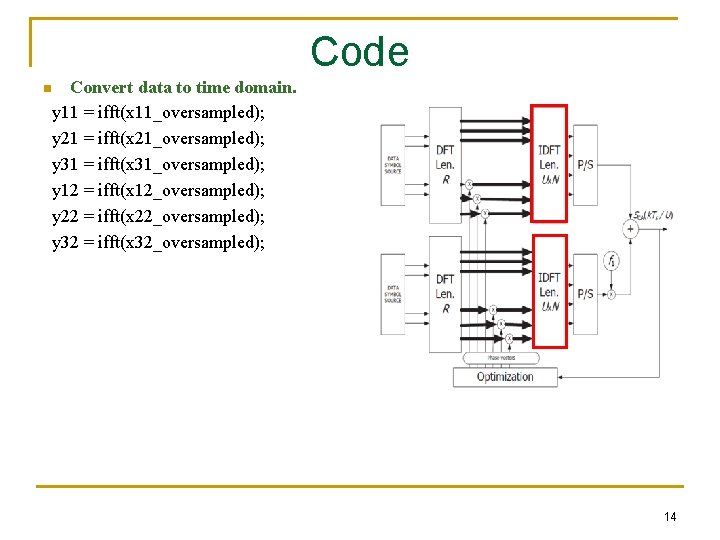
Code Convert data to time domain. y 11 = ifft(x 11_oversampled); y 21 = ifft(x 21_oversampled); y 31 = ifft(x 31_oversampled); y 12 = ifft(x 12_oversampled); y 22 = ifft(x 22_oversampled); y 32 = ifft(x 32_oversampled); n 14
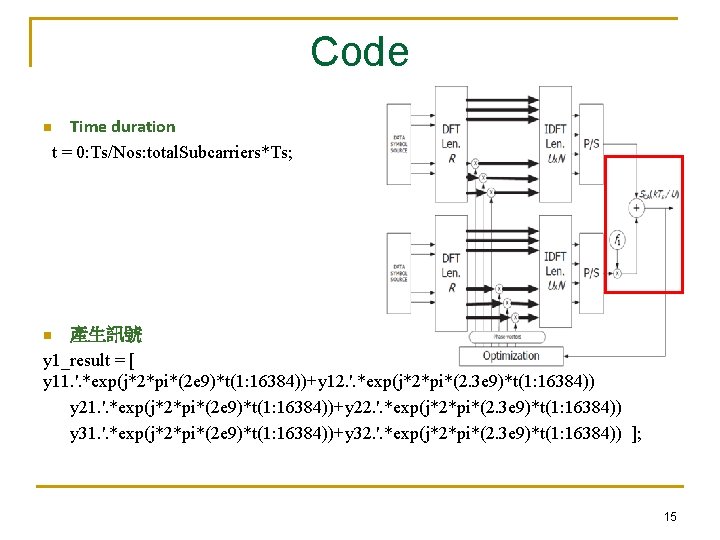
Code Time duration t = 0: Ts/Nos: total. Subcarriers*Ts; n 產生訊號 y 1_result = [ y 11. '. *exp(j*2*pi*(2 e 9)*t(1: 16384))+y 12. '. *exp(j*2*pi*(2. 3 e 9)*t(1: 16384)) y 21. '. *exp(j*2*pi*(2 e 9)*t(1: 16384))+y 22. '. *exp(j*2*pi*(2. 3 e 9)*t(1: 16384)) y 31. '. *exp(j*2*pi*(2 e 9)*t(1: 16384))+y 32. '. *exp(j*2*pi*(2. 3 e 9)*t(1: 16384)) ]; n 15
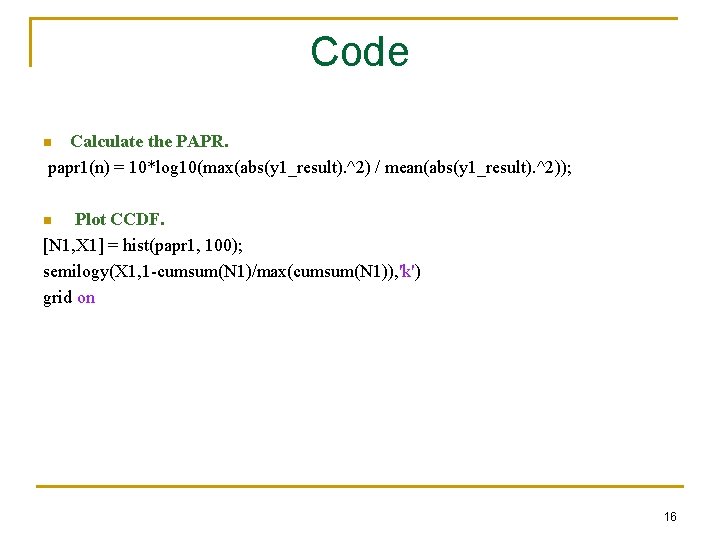
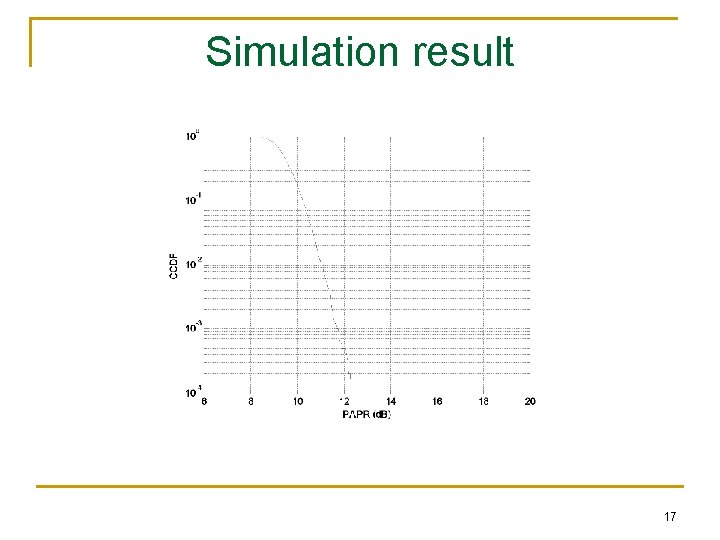
Code Calculate the PAPR. papr 1(n) = 10*log 10(max(abs(y 1_result). ^2) / mean(abs(y 1_result). ^2)); n Plot CCDF. [N 1, X 1] = hist(papr 1, 100); semilogy(X 1, 1 -cumsum(N 1)/max(cumsum(N 1)), 'k') grid on n 16
Simulation result 17
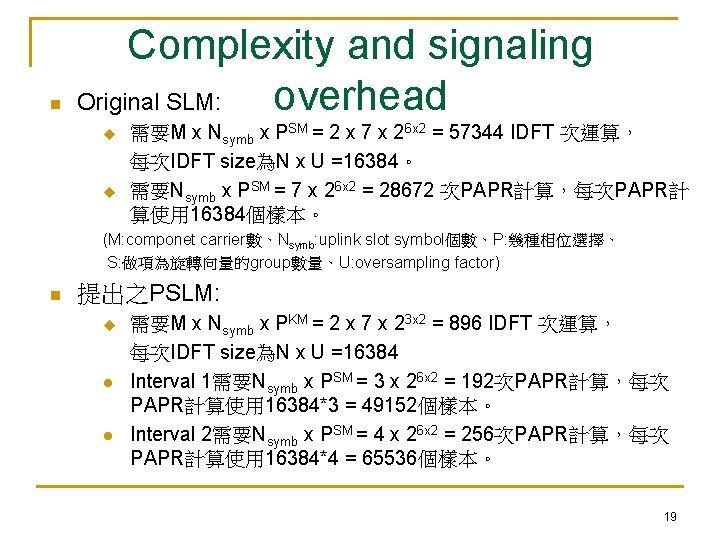
n Complexity and signaling overhead Original SLM: 需要M x Nsymb x PSM = 2 x 7 x 26 x 2 = 57344 IDFT 次運算, 每次IDFT size為N x U =16384。 u 需要Nsymb x PSM = 7 x 26 x 2 = 28672 次PAPR計算,每次PAPR計 算使用 16384個樣本。 u (M: componet carrier數、Nsymb: uplink slot symbol個數、P: 幾種相位選擇、 S: 做項為旋轉向量的group數量、U: oversampling factor) n 提出之PSLM: 需要M x Nsymb x PKM = 2 x 7 x 23 x 2 = 896 IDFT 次運算, 每次IDFT size為N x U =16384 l Interval 1需要Nsymb x PSM = 3 x 26 x 2 = 192次PAPR計算,每次 PAPR計算使用 16384*3 = 49152個樣本。 l Interval 2需要Nsymb x PSM = 4 x 26 x 2 = 256次PAPR計算,每次 PAPR計算使用 16384*4 = 65536個樣本。 u 19
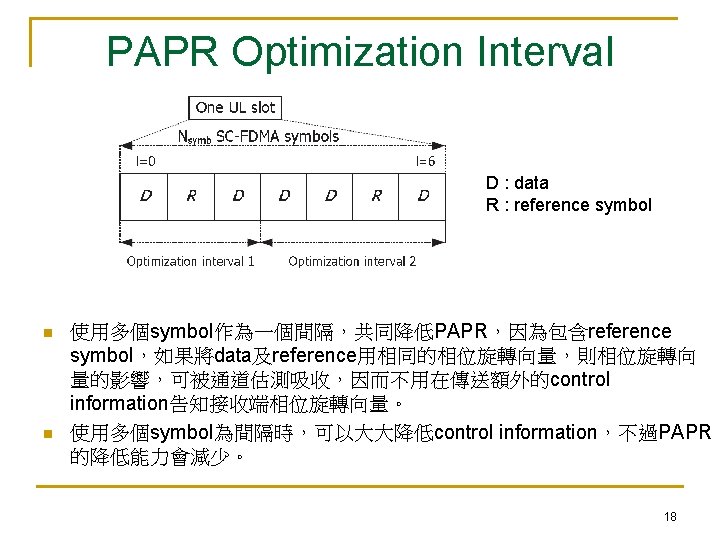
PAPR Optimization Interval n n n The choice of the PAPR optimization interval is constrained by the tradeoff between PAPR reduction capability and control signaling overhead. The optimization interval of one symbol provides the best PAPR reduction capability at the cost of substantial control signaling overhead. Using the interval with a large number of symbols will substantially save the signaling overhead but the PAPR reduction might be negligible or unjustifiable for the associated complexity. 21
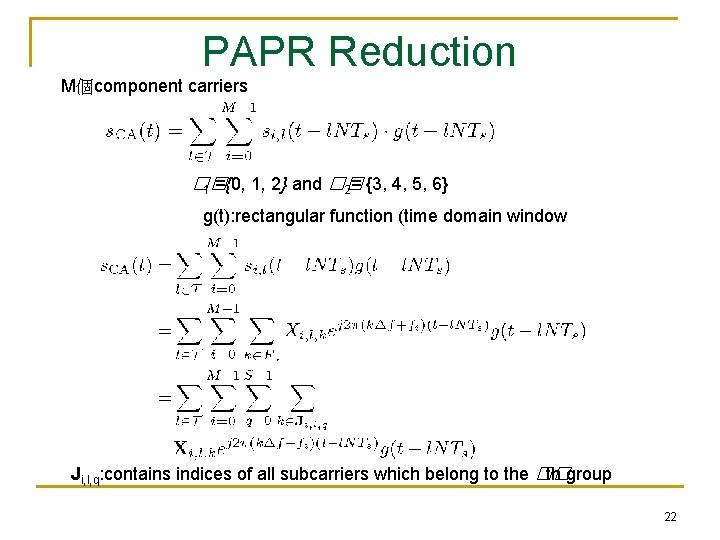
PAPR Reduction M個component carriers �� 2= {3, 4, 5, 6} 1 ={0, 1, 2} and �� g(t): rectangular function (time domain window function) Ji, l, q: contains indices of all subcarriers which belong to the �� th group 22
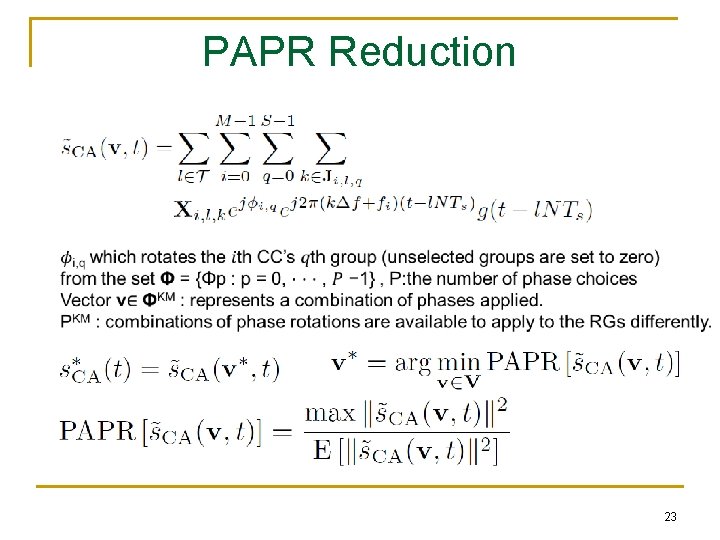
PAPR Reduction 23
Outline n n n Proposed PAPR Reduction Scheme System Model PAPR Reduction 24
Proposed PAPR Reduction Scheme n 結合頻域上的spectrum shaping及相位旋轉, 用於carrier aggregation 系統上,來降低 PAPR。 25
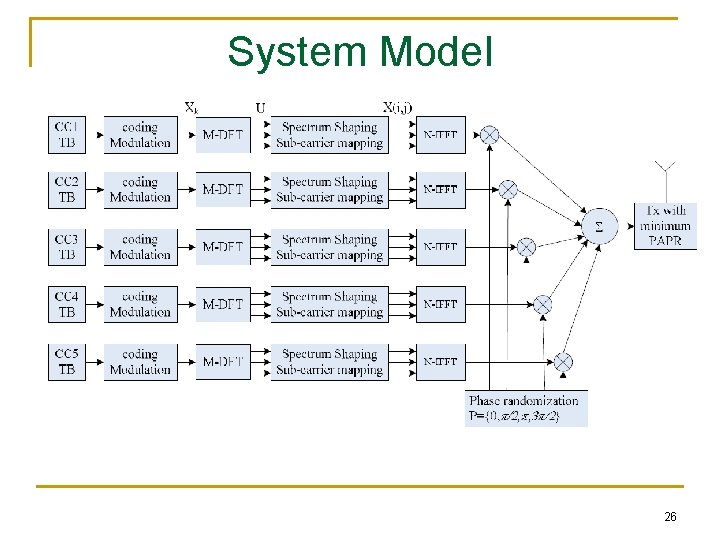
System Model 26
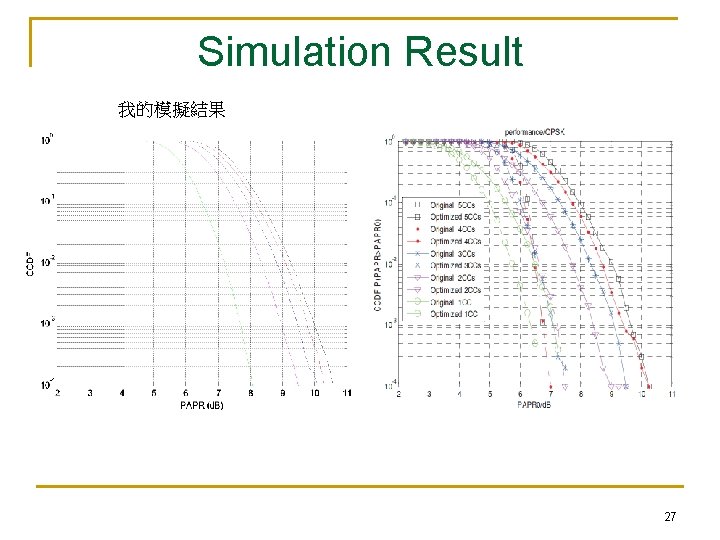
Simulation Result 我的模擬結果 27
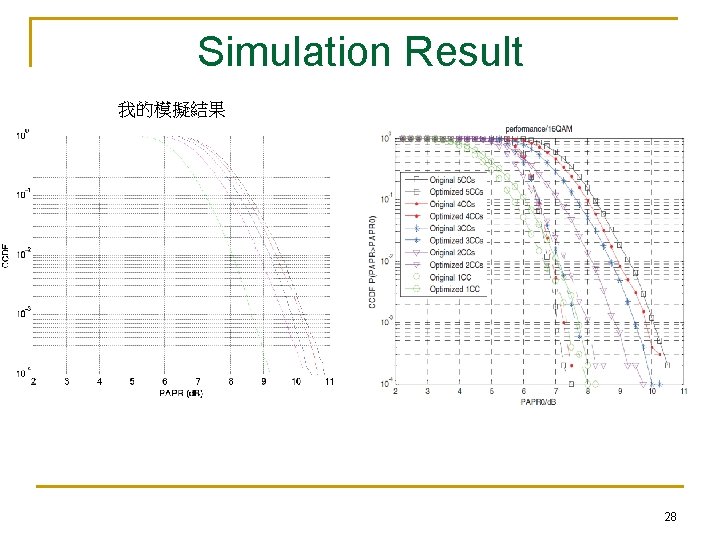
Simulation Result 我的模擬結果 28
29
- Slides: 29