
Paper Medical Record and Electronic Health Record EHR

- Slides: 37
Paper Medical Record and Electronic Health Record (EHR) PROF. AHMED ALBARRAK 1
Traditional Paper-based Medical Record • Purpose: to record observations and could be reminded of patients' details. • Input sources: • History • Notes • Lab • Radiology • Reports • Coding • Other 2
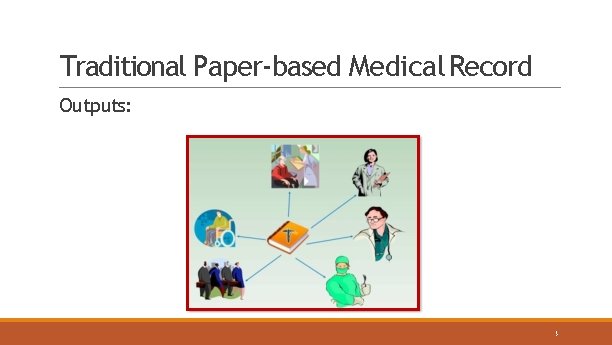
Traditional Paper-based Medical Record Outputs: 3
Paper based medical records dis(advantages) • Find the record (lost, being used elsewhere) • Find data within the record (poorly organized, missing) • Read data (legibility) • • • Update data (manual) Record fragmentation Moving records Redundancy (re-enter data in multiple forms) Statistics and Research (can not search across patients) Passive (no automated decision support) 4
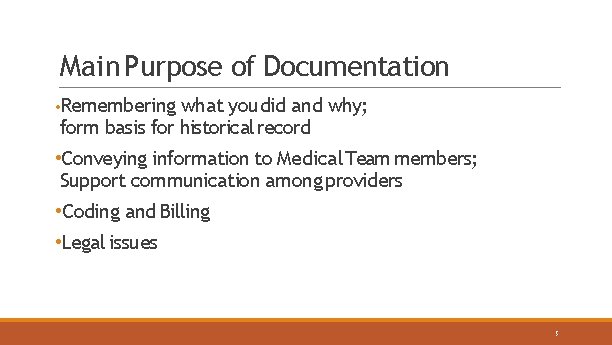
Main Purpose of Documentation • Remembering what you did and form basis for historical record why; • Conveying information to Medical Team members; Support communication among providers • Coding and Billing • Legal issues 5
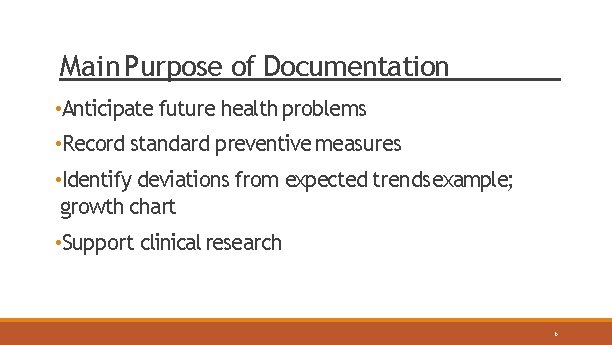
Main Purpose of Documentation • Anticipate future health problems • Record standard preventive measures • Identify deviations from expected trends example; growth chart • Support clinical research 6
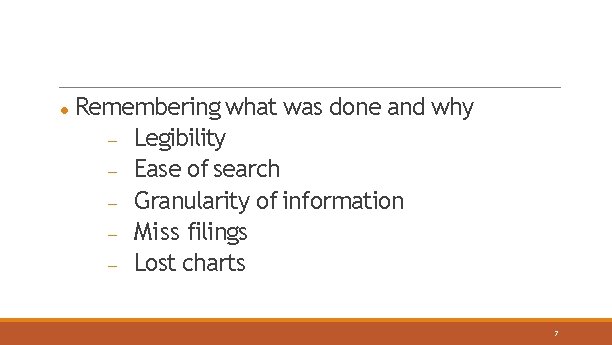
Remembering what was done and why Legibility Ease of search Granularity of information Miss filings Lost charts 7
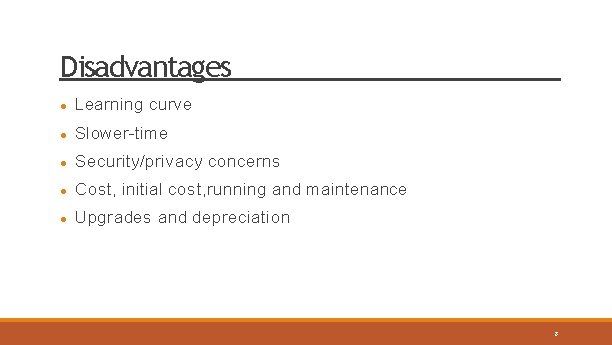
Disadvantages Learning curve Slower-time Security/privacy concerns Cost, initial cost, running and maintenance Upgrades and depreciation 8
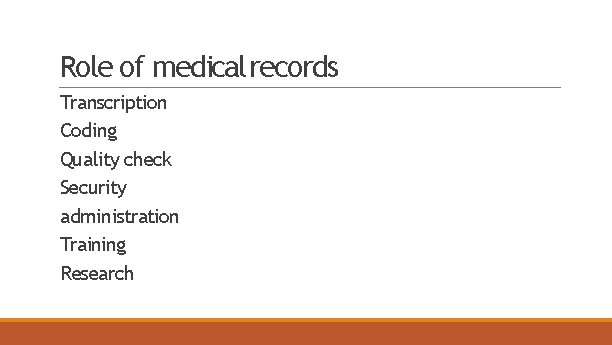
Role of medical records Transcription Coding Quality check Security administration Training Research
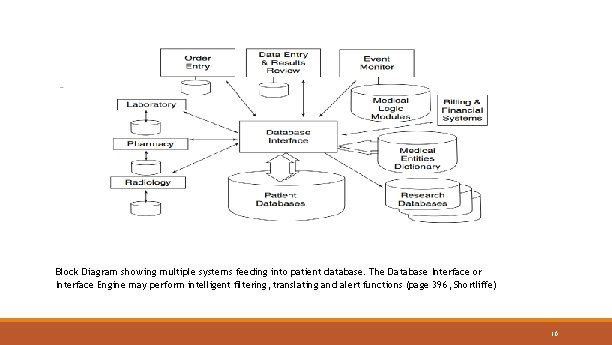
Block Diagram showing multiple systems feeding into patient database. The Database Interface or Interface Engine may perform intelligent filtering, translating and alert functions (page 396, Shortliffe) 10
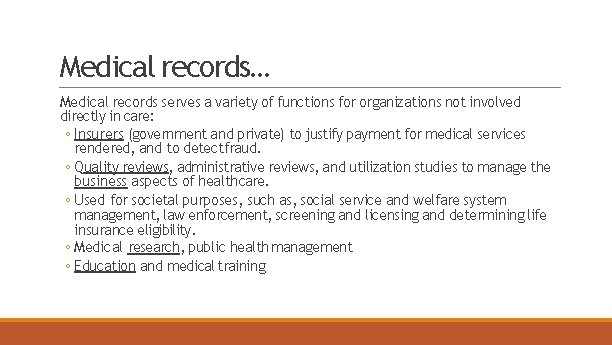
Medical records… Medical records serves a variety of functions for organizations not involved directly in care: ◦ Insurers (government and private) to justify payment for medical services rendered, and to detect fraud. ◦ Quality reviews, administrative reviews, and utilization studies to manage the business aspects of health care. ◦ Used for societal purposes, such as, social service and welfare system management, law enforcement, screening and licensing and determining life insurance eligibility. ◦ Medical research, public health management ◦ Education and medical training
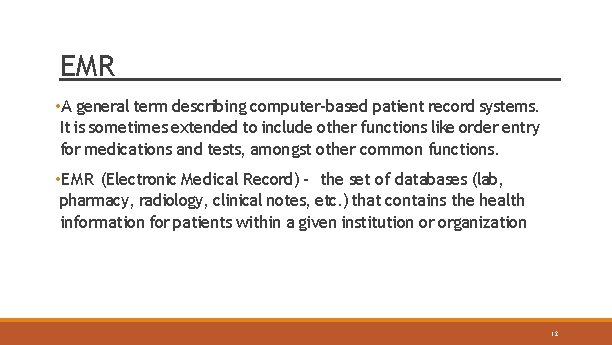
EMR • A general term describing computer-based patient record systems. It is sometimes extended to include other functions like order entry for medications and tests, amongst other common functions. • EMR (Electronic Medical Record) – the set of databases (lab, pharmacy, radiology, clinical notes, etc. ) that contains the health information for patients within a given institution or organization 12
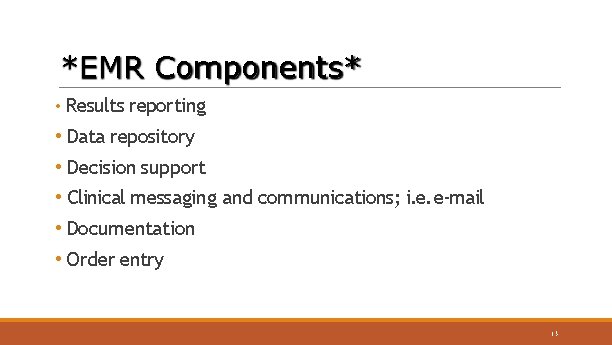
*EMR Components* • Results reporting • Data repository • Decision support • Clinical messaging and communications; i. e. e-mail • Documentation • Order entry 13
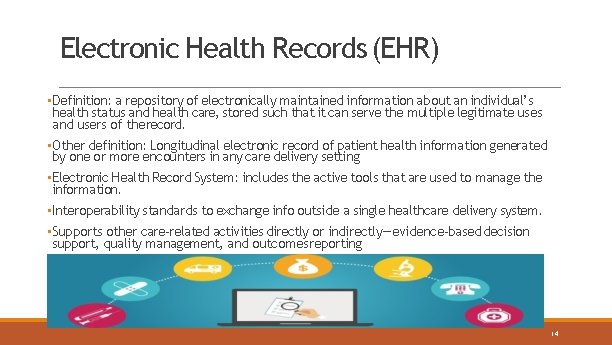
Electronic Health Records (EHR) • Definition: a repository of electronically maintained information about an individual’s health status and health care, stored such that it can serve the multiple legitimate uses and users of the record. • Other definition: Longitudinal electronic record of patient health information generated by one or more encounters in any care delivery setting • Electronic Health Record System: includes the active tools that are used to manage the information. • Interoperability standards to exchange info outside a single healthcare delivery system. • Supports other care-related activities directly or indirectly—evidence-based decision support, quality management, and outcomes reporting 14
Computer-Based Patient Record (CPR) • Comprehensive lifetime record • Attributes identified by the Institute of Medicine (IOM) provide the basis for today’s understanding of the EHR 15
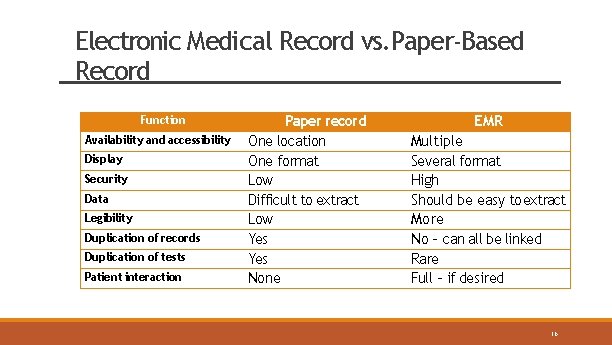
Electronic Medical Record vs. Paper-Based Record Function Availability and accessibility Display Security Data Legibility Duplication of records Duplication of tests Patient interaction Paper record One location One format Low Difficult to extract Low Yes None EMR Multiple Several format High Should be easy to extract More No – can all be linked Rare Full – if desired 16
Functional Components of an Electronic Medical Record System An EHR is not simply an electronic version of the paper record. 1. Integrated view of patient data 2. Clinician order entry 3. Clinical decision support 4. Access to knowledge resources 5. Integrated communication and reporting support 17
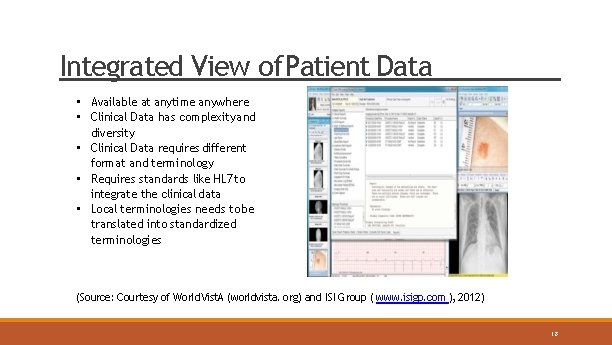
Integrated View of Patient Data • Available at anytime anywhere • Clinical Data has complexity and diversity • Clinical Data requires different format and terminology • Requires standards like HL 7 to integrate the clinical data • Local terminologies needs to be translated into standardized terminologies (Source: Courtesy of World. Vist. A (worldvista. org) and ISI Group ( www. isigp. com ), 2012) 18
Integrated View of Patient Data Interface Engine helps to become mediator for EHR to be connected to other vendor systems( Tracking system, Imaging system, Medication dispenser etc) • Various views: Flowsheet, Chronological views, Summary Views 19
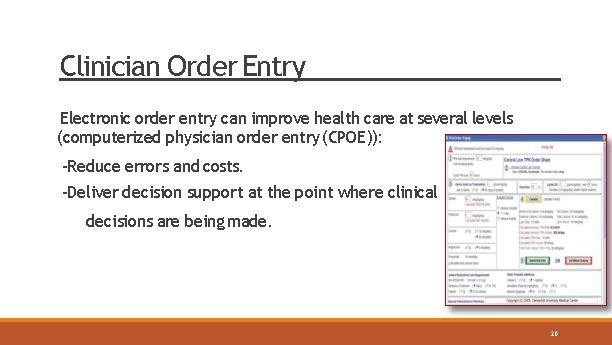
Clinician Order Entry Electronic order entry can improve health care at several levels (computerized physician order entry (CPOE)): -Reduce errors and costs. -Deliver decision support at the point where clinical decisions are being made. 20
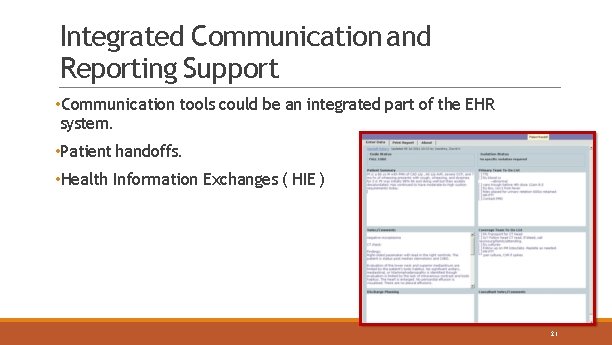
Integrated Communication and Reporting Support • Communication tools could be an integrated part of the EHR system. • Patient handoffs. • Health Information Exchanges ( HIE ) 21
Patient Benefits • Decreased wait time for treatment • Increased access/control over health information • Increased use of best practices/decision support • Increased ability to ask informed questions • Quicker turnaround time for ordered treatments 22
Patient Benefits • Greater clarity to discharge instruction • Increased responsibility for own care • Alerts and reminders for appointments and scheduled tests • Increased satisfaction and understanding of choices • Issue: When a patient could access his/her own health information like in other online services ? (Pros, Cons) 23
* Data Ownership * • Paper medical records are the property of the creators with full responsibilities: storage, accuracy • Many providers share / update the same electronic data in many sites, who is the responsible owner in EHR? 24
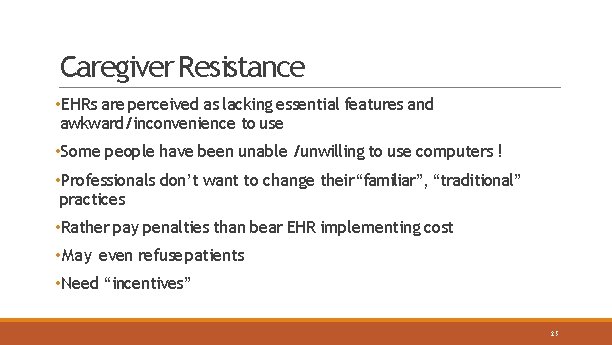
Caregiver Resistance • EHRs are perceived as lacking essential features and awkward/inconvenience to use • Some people have been unable /unwilling to use computers ! • Professionals don’t want to change their “familiar”, “traditional” practices • Rather pay penalties than bear EHR implementing cost • May even refuse patients • Need “incentives” 25
Enabling Factors: 1. Comprehensiveness of information. 2. Duration of use and retention of data. 3. Degree of structure of data. 4. Ubiquity of access. 26
Fundamental Issues: Data Validation: ◦ Range checks (out of range value) ◦ Pattern checks ◦ Computed checks(values have the correct mathematical relationship ) ◦ Consistency checks ◦ Delta checks (large and unlikely differences between the values ) ◦ Spelling checks 27
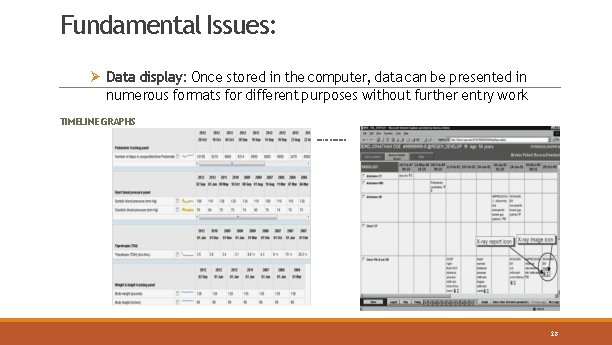
Fundamental Issues: Data display: Once stored in the computer, data can be presented in numerous formats for different purposes without further entry work TIMELINE GRAPHS TIMELINE FLOWSHEETS 28
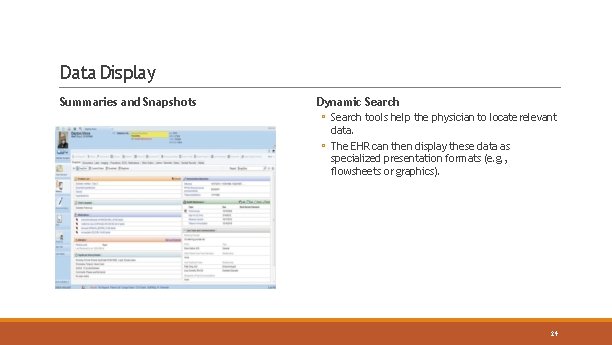
Data Display Summaries and Snapshots Dynamic Search ◦ Search tools help the physician to locaterelevant data. ◦ The EHR can then display these data as specialized presentation formats (e. g. , flowsheets or graphics). 29
Fundamental issues: Query and Surveillance Systems ◦ Find records of patients that satisfy pre-specified criteria and export selected data. ◦ Clinical care ◦ Clinical research ◦ Quality reporting ◦ Retrospective studies ◦ Administration (e. g. resource consumption) 30
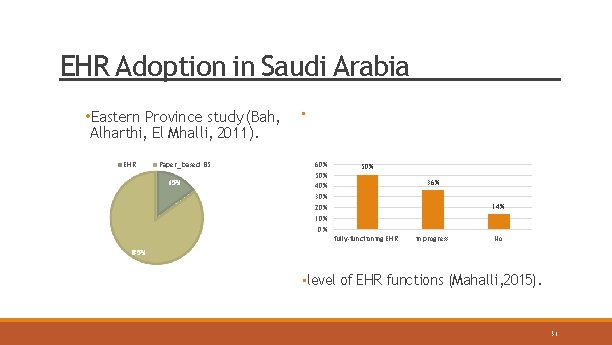
EHR Adoption in Saudi Arabia • Eastern Province study (Bah, Alharthi, El Mhalli, 2011). EHR Paper_ based. 85 15% • 60% 50% 40% 30% 20% 10% 0% 50% 36% 14% fully-functioning EHR in progress No 85% • level of EHR functions (Mahalli , 2015). 31
Barriers of EHR in Saudi Arabia: 1. Human Barriers: ◦ Lack of ◦ awareness of the importance and benefits of EHR, ◦ knowledge and experience of using EHRs, ◦ experience of computer applications. ◦ Negative beliefs and impressions about EHRs and about their ability to use EHRs 2. ◦ ◦ ◦ Financial Barriers: High initial cost of EHRs implementation. High operation and maintenance costs of EHRs. Lack of feasibility studies that show the benefits versus costs of implementing and using EHRs. 32
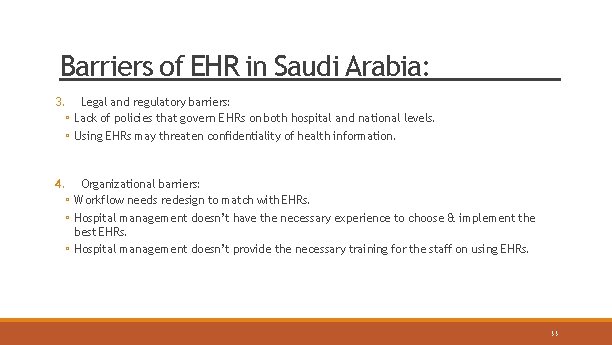
Barriers of EHR in Saudi Arabia: 3. Legal and regulatory barriers: ◦ Lack of policies that govern EHRs on both hospital and national levels. ◦ Using EHRs may threaten confidentiality of health information. 4. Organizational barriers: ◦ Workflow needs redesign to match with EHRs. ◦ Hospital management doesn’t have the necessary experience to choose & implement the best EHRs. ◦ Hospital management doesn’t provide the necessary training for the staff on using EHRs. 33
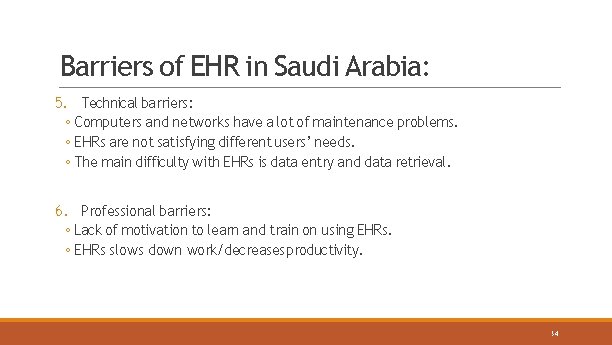
Barriers of EHR in Saudi Arabia: 5. Technical barriers: ◦ Computers and networks have a lot of maintenance problems. ◦ EHRs are not satisfying different users’ needs. ◦ The main difficulty with EHRs is data entry and data retrieval. 6. Professional barriers: ◦ Lack of motivation to learn and train on using EHRs. ◦ EHRs slows down work/decreases productivity. 34
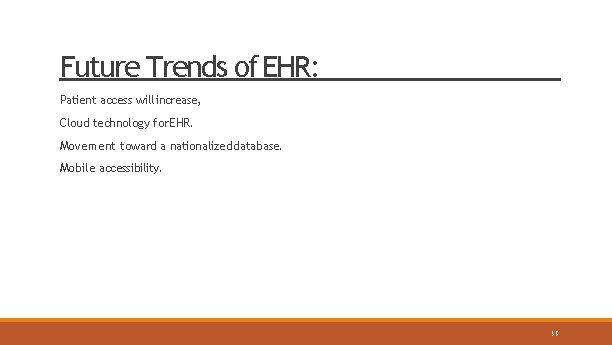
Future Trends of EHR: Patient access will increase, Cloud technology for EHR. Movement toward a nationalized database. Mobile accessibility. 35
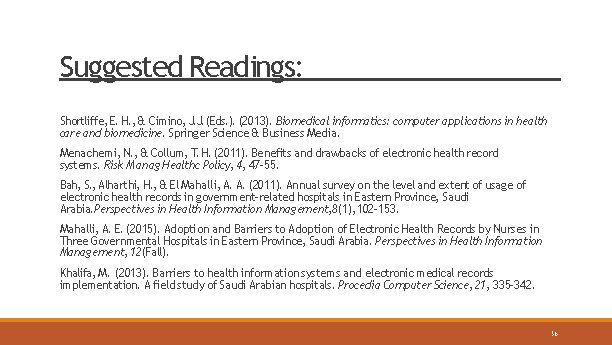
Suggested Readings: Shortliffe, E. H. , & Cimino, J. J. (Eds. ). (2013). Biomedical informatics: computer applications in health care and biomedicine. Springer Science & Business Media. Menachemi, N. , & Collum, T. H. (2011). Benefits and drawbacks of electronic health record systems. Risk Manag Healthc Policy, 4, 47 -55. Bah, S. , Alharthi, H. , & El Mahalli, A. A. (2011). Annual survey on the level and extent of usage of electronic health records in government-related hospitals in Eastern Province, Saudi Arabia. Perspectives in Health Information Management, 8(1), 102 -153. Mahalli, A. E. (2015). Adoption and Barriers to Adoption of Electronic Health Records by Nurses in Three Governmental Hospitals in Eastern Province, Saudi Arabia. Perspectives in Health Information Management, 12(Fall). Khalifa, M. (2013). Barriers to health information systems and electronic medical records implementation. A field study of Saudi Arabian hospitals. Procedia Computer Science, 21, 335 -342. 36
Best wishes Albarrak@ksu. edu. sa 37