
Paper chromatography Do Now Copy and label parts
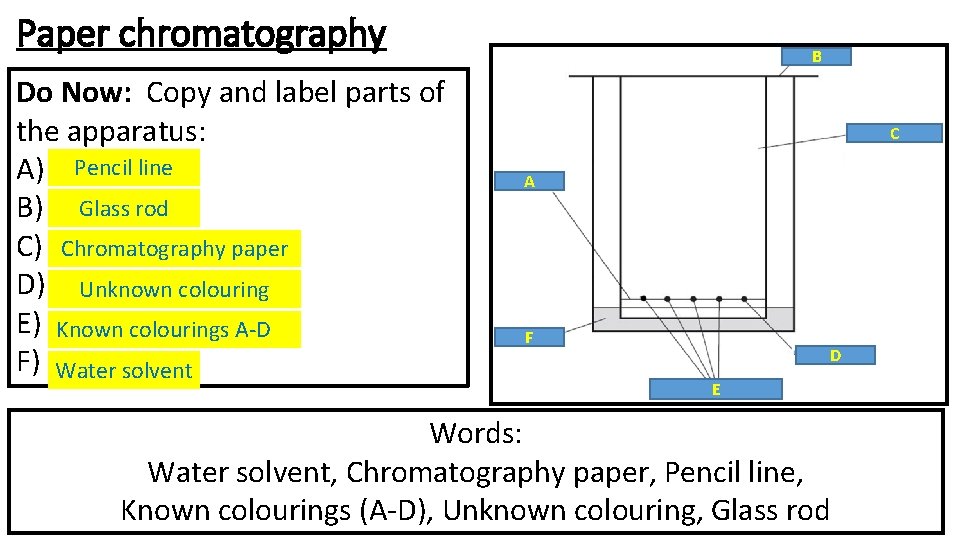
Paper chromatography Do Now: Copy and label parts of the apparatus: A) Pencil line B) Glass rod C) Chromatography paper D) Unknown colouring E) Known colourings A-D F) Water solvent B C A F D E Words: Water solvent, Chromatography paper, Pencil line, Known colourings (A-D), Unknown colouring, Glass rod
Progress Outcomes Good Progress • Interpret chromatograms and determine Rf values from chromatograms • Explain how paper chromatography separates mixture Outstanding Progress • Suggest how chromatographic methods can be used for distinguishing pure substances from impure substances

3 of 37 © Boardworks Ltd 2009
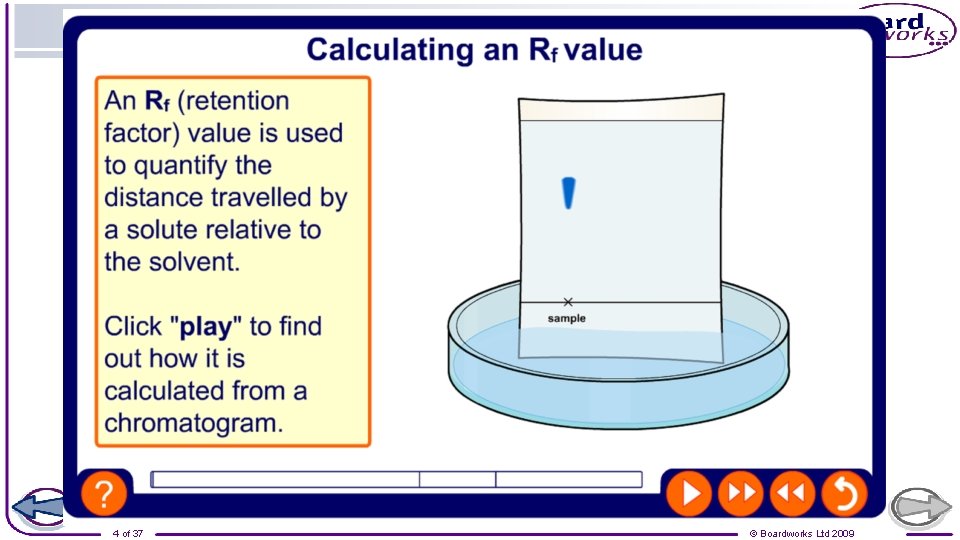
4 of 37 © Boardworks Ltd 2009

Interpret chromatograms and determine Rf values from chromatograms A scientist used chromatography to analyse the composition of five food colourings. Four of the food colourings were unknown (A-D). The other was sunrise yellow. Calculate the Rf value for the spot of chemical in sunrise yellow which is furthest up the chromatogram.
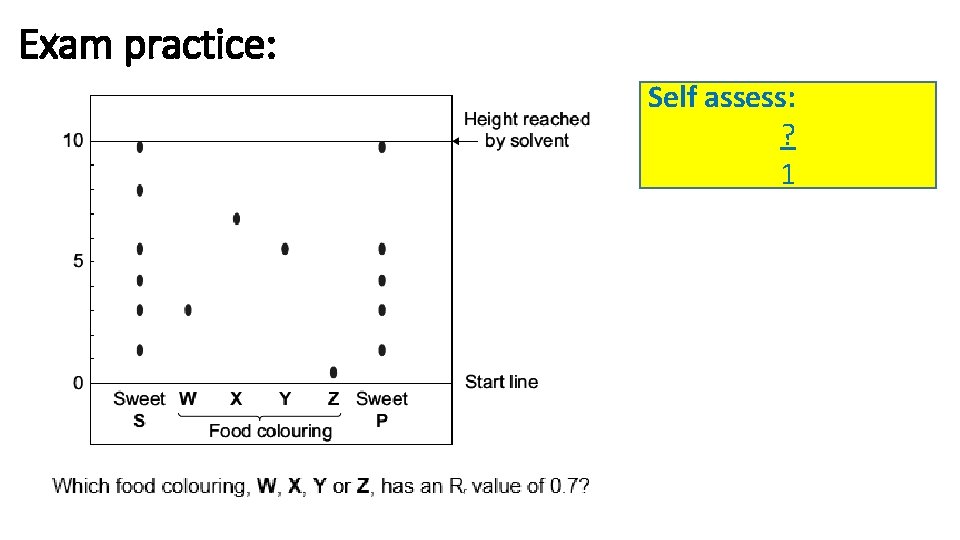
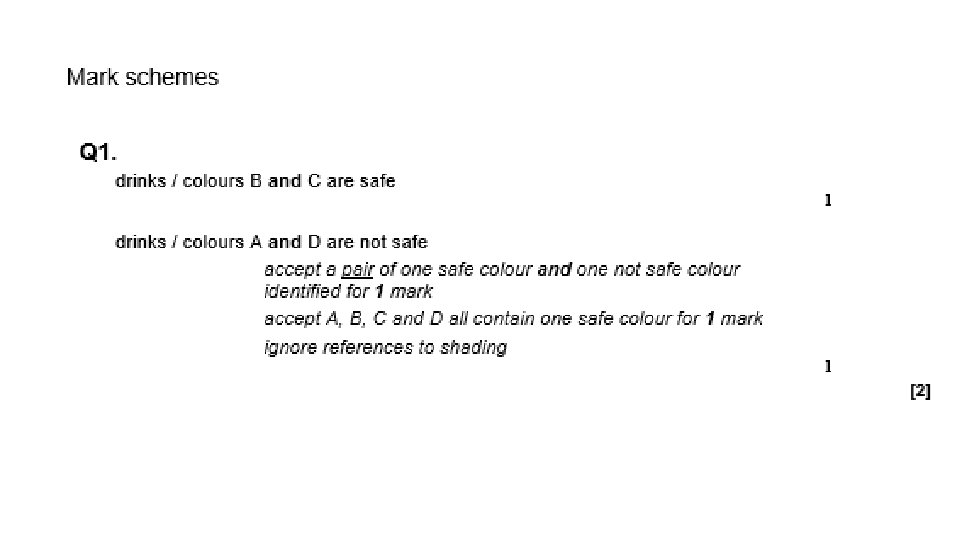
Exam practice: Self assess: ? 1
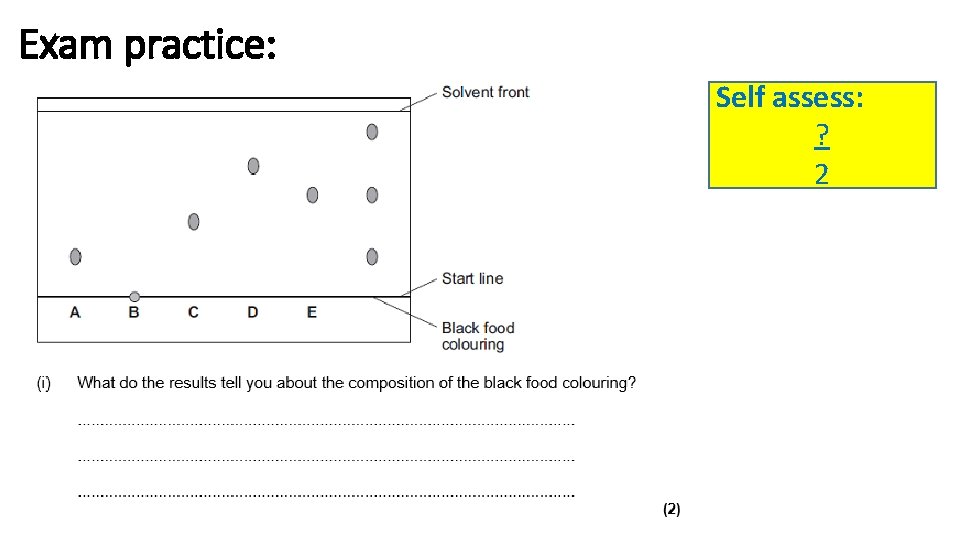
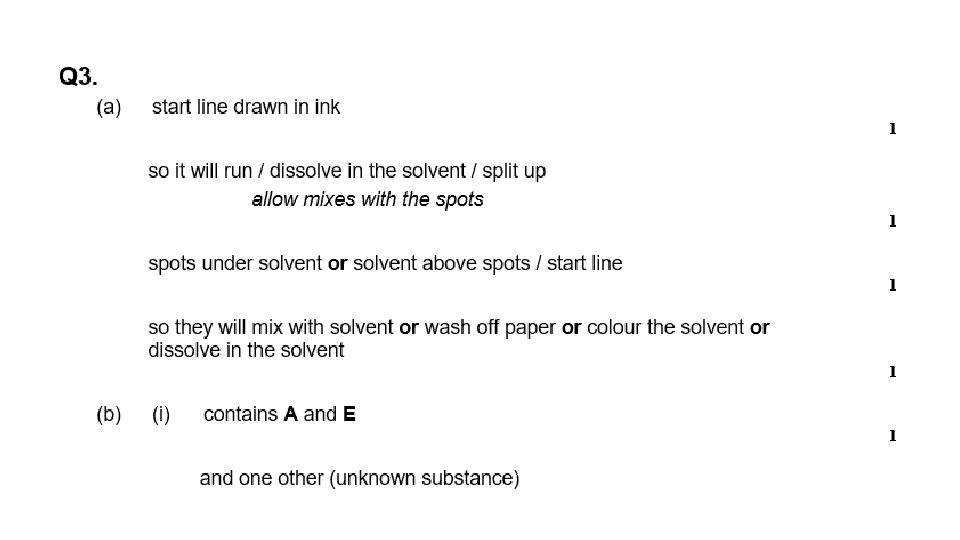
Exam practice: Self assess: ? 2
8 of 37 © Boardworks Ltd 2009
Explain how paper chromatography separates mixture Paper and thin layer chromatography Watch this video and answer the questions below: 1. Describe the steps used to create a chromatogram. 2. What is meant by the terms ‘stationary phase’ and ‘mobile phase’? 3. What does the Rf value tell you about the solubility of a separated component in the mobile phase solvent? 4. Give examples of where chromatography is used to identify and compare samples.
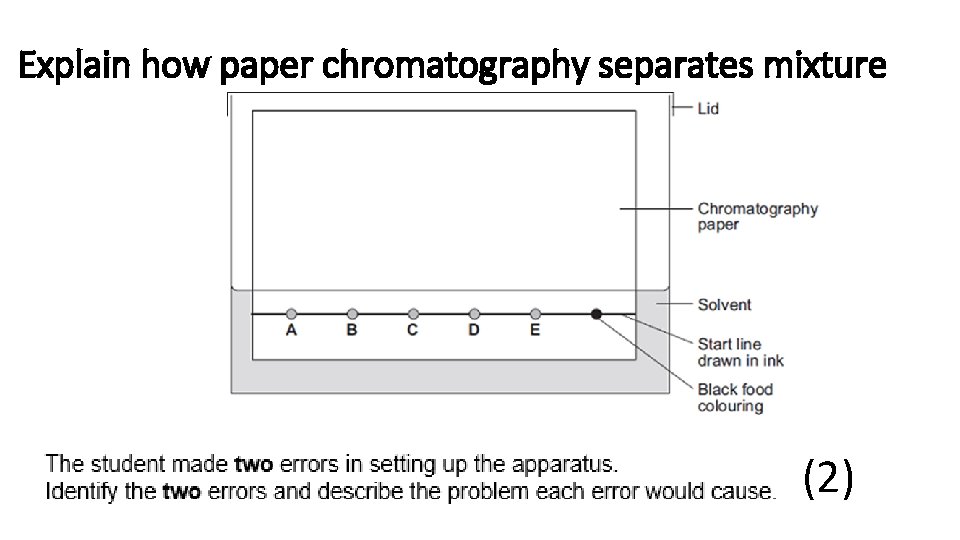
Explain how paper chromatography separates mixture (2)
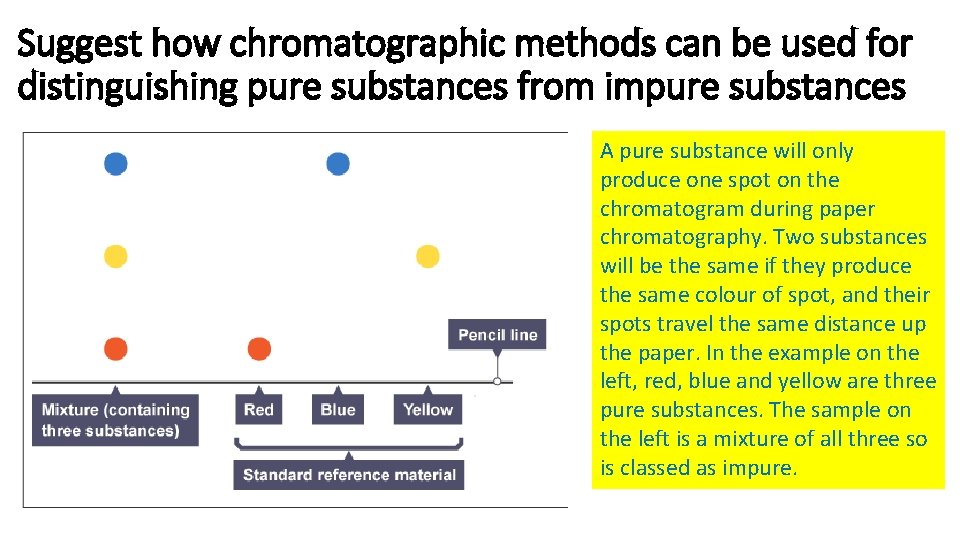
Suggest how chromatographic methods can be used for distinguishing pure substances from impure substances A pure substance will only Red, blue produce oneand spotyellow on the are all chromatogram during. How paper pure substances. can chromatography. Two substances you tell from the will be the same if they produce chromatogram that they the same colour of spot, and their are spotspure? travel the same distance up the paper. In the example on the left, red, blue and yellow are three pure substances. The sample on the left is a mixture of all three so is classed as impure.

Required Practical

List apparatus 250 cm 3 beaker Chromatography paper Glass rod known Glass capillary tube unknown

Identify the main hazards and suggest methods of reducing the risk of harm Hazard Copy and complete the table. Associated Risk Control Measures (minimum two for each) Slipping on water Hazard – Something that could potentially cause harm Associated risk – How the hazard could cause harm Control measures – What can be done to reduce the associated risk
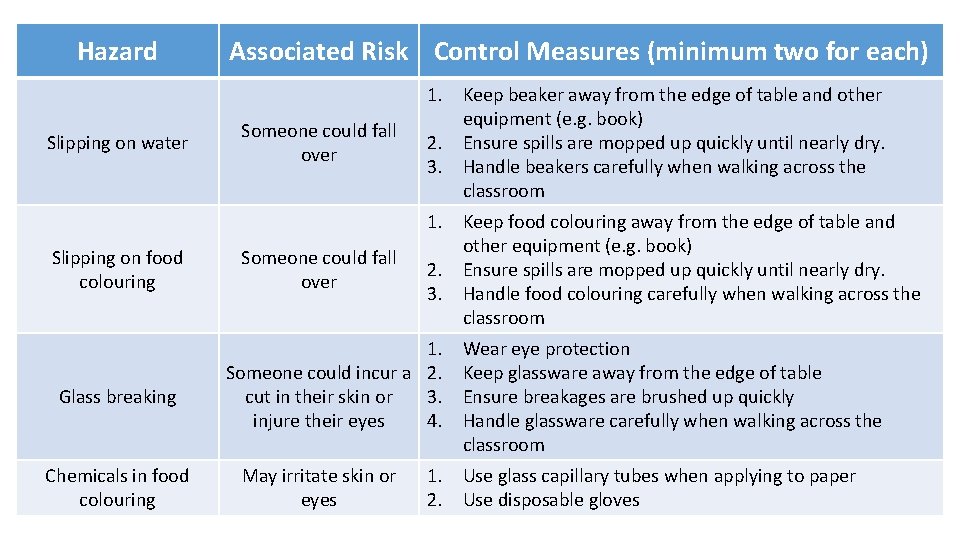
Hazard Slipping on water Slipping on food colouring Glass breaking Chemicals in food colouring Associated Risk Control Measures (minimum two for each) Someone could fall over 1. Keep beaker away from the edge of table and other equipment (e. g. book) 2. Ensure spills are mopped up quickly until nearly dry. 3. Handle beakers carefully when walking across the classroom Someone could fall over 1. Keep food colouring away from the edge of table and other equipment (e. g. book) 2. Ensure spills are mopped up quickly until nearly dry. 3. Handle food colouring carefully when walking across the classroom 1. Someone could incur a 2. cut in their skin or 3. injure their eyes 4. May irritate skin or eyes Wear eye protection Keep glassware away from the edge of table Ensure breakages are brushed up quickly Handle glassware carefully when walking across the classroom 1. Use glass capillary tubes when applying to paper 2. Use disposable gloves
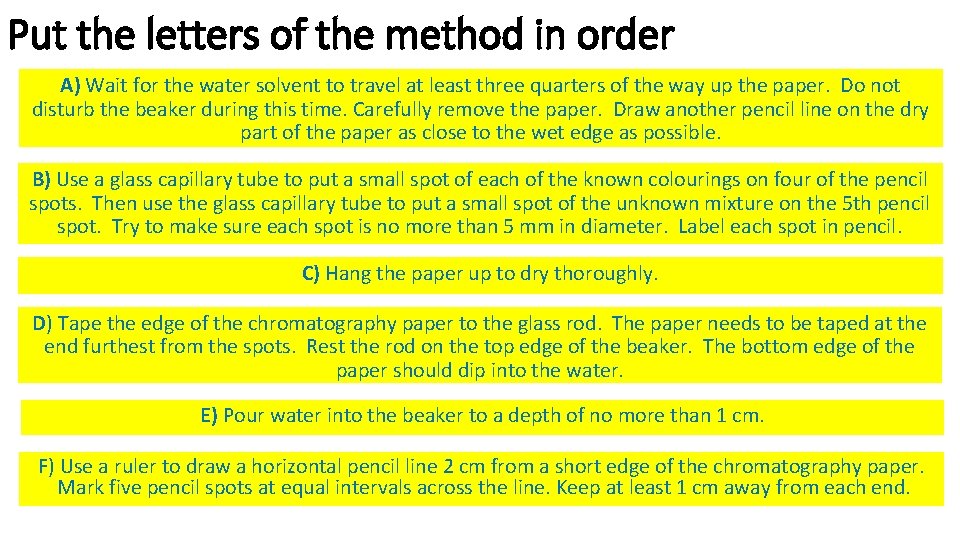
Put the letters of the method in order A) Wait for the water solvent to travel at least three quarters of the way up the paper. Do not disturb the beaker during this time. Carefully remove the paper. Draw another pencil line on the dry part of the paper as close to the wet edge as possible. B) Use a glass capillary tube to put a small spot of each of the known colourings on four of the pencil spots. Then use the glass capillary tube to put a small spot of the unknown mixture on the 5 th pencil spot. Try to make sure each spot is no more than 5 mm in diameter. Label each spot in pencil. C) Hang the paper up to dry thoroughly. D) Tape the edge of the chromatography paper to the glass rod. The paper needs to be taped at the end furthest from the spots. Rest the rod on the top edge of the beaker. The bottom edge of the paper should dip into the water. E) Pour water into the beaker to a depth of no more than 1 cm. F) Use a ruler to draw a horizontal pencil line 2 cm from a short edge of the chromatography paper. Mark five pencil spots at equal intervals across the line. Keep at least 1 cm away from each end.
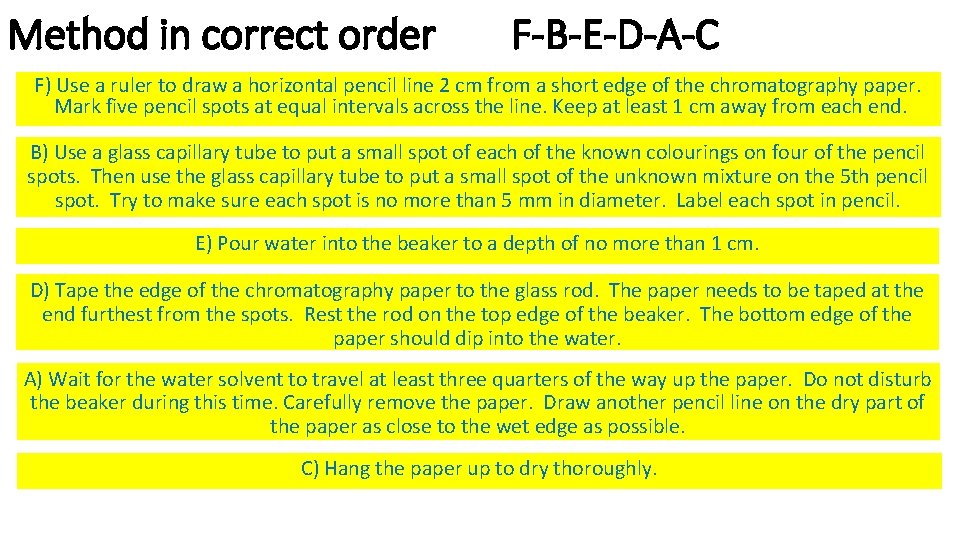
Method in correct order F-B-E-D-A-C F) Use a ruler to draw a horizontal pencil line 2 cm from a short edge of the chromatography paper. Mark five pencil spots at equal intervals across the line. Keep at least 1 cm away from each end. B) Use a glass capillary tube to put a small spot of each of the known colourings on four of the pencil spots. Then use the glass capillary tube to put a small spot of the unknown mixture on the 5 th pencil spot. Try to make sure each spot is no more than 5 mm in diameter. Label each spot in pencil. E) Pour water into the beaker to a depth of no more than 1 cm. D) Tape the edge of the chromatography paper to the glass rod. The paper needs to be taped at the end furthest from the spots. Rest the rod on the top edge of the beaker. The bottom edge of the paper should dip into the water. A) Wait for the water solvent to travel at least three quarters of the way up the paper. Do not disturb the beaker during this time. Carefully remove the paper. Draw another pencil line on the dry part of the paper as close to the wet edge as possible. C) Hang the paper up to dry thoroughly.
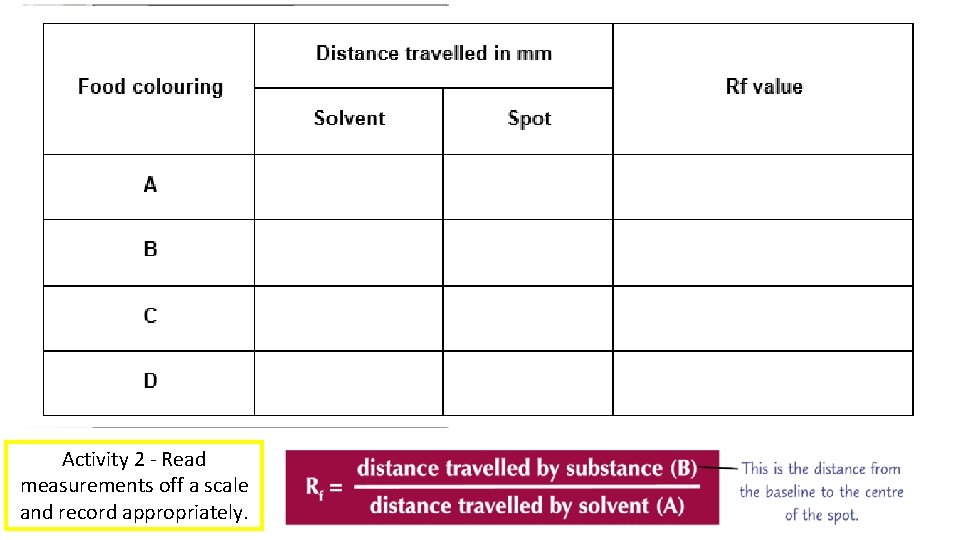
Recording results Activity 2 - Read measurements off a scale and record appropriately.
Conclusion Match the spots in mixture U with those from A–D. Use the colour and distance travelled to help you. 1. Which of colourings A–D are in mixture U? 2. Are there any other colourings in mixture U which do not match A–D?

Demonstrate
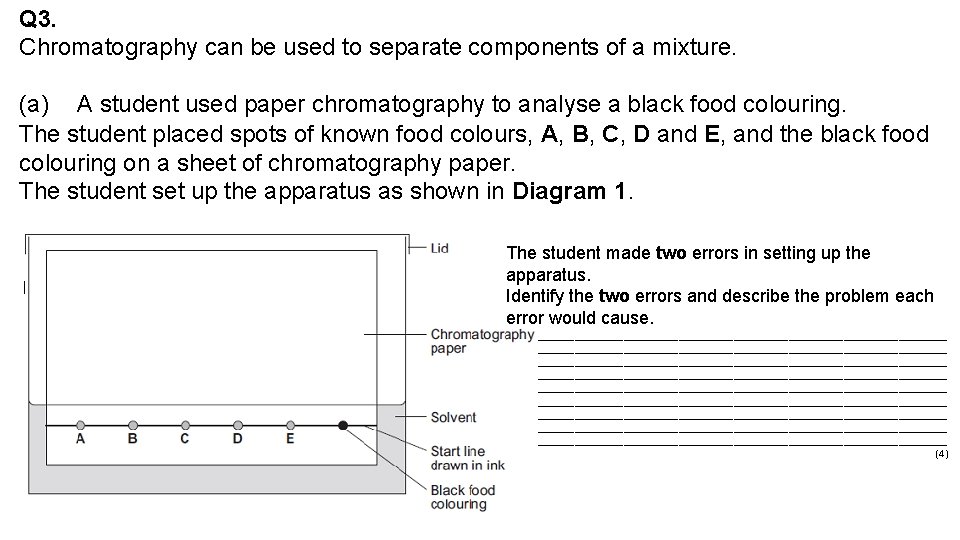
Q 3. Chromatography can be used to separate components of a mixture. (a) A student used paper chromatography to analyse a black food colouring. The student placed spots of known food colours, A, B, C, D and E, and the black food colouring on a sheet of chromatography paper. The student set up the apparatus as shown in Diagram 1 The student made two errors in setting up the apparatus. Identify the two errors and describe the problem each error would cause. ___________________________________________________________________ ___________________________________________________________________ __________________________________ (4)
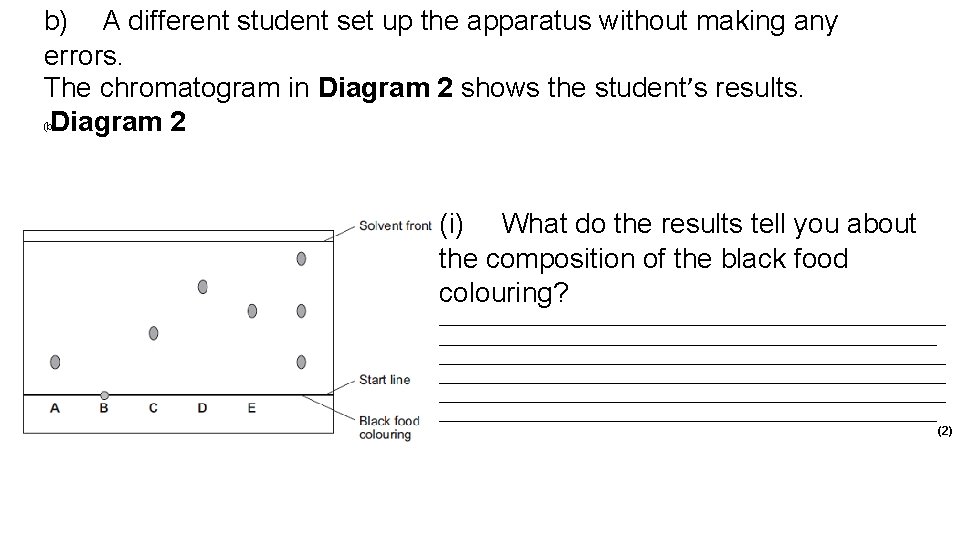
b) A different student set up the apparatus without making any errors. The chromatogram in Diagram 2 shows the student’s results. Diagram 2 (b (i) What do the results tell you about the composition of the black food colouring? _________________________________________________________ ________________________________________________________ (2)
0 -3 4 -5 6 -8
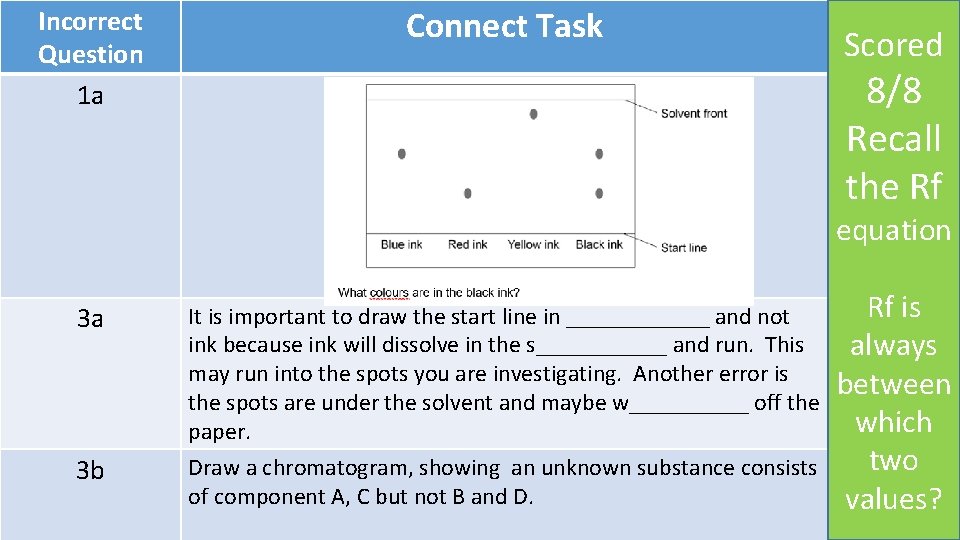
Incorrect Question 1 a Connect Task Scored 8/8 Recall the Rf equation 3 a It is important to draw the start line in ______ and not ink because ink will dissolve in the s______ and run. This may run into the spots you are investigating. Another error is the spots are under the solvent and maybe w_____ off the paper. 3 b Draw a chromatogram, showing an unknown substance consists of component A, C but not B and D. Rf is always between which two values?
- Slides: 26