
PAPER CAN BE ADJUSTED TO CREATE DIFFERENT PROPERTIES

PAPER CAN BE ADJUSTED TO CREATE DIFFERENT PROPERTIES FOR SPECIFIC For example, Foil Lined Board is used. PURPOSES in fast food containers for insulation, and also to help keep moisture in. Also, Duplex Board has a bleached liner on one side which makes it suitable for use in food packaging and drinks cartons.
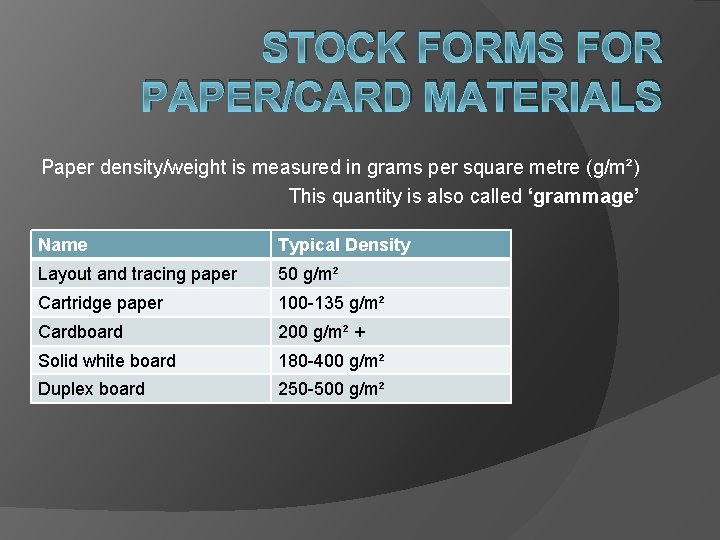
STOCK FORMS FOR PAPER/CARD MATERIALS Paper density/weight is measured in grams per square metre (g/m²) This quantity is also called ‘grammage’ Name Typical Density Layout and tracing paper 50 g/m² Cartridge paper 100 -135 g/m² Cardboard 200 g/m² + Solid white board 180 -400 g/m² Duplex board 250 -500 g/m²
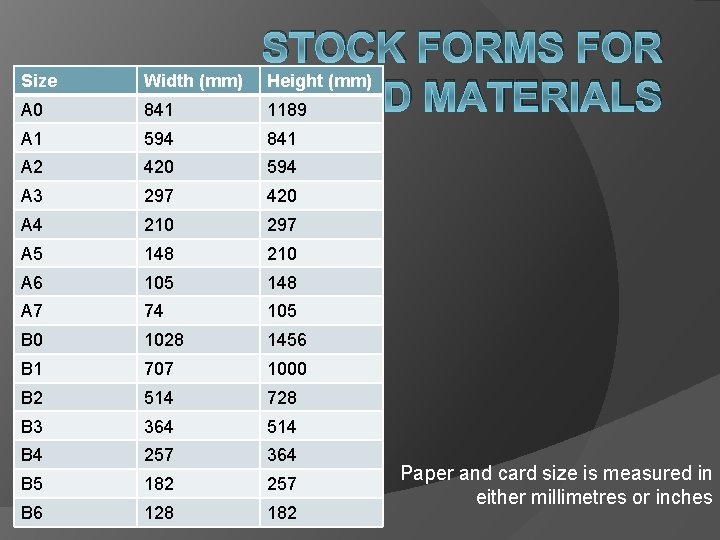
A 0 STOCK FORMS FOR Width (mm) Height (mm) PAPER/CARD MATERIALS 841 1189 A 1 594 841 A 2 420 594 A 3 297 420 A 4 210 297 A 5 148 210 A 6 105 148 A 7 74 105 B 0 1028 1456 B 1 707 1000 B 2 514 728 B 3 364 514 B 4 257 364 B 5 182 257 B 6 128 182 Size Paper and card size is measured in either millimetres or inches
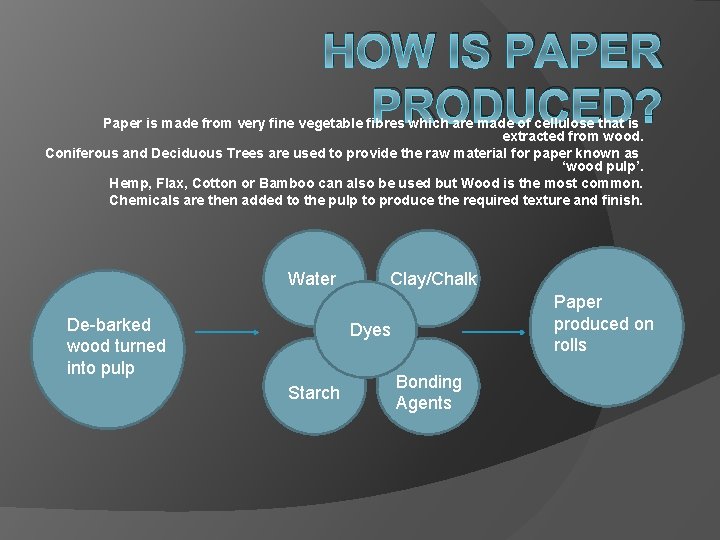
HOW IS PAPER PRODUCED? Paper is made from very fine vegetable fibres which are made of cellulose that is extracted from wood. Coniferous and Deciduous Trees are used to provide the raw material for paper known as ‘wood pulp’. Hemp, Flax, Cotton or Bamboo can also be used but Wood is the most common. Chemicals are then added to the pulp to produce the required texture and finish. Water De-barked wood turned into pulp Clay/Chalk Paper produced on rolls Dyes Starch Bonding Agents
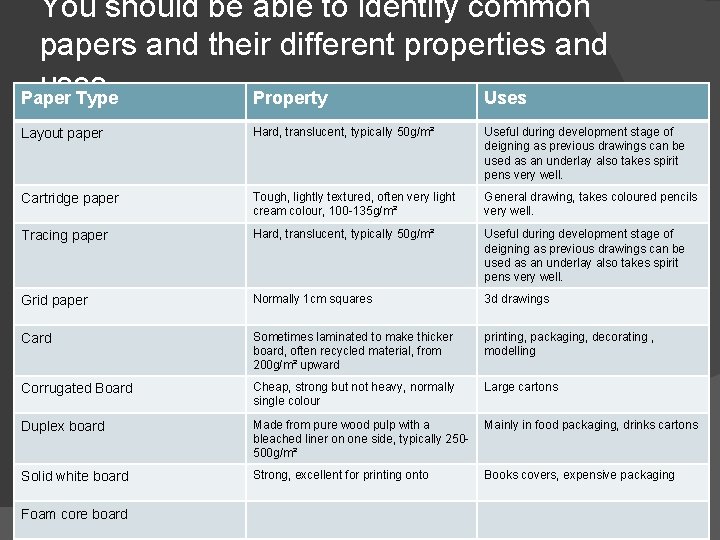
You should be able to identify common papers and their different properties and uses… Paper Type Property Uses Layout paper Hard, translucent, typically 50 g/m² Useful during development stage of deigning as previous drawings can be used as an underlay also takes spirit pens very well. Cartridge paper Tough, lightly textured, often very light cream colour, 100 -135 g/m² General drawing, takes coloured pencils very well. Tracing paper Hard, translucent, typically 50 g/m² Useful during development stage of deigning as previous drawings can be used as an underlay also takes spirit pens very well. Grid paper Normally 1 cm squares 3 d drawings Card Sometimes laminated to make thicker board, often recycled material, from 200 g/m² upward printing, packaging, decorating , modelling Corrugated Board Cheap, strong but not heavy, normally single colour Large cartons Duplex board Made from pure wood pulp with a bleached liner on one side, typically 250500 g/m² Mainly in food packaging, drinks cartons Solid white board Strong, excellent for printing onto Books covers, expensive packaging Foam core board
You should be able to understand the different properties and uses of different papers both as media for communication and as a material for manufacturing products… For communication purposes paper is used for Letters, Memos, Bills, Invoices, Fax copies, Tickets (Rail, bus, train, boat, theatre, concerts, entry to buildings & more) Newspapers, magazines, Advertising - placards, technical and engineering drawings, books, music scores, birthday cards , writing pads, envelopes, greeting cards, calendars, diaries, telephone directories, labels, and identity cards and the list goes on! Paper is used for packaging, design, note taking, modelling, drawing, covering, wrapping lining, protecting and strengthening throughout manufacture. It can also be used as protection for all manufactured goods, transfer sheets
- Slides: 6