
Paper Airplane Designs Question How does the design

- Slides: 12
Paper Airplane Designs
Question How does the design of a paper airplane influence how far it can fly?
Background Research There are four main forces that act on a paper airplane to make it fly. The four main forces are lift, drag, thrust, and gravity. Gravity is a downward force, and lift is an upward force. Lift has to be greater than or equal to gravity. Lift creates altitude that allows the airplane to stay up in the air. Drag is the resistance of air. Drag works against gravity. Thrust is the force that makes the airplane move forward. Thrust has to be greater than or equal to drag. These four main forces have to work correctly in order to make the airplane fly.
Resources • Alex Deahr - Guest Speaker • Brainpop – Flight • https: //www. brainpop. com/technology/transportation/flight/ • Bill Nye the Science Guy Video/ Flight • https: //www. youtube. com/watch? v=FOm 1 v. Cx 5 EHE • Read Works Article – How do Airplanes Fly
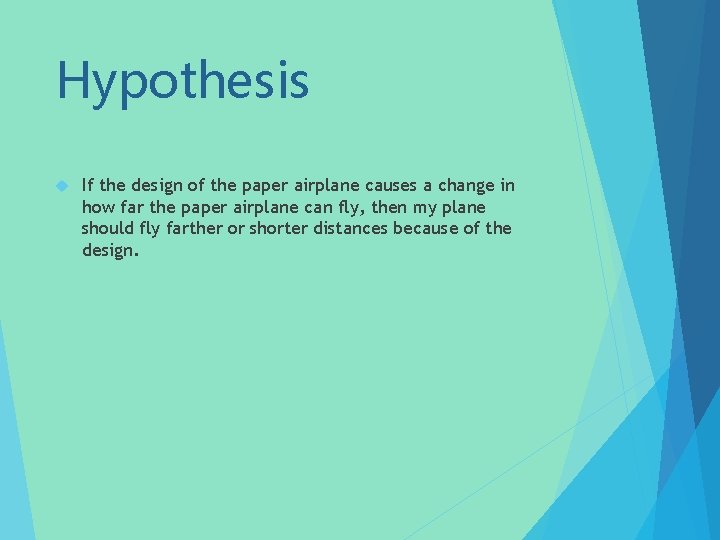
Hypothesis If the design of the paper airplane causes a change in how far the paper airplane can fly, then my plane should fly farther or shorter distances because of the design.
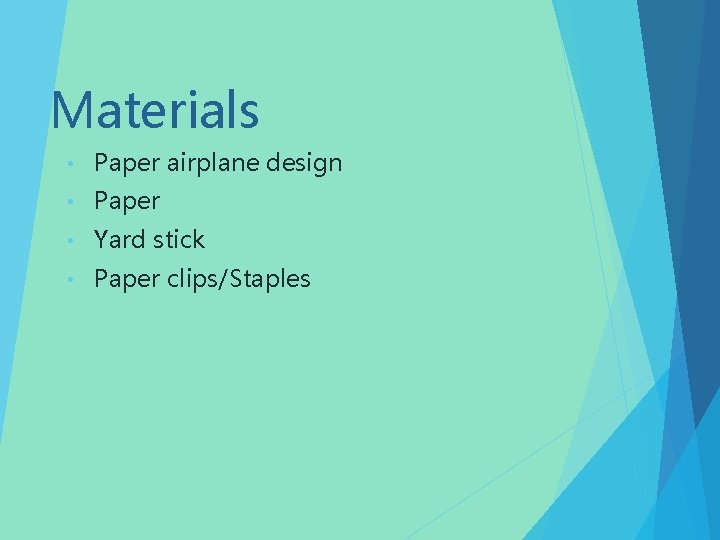
Materials • Paper airplane design • Paper • Yard stick • Paper clips/Staples
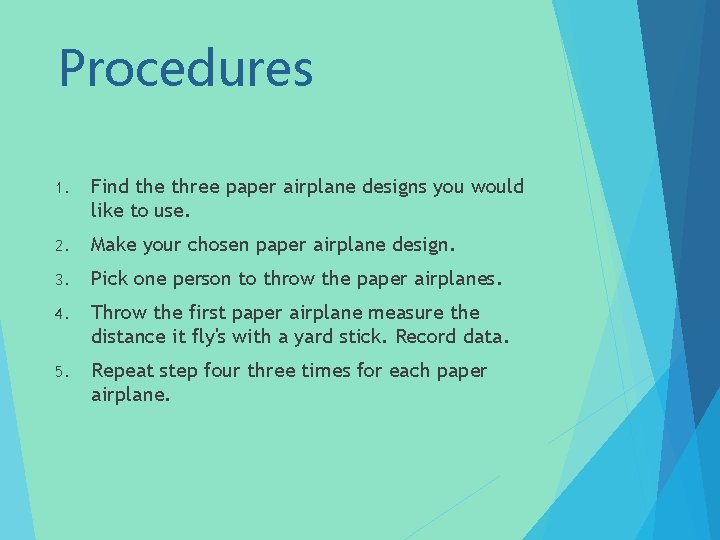
Procedures 1. Find the three paper airplane designs you would like to use. 2. Make your chosen paper airplane design. 3. Pick one person to throw the paper airplanes. 4. Throw the first paper airplane measure the distance it fly's with a yard stick. Record data. 5. Repeat step four three times for each paper airplane.
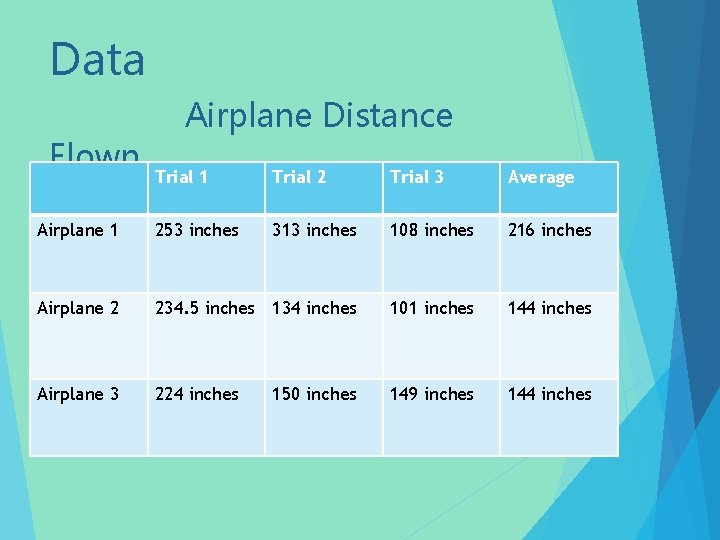
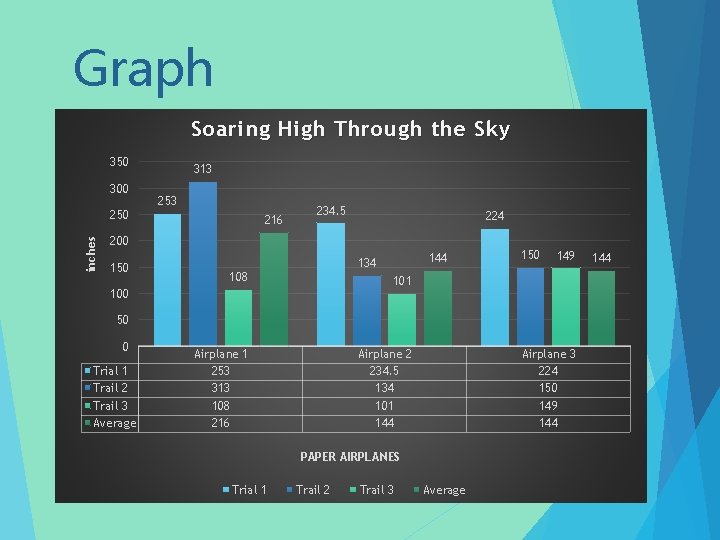
Data Flown Airplane Distance Trial 1 Trial 2 Trial 3 Average Airplane 1 253 inches 313 inches 108 inches 216 inches Airplane 2 234. 5 inches 134 inches 101 inches 144 inches Airplane 3 224 inches 149 inches 144 inches 150 inches
Pictures
Graph Soaring High Through the Sky 350 300 313 253 inches 250 216 234. 5 224 200 150 144 134 108 150 149 101 100 50 0 Trial 1 Trail 2 Trail 3 Average Airplane 1 253 313 108 216 Airplane 2 234. 5 134 101 144 Airplane 3 224 150 149 144 PAPER AIRPLANES Trial 1 Trail 2 Trail 3 Average 144
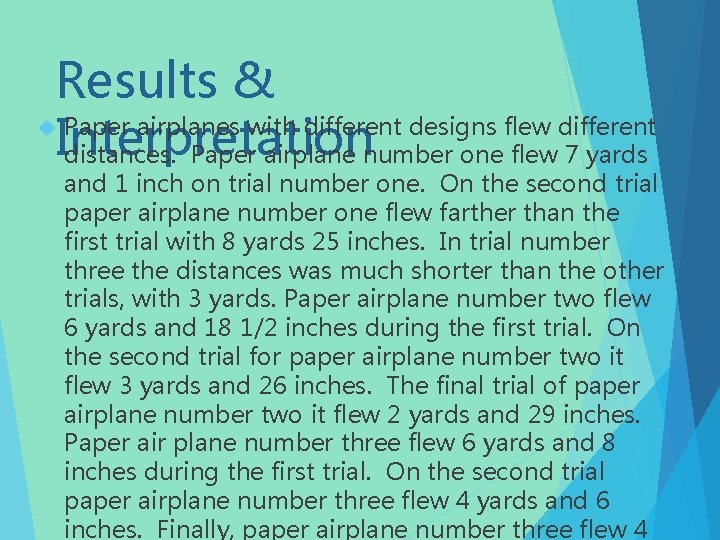
Results & Paper airplanes with different designs flew different Interpretation distances. Paper airplane number one flew 7 yards and 1 inch on trial number one. On the second trial paper airplane number one flew farther than the first trial with 8 yards 25 inches. In trial number three the distances was much shorter than the other trials, with 3 yards. Paper airplane number two flew 6 yards and 18 1/2 inches during the first trial. On the second trial for paper airplane number two it flew 3 yards and 26 inches. The final trial of paper airplane number two it flew 2 yards and 29 inches. Paper air plane number three flew 6 yards and 8 inches during the first trial. On the second trial paper airplane number three flew 4 yards and 6 inches. Finally, paper airplane number three flew 4
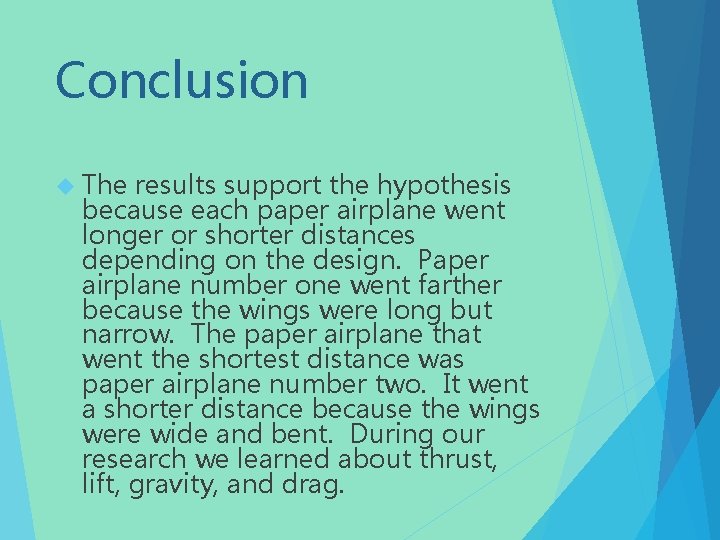
Conclusion The results support the hypothesis because each paper airplane went longer or shorter distances depending on the design. Paper airplane number one went farther because the wings were long but narrow. The paper airplane that went the shortest distance was paper airplane number two. It went a shorter distance because the wings were wide and bent. During our research we learned about thrust, lift, gravity, and drag.