
Paper 1 Assault Battery Miss Mc Lean Oct
Paper 1: Assault & Battery Miss Mc. Lean (Oct 2017) 1
Student Scenarios • Swap your scenario with another person on your table • Using your ISAS – complete the ‘application’ component for the scenario you have been given • Swap back – mark the work completed – are they correct? Did they spot all the issues raised? Did they pick out the key quotes to support their argument? 2
![Definition R v Ireland [1997] • Lord Steyn defined battery as: "unlawful application of](http://slidetodoc.com/presentation_image_h2/6f465c4bafd694f00e2d9522a0373e55/image-3.jpg "Definition R v Ireland [1997] • Lord Steyn defined battery as: \"unlawful application of")
Definition R v Ireland [1997] • Lord Steyn defined battery as: "unlawful application of force by the defendant upon the victim“ The victim need not be aware that he or she is about to be struck. Therefore, if someone is struck from behind this will still constitute battery, and he or she need not have seen it coming. • S. 39 of the Criminal Justice Act 1988 states that battery is a summary offence with a maximum sentence on conviction of up to 6 months’ imprisonment or a fine.
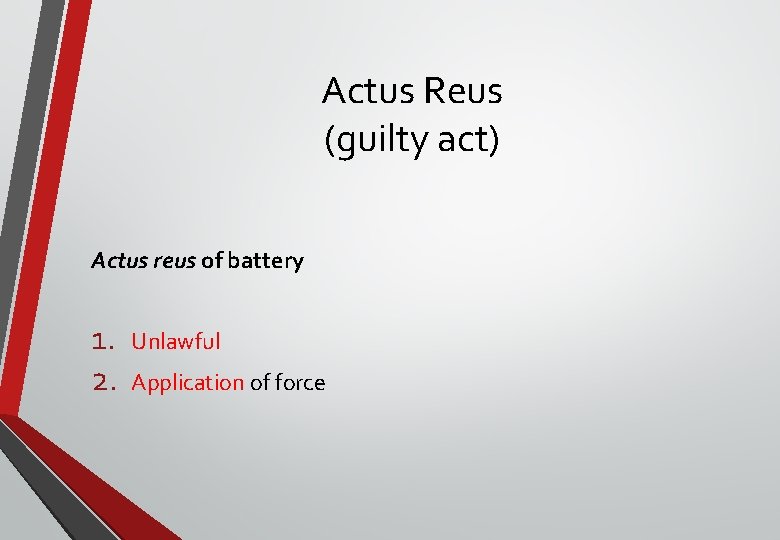
Actus Reus (guilty act) Actus reus of battery 1. 2. Unlawful Application of force
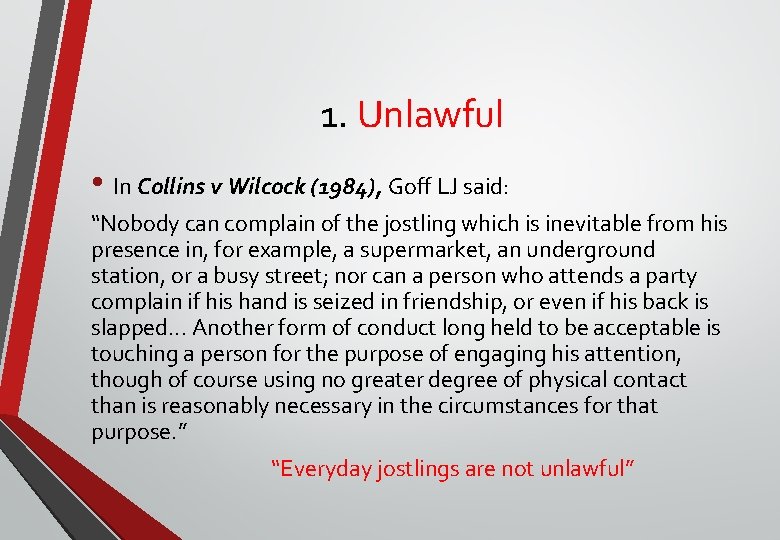
1. Unlawful • In Collins v Wilcock (1984), Goff LJ said: “Nobody can complain of the jostling which is inevitable from his presence in, for example, a supermarket, an underground station, or a busy street; nor can a person who attends a party complain if his hand is seized in friendship, or even if his back is slapped. . . Another form of conduct long held to be acceptable is touching a person for the purpose of engaging his attention, though of course using no greater degree of physical contact than is reasonably necessary in the circumstances for that purpose. ” “Everyday jostlings are not unlawful”

2. Application Battery can be direct or indirect. • Direct battery is force applied directly by one person to another using their own body, e. g. a slap. • Indirect battery can be applied using an implement or vehicle. 6
2. Application (Direct) R v Thomas (1985) • D, a school caretaker was charged with the battery of a 12 -year-old after taking hold of the hem of her skirt. • P. O. L: Touching the girl with his hand is a direct battery
2. Application (Indirect) • Fagan v MPC (1968) • R v Haystead (2000) • DPP v K (1990) • R v Martin (1881)
2. Application (Additional points) An omission can constitute a battery; • • R v Santana- Bermudez (2003) • Held: Where someone created a danger and thereby exposed another to a reasonably foreseeable risk of injury, there was an evidential basis for the actus reus of an assault occasioning actual bodily harm. D injured a woman police officer by allowing her to search him, knowing he had hypodermic needles in his pockets which stabbed her. D denied having any needles or sharps when asked.
2. Application (Additional points) R v Thomas (1985) • P. O. L 2: Ackner LJ said; “that there can be no dispute that if you touch a person’s clothes while he is wearing them, that is equivalent to touching him”. • There can be a battery when there is no direct contact with the victim’s body – touching his or her clothing may be enough to constitute this offence
Assault and Battery CPS Charging Standard • • • Often, the offences of assault and battery occur at the same time. This is known as common assault. The police and Crown Prosecution Service have agreed the Joint Charging Standards, which set out the types of injury that will be regarded as common assault. Such injuries include: minor bruising grazing small cuts swelling
Mens Rea (guilty mind) The MR can be: a) Direct (R v Mohan) or Oblique intention (R v Woollin)as to the unlawful application of force by the defendant upon the victim (as to AR) b) Subjective recklessness (R v Cunningham) as to the unlawful application of force by the defendant upon the victim (as to AR)
Scenarios • Explain whethere is an assault and/or a battery in the following situations. 1. At a party Tanya sneaks up behind Wilhelm, whom she knows well, and slaps him on the back. 2. Vince throws a stone at Delyth, but misses. He picks up another stone and this time hits the edge of Delyth’s coat. 3. Imram turns rounds quickly without realising that Harry is standing just behind him and bumps into Harry shouts at him “ If you were not wearing glasses, I would hit you in the face” 4. Ramsey and Sue are having an argument. During the argument, Ramsey says “If you don’t shut up, I’ll thump you”. Sue is so annoyed at this she gets out a penknife and waves it in front of Ramsey’s face. Ramsey pushes her away.
ISAS • I – Identify (What offence has been committed? ) • S – State ( What is the definition of the offence – include the act and both the AR and MR) • A – Apply (What a re the key elements of the scenario that satisfy the offence? What cases have been used to clarify what the offence means? ) • S – Summarise (what would the D be liable for in the end? Sentencing?
AQA Jan 2011 • Let’s see how the AQA may question on this topic… 15
![• I – Identify (Battery) ISAS S – State (R v Ireland [1997]](http://slidetodoc.com/presentation_image_h2/6f465c4bafd694f00e2d9522a0373e55/image-16.jpg "• I – Identify (Battery) ISAS S – State (R v Ireland [1997]")
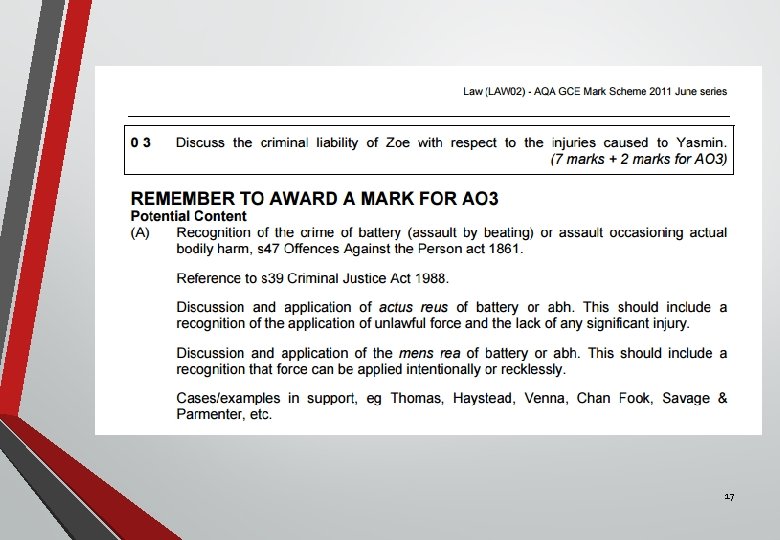
• I – Identify (Battery) ISAS S – State (R v Ireland [1997] Lord Steyn defined battery as "unlawful application of force by the defendant upon the victim“) • A – Apply (AR: 1) Unlawful Collins v Wilcock (1984) ‘beyond everyday jostlings’ Quote. 2) Application R v Thomas (1985) ‘Direct application’ Quote. Police & Crown Prosecution Service agreed JCS, types of injury regarded as battery, include: minor bruising) AR appears to be satisfied (MR: DI (R v Mohan) /OI (R v Woollin) /Recklessness (R v Cunningham) Quote) MR appears to be satisfied • S – Summarise (S. 39 of the Criminal Justice Act 1988 states that battery is a summary offence with a maximum sentence on conviction of up to 6 months’ imprisonment or a fine. )
17
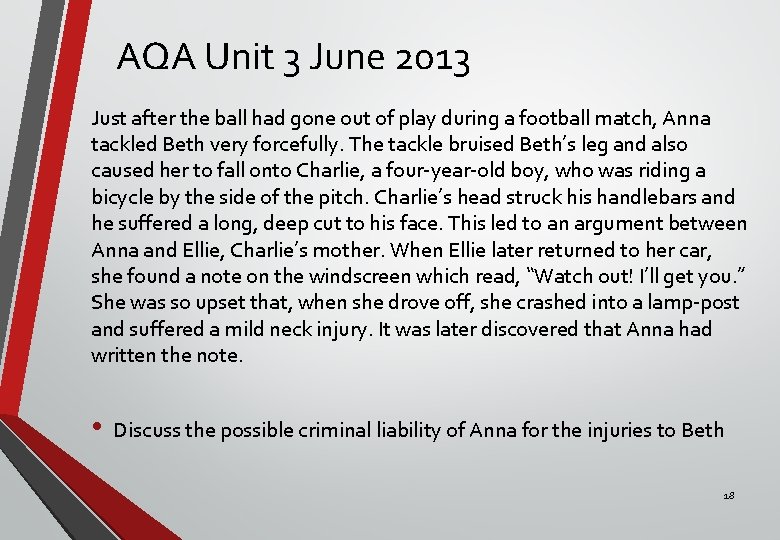
AQA Unit 3 June 2013 Just after the ball had gone out of play during a football match, Anna tackled Beth very forcefully. The tackle bruised Beth’s leg and also caused her to fall onto Charlie, a four-year-old boy, who was riding a bicycle by the side of the pitch. Charlie’s head struck his handlebars and he suffered a long, deep cut to his face. This led to an argument between Anna and Ellie, Charlie’s mother. When Ellie later returned to her car, she found a note on the windscreen which read, “Watch out! I’ll get you. ” She was so upset that, when she drove off, she crashed into a lamp-post and suffered a mild neck injury. It was later discovered that Anna had written the note. • Discuss the possible criminal liability of Anna for the injuries to Beth 18
Timed attempt! • Using your notes and plan complete a timed attempt • 9 marks = 9 minutes 19
Homework • • Design a scenario involving battery Update case chart 20
- Slides: 20