
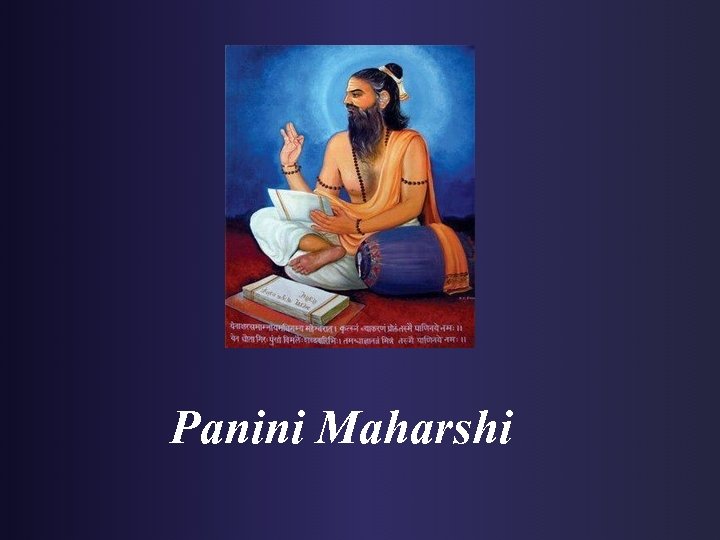
Panini Maharshi PANINI MAHARSHI Panini is the first
- Slides: 10
Panini Maharshi
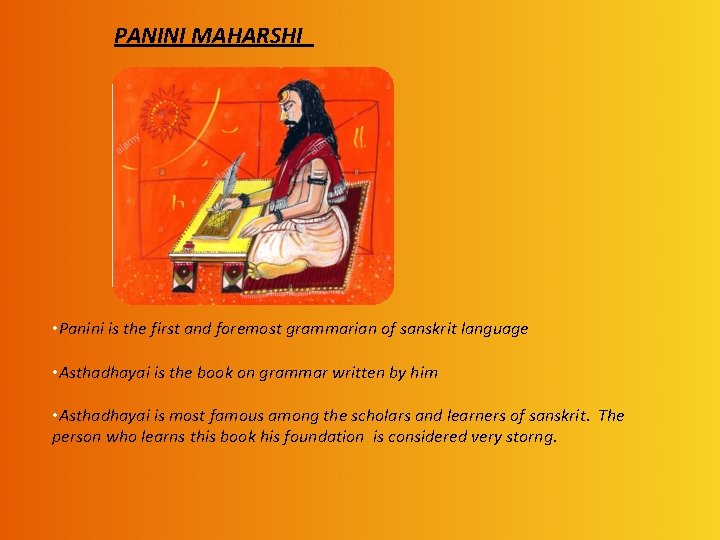
PANINI MAHARSHI • Panini is the first and foremost grammarian of sanskrit language • Asthadhayai is the book on grammar written by him • Asthadhayai is most famous among the scholars and learners of sanskrit. The person who learns this book his foundation is considered very storng.
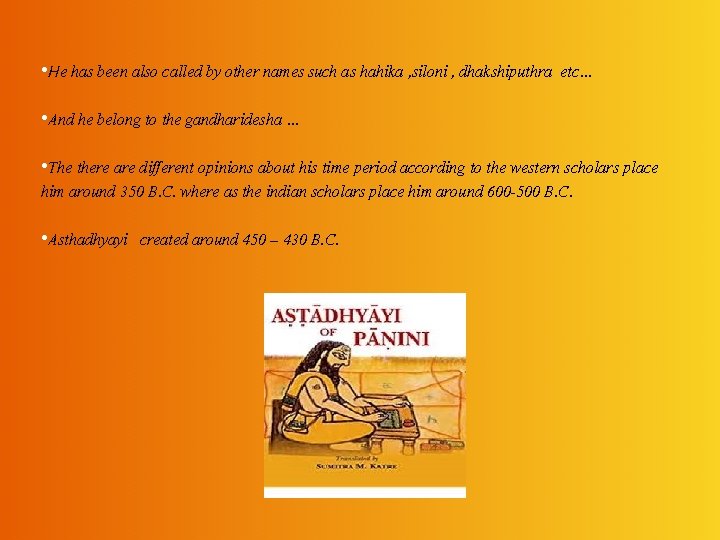
• He has been also called by other names such as hahika , siloni , dhakshiputhra etc… • And he belong to the gandharidesha … • The there are different opinions about his time period according to the western scholars place him around 350 B. C. where as the indian scholars place him around 600 -500 B. C. • Asthadhyayi created around 450 – 430 B. C.
• The grammarian panini is endowed with the scholarly apporach of te earlier sages and even the scholars who excited prior to him. • The boook asthadhyayai is called by few other names aslo. • The book has around 4000 sutras (grammatical formulae). • The book is divided into eight chapters. ecah chapter consisting of four sections each. • The book is a glossary of grammar. it deals with nouns , verbs ( active & passive ) , cases , samasa (compounds ), sandhi (coalescence), participles and other essentials of grammar in a scientific manner. during the period of panini sanskrit wass the spoken language nof the people. hence we find that who studies asthadhayai masters the sanskrit language
V V Maheshwara sutrani
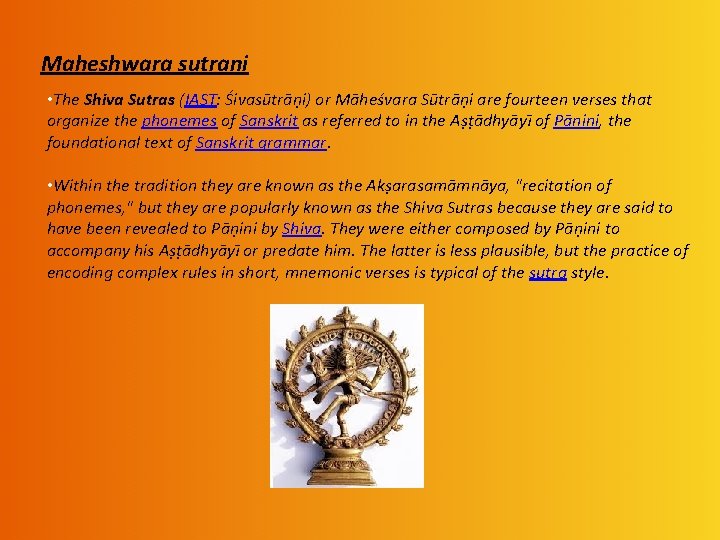
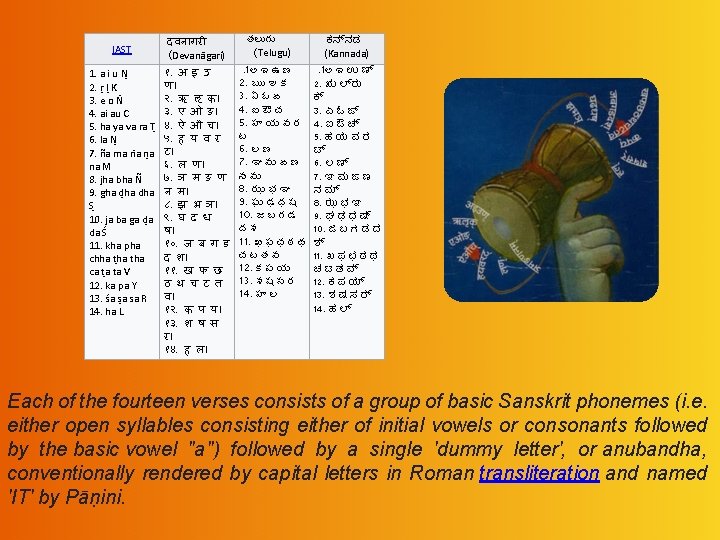
Maheshwara sutrani • The Shiva Sutras (IAST: Śivasūtrāṇi) or Māheśvara Sūtrāṇi are fourteen verses that organize the phonemes of Sanskrit as referred to in the Aṣṭādhyāyī of Pāṇini, the foundational text of Sanskrit grammar. • Within the tradition they are known as the Akṣarasamāmnāya, "recitation of phonemes, " but they are popularly known as the Shiva Sutras because they are said to have been revealed to Pāṇini by Shiva. They were either composed by Pāṇini to accompany his Aṣṭādhyāyī or predate him. The latter is less plausible, but the practice of encoding complex rules in short, mnemonic verses is typical of the sutra style.
• From these 14 verses, a total of 281 pratyāhāras can be formed: 14*3 + 13*2 + 12*2 + 11*2 + 10*4 + 9*1 + 8*5 + 7*2 + 6*3 * 5*5 + 4*8 + 3*2 + 2*3 +1*1, minus 14 (as Pāṇini does not use single element pratyāhāras) minus 10 (as there are 10 duplicate sets due to h appearing twice); the second multiplier in each term represents the number of phonemes in each. But Pāṇini uses only 41 (with a 42 nd introduced by later grammarians, raṆ=r l) pratyāhāras in the Aṣṭādhyāyī. • The Shiva Sutras put phonemes with a similar manner of articulation together (so sibilants in 13 śa ṣa sa R, nasals in 7 ñ m ṅ ṇ n M). Economy (Sanskrit: lāghava) is a major principle of their organization, and it is debated whether Pāṇini deliberately encoded phonological patterns in them (as they were treated in traditional phonetic texts called Prātiśakyas) or simply grouped together phonemes which he needed to refer to in the Aṣṭādhyāyī and which only secondarily reflect phonological patterns (as argued by Paul Kiparsky and Wiebke Petersen, for example). Pāṇini does not use the Shiva Sutras to refer to homorganic stops (stop consonants produced at the same place of articulation), but rather the anubandha U: to refer to the palatals c ch j jh he uses c. U.
PRESENTED BY S. MADHAVI Faculty of Sanskrit AVANTHI DEGREE & P. G COLLEGE THE END