
Panel Potential of AI systems in AviationAerospace SAE
- Slides: 23
Panel: Potential of AI systems in Aviation/Aerospace SAE Aerospace Summit 2018 | 2 October Dr. Bob Touchton Chief Autonomy Scientist Robert. A. Touchton@leidos. com Cleared for Open Publication by Do. D Office of Prepublication and Security Review 18 -S-0076 and 18 -S-1160 © Leidos. All rights reserved.
What is Autonomy? Standards’ Definition: the condition or quality of being self-governing; an Unmanned System’s own ability of integrated sensing, perceiving, analyzing, communicating, planning, decision-making, and acting/executing to achieve its goals as assigned by its human operator(s) through designed Human-Robot Interface (HRI) or by another system* Qualities and Discriminators – what makes a system autonomous? : − Perceive the world, the mission, and itself with awareness and understanding of what it perceives − Communicate and interact with the outside world, its environment and other agents (other unmanned systems or humans) − Make decisions and respond appropriately, with an ability to make short-term and long-term plans that achieve goals of varying degrees of importance More advanced autonomous systems also maintain Models of processes, strategies and relationships, with an ability to learn about itself and its environment * SAE International AS 4 AIR 5665 A 2 © LEIDOS. ALL RIGHTS RESERVED. Cleared for Open Publication Nov 14, 2017 by Do. D Office of Prepublication and Security Review 18 -S-0076
Why do we care about Autonomy? Autonomy is a key enabler for: Increasing the duration, complexity and general effectiveness of Unmanned Systems (UMS) and their missions Increasing the number of Unmanned Systems that an Operator can manage and control Moving Warfighters out of harm’s way by taking on dangerous tasks beyond what can be done with teleoperation Performing dull or dirty tasks UMS Autonomy helps increase mission capability and Warfighter safety while containing cost 3 © LEIDOS. ALL RIGHTS RESERVED. Cleared for Open Publication Nov 14, 2017 by Do. D Office of Prepublication and Security Review 18 -S-0076
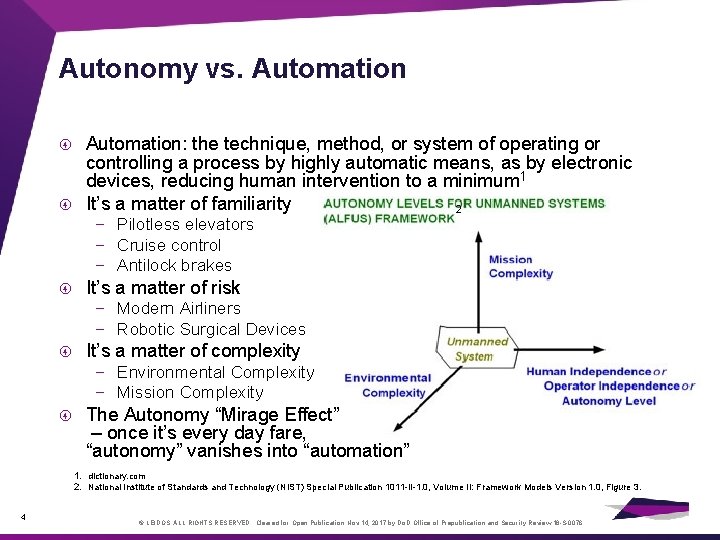
Autonomy vs. Automation: the technique, method, or system of operating or controlling a process by highly automatic means, as by electronic devices, reducing human intervention to a minimum 1 It’s a matter of familiarity 2 − Pilotless elevators − Cruise control − Antilock brakes It’s a matter of risk − Modern Airliners − Robotic Surgical Devices It’s a matter of complexity − Environmental Complexity − Mission Complexity The Autonomy “Mirage Effect” – once it’s every day fare, “autonomy” vanishes into “automation” 1. dictionary. com 2. National Institute of Standards and Technology (NIST) Special Publication 1011 -II-1. 0, Volume II: Framework Models Version 1. 0, Figure 3. 4 © LEIDOS. ALL RIGHTS RESERVED. Cleared for Open Publication Nov 14, 2017 by Do. D Office of Prepublication and Security Review 18 -S-0076
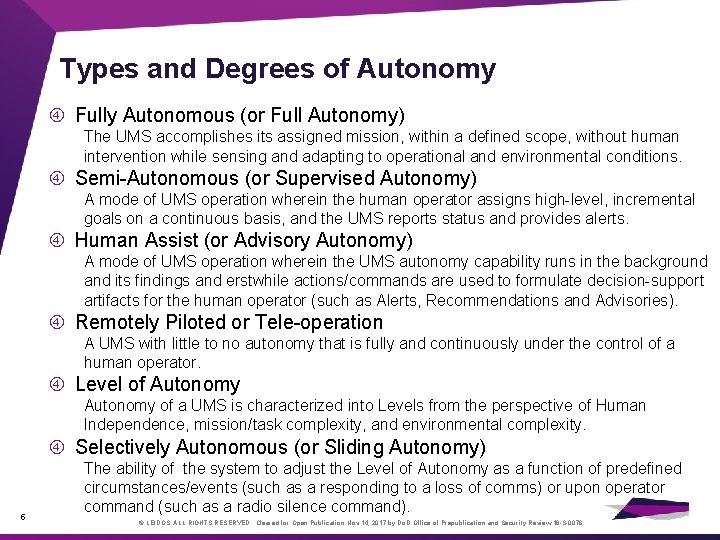
Types and Degrees of Autonomy Fully Autonomous (or Full Autonomy) The UMS accomplishes its assigned mission, within a defined scope, without human intervention while sensing and adapting to operational and environmental conditions. Semi-Autonomous (or Supervised Autonomy) A mode of UMS operation wherein the human operator assigns high-level, incremental goals on a continuous basis, and the UMS reports status and provides alerts. Human Assist (or Advisory Autonomy) A mode of UMS operation wherein the UMS autonomy capability runs in the background and its findings and erstwhile actions/commands are used to formulate decision-support artifacts for the human operator (such as Alerts, Recommendations and Advisories). Remotely Piloted or Tele-operation A UMS with little to no autonomy that is fully and continuously under the control of a human operator. Level of Autonomy of a UMS is characterized into Levels from the perspective of Human Independence, mission/task complexity, and environmental complexity. Selectively Autonomous (or Sliding Autonomy) 5 The ability of the system to adjust the Level of Autonomy as a function of predefined circumstances/events (such as a responding to a loss of comms) or upon operator command (such as a radio silence command). © LEIDOS. ALL RIGHTS RESERVED. Cleared for Open Publication Nov 14, 2017 by Do. D Office of Prepublication and Security Review 18 -S-0076
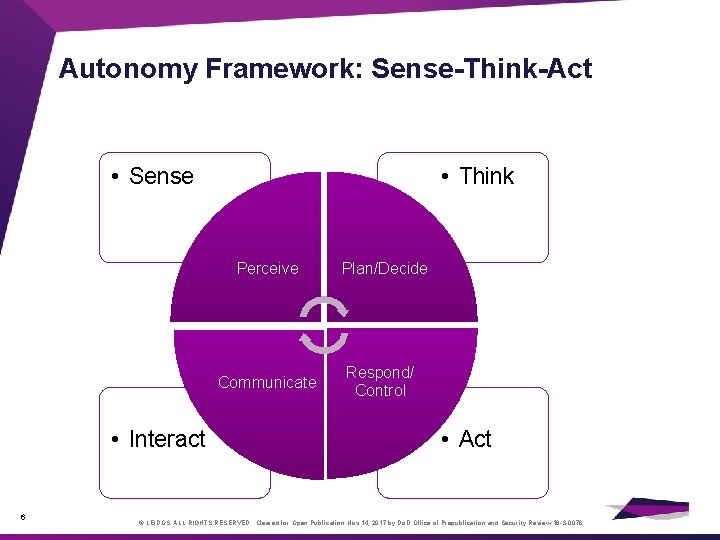
Autonomy Framework: Sense-Think-Act • Sense • Interact 6 • Think Perceive Plan/Decide Communicate Respond/ Control • Act © LEIDOS. ALL RIGHTS RESERVED. Cleared for Open Publication Nov 14, 2017 by Do. D Office of Prepublication and Security Review 18 -S-0076
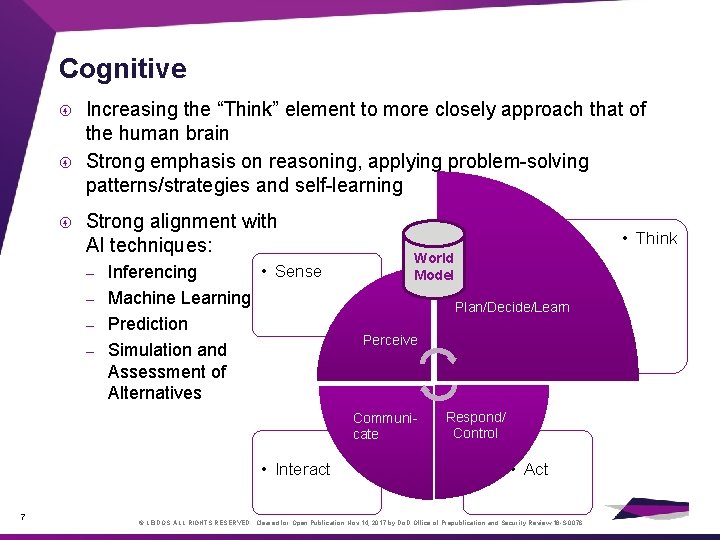
Cognitive Increasing the “Think” element to more closely approach that of the human brain Strong emphasis on reasoning, applying problem-solving patterns/strategies and self-learning Strong alignment with AI techniques: ‒ ‒ • Sense Inferencing Machine Learning Prediction Simulation and Assessment of Alternatives • Think World Model Plan/Decide/Learn Perceive Communicate • Interact 7 Respond/ Control • Act © LEIDOS. ALL RIGHTS RESERVED. Cleared for Open Publication Nov 14, 2017 by Do. D Office of Prepublication and Security Review 18 -S-0076
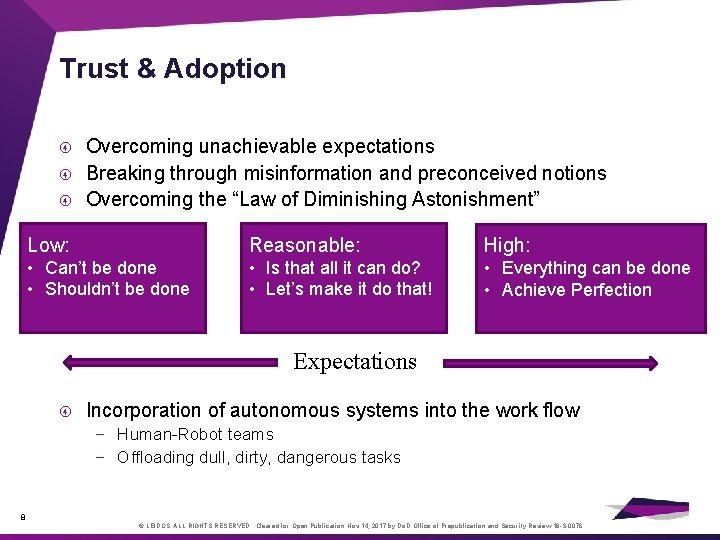
Trust & Adoption Overcoming unachievable expectations Breaking through misinformation and preconceived notions Overcoming the “Law of Diminishing Astonishment” Low: Reasonable: High: • Can’t be done • Shouldn’t be done • Is that all it can do? • Let’s make it do that! • Everything can be done • Achieve Perfection Expectations Incorporation of autonomous systems into the work flow − Human-Robot teams − Offloading dull, dirty, dangerous tasks 8 © LEIDOS. ALL RIGHTS RESERVED. Cleared for Open Publication Nov 14, 2017 by Do. D Office of Prepublication and Security Review 18 -S-0076
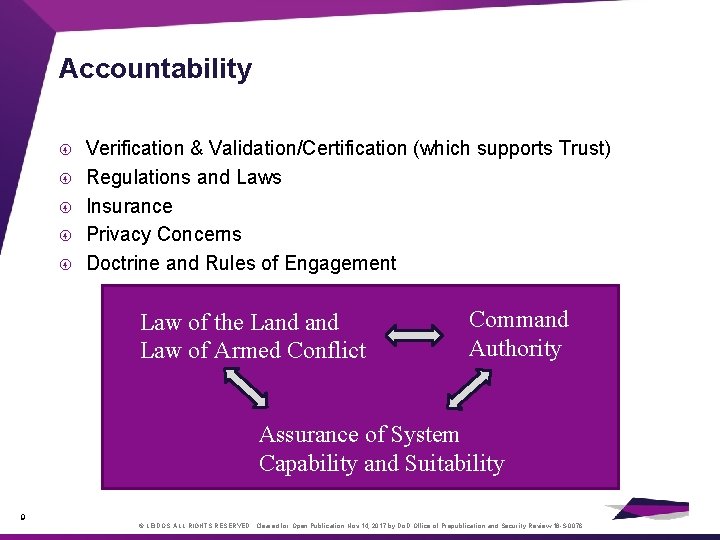
Accountability Verification & Validation/Certification (which supports Trust) Regulations and Laws Insurance Privacy Concerns Doctrine and Rules of Engagement Law of the Land Law of Armed Conflict Command Authority Assurance of System Capability and Suitability 9 © LEIDOS. ALL RIGHTS RESERVED. Cleared for Open Publication Nov 14, 2017 by Do. D Office of Prepublication and Security Review 18 -S-0076
Safety COLREGS (when surfaced) Defining “fail-safe” as a function of mission mode Scaling safety measures as a function of risk (e. g. , man-portable vs. Large Displacement UUV) Self Preservation How to affordably ensure safety when leveraging Open, Modular componentry? 10 © LEIDOS. ALL RIGHTS RESERVED. Cleared for Open Publication Nov 14, 2017 by Do. D Office of Prepublication and Security Review 18 -S-0076
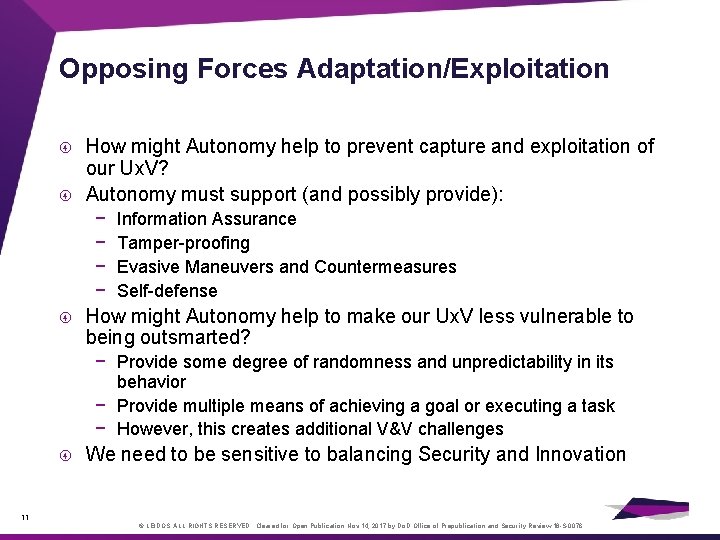
Opposing Forces Adaptation/Exploitation How might Autonomy help to prevent capture and exploitation of our Ux. V? Autonomy must support (and possibly provide): − − Information Assurance Tamper-proofing Evasive Maneuvers and Countermeasures Self-defense How might Autonomy help to make our Ux. V less vulnerable to being outsmarted? − Provide some degree of randomness and unpredictability in its behavior − Provide multiple means of achieving a goal or executing a task − However, this creates additional V&V challenges We need to be sensitive to balancing Security and Innovation 11 © LEIDOS. ALL RIGHTS RESERVED. Cleared for Open Publication Nov 14, 2017 by Do. D Office of Prepublication and Security Review 18 -S-0076
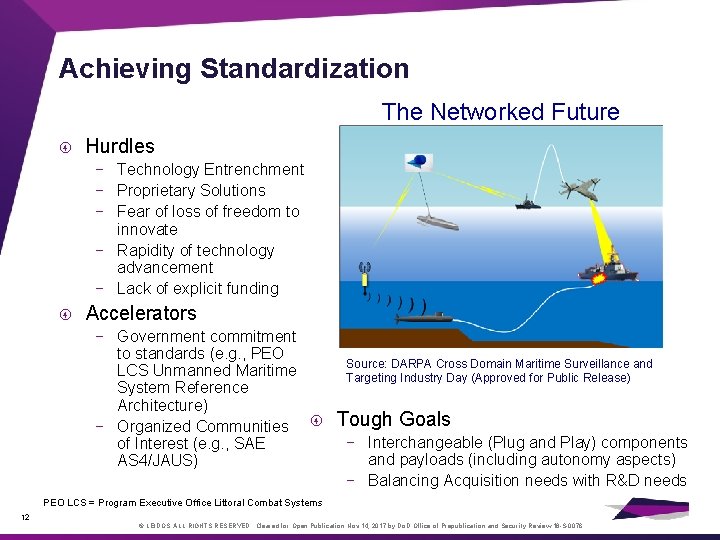
Achieving Standardization The Networked Future Hurdles − Technology Entrenchment − Proprietary Solutions − Fear of loss of freedom to innovate − Rapidity of technology advancement − Lack of explicit funding Accelerators − Government commitment to standards (e. g. , PEO LCS Unmanned Maritime System Reference Architecture) − Organized Communities of Interest (e. g. , SAE AS 4/JAUS) Source: DARPA Cross Domain Maritime Surveillance and Targeting Industry Day (Approved for Public Release) Tough Goals − Interchangeable (Plug and Play) components and payloads (including autonomy aspects) − Balancing Acquisition needs with R&D needs PEO LCS = Program Executive Office Littoral Combat Systems 12 © LEIDOS. ALL RIGHTS RESERVED. Cleared for Open Publication Nov 14, 2017 by Do. D Office of Prepublication and Security Review 18 -S-0076
SAE AS 4 (JAUS) Joint Architecture for Unmanned Systems (JAUS) establishes a standardized definition of Services and Messages that supports Interoperability Defines message data content /formats and the methods for exchanging those messages among heterogeneous systems and their computing nodes Independent of technology, computer hardware, operator use, communications equipment, and vehicle platforms Originally commissioned in the mid-1990’s by the Office of the Secretary of Defense (OSD) as the JAUS Working Group, which is now officially sunset SAE/AS 4 is now the official home of JAUS New version under SAE is now being explored and adopted − International, commercial standards body − Transition was encouraged and supported by OSD − Modernized Service Oriented Architecture − XML-based − JAUS Service Interface Definition Language (JSIDL) 13 © LEIDOS. ALL RIGHTS RESERVED. Cleared for Open Publication Nov 14, 2017 by Do. D Office of Prepublication and Security Review 18 -S-0076
Backup Slides 14 © 2016 LEIDOS. ALL RIGHTS RESERVED.
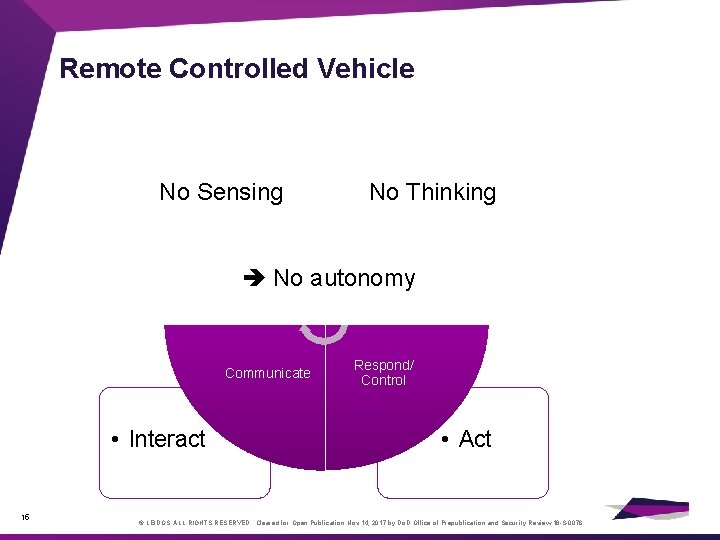
Remote Controlled Vehicle • Sense No Sensing • Think No Thinking Intelligence No autonomy Perception Communicate • Interact 15 Respond/ Control • Act © LEIDOS. ALL RIGHTS RESERVED. Cleared for Open Publication Nov 14, 2017 by Do. D Office of Prepublication and Security Review 18 -S-0076
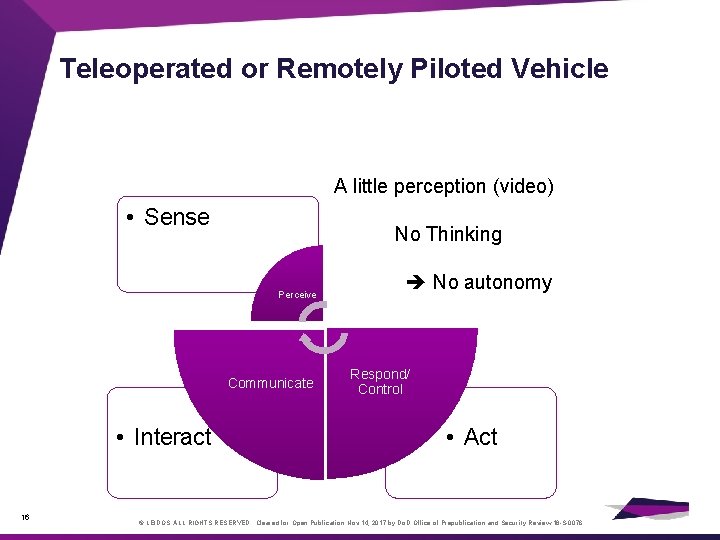
Teleoperated or Remotely Piloted Vehicle • Think A little perception (video) • Sense No Thinking Intelligence Perceive Communicate • Interact 16 No autonomy Respond/ Control • Act © LEIDOS. ALL RIGHTS RESERVED. Cleared for Open Publication Nov 14, 2017 by Do. D Office of Prepublication and Security Review 18 -S-0076
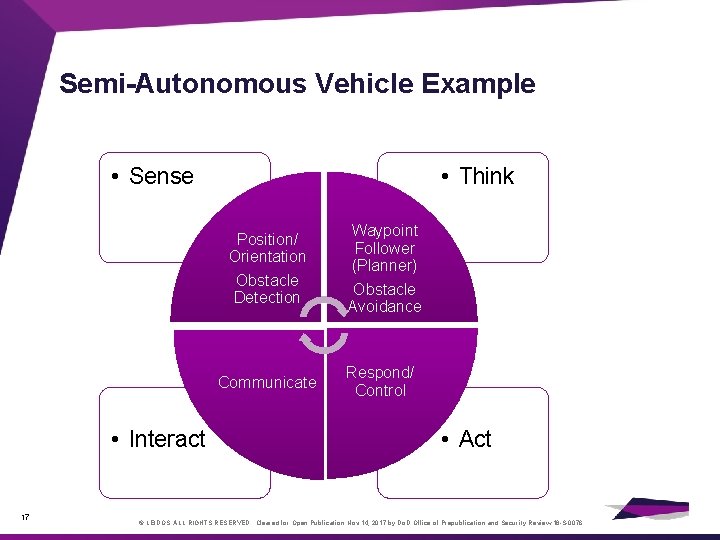
Semi-Autonomous Vehicle Example • Sense • Think Position/ Orientation Obstacle Detection Communicate • Interact 17 Waypoint Follower (Planner) Obstacle Avoidance Respond/ Control • Act © LEIDOS. ALL RIGHTS RESERVED. Cleared for Open Publication Nov 14, 2017 by Do. D Office of Prepublication and Security Review 18 -S-0076
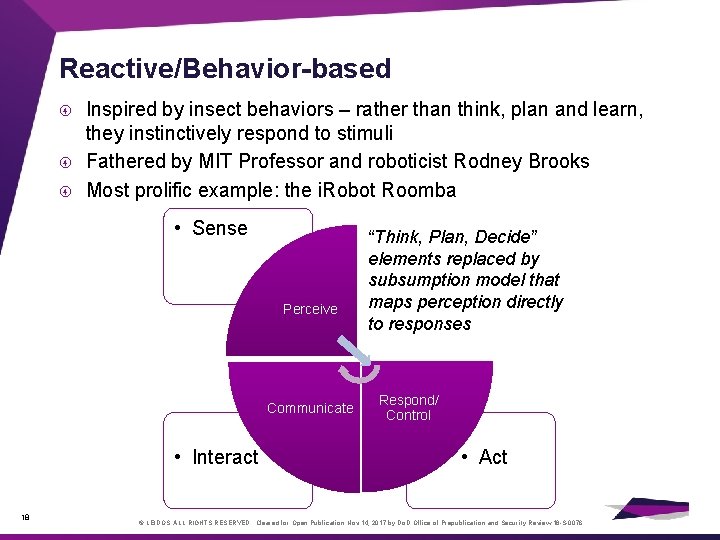
Reactive/Behavior-based Inspired by insect behaviors – rather than think, plan and learn, they instinctively respond to stimuli Fathered by MIT Professor and roboticist Rodney Brooks Most prolific example: the i. Robot Roomba • Sense Perceive Communicate • Interact 18 Think “Think, Plan, • Decide” elements replaced by subsumption model that Plan/Decid maps perception directly e to responses Respond/ Control • Act © LEIDOS. ALL RIGHTS RESERVED. Cleared for Open Publication Nov 14, 2017 by Do. D Office of Prepublication and Security Review 18 -S-0076
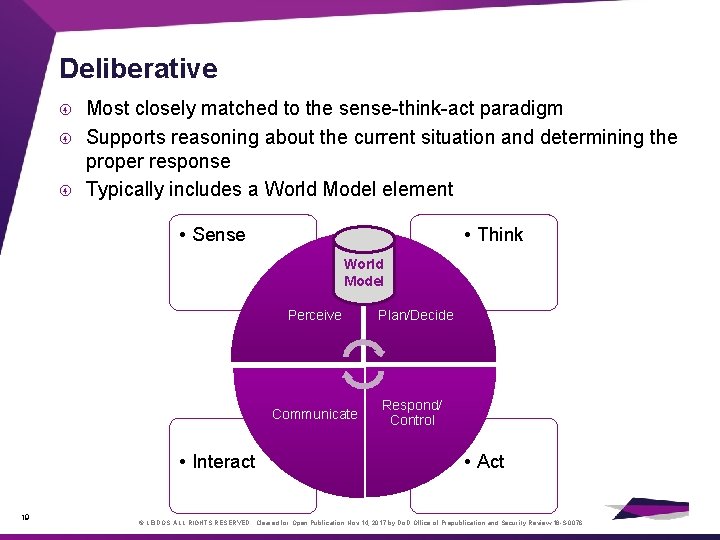
Deliberative Most closely matched to the sense-think-act paradigm Supports reasoning about the current situation and determining the proper response Typically includes a World Model element • Sense • Think World Model • Interact 19 Perceive Plan/Decide Communicate Respond/ Control • Act © LEIDOS. ALL RIGHTS RESERVED. Cleared for Open Publication Nov 14, 2017 by Do. D Office of Prepublication and Security Review 18 -S-0076
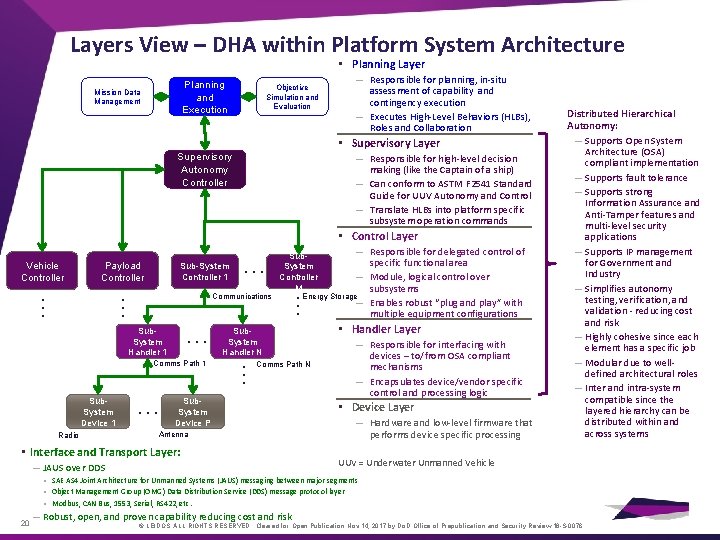
Layers View – DHA within Platform System Architecture • Planning Layer Planning and Execution Mission Data Management – Responsible for planning, in-situ assessment of capability and contingency execution – Executes High-Level Behaviors (HLBs), Roles and Collaboration Objective Simulation and Evaluation • Supervisory Layer Supervisory Autonomy Controller – Responsible for high-level decision making (like the Captain of a ship) – Can conform to ASTM F 2541 Standard Guide for UUV Autonomy and Control – Translate HLBs into platform specific subsystem operation commands • Control Layer Vehicle Controller Payload Controller Sub-System Controller 1 … Radio … Sub. System Handler N • Handler Layer – Responsible for interfacing with devices – to/from OSA compliant mechanisms – Encapsulates device/vendor specific control and processing logic Comms Path N … Comms Path 1 … … … Communications Sub. System Handler 1 Sub. System Device 1 … – Responsible for delegated control of specific functional area – Module, logical control over subsystems Energy Storage – Enables robust “plug and play” with multiple equipment configurations Sub. System Controller M Sub. System Device P • Device Layer – Hardware and low-level firmware that performs device specific processing Antenna • Interface and Transport Layer: – JAUS over DDS Distributed Hierarchical Autonomy: – Supports Open System Architecture (OSA) compliant implementation – Supports fault tolerance – Supports strong Information Assurance and Anti-Tamper features and multi-level security applications – Supports IP management for Government and Industry – Simplifies autonomy testing, verification, and validation - reducing cost and risk – Highly cohesive since each element has a specific job – Modular due to welldefined architectural roles – Inter and intra-system compatible since the layered hierarchy can be distributed within and across systems UUV = Underwater Unmanned Vehicle § SAE AS 4 Joint Architecture for Unmanned Systems (JAUS) messaging between major segments § Object Management Group (OMG) Data Distribution Service (DDS) message protocol layer § Modbus, CAN Bus, 1553, Serial, RS 422, etc. 20 – Robust, open, and proven capability reducing cost and risk © LEIDOS. ALL RIGHTS RESERVED. Cleared for Open Publication Nov 14, 2017 by Do. D Office of Prepublication and Security Review 18 -S-0076
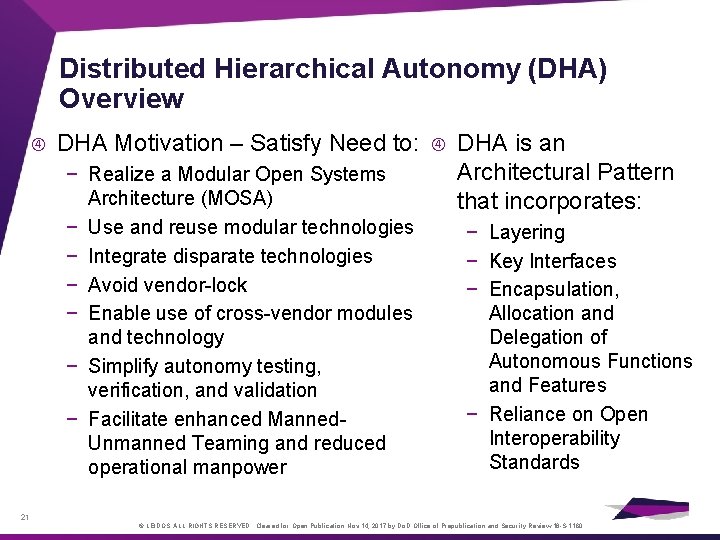
Distributed Hierarchical Autonomy (DHA) Overview DHA Motivation – Satisfy Need to: − Realize a Modular Open Systems Architecture (MOSA) − Use and reuse modular technologies − Integrate disparate technologies − Avoid vendor-lock − Enable use of cross-vendor modules and technology − Simplify autonomy testing, verification, and validation − Facilitate enhanced Manned. Unmanned Teaming and reduced operational manpower DHA is an Architectural Pattern that incorporates: − Layering − Key Interfaces − Encapsulation, Allocation and Delegation of Autonomous Functions and Features − Reliance on Open Interoperability Standards 21 © LEIDOS. ALL RIGHTS RESERVED. Cleared for Open Publication Nov 14, 2017 by Do. D Office of Prepublication and Security Review 18 -S-1160
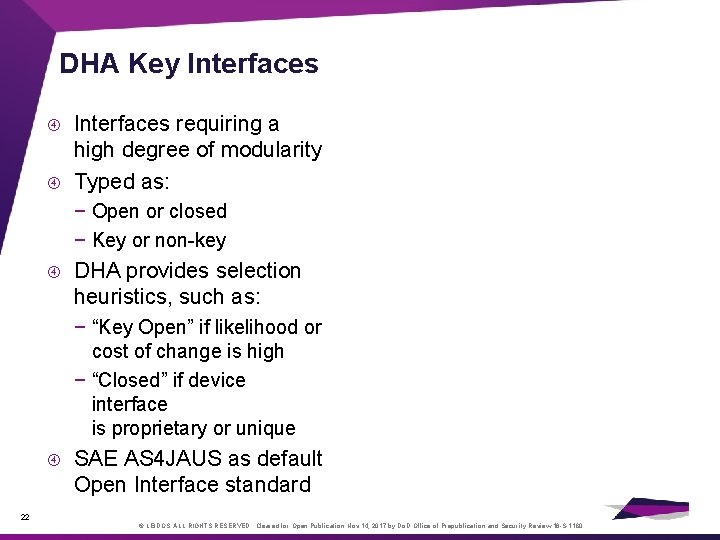
DHA Key Interfaces requiring a high degree of modularity Typed as: − Open or closed − Key or non-key DHA provides selection heuristics, such as: − “Key Open” if likelihood or cost of change is high − “Closed” if device interface is proprietary or unique SAE AS 4 JAUS as default Open Interface standard 22 © LEIDOS. ALL RIGHTS RESERVED. Cleared for Open Publication Nov 14, 2017 by Do. D Office of Prepublication and Security Review 18 -S-1160
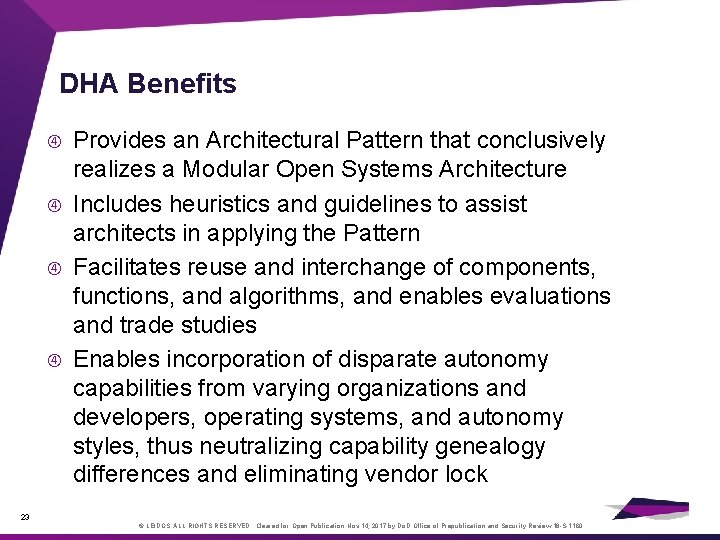
DHA Benefits Provides an Architectural Pattern that conclusively realizes a Modular Open Systems Architecture Includes heuristics and guidelines to assist architects in applying the Pattern Facilitates reuse and interchange of components, functions, and algorithms, and enables evaluations and trade studies Enables incorporation of disparate autonomy capabilities from varying organizations and developers, operating systems, and autonomy styles, thus neutralizing capability genealogy differences and eliminating vendor lock 23 © LEIDOS. ALL RIGHTS RESERVED. Cleared for Open Publication Nov 14, 2017 by Do. D Office of Prepublication and Security Review 18 -S-1160