
Panel Methods Engineering Design of Turbine Blade Shape

Panel Methods & Engineering Design of Turbine Blade Shape P M V Subbarao Professor Mechanical Engineering Department The Power of Linear Mathematics to Implement Design by Authority…
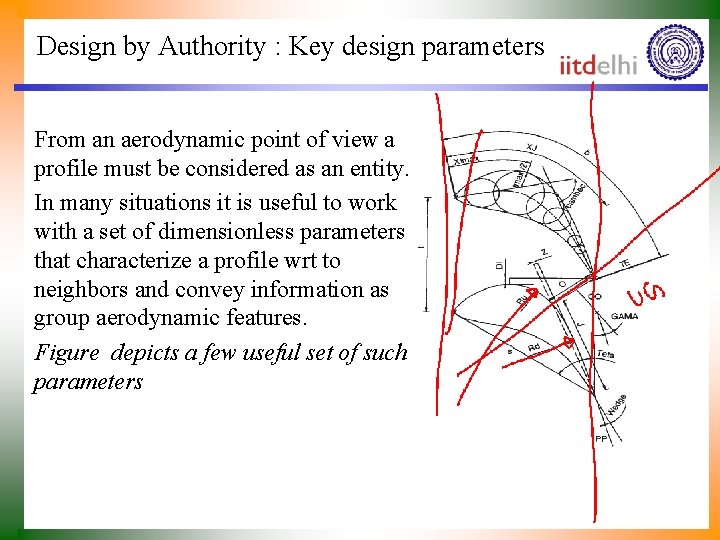
Design by Authority : Key design parameters • From an aerodynamic point of view a profile must be considered as an entity. • In many situations it is useful to work with a set of dimensionless parameters that characterize a profile wrt to neighbors and convey information as group aerodynamic features. • Figure depicts a few useful set of such parameters
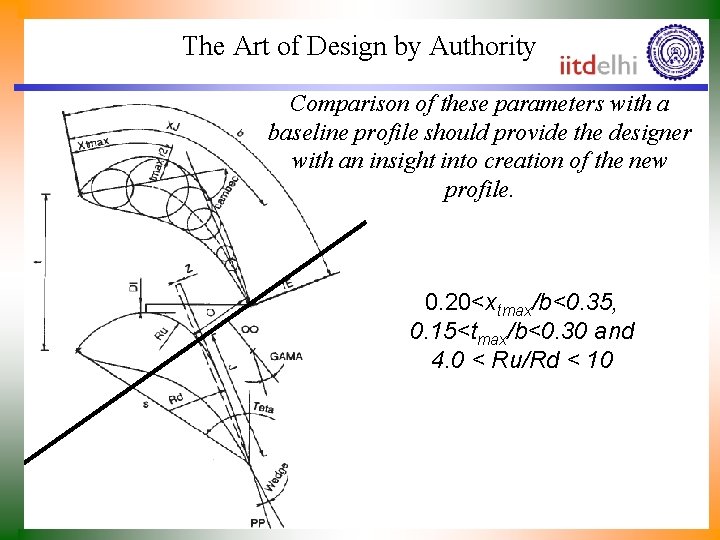
The Art of Design by Authority Comparison of these parameters with a baseline profile should provide the designer with an insight into creation of the new profile. 0. 20<xtmax/b<0. 35, 0. 15<tmax/b<0. 30 and 4. 0 < Ru/Rd < 10

2 D Inviscid Panels Source Panel Vortex Panel Doublet Panel • The line segments are called as panels. • Either source sheets of strength m are vortex sheets of strength g or doublets of strength , are placed on each panel.

The Point Source Vs The Panel Source Consider a point source m m
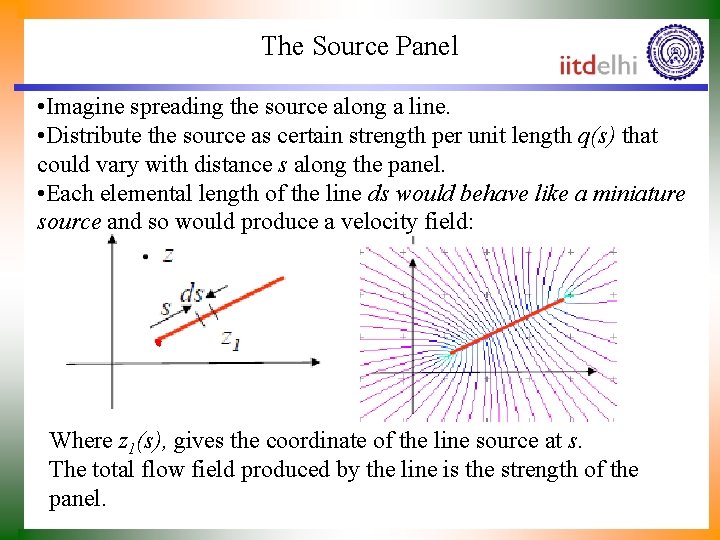
The Source Panel • Imagine spreading the source along a line. • Distribute the source as certain strength per unit length q(s) that could vary with distance s along the panel. • Each elemental length of the line ds would behave like a miniature source and so would produce a velocity field: Where z 1(s), gives the coordinate of the line source at s. The total flow field produced by the line is the strength of the panel.
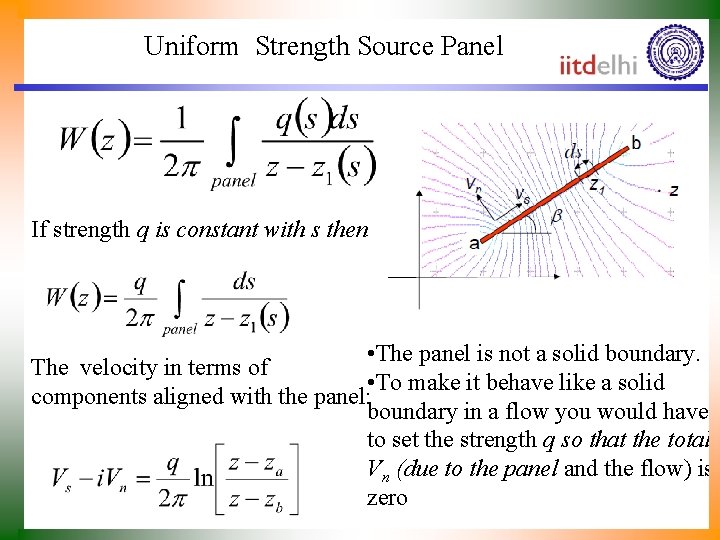
Uniform Strength Source Panel If strength q is constant with s then • The panel is not a solid boundary. The velocity in terms of • To make it behave like a solid components aligned with the panel: boundary in a flow you would have to set the strength q so that the total Vn (due to the panel and the flow) is zero
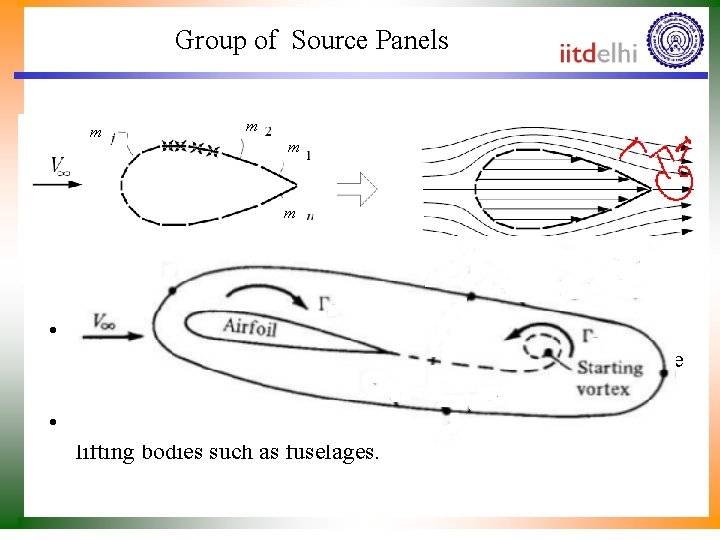
Group of Source Panels m m • This use of source sheets in this manner to represent a flow is the basis of the panel method, which is widely used to compute the flow about aerodynamic bodies of arbitrary shape. • The approach presented here is actually suitable only for nonlifting bodies such as fuselages.
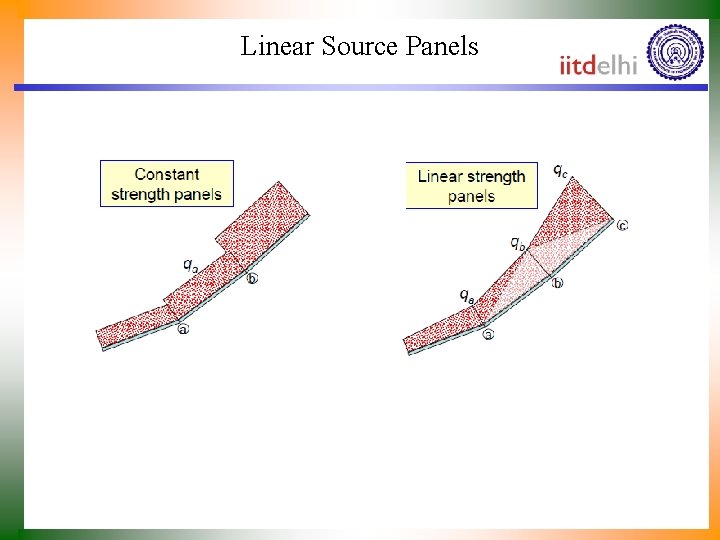
Linear Source Panels
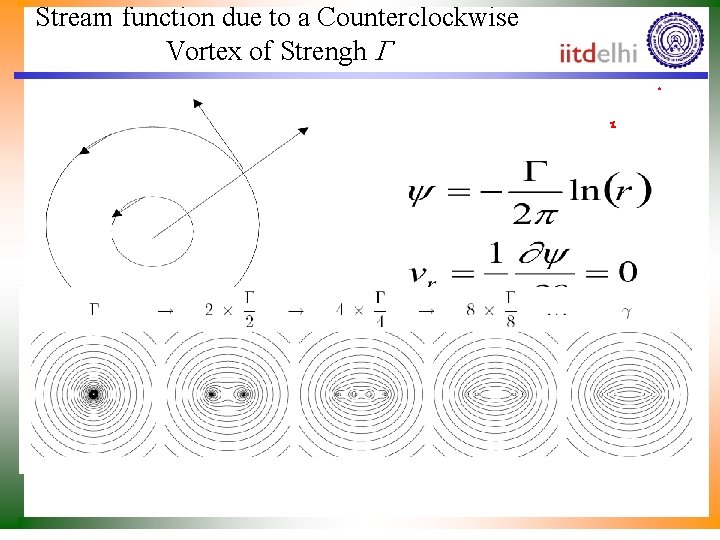
Stream function due to a Counterclockwise Vortex of Strengh G
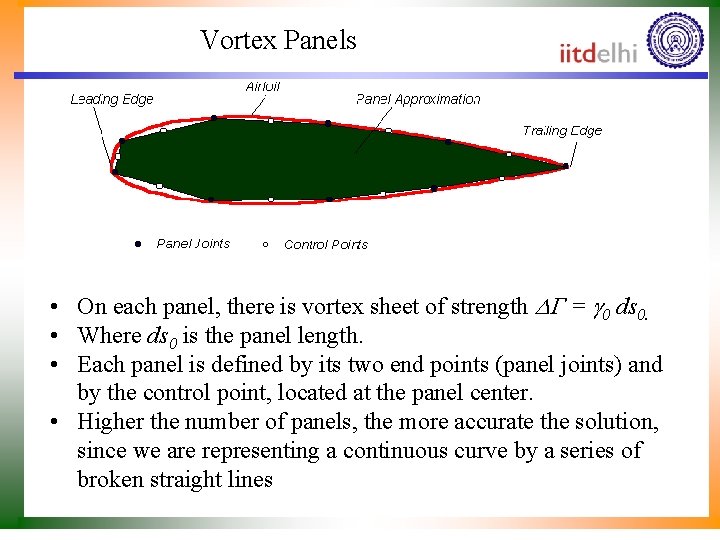
Vortex Panels • On each panel, there is vortex sheet of strength DG = g 0 ds 0. • Where ds 0 is the panel length. • Each panel is defined by its two end points (panel joints) and by the control point, located at the panel center. • Higher the number of panels, the more accurate the solution, since we are representing a continuous curve by a series of broken straight lines
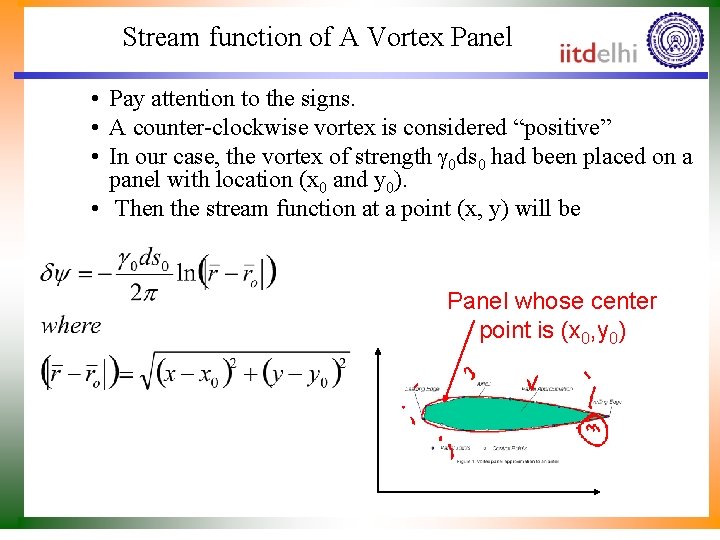
Stream function of A Vortex Panel • Pay attention to the signs. • A counter-clockwise vortex is considered “positive” • In our case, the vortex of strength 0 ds 0 had been placed on a panel with location (x 0 and y 0). • Then the stream function at a point (x, y) will be Panel whose center point is (x 0, y 0)
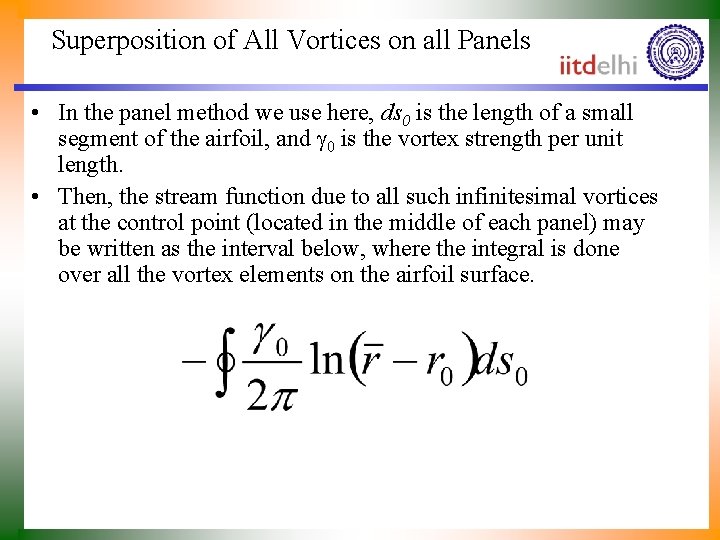
Superposition of All Vortices on all Panels • In the panel method we use here, ds 0 is the length of a small segment of the airfoil, and 0 is the vortex strength per unit length. • Then, the stream function due to all such infinitesimal vortices at the control point (located in the middle of each panel) may be written as the interval below, where the integral is done over all the vortex elements on the airfoil surface.
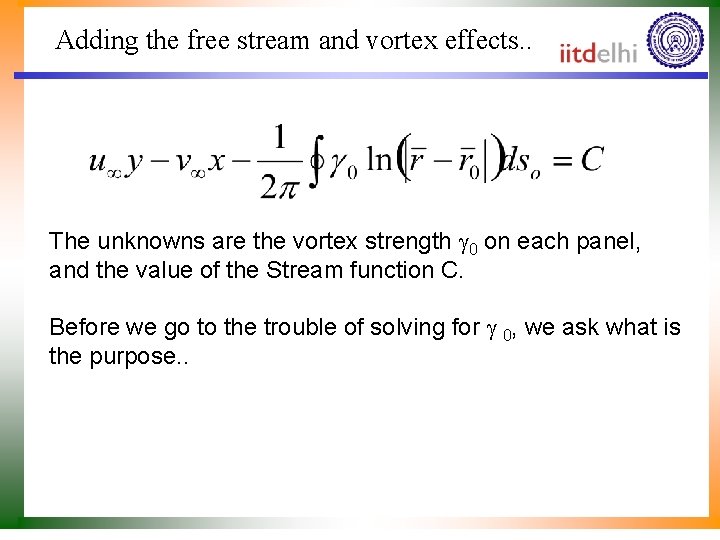
Adding the free stream and vortex effects. . The unknowns are the vortex strength 0 on each panel, and the value of the Stream function C. Before we go to the trouble of solving for 0, we ask what is the purpose. .
Boundary Condition • The stream function is due to superposition of the effects of the free stream and the effects of the vortices 0 ds 0 on each of the panel. • We treat the airfoil surface as a streamline. – This ensures that the velocity is tangential to the airfoil surface, and no fluid can penetrate the surface. • We require that at all control points (middle points of each panel) y= C.
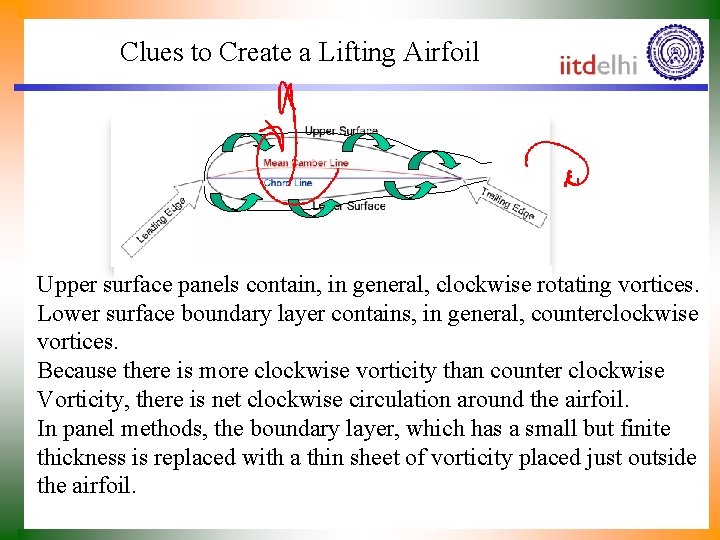
Clues to Create a Lifting Airfoil Upper surface panels contain, in general, clockwise rotating vortices. Lower surface boundary layer contains, in general, counterclockwise vortices. Because there is more clockwise vorticity than counter clockwise Vorticity, there is net clockwise circulation around the airfoil. In panel methods, the boundary layer, which has a small but finite thickness is replaced with a thin sheet of vorticity placed just outside the airfoil.
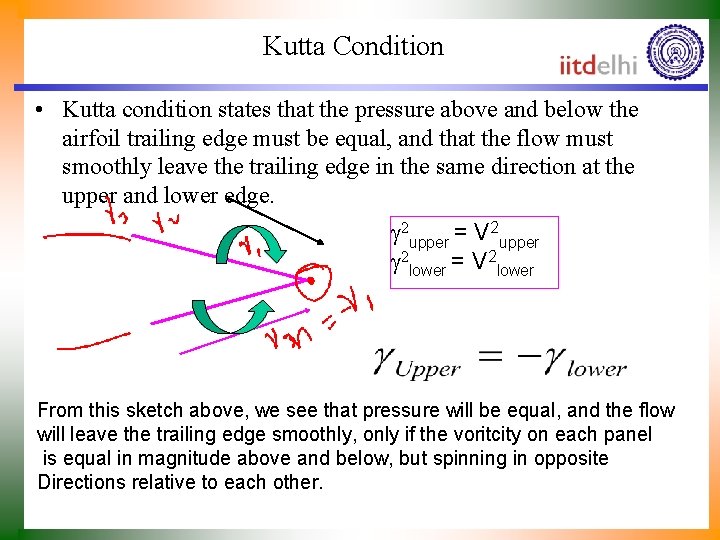
Kutta Condition • Kutta condition states that the pressure above and below the airfoil trailing edge must be equal, and that the flow must smoothly leave the trailing edge in the same direction at the upper and lower edge. 2 upper = V 2 upper 2 lower = V 2 lower From this sketch above, we see that pressure will be equal, and the flow will leave the trailing edge smoothly, only if the voritcity on each panel is equal in magnitude above and below, but spinning in opposite Directions relative to each other.
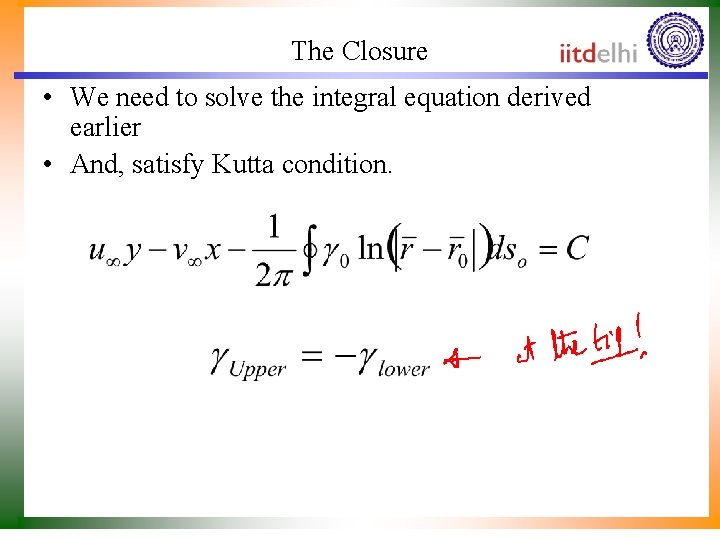
The Closure • We need to solve the integral equation derived earlier • And, satisfy Kutta condition.
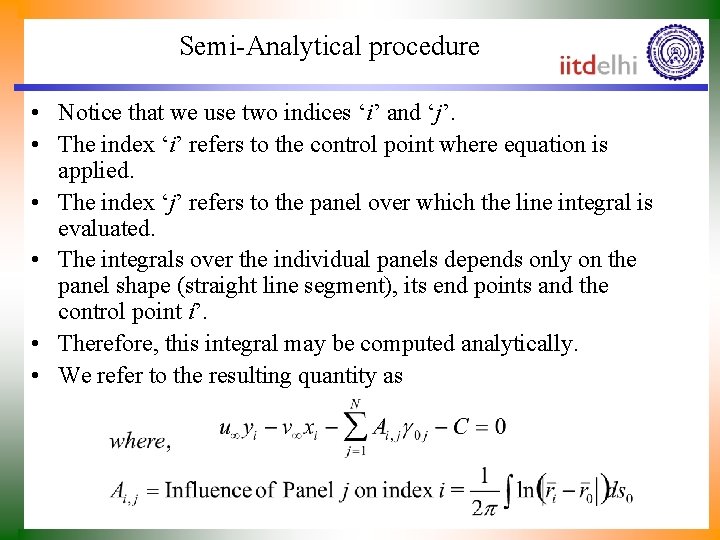
Semi-Analytical procedure • Notice that we use two indices ‘i’ and ‘j’. • The index ‘i’ refers to the control point where equation is applied. • The index ‘j’ refers to the panel over which the line integral is evaluated. • The integrals over the individual panels depends only on the panel shape (straight line segment), its end points and the control point í’. • Therefore, this integral may be computed analytically. • We refer to the resulting quantity as
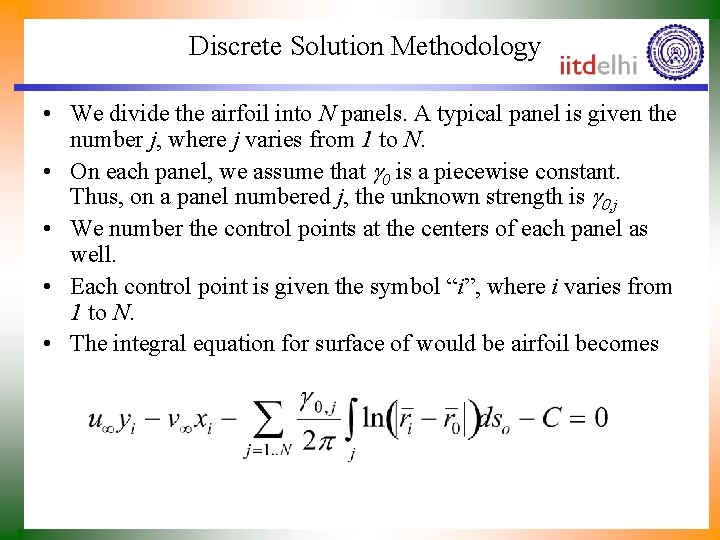
Discrete Solution Methodology • We divide the airfoil into N panels. A typical panel is given the number j, where j varies from 1 to N. • On each panel, we assume that g 0 is a piecewise constant. Thus, on a panel numbered j, the unknown strength is g 0, j • We number the control points at the centers of each panel as well. • Each control point is given the symbol “i”, where i varies from 1 to N. • The integral equation for surface of would be airfoil becomes
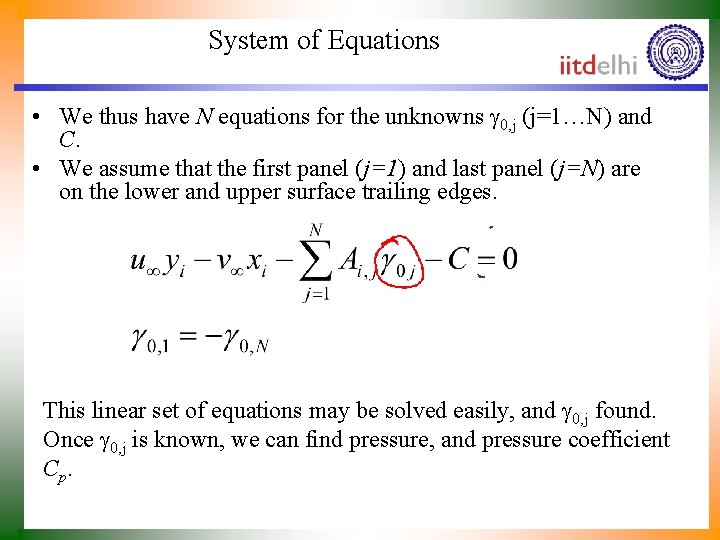
System of Equations • We thus have N equations for the unknowns 0, j (j=1…N) and C. • We assume that the first panel (j=1) and last panel (j=N) are on the lower and upper surface trailing edges. This linear set of equations may be solved easily, and 0, j found. Once 0, j is known, we can find pressure, and pressure coefficient C p.
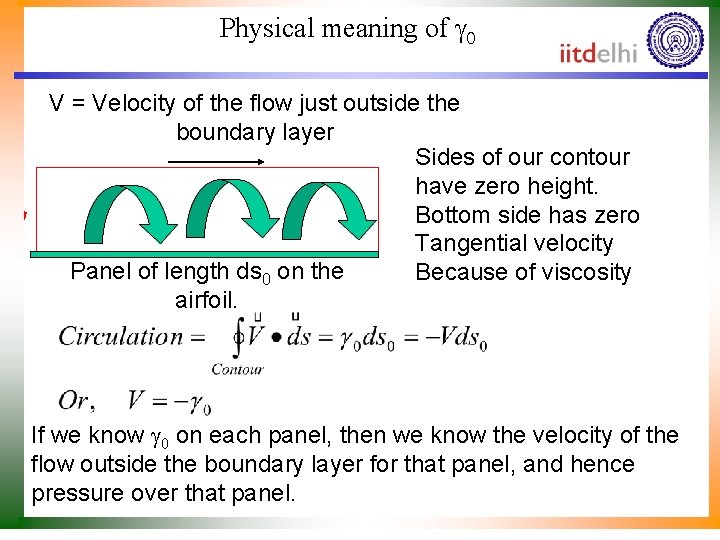
Physical meaning of 0 V = Velocity of the flow just outside the boundary layer Sides of our contour have zero height. Bottom side has zero Tangential velocity Panel of length ds 0 on the Because of viscosity airfoil. If we know 0 on each panel, then we know the velocity of the flow outside the boundary layer for that panel, and hence pressure over that panel.
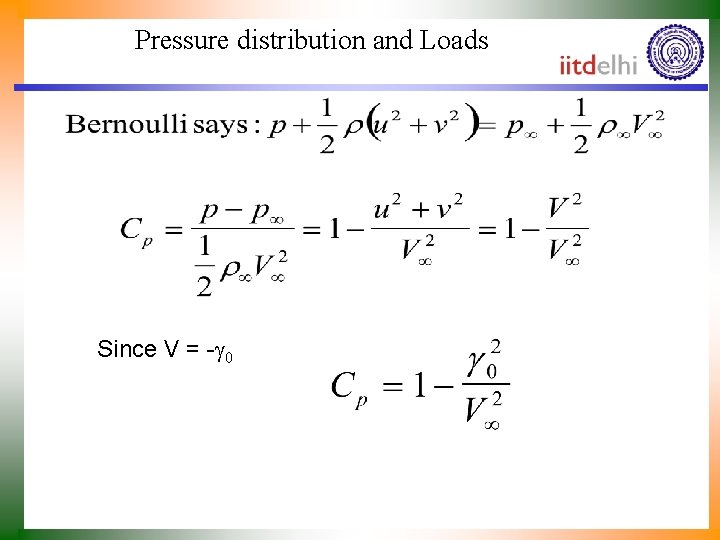
Pressure distribution and Loads Since V = - 0
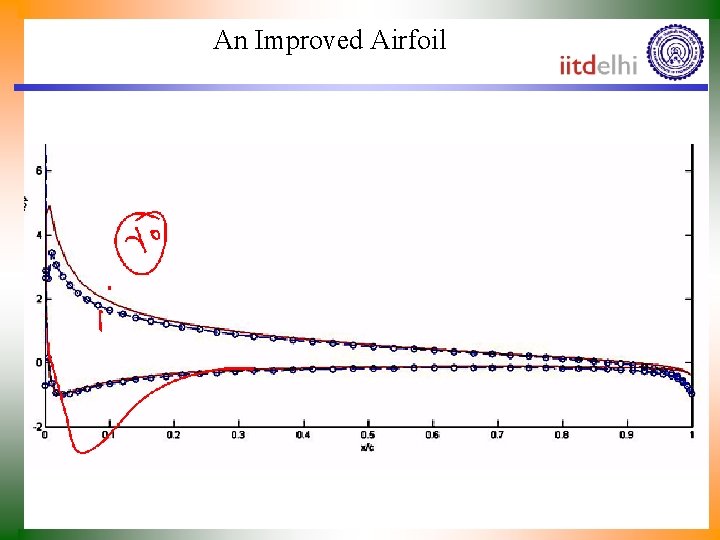
An Improved Airfoil
PABLO • A powerful panel code is found on the web. • It is called PABLO: Potential flow around Airfoils with Boundary Layer coupled One-way • See http: //www. nada. kth. se/~chris/pablo. html • It also computes the boundary layer growth on the airfoil, and skin friction drag. • Learn to use it!

Innovative Mathematics close to the Current Reality • It is time to modify theory to model advanced practice. • The potential theory learnt during few past lectures, is it truly a realistic invention? • Can we see another important positive characteristic of flow is being missed in developing theory(earlier) of designing a lifting body ? !? !? !? • Is it correct to assume 2 =0 for all potential flows? ? ? • The real behavior of flow in steam and gas turbines is consider compressible subsonic flow through flow path and hence past a blade.
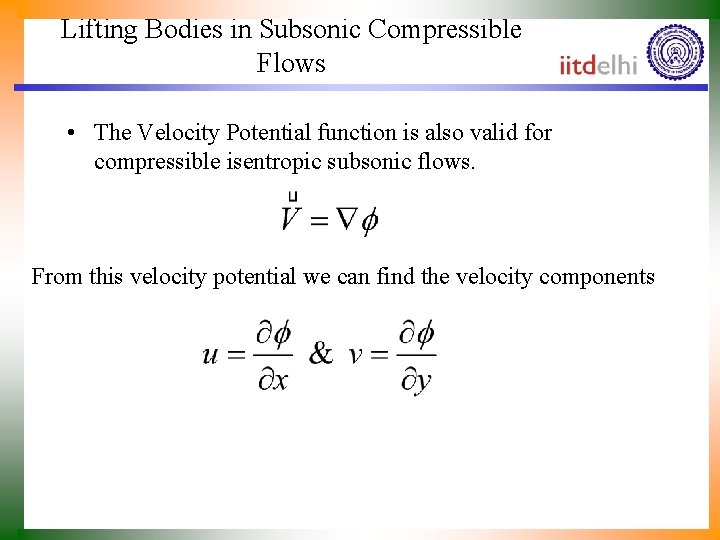
Lifting Bodies in Subsonic Compressible Flows • The Velocity Potential function is also valid for compressible isentropic subsonic flows. From this velocity potential we can find the velocity components
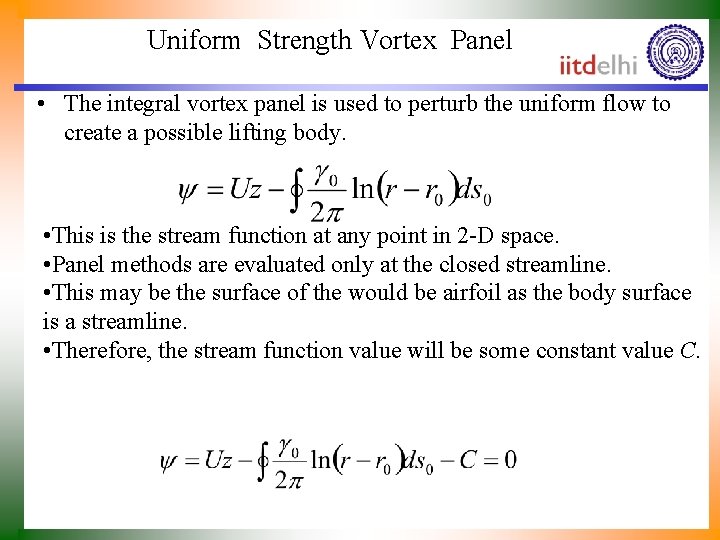
Uniform Strength Vortex Panel • The integral vortex panel is used to perturb the uniform flow to create a possible lifting body. • This is the stream function at any point in 2 -D space. • Panel methods are evaluated only at the closed streamline. • This may be the surface of the would be airfoil as the body surface is a streamline. • Therefore, the stream function value will be some constant value C.
- Slides: 28