
Panel Discussion e Signature Forms Management and Systems

- Slides: 7
Panel Discussion: e. Signature, Forms Management and Systems Integration
Moderator & Panelists Moderator v Daniel Lievrouw, Vice President of Operations and IT, American Guardian Warranty Services Panelists v John Jacobs, Director of Business Development, e. Original, Inc. v Kumar Kathinokkula, COO, F&I Administration Solutions, Inc. v Brian Krasavage, Director of Product Management, ADP Dealer Services v Ronda Lewis, National Director of Sales, Dealertrack v Brent Allen, President, Stone. Eagle
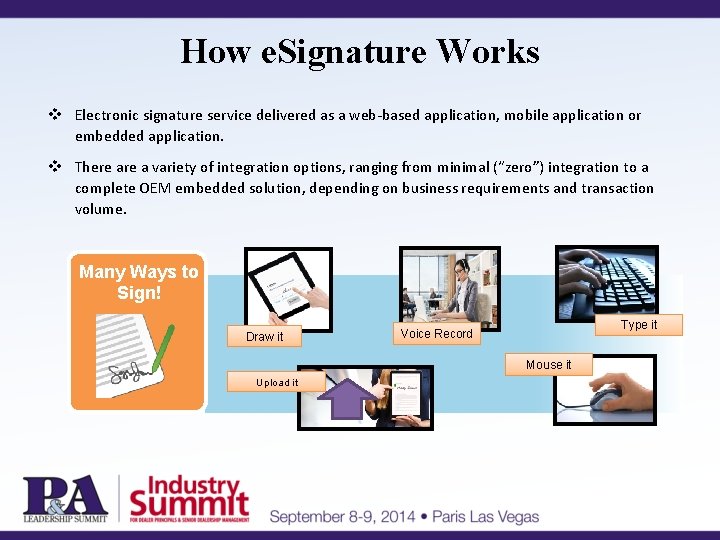
How e. Signature Works v Electronic signature service delivered as a web-based application, mobile application or embedded application. v There a variety of integration options, ranging from minimal (“zero”) integration to a complete OEM embedded solution, depending on business requirements and transaction volume. Many Ways to Sign! Draw it Type it Voice Record Mouse it Upload it
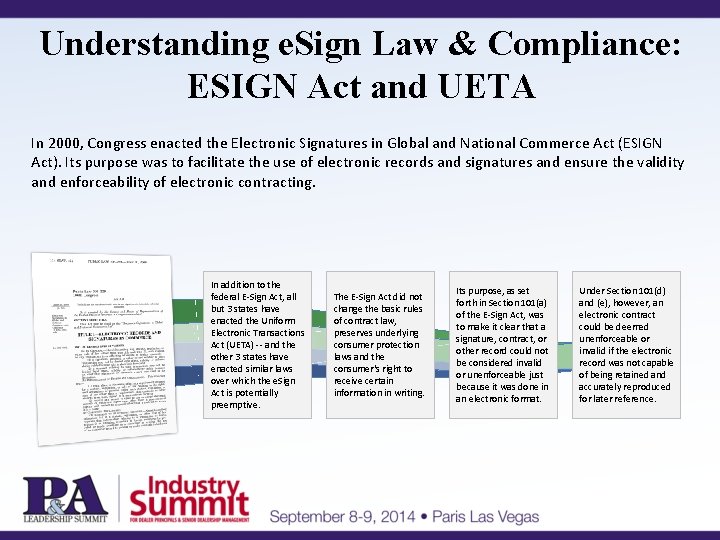
Understanding e. Sign Law & Compliance: ESIGN Act and UETA In 2000, Congress enacted the Electronic Signatures in Global and National Commerce Act (ESIGN Act). Its purpose was to facilitate the use of electronic records and signatures and ensure the validity and enforceability of electronic contracting. In addition to the federal E-Sign Act, all but 3 states have enacted the Uniform Electronic Transactions Act (UETA) -- and the other 3 states have enacted similar laws over which the e. Sign Act is potentially preemptive. The E-Sign Act did not change the basic rules of contract law, preserves underlying consumer protection laws and the consumer's right to receive certain information in writing. Its purpose, as set forth in Section 101(a) of the E-Sign Act, was to make it clear that a signature, contract, or other record could not be considered invalid or unenforceable just because it was done in an electronic format. Under Section 101(d) and (e), however, an electronic contract could be deemed unenforceable or invalid if the electronic record was not capable of being retained and accurately reproduced for later reference.
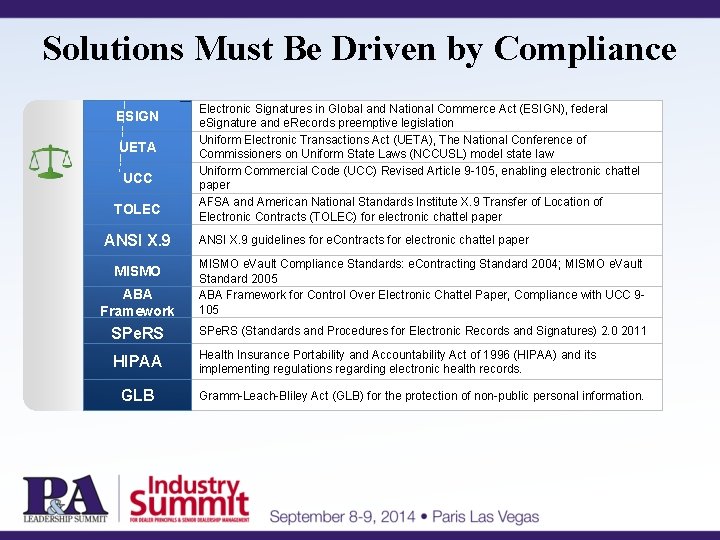
Solutions Must Be Driven by Compliance ESIGN UETA UCC TOLEC ANSI X. 9 Electronic Signatures in Global and National Commerce Act (ESIGN), federal e. Signature and e. Records preemptive legislation Uniform Electronic Transactions Act (UETA), The National Conference of Commissioners on Uniform State Laws (NCCUSL) model state law Uniform Commercial Code (UCC) Revised Article 9 -105, enabling electronic chattel paper AFSA and American National Standards Institute X. 9 Transfer of Location of Electronic Contracts (TOLEC) for electronic chattel paper ANSI X. 9 guidelines for e. Contracts for electronic chattel paper ABA Framework MISMO e. Vault Compliance Standards: e. Contracting Standard 2004; MISMO e. Vault Standard 2005 ABA Framework for Control Over Electronic Chattel Paper, Compliance with UCC 9105 SPe. RS (Standards and Procedures for Electronic Records and Signatures) 2. 0 2011 HIPAA Health Insurance Portability and Accountability Act of 1996 (HIPAA) and its implementing regulations regarding electronic health records. MISMO GLB Gramm-Leach-Bliley Act (GLB) for the protection of non-public personal information.
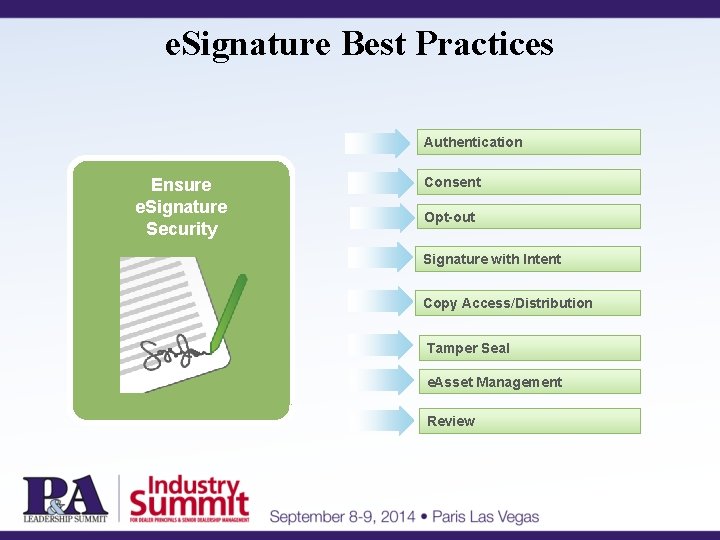
e. Signature Best Practices Authentication Ensure e. Signature Security Consent Opt-out Signature with Intent Copy Access/Distribution Tamper Seal e. Asset Management Review