
PANCREAS Color index Slides Important Notes Extra Objectives
PANCREAS Color index: Slides. . Important. . Notes. . Extra. .
Objectives : By the end of this lecture, the student should be able to describe: üThe endocrine part of the pancreas within the exocrine part. üThe histological features of the cells of islet of Langerhans. üThe function of different cells of islets of Langerhans.
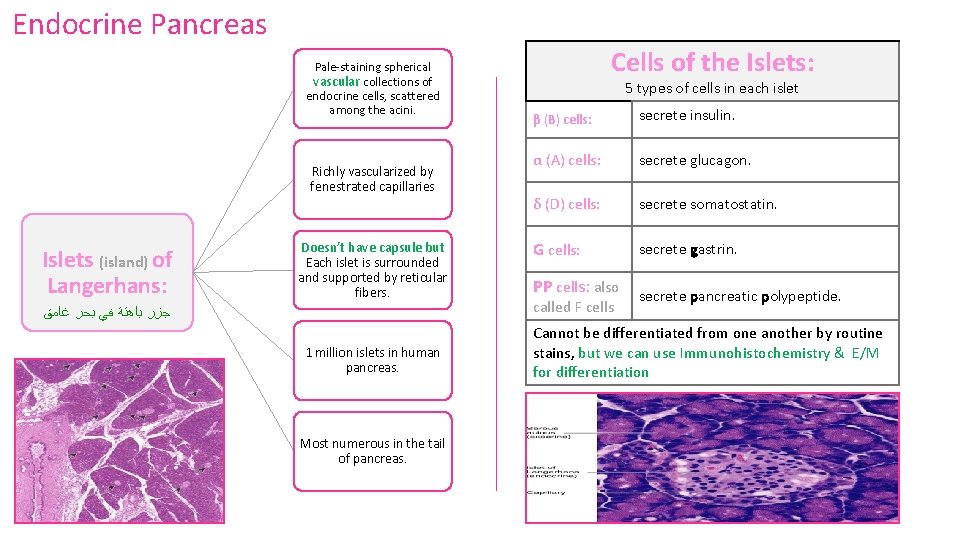
Endocrine Pancreas Pale-staining spherical vascular collections of endocrine cells, scattered among the acini. Richly vascularized by fenestrated capillaries Islets (island) of Langerhans: Doesn’t have capsule but Each islet is surrounded and supported by reticular fibers. ﺟﺰﺭ ﺑﺎﻫﺘﺔ ﻓﻲ ﺑﺤﺮ ﻏﺎﻣﻖ 1 million islets in human pancreas. Most numerous in the tail of pancreas. Cells of the Islets: 5 types of cells in each islet β (B) cells: secrete insulin. α (A) cells: secrete glucagon. δ (D) cells: secrete somatostatin. G cells: secrete gastrin. PP cells: also called F cells secrete pancreatic polypeptide. Cannot be differentiated from one another by routine stains, but we can use Immunohistochemistry & E/M for differentiation

Endocrine Pancreas: Cells of the Islets β (B) cells: • Constitute 70% of islet cells. • Concentrated in islet center. • Function: secrete insulin which ↓ blood sugar. α (A) cells: • Constitute 15 -20%. • Concentrated in islet periphery. • Granules are much more numerous, more tightly packed, smaller, and denser than those of β cells. • Function: secrete glucagon which ↑ blood sugar. δ (D) cells: • Constitute 5 -10% of islet cells. • Scattered (doesn’t have a certain distribution ) throughout the islet. • Granules are less dense than those of β and α cells. • Function: secrete somatostatin which ↓ release of hormones from endocrine pancreas and enzymes from exocrine pancreas. G cells: PP cells: • Constitute 1% of islet cells. • Scattered throughout the islet. • Function: secrete gastrin which ↑ production of HCl by parietal cells of the stomach. • Function: secrete pancreatic polypeptide which ↓ exocrine secretions of pancreas.

Exocrine Pancreas o Stroma: Capsule, septa & reticular fibers. o Parenchyma: Pancreas is a mixed gland: Exocrine part (acini & ducts): produces digestive pancreatic enzymes. Endocrine part (islets of Langerhans): produces hormones. Pancreatic Acini: - They are serous acini: secreting a thin fluid rich in digestive pancreatic enzymes. - The Acinar cells: rosette shape o Pyramidal in shape. o Nuclei are basal. o Cytoplasm: Basal part Basophilic (due to abundant r. ER) to secrete proteins Apical part Acidophilic (due to secretory granules). - No Myoepithelial Cells around the acini. Duct System: 1. Centroacinar cells: simple cuboidal Their nuclei appear in the center of the acini. They represent the beginning of the ducts. First ductal cells, have serous secretions like parotid. 2. 3. 4. 5. Intercalated ducts (low cuboidal). Intralobular ducts (NOT prominent). Interlobular ducts. Inter = between Main pancreatic duct.

MCQs 1) Islets of Langerhans are most numerous in which part of the following? 4)islets of Langerhans contain fenestrated capillaries? A-Tail B-Head A-True C-Neck D-Body 2)Which cell of the following is the most numerous in islets of Langerhans? B-False 5) What is the function of PP cell ? A- A cell B- B cell A- Decrease endocrine and exocrine part C- D cell D- PP cell B-Increase exocrine part C-Decrease exocrine part 3)Which cell of the following is found in periphery of the islets? D-increase both part A- A cell 6)Which cell is present in 5 -10% of islets of Langerhans? B- B cell C- D cell D- PP cell A- A cell B- B cell C- D cell D- PP cell 1 -A 2 -B 3 -A 4 -A 5 -C 6 -C
Thank you & good luck - Histology team Done by: ü Ahmed Badahdah ü Mutasem Alhasani ü Omar Turkistani ü Nawaf Aldarweesh ü Mohammed Khojah References: ü ü Females’ and Males’ slides. Doctors’ notes Team leaders: ü Rana Barasain ü Faisal Alrabaii
- Slides: 7